POPULATION GENETICS:
The studyof the rules governing the
maintenance and transmission of
genetic variation in natural populations.
4.
Population Genetics
Evolutioncan be defined as a change in gene frequencies
through time.
Population genetics tracks the fate, across generations, of
Mendelian genes in populations.
Population genetics is concerned with whether a particular
allele or genotype will become more or less common over
time, and WHY.
5.
Assumptions:
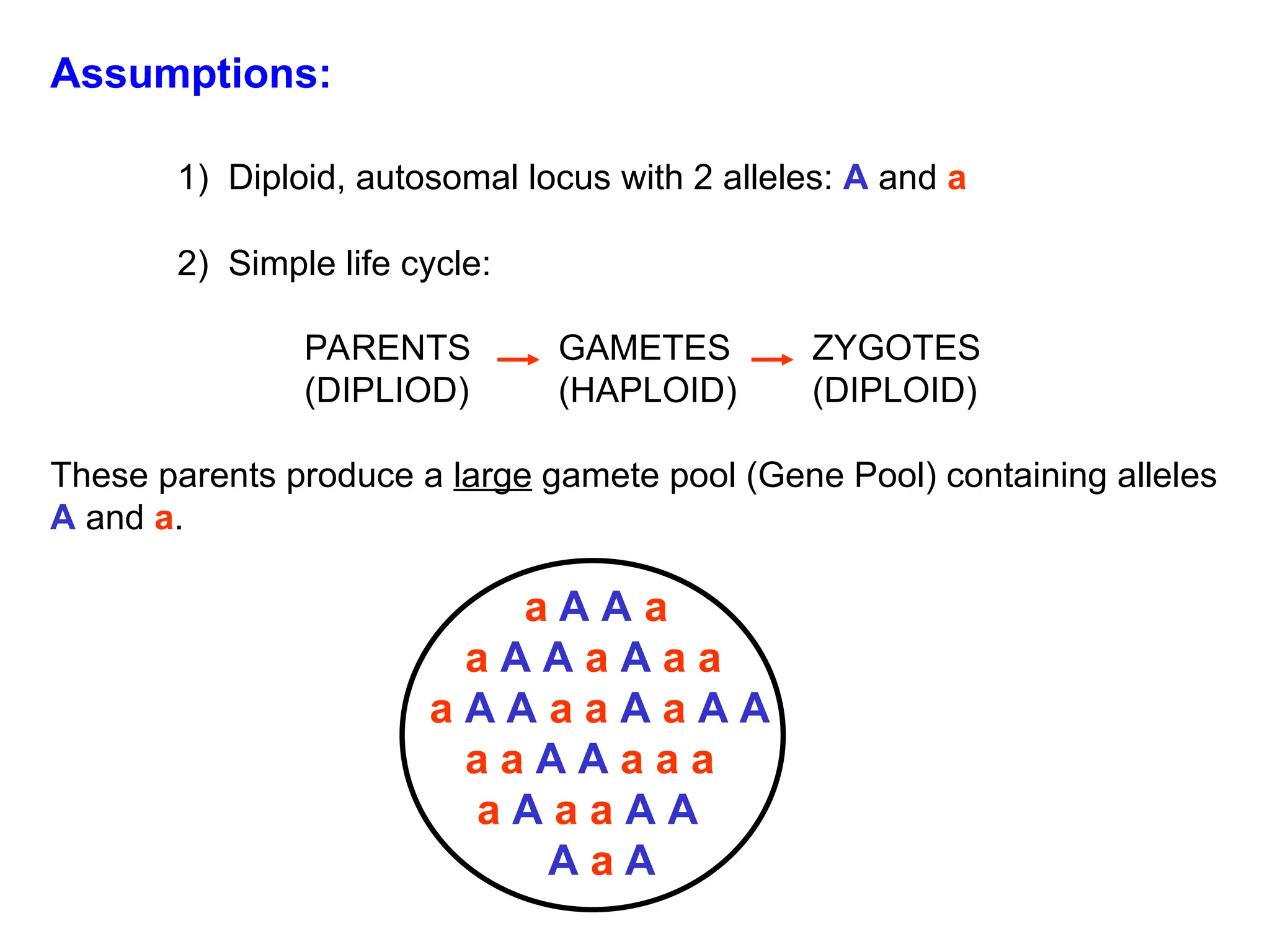
1) Diploid, autosomallocus with 2 alleles: A and a
2) Simple life cycle:
PARENTS GAMETES ZYGOTES
(DIPLIOD) (HAPLOID) (DIPLOID)
These parents produce a large gamete pool (Gene Pool) containing alleles
A and a.
a A A a
a A A a A a a
a A A a a A a A A
a a A A a a a
a A a a A A
A a A
6.
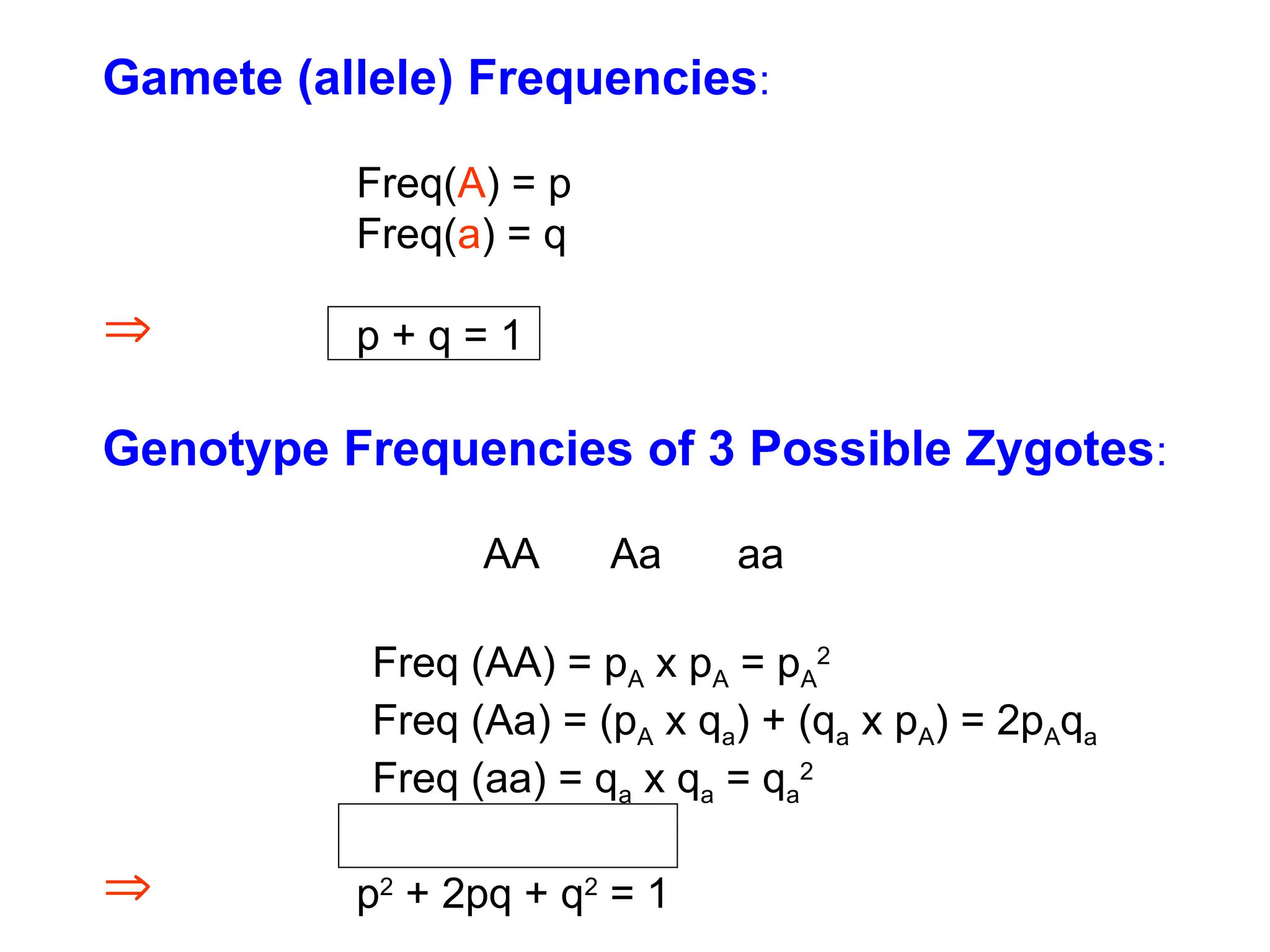
Gamete (allele) Frequencies:
Freq(A)= p
Freq(a) = q
p + q = 1
Genotype Frequencies of 3 Possible Zygotes:
AA Aa aa
Freq (AA) = pA x pA = pA
2
Freq (Aa) = (pA x qa) + (qa x pA) = 2pAqa
Freq (aa) = qa x qa = qa
2
p2
+ 2pq + q2
= 1
7.
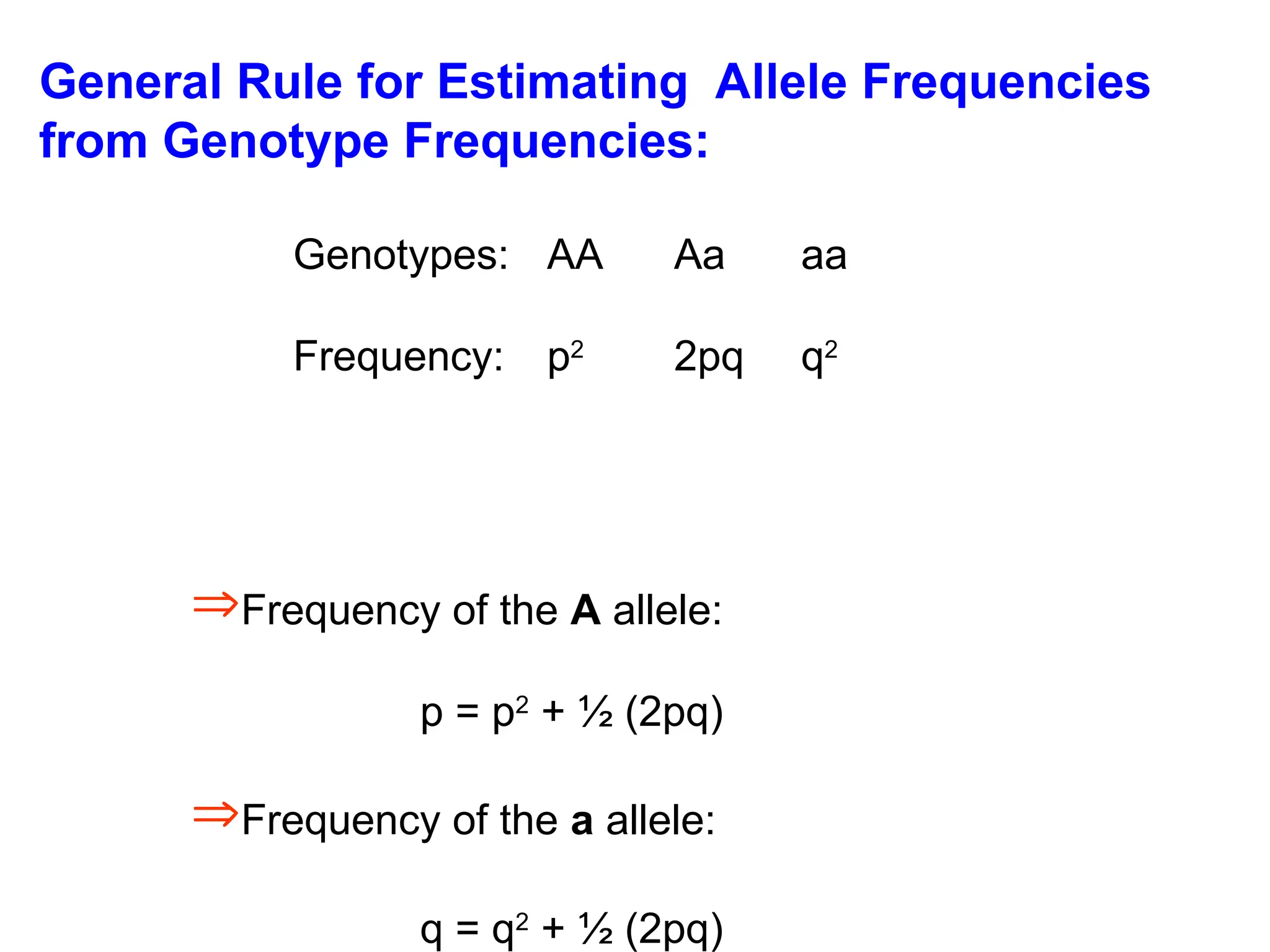
General Rule forEstimating Allele Frequencies
from Genotype Frequencies:
Genotypes: AA Aa aa
Frequency: p2
2pq q2
Frequency of the A allele:
p = p2
+ ½ (2pq)
Frequency of the a allele:
q = q2
+ ½ (2pq)
8.
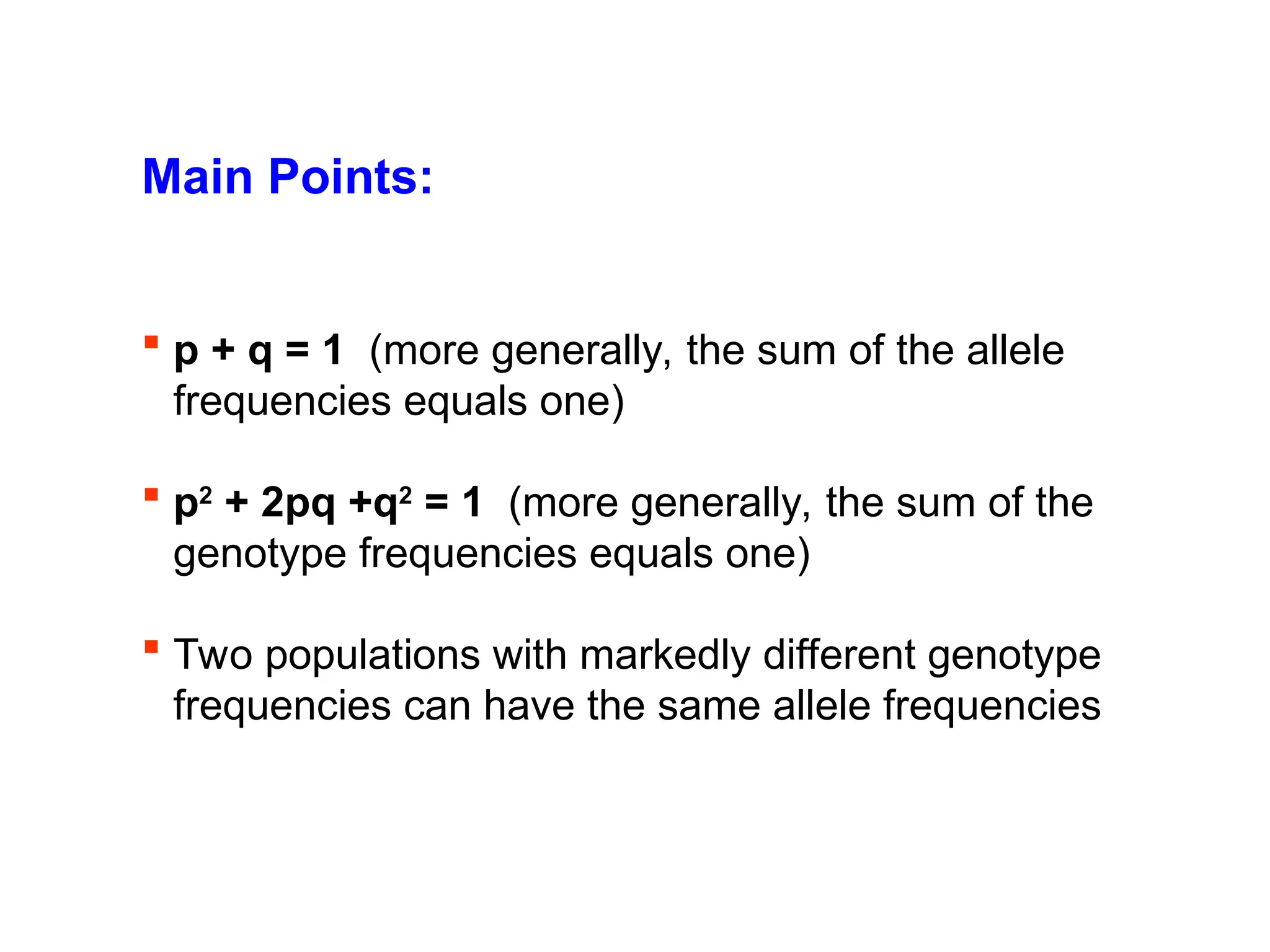
Main Points:
p+ q = 1 (more generally, the sum of the allele
frequencies equals one)
p2
+ 2pq +q2
= 1 (more generally, the sum of the
genotype frequencies equals one)
Two populations with markedly different genotype
frequencies can have the same allele frequencies
9.
Hardy-Weinberg
equilibrium(HWE).
• In 1908G.H Hardy(a British mathematician)
and W. Weinberg (a German physician)
independently identified a mathematical
relationship between alleles and genotypes in
a population .
• The relationship has been called the Hardy-
Weinberg equilibrium(HWE).
• The HWE concerns allele frequency.
10.
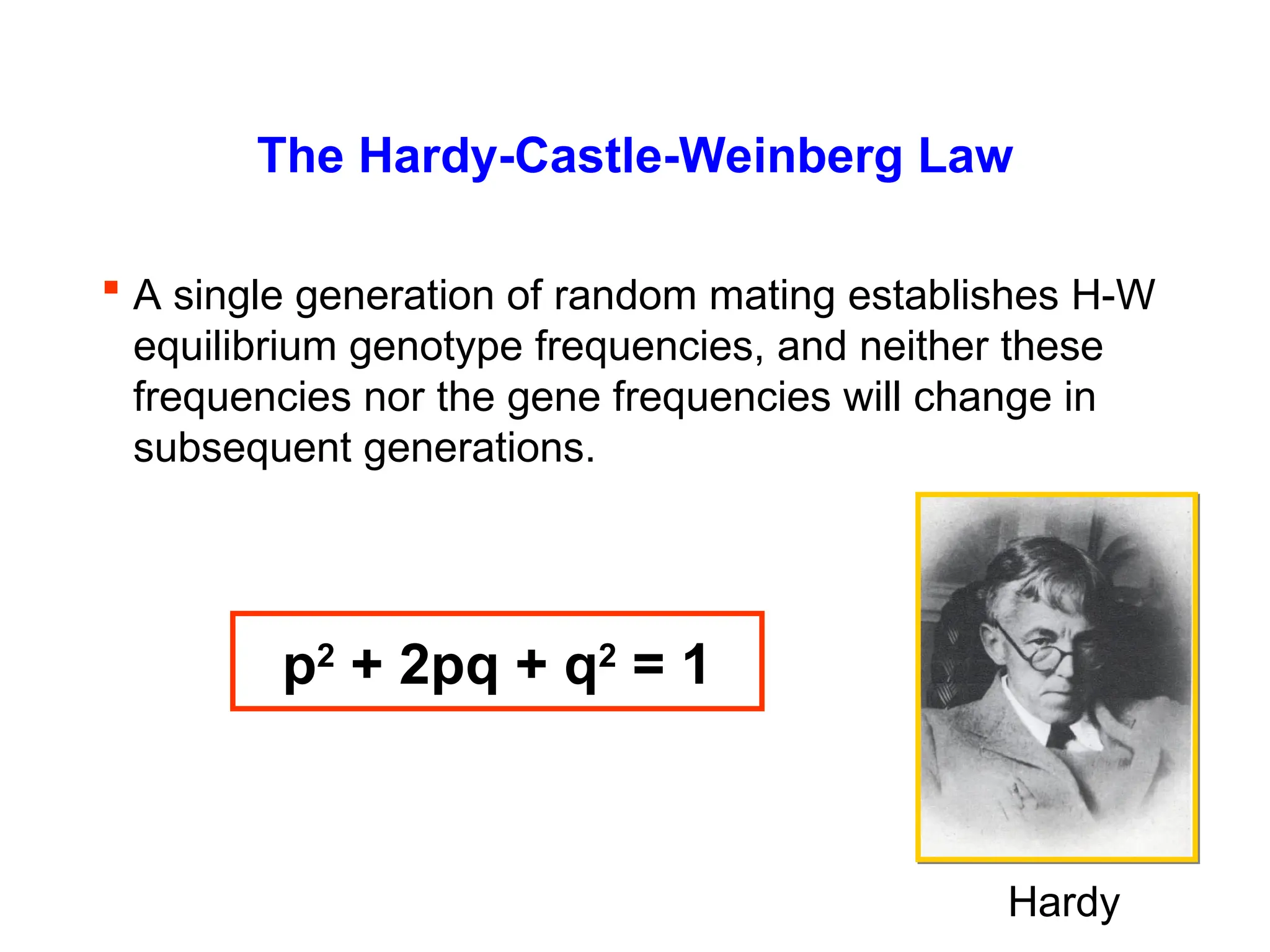
The Hardy-Castle-Weinberg Law
A single generation of random mating establishes H-W
equilibrium genotype frequencies, and neither these
frequencies nor the gene frequencies will change in
subsequent generations.
Hardy
p2
+ 2pq + q2
= 1
11.
The Hardy-Weinberg Law
MeasuresAllele and Genotype
Frequencies
• Hardy-Weinberg Law
– Allele and genotype frequencies remain
constant from generation to generation when
the population meets certain assumptions
– There is a difference between how a trait is
inherited and the frequency of recessive and
dominant alleles in a population
12.
Mathematics of
the Hardy-WeinbergLaw
• For a population, p + q = 1
– p = frequency of the dominant allele A
– q = frequency of the recessive allele a
• The chance of a fertilized egg carrying the
same alleles is p2
(AA) or q2
(aa)
• The chance of a fertilized egg carrying
different alleles is pq (Aa)
13.
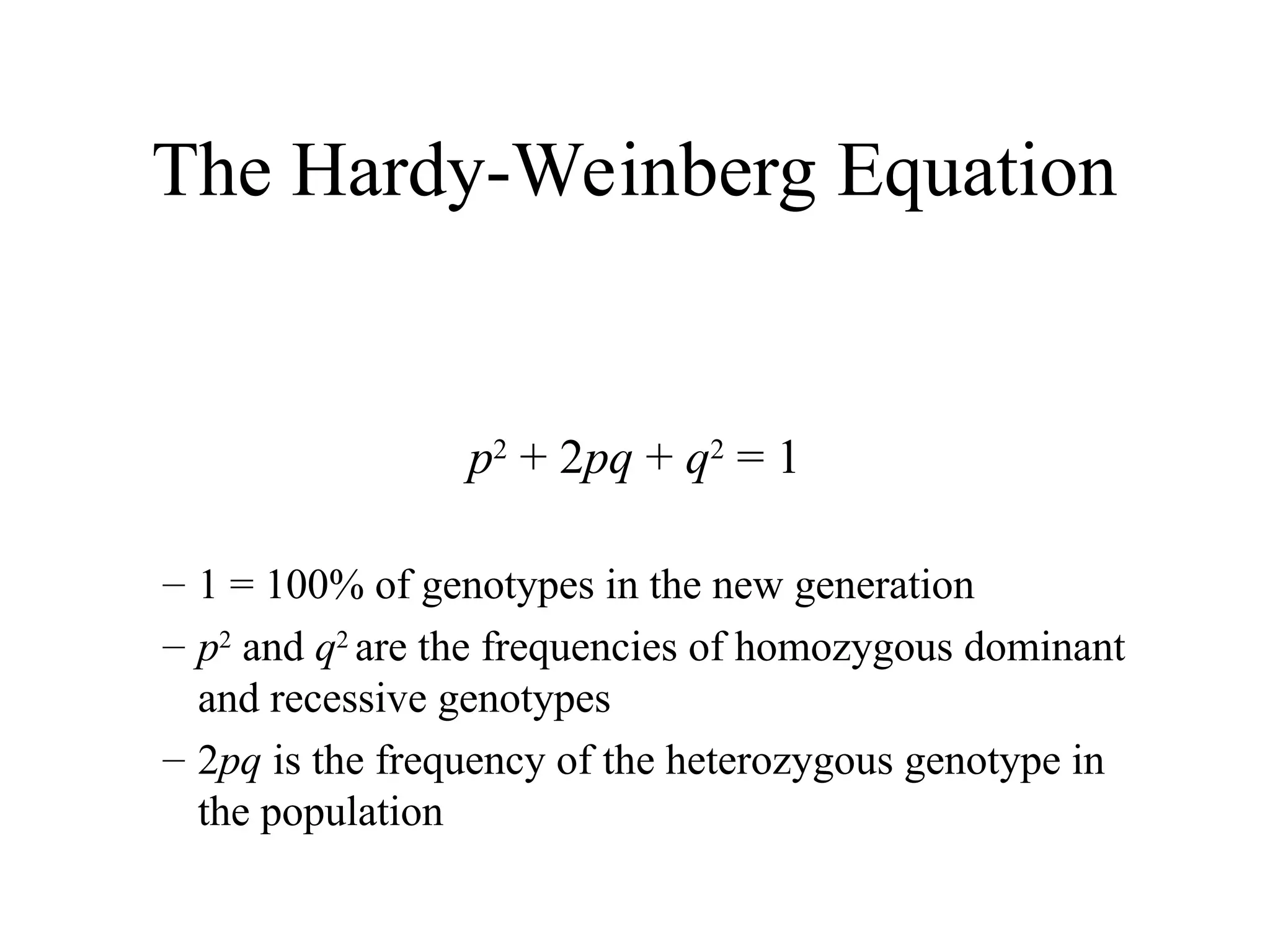
The Hardy-Weinberg Equation
p2
+2pq + q2
= 1
– 1 = 100% of genotypes in the new generation
– p2
and q2
are the frequencies of homozygous dominant
and recessive genotypes
– 2pq is the frequency of the heterozygous genotype in
the population
14.
Populations Can Be
inGenetic Equilibrium
• Genetic equilibrium
– When the allele frequency for a particular gene remains
constant from generation to generation
– Equilibrium in a population explains why dominant alleles
do not replace recessive alleles
• In equilibrium populations, Hardy-Weinberg law can be used
to measure allele and genotype frequencies from generation
to generation
15.
Using the Hardy-WeinbergLaw
in Human Genetics
• The Hardy-Weinberg Law can be used to
– Estimate frequencies of autosomal dominant
and recessive alleles in a population
– Detect when allele frequencies are shifting in a
population (evolutionary change)
– Measure the frequency of heterozygous carriers
of deleterious recessive alleles in a population
16.
HWE
Hardy-Weinberg law
The HWlaw states that frequencies of alleles
and genotypes in a population remain
constant from generation to generation
given the following conditions are met.
17.
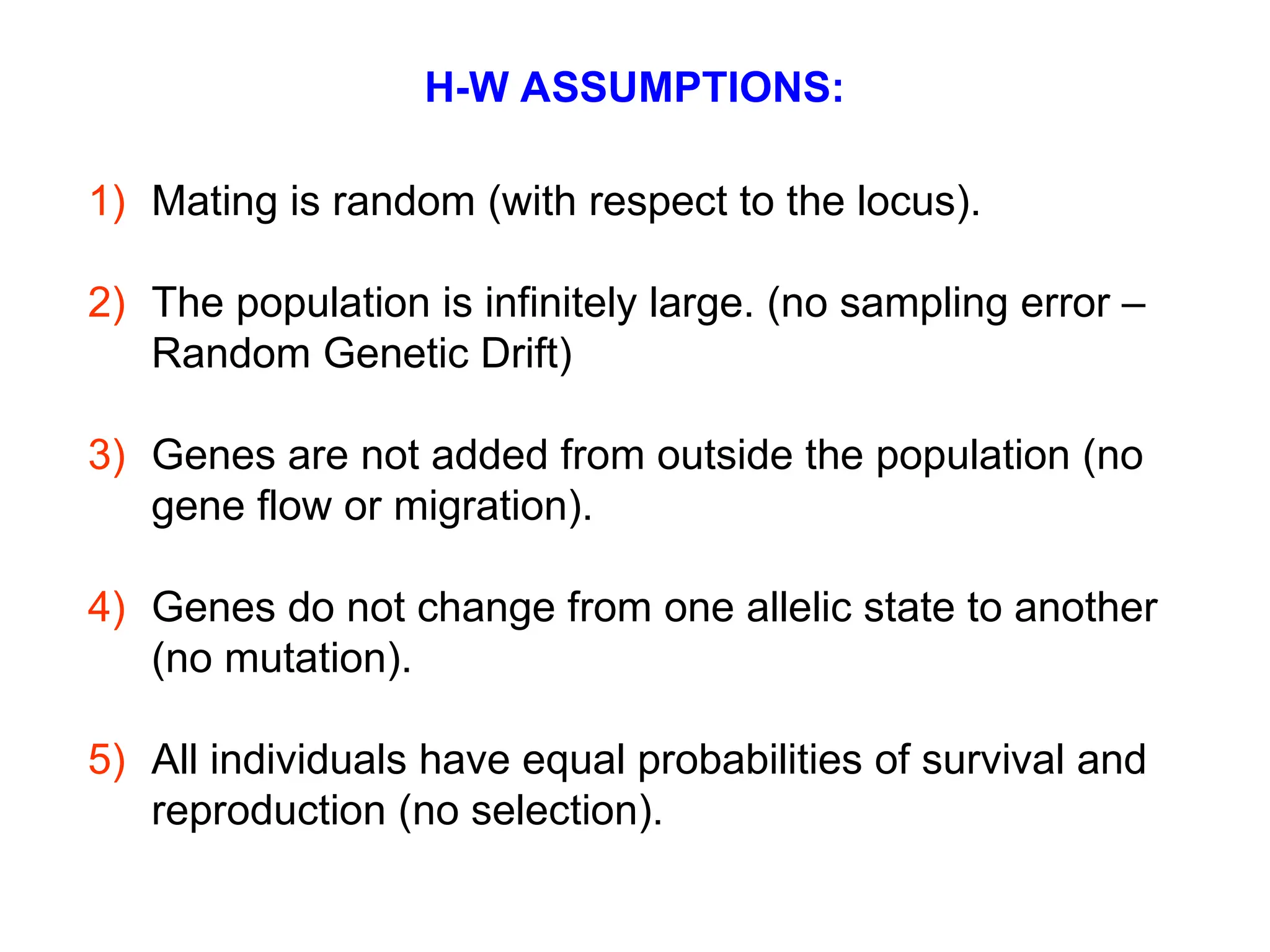
H-W ASSUMPTIONS:
1) Matingis random (with respect to the locus).
2) The population is infinitely large. (no sampling error –
Random Genetic Drift)
3) Genes are not added from outside the population (no
gene flow or migration).
4) Genes do not change from one allelic state to another
(no mutation).
5) All individuals have equal probabilities of survival and
reproduction (no selection).
18.
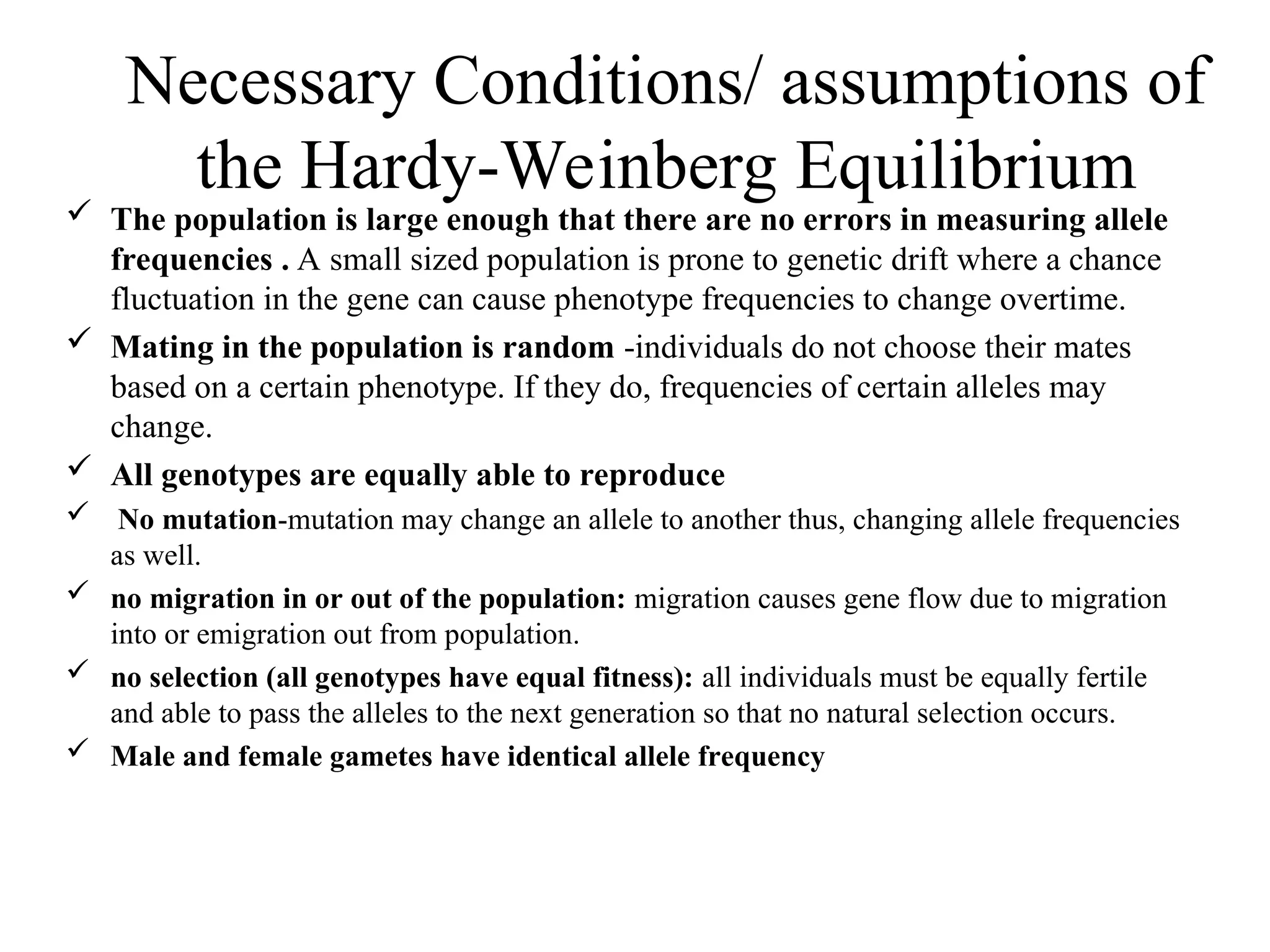
Necessary Conditions/ assumptionsof
the Hardy-Weinberg Equilibrium
The population is large enough that there are no errors in measuring allele
frequencies . A small sized population is prone to genetic drift where a chance
fluctuation in the gene can cause phenotype frequencies to change overtime.
Mating in the population is random -individuals do not choose their mates
based on a certain phenotype. If they do, frequencies of certain alleles may
change.
All genotypes are equally able to reproduce
No mutation-mutation may change an allele to another thus, changing allele frequencies
as well.
no migration in or out of the population: migration causes gene flow due to migration
into or emigration out from population.
no selection (all genotypes have equal fitness): all individuals must be equally fertile
and able to pass the alleles to the next generation so that no natural selection occurs.
Male and female gametes have identical allele frequency
19.
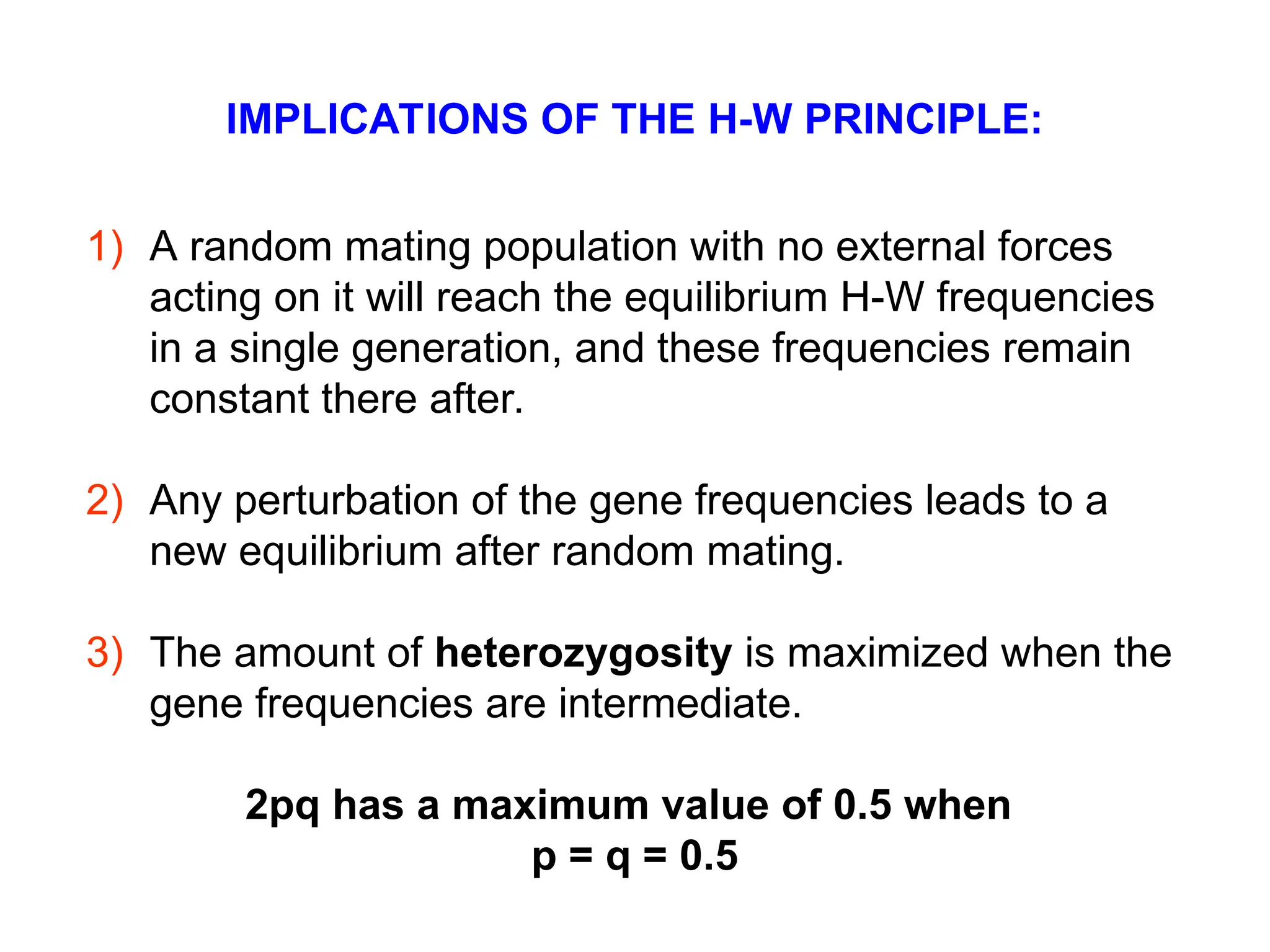
IMPLICATIONS OF THEH-W PRINCIPLE:
1) A random mating population with no external forces
acting on it will reach the equilibrium H-W frequencies
in a single generation, and these frequencies remain
constant there after.
2) Any perturbation of the gene frequencies leads to a
new equilibrium after random mating.
3) The amount of heterozygosity is maximized when the
gene frequencies are intermediate.
2pq has a maximum value of 0.5 when
p = q = 0.5
20.
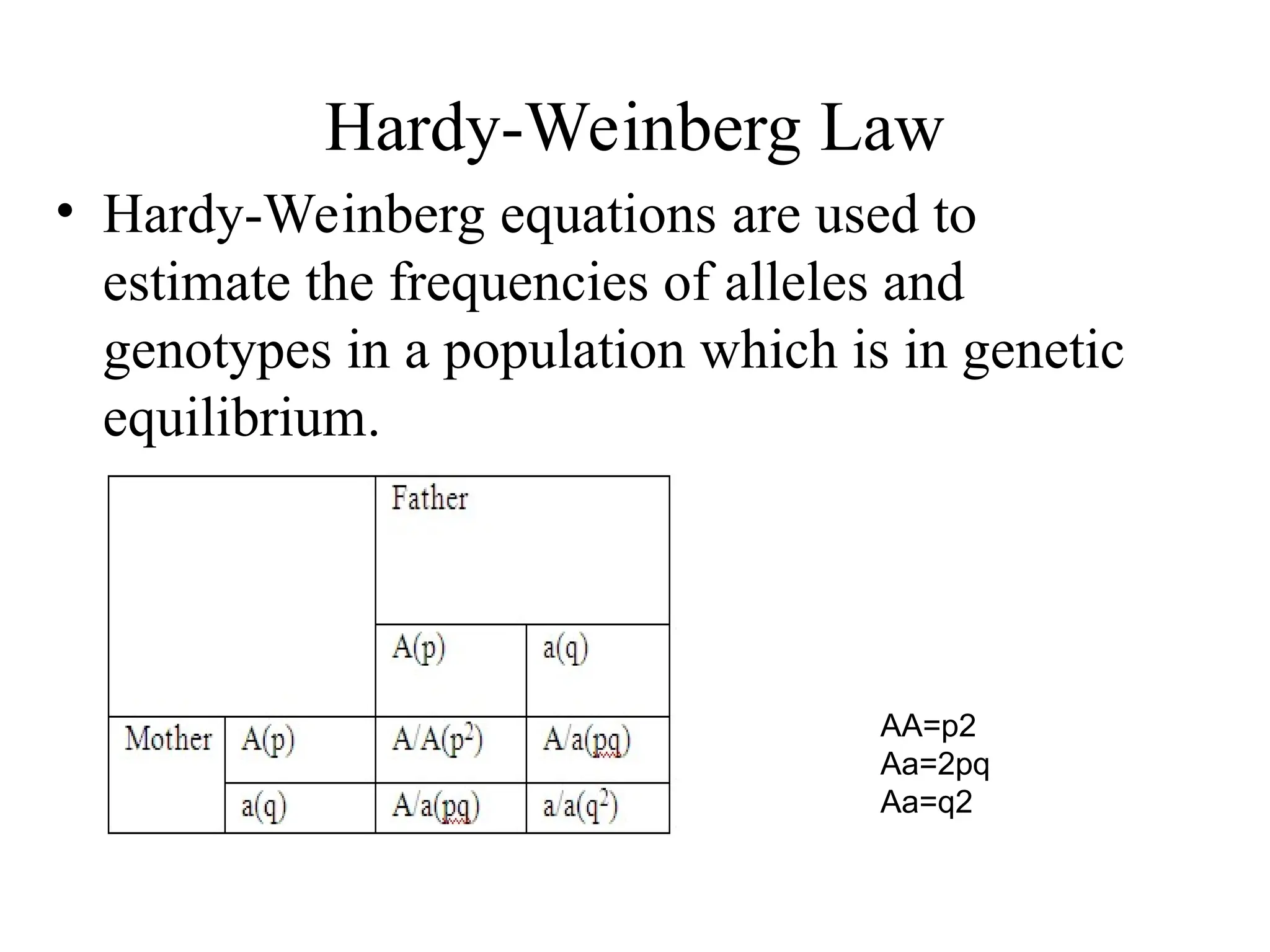
Hardy-Weinberg Law
• Hardy-Weinbergequations are used to
estimate the frequencies of alleles and
genotypes in a population which is in genetic
equilibrium.
AA=p2
Aa=2pq
Aa=q2
21.
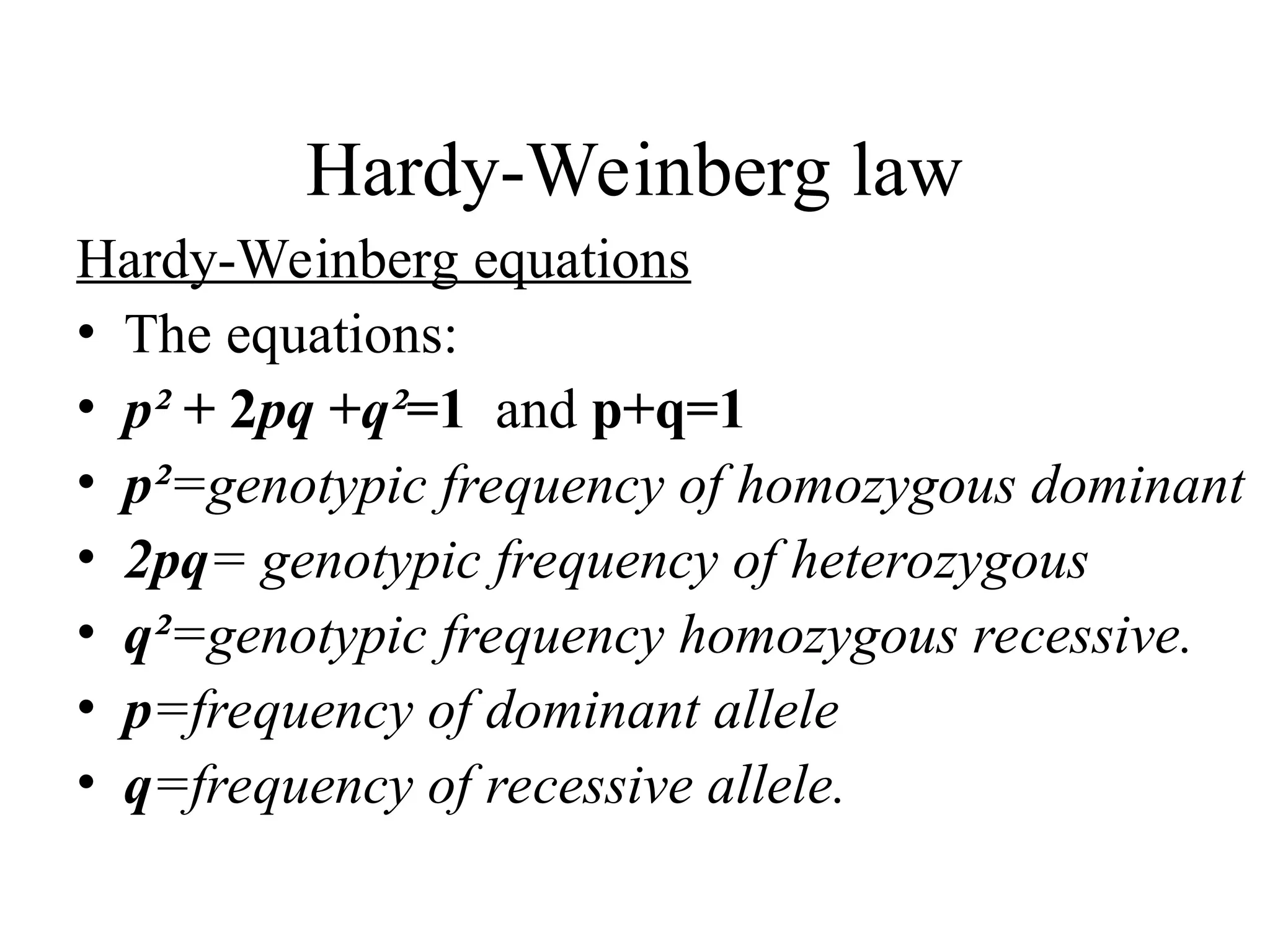
Hardy-Weinberg law
Hardy-Weinberg equations
•The equations:
• p² + 2pq +q²=1 and p+q=1
• p²=genotypic frequency of homozygous dominant
• 2pq= genotypic frequency of heterozygous
• q²=genotypic frequency homozygous recessive.
• p=frequency of dominant allele
• q=frequency of recessive allele.
22.
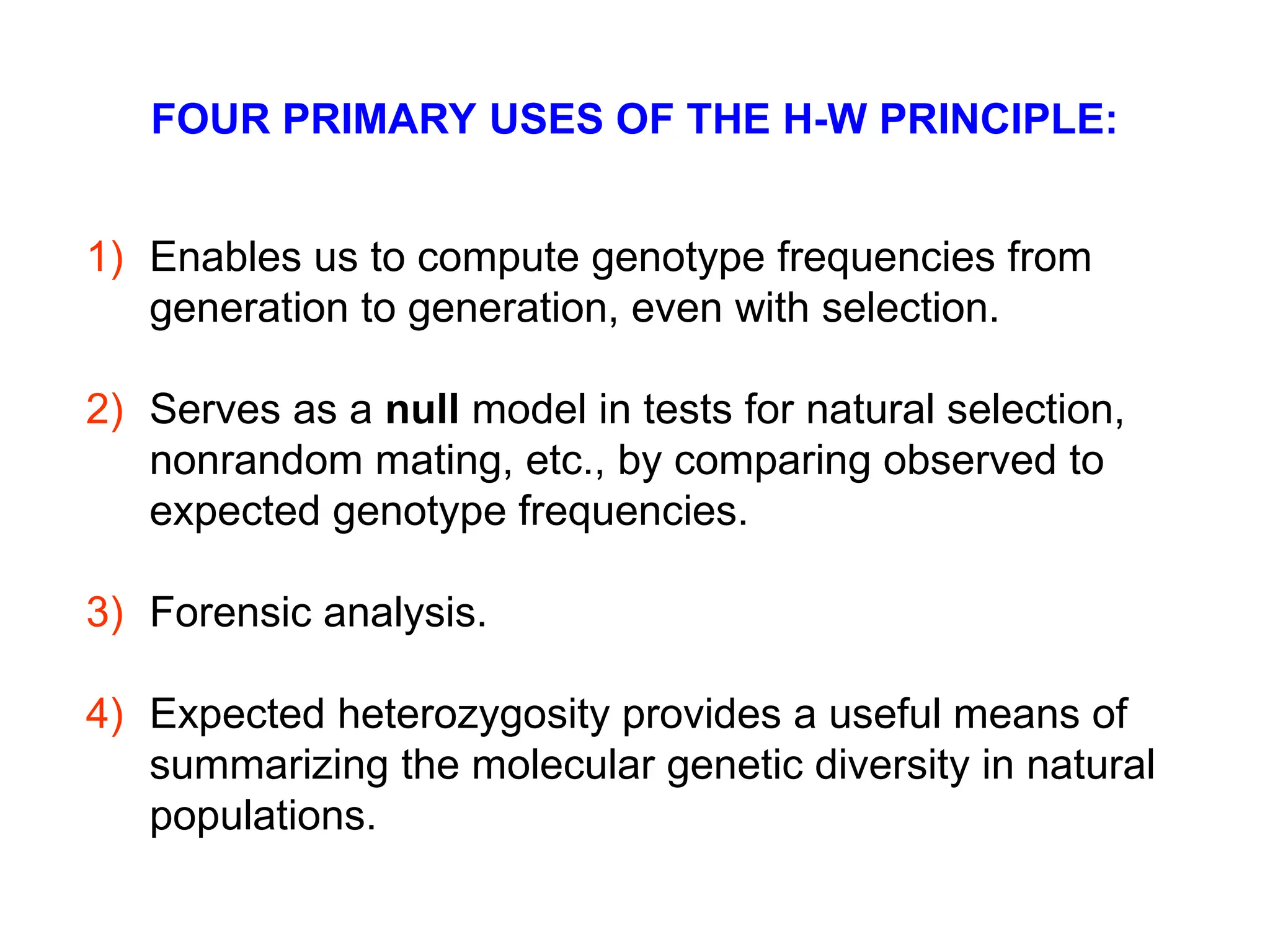
FOUR PRIMARY USESOF THE H-W PRINCIPLE:
1) Enables us to compute genotype frequencies from
generation to generation, even with selection.
2) Serves as a null model in tests for natural selection,
nonrandom mating, etc., by comparing observed to
expected genotype frequencies.
3) Forensic analysis.
4) Expected heterozygosity provides a useful means of
summarizing the molecular genetic diversity in natural
populations.
23.
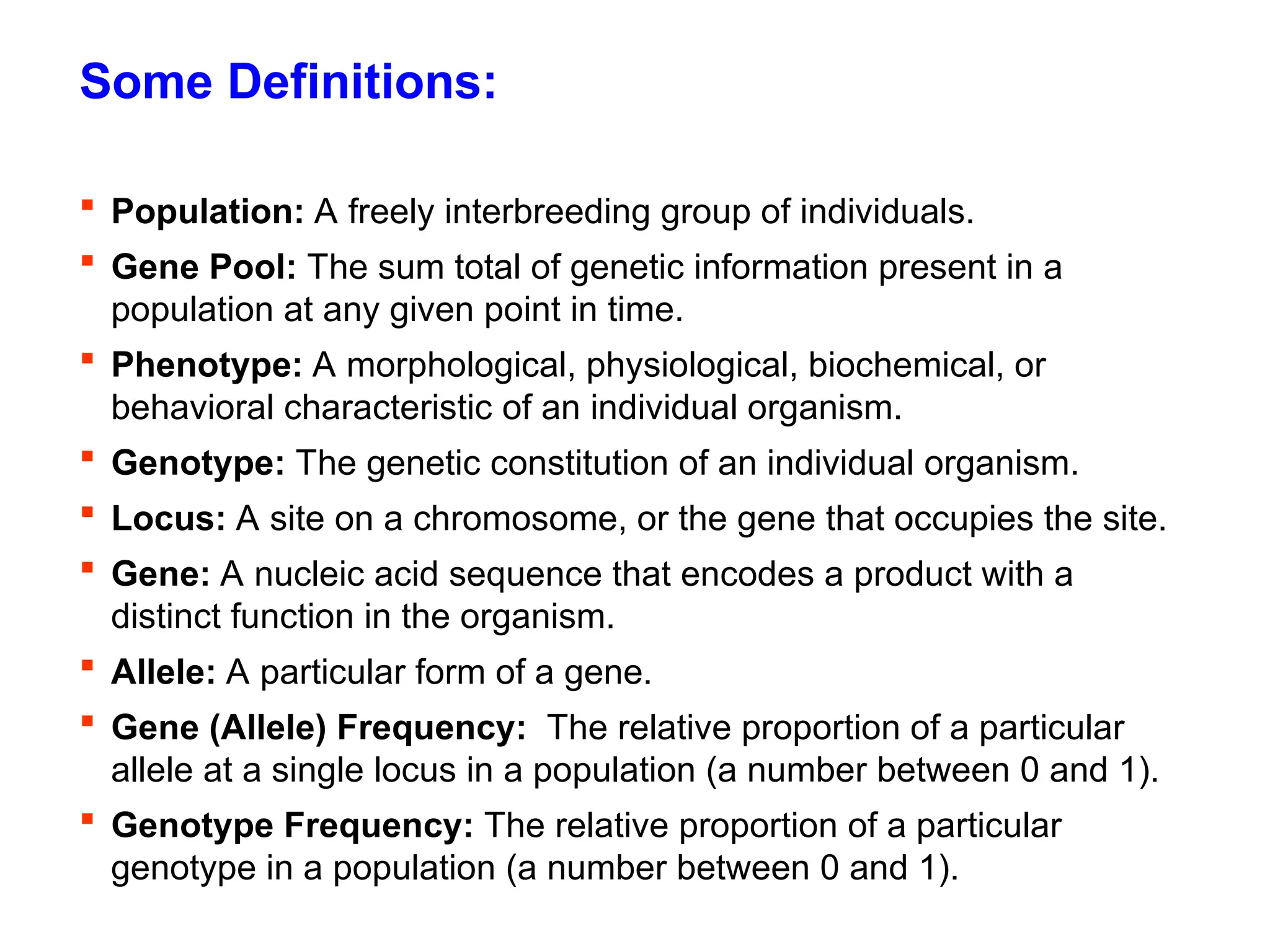
Some Definitions:
Population:A freely interbreeding group of individuals.
Gene Pool: The sum total of genetic information present in a
population at any given point in time.
Phenotype: A morphological, physiological, biochemical, or
behavioral characteristic of an individual organism.
Genotype: The genetic constitution of an individual organism.
Locus: A site on a chromosome, or the gene that occupies the site.
Gene: A nucleic acid sequence that encodes a product with a
distinct function in the organism.
Allele: A particular form of a gene.
Gene (Allele) Frequency: The relative proportion of a particular
allele at a single locus in a population (a number between 0 and 1).
Genotype Frequency: The relative proportion of a particular
genotype in a population (a number between 0 and 1).
24.
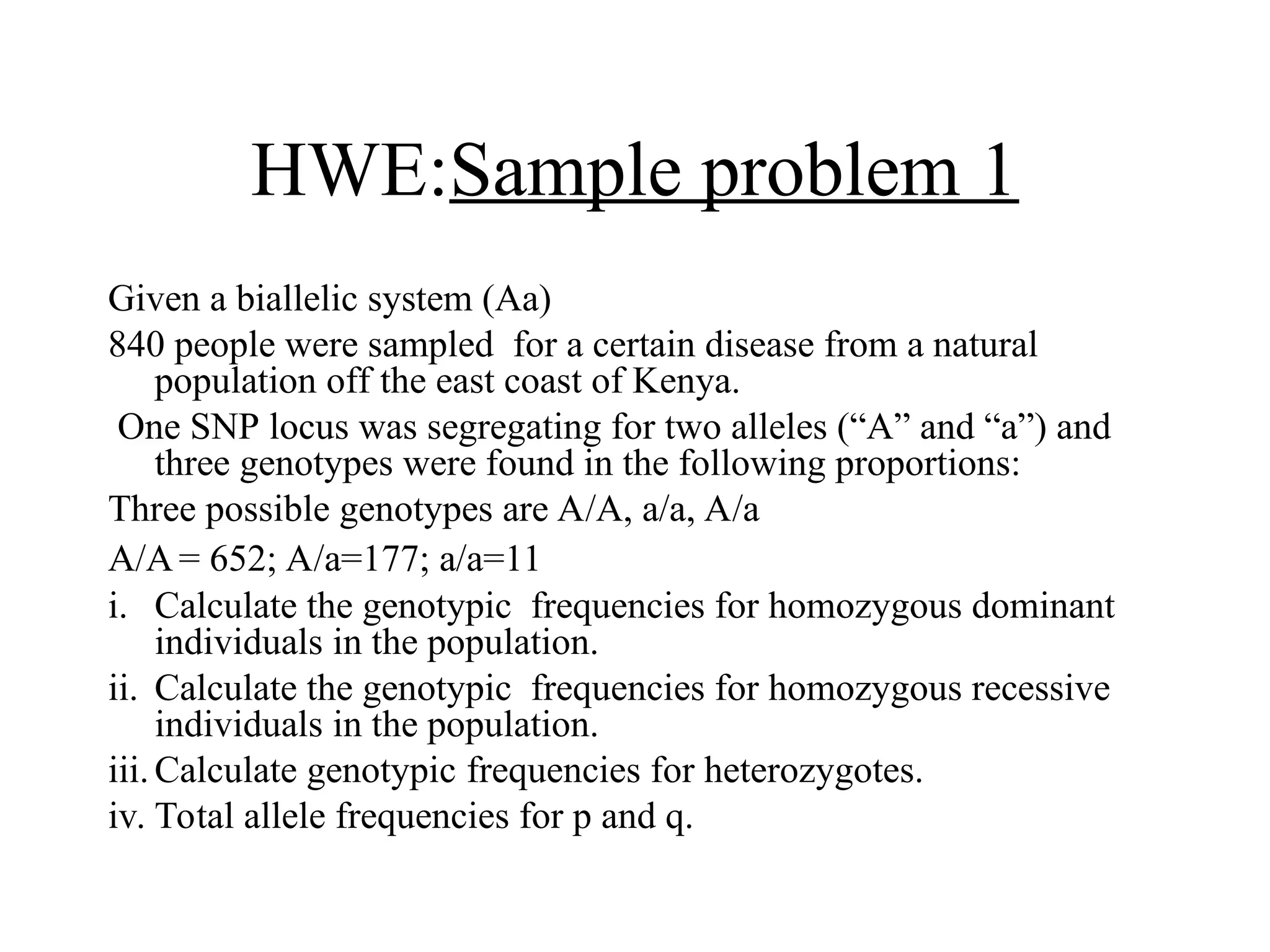
HWE:Sample problem 1
Givena biallelic system (Aa)
840 people were sampled for a certain disease from a natural
population off the east coast of Kenya.
One SNP locus was segregating for two alleles (“A” and “a”) and
three genotypes were found in the following proportions:
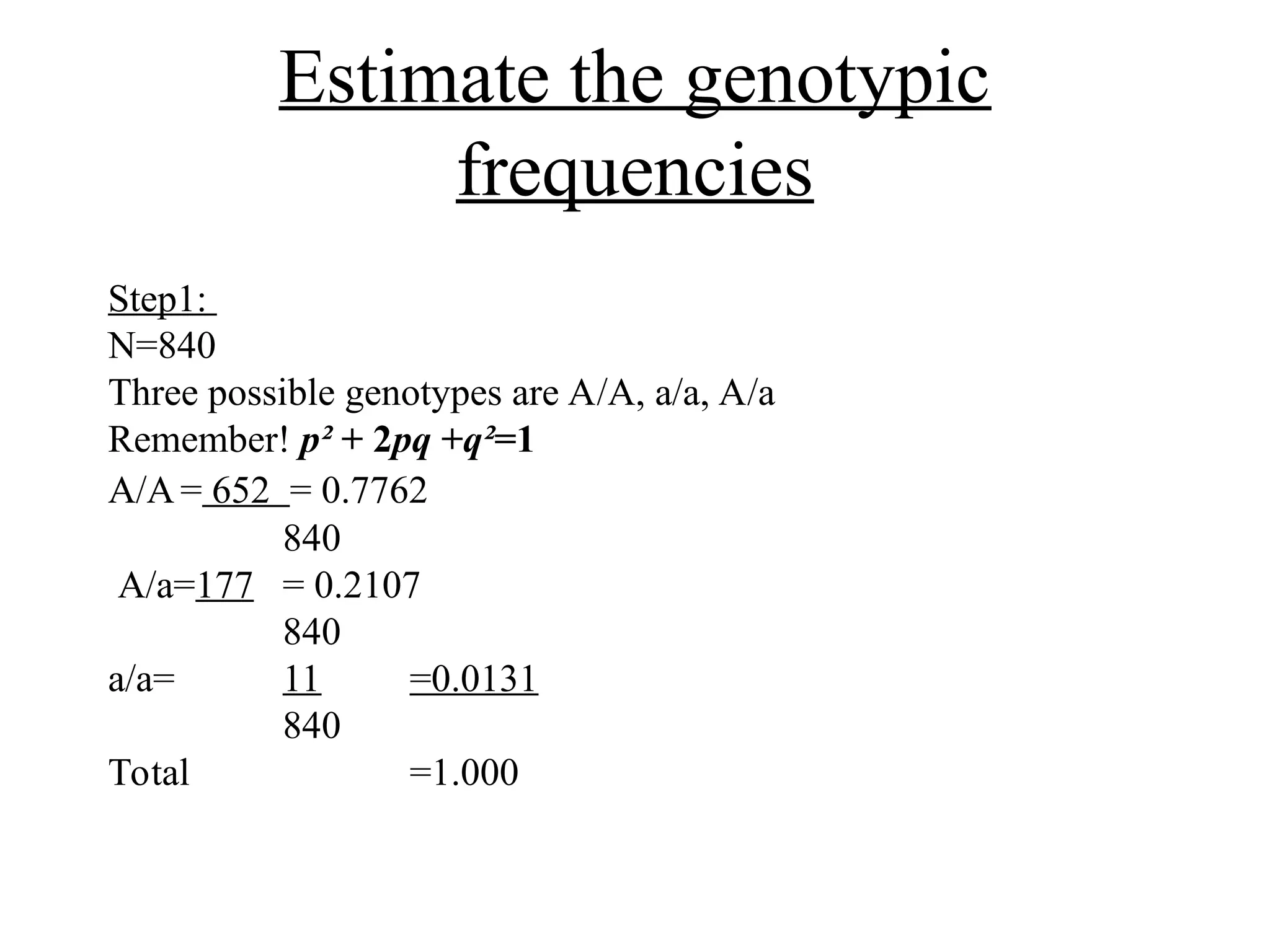
Three possible genotypes are A/A, a/a, A/a
A/A= 652; A/a=177; a/a=11
i. Calculate the genotypic frequencies for homozygous dominant
individuals in the population.
ii. Calculate the genotypic frequencies for homozygous recessive
individuals in the population.
iii.Calculate genotypic frequencies for heterozygotes.
iv. Total allele frequencies for p and q.
Estimating allele frequencies
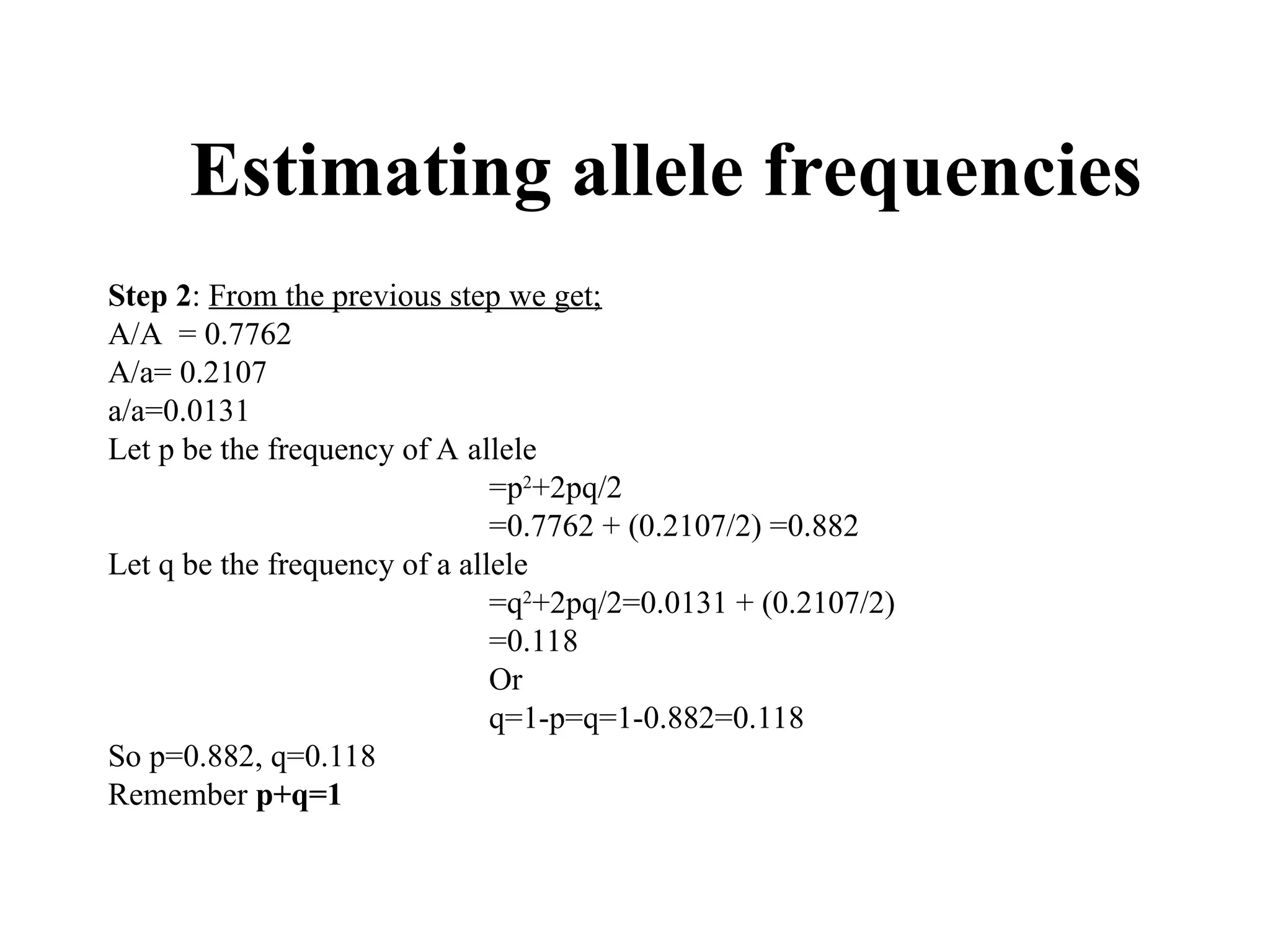
Step2: From the previous step we get;
A/A = 0.7762
A/a= 0.2107
a/a=0.0131
Let p be the frequency of A allele
=p2
+2pq/2
=0.7762 + (0.2107/2) =0.882
Let q be the frequency of a allele
=q2
+2pq/2=0.0131 + (0.2107/2)
=0.118
Or
q=1-p=q=1-0.882=0.118
So p=0.882, q=0.118
Remember p+q=1
27.
HWE: Sample problem2
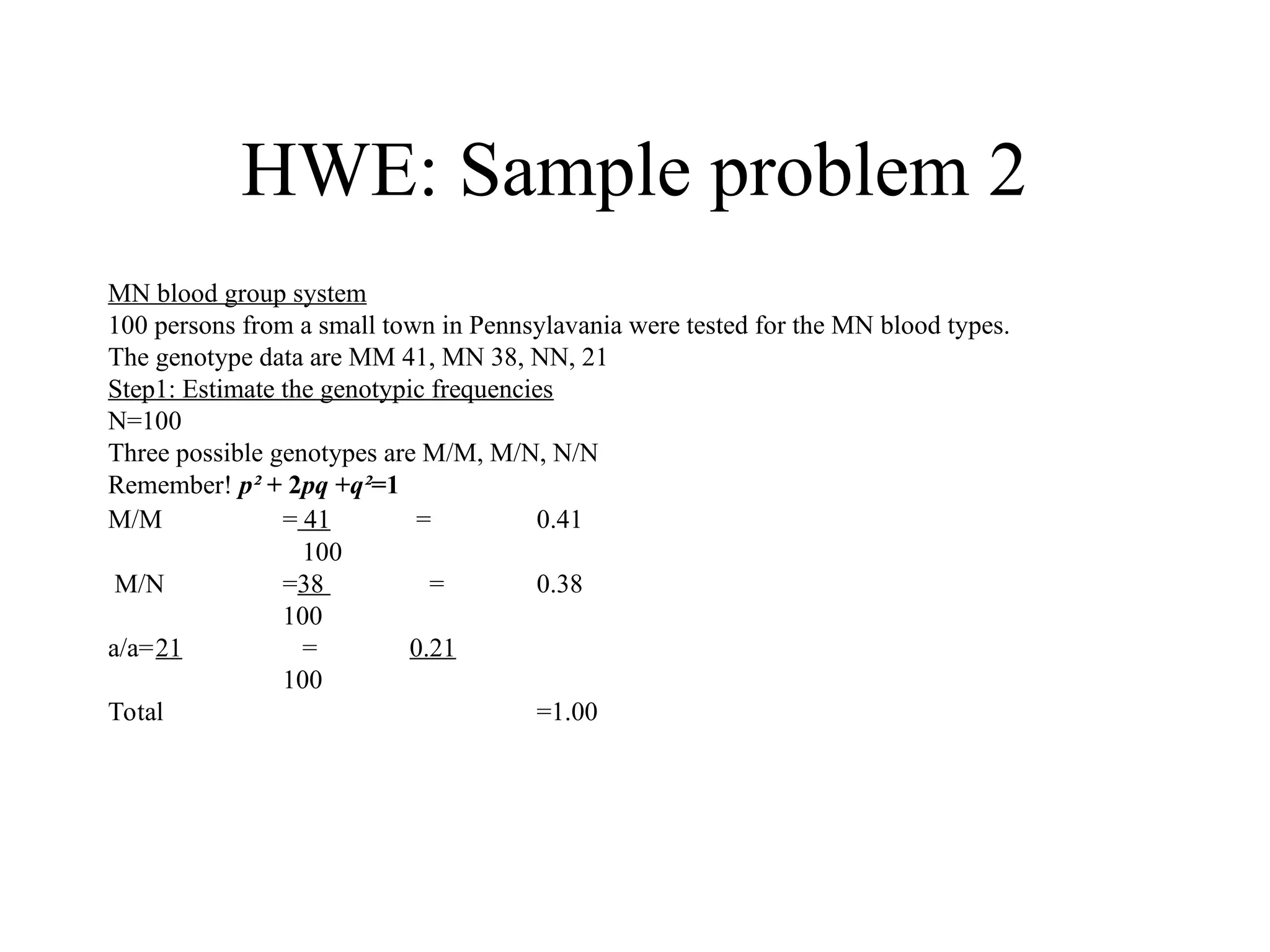
MN blood group system
100 persons from a small town in Pennsylavania were tested for the MN blood types.
The genotype data are MM 41, MN 38, NN, 21
Step1: Estimate the genotypic frequencies
N=100
Three possible genotypes are M/M, M/N, N/N
Remember! p² + 2pq +q²=1
M/M = 41 = 0.41
100
M/N =38 = 0.38
100
a/a=21 = 0.21
100
Total =1.00
28.
Hardy-Weinberg law
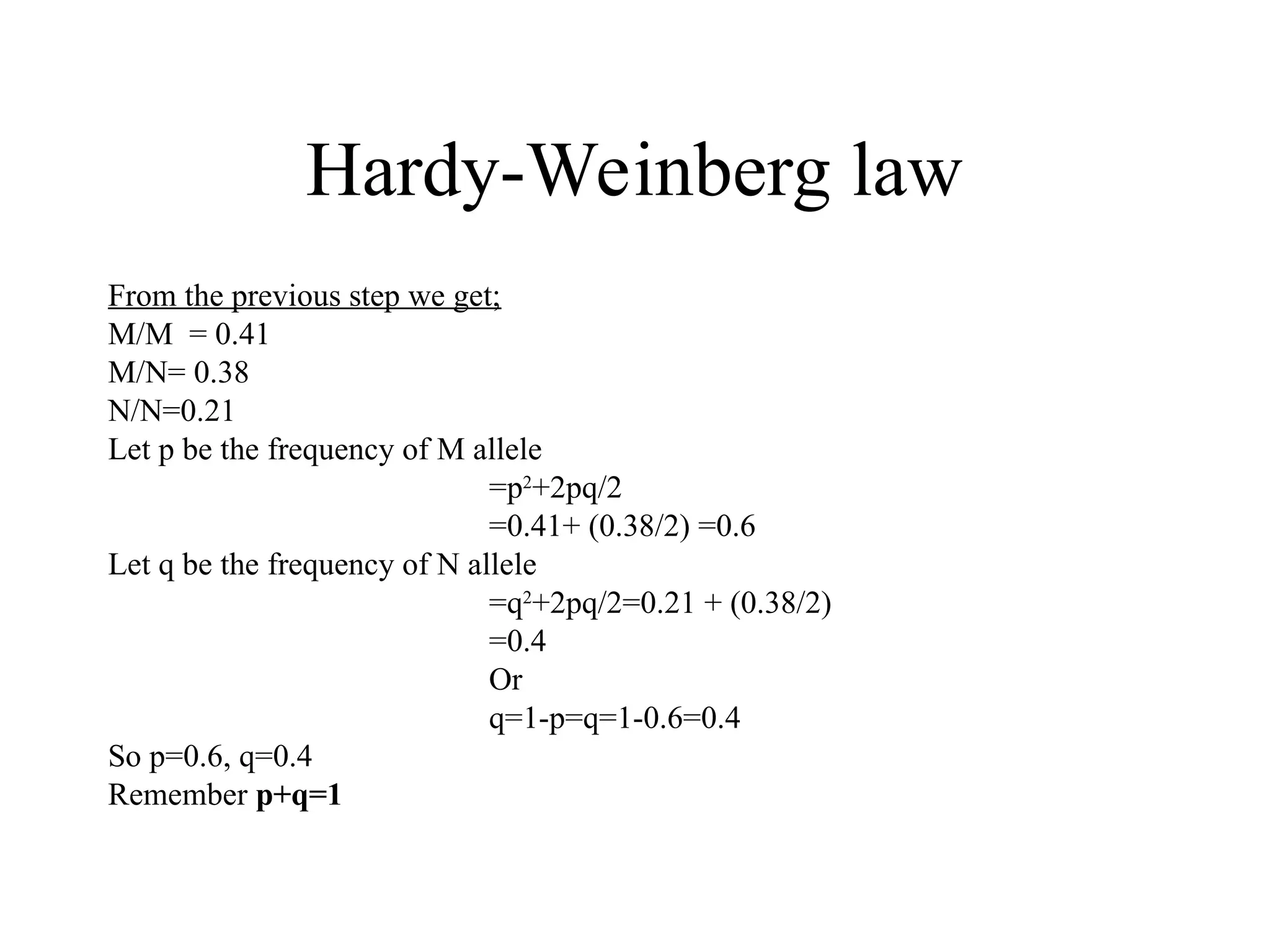
From theprevious step we get;
M/M = 0.41
M/N= 0.38
N/N=0.21
Let p be the frequency of M allele
=p2
+2pq/2
=0.41+ (0.38/2) =0.6
Let q be the frequency of N allele
=q2
+2pq/2=0.21 + (0.38/2)
=0.4
Or
q=1-p=q=1-0.6=0.4
So p=0.6, q=0.4
Remember p+q=1
29.
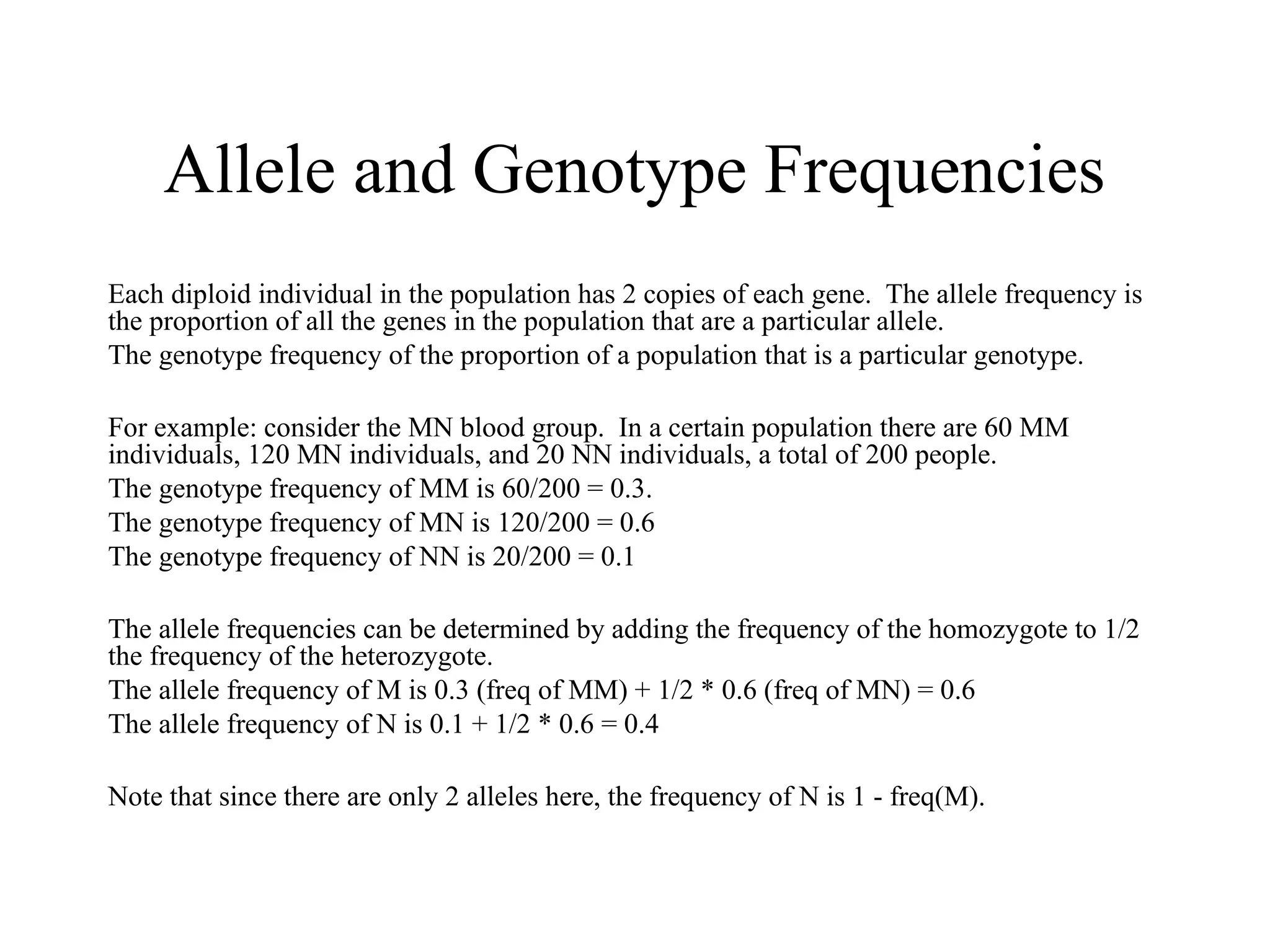
Allele and GenotypeFrequencies
Each diploid individual in the population has 2 copies of each gene. The allele frequency is
the proportion of all the genes in the population that are a particular allele.
The genotype frequency of the proportion of a population that is a particular genotype.
For example: consider the MN blood group. In a certain population there are 60 MM
individuals, 120 MN individuals, and 20 NN individuals, a total of 200 people.
The genotype frequency of MM is 60/200 = 0.3.
The genotype frequency of MN is 120/200 = 0.6
The genotype frequency of NN is 20/200 = 0.1
The allele frequencies can be determined by adding the frequency of the homozygote to 1/2
the frequency of the heterozygote.
The allele frequency of M is 0.3 (freq of MM) + 1/2 * 0.6 (freq of MN) = 0.6
The allele frequency of N is 0.1 + 1/2 * 0.6 = 0.4
Note that since there are only 2 alleles here, the frequency of N is 1 - freq(M).
30.
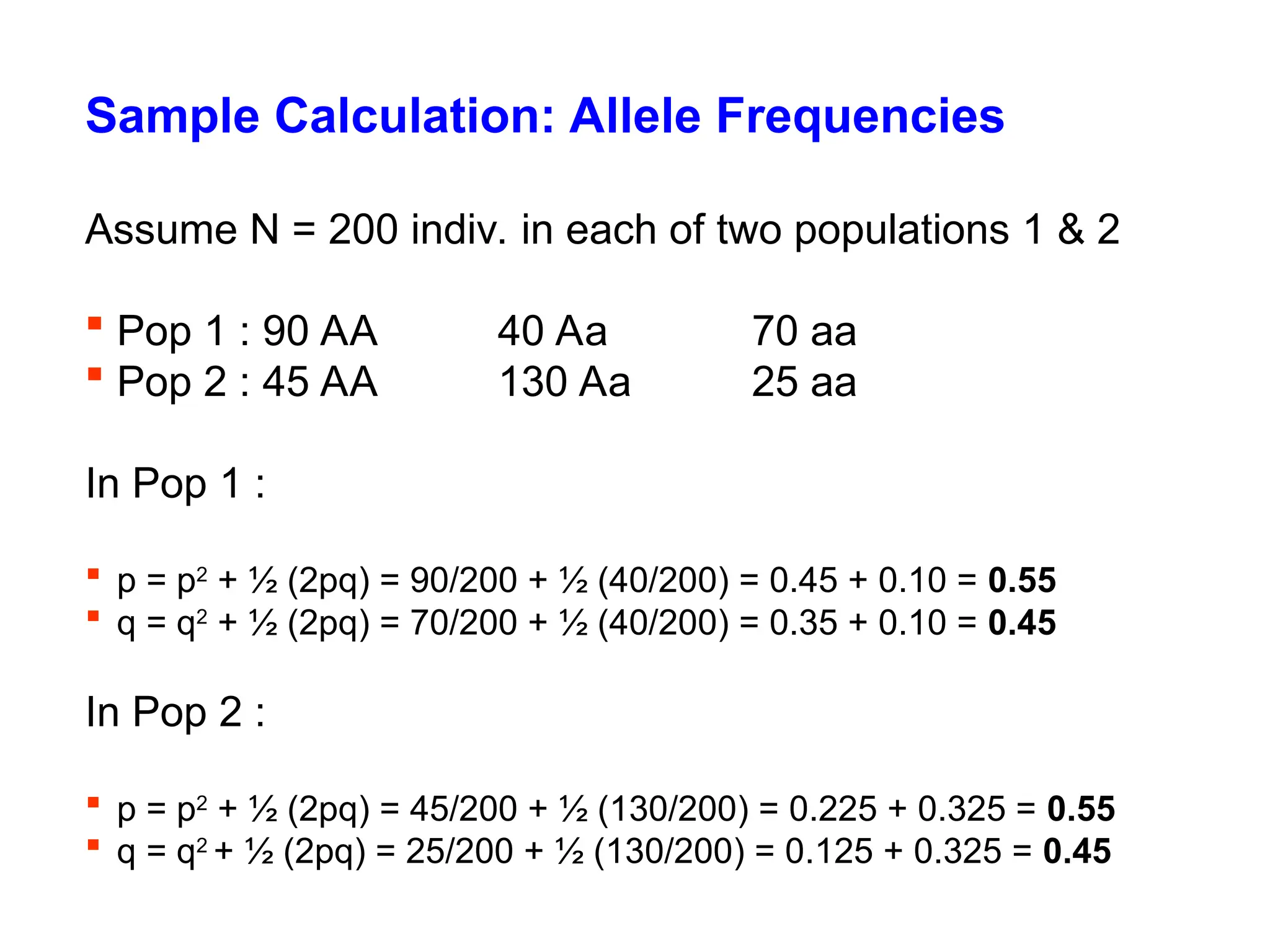
Sample Calculation: AlleleFrequencies
Assume N = 200 indiv. in each of two populations 1 & 2
Pop 1 : 90 AA 40 Aa 70 aa
Pop 2 : 45 AA 130 Aa 25 aa
In Pop 1 :
p = p2
+ ½ (2pq) = 90/200 + ½ (40/200) = 0.45 + 0.10 = 0.55
q = q2
+ ½ (2pq) = 70/200 + ½ (40/200) = 0.35 + 0.10 = 0.45
In Pop 2 :
p = p2
+ ½ (2pq) = 45/200 + ½ (130/200) = 0.225 + 0.325 = 0.55
q = q2
+ ½ (2pq) = 25/200 + ½ (130/200) = 0.125 + 0.325 = 0.45
31.
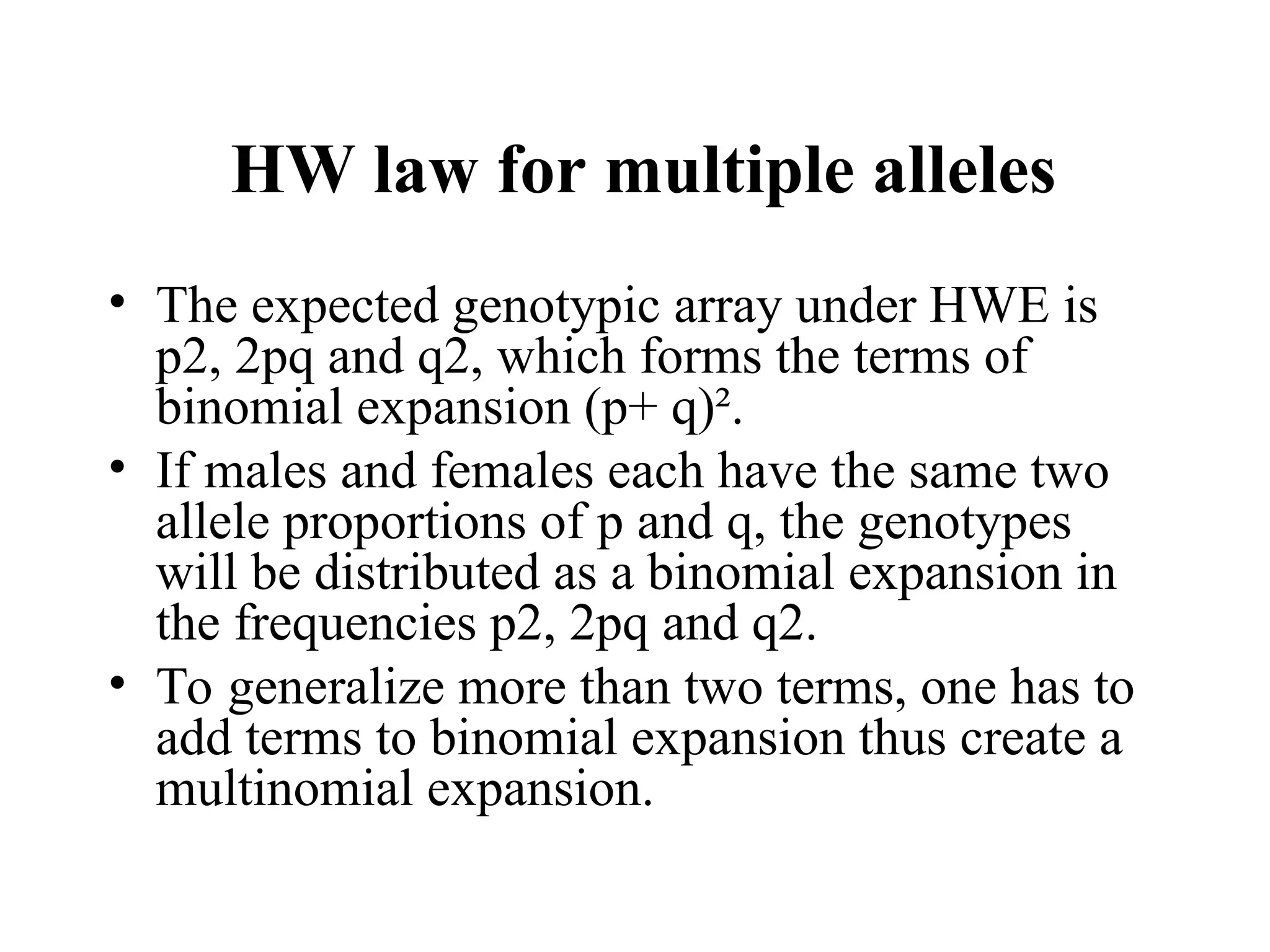
HW law formultiple alleles
• The expected genotypic array under HWE is
p2, 2pq and q2, which forms the terms of
binomial expansion (p+ q)².
• If males and females each have the same two
allele proportions of p and q, the genotypes
will be distributed as a binomial expansion in
the frequencies p2, 2pq and q2.
• To generalize more than two terms, one has to
add terms to binomial expansion thus create a
multinomial expansion.
32.
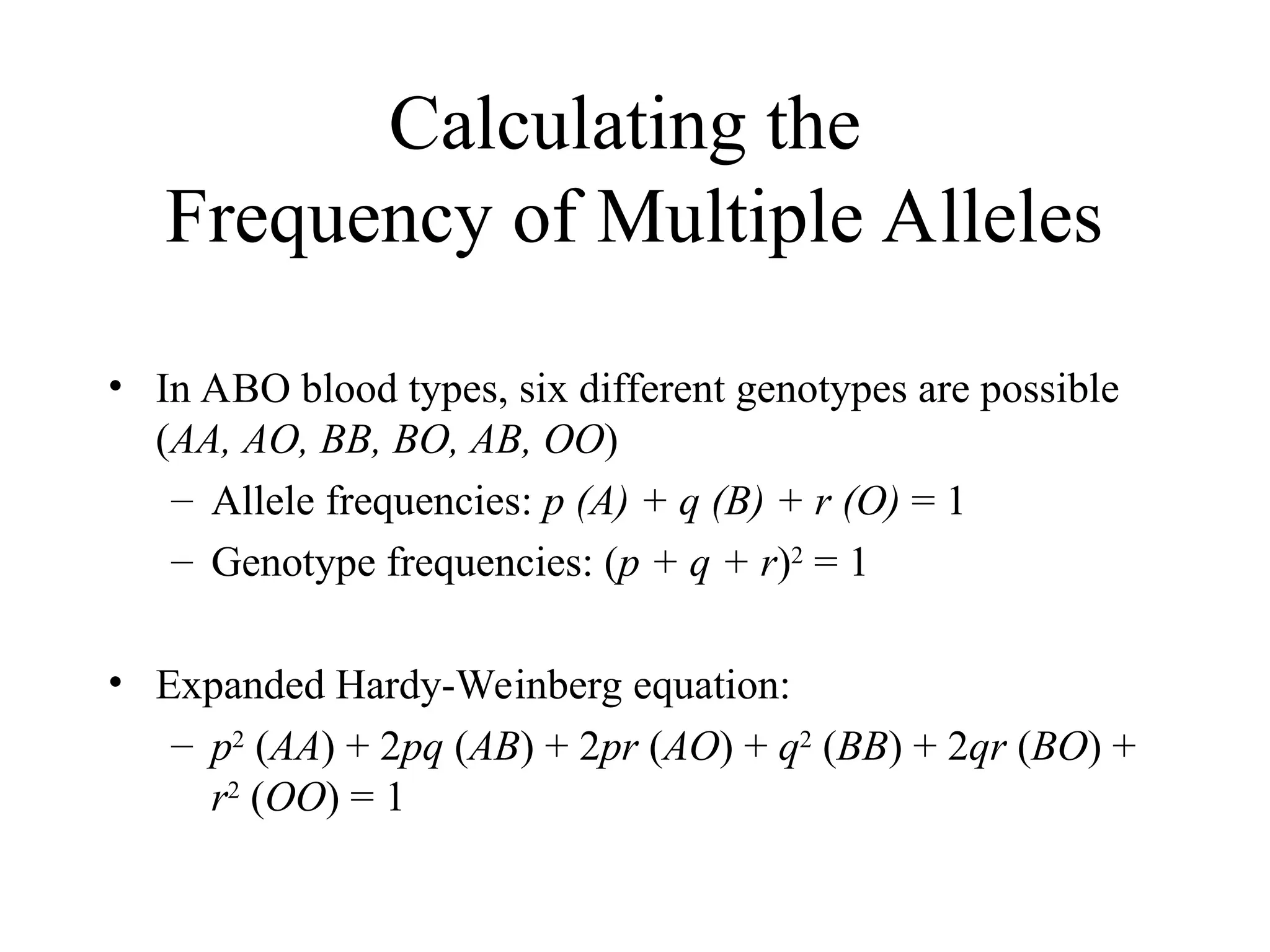
Calculating the
Frequency ofMultiple Alleles
• In ABO blood types, six different genotypes are possible
(AA, AO, BB, BO, AB, OO)
– Allele frequencies: p (A) + q (B) + r (O) = 1
– Genotype frequencies: (p + q + r)2
= 1
• Expanded Hardy-Weinberg equation:
– p2
(AA) + 2pq (AB) + 2pr (AO) + q2
(BB) + 2qr (BO) +
r2
(OO) = 1
33.
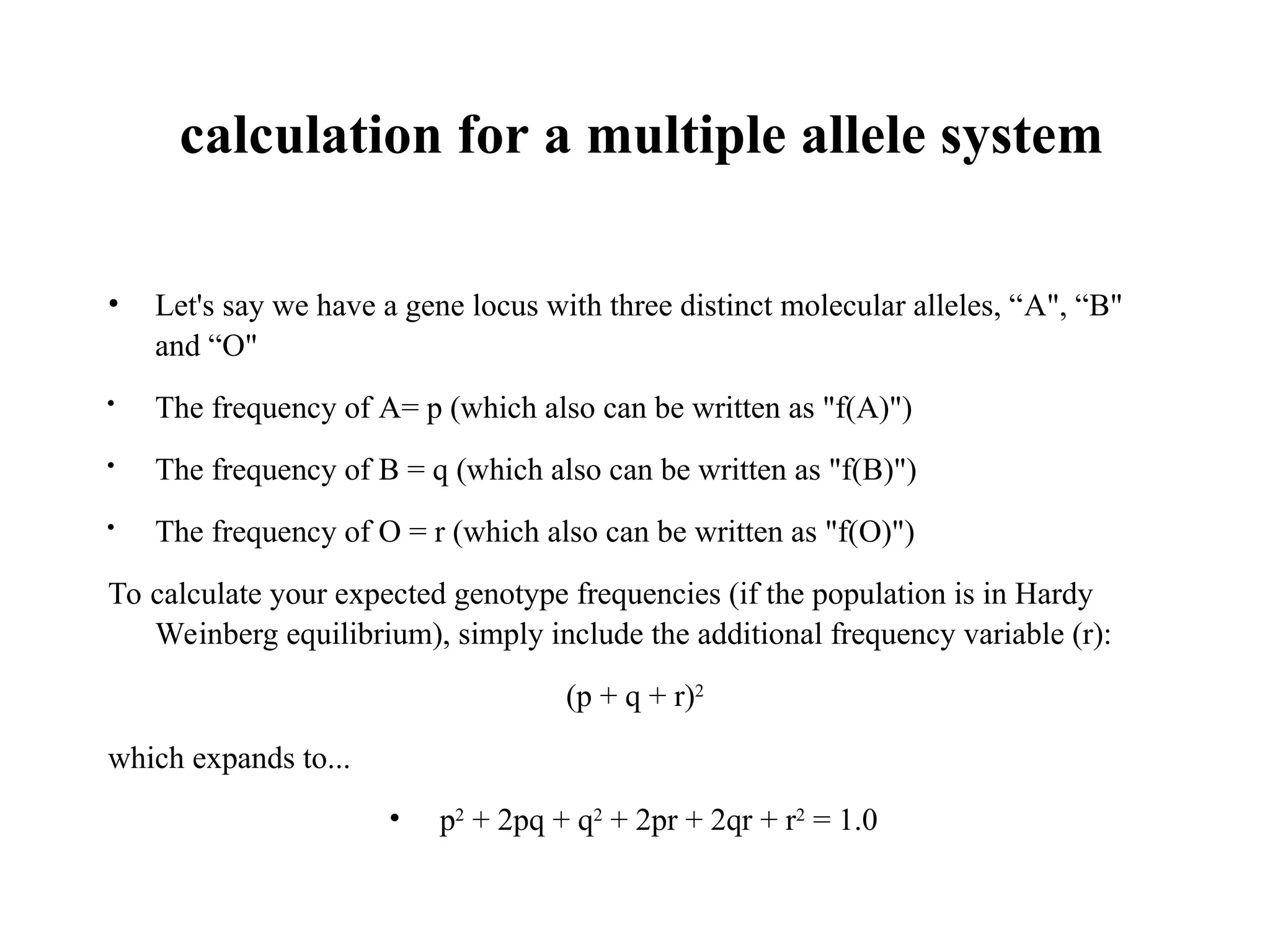
calculation for amultiple allele system
• Let's say we have a gene locus with three distinct molecular alleles, “A", “B"
and “O"
The frequency of A= p (which also can be written as "f(A)")
The frequency of B = q (which also can be written as "f(B)")
The frequency of O = r (which also can be written as "f(O)")
To calculate your expected genotype frequencies (if the population is in Hardy
Weinberg equilibrium), simply include the additional frequency variable (r):
(p + q + r)2
which expands to...
• p2
+ 2pq + q2
+ 2pr + 2qr + r2
= 1.0
34.
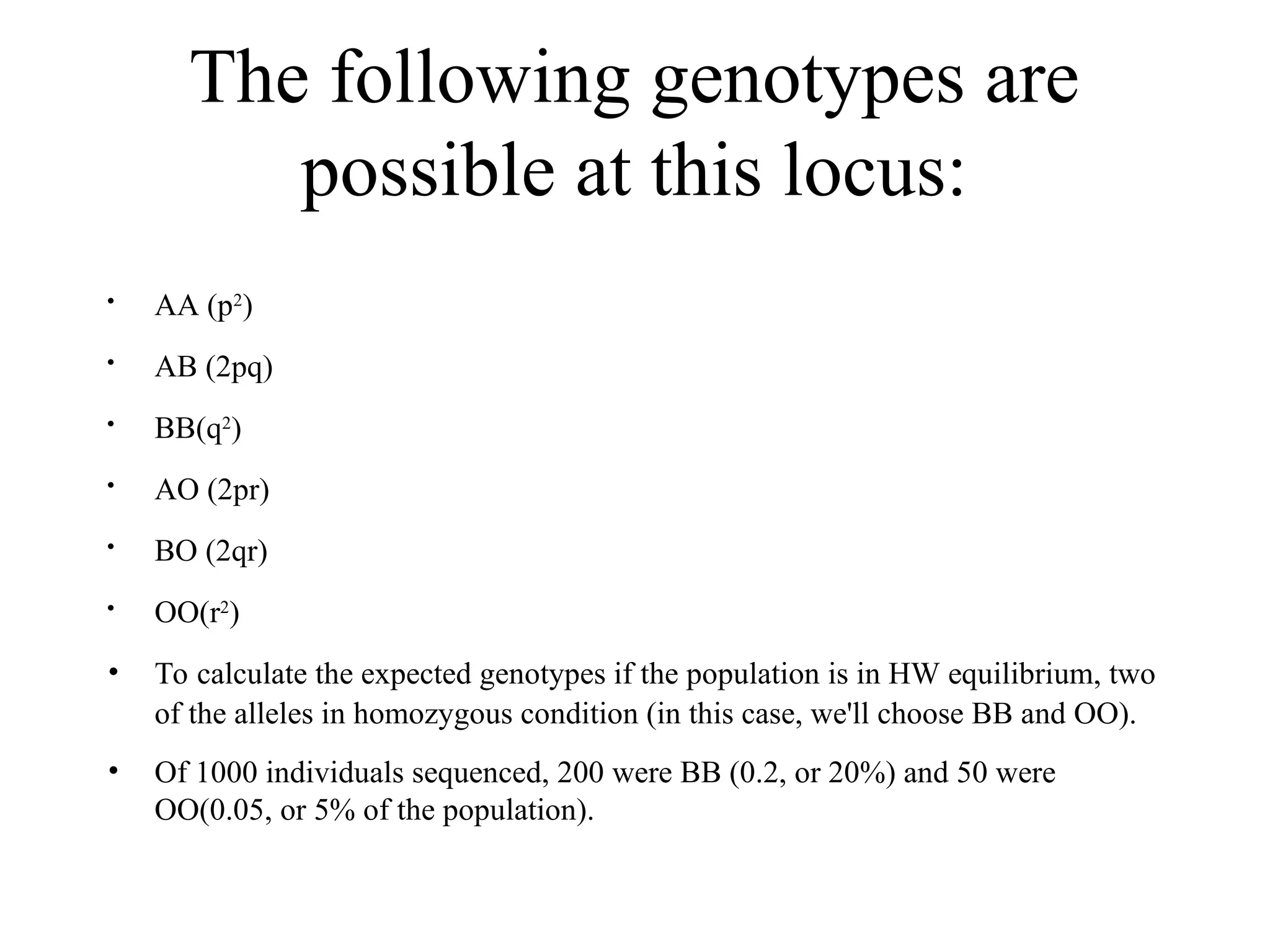
The following genotypesare
possible at this locus:
AA (p2
)
AB (2pq)
BB(q2
)
AO (2pr)
BO (2qr)
OO(r2
)
• To calculate the expected genotypes if the population is in HW equilibrium, two
of the alleles in homozygous condition (in this case, we'll choose BB and OO).
• Of 1000 individuals sequenced, 200 were BB (0.2, or 20%) and 50 were
OO(0.05, or 5% of the population).
35.
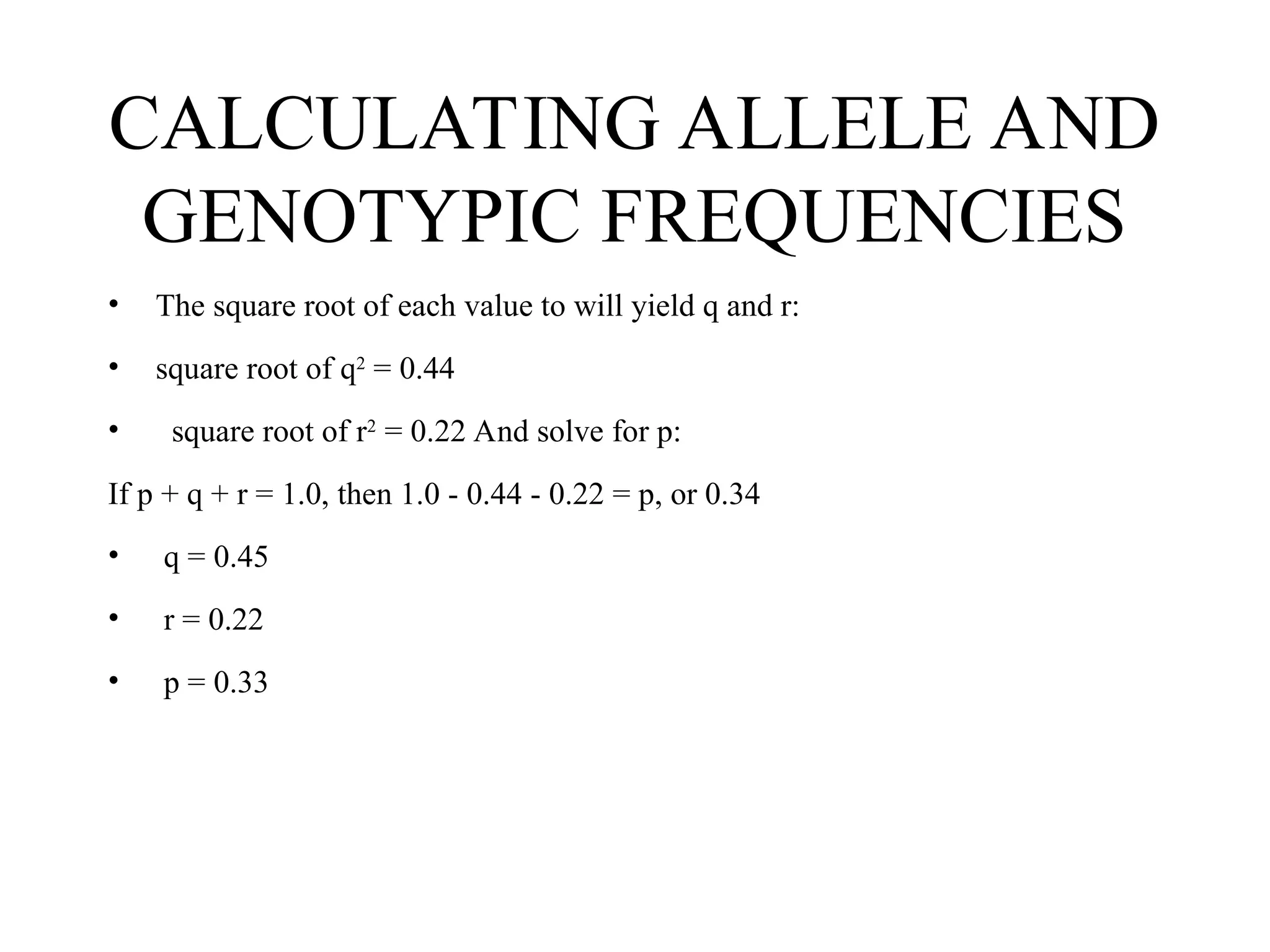
CALCULATING ALLELE AND
GENOTYPICFREQUENCIES
• The square root of each value to will yield q and r:
• square root of q2
= 0.44
• square root of r2
= 0.22 And solve for p:
If p + q + r = 1.0, then 1.0 - 0.44 - 0.22 = p, or 0.34
• q = 0.45
• r = 0.22
• p = 0.33
36.
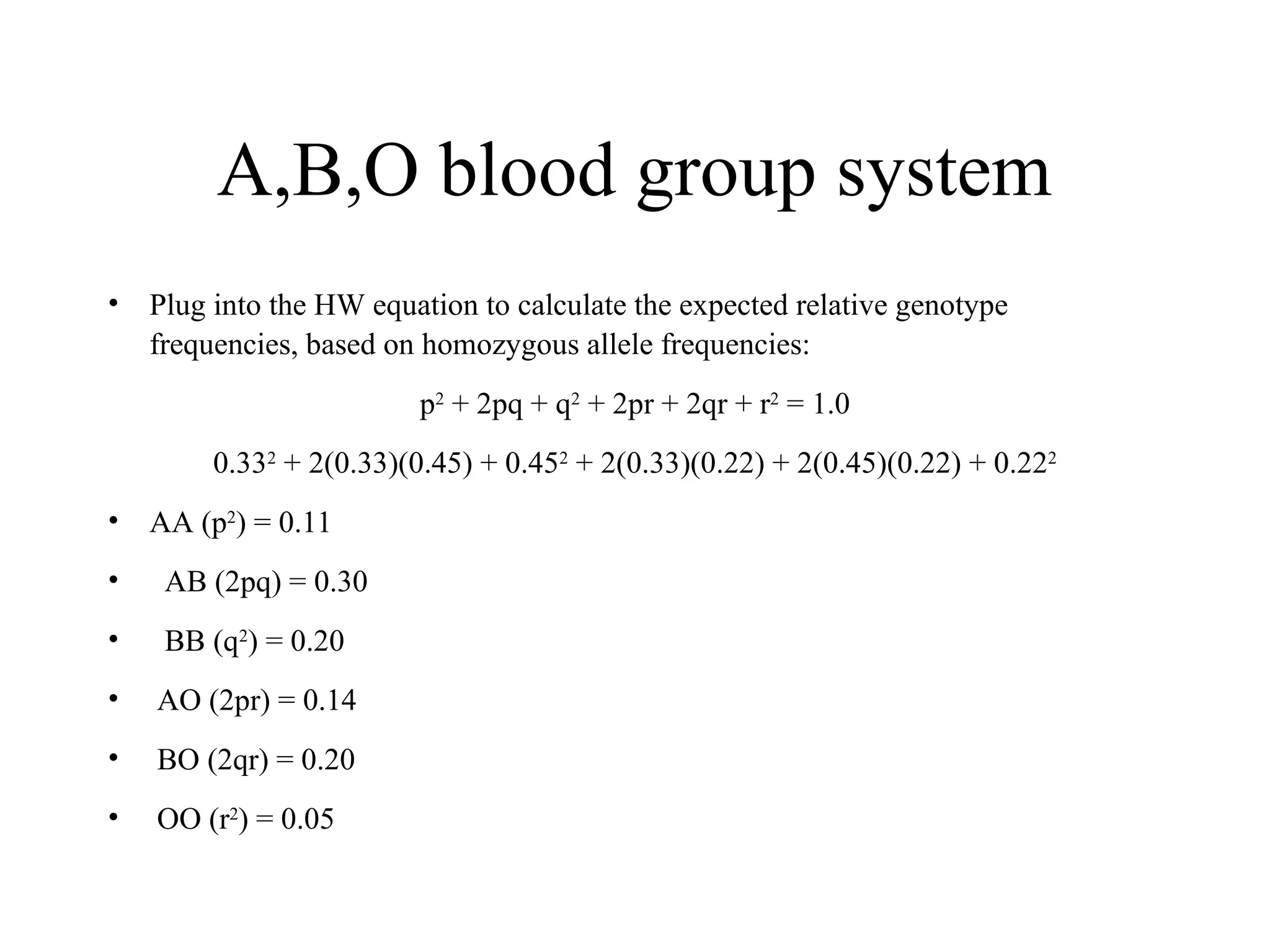
A,B,O blood groupsystem
• Plug into the HW equation to calculate the expected relative genotype
frequencies, based on homozygous allele frequencies:
p2
+ 2pq + q2
+ 2pr + 2qr + r2
= 1.0
0.332
+ 2(0.33)(0.45) + 0.452
+ 2(0.33)(0.22) + 2(0.45)(0.22) + 0.222
• AA (p2
) = 0.11
• AB (2pq) = 0.30
• BB (q2
) = 0.20
• AO (2pr) = 0.14
• BO (2qr) = 0.20
• OO (r2
) = 0.05
37.
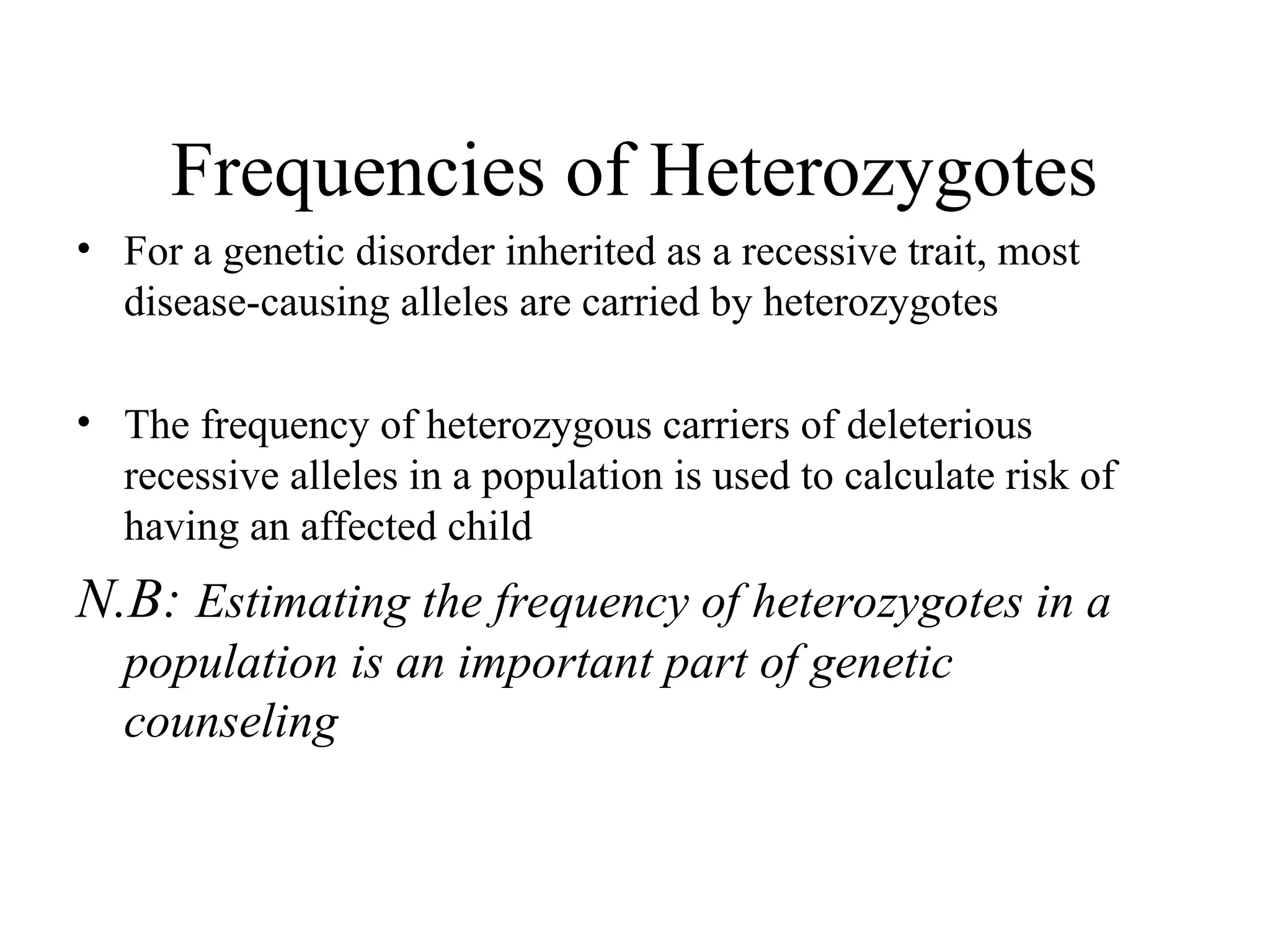
Frequencies of Heterozygotes
•For a genetic disorder inherited as a recessive trait, most
disease-causing alleles are carried by heterozygotes
• The frequency of heterozygous carriers of deleterious
recessive alleles in a population is used to calculate risk of
having an affected child
N.B: Estimating the frequency of heterozygotes in a
population is an important part of genetic
counseling
38.
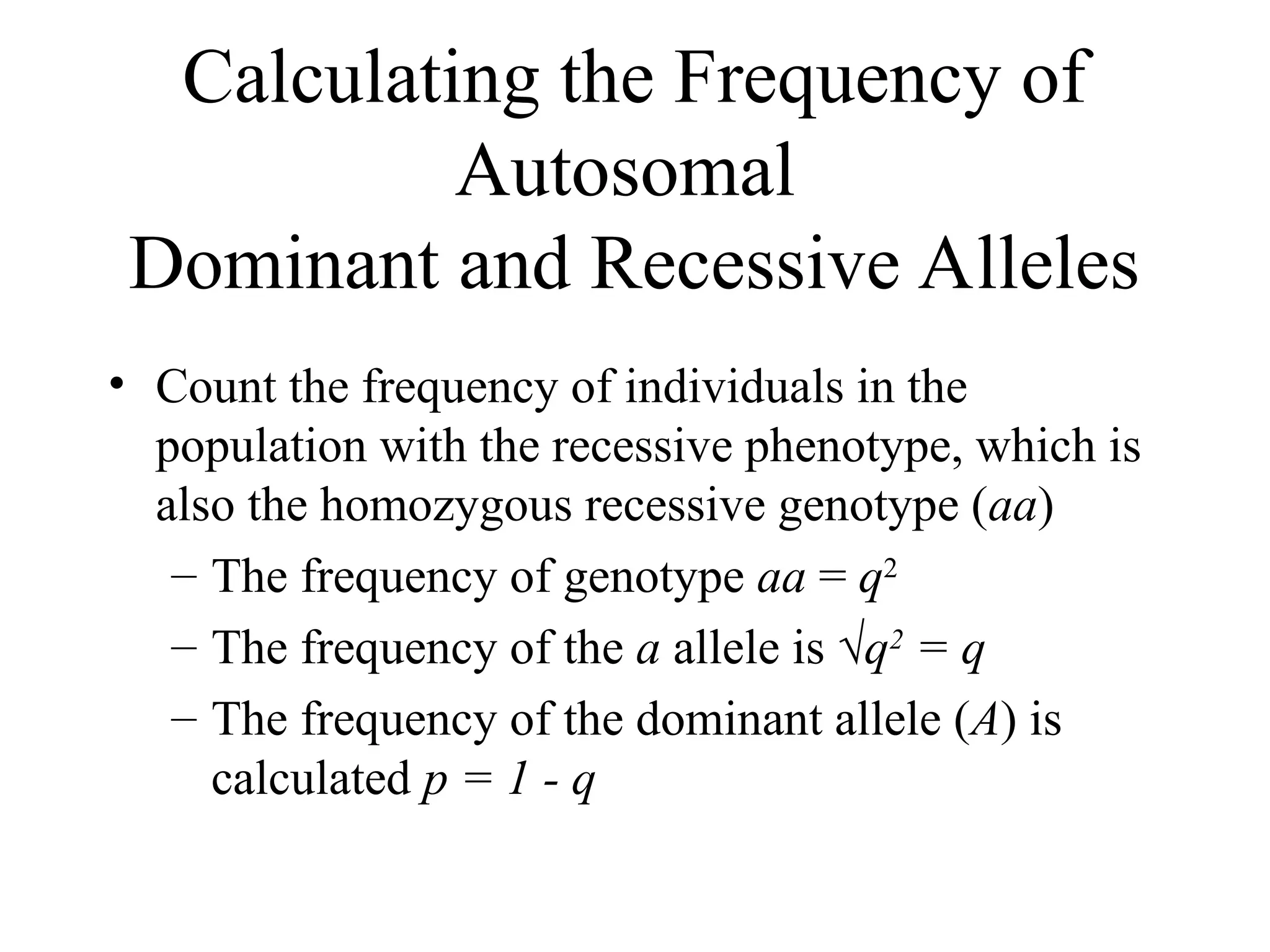
Calculating the Frequencyof
Autosomal
Dominant and Recessive Alleles
• Count the frequency of individuals in the
population with the recessive phenotype, which is
also the homozygous recessive genotype (aa)
– The frequency of genotype aa = q2
– The frequency of the a allele is √q2
= q
– The frequency of the dominant allele (A) is
calculated p = 1 - q
39.
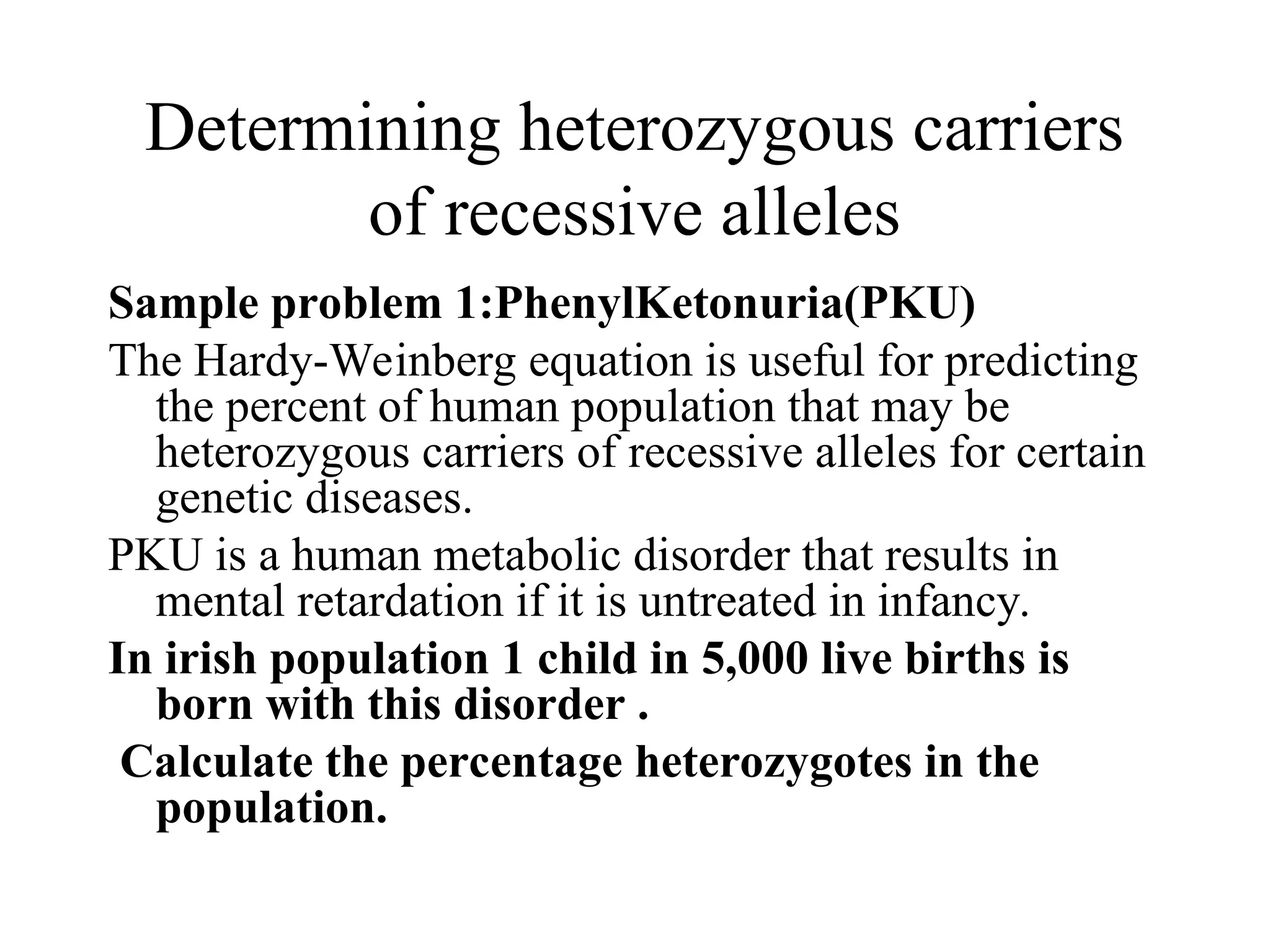
Determining heterozygous carriers
ofrecessive alleles
Sample problem 1:PhenylKetonuria(PKU)
The Hardy-Weinberg equation is useful for predicting
the percent of human population that may be
heterozygous carriers of recessive alleles for certain
genetic diseases.
PKU is a human metabolic disorder that results in
mental retardation if it is untreated in infancy.
In irish population 1 child in 5,000 live births is
born with this disorder .
Calculate the percentage heterozygotes in the
population.
40.
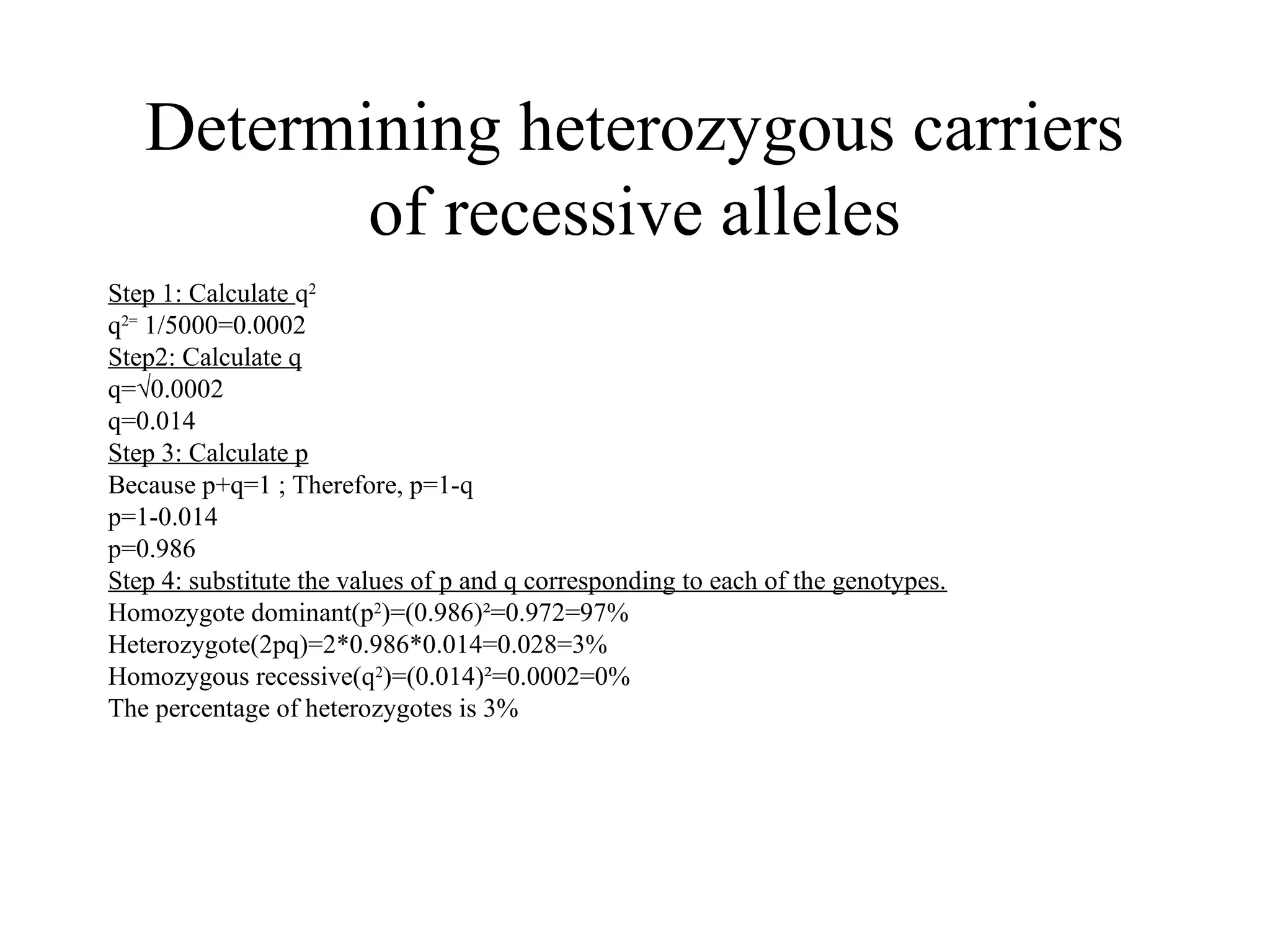
Determining heterozygous carriers
ofrecessive alleles
Step 1: Calculate q2
q2=
1/5000=0.0002
Step2: Calculate q
q=√0.0002
q=0.014
Step 3: Calculate p
Because p+q=1 ; Therefore, p=1-q
p=1-0.014
p=0.986
Step 4: substitute the values of p and q corresponding to each of the genotypes.
Homozygote dominant(p2
)=(0.986)²=0.972=97%
Heterozygote(2pq)=2*0.986*0.014=0.028=3%
Homozygous recessive(q2
)=(0.014)²=0.0002=0%
The percentage of heterozygotes is 3%
41.
Determining heterozygous carriers
ofrecessive alleles
Sample example 2:phenylthiocarbamide(PTC)
tasting
• About 70% of all white North American can taste
PTC and the remainder cannot .The ability to taste
this chemical is determined by the dominant allele
T, and the inability to taste is determined by the
recessive allele t.
If the population is assumed to be in HWE what are
the genotype and allele frequencies in this
population. What is the percentage of
heterozygotes in the population?
42.
Determining heterozygous carriers
ofrecessive alleles
Step 1: Calculate q2
q2=
0.3
Step2: Calculate q
q=√0.3
q=0.55
Step 3: Calculate p
Because p+q=1 ; Therefore, p=1-q
p=1-0.55
p=0.45
p2
=(0.45)²=0.20, the frequency of T/T
2pq=2*0.45*0.55=0.50, the frequency of T/t
q2
=(0.55)²=0.3, the frequency of t/t
The percentage of heterozygotes is 50%
43.
to be donein class by students
Albinism
• Albinism is a rare genetically inherited trait that is
only expressed in the phenotype of homozygous
recessive individuals(aa).
• The most characteristic symptom is a marked
deficiency in the skin and hair pigment. This
condition can occur among any human group as
well as among other animal species. The average
human frequency of albinism in North Africa is
about 1 in 20,000. calculate the percentage and the
number of individuals which are heterozygous.