A presentation on
heritability
Submitted By:
Santosh pathak
INTRODUCTION
 Heritability is the proportion of observed variation in a
particular trait that can be attributed to inherited genetic
factors in contrast to environmental ones.
 Has two definitions. Statistical definition, defines
heritability as the proportion of phenotypic variance
attributable to genetic variance.
 And the second definition is more common ‘sensical’ &
defines heritability as the extent to which genetic
individual differences contribute to individual differences
in observed behavior (or phenotypic individual
differences).
Introduction contd…………..
 The concept of heritability plays a central role in the
psychology of individual differences.
 It analyzes the relative contributions of differences in
genetic and non-genetic factors to the total
phenotypic variance in a population.
 It measures the fraction of phenotype variability that
can be attributed to genetic variation.
 Heritability can change without any genetic change
occurring (e.g. when the environment starts
contributing to more variation).
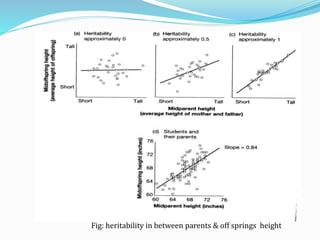
Fig: heritability in between parents & off springs height
Introduction contd……………..
 Heritability is a proportion, its numeric value will range
from 0( no gene contribution at all) to 1( genes are the only
reason for phenotypic individual differences).
 Heritability might also increase if the environmental
variation decreases, causing individuals to
show less phenotypic variation (e.g. to show more similar
levels of intelligence).
 The extent of dependence of phenotype on environment
can also be a function of the genes involved.
 Individuals with the same genotype can also exhibit
different phenotypes through a mechanism
called phenotypic plasticity.
Estimating Heritability
 Any particular phenotype can be modelled as the sum
of genetic and environmental effects:
Phenotype (P) = Genotype (G) + Environment (E).
 The variance in the trait Var (P) – is the sum of
genetic effects as follows:
Var(P) = Var(G) + Var(E) + 2 Cov(G,E).
 In a planned experiment Cov(G,E) can be controlled
and held at 0. In this case, heritability is defined as:
h² =Var(G)/Var(P).
Contd……….
 h² is the broad-sense heritability.
 It reflects all the genetic contributions to a
population's phenotypic variance including
additive, dominant, and epistatic (multi-genic
interactions), as well as maternal and paternal effects,
where individuals are directly affected by their
parents' phenotype (such as with milk production in
mammals).
 The additive genetic portion is known as Narrow-
sense heritability and is defined as h²= Var(A)/Var(P).
Contd……………..
 Additive variance is important for selection.
 Since only P can be observed or measured directly,
heritability must be estimated from the similarities
observed in subjects varying in their level of genetic or
environmental similarity.
 The statistical analyses required to estimate
the genetic and environmental components of variance
depend on the sample characteristics.
 In non-human populations it is often possible to collect
information in a controlled way.
 Studies of human heritability often utilize adoption
study designs, often with identical twins who have
been separated early in life and raised in different
environments.
 A second and more common design is the twin
study in which the similarity of identical and
fraternal twins is used to estimate heritability.
 Heritability estimates are always relative to the
genetic and environmental factors in the population.
 Heritability can be made larger by diversifying the
genetic background.
 In observational studies, or because of evokative
effects (where a genome evokes environments by its
effect on them), G and E may covary: gene
environment correlation.
 Depending on the methods used to estimate
heritability, correlations between genetic factors and
shared or non-shared environments may or may not be
confounded with heritability.
Estimation methods
 There are essentially two schools of thought regarding
estimation of heritability.
 School of thought- based on the analysis of
correlations and, by extension, regression.
 Path Analysis is based on the analysis of
variance of breeding studies, using the intra-class
correlation of relatives. Various methods of
estimating components of variance (and, hence,
heritability) from ANOVA are used in these
analyses.
Response to selection
In selective breeding of plants and animals, the expected
response to selection can be estimated by the following
equation: R²= h²S
 In this equation, the Response to Selection (R) is defined
as the realized average difference between the parent
generation and the next generation. The Selection
Differential (S) is defined as the average difference
between the parent generation and the selected parents.
 The above equation is equal to the ratio
Var(A)/Var(P) only if the genotype and the environmental
noise follow Gaussian distributions.
THANK YOU

Presentation on Heritability

  • 1.
  • 2.
    INTRODUCTION  Heritability isthe proportion of observed variation in a particular trait that can be attributed to inherited genetic factors in contrast to environmental ones.  Has two definitions. Statistical definition, defines heritability as the proportion of phenotypic variance attributable to genetic variance.  And the second definition is more common ‘sensical’ & defines heritability as the extent to which genetic individual differences contribute to individual differences in observed behavior (or phenotypic individual differences).
  • 3.
    Introduction contd…………..  Theconcept of heritability plays a central role in the psychology of individual differences.  It analyzes the relative contributions of differences in genetic and non-genetic factors to the total phenotypic variance in a population.  It measures the fraction of phenotype variability that can be attributed to genetic variation.  Heritability can change without any genetic change occurring (e.g. when the environment starts contributing to more variation).
  • 4.
    Fig: heritability inbetween parents & off springs height
  • 5.
    Introduction contd……………..  Heritabilityis a proportion, its numeric value will range from 0( no gene contribution at all) to 1( genes are the only reason for phenotypic individual differences).  Heritability might also increase if the environmental variation decreases, causing individuals to show less phenotypic variation (e.g. to show more similar levels of intelligence).  The extent of dependence of phenotype on environment can also be a function of the genes involved.  Individuals with the same genotype can also exhibit different phenotypes through a mechanism called phenotypic plasticity.
  • 6.
    Estimating Heritability  Anyparticular phenotype can be modelled as the sum of genetic and environmental effects: Phenotype (P) = Genotype (G) + Environment (E).  The variance in the trait Var (P) – is the sum of genetic effects as follows: Var(P) = Var(G) + Var(E) + 2 Cov(G,E).  In a planned experiment Cov(G,E) can be controlled and held at 0. In this case, heritability is defined as: h² =Var(G)/Var(P).
  • 7.
    Contd……….  h² isthe broad-sense heritability.  It reflects all the genetic contributions to a population's phenotypic variance including additive, dominant, and epistatic (multi-genic interactions), as well as maternal and paternal effects, where individuals are directly affected by their parents' phenotype (such as with milk production in mammals).  The additive genetic portion is known as Narrow- sense heritability and is defined as h²= Var(A)/Var(P).
  • 8.
    Contd……………..  Additive varianceis important for selection.  Since only P can be observed or measured directly, heritability must be estimated from the similarities observed in subjects varying in their level of genetic or environmental similarity.  The statistical analyses required to estimate the genetic and environmental components of variance depend on the sample characteristics.  In non-human populations it is often possible to collect information in a controlled way.
  • 9.
     Studies ofhuman heritability often utilize adoption study designs, often with identical twins who have been separated early in life and raised in different environments.  A second and more common design is the twin study in which the similarity of identical and fraternal twins is used to estimate heritability.  Heritability estimates are always relative to the genetic and environmental factors in the population.  Heritability can be made larger by diversifying the genetic background.
  • 10.
     In observationalstudies, or because of evokative effects (where a genome evokes environments by its effect on them), G and E may covary: gene environment correlation.  Depending on the methods used to estimate heritability, correlations between genetic factors and shared or non-shared environments may or may not be confounded with heritability.
  • 11.
    Estimation methods  Thereare essentially two schools of thought regarding estimation of heritability.  School of thought- based on the analysis of correlations and, by extension, regression.  Path Analysis is based on the analysis of variance of breeding studies, using the intra-class correlation of relatives. Various methods of estimating components of variance (and, hence, heritability) from ANOVA are used in these analyses.
  • 12.
    Response to selection Inselective breeding of plants and animals, the expected response to selection can be estimated by the following equation: R²= h²S  In this equation, the Response to Selection (R) is defined as the realized average difference between the parent generation and the next generation. The Selection Differential (S) is defined as the average difference between the parent generation and the selected parents.  The above equation is equal to the ratio Var(A)/Var(P) only if the genotype and the environmental noise follow Gaussian distributions.
  • 13.