AN ASSIGNMENT ON CROP
IMPROVEMENT IN OILSEEDS
PRESENTED BY:
Aliza shrestha (9)
Santosh Pathak (18)
Santosh K.C . (27)
Prativa Dhakal (36)
Nabin Subedi (45)
Introduction:
Oilseeds crop is one of the most important cash
crops grown in Nepal. Oilseeds are the crops
grown for oil extraction from their seeds.
They are a very important component of semi-
tropical and tropical agriculture, providing easily
available and highly nutritious human and animal
food.
Cash crops shares about 6.87% to agricultural
GDP whereas it shares 1.5% to agricultural GDP.
. Oilseeds crops is grown in 180,000 ha of land
with a production of 134,000mt (APSD, 2008).
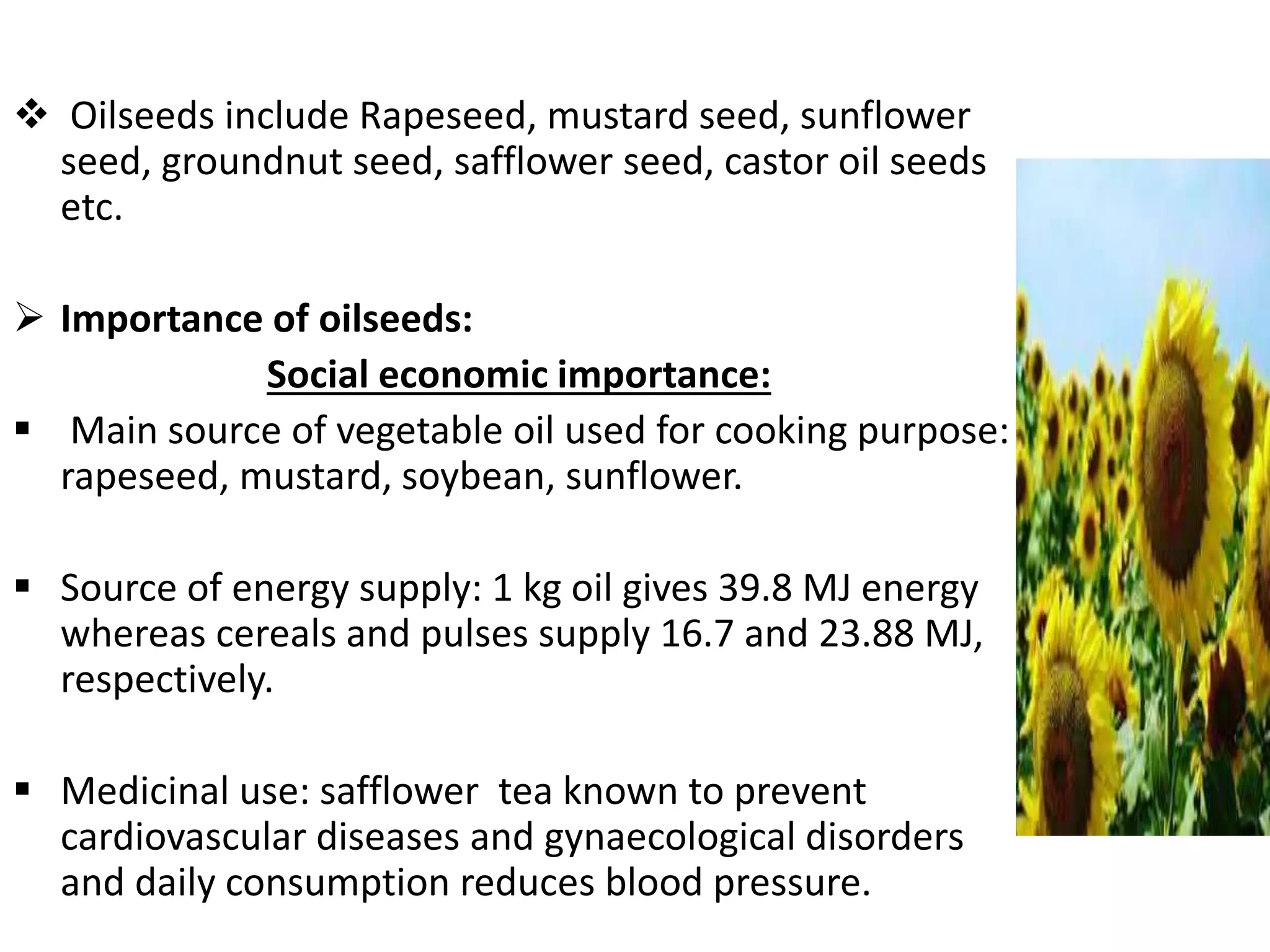
 Oilseeds include Rapeseed, mustard seed, sunflower
seed, groundnut seed, safflower seed, castor oil seeds
etc.
 Importance of oilseeds:
Social economic importance:
 Main source of vegetable oil used for cooking purpose:
rapeseed, mustard, soybean, sunflower.
 Source of energy supply: 1 kg oil gives 39.8 MJ energy
whereas cereals and pulses supply 16.7 and 23.88 MJ,
respectively.
 Medicinal use: safflower tea known to prevent
cardiovascular diseases and gynaecological disorders
and daily consumption reduces blood pressure.
• Nutritional importance:
 Rich source of oil contains about 20-60%.
 Oil contain linoleic acid, linolenic acids,V it. A, E,provitamin etc
 Linoleic and linolenic acids lowers the fat and cholesterol contents
of blood and hence the oils containing such acid groups are
important for prevention of coronary sclerosis.
• Soil fertility maintenance and biological N fixation:
 Rhizobium , Bradyrhizobium
Crops Scientific name N fixed (kg
N/ha/yr)
Groundnut Arachis hypogaea 72-124
Soybean Glycine max 60-168
Area, production and yield of oilseeds in
Nepal:
• Table 1: Area, production and yields of oilseeds in Nepal over
1984/85 - 2008/09
Years Area(ha) Production(mt) Yield(kg/ha)
1984/85 1,27,820 84,030 657
1990/91 1,56,310 92,140 589
1995/96 1,85,000 1,15,990 627
2000/01 1,88,455 1,32,331 702
2004/05 1,87,823 1,41,989 756
2007/08 1,80,328 1,34,246 745
2008/09 1,81,361 1,35,494 747
Crops improvement in oilseeds crops:
 Breeding for improved oilseeds has traditionally emphasized
improvement in yield, oil content and disease resistance.
 The soybean varieties Provar and Protana were released in 1969
because they contain higher percentage of protein than other
varieties.
 Safflower germplasm has been screened and a source of improved
lysine has been identified.
 Emphasis in sunflower programs will be on developing higher yielding
lines and on exploiting the possibility of developing hybrids.
 Sunflower research personnel is so limited that there is not likely to
be any major effort on quality factors for some time, sesame research
is very limited major emphasis being on control of shattering.
• In context of Brassica spp., it has been suggested
that yield in this crop equals the product of
number of siliqua/m2, number of seeds/siliqua and
seed weight.
• Analysis of yield and yield traits has been used to
propose the following ideotype by Bhargava and
coworkers in 1984 for an optimum production
environment.
1. Height of 1-1.25 m.
2 Only 5-6 primary branches at an angle of 40-450.
3 The main stem should bear only 40 siliquae, the
lower 3 branches only 15 siliqua each and the
upper two branches only 20 siliqua each.
4 There should be only 7-10 smaller and thicker
leaves, with a higher photosynthetic rate, low dark
respiration rate and high nitrate reductase activity.
5. Each siliqua should have 20 seeds and each seed
should weigh 5mg.
6. Root system should be deep
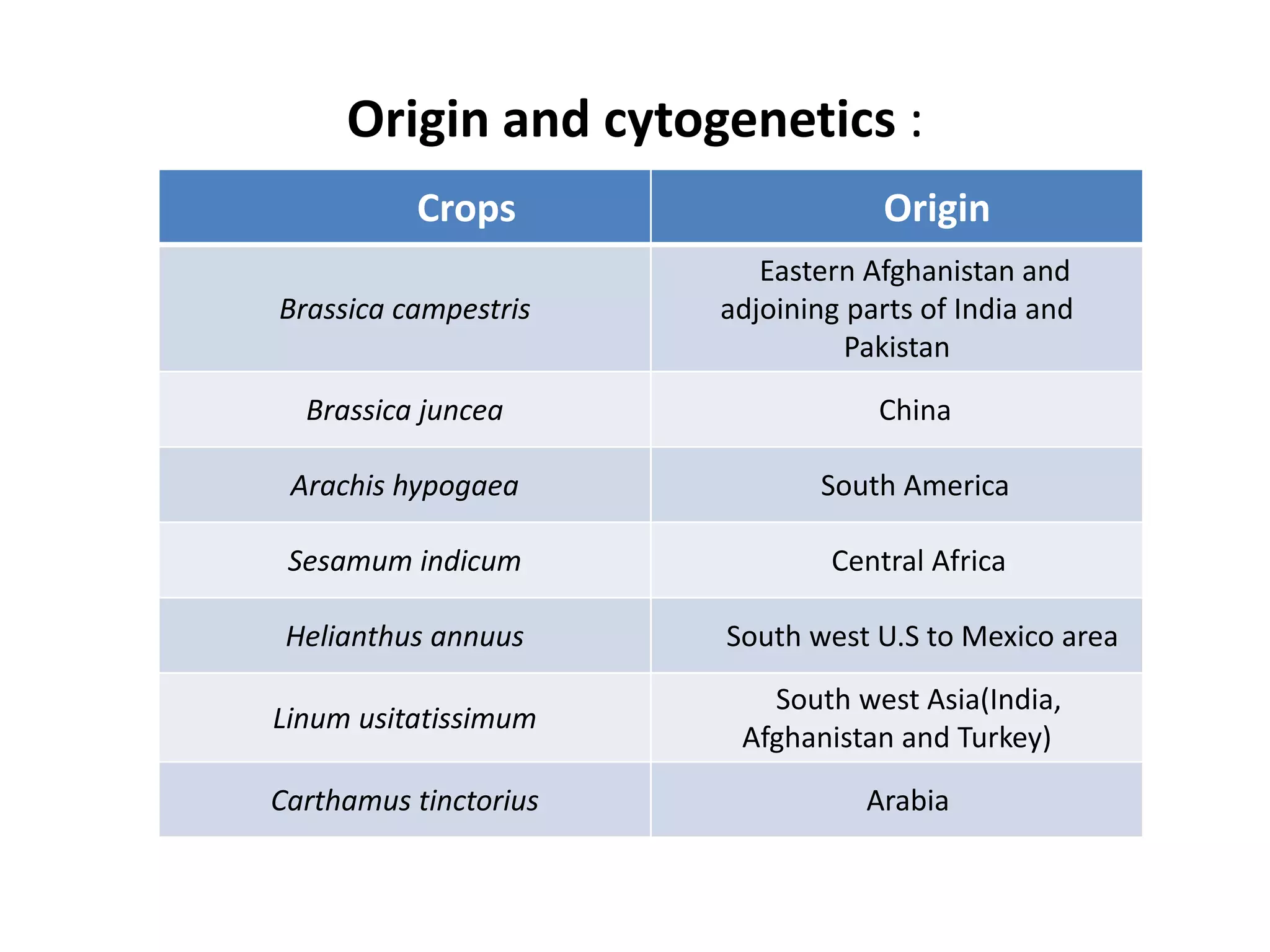
Origin and cytogenetics :
Crops Origin
Brassica campestris
Eastern Afghanistan and
adjoining parts of India and
Pakistan
Brassica juncea China
Arachis hypogaea South America
Sesamum indicum Central Africa
Helianthus annuus South west U.S to Mexico area
Linum usitatissimum
South west Asia(India,
Afghanistan and Turkey)
Carthamus tinctorius Arabia
Species Chromosome no.
Common
name
Genome
Brassica nigra 16 Black sarson BB
Brassica campestris 20 Rape AA
Brassica juncea 36 Rai, mustard AABB
Brassica carinata 34
Abyssnian
cabbage
BBCC
Brassica oleracea 18 Cabbage CC
Brassica napus 38 Rape AACC
Breeding objectives:
• High oil yield and stability of oil yield.
• Adaptation of the species to the environment
• Cold / frost tolerance
• Resistance to disease and pests
• Good quality oil
• Earlier maturity
Varieties:
• Brassica campestris var Toria: Pragati, Lumle tori 1, Bikas, T9
• Brassica juncea: Krishna , Pusa bold
• Sesamum indicum: Nawalpur khairo til 1, Nawalpur jhuse til 1
• Arachis hypogaea: Jayanti, Jyoti, Janak and B4
 Methods of breeding:
• Germplasm collection, evaluation and introduction
• Mutation breeding
• Tissue culture
• Somaclonal variation
• Hybridization
Fig: Tissue culture
Present research status and future research strategies:
• National Oilseed Research Programme (NORP), Nawalpur , Sarlahi:
The sole responsible organization in Nepal for research and
development.
• Established in April14, 1976 as National Oilseeds Development
Program and after the inception of Nepal Agricultural Research
council in 1990 it was renamed as National Oilseed Research
program(NORP).
Achievement:
Genetic improvement:
• Evaluation of basic germplasm,
• Selection of lines with yield and productive stability,
• Pest resistance and stress tolerance,
• Earliness, shattering resistance .
• Robust growth and product qualities.
• Released of varieties: rapeseed and mustard:7, sesamum:2,
groundnut:6
Plant protection:
• Development of diseases and insects resistance varieties,
• Survey and surveillance of pest or disease and development of
appropriate pest control measures.
Cultural practices:
• Development of package of practice for different agro-ecological
conditions.
Oilseeds in cropping system:
• Suitability of different genotypes for different cropping system
Plant nutrient requirement:
• Dose and type of fertilizer
• Compost, bio-fertilizer, time of their application etc
Seed production:
• Production of nucleus/breeder seed, foundation and certified seeds.
• Maintain genetic purity and seed quality.
Mechanization and post harvest technology:
• Improve post harvest handling,
• Efficient tillage methods,
• Herbicides
• Use of farm equipments.
Future research strategies:
• Breeding varieties resistant to major biotic constraints such as
diseases, insects pest and nematodes.
• Improving yield levels by developing input -responsive
improved plant types.
• Evolving early maturing varieties suitable for different
cropping pattern
• Germplasm collection and evaluation.
• Identification of efficient strains of rhizobium for leguminous
oilseeds and Azospirillium to others
• Development of integrated pest management systems.
• Development of better agronomic practices for major oilseeds
and production systems and post harvest technologies and
initiation of systematic research on minor oilseeds crops
Conclusion:
• As we know oilseeds are important for daily cooking
purposes and many other purposes. We can't ignore
the importance of oilseeds in our daily life.
• To fulfill the demand of people, there should be the a
lots of research activities in the field of oilseeds.
• Scientist should be involved in different types of
research activities for increasing the yield per unit area.
They should have the objectives of making the oilseeds
as more proteinous , fat and free from disease and
pest.
• In context of Nepal, there is an organization named
Nepal oilseeds research program.
• It is the only organization carrying out research
activities which was established in 1976. Government
should force in the genetic improvement of this crop.
THANK-YOUTHANK-YOU

crop improvemnet in oilseeds

  • 1.
    AN ASSIGNMENT ONCROP IMPROVEMENT IN OILSEEDS PRESENTED BY: Aliza shrestha (9) Santosh Pathak (18) Santosh K.C . (27) Prativa Dhakal (36) Nabin Subedi (45)
  • 2.
    Introduction: Oilseeds crop isone of the most important cash crops grown in Nepal. Oilseeds are the crops grown for oil extraction from their seeds. They are a very important component of semi- tropical and tropical agriculture, providing easily available and highly nutritious human and animal food. Cash crops shares about 6.87% to agricultural GDP whereas it shares 1.5% to agricultural GDP. . Oilseeds crops is grown in 180,000 ha of land with a production of 134,000mt (APSD, 2008).
  • 3.
     Oilseeds includeRapeseed, mustard seed, sunflower seed, groundnut seed, safflower seed, castor oil seeds etc.  Importance of oilseeds: Social economic importance:  Main source of vegetable oil used for cooking purpose: rapeseed, mustard, soybean, sunflower.  Source of energy supply: 1 kg oil gives 39.8 MJ energy whereas cereals and pulses supply 16.7 and 23.88 MJ, respectively.  Medicinal use: safflower tea known to prevent cardiovascular diseases and gynaecological disorders and daily consumption reduces blood pressure.
  • 4.
    • Nutritional importance: Rich source of oil contains about 20-60%.  Oil contain linoleic acid, linolenic acids,V it. A, E,provitamin etc  Linoleic and linolenic acids lowers the fat and cholesterol contents of blood and hence the oils containing such acid groups are important for prevention of coronary sclerosis. • Soil fertility maintenance and biological N fixation:  Rhizobium , Bradyrhizobium Crops Scientific name N fixed (kg N/ha/yr) Groundnut Arachis hypogaea 72-124 Soybean Glycine max 60-168
  • 5.
    Area, production andyield of oilseeds in Nepal: • Table 1: Area, production and yields of oilseeds in Nepal over 1984/85 - 2008/09 Years Area(ha) Production(mt) Yield(kg/ha) 1984/85 1,27,820 84,030 657 1990/91 1,56,310 92,140 589 1995/96 1,85,000 1,15,990 627 2000/01 1,88,455 1,32,331 702 2004/05 1,87,823 1,41,989 756 2007/08 1,80,328 1,34,246 745 2008/09 1,81,361 1,35,494 747
  • 6.
    Crops improvement inoilseeds crops:  Breeding for improved oilseeds has traditionally emphasized improvement in yield, oil content and disease resistance.  The soybean varieties Provar and Protana were released in 1969 because they contain higher percentage of protein than other varieties.  Safflower germplasm has been screened and a source of improved lysine has been identified.  Emphasis in sunflower programs will be on developing higher yielding lines and on exploiting the possibility of developing hybrids.  Sunflower research personnel is so limited that there is not likely to be any major effort on quality factors for some time, sesame research is very limited major emphasis being on control of shattering.
  • 7.
    • In contextof Brassica spp., it has been suggested that yield in this crop equals the product of number of siliqua/m2, number of seeds/siliqua and seed weight. • Analysis of yield and yield traits has been used to propose the following ideotype by Bhargava and coworkers in 1984 for an optimum production environment. 1. Height of 1-1.25 m. 2 Only 5-6 primary branches at an angle of 40-450. 3 The main stem should bear only 40 siliquae, the lower 3 branches only 15 siliqua each and the upper two branches only 20 siliqua each. 4 There should be only 7-10 smaller and thicker leaves, with a higher photosynthetic rate, low dark respiration rate and high nitrate reductase activity. 5. Each siliqua should have 20 seeds and each seed should weigh 5mg. 6. Root system should be deep
  • 8.
    Origin and cytogenetics: Crops Origin Brassica campestris Eastern Afghanistan and adjoining parts of India and Pakistan Brassica juncea China Arachis hypogaea South America Sesamum indicum Central Africa Helianthus annuus South west U.S to Mexico area Linum usitatissimum South west Asia(India, Afghanistan and Turkey) Carthamus tinctorius Arabia
  • 9.
    Species Chromosome no. Common name Genome Brassicanigra 16 Black sarson BB Brassica campestris 20 Rape AA Brassica juncea 36 Rai, mustard AABB Brassica carinata 34 Abyssnian cabbage BBCC Brassica oleracea 18 Cabbage CC Brassica napus 38 Rape AACC
  • 10.
    Breeding objectives: • Highoil yield and stability of oil yield. • Adaptation of the species to the environment • Cold / frost tolerance • Resistance to disease and pests • Good quality oil • Earlier maturity Varieties: • Brassica campestris var Toria: Pragati, Lumle tori 1, Bikas, T9 • Brassica juncea: Krishna , Pusa bold • Sesamum indicum: Nawalpur khairo til 1, Nawalpur jhuse til 1 • Arachis hypogaea: Jayanti, Jyoti, Janak and B4
  • 11.
     Methods ofbreeding: • Germplasm collection, evaluation and introduction • Mutation breeding • Tissue culture • Somaclonal variation • Hybridization Fig: Tissue culture
  • 12.
    Present research statusand future research strategies: • National Oilseed Research Programme (NORP), Nawalpur , Sarlahi: The sole responsible organization in Nepal for research and development. • Established in April14, 1976 as National Oilseeds Development Program and after the inception of Nepal Agricultural Research council in 1990 it was renamed as National Oilseed Research program(NORP).
  • 13.
    Achievement: Genetic improvement: • Evaluationof basic germplasm, • Selection of lines with yield and productive stability, • Pest resistance and stress tolerance, • Earliness, shattering resistance . • Robust growth and product qualities. • Released of varieties: rapeseed and mustard:7, sesamum:2, groundnut:6
  • 14.
    Plant protection: • Developmentof diseases and insects resistance varieties, • Survey and surveillance of pest or disease and development of appropriate pest control measures. Cultural practices: • Development of package of practice for different agro-ecological conditions. Oilseeds in cropping system: • Suitability of different genotypes for different cropping system Plant nutrient requirement: • Dose and type of fertilizer • Compost, bio-fertilizer, time of their application etc
  • 15.
    Seed production: • Productionof nucleus/breeder seed, foundation and certified seeds. • Maintain genetic purity and seed quality. Mechanization and post harvest technology: • Improve post harvest handling, • Efficient tillage methods, • Herbicides • Use of farm equipments.
  • 16.
    Future research strategies: •Breeding varieties resistant to major biotic constraints such as diseases, insects pest and nematodes. • Improving yield levels by developing input -responsive improved plant types. • Evolving early maturing varieties suitable for different cropping pattern • Germplasm collection and evaluation. • Identification of efficient strains of rhizobium for leguminous oilseeds and Azospirillium to others • Development of integrated pest management systems. • Development of better agronomic practices for major oilseeds and production systems and post harvest technologies and initiation of systematic research on minor oilseeds crops
  • 17.
    Conclusion: • As weknow oilseeds are important for daily cooking purposes and many other purposes. We can't ignore the importance of oilseeds in our daily life. • To fulfill the demand of people, there should be the a lots of research activities in the field of oilseeds. • Scientist should be involved in different types of research activities for increasing the yield per unit area. They should have the objectives of making the oilseeds as more proteinous , fat and free from disease and pest. • In context of Nepal, there is an organization named Nepal oilseeds research program. • It is the only organization carrying out research activities which was established in 1976. Government should force in the genetic improvement of this crop.
  • 18.