On-site and off-site
consequences of soil erosion
Prepared by:
Santosh Pathak ( IAAS, Lamjung)
Soil erosion
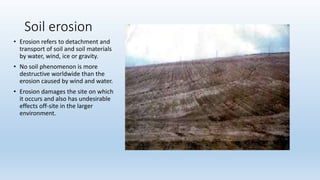
• Erosion refers to detachment and
transport of soil and soil materials
by water, wind, ice or gravity.
• No soil phenomenon is more
destructive worldwide than the
erosion caused by wind and water.
• Erosion damages the site on which
it occurs and also has undesirable
effects off-site in the larger
environment.
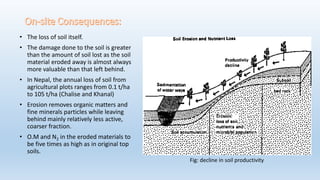
• The loss of soil itself.
• The damage done to the soil is greater
than the amount of soil lost as the soil
material eroded away is almost always
more valuable than that left behind.
• In Nepal, the annual loss of soil from
agricultural plots ranges from 0.1 t/ha
to 105 t/ha (Chalise and Khanal)
• Erosion removes organic matters and
fine minerals particles while leaving
behind mainly relatively less active,
coarser fraction.
• O.M and N2 in the eroded materials to
be five times as high as in original top
soils.
Fig: decline in soil productivity
On site consequences…
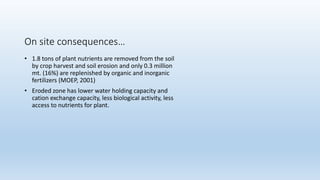
• 1.8 tons of plant nutrients are removed from the soil
by crop harvest and soil erosion and only 0.3 million
mt. (16%) are replenished by organic and inorganic
fertilizers (MOEP, 2001)
• Eroded zone has lower water holding capacity and
cation exchange capacity, less biological activity, less
access to nutrients for plant.
• Erosion spread plant disease
organisms.
• Deterioration of soil structure
• Dense crust formation
• Reduce water infiltration
• Increases water runoff
• Seed and seedlings may be
washed downhills.
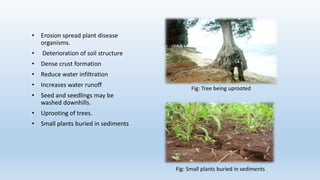
• Uprooting of trees.
• Small plants buried in sediments
Fig: Tree being uprooted
Fig: Small plants buried in sediments
• In the case of wind erosion :
 Fruits and foliage damaged
by the sand blasting.
 leaf incrustation causes
stomatal closening.
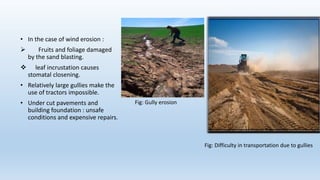
• Relatively large gullies make the
use of tractors impossible.
• Under cut pavements and
building foundation : unsafe
conditions and expensive repairs.
Fig: Gully erosion
Fig: Difficulty in transportation due to gullies
• Movements of sediments and
nutrients off the land, creates
two most widespread water
pollution.
• eutrophication caused by
excessive nitrogen and
phosphorus.
• Carry toxic metals and
organic compounds such as
pesticides, leads to bio
magnification.
Damages from sediments
 Smother crop and low
growing vegetation.
 Roadside drainage and
ditches filled creating
hazardous driving
conditions.
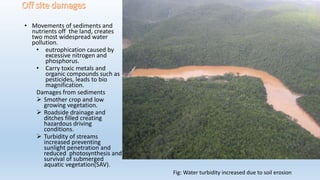
 Turbidity of streams
increased preventing
sunlight penetration and
reduced photosynthesis and
survival of submerged
aquatic vegetation(SAV).
Fig: Water turbidity increased due to soil erosion
Contd……
 The demise of SAV, in turn, degrades the fish
habitat and upsets the aquatic food chain.
 Spawning sites of the freshwater fishes buried.
 According to the WWF, a group of Brazilian Indians
reported significant decreases in fish numbers.
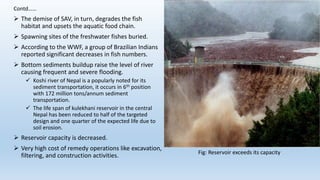
 Bottom sediments buildup raise the level of river
causing frequent and severe flooding.
 Koshi river of Nepal is a popularly noted for its
sediment transportation, it occurs in 6th position
with 172 million tons/annum sediment
transportation.
 The life span of kulekhani reservoir in the central
Nepal has been reduced to half of the targeted
design and one quarter of the expected life due to
soil erosion.
 Reservoir capacity is decreased.
 Very high cost of remedy operations like excavation,
filtering, and construction activities. Fig: Reservoir exceeds its capacity
Contd…..
• In case of wind erosion, blowing
sand may bury roads and fill
drainage ditches, necessitating
expensive maintainance.
• Sand blasting effect damage the
fruits and foliage of the field as well
as paint on vehicle and building.
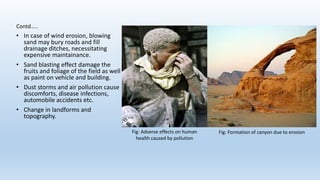
• Dust storms and air pollution cause
discomforts, disease infections,
automobile accidents etc.
• Change in landforms and
topography.
Fig: Adverse effects on human
health caused by pollution
Fig: Formation of canyon due to erosion
• Combating soil erosion is
everybody's business.
attention must be paid to control on
site consequences which finally
reduce off site consequenses.

Offsite and onsite

  • 1.
    On-site and off-site consequencesof soil erosion Prepared by: Santosh Pathak ( IAAS, Lamjung)
  • 2.
    Soil erosion • Erosionrefers to detachment and transport of soil and soil materials by water, wind, ice or gravity. • No soil phenomenon is more destructive worldwide than the erosion caused by wind and water. • Erosion damages the site on which it occurs and also has undesirable effects off-site in the larger environment.
  • 3.
    • The lossof soil itself. • The damage done to the soil is greater than the amount of soil lost as the soil material eroded away is almost always more valuable than that left behind. • In Nepal, the annual loss of soil from agricultural plots ranges from 0.1 t/ha to 105 t/ha (Chalise and Khanal) • Erosion removes organic matters and fine minerals particles while leaving behind mainly relatively less active, coarser fraction. • O.M and N2 in the eroded materials to be five times as high as in original top soils. Fig: decline in soil productivity
  • 4.
    On site consequences… •1.8 tons of plant nutrients are removed from the soil by crop harvest and soil erosion and only 0.3 million mt. (16%) are replenished by organic and inorganic fertilizers (MOEP, 2001) • Eroded zone has lower water holding capacity and cation exchange capacity, less biological activity, less access to nutrients for plant.
  • 5.
    • Erosion spreadplant disease organisms. • Deterioration of soil structure • Dense crust formation • Reduce water infiltration • Increases water runoff • Seed and seedlings may be washed downhills. • Uprooting of trees. • Small plants buried in sediments Fig: Tree being uprooted Fig: Small plants buried in sediments
  • 6.
    • In thecase of wind erosion :  Fruits and foliage damaged by the sand blasting.  leaf incrustation causes stomatal closening. • Relatively large gullies make the use of tractors impossible. • Under cut pavements and building foundation : unsafe conditions and expensive repairs. Fig: Gully erosion Fig: Difficulty in transportation due to gullies
  • 7.
    • Movements ofsediments and nutrients off the land, creates two most widespread water pollution. • eutrophication caused by excessive nitrogen and phosphorus. • Carry toxic metals and organic compounds such as pesticides, leads to bio magnification. Damages from sediments  Smother crop and low growing vegetation.  Roadside drainage and ditches filled creating hazardous driving conditions.  Turbidity of streams increased preventing sunlight penetration and reduced photosynthesis and survival of submerged aquatic vegetation(SAV). Fig: Water turbidity increased due to soil erosion
  • 8.
    Contd……  The demiseof SAV, in turn, degrades the fish habitat and upsets the aquatic food chain.  Spawning sites of the freshwater fishes buried.  According to the WWF, a group of Brazilian Indians reported significant decreases in fish numbers.  Bottom sediments buildup raise the level of river causing frequent and severe flooding.  Koshi river of Nepal is a popularly noted for its sediment transportation, it occurs in 6th position with 172 million tons/annum sediment transportation.  The life span of kulekhani reservoir in the central Nepal has been reduced to half of the targeted design and one quarter of the expected life due to soil erosion.  Reservoir capacity is decreased.  Very high cost of remedy operations like excavation, filtering, and construction activities. Fig: Reservoir exceeds its capacity
  • 9.
    Contd….. • In caseof wind erosion, blowing sand may bury roads and fill drainage ditches, necessitating expensive maintainance. • Sand blasting effect damage the fruits and foliage of the field as well as paint on vehicle and building. • Dust storms and air pollution cause discomforts, disease infections, automobile accidents etc. • Change in landforms and topography. Fig: Adverse effects on human health caused by pollution Fig: Formation of canyon due to erosion
  • 10.
    • Combating soilerosion is everybody's business. attention must be paid to control on site consequences which finally reduce off site consequenses.