Presented by: Glory Borah
M.Phil, Department of Botany
Gauhati University
Guided by- Dr. Hemen Deka
METAPOPULATION
CONTENT
• INTRODUCTION
• POPULATION V/S METAPOPULATION
• METAPOPULATION
• 4 CONDITION FOR METAPOPULATION
• ITS DYNAMICS
• MODELS OF METAPOPULATION
• CONLUSION
• BIBLIOGRAPHY
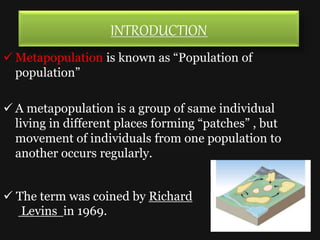
 Metapopulation is known as “Population of
population”
 A metapopulation is a group of same individual
living in different places forming “patches” , but
movement of individuals from one population to
another occurs regularly.
INTRODUCTION
 The term was coined by Richard
Levins in 1969.
POPULATION V/S METAPOPULATION
Local Population:
 Closed population
 Group of same individuals
living in same places at a same
time
 Here the individuals are
added only through birth and
loses through death.
 Interact takes place within
the a subpopulation
Metapopulation:
 Open population
 Group of same individual
living in different places
at a same time.
 Here the individuals are
added through
immigration and loses
through emigration
 For interaction,
migration from one local
population to other
patches is possible.
Defination of “METAPOPULATION”
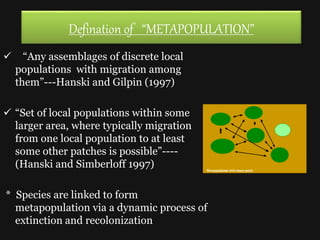
 “Any assemblages of discrete local
populations with migration among
them”---Hanski and Gilpin (1997)
 “Set of local populations within some
larger area, where typically migration
from one local population to at least
some other patches is possible”----
(Hanski and Simberloff 1997)
* Species are linked to form
metapopulation via a dynamic process of
extinction and recolonization
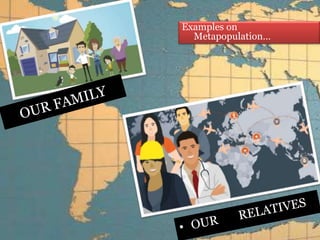
Examples on
Metapopulation…
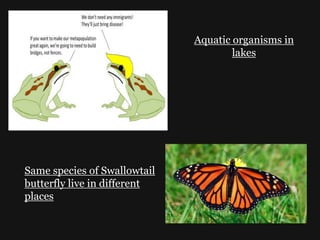
Aquatic organisms in
lakes
Same species of Swallowtail
butterfly live in different
places
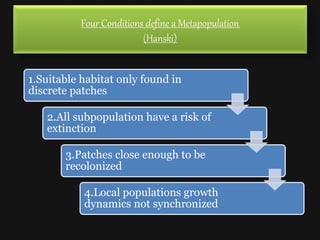
Four Conditions define a Metapopulation
(Hanski)
1.Suitable habitat only found in
discrete patches
2.All subpopulation have a risk of
extinction
3.Patches close enough to be
recolonized
4.Local populations growth
dynamics not synchronized
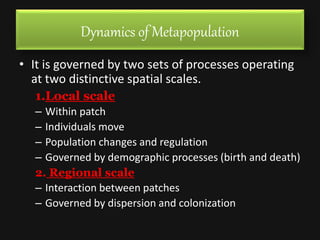
Dynamics of Metapopulation
• It is governed by two sets of processes operating
at two distinctive spatial scales.
1.Local scale
– Within patch
– Individuals move
– Population changes and regulation
– Governed by demographic processes (birth and death)
2. Regional scale
– Interaction between patches
– Governed by dispersion and colonization
Harrison (1991) types of spatially
dynamic population
• Classical levins metapopulation
• Mainland island metapopulation
• Patchy population
• Non equilibrium population
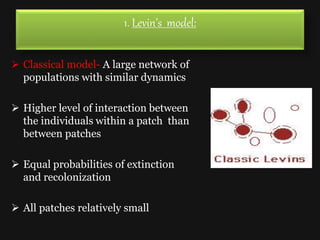
1. Levin’s model:
 Classical model- A large network of
populations with similar dynamics
 Higher level of interaction between
the individuals within a patch than
between patches
 Equal probabilities of extinction
and recolonization
 All patches relatively small
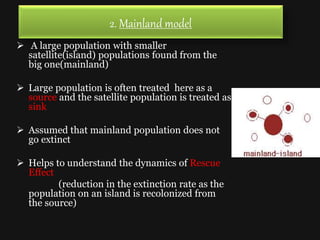
2. Mainland model
 A large population with smaller
satellite(island) populations found from the
big one(mainland)
 Large population is often treated here as a
source and the satellite population is treated as
sink
 Assumed that mainland population does not
go extinct
 Helps to understand the dynamics of Rescue
Effect
(reduction in the extinction rate as the
population on an island is recolonized from
the source)
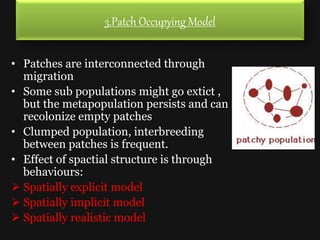
3.Patch Occupying Model
• Patches are interconnected through
migration
• Some sub populations might go extict ,
but the metapopulation persists and can
recolonize empty patches
• Clumped population, interbreeding
between patches is frequent.
• Effect of spactial structure is through
behaviours:
 Spatially explicit model
 Spatially implicit model
 Spatially realistic model
Spatially explicit model: Assume that local populations
interact only with nearby local populations, thus migration
is distance dependent .
Spatially implicit model: All local populations are
equally connected and have independent local dynamics
Spatially realistic model: Account for variation in size of
patches, total patch number and their spatial
arrangement. Models are often complex and rely on
detailed data.
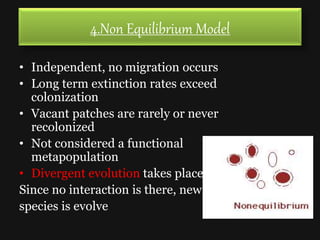
4.Non Equilibrium Model
• Independent, no migration occurs
• Long term extinction rates exceed
colonization
• Vacant patches are rarely or never
recolonized
• Not considered a functional
metapopulation
• Divergent evolution takes place
Since no interaction is there, new
species is evolve
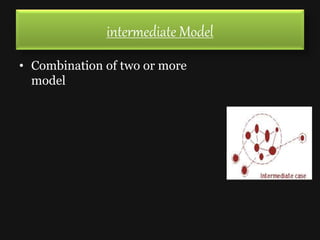
intermediate Model
• Combination of two or more
model
conclusion
• Metapopulation helps in Conservation biology: If
a species got extinct in a metapopulation, it is
recolonixed by the other subpopulation
• Metapopulation structure imposes genetic
stucture on a population: it influence the genetic
viability, rate of evolution and what traits evolve
BIBLIOGRAGHY…
Smith & Smith ,Ecology
Biotecnika ,Life Science
Internet (Google,wikipedia, youtube videos)
Metapopulation

Metapopulation

  • 1.
    Presented by: GloryBorah M.Phil, Department of Botany Gauhati University Guided by- Dr. Hemen Deka METAPOPULATION
  • 2.
    CONTENT • INTRODUCTION • POPULATIONV/S METAPOPULATION • METAPOPULATION • 4 CONDITION FOR METAPOPULATION • ITS DYNAMICS • MODELS OF METAPOPULATION • CONLUSION • BIBLIOGRAPHY
  • 3.
     Metapopulation isknown as “Population of population”  A metapopulation is a group of same individual living in different places forming “patches” , but movement of individuals from one population to another occurs regularly. INTRODUCTION  The term was coined by Richard Levins in 1969.
  • 4.
    POPULATION V/S METAPOPULATION LocalPopulation:  Closed population  Group of same individuals living in same places at a same time  Here the individuals are added only through birth and loses through death.  Interact takes place within the a subpopulation Metapopulation:  Open population  Group of same individual living in different places at a same time.  Here the individuals are added through immigration and loses through emigration  For interaction, migration from one local population to other patches is possible.
  • 5.
    Defination of “METAPOPULATION” “Any assemblages of discrete local populations with migration among them”---Hanski and Gilpin (1997)  “Set of local populations within some larger area, where typically migration from one local population to at least some other patches is possible”---- (Hanski and Simberloff 1997) * Species are linked to form metapopulation via a dynamic process of extinction and recolonization
  • 6.
  • 7.
    Aquatic organisms in lakes Samespecies of Swallowtail butterfly live in different places
  • 8.
    Four Conditions definea Metapopulation (Hanski) 1.Suitable habitat only found in discrete patches 2.All subpopulation have a risk of extinction 3.Patches close enough to be recolonized 4.Local populations growth dynamics not synchronized
  • 9.
    Dynamics of Metapopulation •It is governed by two sets of processes operating at two distinctive spatial scales. 1.Local scale – Within patch – Individuals move – Population changes and regulation – Governed by demographic processes (birth and death) 2. Regional scale – Interaction between patches – Governed by dispersion and colonization
  • 10.
    Harrison (1991) typesof spatially dynamic population • Classical levins metapopulation • Mainland island metapopulation • Patchy population • Non equilibrium population
  • 11.
    1. Levin’s model: Classical model- A large network of populations with similar dynamics  Higher level of interaction between the individuals within a patch than between patches  Equal probabilities of extinction and recolonization  All patches relatively small
  • 12.
    2. Mainland model A large population with smaller satellite(island) populations found from the big one(mainland)  Large population is often treated here as a source and the satellite population is treated as sink  Assumed that mainland population does not go extinct  Helps to understand the dynamics of Rescue Effect (reduction in the extinction rate as the population on an island is recolonized from the source)
  • 13.
    3.Patch Occupying Model •Patches are interconnected through migration • Some sub populations might go extict , but the metapopulation persists and can recolonize empty patches • Clumped population, interbreeding between patches is frequent. • Effect of spactial structure is through behaviours:  Spatially explicit model  Spatially implicit model  Spatially realistic model
  • 14.
    Spatially explicit model:Assume that local populations interact only with nearby local populations, thus migration is distance dependent . Spatially implicit model: All local populations are equally connected and have independent local dynamics Spatially realistic model: Account for variation in size of patches, total patch number and their spatial arrangement. Models are often complex and rely on detailed data.
  • 15.
    4.Non Equilibrium Model •Independent, no migration occurs • Long term extinction rates exceed colonization • Vacant patches are rarely or never recolonized • Not considered a functional metapopulation • Divergent evolution takes place Since no interaction is there, new species is evolve
  • 16.
  • 17.
    conclusion • Metapopulation helpsin Conservation biology: If a species got extinct in a metapopulation, it is recolonixed by the other subpopulation • Metapopulation structure imposes genetic stucture on a population: it influence the genetic viability, rate of evolution and what traits evolve
  • 18.
    BIBLIOGRAGHY… Smith & Smith,Ecology Biotecnika ,Life Science Internet (Google,wikipedia, youtube videos)