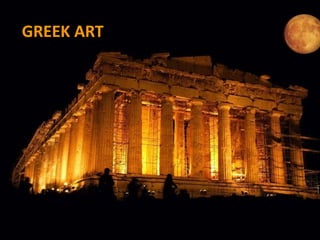
GREEK ART
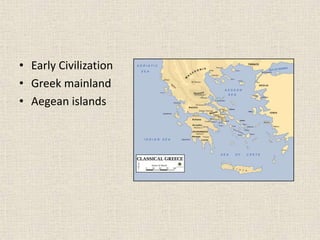
• Early Civilization
• Greek mainland
• Aegean islands
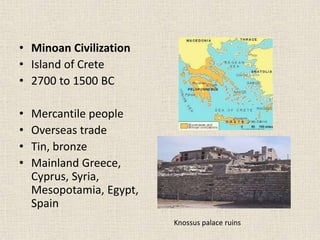
• Minoan Civilization
• Island of Crete
• 2700 to 1500 BC
• Mercantile people
• Overseas trade
• Tin, bronze
• Mainland Greece,
Cyprus, Syria,
Mesopotamia, Egypt,
Spain
Knossus palace ruins
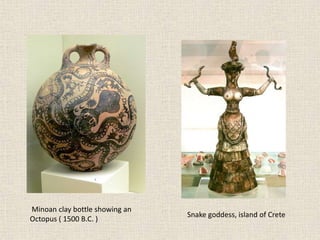
Minoan clay bottle showing an
Octopus ( 1500 B.C. )
Snake goddess, island of Crete
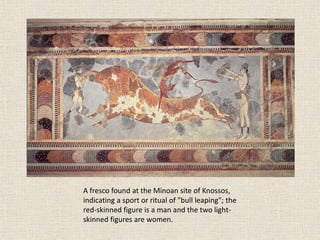
A fresco found at the Minoan site of Knossos,
indicating a sport or ritual of "bull leaping"; the
red-skinned figure is a man and the two light-
skinned figures are women.
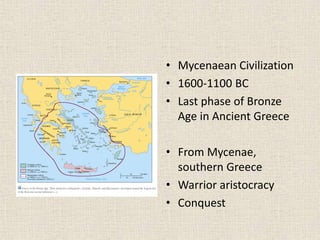
• Mycenaean Civilization
• 1600-1100 BC
• Last phase of Bronze
Age in Ancient Greece
• From Mycenae,
southern Greece
• Warrior aristocracy
• Conquest
• Palace dwellers and
commoners (demos)
• Agriculture
• Industries (textile,
metallurgy, pottery,
perfume)
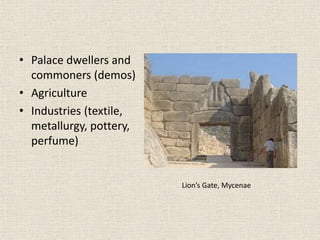
Lion’s Gate, Mycenae
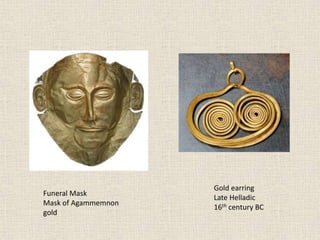
Funeral Mask
Mask of Agammemnon
gold
Gold earring
Late Helladic
16th century BC
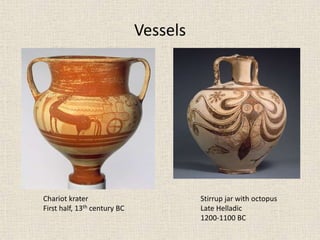
Vessels
Chariot krater
First half, 13th century BC
Stirrup jar with octopus
Late Helladic
1200-1100 BC
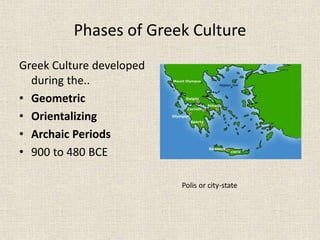
Phases of Greek Culture
Greek Culture developed
during the..
• Geometric
• Orientalizing
• Archaic Periods
• 900 to 480 BCE
Polis or city-state
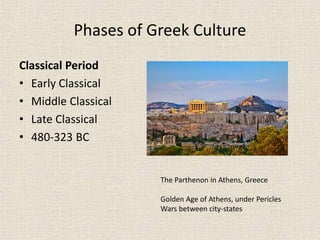
Phases of Greek Culture
Classical Period
• Early Classical
• Middle Classical
• Late Classical
• 480-323 BC
The Parthenon in Athens, Greece
Golden Age of Athens, under Pericles
Wars between city-states
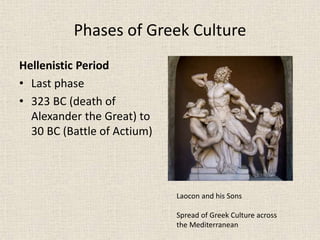
Phases of Greek Culture
Hellenistic Period
• Last phase
• 323 BC (death of
Alexander the Great) to
30 BC (Battle of Actium)
Laocon and his Sons
Spread of Greek Culture across
the Mediterranean
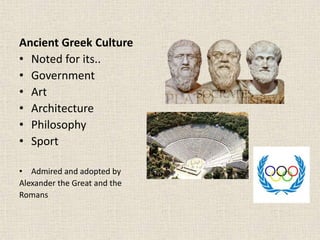
Ancient Greek Culture
• Noted for its..
• Government
• Art
• Architecture
• Philosophy
• Sport
• Admired and adopted by
Alexander the Great and the
Romans
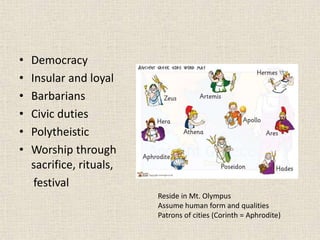
• Democracy
• Insular and loyal
• Barbarians
• Civic duties
• Polytheistic
• Worship through
sacrifice, rituals,
festival
Reside in Mt. Olympus
Assume human form and qualities
Patrons of cities (Corinth = Aphrodite)
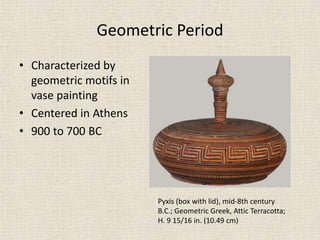
Geometric Period
• Characterized by
geometric motifs in
vase painting
• Centered in Athens
• 900 to 700 BC
Pyxis (box with lid), mid-8th century
B.C.; Geometric Greek, Attic Terracotta;
H. 9 15/16 in. (10.49 cm)
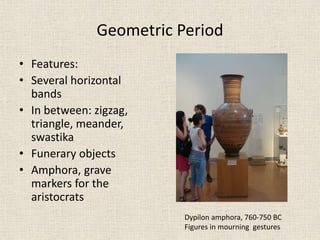
Geometric Period
• Features:
• Several horizontal
bands
• In between: zigzag,
triangle, meander,
swastika
• Funerary objects
• Amphora, grave
markers for the
aristocrats
Dypilon amphora, 760-750 BC
Figures in mourning gestures
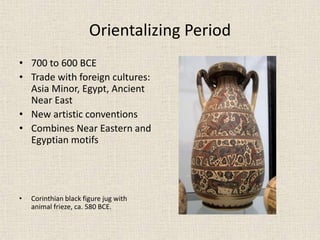
Orientalizing Period
• 700 to 600 BCE
• Trade with foreign cultures:
Asia Minor, Egypt, Ancient
Near East
• New artistic conventions
• Combines Near Eastern and
Egyptian motifs
• Corinthian black figure jug with
animal frieze, ca. 580 BCE.
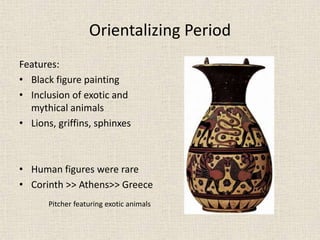
Orientalizing Period
Features:
• Black figure painting
• Inclusion of exotic and
mythical animals
• Lions, griffins, sphinxes
• Human figures were rare
• Corinth >> Athens>> Greece
Pitcher featuring exotic animals
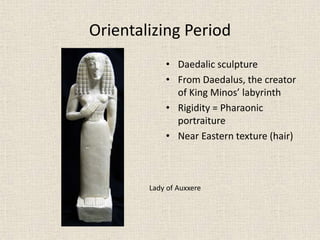
Orientalizing Period
• Daedalic sculpture
• From Daedalus, the creator
of King Minos’ labyrinth
• Rigidity = Pharaonic
portraiture
• Near Eastern texture (hair)
Lady of Auxxere
Archaic Period
• 600 – 480 BC
• Expansion of Greek culture
• Rise in population
• Colonies along the Mediterranean and Black Sea
• Major powers: Athens, Corinth, Sparta, Thebes
Archaic Period
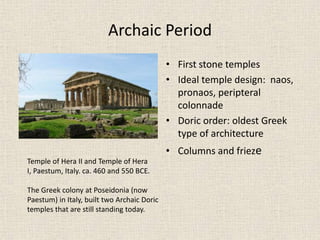
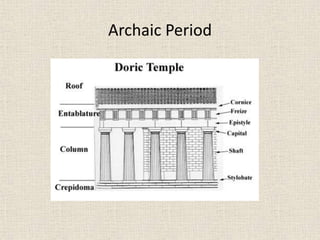
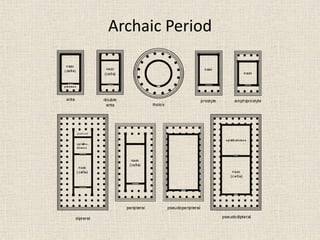
• First stone temples
• Ideal temple design: naos,
pronaos, peripteral
colonnade
• Doric order: oldest Greek
type of architecture
• Columns and frieze
Temple of Hera II and Temple of Hera
I, Paestum, Italy. ca. 460 and 550 BCE.
The Greek colony at Poseidonia (now
Paestum) in Italy, built two Archaic Doric
temples that are still standing today.
Archaic Period
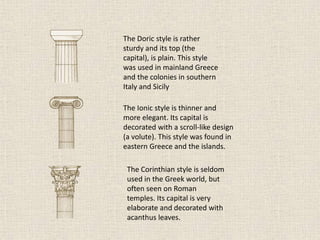
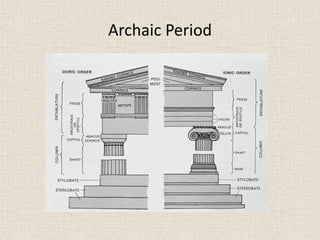
The Doric style is rather
sturdy and its top (the
capital), is plain. This style
was used in mainland Greece
and the colonies in southern
Italy and Sicily
The Ionic style is thinner and
more elegant. Its capital is
decorated with a scroll-like design
(a volute). This style was found in
eastern Greece and the islands.
The Corinthian style is seldom
used in the Greek world, but
often seen on Roman
temples. Its capital is very
elaborate and decorated with
acanthus leaves.
Archaic Period
Archaic Period
Archaic Period
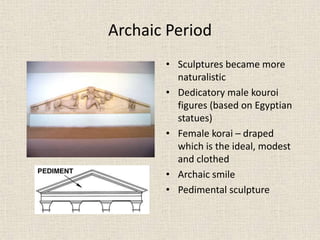
• Sculptures became more
naturalistic
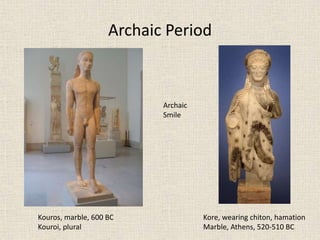
• Dedicatory male kouroi
figures (based on Egyptian
statues)
• Female korai – draped
which is the ideal, modest
and clothed
• Archaic smile
• Pedimental sculpture
Archaic Period
Archaic
Smile
Kouros, marble, 600 BC
Kouroi, plural
Kore, wearing chiton, hamation
Marble, Athens, 520-510 BC
Archaic Period
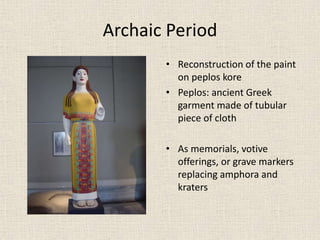
• Reconstruction of the paint
on peplos kore
• Peplos: ancient Greek
garment made of tubular
piece of cloth
• As memorials, votive
offerings, or grave markers
replacing amphora and
kraters
Classical Greece
• Began 480 BCE
• Sacking of Athens by the
Persians
• Athens became the most
powerful polis
• Height of Greek culture
• Creation of Greece’s famous
art and architecture
The Classical Period (480-323 BC)
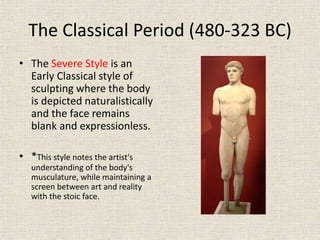
• The Severe Style is an
Early Classical style of
sculpting where the body
is depicted naturalistically
and the face remains
blank and expressionless.
• *This style notes the artist's
understanding of the body's
musculature, while maintaining a
screen between art and reality
with the stoic face.
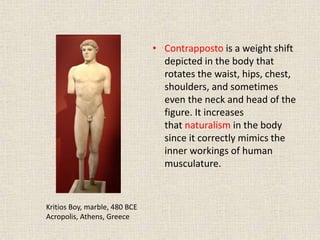
• Contrapposto is a weight shift
depicted in the body that
rotates the waist, hips, chest,
shoulders, and sometimes
even the neck and head of the
figure. It increases
that naturalism in the body
since it correctly mimics the
inner workings of human
musculature.
Kritios Boy, marble, 480 BCE
Acropolis, Athens, Greece
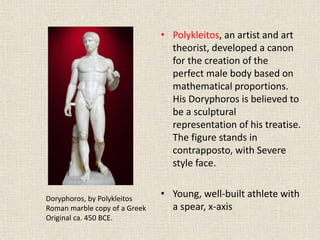
• Polykleitos, an artist and art
theorist, developed a canon
for the creation of the
perfect male body based on
mathematical proportions.
His Doryphoros is believed to
be a sculptural
representation of his treatise.
The figure stands in
contrapposto, with Severe
style face.
• Young, well-built athlete with
a spear, x-axis
Doryphoros, by Polykleitos
Roman marble copy of a Greek
Original ca. 450 BCE.
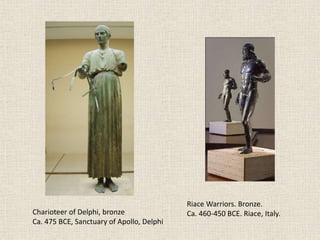
Charioteer of Delphi, bronze
Ca. 475 BCE, Sanctuary of Apollo, Delphi
Riace Warriors. Bronze.
Ca. 460-450 BCE. Riace, Italy.
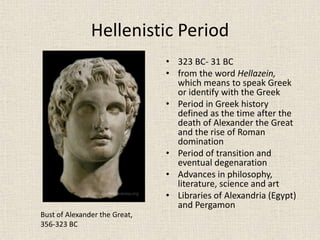
Hellenistic Period
• 323 BC- 31 BC
• from the word Hellazein,
which means to speak Greek
or identify with the Greek
• Period in Greek history
defined as the time after the
death of Alexander the Great
and the rise of Roman
domination
• Period of transition and
eventual degenaration
• Advances in philosophy,
literature, science and art
• Libraries of Alexandria (Egypt)
and Pergamon
Bust of Alexander the Great,
356-323 BC
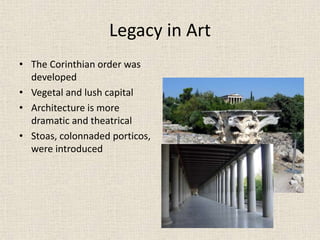
Legacy in Art
• The Corinthian order was
developed
• Vegetal and lush capital
• Architecture is more
dramatic and theatrical
• Stoas, colonnaded porticos,
were introduced
Legacy in Art
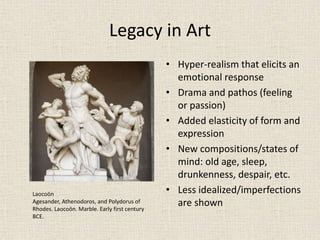
• Hyper-realism that elicits an
emotional response
• Drama and pathos (feeling
or passion)
• Added elasticity of form and
expression
• New compositions/states of
mind: old age, sleep,
drunkenness, despair, etc.
• Less idealized/imperfections
are shown
Laocoön
Agesander, Athenodoros, and Polydorus of
Rhodes. Laocoön. Marble. Early first century
BCE.
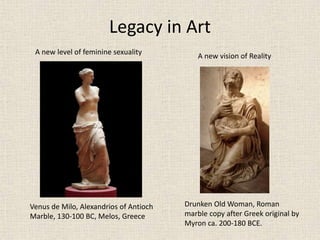
Legacy in Art
Venus de Milo, Alexandrios of Antioch
Marble, 130-100 BC, Melos, Greece
A new level of feminine sexuality
Drunken Old Woman, Roman
marble copy after Greek original by
Myron ca. 200-180 BCE.
A new vision of Reality
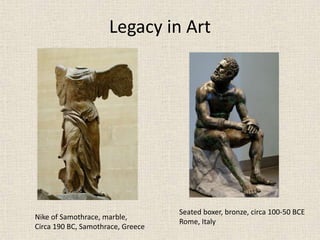
Legacy in Art
Nike of Samothrace, marble,
Circa 190 BC, Samothrace, Greece
Seated boxer, bronze, circa 100-50 BCE
Rome, Italy
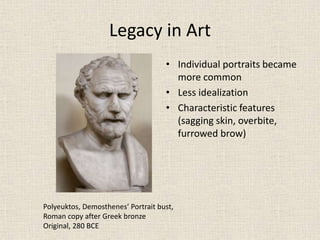
Legacy in Art
• Individual portraits became
more common
• Less idealization
• Characteristic features
(sagging skin, overbite,
furrowed brow)
Polyeuktos, Demosthenes’ Portrait bust,
Roman copy after Greek bronze
Original, 280 BCE
Key Terms
• Minoan art
• Mycenean art
• Geometric period
• Orientalizing period
• Archaic period
• Hellenistic art
• Amphora
• Doric order
• Ionic order
• Corinthian order
• Parts of a Doric temple
• Types of temple
according to floor plan

Greek art

  • 1.
  • 2.
    • Early Civilization •Greek mainland • Aegean islands
  • 3.
    • Minoan Civilization •Island of Crete • 2700 to 1500 BC • Mercantile people • Overseas trade • Tin, bronze • Mainland Greece, Cyprus, Syria, Mesopotamia, Egypt, Spain Knossus palace ruins
  • 4.
    Minoan clay bottleshowing an Octopus ( 1500 B.C. ) Snake goddess, island of Crete
  • 5.
    A fresco foundat the Minoan site of Knossos, indicating a sport or ritual of "bull leaping"; the red-skinned figure is a man and the two light- skinned figures are women.
  • 6.
    • Mycenaean Civilization •1600-1100 BC • Last phase of Bronze Age in Ancient Greece • From Mycenae, southern Greece • Warrior aristocracy • Conquest
  • 7.
    • Palace dwellersand commoners (demos) • Agriculture • Industries (textile, metallurgy, pottery, perfume) Lion’s Gate, Mycenae
  • 8.
    Funeral Mask Mask ofAgammemnon gold Gold earring Late Helladic 16th century BC
  • 9.
    Vessels Chariot krater First half,13th century BC Stirrup jar with octopus Late Helladic 1200-1100 BC
  • 10.
    Phases of GreekCulture Greek Culture developed during the.. • Geometric • Orientalizing • Archaic Periods • 900 to 480 BCE Polis or city-state
  • 11.
    Phases of GreekCulture Classical Period • Early Classical • Middle Classical • Late Classical • 480-323 BC The Parthenon in Athens, Greece Golden Age of Athens, under Pericles Wars between city-states
  • 12.
    Phases of GreekCulture Hellenistic Period • Last phase • 323 BC (death of Alexander the Great) to 30 BC (Battle of Actium) Laocon and his Sons Spread of Greek Culture across the Mediterranean
  • 13.
    Ancient Greek Culture •Noted for its.. • Government • Art • Architecture • Philosophy • Sport • Admired and adopted by Alexander the Great and the Romans
  • 14.
    • Democracy • Insularand loyal • Barbarians • Civic duties • Polytheistic • Worship through sacrifice, rituals, festival Reside in Mt. Olympus Assume human form and qualities Patrons of cities (Corinth = Aphrodite)
  • 15.
    Geometric Period • Characterizedby geometric motifs in vase painting • Centered in Athens • 900 to 700 BC Pyxis (box with lid), mid-8th century B.C.; Geometric Greek, Attic Terracotta; H. 9 15/16 in. (10.49 cm)
  • 16.
    Geometric Period • Features: •Several horizontal bands • In between: zigzag, triangle, meander, swastika • Funerary objects • Amphora, grave markers for the aristocrats Dypilon amphora, 760-750 BC Figures in mourning gestures
  • 17.
    Orientalizing Period • 700to 600 BCE • Trade with foreign cultures: Asia Minor, Egypt, Ancient Near East • New artistic conventions • Combines Near Eastern and Egyptian motifs • Corinthian black figure jug with animal frieze, ca. 580 BCE.
  • 18.
    Orientalizing Period Features: • Blackfigure painting • Inclusion of exotic and mythical animals • Lions, griffins, sphinxes • Human figures were rare • Corinth >> Athens>> Greece Pitcher featuring exotic animals
  • 19.
    Orientalizing Period • Daedalicsculpture • From Daedalus, the creator of King Minos’ labyrinth • Rigidity = Pharaonic portraiture • Near Eastern texture (hair) Lady of Auxxere
  • 20.
    Archaic Period • 600– 480 BC • Expansion of Greek culture • Rise in population • Colonies along the Mediterranean and Black Sea • Major powers: Athens, Corinth, Sparta, Thebes
  • 21.
    Archaic Period • Firststone temples • Ideal temple design: naos, pronaos, peripteral colonnade • Doric order: oldest Greek type of architecture • Columns and frieze Temple of Hera II and Temple of Hera I, Paestum, Italy. ca. 460 and 550 BCE. The Greek colony at Poseidonia (now Paestum) in Italy, built two Archaic Doric temples that are still standing today.
  • 22.
  • 23.
    The Doric styleis rather sturdy and its top (the capital), is plain. This style was used in mainland Greece and the colonies in southern Italy and Sicily The Ionic style is thinner and more elegant. Its capital is decorated with a scroll-like design (a volute). This style was found in eastern Greece and the islands. The Corinthian style is seldom used in the Greek world, but often seen on Roman temples. Its capital is very elaborate and decorated with acanthus leaves.
  • 24.
  • 25.
  • 26.
    Archaic Period • Sculpturesbecame more naturalistic • Dedicatory male kouroi figures (based on Egyptian statues) • Female korai – draped which is the ideal, modest and clothed • Archaic smile • Pedimental sculpture
  • 27.
    Archaic Period Archaic Smile Kouros, marble,600 BC Kouroi, plural Kore, wearing chiton, hamation Marble, Athens, 520-510 BC
  • 28.
    Archaic Period • Reconstructionof the paint on peplos kore • Peplos: ancient Greek garment made of tubular piece of cloth • As memorials, votive offerings, or grave markers replacing amphora and kraters
  • 29.
    Classical Greece • Began480 BCE • Sacking of Athens by the Persians • Athens became the most powerful polis • Height of Greek culture • Creation of Greece’s famous art and architecture
  • 30.
    The Classical Period(480-323 BC) • The Severe Style is an Early Classical style of sculpting where the body is depicted naturalistically and the face remains blank and expressionless. • *This style notes the artist's understanding of the body's musculature, while maintaining a screen between art and reality with the stoic face.
  • 31.
    • Contrapposto isa weight shift depicted in the body that rotates the waist, hips, chest, shoulders, and sometimes even the neck and head of the figure. It increases that naturalism in the body since it correctly mimics the inner workings of human musculature. Kritios Boy, marble, 480 BCE Acropolis, Athens, Greece
  • 32.
    • Polykleitos, anartist and art theorist, developed a canon for the creation of the perfect male body based on mathematical proportions. His Doryphoros is believed to be a sculptural representation of his treatise. The figure stands in contrapposto, with Severe style face. • Young, well-built athlete with a spear, x-axis Doryphoros, by Polykleitos Roman marble copy of a Greek Original ca. 450 BCE.
  • 33.
    Charioteer of Delphi,bronze Ca. 475 BCE, Sanctuary of Apollo, Delphi Riace Warriors. Bronze. Ca. 460-450 BCE. Riace, Italy.
  • 34.
    Hellenistic Period • 323BC- 31 BC • from the word Hellazein, which means to speak Greek or identify with the Greek • Period in Greek history defined as the time after the death of Alexander the Great and the rise of Roman domination • Period of transition and eventual degenaration • Advances in philosophy, literature, science and art • Libraries of Alexandria (Egypt) and Pergamon Bust of Alexander the Great, 356-323 BC
  • 35.
    Legacy in Art •The Corinthian order was developed • Vegetal and lush capital • Architecture is more dramatic and theatrical • Stoas, colonnaded porticos, were introduced
  • 36.
    Legacy in Art •Hyper-realism that elicits an emotional response • Drama and pathos (feeling or passion) • Added elasticity of form and expression • New compositions/states of mind: old age, sleep, drunkenness, despair, etc. • Less idealized/imperfections are shown Laocoön Agesander, Athenodoros, and Polydorus of Rhodes. Laocoön. Marble. Early first century BCE.
  • 37.
    Legacy in Art Venusde Milo, Alexandrios of Antioch Marble, 130-100 BC, Melos, Greece A new level of feminine sexuality Drunken Old Woman, Roman marble copy after Greek original by Myron ca. 200-180 BCE. A new vision of Reality
  • 38.
    Legacy in Art Nikeof Samothrace, marble, Circa 190 BC, Samothrace, Greece Seated boxer, bronze, circa 100-50 BCE Rome, Italy
  • 39.
    Legacy in Art •Individual portraits became more common • Less idealization • Characteristic features (sagging skin, overbite, furrowed brow) Polyeuktos, Demosthenes’ Portrait bust, Roman copy after Greek bronze Original, 280 BCE
  • 40.
    Key Terms • Minoanart • Mycenean art • Geometric period • Orientalizing period • Archaic period • Hellenistic art • Amphora • Doric order • Ionic order • Corinthian order • Parts of a Doric temple • Types of temple according to floor plan