ANCIENT GREEK ART
INTRODUCTION
• Greek art began in the Cycladic and Minoan civilization and
gave birth toWestern art of today.
• It has been divided into Geometric, Archaic and Classical
periods, with further developments during the Hellenistic
Period.
• Greek art consists mainly five forms: architecture, sculpture,
painting, pottery and jewelry making.
What is Greek Art known for?
• Ancient Greek art emphasized the importance and
accomplishments of human beings.
• The art Greeks produced over the years reflect the society that
creates them.
• Through their temples, sculpture, and pottery, the Greeks
incorporated a fundamental principle of their culture.
Let's explore Greek Periods!
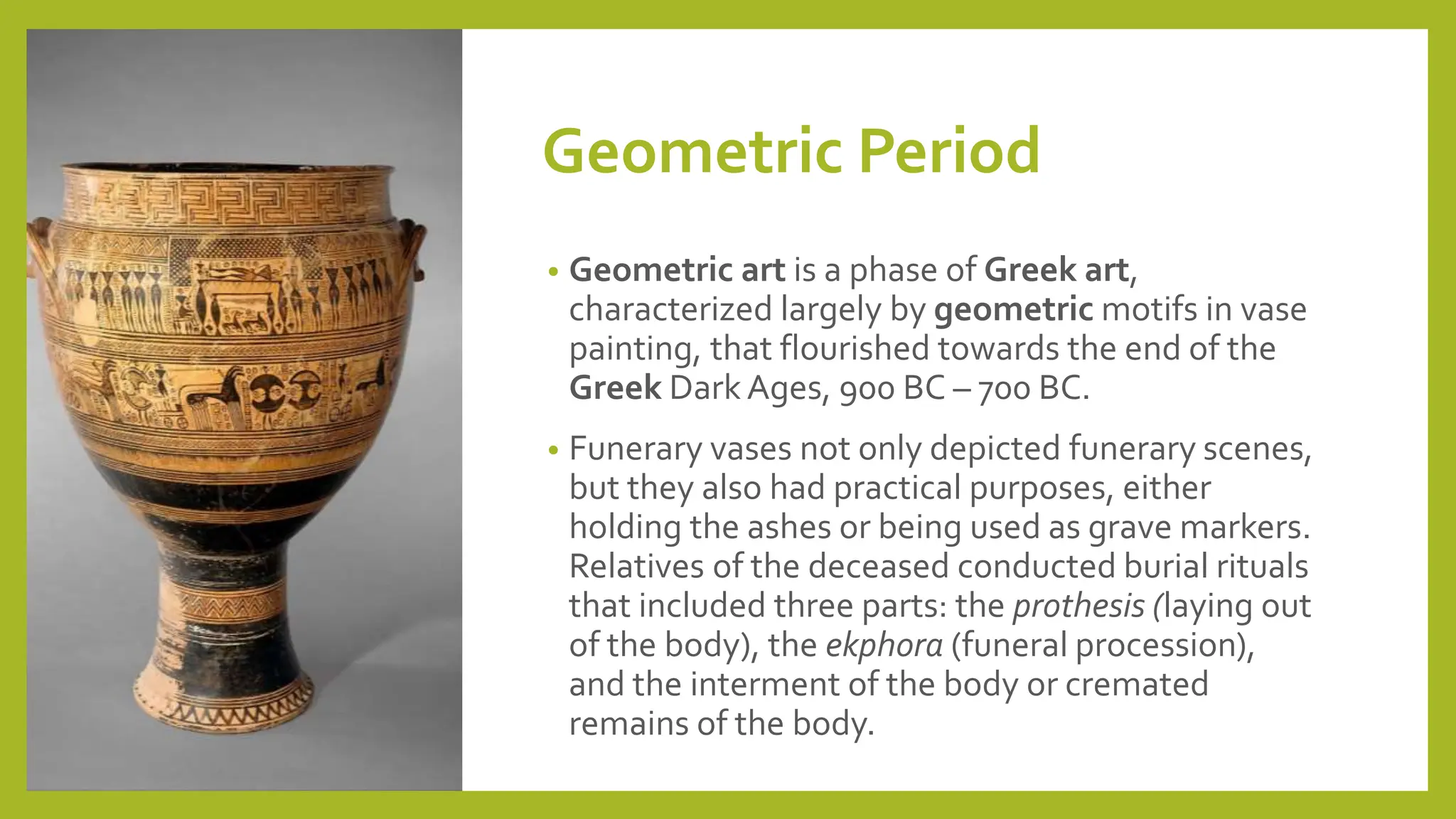
Geometric Period
• Geometric art is a phase of Greek art,
characterized largely by geometric motifs in vase
painting, that flourished towards the end of the
Greek Dark Ages, 900 BC – 700 BC.
• Funerary vases not only depicted funerary scenes,
but they also had practical purposes, either
holding the ashes or being used as grave markers.
Relatives of the deceased conducted burial rituals
that included three parts: the prothesis (laying out
of the body), the ekphora (funeral procession),
and the interment of the body or cremated
remains of the body.
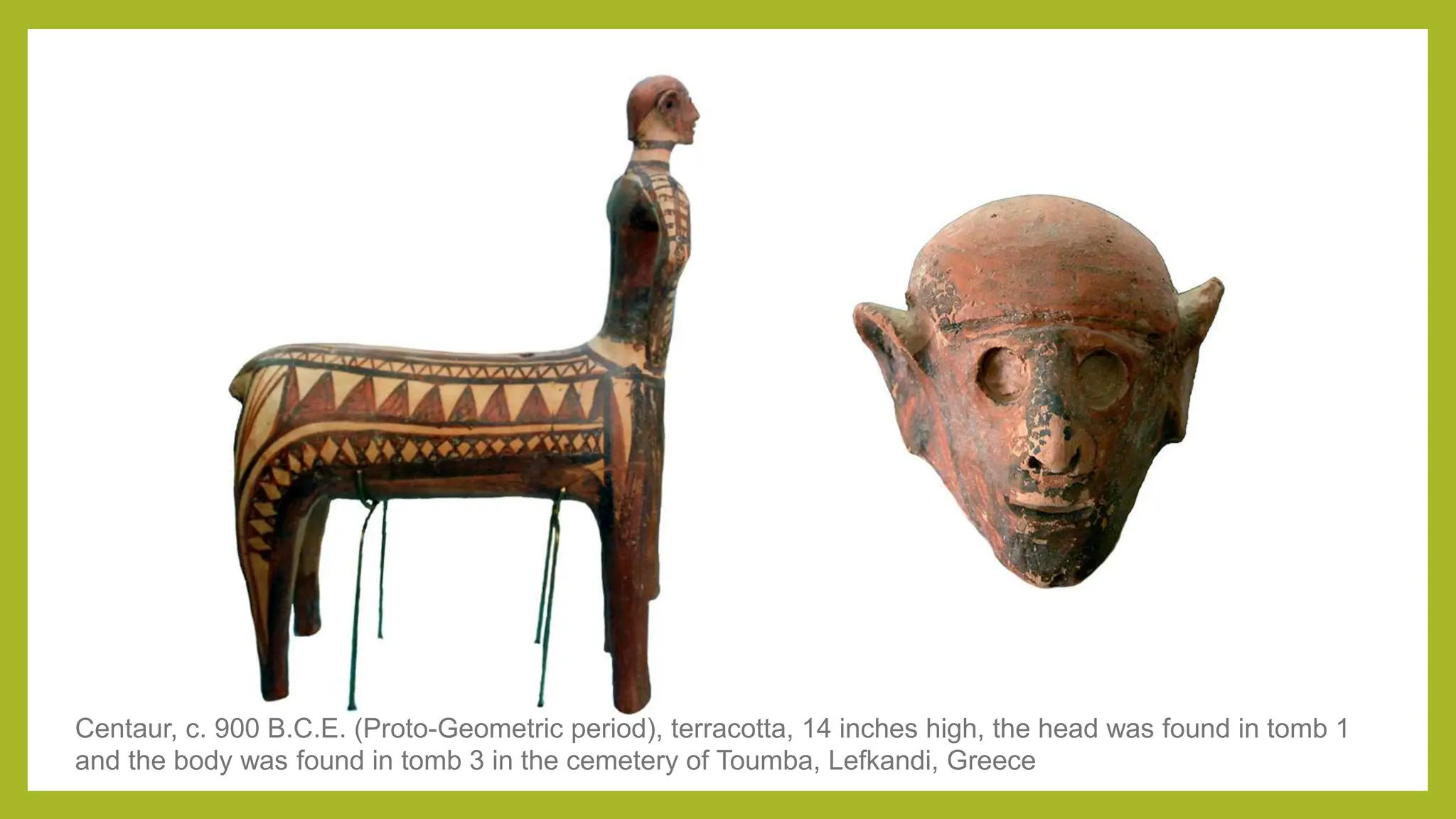
Centaur, c. 900 B.C.E. (Proto-Geometric period), terracotta, 14 inches high, the head was found in tomb 1
and the body was found in tomb 3 in the cemetery of Toumba, Lefkandi, Greece
Archaic
Period
This is one of the
earliest phase of
Greek art. It took
place in the eighth
century BC and
lasted until 480
BC.
During this
period, the
artwork became
a more
naturalistic
mode of
expression.
This was very
different from
earlier works,
which had been
much more
rigid.
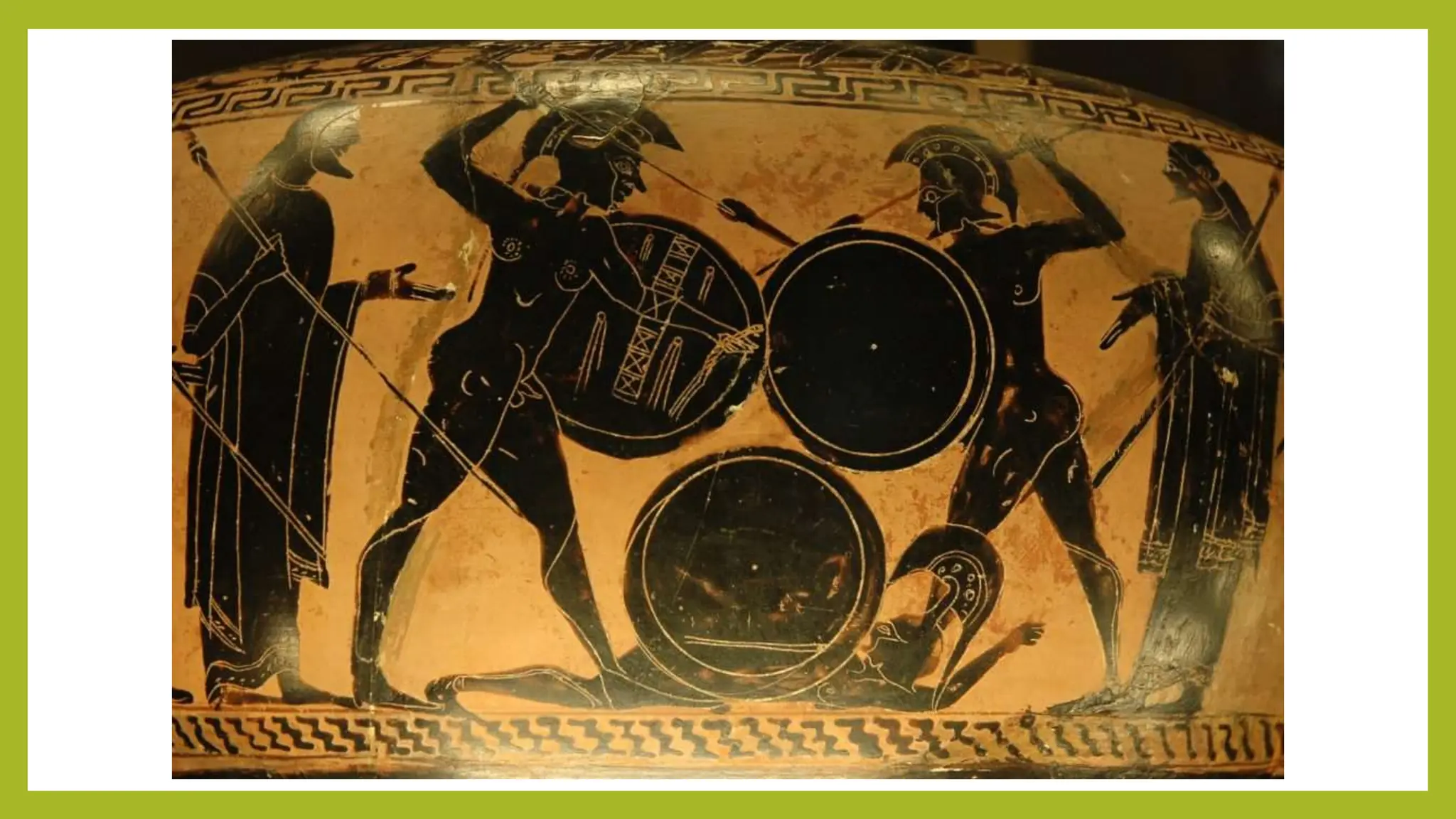
Paintings on vases
evolved from
geometric designs
to ones that more
clearly showed
human figures.
These vases usually
showed epic tales.
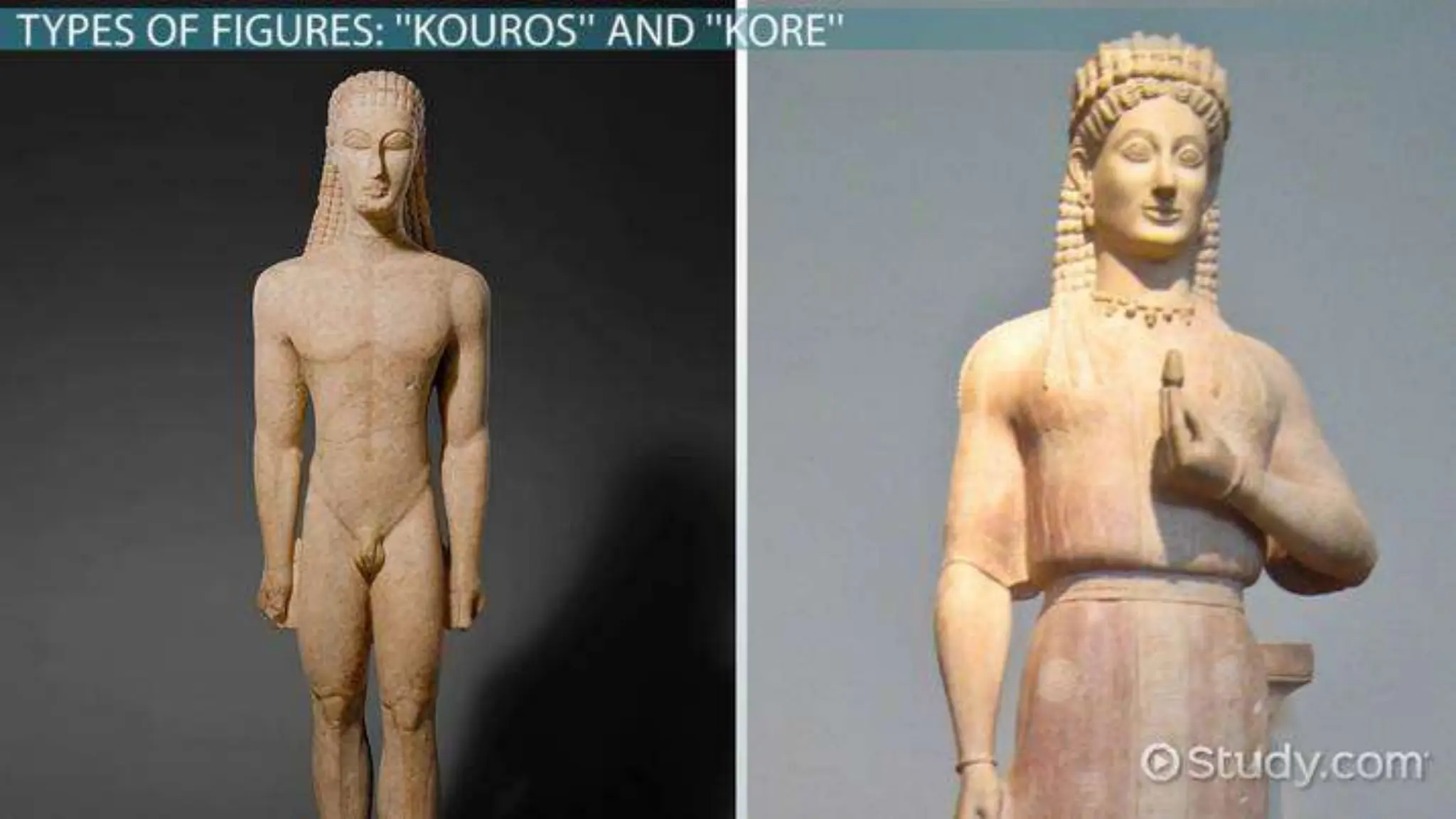
Archaic sculpture
• Sculptures during this period had very animated faces.The
bodies were made to show human proportions accurately.
• Any statue of a man during this period was known as a Kouroi.
Statues or sculptures that depicted women were called Korai.
• All of these statues had similar features.They would usually be
shown standing stiffly with their hands at their sides.
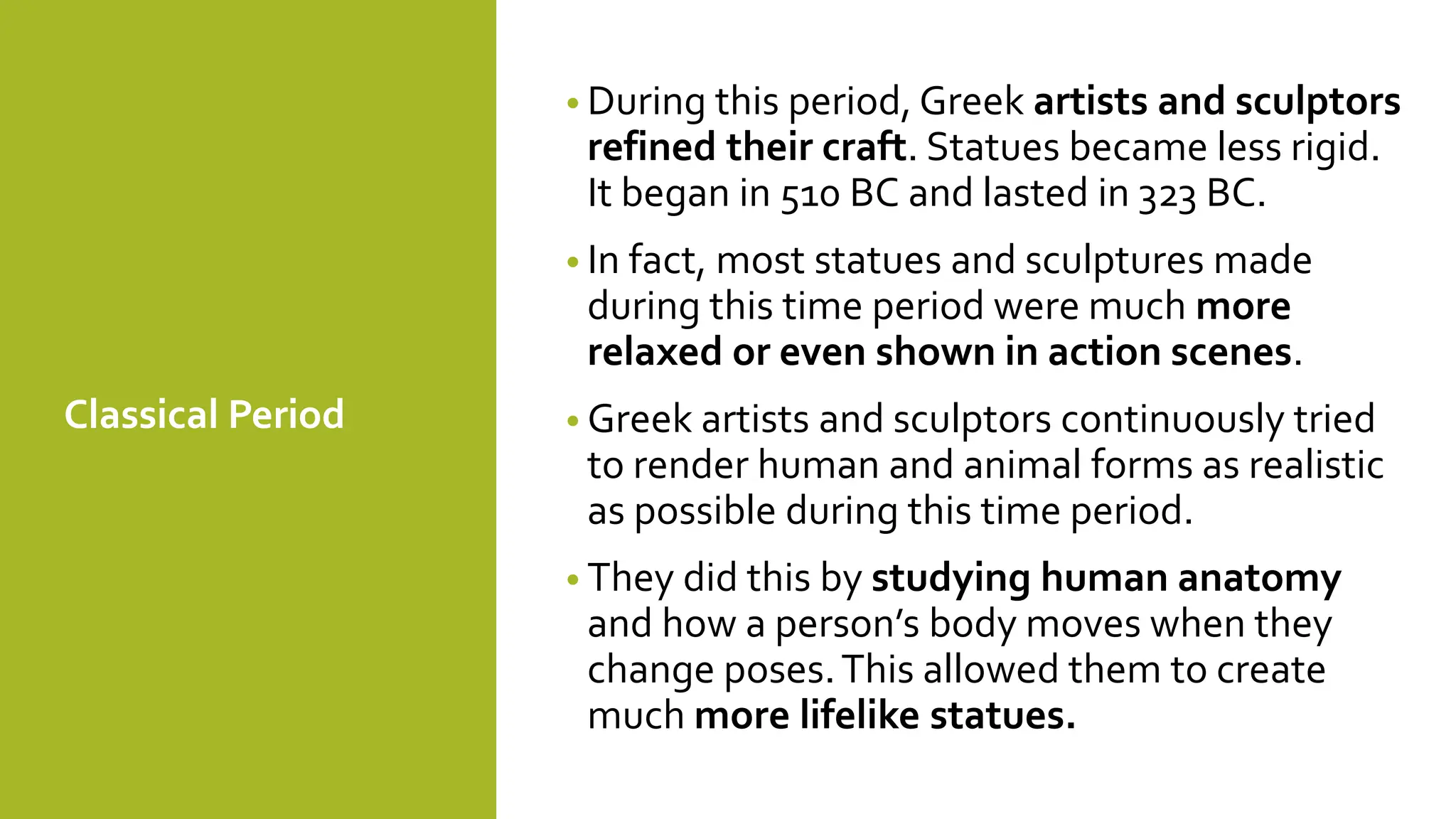
Classical Period
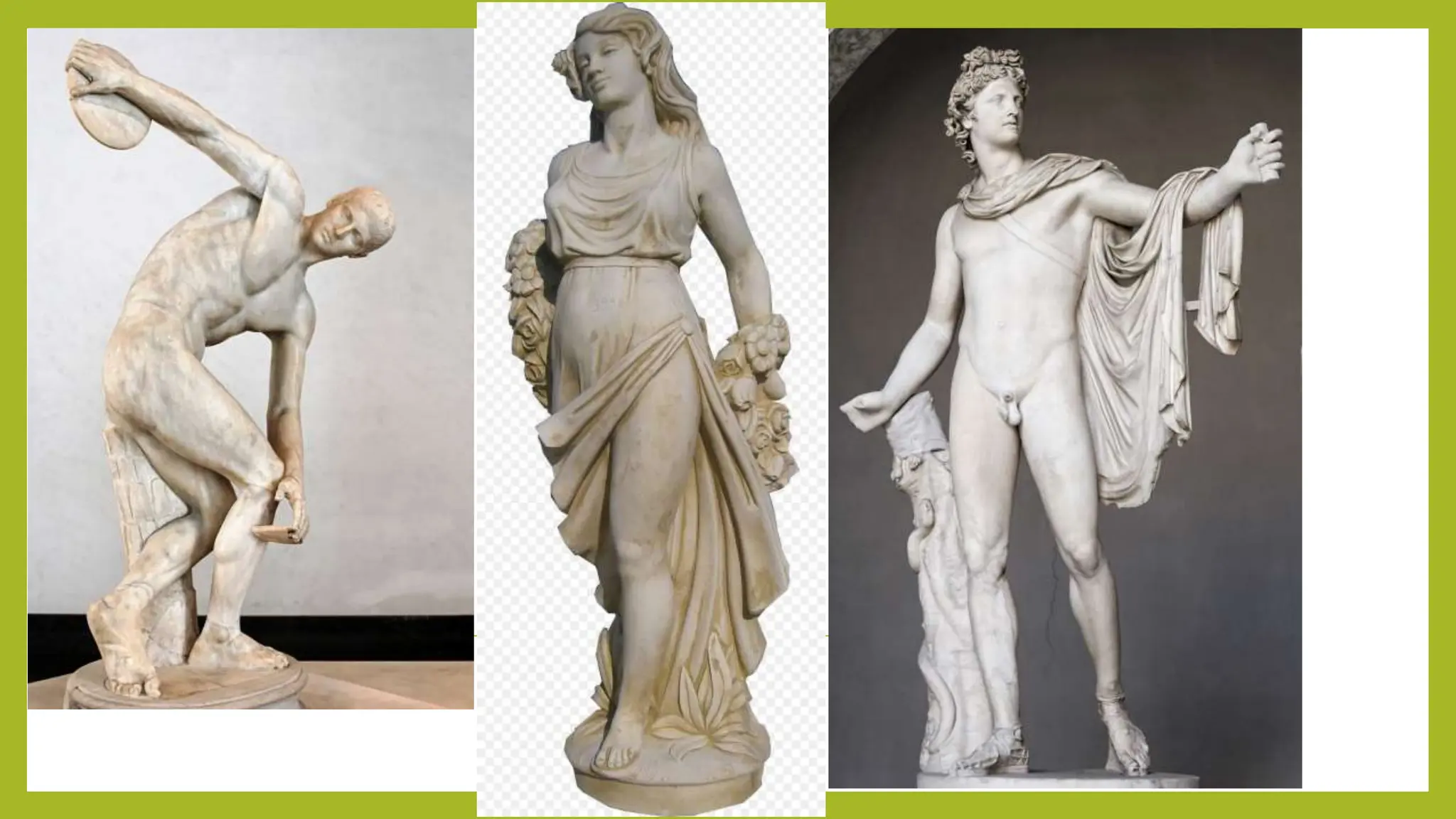
• During this period, Greek artists and sculptors
refined their craft. Statues became less rigid.
It began in 510 BC and lasted in 323 BC.
• In fact, most statues and sculptures made
during this time period were much more
relaxed or even shown in action scenes.
• Greek artists and sculptors continuously tried
to render human and animal forms as realistic
as possible during this time period.
• They did this by studying human anatomy
and how a person’s body moves when they
change poses.This allowed them to create
much more lifelike statues.
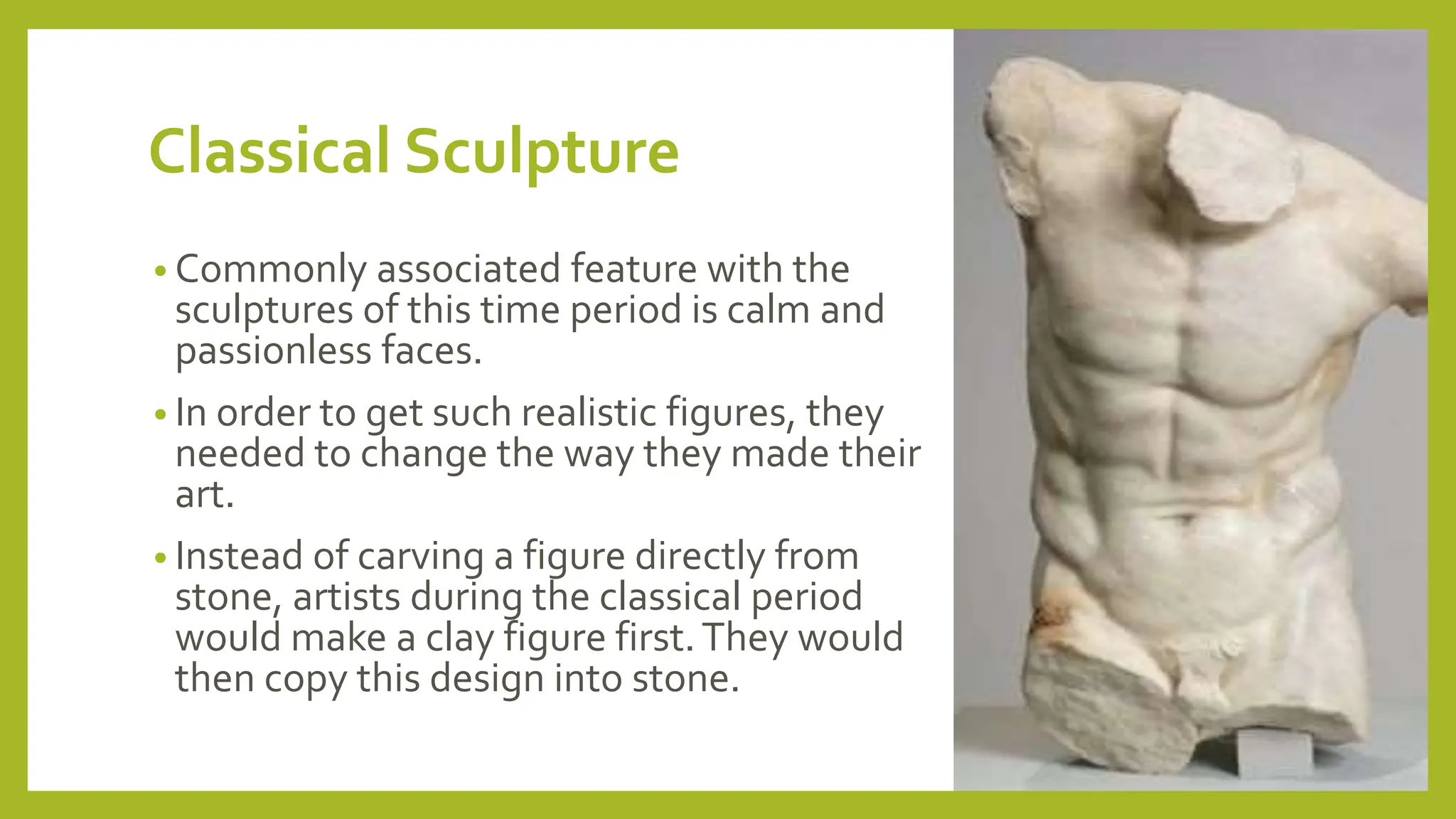
Classical Sculpture
• Commonly associated feature with the
sculptures of this time period is calm and
passionless faces.
• In order to get such realistic figures, they
needed to change the way they made their
art.
• Instead of carving a figure directly from
stone, artists during the classical period
would make a clay figure first.They would
then copy this design into stone.
Hellenistic Period
• The last period of Ancient Greek art, the
Hellenistic period began after Alexander
the Great’s death in 323 BC. It continued
until 31 BC.
• During this time period, Greek art was
heavily influenced by the different
cultures that they had conquered under
Alexander the Great.
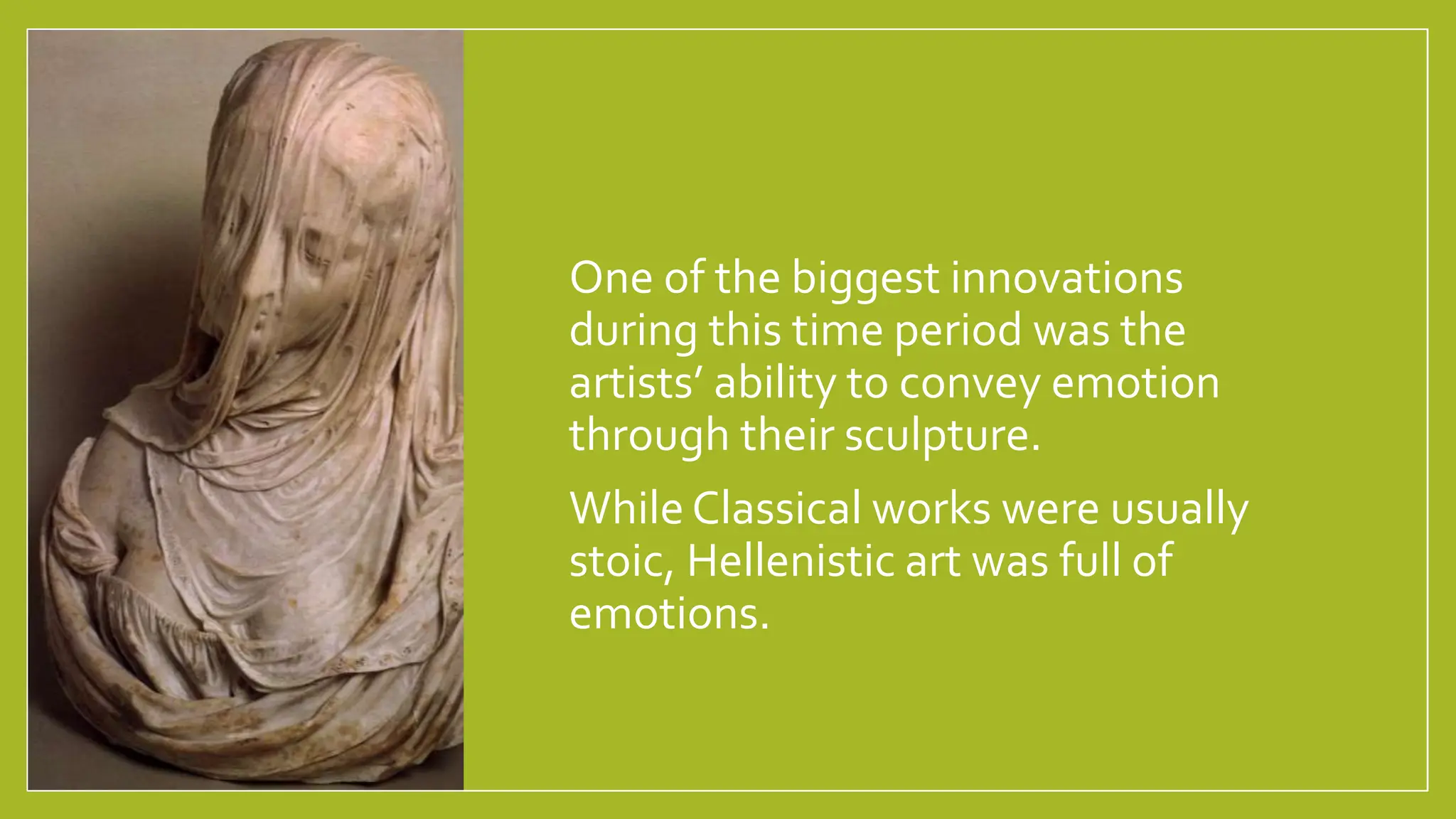
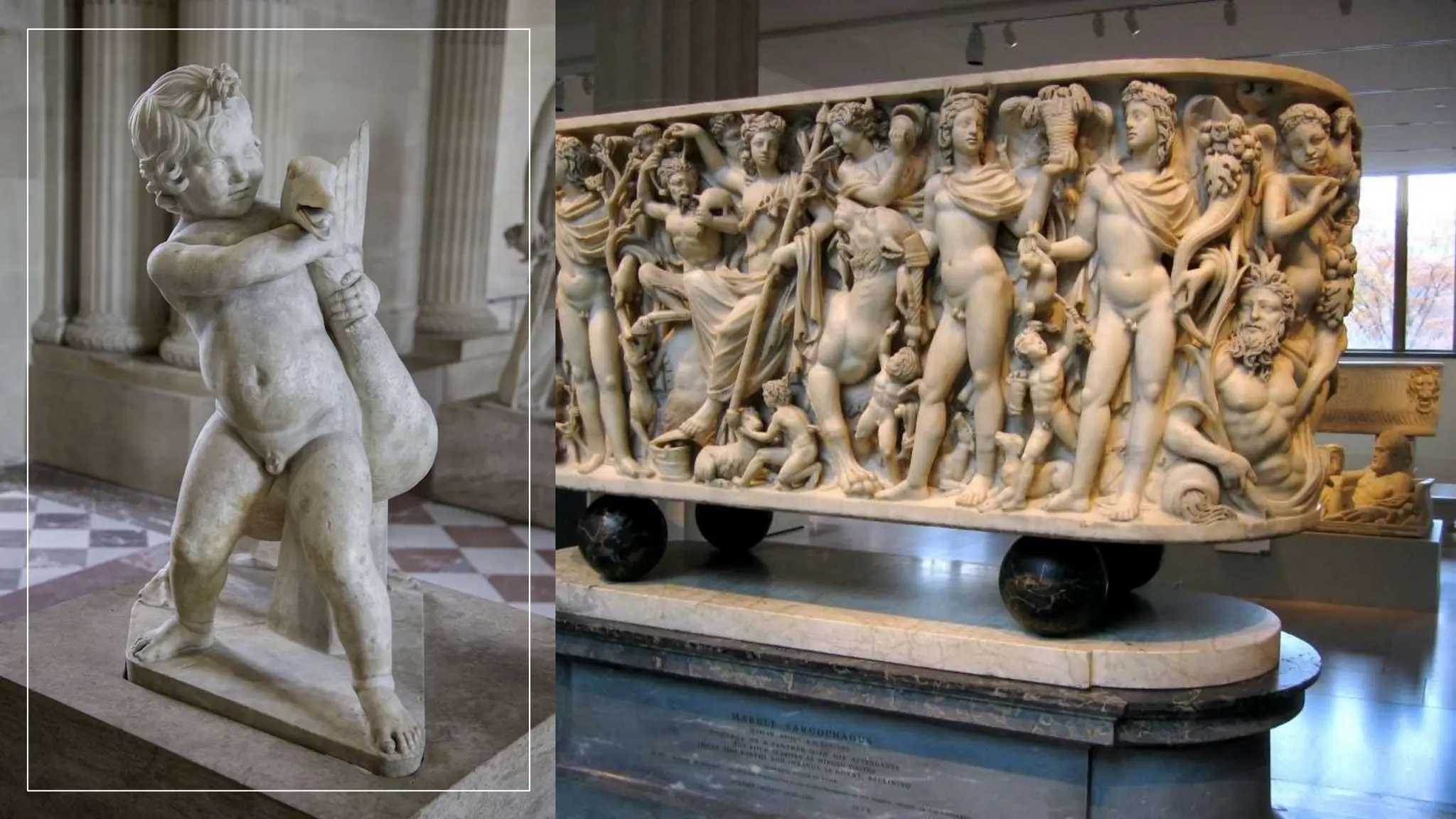
• This period focused on new subjects,
such as women, children, and common
people rather than deities and rulers.
• Hellenistic artists were able to copy and
alter from all the different works of art
that came before.This gave them a good
sense of their history, which influenced
their works.
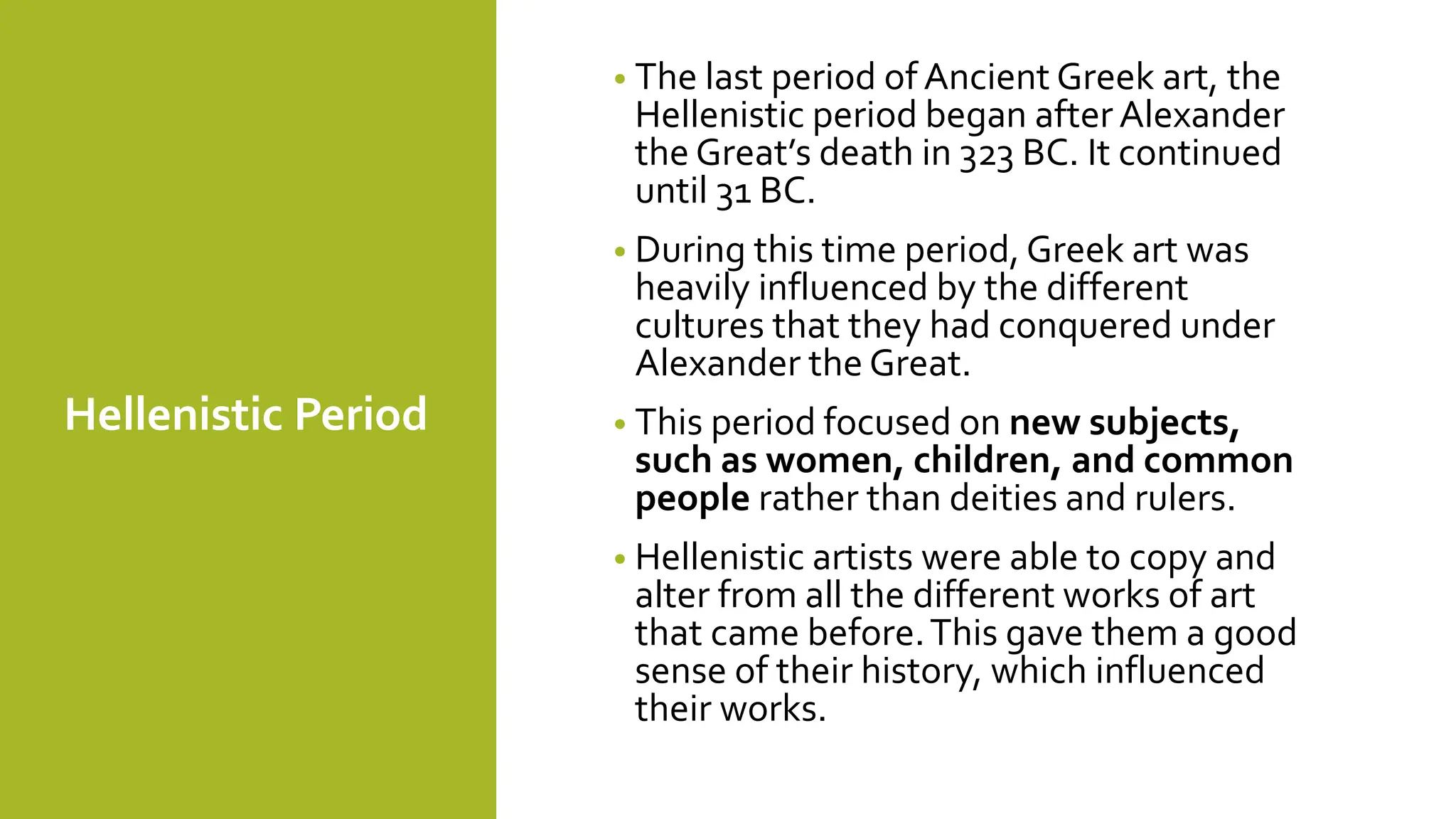
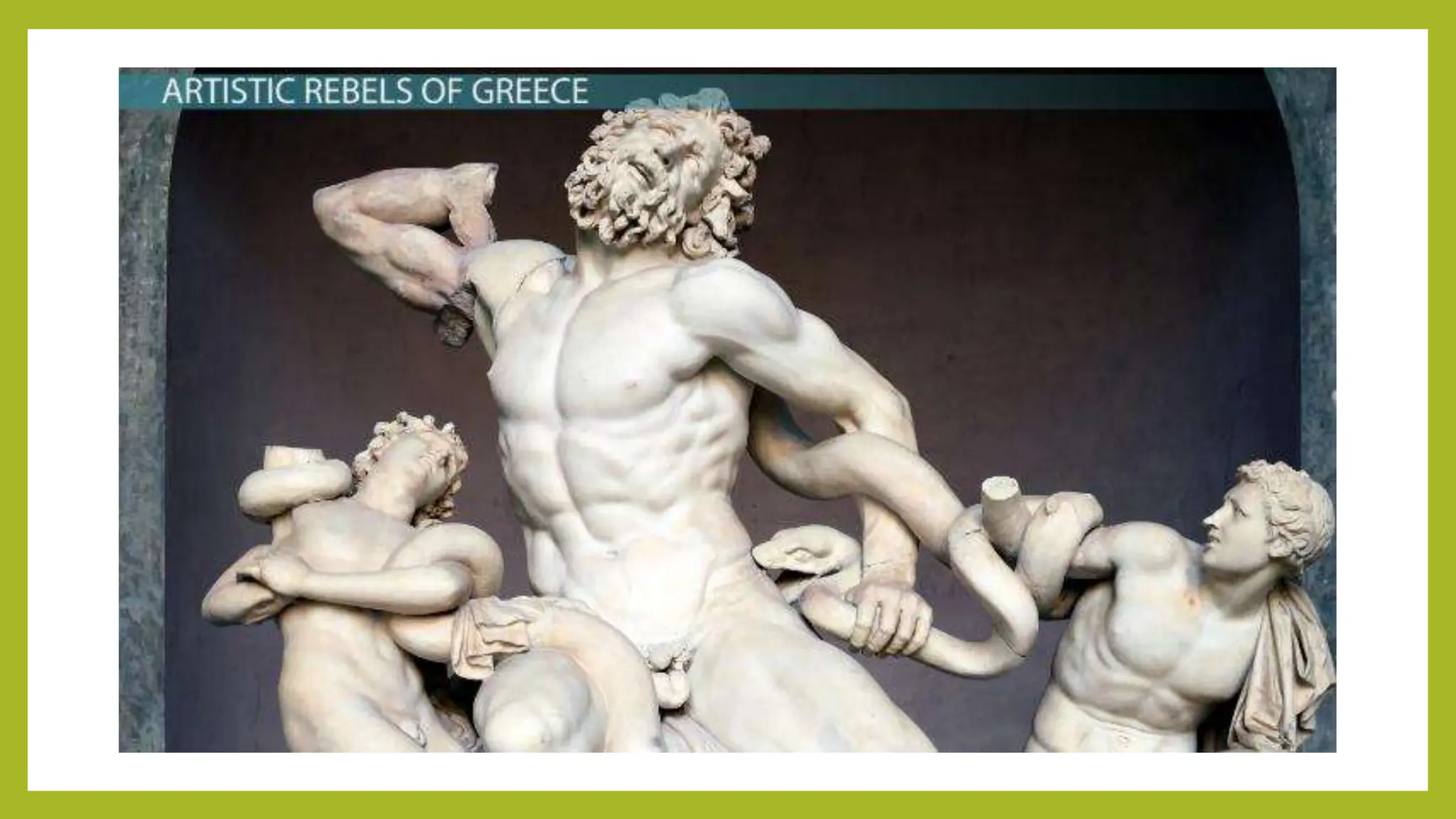
•One of the biggest innovations
during this time period was the
artists’ ability to convey emotion
through their sculpture.
•While Classical works were usually
stoic, Hellenistic art was full of
emotions.
Greek Pottery
• Much of our knowledge of classical Greek art comes from objects made of
stone and clay that have survived for thousands of years.
• Classical Greek pottery was perhaps the most utilitarian of the era’s art
forms.
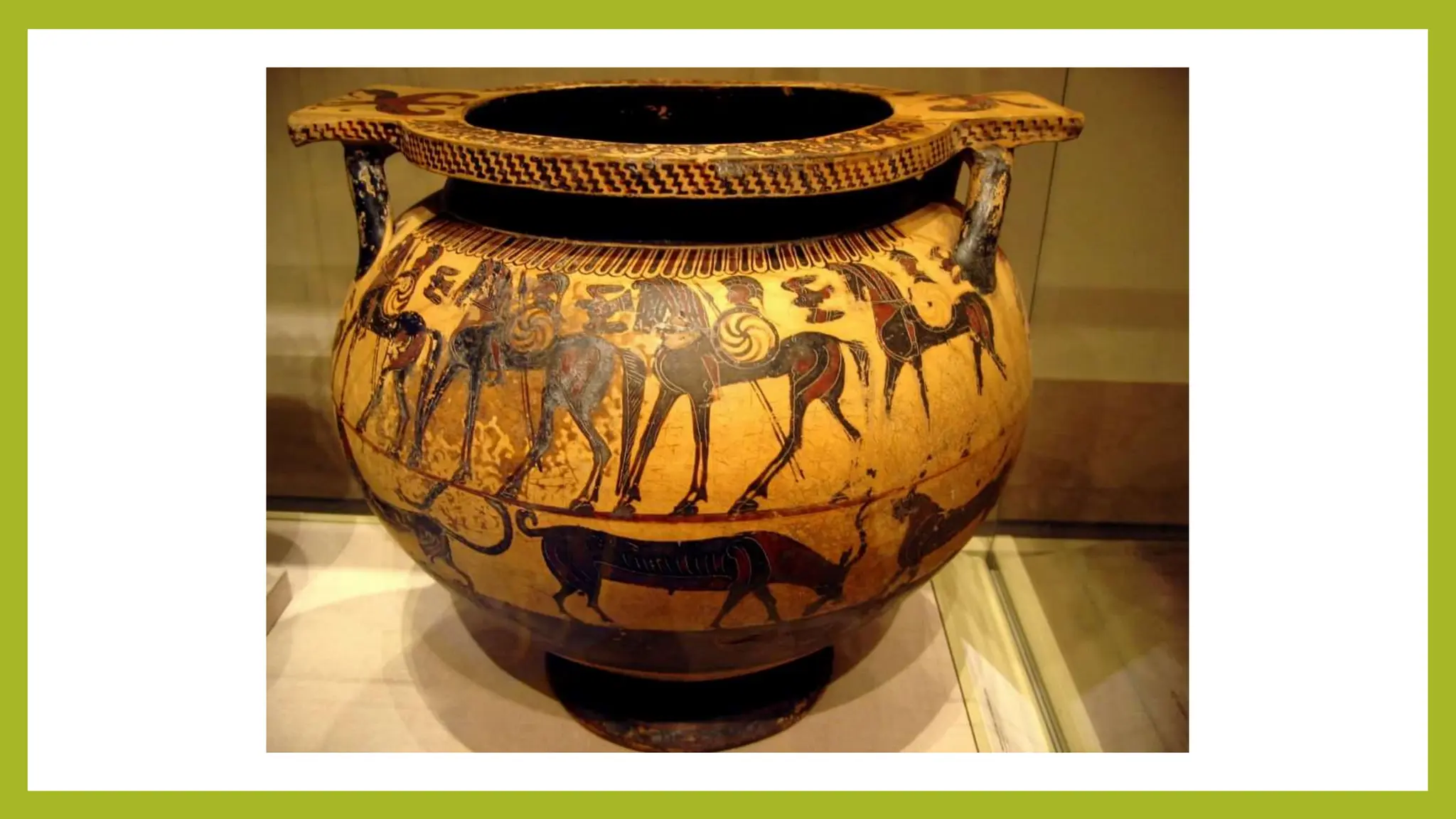
• They also used clay pots, jars and vases for almost everything.These were
painted with religious or mythological scenes.
• The themes explored on pottery were pattern and order, perspective and
proportion and man himself–appeared as well in less-durable creations such as
ancient Greek paintings and drawings.
Greek Painting
• Until recently, archaeologists only knew about Greek painting
through ancient Greek stories.
• These stories, which were written by authors such as Pliny and
Pausanias, describe large, monumental paintings. But
unfortunately, not a lot of these paintings remain.
• Some Greek cities, such as Sikyon, were known for their
schools, which taught painters and created many successful
Greek artists, who then traveled theWestern world, spreading
their Greek art.
Greek Metalwork
• Greeks were very skilled at working with metal, and they worked with
many different types.
• Bronze is a special type of metal, which is mostly made up of copper, with
another metal added, such as tin or zinc.
• Bronze is a hard and strong metal, and it was a very popular choice for
statues and other decorations.
• Greeks also used iron, which is a harder metal, as well as precious metals
such as gold and silver.
• Because metal can be melted down and made into something else, many
metal sculptures and other metal items were melted down so they could
be used for other things.
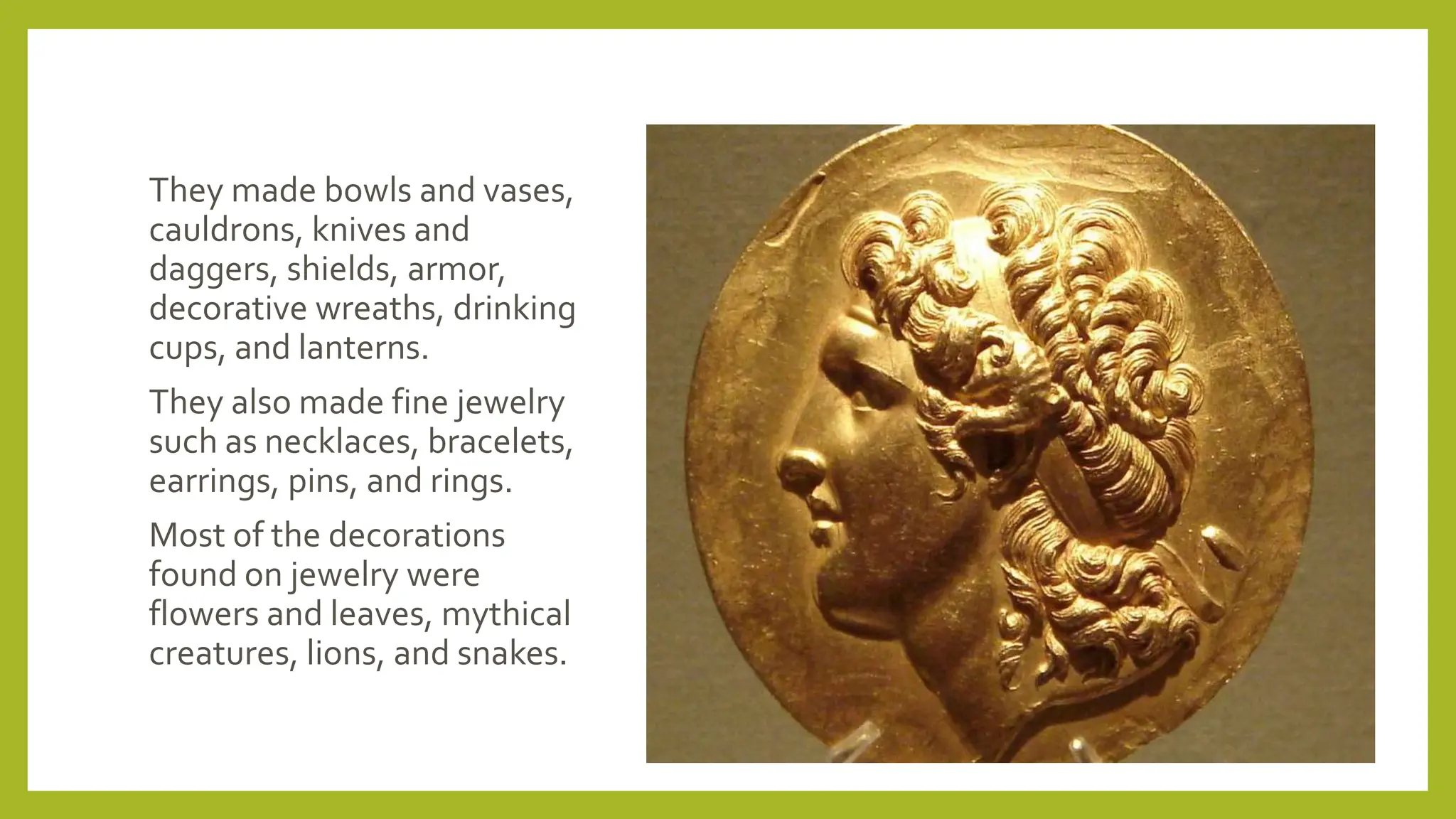
They made bowls and vases,
cauldrons, knives and
daggers, shields, armor,
decorative wreaths, drinking
cups, and lanterns.
They also made fine jewelry
such as necklaces, bracelets,
earrings, pins, and rings.
Most of the decorations
found on jewelry were
flowers and leaves, mythical
creatures, lions, and snakes.
Greek Mosaic
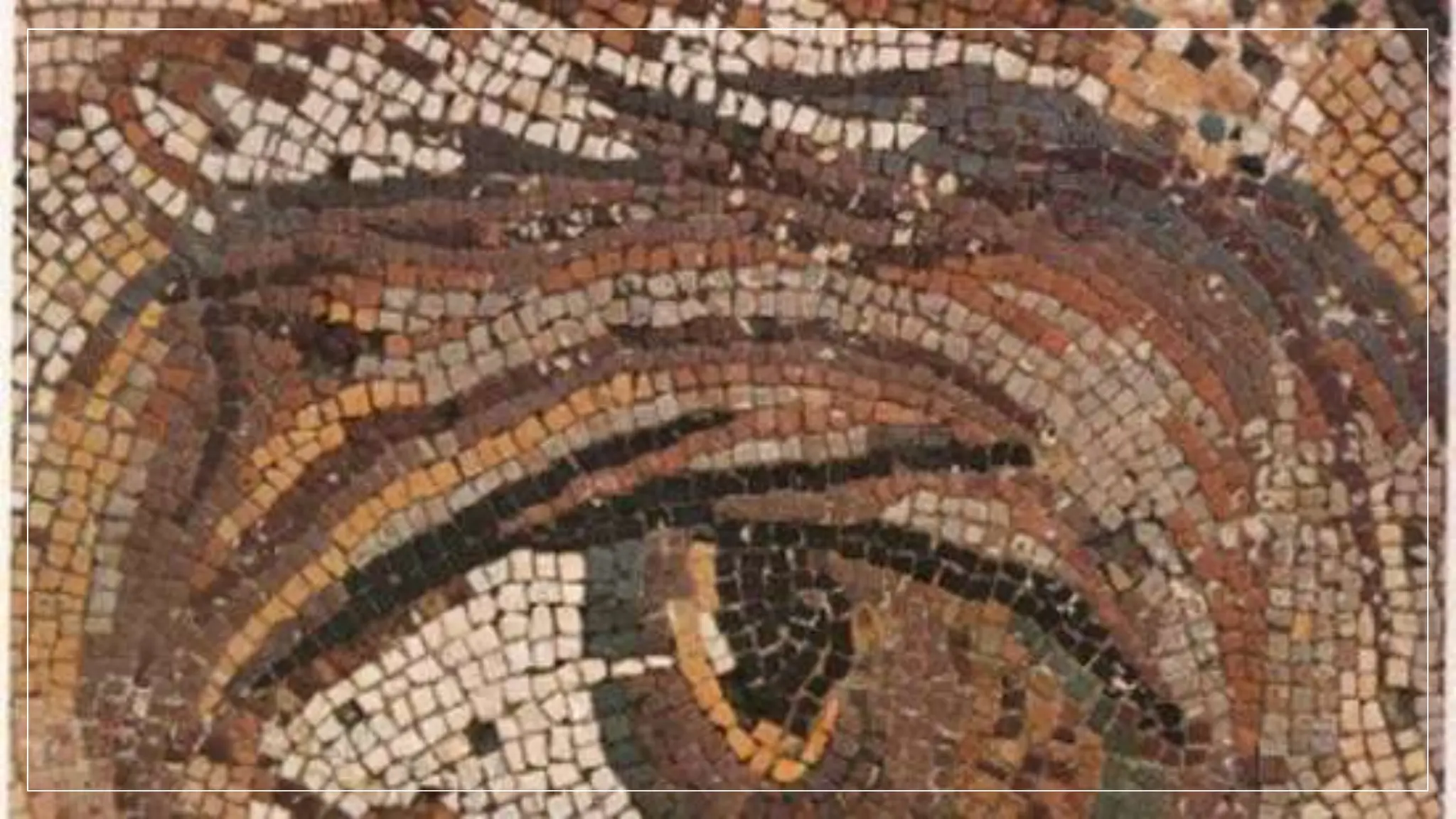
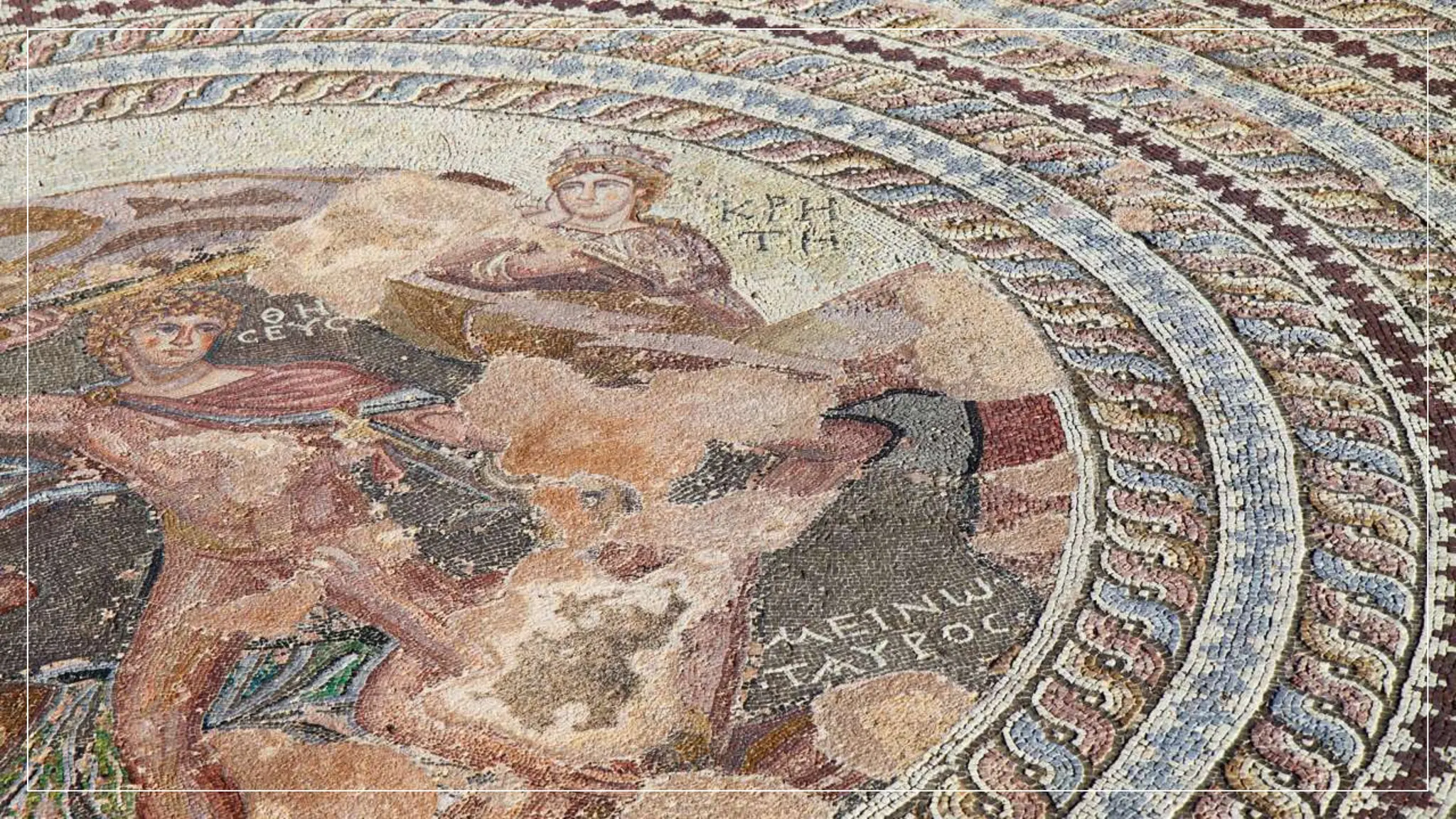
• A mosaic is a picture made up of small pieces of glass, pottery, or small
tiles.Thousands of small pieces of colored tiles are placed together so that
all together they make up a picture.
• It is one of the lasting artistic legacies from the ancient Greeks is the art of
the mosaic.
• Greeks decorated their houses with mosaics, both on the walls as well as on
the floor.
• In Macedonia, archaeologists have found houses that have brightly painted
walls and mosaic floors.
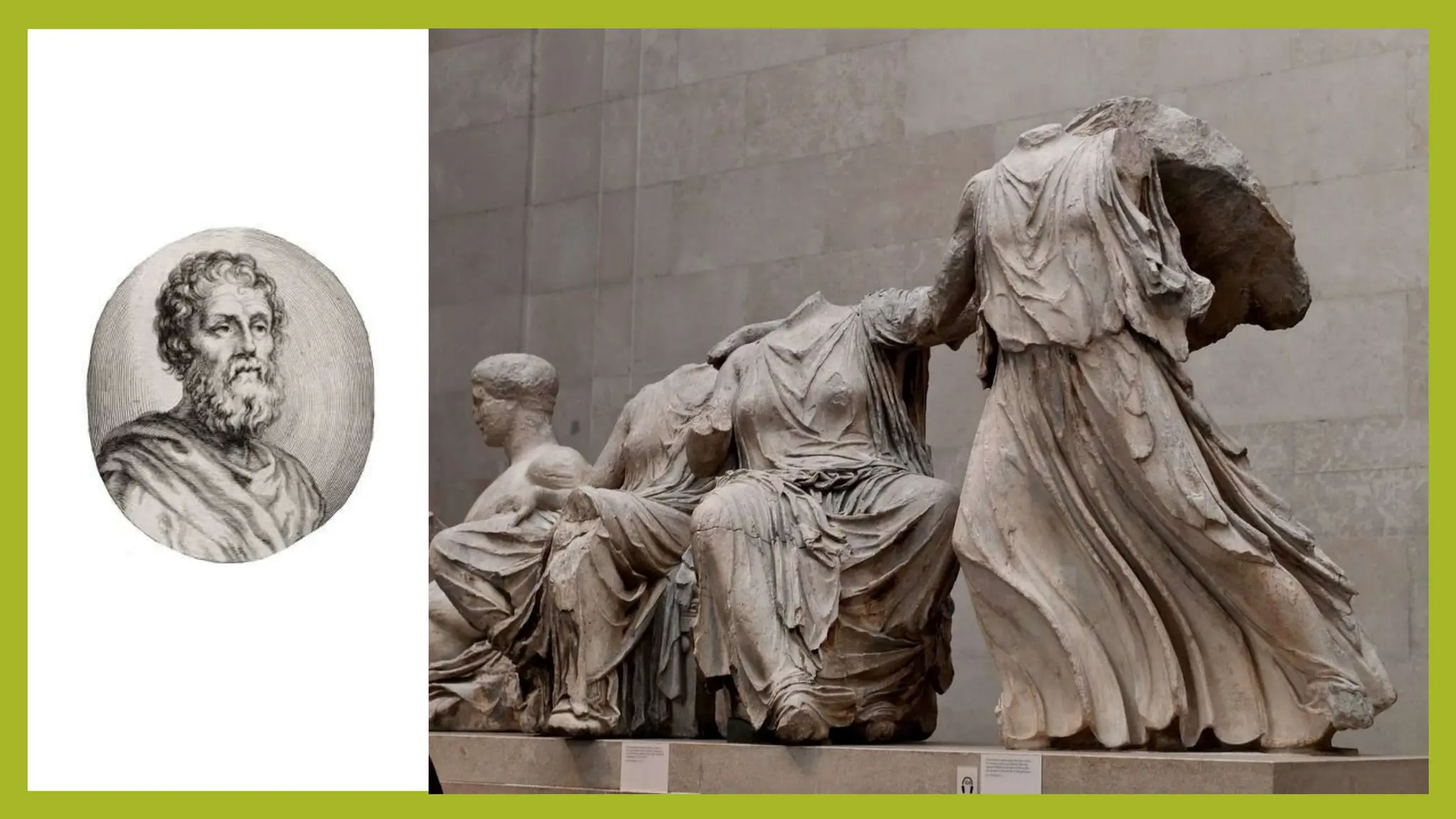
Greek Sculpture
• Sculpture was perhaps the favorite mode of expression for
Ancient Greek artists.They used this medium to show what the
ideal human form would look like.
• They wanted to create lifelike images of near perfect
individuals and what they believed their gods to look like.
• As such, the Greeks didn’t usually show human imperfections
in their sculpture, which is very different from the Romans.
• Perhaps the most famous Greek sculptor is Phidias. He is the
person who designed and completed the Parthenon in Athens.
INTERESTING FACTS ABOUT GREEK ART
• Most of the Greek sculpture were originally painted in bright colors. Most of
these elements have been worn away over the years.
• Since painting on pottery was considered a worthy art form, most artists
signed their works.
• Many of the most famous pieces of art fromAncient Greece were actually
decorations that people had inside of their homes!

ancient greeks.pptx.ancien. Greeks. ad

  • 1.
  • 2.
    INTRODUCTION • Greek artbegan in the Cycladic and Minoan civilization and gave birth toWestern art of today. • It has been divided into Geometric, Archaic and Classical periods, with further developments during the Hellenistic Period. • Greek art consists mainly five forms: architecture, sculpture, painting, pottery and jewelry making.
  • 3.
    What is GreekArt known for? • Ancient Greek art emphasized the importance and accomplishments of human beings. • The art Greeks produced over the years reflect the society that creates them. • Through their temples, sculpture, and pottery, the Greeks incorporated a fundamental principle of their culture.
  • 4.
  • 5.
    Geometric Period • Geometricart is a phase of Greek art, characterized largely by geometric motifs in vase painting, that flourished towards the end of the Greek Dark Ages, 900 BC – 700 BC. • Funerary vases not only depicted funerary scenes, but they also had practical purposes, either holding the ashes or being used as grave markers. Relatives of the deceased conducted burial rituals that included three parts: the prothesis (laying out of the body), the ekphora (funeral procession), and the interment of the body or cremated remains of the body.
  • 6.
    Centaur, c. 900B.C.E. (Proto-Geometric period), terracotta, 14 inches high, the head was found in tomb 1 and the body was found in tomb 3 in the cemetery of Toumba, Lefkandi, Greece
  • 7.
    Archaic Period This is oneof the earliest phase of Greek art. It took place in the eighth century BC and lasted until 480 BC. During this period, the artwork became a more naturalistic mode of expression. This was very different from earlier works, which had been much more rigid. Paintings on vases evolved from geometric designs to ones that more clearly showed human figures. These vases usually showed epic tales.
  • 9.
    Archaic sculpture • Sculpturesduring this period had very animated faces.The bodies were made to show human proportions accurately. • Any statue of a man during this period was known as a Kouroi. Statues or sculptures that depicted women were called Korai. • All of these statues had similar features.They would usually be shown standing stiffly with their hands at their sides.
  • 11.
    Classical Period • Duringthis period, Greek artists and sculptors refined their craft. Statues became less rigid. It began in 510 BC and lasted in 323 BC. • In fact, most statues and sculptures made during this time period were much more relaxed or even shown in action scenes. • Greek artists and sculptors continuously tried to render human and animal forms as realistic as possible during this time period. • They did this by studying human anatomy and how a person’s body moves when they change poses.This allowed them to create much more lifelike statues.
  • 12.
    Classical Sculpture • Commonlyassociated feature with the sculptures of this time period is calm and passionless faces. • In order to get such realistic figures, they needed to change the way they made their art. • Instead of carving a figure directly from stone, artists during the classical period would make a clay figure first.They would then copy this design into stone.
  • 14.
    Hellenistic Period • Thelast period of Ancient Greek art, the Hellenistic period began after Alexander the Great’s death in 323 BC. It continued until 31 BC. • During this time period, Greek art was heavily influenced by the different cultures that they had conquered under Alexander the Great. • This period focused on new subjects, such as women, children, and common people rather than deities and rulers. • Hellenistic artists were able to copy and alter from all the different works of art that came before.This gave them a good sense of their history, which influenced their works.
  • 15.
    •One of thebiggest innovations during this time period was the artists’ ability to convey emotion through their sculpture. •While Classical works were usually stoic, Hellenistic art was full of emotions.
  • 18.
    Greek Pottery • Muchof our knowledge of classical Greek art comes from objects made of stone and clay that have survived for thousands of years. • Classical Greek pottery was perhaps the most utilitarian of the era’s art forms. • They also used clay pots, jars and vases for almost everything.These were painted with religious or mythological scenes. • The themes explored on pottery were pattern and order, perspective and proportion and man himself–appeared as well in less-durable creations such as ancient Greek paintings and drawings.
  • 20.
    Greek Painting • Untilrecently, archaeologists only knew about Greek painting through ancient Greek stories. • These stories, which were written by authors such as Pliny and Pausanias, describe large, monumental paintings. But unfortunately, not a lot of these paintings remain. • Some Greek cities, such as Sikyon, were known for their schools, which taught painters and created many successful Greek artists, who then traveled theWestern world, spreading their Greek art.
  • 21.
    Greek Metalwork • Greekswere very skilled at working with metal, and they worked with many different types. • Bronze is a special type of metal, which is mostly made up of copper, with another metal added, such as tin or zinc. • Bronze is a hard and strong metal, and it was a very popular choice for statues and other decorations. • Greeks also used iron, which is a harder metal, as well as precious metals such as gold and silver. • Because metal can be melted down and made into something else, many metal sculptures and other metal items were melted down so they could be used for other things.
  • 22.
    They made bowlsand vases, cauldrons, knives and daggers, shields, armor, decorative wreaths, drinking cups, and lanterns. They also made fine jewelry such as necklaces, bracelets, earrings, pins, and rings. Most of the decorations found on jewelry were flowers and leaves, mythical creatures, lions, and snakes.
  • 23.
    Greek Mosaic • Amosaic is a picture made up of small pieces of glass, pottery, or small tiles.Thousands of small pieces of colored tiles are placed together so that all together they make up a picture. • It is one of the lasting artistic legacies from the ancient Greeks is the art of the mosaic. • Greeks decorated their houses with mosaics, both on the walls as well as on the floor. • In Macedonia, archaeologists have found houses that have brightly painted walls and mosaic floors.
  • 26.
    Greek Sculpture • Sculpturewas perhaps the favorite mode of expression for Ancient Greek artists.They used this medium to show what the ideal human form would look like. • They wanted to create lifelike images of near perfect individuals and what they believed their gods to look like. • As such, the Greeks didn’t usually show human imperfections in their sculpture, which is very different from the Romans. • Perhaps the most famous Greek sculptor is Phidias. He is the person who designed and completed the Parthenon in Athens.
  • 28.
    INTERESTING FACTS ABOUTGREEK ART • Most of the Greek sculpture were originally painted in bright colors. Most of these elements have been worn away over the years. • Since painting on pottery was considered a worthy art form, most artists signed their works. • Many of the most famous pieces of art fromAncient Greece were actually decorations that people had inside of their homes!