.Ancient Roman Architecture753 BCE-337 CE
Roman republic 509-27 BCE
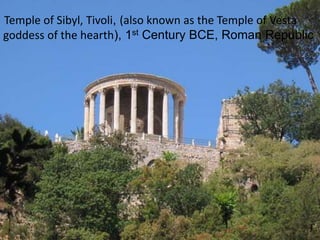
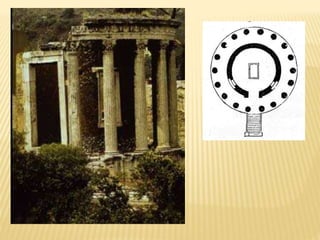
 Temple of Sibyl, Tivoli, (also known as the Temple of Vesta goddess of the hearth), 1st Century BCE, Roman Republic
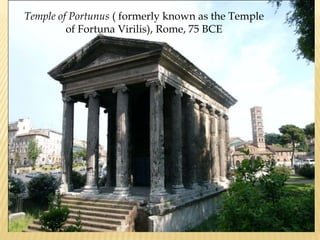
Temple of Portunus( formerly known as the Temple of Fortuna Virilis), Rome, 75 BCE
Early Empire 27 BCE – 96 CE
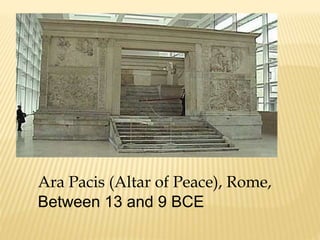
AraPacis (Altar of Peace), Rome, Between 13 and 9 BCE
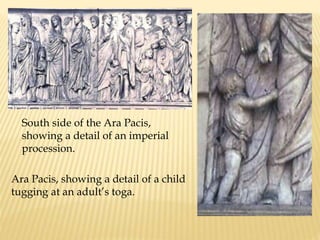
South side of the AraPacis, showing a detail of an imperial procession. AraPacis, showing a detail of a child tugging at an adult’s toga.
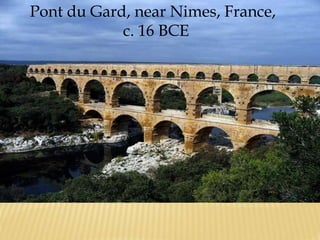
Pont du Gard, near Nimes, France, c. 16 BCE
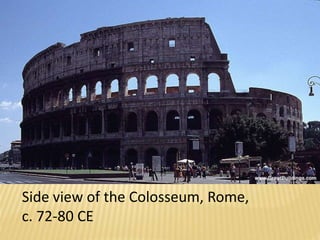
Side view of the Colosseum, Rome, c. 72-80 CE
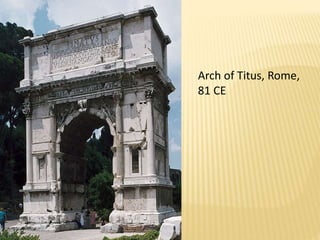
Arch of Titus, Rome,81 CE
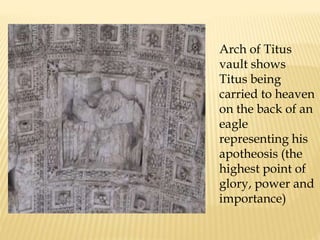
Arch of Titus vault shows Titus being carried to heaven on the back of an eagle representing his apotheosis (the highest point of glory, power and importance)
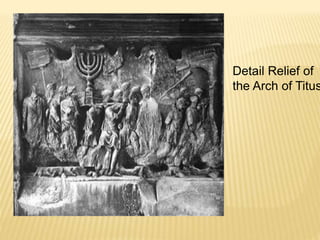
Detail Relief of the Arch of Titus
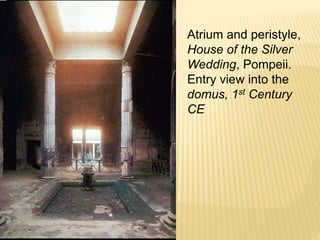
Atrium and peristyle, House of the Silver Wedding, Pompeii.Entry view into the domus, 1st Century CE
High Empire 96-192 CE
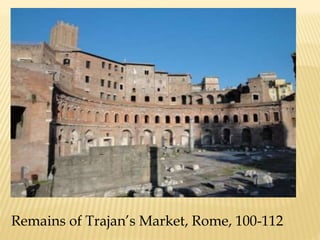
Remains of Trajan’s Market, Rome, 100-112
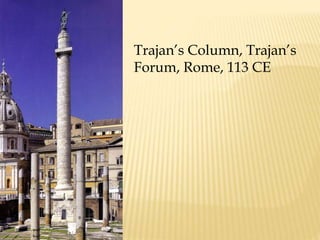
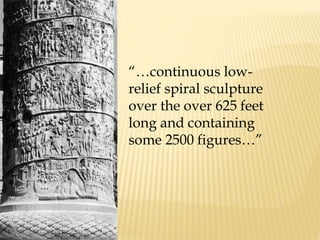
Trajan’s Column, Trajan’s Forum, Rome, 113 CE
“…continuous low-relief spiral sculpture over the over 625 feet long and containing some 2500 figures…”
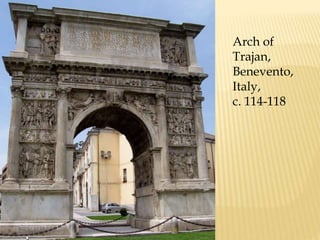
Arch of Trajan, Benevento, Italy, c. 114-118
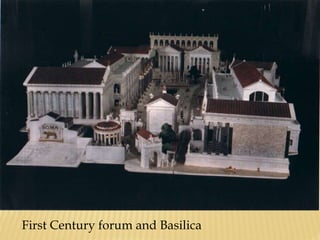
First Century forum and Basilica
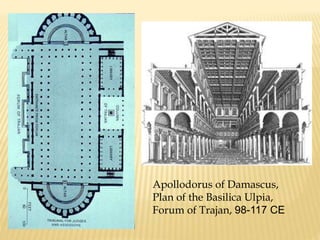
Apollodorus of Damascus, Plan of the Basilica Ulpia, Forum of Trajan, 98-117 CE
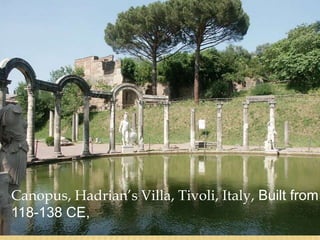
Canopus, Hadrian’s Villa, Tivoli, Italy,Built from 118-138 CE,
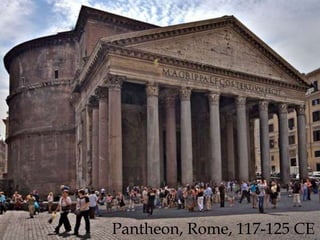
Pantheon, Rome, 117-125 CE
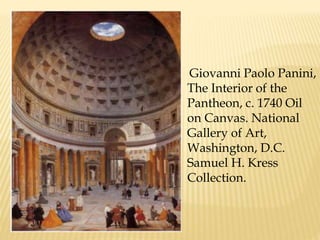
Giovanni Paolo Panini, The Interior of the Pantheon, c. 1740 Oil on Canvas. National Gallery of Art, Washington, D.C. Samuel H. Kress Collection.
Late empire 192-337 CE
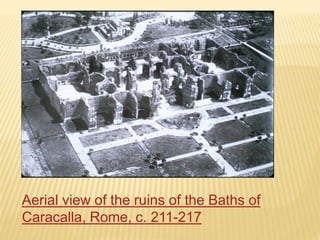
Aerial view of the ruins of the Baths of Caracalla, Rome, c. 211-217
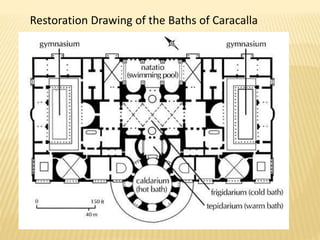
Restoration Drawing of the Baths of Caracalla
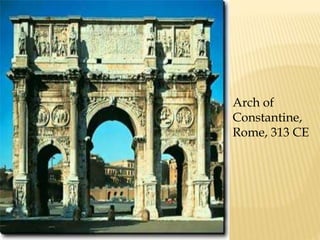
Arch of Constantine, Rome, 313 CE
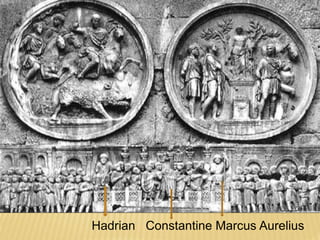
    Hadrian   Constantine Marcus Aurelius

Roman art ppt

Editor's Notes

  • #4 Overlooking a deep gorge Worshiping the Sybils  “…wise women who inhabited shrines, temples, and caves, and who, being blessed "by the gods" with the gift of prophecy, read the signs of nature in order to foretell the future. We call these seers "Sibyls," after the Greek word for prophetess ("sibulla"). Travertine Corinthian columns Frieze is carved with garlands help up by oxenheads Greek High podium can be reached via a narrow stairway leading to the cella door. This introduces an axial alignment not found in Greek Tholoi  Foundations are tufa Temple is concrete faced with travertine ashlar Temple is a tholos, in the round Stands on a podium 18 fluted Corinthian columns support an entablature with continuous frieze of ox heads alternating with garlands. Steps are located only in front of the entrance.
  • #5 Not built with Greek masonry blocks, but with concrete, new invention. Concrete was made from a changing recipe of lime mortar, volcanic sand, water, and small stones (caement, from the English cement) Builders placed the mixture in wooden frames and left it to dry. When the concrete hardened completely, they removed the wooden molds, leaving behind a solid mass of great strength, rough in appearance, they covered it with stucco or marble revetment (facing) Concrete walls were less costly than the Greek imported marble and travertine and tufa.
  • #6 Dedicated to Portuna, Roman god of harbors. Tufa Porous or volcanic rock that hardens upon exposure to air and travertine (hard limestone), originally overlaid with imitation Greek marble (stucco) Greek influence in the entablature held up by the thin Ionic columns The corner columns resemble the Parthenon as they too serve both long and short sides simultaneously Romans moved away beyond the Greek order that columns had a sole purpose of being load bearing. Eclecticism is the primary characteristic: Etruscan pattern with high podium and a flight of steps only at the front, in Greek Architecture steps go all the way around the temples. Freestanding columns confined to the deep porch. Ionic columns, Ionic frieze, Ionic half columns (Pilasters) used to approximate a peripteral (courtyard surrounded by columns) to the sides and back of the cella The result is a pseudoperipteral temple All these combinations of Etruscan and Greek mix make it uniquely Roman.
  • #8 Celebrate Peace of Augustus Vine scroll traceries (a decorative interlaced design) indicating peace and fertility under Augustus, are represented on the lower half of the frame, while the upper half illustrates the actual procession that took place at the founding of the altar. On the north side senators and other officials, some with wives and children, are shown proceeding to the entrance. The south side depicts members of the imperial family Augustus has hid head draped in the manner of Pontifex Maximus (highest Priest) denoting his role as the state’s religious leader. His wives’ heads are covered indicating a religious rite. The presence of children refers to the dynastic aims of Augustus; he hoped to have a stable system of succession for the government. He wanted aristocrats to have large families and offered tax breaks of large families. He also stressed the importance of the family as an institution. Parian marble Altar stood on a podium, and was the primitive open air altars of early Roman Times The reliefs on the exterior were executed in Classical Greek style, with Greek motifs like the processional Frieze, but the subjects are Roman The procession satisfies the Roman Taste for Spatial illusionism The highest relief is reserved for the more prominent foreground figures, whose feet project from the base. An important category of Roman architecture was developed specifically to commemorate the actions of individuals, usually emperors or generals. Celebrate peace that Augustus made with the Gauls Resolves the conflict between native tradition and Greek culture and marks the beginning of truly Roman Art. Each year magistrates, priests and vestal virgins, (virgins consecrated to the service of Vesta, goddess of the hearth) made sacrifices. They performed the sacrifices while facing east toward the sunrise.
  • #9 Human nature of children Age related behavior of a tired child who wants to be carried Marble Chubby rolls of fat are around his ankles and dimpled elbows and knees Age appropriate behavior is consistent with the Roman interest in portraiture
  • #10 Roman ability to build massive monumental projects Stone Bridge to carry water The system maintains a constant decline of 1:3000 feet resulting in a total drop of only 54 feet over its whole length of 30 miles Constructed in three tiers each with narrow barrel vaults. Vaults on the first two tiers are the same size, while the third story vault, which carried the channel containing the water, were smaller. The top vaults and larger ones are in a ratio of 1:4 The voussoirs ( a wedge shaped brick or stone used to form the curved part of the arch or vault) that make up the arches weigh up to 6 tons each. They were precisely cut to standard measurements, then fit into place without mortar or clamps The vault system was well suited to massive engineering projects With the tunnel vaults arranged in a continuous series, side by side, the lateral thrust of each vault is counteracted by its neighbor so that only the end vaults needed buttresses. The design on larger vaults on below and smaller ones on top is both structurally and aesthetically sound.
  • #11 72-80 ACE Roman colossal architecture Monumental provided entertainment of cruelty and violence while making spectators comfortable Political acumen of Imperial Rome Concrete, travertine, tufa, brick and marble Exterior arcades (a gallery formed by a series of arches supporting columns or piers either free standing or blind-attached to a wall) Three stories of round arches framed by entablatures and engaged columns. The ground floor columns are Tuscan, a later development of Doric Second floor columns are ionic Third floor columns are Corinthian Fourth floor has small windows and engaged rectangular Corinthian pilasters.(a flattened rectangular version of a column, sometimes load-bearing but often purely decorative) The system of putting the heaviest columns, Doric, on the bottom was common in Roman construction. The projecting cornice at the top serves aesthetically to crown the structure. Travertine, reused during the middle ages, was used for frame work of the piers (a vertical support used to bear loads in arched or vaulted structures) Tufa (porous yellow rock) and brick-faced concrete were used for the walls between the piers. Originally there was marble on the interior. The concrete foundations were 25 feet deep Both the barrel vault and the groin vault were used in the corridor ceilings. Upper wall was fitted with sockets into which poles were inserted as supports for awnings that were stretched to protect spectators from the sun. from the Greek word Amphi meaning “around” and theatron, meaning theater Amphitheatres were built for spectator sports, games and other lavish spectacles. Gladiatorial contests, combats between man and animals or animal v animal. It was built over a pond formerly on Nero’s property a drainage system allowed for washing away the blood and guts. The Colosseum began un Vespasian in 72 ACE It was inaugurated in 80 ACE by his son Titus. Colosseum comes from the colossal statue of Nero. On opening day more than 50,000 spectators proceeded along corridors and stairways through numbered gates to their seats.
  • #12 Marble over concrete core Arch of Titus commemorates his capture of Jerusalem and suppression of Jewish rebellion Triumphal Arch was a Roman innovation commemorating the military exploits of a victorious general or emperor It marked a ritual passage for the army into a city, but not as the entrance into the city by the populace Chariots symbolized the triumphal and divine power of the emperor Elephants, imported from Africa were owned only by emperors, symbolized the emperor’s power and immortality. Arch of Titus columns are of the Composite Order of Roman Order (combining elements of Ionic and Corinthian) Spandrels (triangular sections between the arch and the frame) have winged victories holding laurel wreaths Reliefs on the piers ( large rectangular supports) depict scenes of Titus’s triumphs Consisted of a rectangular block enclosing one or more round arches and a short barrel vault. Had one or three openings Pilasters framed the openings and supported an entablature, which was surmounted by a rectangular attic (a low story placed above the entablature) The attic supported sculptures of horses, chariots or even elephants, it also bore an inscription The Latin inscription reads, “the senate and people of Rome dedicate the arch to divine Titus, Vespasian Augustus, son of divine Vespasian.” Arches stood alone
  • #14 Demonstrates the spoils of the temple of Jerusalem carried in a triumphal procession Titus’ warriors carry off their booty from the Jewish wars Soldiers raise the menorah whose weight and prominence reflect its importance for the Jews and its role as a symbol of Roman Victory. Marble Figures project illusionistically from the surface of the relief The base of the menorah is carved in perspective reflecting the Roman taste for spatial effects and optical illusion
  • #15 1st Century ACE Roman Empire Domus (Roman private home) Functional as well as inviting into the home Material comforts Features of the Roman domus Atrium- large hall entered through the corridor from the street Atrium roof sloped forward The compluvium, a primary source of light in the atrium, allowed rain water to collect in to the impluvian, a sunken basin in the floor, from which is was channeled into a cistern Compluvium is supported by four Corinthian columns Romans carried out extensive building during the Empire To accommodate their expanding territory and its growing population To glorify the state and the emperor They assimilated and developed building techniques from the Near East, Etruscans, and Greece. Recognized the potential of concrete and used it in monumental construction. They also used Tavertine, a hard, durable limestone that mellows to a golden yellow And the Etruscan Tufa Roman interest in material comforts led sophisticated domestic architecture Vesuvius erupted in 79 ACE over a seaside Roman Resort of Herculaneum. Ash covered Pompeii a commercial and agricultural center. Herculaneum was covered with lava and mud and was difficult to excavate. Pompeii was easier and that is where the excavation began in 1592 and continues in both places today. Both sites have given history an insight into Roman domestic (from the Latin domus meaning “house”) architecture.
  • #17 Huge size and innovative engineering by Apollodorus of Damascus . Concrete core faced with brick Concrete made it possible to build on a slope. Apollodorus was the master of post and lintel, stone and timber architecture. The basic unit was the taberna a single room shop covered by a barrel vault Each taberna had a wide doorway, usually with a window above it that allowed light to enter a wooden inner attic used for storage. Shops were on several levels opening onto a hemispherical façade winding around one of the great exedras (ancient Greece and Rome, a room for relaxation or conversation, especially a semicircular recess in a larger hall with a continuous bench along the wall) of Trajan’s forum Total urban renovation included Trajan’s forum, which was faced with marble Market contained over 200 rooms Administrative offices and shops linked by a complex system of stairways and arcades Tiered, apsidal spaces with barrel vaulted ceilings, groin vaults used in the main hall, clerestory windows in the basilica Shifting axes, flowing masses and spaces, patterns of light and shadow, served as a social and commercial function for large numbers of people. Apollodorus departed from traditional columns and colonnades.
  • #18 Marble Originally had a bronze statue of Trajan Column is unique to Romans with its documentary, ribbonlike narrative frieze. Column consists of marble drums cut horizontally and imperceptibly joined together Inside is a spiral staircase illuminated with cuts into the marble
  • #19 Background figures raise above the foreground eliminating any empty space Zig zagging buildings faced with brickwork patterns and boats add to the sense of surface movement  Supporting the column is a podium decorated with sculptures illustrating the spoils of war and containing a repository of Trajan’s ashes The first three bands is the Roman Army preparing for its campaign On the first band the giant bearded river god of the Danube appears under the arch of a cave He watches as Trajan leads the Roman army out of a walled city Boats and soldiers fill the river. The second level contains army camps, war councils, reconnaissance missions and the capture of a spy. This frieze is one of the most informative historical documents of life in the Roman army
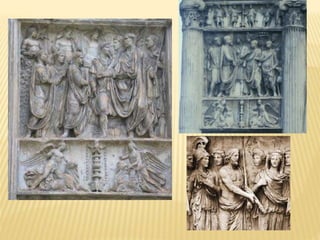
  • #20 Total Propaganda Trajan built a new road called Via Traiana in southern Italy in 109 Several years later the Senate erected a great arch honoring Trahan at the point where the road entered Benevento. Structurally it is similar to the Titus arch in Rome. Relief panes cover both facades of the arch giving it a billboardlike function. Every inch of the surface heraldes the emperor’s achievements. In one panel he enters Rome after a successful military campaign In another he distributes largesse to needy children He is also portrayed as a founder of colonies for army veterans and the builder of a new port at Ostia, at the mouth of the Tiber River. He is presented as a guarantor of peace, security, benefactor of the poor and patron of soldiers and merchants. He is ALL THINGS TO ALL PEOPLE according to this arch HE also freely intermingles with divinities and on the arch’s attic Jupiter hands his thunderbolt to the emperor awarding him dominion over Earth. Depicting the ruler as divine then became the norm in Rome
  • #21 All things to all people
  • #22 Public Buildings: Complex life in Rome required public buildings for civic and administrative functions These activities led to the Forum and the Basilica First forum was built during the 6th century First century ACE the Forum Julium became the prototype for all imperial forums. Julius Caesar planned it and Augustus completed it. It’s now in ruins Forum Plan of the Roman and Imperial Forums, Rome Political, religious, social, and commercial center Shops went elsewhere and forum was only a civic and social activity Meetings for the town council (the curia) and the popular assembly (the comitium)
  • #23 Basilica (from the Greek word basilikos meaning “royal”) Roofing was made of timber and covered with tile, the interior was adorned with marble and bronze Basilicas were rectangular in plan with an apse ( a projecting part of the building usually semi circular and topped by a half dome or vault) The apses contained statues of gods or emperors, provided space for legal proceedings, and included a throne for the current emperor. Basilicas were large roofed building usually located at the end of the forums Divided into three aisles. A large central aisle was flanked by two smaller aisles on each side, separated with one or two rows of columns in a colonnade used for socializing or awaiting trial, or transacting business. The nave (from the Latin word navis, meaning “ship” and derived from the idea of an inverted boat) permitted the construction of a second story wall above the colonnades separating the nave aisles Clerestory windows admitted light into the basilica. A clerestory is a high wall with a band of narrow windows along the very top. The clerestory wall usually rises above adjoining roofs.  It was used for commercial transactions, municipal hall, and law court
  • #24 Emperor Hadrian’s Villa, tell of Hadrian’s lover, wife, travels, beard Opulence Power  Consisted of Libraries containing Greek and Latin literature Courtyards Temples Visiting Alexandria Egypt he admired the Serapaeum, a temple dedicated to Serpis, the Egyptian god who combined Osiris, Zeus, and Hades. Plazas Theatre Occupied more than a square mile He constructed a canal. He used Ionic columns in the Serapaem and Corinthian columns in the Canopus that supported the round arches alternating with lentils and sculptures to occupy the arched spaces. The entrance contained fountains Country Villa was built as an escape from the city. Most elaborate Villas belonged only to the emperors
  • #25 Dedicated to the five then known planets (Jupiter, Mars, Mercury, Saturn, and Venus) and all (pan) gods (theoi) Played a role as a symbol of the sky Dome of heaven Symbolic equation between the sun and the eye of Jupiter, the supreme celestial deity of Rome Dedicated to all the gods Consists of two main parts Traditional rectangular portico supported by massive granite Corinthian columns Huge concrete rotunda faced on the exterior with brick. The entire Pantheon stands on a podium with steps leading to the portico entrance. The Pantheon’s portico is Greek
  • #26 Rotunda is truly Roman, absence of symmetry between the rectangular portico and the mass cylindrical rotunda Vast dome is illuminated from the open, centered oculus (Latin for eye) The dome and the drum (the circular or polygonal wall of a building surmounted by a dome or cupola) are in perfect proportion, the distance from the top of the dome to the floor being identical the diameter of the drum. The circle is inscribed in a square Marble floor is patterns of circles and squares The walls contain niches, each one for a different deity, with Corinthian columns supporting alternating triangular rounded pediments Between each niche is a recess with two huge columns flanked by two corner pilasters A circular entablature forms the base of a short “second story,” which bears the whole weight of the dome, the weight is channeled down to the eight piers. (the vertical support used to bear loads in arched and vaulted structures) The dome has five coffered bands ( a recessed geometrical pattern in a ceiling) that diminish in size toward the oculus. The coffers reduce the weight of the structure and create an optical illusion of greater height. They were originally painted blue and each had a gold rosette in the middle, Dome tapers toward the top from approximately 20 feet to 6 feet There are stepped buttresses on the lower half of the dome The most monumental ancient Roman Temple Build during the reign of Hadrian Inscribed on the pediment of the portico is the name of Augustus’s friend Marcus Agrippa, who had dedicated an earlier temple on the same site.
  • #29 Enormous Corinthian columns supported the Groin vaults of the ceiling in this central hall
  • #30 Commemorated Constantine’s assumption of sole imperial power in 312. Marble Largest triumphal arch Decorated with original reliefs and those removed from earlier monuments in honor of other emperors, Trajan, Hadrian, Marcus Aurelius The juxtaposition of reliefs from different periods illustrates changes that took place in Roman sculpture Elaborate arch with three openings The arch was built after Constantine defeated his rival, Maxentius at the Battle of Milvian Bridge.
  • #31 Medallions, and Frieze from the Arch of Constantine, Rome Three riders hunt a boar (left) Three worshipers stand before an altar of Apollo Honoring Hadrian, Marcus Aurelius,(both were influenced by Greek culture) and Constantine while he makes a public speech Medallions are spolia ( pieces taken from older reliefs and reused in new ones) Lined up and listening to Constantine are figures accented by arches and columns The style is less naturalistic, more stylized and patterned than the medallions The proportions of figures are stubbier, their heads are enlarged, their poses are repetitious and their carving is flatter Constantine’s reign developed abstract reliefs, not Classical naturalism. The use of the medallions, which is Classical naturalism next to the stylistic relief is unknown and no iconographic relationship can be determined.