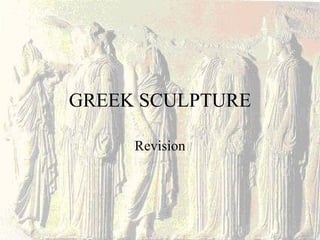
GREEK SCULPTURE Revision
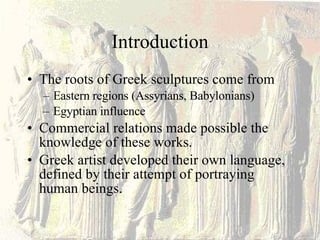
Introduction The roots of Greek sculptures come from  Eastern regions (Assyrians, Babylonians) Egyptian influence Commercial relations made possible the knowledge of these works. Greek artist developed their own language, defined by their attempt of portraying human beings.
Introduction Sculpture is the art that best shows the fight for depicting their ideals of Beauty Expression Movement Volume Periods: Archaic: until 5th century bc Classical: 5th and 4th centuries bc Hellenistic: last 4th century bc until the Roman conquer in 1st century bc.
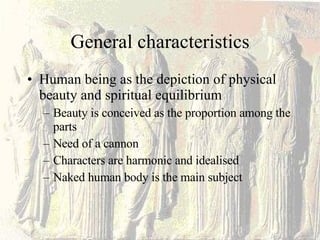
General characteristics Human being as the depiction of physical beauty and spiritual equilibrium Beauty is conceived as the proportion among the parts Need of a cannon Characters are harmonic and idealised Naked human body is the main subject
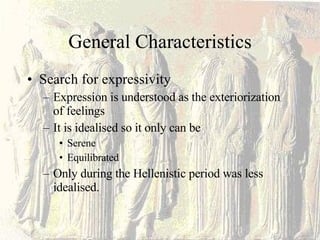
General Characteristics Search for expressivity Expression is understood as the exteriorization of feelings It is idealised so it only can be Serene Equilibrated  Only during the Hellenistic period was less idealised.
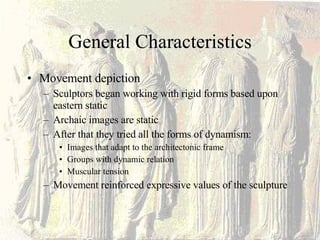
General Characteristics Movement depiction Sculptors began working with rigid forms based upon eastern static Archaic images are static After that they tried all the forms of dynamism: Images that adapt to the architectonic frame Groups with dynamic relation  Muscular tension Movement reinforced expressive values of the sculpture
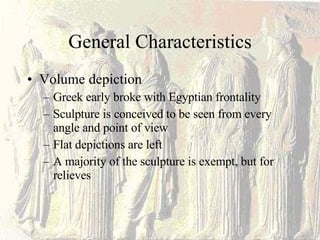
General Characteristics Volume depiction Greek early broke with Egyptian frontality Sculpture is conceived to be seen from every angle and point of view Flat depictions are left A majority of the sculpture is exempt, but for relieves
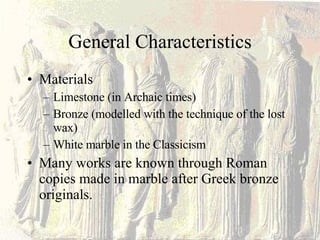
General Characteristics Materials Limestone (in Archaic times) Bronze (modelled with the technique of the lost wax) White marble in the Classicism Many works are known through Roman copies made in marble after Greek bronze originals.
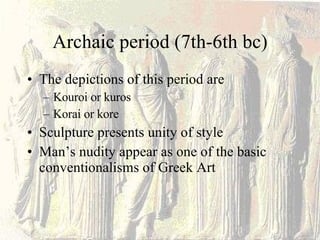
Archaic period (7th-6th bc) The depictions of this period are  Kouroi or kuros Korai or kore Sculpture presents unity of style Man’s nudity appear as one of the basic conventionalisms of Greek Art
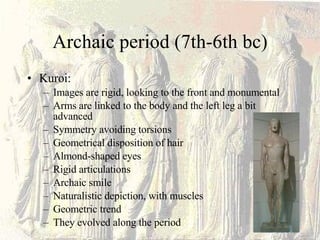
Archaic period (7th-6th bc) Kuroi: Images are rigid, looking to the front and monumental Arms are linked to the body and the left leg a bit advanced Symmetry avoiding torsions Geometrical disposition of hair Almond-shaped eyes Rigid articulations Archaic smile Naturalistic depiction, with muscles Geometric trend They evolved along the period
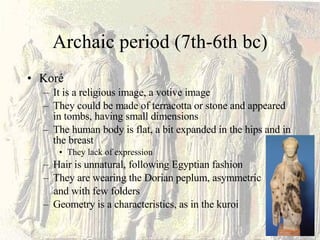
Archaic period (7th-6th bc) Koré It is a religious image, a votive image They could be made of terracotta or stone and appeared in tombs, having small dimensions The human body is flat, a bit expanded in the hips and in the breast They lack of expression Hair is unnatural, following Egyptian fashion They are wearing the Dorian peplum, asymmetric and with few folders Geometry is a characteristics, as in the kuroi
Transition to the Classicism The main work are the relieves such as the Egina pediments There are composite sculptures where the images are adapted to the frame of the architectonical space. They show the evolution towards naturalistic forms, with a limited expression of feelings. Images are in natural attitudes, but rigid. Thematic is more varied too.
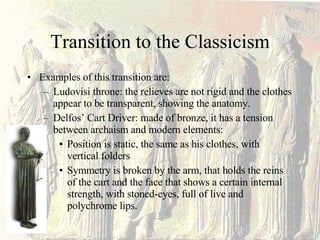
Transition to the Classicism Examples of this transition are: Ludovisi throne: the relieves are not rigid and the clothes appear to be transparent, showing the anatomy. Delfos’ Cart Driver: made of bronze, it has a tension between archaism and modern elements: Position is static, the same as his clothes, with vertical folders Symmetry is broken by the arm, that holds the reins of the cart and the face that shows a certain internal strength, with stoned-eyes, full of live and polychrome lips.
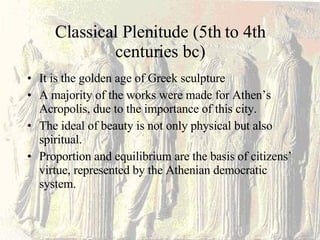
Classical Plenitude (5th to 4th centuries bc) It is the golden age of Greek sculpture A majority of the works were made for Athen’s Acropolis, due to the importance of this city. The ideal of beauty is not only physical but also spiritual. Proportion and equilibrium are the basis of citizens’ virtue, represented by the Athenian democratic system.
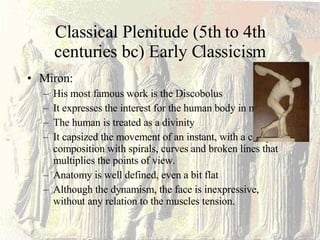
Classical Plenitude (5th to 4th centuries bc) Early Classicism Miron: His most famous work is the Discobolus It expresses the interest for the human body in movement The human is treated as a divinity It capsized the movement of an instant, with a complex composition with spirals, curves and broken lines that multiplies the points of view. Anatomy is well defined, even a bit flat Although the dynamism, the face is inexpressive, without any relation to the muscles tension.
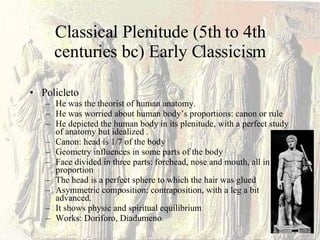
Classical Plenitude (5th to 4th centuries bc) Early Classicism Policleto He was the theorist of human anatomy. He was worried about human body’s proportions: canon or rule He depicted the human body in its plenitude, with a perfect study of anatomy but idealized . Canon: head is 1/7 of the body Geometry influences in some parts of the body Face divided in three parts: forehead, nose and mouth, all in proportion The head is a perfect sphere to which the hair was glued Asymmetric composition: contraposition, with a leg a bit advanced. It shows physic and spiritual equilibrium Works: Doriforo, Diadumeno
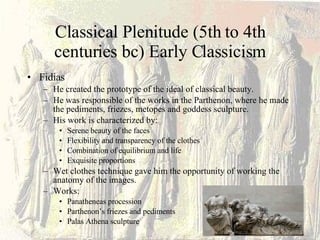
Classical Plenitude (5th to 4th centuries bc) Early Classicism Fidias He created the prototype of the ideal of classical beauty. He was responsible of the works in the Parthenon, where he made the pediments, friezes, metopes and goddess sculpture. His work is characterized by: Serene beauty of the faces Flexibility and transparency of the clothes Combination of equilibrium and life Exquisite proportions Wet clothes technique gave him the opportunity of working the anatomy of the images. Works: Panatheneas procession  Parthenon’s friezes and pediments Palas Athena sculpture
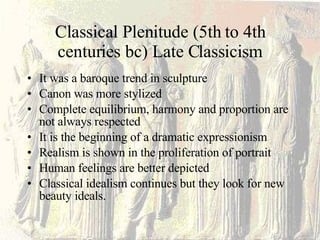
Classical Plenitude (5th to 4th centuries bc) Late Classicism It was a baroque trend in sculpture Canon was more stylized  Complete equilibrium, harmony and proportion are not always respected It is the beginning of a dramatic expressionism Realism is shown in the proliferation of portrait Human feelings are better depicted Classical idealism continues but they look for new beauty ideals.
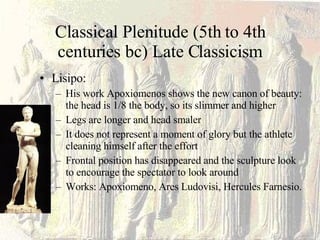
Classical Plenitude (5th to 4th centuries bc) Late Classicism Lisipo: His work Apoxiomenos shows the new canon of beauty: the head is 1/8 the body, so its slimmer and higher Legs are longer and head smaler It does not represent a moment of glory but the athlete cleaning himself after the effort Frontal position has disappeared and the sculpture look to encourage the spectator to look around Works: Apoxiomeno, Ares Ludovisi, Hercules Farnesio.
Classical Plenitude (5th to 4th centuries bc) Late Classicism Scopas: His work supposed the crisis of Fidias’ serenity. The images are contortioned, with extreme and violent positions. He was Alexander's sculptor. Works: Menade Mausolo’s head
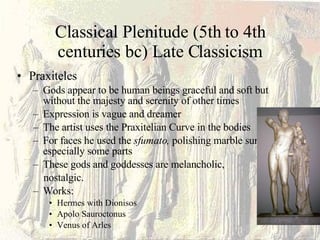
Classical Plenitude (5th to 4th centuries bc) Late Classicism Praxiteles Gods appear to be human beings graceful and soft but without the majesty and serenity of other times Expression is vague and dreamer  The artist uses the Praxitelian Curve in the bodies For faces he used the  sfumato,  polishing marble surface, especially some parts These gods and goddesses are melancholic,  nostalgic. Works: Hermes with Dionisos Apolo Sauroctonus Venus of Arles
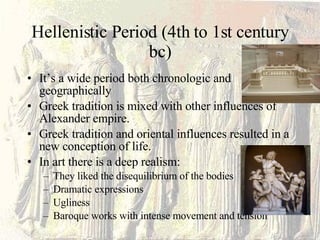
Hellenistic Period (4th to 1st century bc) It’s a wide period both chronologic and geographically Greek tradition is mixed with other influences of Alexander empire. Greek tradition and oriental influences resulted in a new conception of life. In art there is a deep realism: They liked the disequilibrium of the bodies Dramatic expressions Ugliness  Baroque works with intense movement and tension
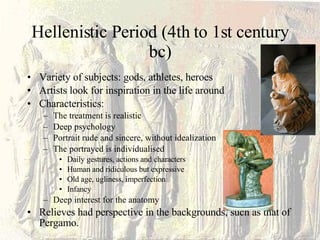
Hellenistic Period (4th to 1st century bc) Variety of subjects: gods, athletes, heroes Artists look for inspiration in the life around Characteristics: The treatment is realistic Deep psychology  Portrait rude and sincere, without idealization The portrayed is individualised  Daily gestures, actions and characters Human and ridiculous but expressive Old age, ugliness, imperfection Infancy  Deep interest for the anatomy Relieves had perspective in the backgrounds, such as that of Pergamo.
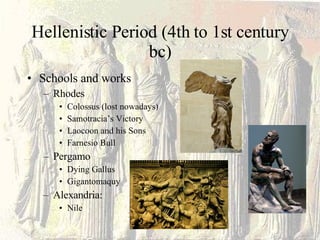
Hellenistic Period (4th to 1st century bc) Schools and works Rhodes  Colossus (lost nowadays)  Samotracia’s Victory Laocoon and his Sons  Farnesio Bull Pergamo Dying Gallus Gigantomaquy Alexandria: Nile

Greek Sculpture

  • 1.
  • 2.
    Introduction The rootsof Greek sculptures come from Eastern regions (Assyrians, Babylonians) Egyptian influence Commercial relations made possible the knowledge of these works. Greek artist developed their own language, defined by their attempt of portraying human beings.
  • 3.
    Introduction Sculpture isthe art that best shows the fight for depicting their ideals of Beauty Expression Movement Volume Periods: Archaic: until 5th century bc Classical: 5th and 4th centuries bc Hellenistic: last 4th century bc until the Roman conquer in 1st century bc.
  • 4.
    General characteristics Humanbeing as the depiction of physical beauty and spiritual equilibrium Beauty is conceived as the proportion among the parts Need of a cannon Characters are harmonic and idealised Naked human body is the main subject
  • 5.
    General Characteristics Searchfor expressivity Expression is understood as the exteriorization of feelings It is idealised so it only can be Serene Equilibrated Only during the Hellenistic period was less idealised.
  • 6.
    General Characteristics Movementdepiction Sculptors began working with rigid forms based upon eastern static Archaic images are static After that they tried all the forms of dynamism: Images that adapt to the architectonic frame Groups with dynamic relation Muscular tension Movement reinforced expressive values of the sculpture
  • 7.
    General Characteristics Volumedepiction Greek early broke with Egyptian frontality Sculpture is conceived to be seen from every angle and point of view Flat depictions are left A majority of the sculpture is exempt, but for relieves
  • 8.
    General Characteristics MaterialsLimestone (in Archaic times) Bronze (modelled with the technique of the lost wax) White marble in the Classicism Many works are known through Roman copies made in marble after Greek bronze originals.
  • 9.
    Archaic period (7th-6thbc) The depictions of this period are Kouroi or kuros Korai or kore Sculpture presents unity of style Man’s nudity appear as one of the basic conventionalisms of Greek Art
  • 10.
    Archaic period (7th-6thbc) Kuroi: Images are rigid, looking to the front and monumental Arms are linked to the body and the left leg a bit advanced Symmetry avoiding torsions Geometrical disposition of hair Almond-shaped eyes Rigid articulations Archaic smile Naturalistic depiction, with muscles Geometric trend They evolved along the period
  • 11.
    Archaic period (7th-6thbc) Koré It is a religious image, a votive image They could be made of terracotta or stone and appeared in tombs, having small dimensions The human body is flat, a bit expanded in the hips and in the breast They lack of expression Hair is unnatural, following Egyptian fashion They are wearing the Dorian peplum, asymmetric and with few folders Geometry is a characteristics, as in the kuroi
  • 12.
    Transition to theClassicism The main work are the relieves such as the Egina pediments There are composite sculptures where the images are adapted to the frame of the architectonical space. They show the evolution towards naturalistic forms, with a limited expression of feelings. Images are in natural attitudes, but rigid. Thematic is more varied too.
  • 13.
    Transition to theClassicism Examples of this transition are: Ludovisi throne: the relieves are not rigid and the clothes appear to be transparent, showing the anatomy. Delfos’ Cart Driver: made of bronze, it has a tension between archaism and modern elements: Position is static, the same as his clothes, with vertical folders Symmetry is broken by the arm, that holds the reins of the cart and the face that shows a certain internal strength, with stoned-eyes, full of live and polychrome lips.
  • 14.
    Classical Plenitude (5thto 4th centuries bc) It is the golden age of Greek sculpture A majority of the works were made for Athen’s Acropolis, due to the importance of this city. The ideal of beauty is not only physical but also spiritual. Proportion and equilibrium are the basis of citizens’ virtue, represented by the Athenian democratic system.
  • 15.
    Classical Plenitude (5thto 4th centuries bc) Early Classicism Miron: His most famous work is the Discobolus It expresses the interest for the human body in movement The human is treated as a divinity It capsized the movement of an instant, with a complex composition with spirals, curves and broken lines that multiplies the points of view. Anatomy is well defined, even a bit flat Although the dynamism, the face is inexpressive, without any relation to the muscles tension.
  • 16.
    Classical Plenitude (5thto 4th centuries bc) Early Classicism Policleto He was the theorist of human anatomy. He was worried about human body’s proportions: canon or rule He depicted the human body in its plenitude, with a perfect study of anatomy but idealized . Canon: head is 1/7 of the body Geometry influences in some parts of the body Face divided in three parts: forehead, nose and mouth, all in proportion The head is a perfect sphere to which the hair was glued Asymmetric composition: contraposition, with a leg a bit advanced. It shows physic and spiritual equilibrium Works: Doriforo, Diadumeno
  • 17.
    Classical Plenitude (5thto 4th centuries bc) Early Classicism Fidias He created the prototype of the ideal of classical beauty. He was responsible of the works in the Parthenon, where he made the pediments, friezes, metopes and goddess sculpture. His work is characterized by: Serene beauty of the faces Flexibility and transparency of the clothes Combination of equilibrium and life Exquisite proportions Wet clothes technique gave him the opportunity of working the anatomy of the images. Works: Panatheneas procession Parthenon’s friezes and pediments Palas Athena sculpture
  • 18.
    Classical Plenitude (5thto 4th centuries bc) Late Classicism It was a baroque trend in sculpture Canon was more stylized Complete equilibrium, harmony and proportion are not always respected It is the beginning of a dramatic expressionism Realism is shown in the proliferation of portrait Human feelings are better depicted Classical idealism continues but they look for new beauty ideals.
  • 19.
    Classical Plenitude (5thto 4th centuries bc) Late Classicism Lisipo: His work Apoxiomenos shows the new canon of beauty: the head is 1/8 the body, so its slimmer and higher Legs are longer and head smaler It does not represent a moment of glory but the athlete cleaning himself after the effort Frontal position has disappeared and the sculpture look to encourage the spectator to look around Works: Apoxiomeno, Ares Ludovisi, Hercules Farnesio.
  • 20.
    Classical Plenitude (5thto 4th centuries bc) Late Classicism Scopas: His work supposed the crisis of Fidias’ serenity. The images are contortioned, with extreme and violent positions. He was Alexander's sculptor. Works: Menade Mausolo’s head
  • 21.
    Classical Plenitude (5thto 4th centuries bc) Late Classicism Praxiteles Gods appear to be human beings graceful and soft but without the majesty and serenity of other times Expression is vague and dreamer The artist uses the Praxitelian Curve in the bodies For faces he used the sfumato, polishing marble surface, especially some parts These gods and goddesses are melancholic, nostalgic. Works: Hermes with Dionisos Apolo Sauroctonus Venus of Arles
  • 22.
    Hellenistic Period (4thto 1st century bc) It’s a wide period both chronologic and geographically Greek tradition is mixed with other influences of Alexander empire. Greek tradition and oriental influences resulted in a new conception of life. In art there is a deep realism: They liked the disequilibrium of the bodies Dramatic expressions Ugliness Baroque works with intense movement and tension
  • 23.
    Hellenistic Period (4thto 1st century bc) Variety of subjects: gods, athletes, heroes Artists look for inspiration in the life around Characteristics: The treatment is realistic Deep psychology Portrait rude and sincere, without idealization The portrayed is individualised Daily gestures, actions and characters Human and ridiculous but expressive Old age, ugliness, imperfection Infancy Deep interest for the anatomy Relieves had perspective in the backgrounds, such as that of Pergamo.
  • 24.
    Hellenistic Period (4thto 1st century bc) Schools and works Rhodes Colossus (lost nowadays) Samotracia’s Victory Laocoon and his Sons Farnesio Bull Pergamo Dying Gallus Gigantomaquy Alexandria: Nile