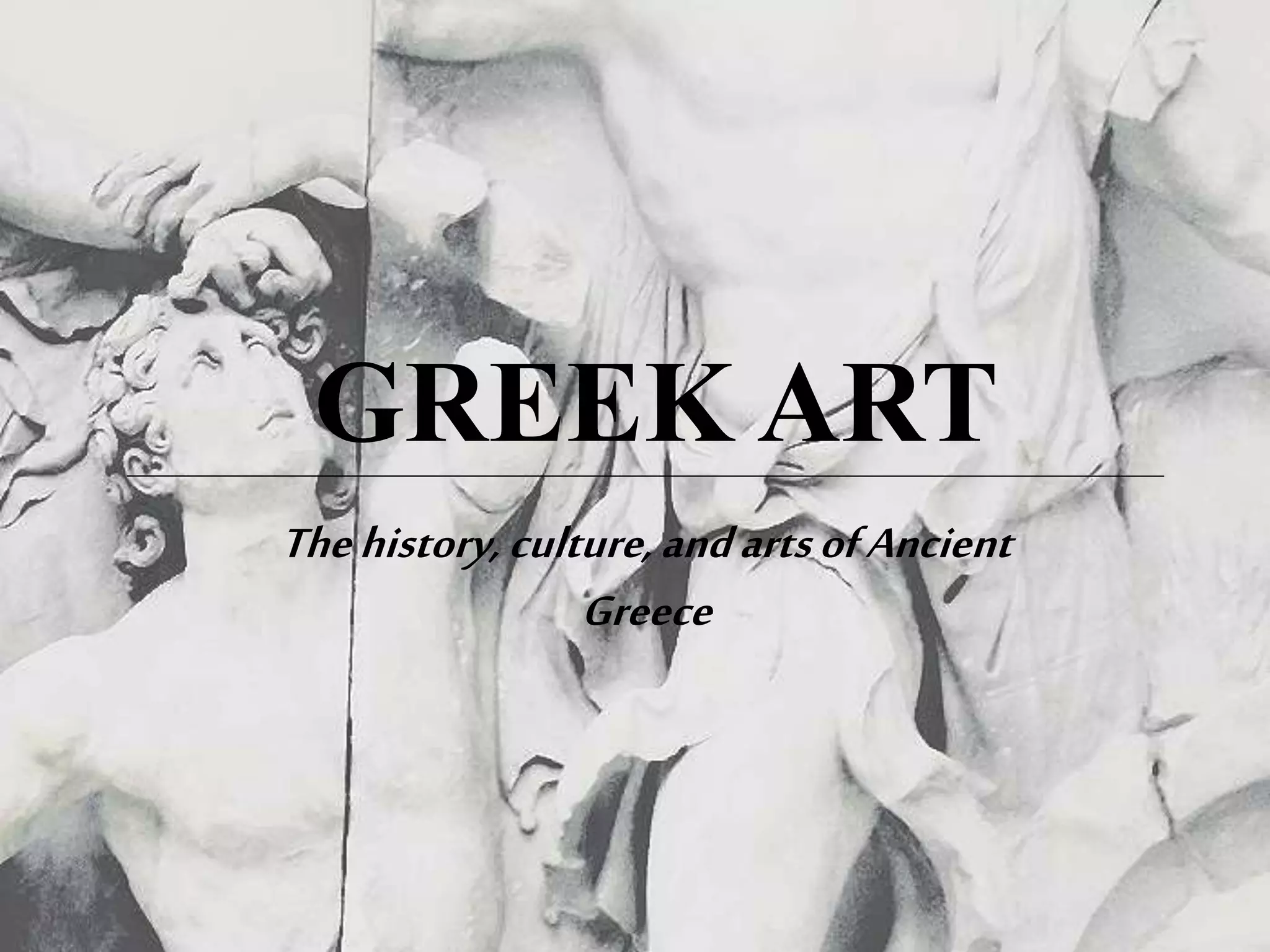
GREEK ART
Thehistory,culture,andartsofAncient
Greece
The culture of Greece has evolved over thousands
of years, beginning in Mycenaean Greece, continuing
most notably into Classical Greece, through the
influence of the Roman Empire and its successor
the Byzantine Empire.
Historians credit the Greek War of Independence
with revitalizing Greece and giving birth to a single
entity of its multi-faceted culture.
 The ancient Greeks pioneered in many fields that
rely on systematic thought, including biology,
geometry, history, philosophy, and physics.
They introduced such important literary forms as epic
and lyric poetry, history, tragedy, and comedy. In their
pursuit of order and proportion, the Greeks created an
ideal of beauty that strongly influenced Western art.
The ancient Greeks were a deeply religious people. They
worshipped many gods whom they believed appeared in human
form and yet were endowed with superhuman strength and
ageless beauty.
Funerary Art: the ancient Greeks did not generally leave
elaborate grave goods, except for a coin in the hand to pay
Charon, the ferryman to Hades, and pottery; however the
epitaphios or funeral oration (from which epitaph comes) was
regarded as of great importance, and animal sacrifices were
made.
Men ran the government, and spent a great deal of their
time away from home. When not involved in politics, the
men spent time in the fields, overseeing or working the
crops, sailing, hunting, in manufacturing or in trade. For
fun, in addition to drinking parties, the men enjoyed
wrestling, horseback riding, and the famous Olympic
Games. When the men entertained their male friends, at
the popular drinking parties, their wives and daughters
were not allowed to attend.
With the exception of ancient Sparta, Greek women had
very limited freedom outside the home. They could attend
weddings, funerals, some religious festivals, and could
visit female neighbors for brief periods of time. In their
home, Greek women were in charge. Their job was to run
the house and to bear children.
The ancient Greeks considered their children to be 'youths'
until they reached the age of 30! When a child was born to
ancient Greek family, a naked father carried his child, in a
ritual dance, around the household. Friends and relatives sent
gifts. The family decorated the doorway of their home with a
wreath of olives (for a boy) or a wreath of wool (for a girl).
Education - Military Training - Sparta
. The goal of education in the Greek city-states was to
prepare the child for adult activities as a citizen. The nature of
the city-states varied greatly, and this was also true of the
education they considered appropriate. In most Greek city-
states, when young, the boys stayed at home, helping in the
fields, sailing, and fishing. At age 6 or 7, they went to school.
Both daily life and education were very different in Sparta
[militant], than in Athens [arts and culture] or in the other
ancient Greek city-states.
Birds, dogs, goats, tortoises, and mice were all popular
pets. Cats, however, were not.
Greek houses, in the 6th and 5th century B.C., were made
up of two or three rooms, built around an open air courtyard,
built of stone, wood, or clay bricks. Larger homes might also
have a kitchen, a room for bathing, a men's dining room, and
perhaps a woman's sitting area.
Greek clothing was very simple. Men and women wore
linen in the summer and wool in the winter. The ancient
Greeks could buy cloth and clothes in the agora, the
marketplace, but that was expensive. Most families made
their own clothes, which were simple tunics and warm
cloaks, made of linen or wool, dyed a bright color, or
bleached white. Clothes were made by the mother, her
daughters, and female slaves. They were often decorated to
represent the city-state in which they lived. The ancient
Greeks were very proud of their home city-state.
Dancing - Music
Dance was very important to the ancient Greeks. They
believed that dance improved both physical and emotional
health. Rarely did men and women dance together. Some
dances were danced by men and others by women.
There were more than 200 ancient Greek dances; comic
dances, warlike dances, dances for athletes and for religious
worship, plus dances for weddings, funerals, and celebrations.
Dance was accompanied by music played on lyres, flutes,
and a wide variety of percussion instruments such as
tambourines, cymbals and castanets.
The ancient Greeks loved stories. They created many
marvelous stories, myths, and fables that we enjoy today,
like Odysseus and the Terrible Sea and Circe, a beautiful
but evil enchantress. Aesop's Fables, written by Aesop, an
ancient Greek, are still read and enjoyed all over the world.
In ancient Athens, wedding ceremonies started after dark.
The veiled bride traveled from her home to the home of the
groom while standing in a chariot. Her family followed the
chariot on foot, carrying the gifts.
Slavery played a major role in ancient Greek
civilization. Slaves could be found everywhere. They
worked not only as domestic servants, but as factory
workers, shopkeepers, mineworkers, farm workers and
as ship's crew members.
HISTORICAL
BACKGROUND
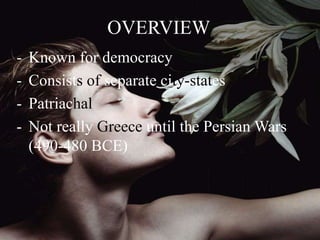
- Known for democracy
- Consists of separate city-states
- Patriachal
- Not really Greece until the Persian Wars
(490-480 BCE)
OVERVIEW
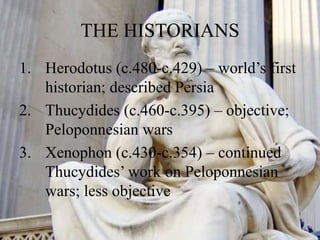
THE HISTORIANS
1. Herodotus (c.480-c.429) – world’s first
historian; described Persia
2. Thucydides (c.460-c.395) – objective;
Peloponnesian wars
3. Xenophon (c.430-c.354) – continued
Thucydides’ work on Peloponnesian
wars; less objective
ARCHAIC PERIOD
- 8th century BCE
- Important city-states: Athens,
Sparta, Corinth, and Thebes
- Athens welcomed democracy
- Rise of city-states
THE CITY-STATES
- Called poleis (sing. polis)
- Emerged from scattered farming villages
- Own governments
- Citizenship were exclusive to males
- Athens: democratic
- Sparta: militaristic oligarchy; 2 kings
- Every state was protected by a
god/goddess
CLASSICAL PERIOD
- Athens and Sparta allies against Persia
- United Greece as a country
- Formation of Delian League
- Golden Age of Greece: flourishing of arts
and crafts in time of peace
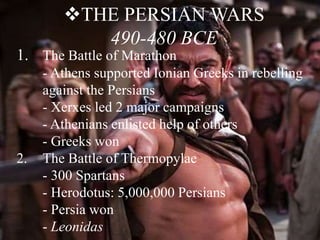
THE PERSIAN WARS
490-480 BCE
1. The Battle of Marathon
- Athens supported Ionian Greeks in rebelling
against the Persians
- Xerxes led 2 major campaigns
- Athenians enlisted help of others
- Greeks won
2. The Battle of Thermopylae
- 300 Spartans
- Herodotus: 5,000,000 Persians
- Persia won
- Leonidas
THE PERSIAN WARS
490-480 BCE
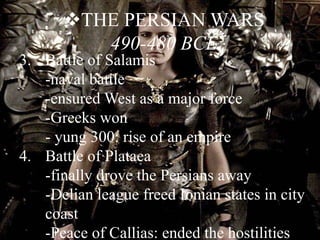
3. Battle of Salamis
-naval battle
-ensured West as a major force
-Greeks won
- yung 300: rise of an empire
4. Battle of Plataea
-finally drove the Persians away
-Delian league freed Ionian states in city
coast
-Peace of Callias: ended the hostilities
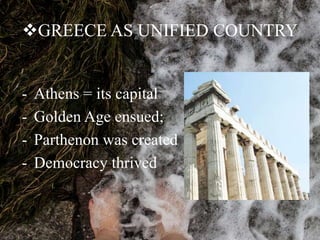
GREECE AS UNIFIED COUNTRY
- Athens = its capital
- Golden Age ensued;
- Parthenon was created
- Democracy thrived
THE PELOPONNESIAN WARS
- SPARTA vs. ATHENS
- About resources and power
- Island of Melos which was under Sparta
- Sparta won by Lysander
RISE OF MACEDON
- Greece was weak due to the
Peloponnesian war
- Philip II of Macedon started
- Alexander the Great conquered Persia
- When he died, the Greek influence was
at its peak
- Event developed Hellenistic culture
HELLENISTIC PERIOD
- Marked the end of the wars of Alexander
the Gr8
- Annexation of Greece to Roman Republic
- Marked the end of Greek independence
- Macedon was absorbed by Roman Empire
SCULPTURE
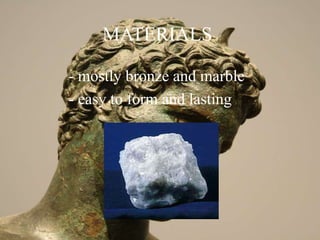
MATERIALS
- mostly bronze and marble
- easy to form and lasting
DEVELOPMENT OF GREEK
SCULPTURES
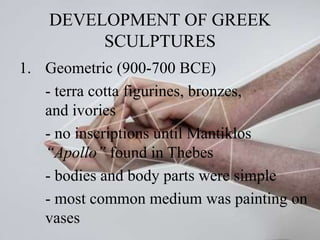
1. Geometric (900-700 BCE)
- terra cotta figurines, bronzes,
and ivories
- no inscriptions until Mantiklos
“Apollo” found in Thebes
- bodies and body parts were simple
- most common medium was painting on
vases
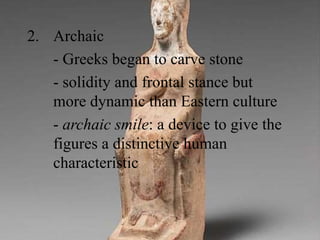
2. Archaic
- Greeks began to carve stone
- solidity and frontal stance but
more dynamic than Eastern culture
- archaic smile: a device to give the
figures a distinctive human
characteristic
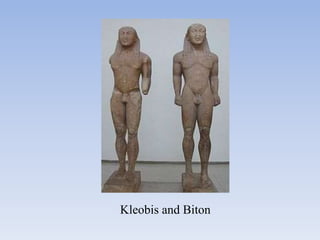
Kleobis and Biton
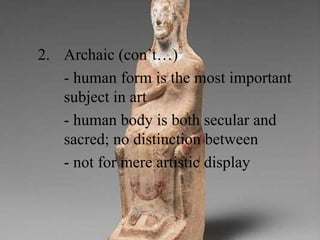
2. Archaic (con’t…)
- human form is the most important
subject in art
- human body is both secular and
sacred; no distinction between
- not for mere artistic display
2. Archaic (con’t…)
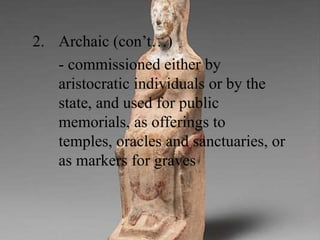
- commissioned either by
aristocratic individuals or by the
state, and used for public
memorials, as offerings to
temples, oracles and sanctuaries, or
as markers for graves
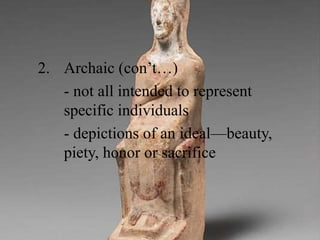
2. Archaic (con’t…)
- not all intended to represent
specific individuals
- depictions of an ideal—beauty,
piety, honor or sacrifice
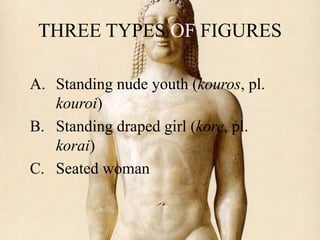
A. Standing nude youth (kouros, pl.
kouroi)
B. Standing draped girl (kore, pl.
korai)
C. Seated woman
THREE TYPES OF FIGURES
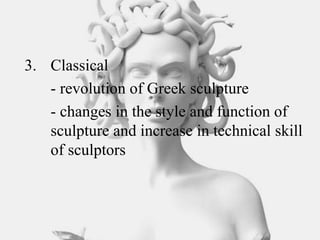
3. Classical
- revolution of Greek sculpture
- changes in the style and function of
sculpture and increase in technical skill
of sculptors
3. Classical(con’t…)
- poses also became more naturalistic
- increasingly to depict real people
- increase in the use of statues and
sculptures as decorations of building
3. Classical (con’t…)
- Funeral statuary evolved from the
rigid kouros of the Archaic period to
the highly personal family groups of
the Classical period
- burgeoning of artistic credit in
sculpture (Archaic and Geometrical
periods are centered upon the works
themselves)
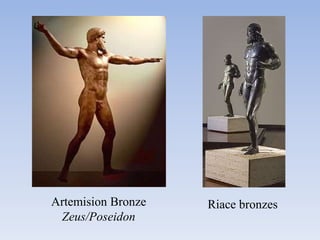
Artemision Bronze
Zeus/Poseidon
Riace bronzes
LYSISTRATUS
- said to have been the first to use plaster
molds taken from living people to
produce lost-wax portraits, and to have
also developed a technique of casting
from existing statues
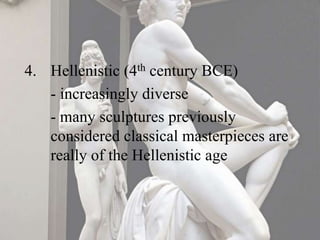
4. Hellenistic (4th century BCE)
- increasingly diverse
- many sculptures previously
considered classical masterpieces are
really of the Hellenistic age
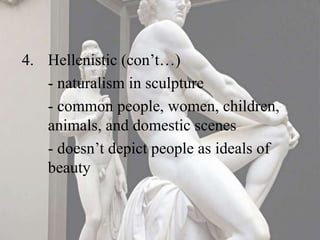
4. Hellenistic (con’t…)
- naturalism in sculpture
- common people, women, children,
animals, and domestic scenes
- doesn’t depict people as ideals of
beauty
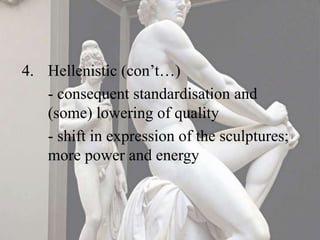
4. Hellenistic (con’t…)
- consequent standardisation and
(some) lowering of quality
- shift in expression of the sculptures;
more power and energy
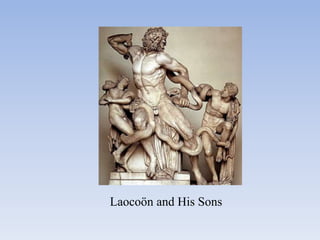
Laocoön and His Sons
• Western civilization
• Pottery decoration
• Heroic realism (realism)
• Paintings on pottery, murals, and panels
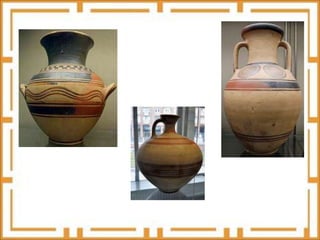
• Protogeometric style - features concentric circles
and patterns of straight, wavy, and zigzag lines.
• This reflects technological innovations, namely
the multi-headed brush (for painting parallel
lines) and the compass (for painting circles).
• Emphasized by sparseness
• Mythology, legends, and daily life
• Known mainly from vase painting. However, it
wasn't limited to pottery.
• Murals, frescoes, and panels
• Three phases: geometric, orientalizing, and black-
figure
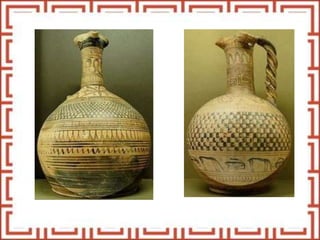
GEOMETRIC STYLE
• Elevated geometric decoration to new heights of
complexity.
• Features a variety of patterns, such as checkers,
repeated shapes, and meanders
• Human or animal figures - they are
rigidly stylized
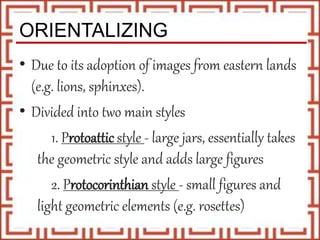
ORIENTALIZING
• Due to its adoption of images from eastern lands
(e.g. lions, sphinxes).
• Divided into two main styles
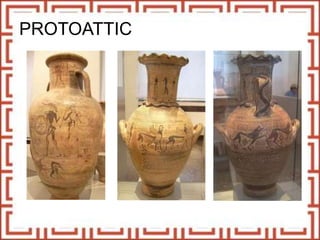
1. Protoattic style - large jars, essentially takes
the geometric style and adds large figures
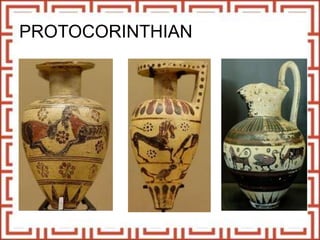
2. Protocorinthian style - small figures and
light geometric elements (e.g. rosettes)
PROTOATTIC
PROTOCORINTHIAN
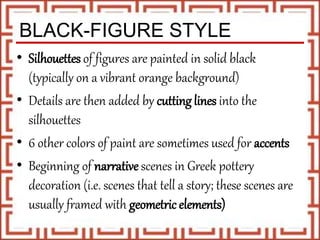
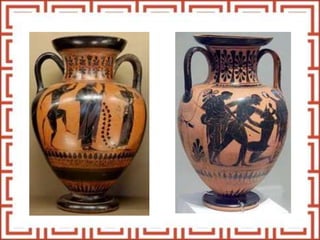
BLACK-FIGURE STYLE
• Silhouettes of figures are painted in solid black
(typically on a vibrant orange background)
• Details are then added by cutting lines into the
silhouettes
• 6 other colors of paint are sometimes used for accents
• Beginning of narrative scenes in Greek pottery
decoration (i.e. scenes that tell a story; these scenes are
usually framed with geometric elements)
• Age of “realistic wall painting”
• Reveals a grasp of linear perspective and
naturalist representation which would remain
unsurpassed until the Italian High Renaissance
• Apart from vase-painting, all types of painting
flourished during the Classical period
• Features three-dimensional perspective and
shading
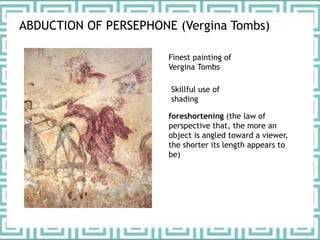
ABDUCTION OF PERSEPHONE (Vergina Tombs)
Skillful use of
shading
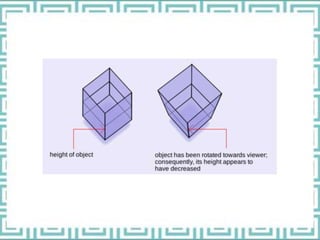
foreshortening (the law of
perspective that, the more an
object is angled toward a viewer,
the shorter its length appears to
be)
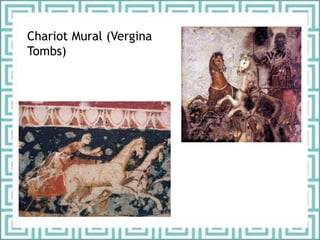
Finest painting of
Vergina Tombs
Chariot Mural (Vergina
Tombs)
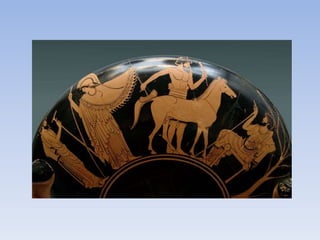
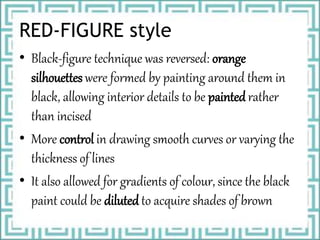
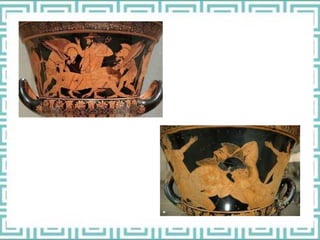
RED-FIGURE style
• Black-figure technique was reversed: orange
silhouettes were formed by painting around them in
black, allowing interior details to be painted rather
than incised
• More control in drawing smooth curves or varying the
thickness of lines
• It also allowed for gradients of colour, since the black
paint could be diluted to acquire shades of brown
PANEL PAINTING
• According to authors like Pliny (23-79 CE) or Pausanias
(active 143-176 CE), it is the highest and respected form of art
• done in encaustic (wax) or tempera
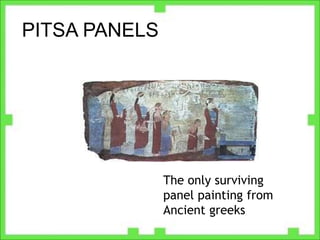
PITSA PANELS
The only surviving
panel painting from
Ancient greeks
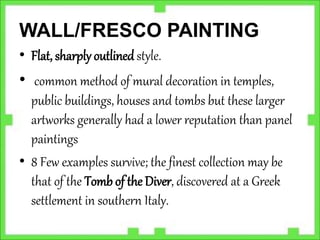
WALL/FRESCO PAINTING
• Flat, sharply outlined style.
• common method of mural decoration in temples,
public buildings, houses and tombs but these larger
artworks generally had a lower reputation than panel
paintings
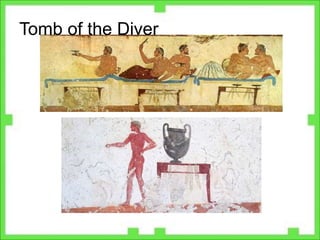
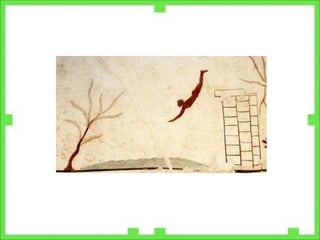
• 8 Few examples survive; the finest collection may be
that of the Tomb of the Diver, discovered at a Greek
settlement in southern Italy.
Tomb of the Diver
• Painting Greek style is also found in Pompeii
and Egypt.
• Painting was also used to
enhance architecture works, and sculptures.
http://www.essential-humanities.net/western-
art/painting/greek/#greek-dark-age
http://www.conservapedia.com/Greek_painting
http://www.visual-arts-cork.com/greek-art.htm
https://en.wikipedia.org/wiki/Ancient_Greek_art

ANCIENT GREEK ART PPT

  • 1.
  • 2.
    The culture ofGreece has evolved over thousands of years, beginning in Mycenaean Greece, continuing most notably into Classical Greece, through the influence of the Roman Empire and its successor the Byzantine Empire. Historians credit the Greek War of Independence with revitalizing Greece and giving birth to a single entity of its multi-faceted culture.
  • 3.
     The ancientGreeks pioneered in many fields that rely on systematic thought, including biology, geometry, history, philosophy, and physics. They introduced such important literary forms as epic and lyric poetry, history, tragedy, and comedy. In their pursuit of order and proportion, the Greeks created an ideal of beauty that strongly influenced Western art.
  • 4.
    The ancient Greekswere a deeply religious people. They worshipped many gods whom they believed appeared in human form and yet were endowed with superhuman strength and ageless beauty. Funerary Art: the ancient Greeks did not generally leave elaborate grave goods, except for a coin in the hand to pay Charon, the ferryman to Hades, and pottery; however the epitaphios or funeral oration (from which epitaph comes) was regarded as of great importance, and animal sacrifices were made.
  • 5.
    Men ran thegovernment, and spent a great deal of their time away from home. When not involved in politics, the men spent time in the fields, overseeing or working the crops, sailing, hunting, in manufacturing or in trade. For fun, in addition to drinking parties, the men enjoyed wrestling, horseback riding, and the famous Olympic Games. When the men entertained their male friends, at the popular drinking parties, their wives and daughters were not allowed to attend. With the exception of ancient Sparta, Greek women had very limited freedom outside the home. They could attend weddings, funerals, some religious festivals, and could visit female neighbors for brief periods of time. In their home, Greek women were in charge. Their job was to run the house and to bear children.
  • 6.
    The ancient Greeksconsidered their children to be 'youths' until they reached the age of 30! When a child was born to ancient Greek family, a naked father carried his child, in a ritual dance, around the household. Friends and relatives sent gifts. The family decorated the doorway of their home with a wreath of olives (for a boy) or a wreath of wool (for a girl). Education - Military Training - Sparta . The goal of education in the Greek city-states was to prepare the child for adult activities as a citizen. The nature of the city-states varied greatly, and this was also true of the education they considered appropriate. In most Greek city- states, when young, the boys stayed at home, helping in the fields, sailing, and fishing. At age 6 or 7, they went to school. Both daily life and education were very different in Sparta [militant], than in Athens [arts and culture] or in the other ancient Greek city-states.
  • 7.
    Birds, dogs, goats,tortoises, and mice were all popular pets. Cats, however, were not. Greek houses, in the 6th and 5th century B.C., were made up of two or three rooms, built around an open air courtyard, built of stone, wood, or clay bricks. Larger homes might also have a kitchen, a room for bathing, a men's dining room, and perhaps a woman's sitting area. Greek clothing was very simple. Men and women wore linen in the summer and wool in the winter. The ancient Greeks could buy cloth and clothes in the agora, the marketplace, but that was expensive. Most families made their own clothes, which were simple tunics and warm cloaks, made of linen or wool, dyed a bright color, or bleached white. Clothes were made by the mother, her daughters, and female slaves. They were often decorated to represent the city-state in which they lived. The ancient Greeks were very proud of their home city-state.
  • 8.
    Dancing - Music Dancewas very important to the ancient Greeks. They believed that dance improved both physical and emotional health. Rarely did men and women dance together. Some dances were danced by men and others by women. There were more than 200 ancient Greek dances; comic dances, warlike dances, dances for athletes and for religious worship, plus dances for weddings, funerals, and celebrations. Dance was accompanied by music played on lyres, flutes, and a wide variety of percussion instruments such as tambourines, cymbals and castanets.
  • 9.
    The ancient Greeksloved stories. They created many marvelous stories, myths, and fables that we enjoy today, like Odysseus and the Terrible Sea and Circe, a beautiful but evil enchantress. Aesop's Fables, written by Aesop, an ancient Greek, are still read and enjoyed all over the world. In ancient Athens, wedding ceremonies started after dark. The veiled bride traveled from her home to the home of the groom while standing in a chariot. Her family followed the chariot on foot, carrying the gifts.
  • 10.
    Slavery played amajor role in ancient Greek civilization. Slaves could be found everywhere. They worked not only as domestic servants, but as factory workers, shopkeepers, mineworkers, farm workers and as ship's crew members.
  • 11.
  • 12.
    - Known fordemocracy - Consists of separate city-states - Patriachal - Not really Greece until the Persian Wars (490-480 BCE) OVERVIEW
  • 13.
    THE HISTORIANS 1. Herodotus(c.480-c.429) – world’s first historian; described Persia 2. Thucydides (c.460-c.395) – objective; Peloponnesian wars 3. Xenophon (c.430-c.354) – continued Thucydides’ work on Peloponnesian wars; less objective
  • 14.
    ARCHAIC PERIOD - 8thcentury BCE - Important city-states: Athens, Sparta, Corinth, and Thebes - Athens welcomed democracy - Rise of city-states
  • 15.
    THE CITY-STATES - Calledpoleis (sing. polis) - Emerged from scattered farming villages - Own governments - Citizenship were exclusive to males - Athens: democratic - Sparta: militaristic oligarchy; 2 kings - Every state was protected by a god/goddess
  • 16.
    CLASSICAL PERIOD - Athensand Sparta allies against Persia - United Greece as a country - Formation of Delian League - Golden Age of Greece: flourishing of arts and crafts in time of peace
  • 17.
    THE PERSIAN WARS 490-480BCE 1. The Battle of Marathon - Athens supported Ionian Greeks in rebelling against the Persians - Xerxes led 2 major campaigns - Athenians enlisted help of others - Greeks won 2. The Battle of Thermopylae - 300 Spartans - Herodotus: 5,000,000 Persians - Persia won - Leonidas
  • 18.
    THE PERSIAN WARS 490-480BCE 3. Battle of Salamis -naval battle -ensured West as a major force -Greeks won - yung 300: rise of an empire 4. Battle of Plataea -finally drove the Persians away -Delian league freed Ionian states in city coast -Peace of Callias: ended the hostilities
  • 19.
    GREECE AS UNIFIEDCOUNTRY - Athens = its capital - Golden Age ensued; - Parthenon was created - Democracy thrived
  • 20.
    THE PELOPONNESIAN WARS -SPARTA vs. ATHENS - About resources and power - Island of Melos which was under Sparta - Sparta won by Lysander
  • 21.
    RISE OF MACEDON -Greece was weak due to the Peloponnesian war - Philip II of Macedon started - Alexander the Great conquered Persia - When he died, the Greek influence was at its peak - Event developed Hellenistic culture
  • 22.
    HELLENISTIC PERIOD - Markedthe end of the wars of Alexander the Gr8 - Annexation of Greece to Roman Republic - Marked the end of Greek independence - Macedon was absorbed by Roman Empire
  • 23.
  • 25.
    MATERIALS - mostly bronzeand marble - easy to form and lasting
  • 26.
    DEVELOPMENT OF GREEK SCULPTURES 1.Geometric (900-700 BCE) - terra cotta figurines, bronzes, and ivories - no inscriptions until Mantiklos “Apollo” found in Thebes - bodies and body parts were simple - most common medium was painting on vases
  • 27.
    2. Archaic - Greeksbegan to carve stone - solidity and frontal stance but more dynamic than Eastern culture - archaic smile: a device to give the figures a distinctive human characteristic
  • 28.
  • 29.
    2. Archaic (con’t…) -human form is the most important subject in art - human body is both secular and sacred; no distinction between - not for mere artistic display
  • 30.
    2. Archaic (con’t…) -commissioned either by aristocratic individuals or by the state, and used for public memorials, as offerings to temples, oracles and sanctuaries, or as markers for graves
  • 31.
    2. Archaic (con’t…) -not all intended to represent specific individuals - depictions of an ideal—beauty, piety, honor or sacrifice
  • 32.
    A. Standing nudeyouth (kouros, pl. kouroi) B. Standing draped girl (kore, pl. korai) C. Seated woman THREE TYPES OF FIGURES
  • 33.
    3. Classical - revolutionof Greek sculpture - changes in the style and function of sculpture and increase in technical skill of sculptors
  • 34.
    3. Classical(con’t…) - posesalso became more naturalistic - increasingly to depict real people - increase in the use of statues and sculptures as decorations of building
  • 35.
    3. Classical (con’t…) -Funeral statuary evolved from the rigid kouros of the Archaic period to the highly personal family groups of the Classical period - burgeoning of artistic credit in sculpture (Archaic and Geometrical periods are centered upon the works themselves)
  • 36.
  • 37.
    LYSISTRATUS - said tohave been the first to use plaster molds taken from living people to produce lost-wax portraits, and to have also developed a technique of casting from existing statues
  • 38.
    4. Hellenistic (4thcentury BCE) - increasingly diverse - many sculptures previously considered classical masterpieces are really of the Hellenistic age
  • 39.
    4. Hellenistic (con’t…) -naturalism in sculpture - common people, women, children, animals, and domestic scenes - doesn’t depict people as ideals of beauty
  • 40.
    4. Hellenistic (con’t…) -consequent standardisation and (some) lowering of quality - shift in expression of the sculptures; more power and energy
  • 41.
  • 43.
    • Western civilization •Pottery decoration • Heroic realism (realism) • Paintings on pottery, murals, and panels
  • 45.
    • Protogeometric style- features concentric circles and patterns of straight, wavy, and zigzag lines. • This reflects technological innovations, namely the multi-headed brush (for painting parallel lines) and the compass (for painting circles). • Emphasized by sparseness
  • 48.
    • Mythology, legends,and daily life • Known mainly from vase painting. However, it wasn't limited to pottery. • Murals, frescoes, and panels • Three phases: geometric, orientalizing, and black- figure
  • 49.
    GEOMETRIC STYLE • Elevatedgeometric decoration to new heights of complexity. • Features a variety of patterns, such as checkers, repeated shapes, and meanders • Human or animal figures - they are rigidly stylized
  • 51.
    ORIENTALIZING • Due toits adoption of images from eastern lands (e.g. lions, sphinxes). • Divided into two main styles 1. Protoattic style - large jars, essentially takes the geometric style and adds large figures 2. Protocorinthian style - small figures and light geometric elements (e.g. rosettes)
  • 52.
  • 53.
  • 54.
    BLACK-FIGURE STYLE • Silhouettesof figures are painted in solid black (typically on a vibrant orange background) • Details are then added by cutting lines into the silhouettes • 6 other colors of paint are sometimes used for accents • Beginning of narrative scenes in Greek pottery decoration (i.e. scenes that tell a story; these scenes are usually framed with geometric elements)
  • 57.
    • Age of“realistic wall painting” • Reveals a grasp of linear perspective and naturalist representation which would remain unsurpassed until the Italian High Renaissance • Apart from vase-painting, all types of painting flourished during the Classical period • Features three-dimensional perspective and shading
  • 58.
    ABDUCTION OF PERSEPHONE(Vergina Tombs) Skillful use of shading foreshortening (the law of perspective that, the more an object is angled toward a viewer, the shorter its length appears to be) Finest painting of Vergina Tombs
  • 60.
  • 61.
    RED-FIGURE style • Black-figuretechnique was reversed: orange silhouettes were formed by painting around them in black, allowing interior details to be painted rather than incised • More control in drawing smooth curves or varying the thickness of lines • It also allowed for gradients of colour, since the black paint could be diluted to acquire shades of brown
  • 63.
    PANEL PAINTING • Accordingto authors like Pliny (23-79 CE) or Pausanias (active 143-176 CE), it is the highest and respected form of art • done in encaustic (wax) or tempera
  • 64.
    PITSA PANELS The onlysurviving panel painting from Ancient greeks
  • 65.
    WALL/FRESCO PAINTING • Flat,sharply outlined style. • common method of mural decoration in temples, public buildings, houses and tombs but these larger artworks generally had a lower reputation than panel paintings • 8 Few examples survive; the finest collection may be that of the Tomb of the Diver, discovered at a Greek settlement in southern Italy.
  • 66.
  • 68.
    • Painting Greekstyle is also found in Pompeii and Egypt. • Painting was also used to enhance architecture works, and sculptures.
  • 69.