EGYPTIAN ART
PRESENTATION BY
IMPRAIM – SWANZY ENOCK
(M.Phil African Art & Culture, B.Ed Art)
………………………………………………………………………
…………………………………………………………………
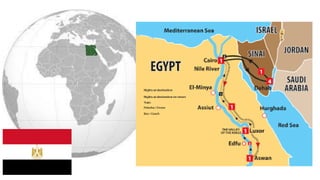
•Egypt is a country located at the northern part
of Africa. Their capital is Cairo. Their kings are
called Pharaohs. They were powerful and
considered as gods.
•Egypt is found along the river Nile with
abundance of papyrus plants along it banks.
•Egypt became the center of civilization around
5000BC.
•Egyptian Art refers to the paintings, sculpture,
decorative arts and architecture produced by the
Egyptians between 5000BC and 300BC to honour
the dead (ancestor)
•Their arts were considered as “Art for Eternity”
or “Funeral Art”
•Their arts were for religious purposes
Religion and Beliefs
• Egyptians were polytheist; believed and worshiped
many gods such as Ra (the sun god), Osiris (god of
the Nile), Horus (the sky god) etc.
• The gods appear in human or animal forms or
combinations
• They belief in life after death, when a person dies,
the soul continues to live in another world in the
same body
Artforms
•Paintings
•Sculpture
•Architecture
•Decorative arts
•Pottery
•Literature
Paintings
•Paintings were done on papyrus paper,
wooden panels, and walls of temples and
tombs.
•Images appear in profile
•Men were painted bigger and darker than
women
•Slaves were painted very small
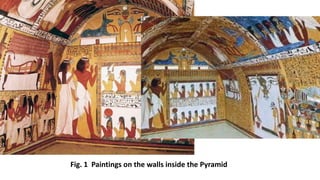
•The ancient Egyptians decorated tombs
with paintings to ensure that the
deceased spent eternity in a
comfortable and familiar environment
Fig. 1 Paintings on the walls inside the Pyramid
Sculpture
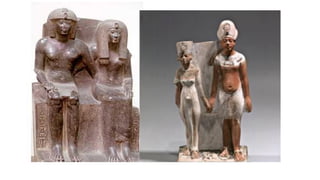
•Life size figures were carved in stones
•Standing figures had their left feet placed
in a forward position
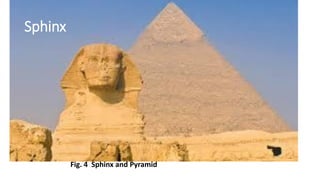
•Huge statues (sphinxes) were placed in
front of the pyramids to guard the tombs
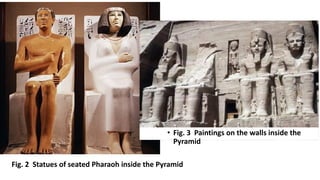
•In ancient Egypt, many sculptures were
placed in tombs, where they
represented the deceased and received
offerings from the living
Fig. 2 Statues of seated Pharaoh inside the Pyramid
• Fig. 3 Paintings on the walls inside the
Pyramid
Sphinx
Fig. 4 Sphinx and Pyramid
Architecture
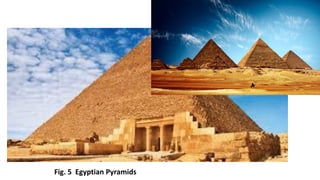
•Egyptians made one of the greatest structures
ever built in the world e.g. Royal tombs and
pyramid
•Mastaba
•Tombs of the elite
•Temples
•Palaces
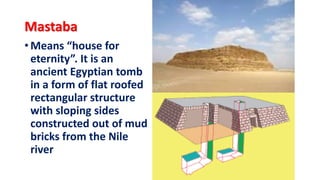
Mastaba
• Means “house for
eternity”. It is an
ancient Egyptian tomb
in a form of flat roofed
rectangular structure
with sloping sides
constructed out of mud
bricks from the Nile
river
Fig. 5 Egyptian Pyramids
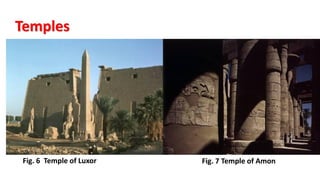
Temples
Fig. 7 Temple of AmonFig. 6 Temple of Luxor
•The Egyptians wore jewelry and amulets
(charms) not only as decoration, but
because they believed these items
protected them against harm. They
buried their dead with jewelry and
amulets for the same reason: to protect
against the perils(dangers) of the
afterlife.
Decorative arts
Relevance and Influence of Egyptian Art on other
cultures
•Egyptians influenced Greek sculpture
•Introduced a system of picture writings called
hieroglyphics
•The Ancient Egyptians invented the calendar
system
•They invented paper from papyrus reed, a plant
found in Egypt
•They believed that when they die, their soul (ka)
will live in another world but in the same body.
Thank you
We will discuss the foreign influence on Egyptian Art
on our next meeting

Egyptian art

  • 1.
    EGYPTIAN ART PRESENTATION BY IMPRAIM– SWANZY ENOCK (M.Phil African Art & Culture, B.Ed Art)
  • 2.
  • 3.
    •Egypt is acountry located at the northern part of Africa. Their capital is Cairo. Their kings are called Pharaohs. They were powerful and considered as gods. •Egypt is found along the river Nile with abundance of papyrus plants along it banks. •Egypt became the center of civilization around 5000BC.
  • 4.
    •Egyptian Art refersto the paintings, sculpture, decorative arts and architecture produced by the Egyptians between 5000BC and 300BC to honour the dead (ancestor) •Their arts were considered as “Art for Eternity” or “Funeral Art” •Their arts were for religious purposes
  • 5.
    Religion and Beliefs •Egyptians were polytheist; believed and worshiped many gods such as Ra (the sun god), Osiris (god of the Nile), Horus (the sky god) etc. • The gods appear in human or animal forms or combinations • They belief in life after death, when a person dies, the soul continues to live in another world in the same body
  • 6.
  • 7.
    Paintings •Paintings were doneon papyrus paper, wooden panels, and walls of temples and tombs. •Images appear in profile •Men were painted bigger and darker than women •Slaves were painted very small
  • 8.
    •The ancient Egyptiansdecorated tombs with paintings to ensure that the deceased spent eternity in a comfortable and familiar environment
  • 9.
    Fig. 1 Paintingson the walls inside the Pyramid
  • 10.
    Sculpture •Life size figureswere carved in stones •Standing figures had their left feet placed in a forward position •Huge statues (sphinxes) were placed in front of the pyramids to guard the tombs
  • 11.
    •In ancient Egypt,many sculptures were placed in tombs, where they represented the deceased and received offerings from the living
  • 12.
    Fig. 2 Statuesof seated Pharaoh inside the Pyramid • Fig. 3 Paintings on the walls inside the Pyramid
  • 14.
  • 15.
    Architecture •Egyptians made oneof the greatest structures ever built in the world e.g. Royal tombs and pyramid •Mastaba •Tombs of the elite •Temples •Palaces
  • 16.
    Mastaba • Means “housefor eternity”. It is an ancient Egyptian tomb in a form of flat roofed rectangular structure with sloping sides constructed out of mud bricks from the Nile river
  • 17.
  • 18.
    Temples Fig. 7 Templeof AmonFig. 6 Temple of Luxor
  • 19.
    •The Egyptians worejewelry and amulets (charms) not only as decoration, but because they believed these items protected them against harm. They buried their dead with jewelry and amulets for the same reason: to protect against the perils(dangers) of the afterlife. Decorative arts
  • 20.
    Relevance and Influenceof Egyptian Art on other cultures •Egyptians influenced Greek sculpture •Introduced a system of picture writings called hieroglyphics •The Ancient Egyptians invented the calendar system •They invented paper from papyrus reed, a plant found in Egypt •They believed that when they die, their soul (ka) will live in another world but in the same body.
  • 21.
    Thank you We willdiscuss the foreign influence on Egyptian Art on our next meeting