THE
ANCIENT
GREEK ART
THE ANCIENT GREEK ART
• Most influential cultures in the
world.
• Rich collection of myth, music,
drama, and art.
• Greek art started 3000 years ago.
GOLDEN
AGES
ARCHAIC PERIOD
= EGYPTIAN INFLUENCE ART
CLASSICAL PERIOD
= IDEALISTIC ART, FULL PERFECTION
BOTH SCULPTURE AND ARCHITECTURE.
THE HELLENIC ART
= TIME WHEN ARCHITECTURE
DECLINE
Five forms where Ancient Greek
Arts Excelled
POTTERY
POTTERY
• Primary for pottery.
• Declaration became more figurative ( animals,
human figures, and zoomorphs ).
• Pottery was introduced by the corinthians.
ARCHITECTURE
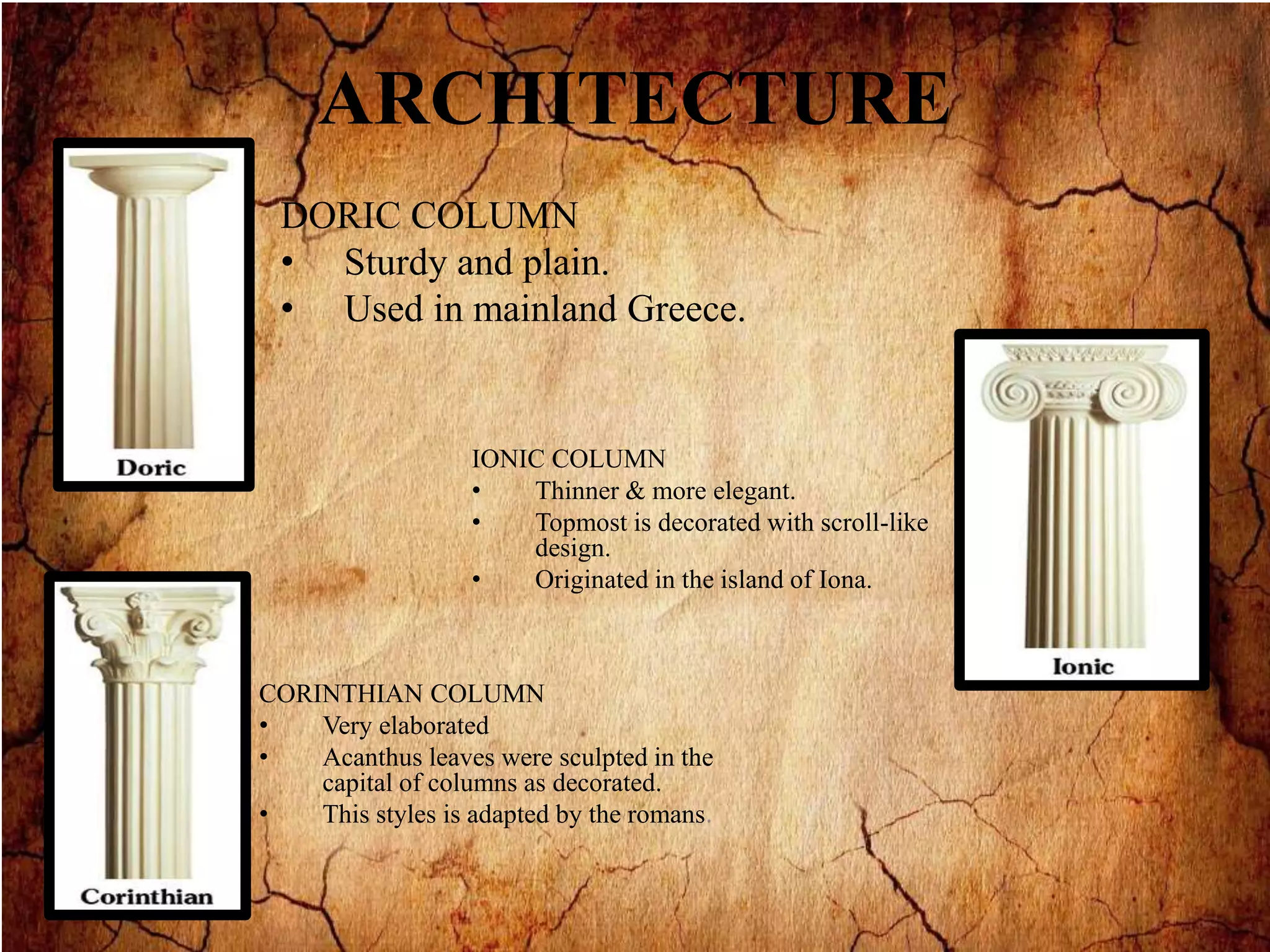
DORIC COLUMN
• Sturdy and plain.
• Used in mainland Greece.
IONIC COLUMN
• Thinner & more elegant.
• Topmost is decorated with scroll-like
design.
• Originated in the island of Iona.
CORINTHIAN COLUMN
• Very elaborated
• Acanthus leaves were sculpted in the
capital of columns as decorated.
• This styles is adapted by the romans.
Temple of Hera
Temple of
Olympian
Temple of
Athena
SCULPTURE
• Influence by Egyptians and
Syrians techniques.
• Figures sculpted were mainly
“Kouros and Kore”
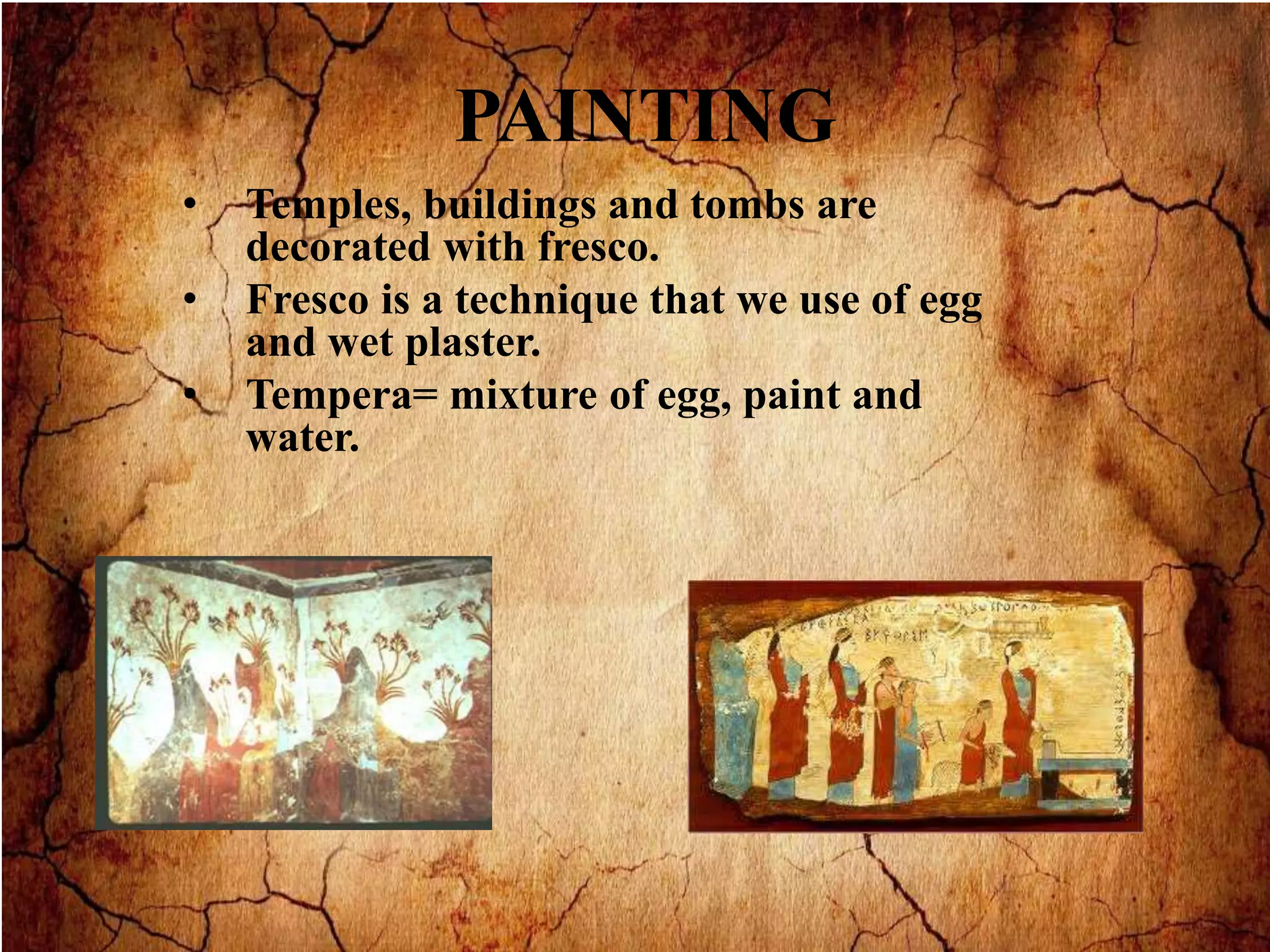
PAINTING
• Temples, buildings and tombs are
decorated with fresco.
• Fresco is a technique that we use of egg
and wet plaster.
• Tempera= mixture of egg, paint and
water.
THE CLASSICAL
PERIOD
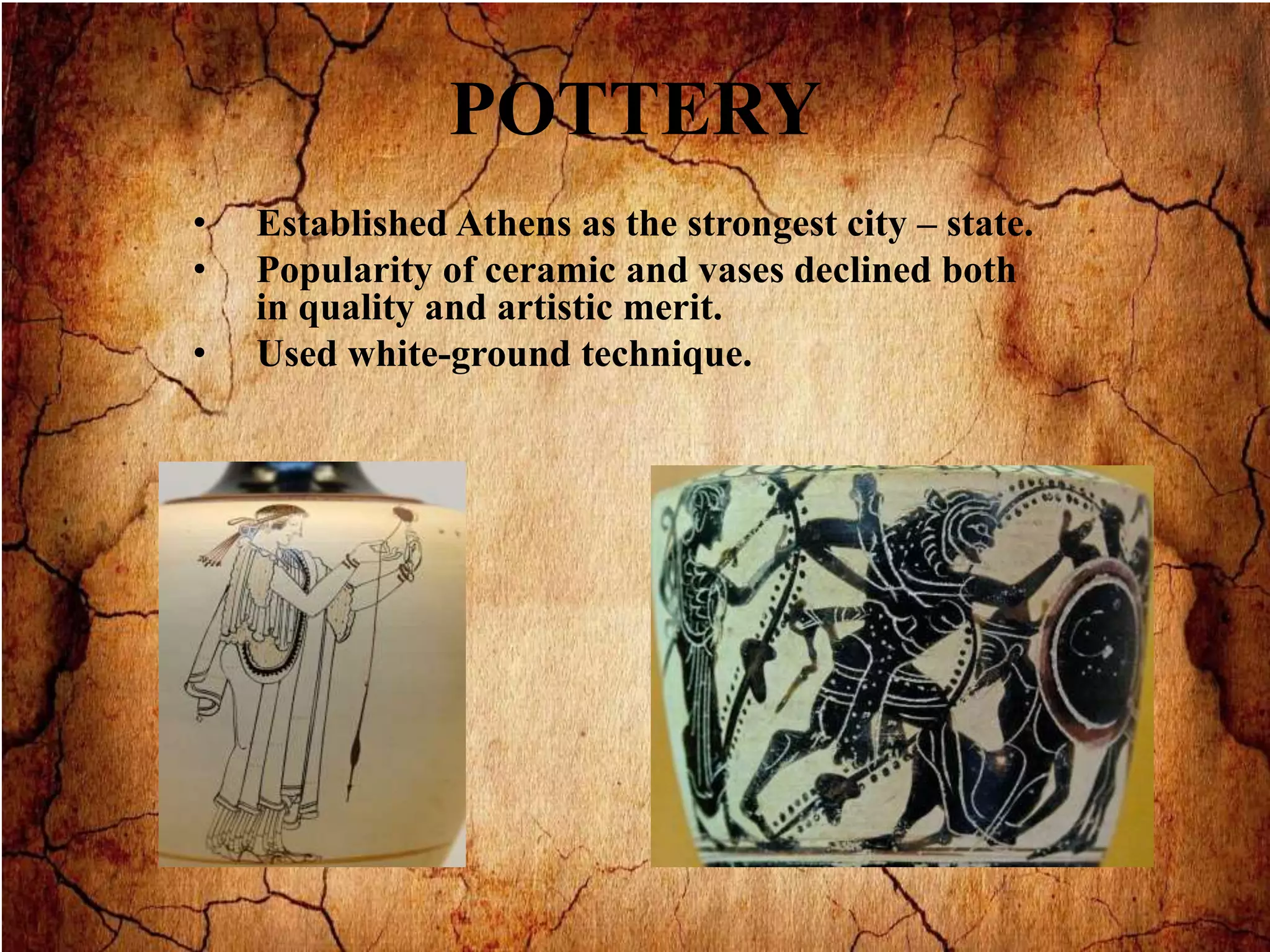
POTTERY
• Established Athens as the strongest city – state.
• Popularity of ceramic and vases declined both
in quality and artistic merit.
• Used white-ground technique.
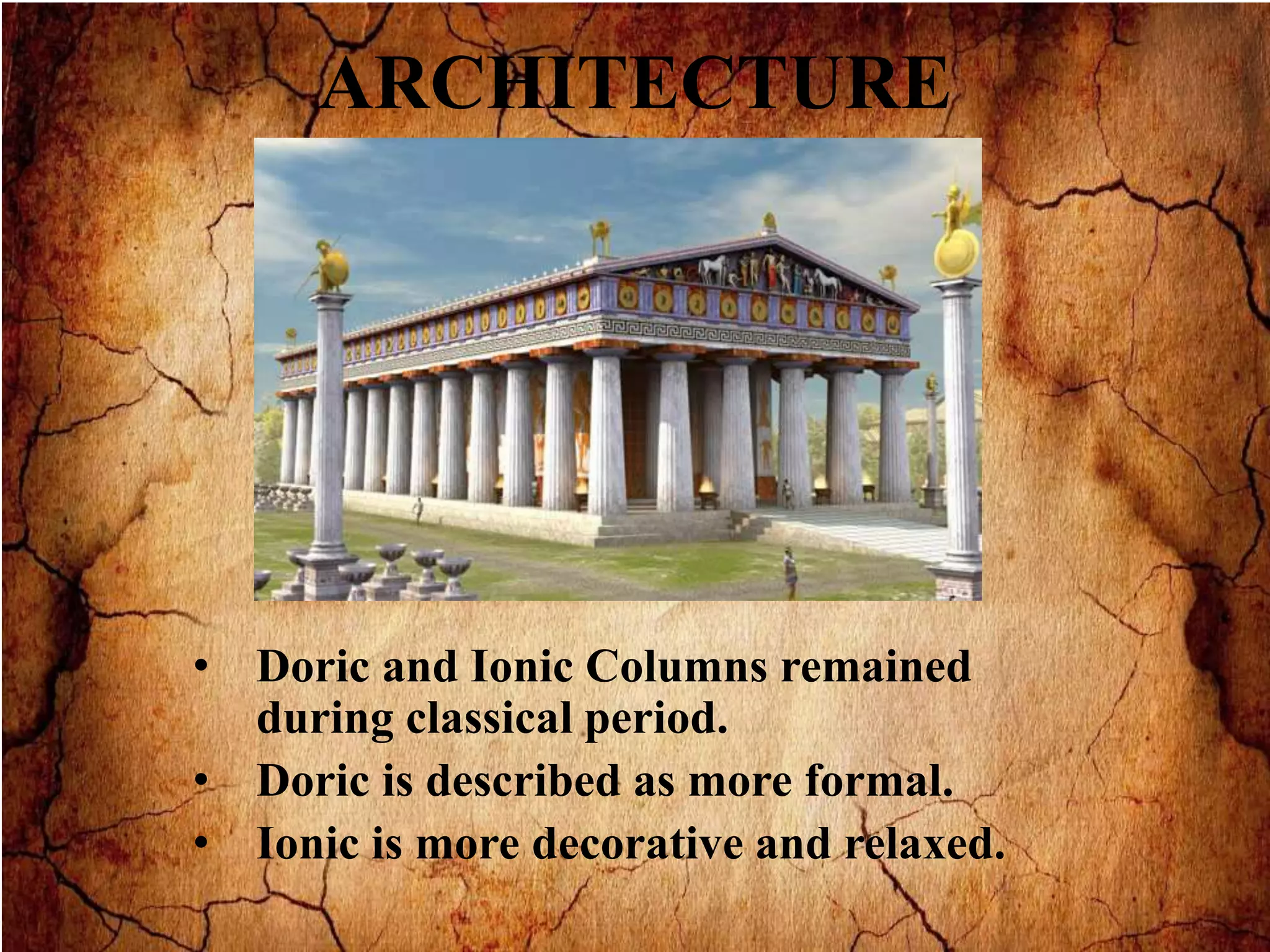
ARCHITECTURE
• Doric and Ionic Columns remained
during classical period.
• Doric is described as more formal.
• Ionic is more decorative and relaxed.
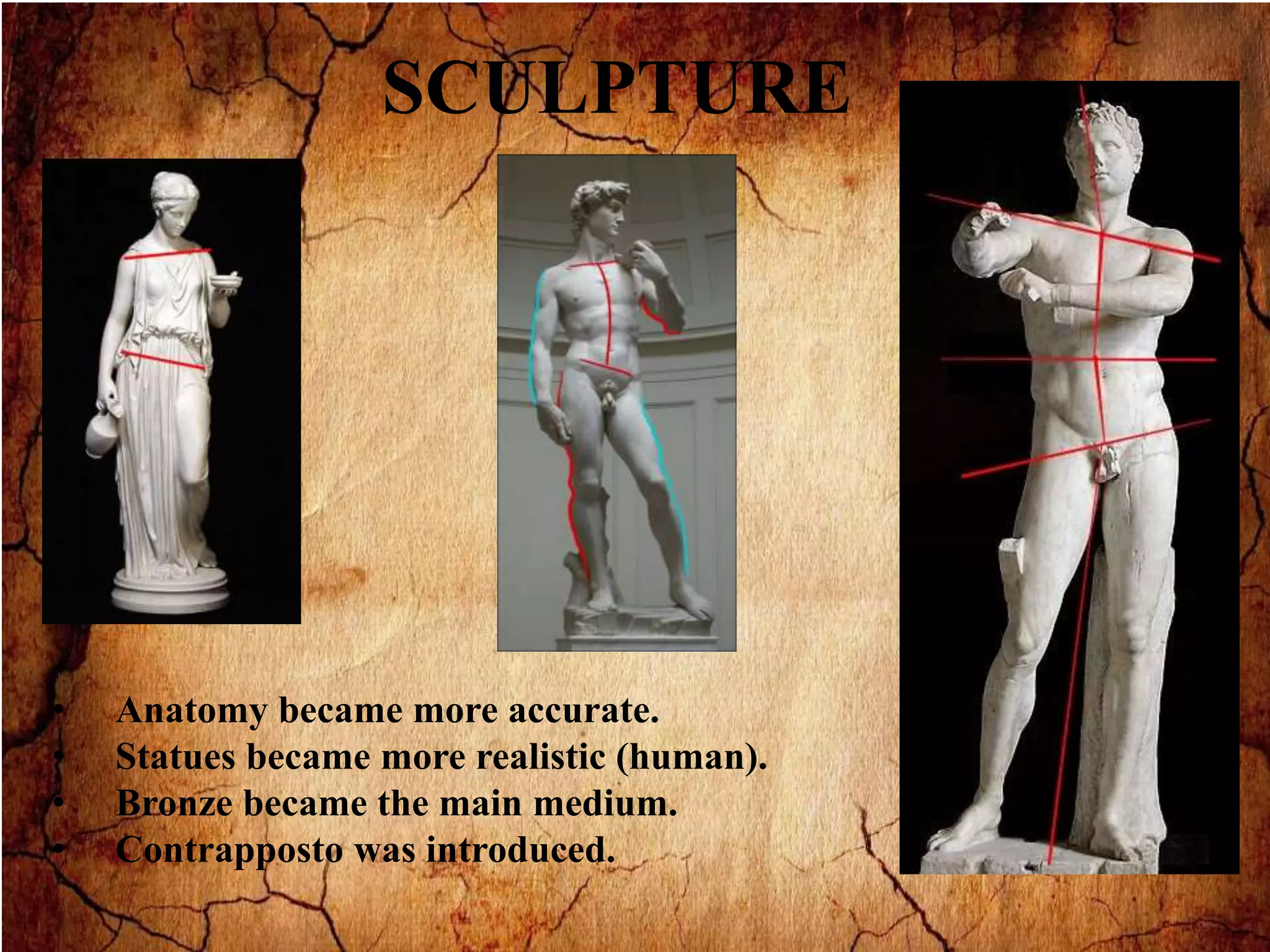
SCULPTURE
• Anatomy became more accurate.
• Statues became more realistic (human).
• Bronze became the main medium.
• Contrapposto was introduced.
FAMOUS
SCULPTORS
MYRON
Discus Thrower
• Greatest sculptor of his
time.
• First to achieve life-like
representation in figurative
sculpture.
• Gods, heroes and Athletes.
POLYKLEITOS
Doryphorus
• Sometimes called Elder.
• Greatest sculptors of
Classical Antiquity.
• Known for his bronze
sculptures.
CALLIMACHUS
Muses
• Poet, Critic and Scholar
at the Library of
Alexandria=largest
library in ancient world.
• Muses the nine
goddesses of art.
HELLENISTIC PERIOD
HELLENISTIC PERIOD
• Secular patrons
influence sculpture
and mosaic.
• Wide range of pottery
was produced.
• But not given much
importance.
SCULPTURE
CHARACTERISTICS
I. Naturalism was continually used.
II. Animals and ordinary people were accepted as
major subject.
III. Although production of sculptures was
increased, workmanship and creativity greatly
suffered.
IV. Greater expression characterized the
sculptures of this period.
Colossus of Rhodes
The Dying Gaul
The Farnese Bull
The Winged Victory
The Three Graces
The Medici Venus
The Pergamon Altar
Borghese
Gladiator
Laocoon and
his Sons
Borghese Vase
Venus De Milo
Barberini Faun
ARCHITECTURE
I. Temple of immense size
II. Theaters of similarly colossal
III.Storied colonel (stoa)
IV.Public monument
V. Monumental tomb (mausoleum)
VI.Council building (bouleuterion)
VII.Processional gateway (propylon)
VIII.Stadium
IX.Public square

The Ancient Greek Art