Baroque Period
Baroque Painting
• encompasses a great
range of styles, as most
important and major
painting during the period
beginning around 1600
and continuing
throughout the 17th
century, and into the early
18th century is identified
today as Baroque
painting.

• characterized by great
drama, rich, deep
colour, and intense light
and dark shadows
Baroque art was meant to evoke emotion and passion
instead of the calm rationality that had been prized
during the Renaissance.

Michelangelo, working in the
High Renaissance, shows his
David composed and still before
he battles Goliath

Bernini's Baroque David is
caught in the act of hurling the
stone at the giant.
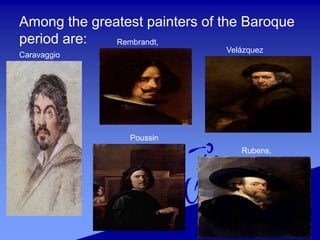
Among the greatest painters of the Baroque
period are:
Rembrandt,
Velázquez

Caravaggio

Poussin
Rubens,
Michelangelo Merisi / Amerighi da Caravaggio
(September 29, 1571 – July 18 1610)
•an Italian artist active in
Rome, Naples, Malta, and Sicily between
1592 and 1610
• His paintings, which combine a realistic
observation of the human state, both
physical and emotional, with a dramatic
use of lighting, had a formative influence
on the Baroque school of painting.
Caravaggio's Artwork
Amor Vincit Omnia. 1601–1602.
Gemäldegalerie, Berlin. Caravaggio shows
Cupid prevailing over all human
endeavors:
war, music, science, government.
Caravaggio's Artwork
•The Musicians, 1595–
1596, Metropolitan
Museum of Art, New York.

• thought to have been
his first painting done
expressly for the
cardinal.
Caravaggio's Artwork
Caravaggio's approach
was, typically, to choose the moment
of greatest dramatic impact, the
moment of the decapitation itself. The
figures are set out in a shallow
stage, theatrically lit from the
side, isolated against the inky, black
background. Judith and her maid
Abra stand to the right, partially over
Holofernes, who is vulnerable on his
back. X-rays have revealed that
Caravaggio adjusted the placement of
Holofernes' head as he
proceeded, separating it slightly from
the torso and moving it slightly to the
right. The faces of the three
characters demonstrate his mastery
of emotion, Judith in particular
showing in her face a mix of

Judith Beheading Holofernes
1598–1599. Galleria Nazionale
d'Arte Antica, Rome.
Rembrandt Harmenszoon van Rijn
(July 15 1606– October4 1669)
•Dutch painter and etcher. He is
generally considered one of the
greatest painters and printmakers in
European art and the most important
in Dutch history.
• His contributions to art came in a period of
great wealth and cultural achievement that
historians call the Dutch Golden Age when
Dutch Golden Age painting, although in
many ways antithetical to the Baroque style
that dominated Europe, was extremely
prolific and innovative.
Rembrandt's Artwork

The Storm on the Sea of Galilee, 1633. The painting is still missing after
the robbery from the Isabella Stewart Gardner Museum in 1990.
Rembrandt's Artwork
It is prominently displayed
in the
Rijksmuseum, Amsterdam, t
he Netherlands, as the best
known painting in its
collection. The Night Watch
is one of the most famous
paintings in the world.

The Night Watch or The Militia Company of Captain
Frans Banning Cocq, 1642. Oil on canvas; on
display at the Rijksmuseum, Amsterdam
Rembrandt's Artwork
The Abduction of
Europa, 1632. Oil on
panel. The work has been
described as "...a shining
example of the 'golden
age' of Baroque painting."
Peter Paul Rubens
(June 28 1577 – May 30 1640)
a Flemish Baroque
painter, and a
proponent of an
extravagant Baroque
style that emphasised
movement, colour, an
d sensuality.

well known for his
CounterReformation
altarpieces, portraits
, landscapes, and
history paintings of
mythological and
allegorical subjects.
Rubens' Artwork
•Once attributed to the minor
Dutch artist Karel van
Mander, it is now recognised
as a work by Rubens.
•reflects Raphael's influence
on Titian and Jan Brueghel
the Elder's influence on
Rubens, who adds a parrot
and changes Adam's
posture, musculature, age
and expression.

The Fall of Man or Adam and Eve 1628–
29. Prado, Madrid
Rubens' Artwork
Peter Paul
Rubens presented
his Venus in Front
of the Mirror as
the ultimate
symbol of beauty.

Venus at the Mirror, 1615
Rubens' Artwork
The painting was
held in the personal
collection of the
artist until his
death, then in 1666 it
went to the Royal
Alcazar of
Madrid, before
hanging in the
Museo del Prado.

The Three Graces, 1635, Prado
Diego Rodríguez de Silva y Velázquez
( June 6, 1599 – August 6, 1660)
• a Spanish painter who was the
leading artist in the court of King Philip
IV and one of the most important
painters of the Spanish Golden Age.
• Velázquez's artwork was a model for
the realist and impressionist painters,
Velázquez's Artwork
The work's complex
and enigmatic
composition raises
questions about
reality and
illusion, and creates
an uncertain
relationship between
the viewer and the
figures depicted.
Because of these
complexities, Las
Meninas has been
one of the most widely
analyzed works in
Western painting.
Las Meninas (Spanish for The Maids of Honour) 1656
Velázquez's Artwork

The triumph of Bacchus/Los Borrachos 1629 (The Drinkers/The Drunks)
The painting shows Bacchus surrounded by drunks.
Velázquez's Artwork
shows the influence of
chiaroscuro, with a
strong light source
coming in from the left
illuminating the
woman, her utensils and
the poaching
eggs, while throwing the
background and the boy
standing to her right into
deep shadow.

Vieja friendo huevos (1618, English: Old Woman
Frying Eggs). National Gallery of Scotland, Edinburgh.
Nicolas Poussin
(June 15 1594 – November 19 1665)
the leading painter of
the classical French
Baroque
style, although he
spent most of his
working life in Rome.
His work is
characterized by
clarity, logic, and
order, and favors line
over color.
Poussin's Artwork
The composition is
built in a series of
opposing
diagonals, highlightin
g Venus’s shapely
limbs and soft belly
and casting the
lovers into
shadow, foreboding
Adonis’s imminent
doom.

Venus and Adonis French (1594–1665)
Kimbell Art Museum, Fort Worth, Texas.
Poussin's Artwork
Poussin shows
the cause of
Cephalus'
rejection of
Aurora through
the putto holding
up Procris'
portrait

Cephalus and Aurora - Nicolas Poussin - 1627 - National
Gallery, London.
Poussin's Artwork

Selene and Endymion 1630s - The Detroit Institute of Arts.
Poussin's painting shows Endymion awake, kneeling to
welcome the arrival of the moon goddess, while her brother
the sun-god is just beginning his journey across the heavens
in his golden chariot.
Thank you
Baroque art

Baroque art

  • 1.
  • 2.
    Baroque Painting • encompassesa great range of styles, as most important and major painting during the period beginning around 1600 and continuing throughout the 17th century, and into the early 18th century is identified today as Baroque painting. • characterized by great drama, rich, deep colour, and intense light and dark shadows
  • 3.
    Baroque art wasmeant to evoke emotion and passion instead of the calm rationality that had been prized during the Renaissance. Michelangelo, working in the High Renaissance, shows his David composed and still before he battles Goliath Bernini's Baroque David is caught in the act of hurling the stone at the giant.
  • 4.
    Among the greatestpainters of the Baroque period are: Rembrandt, Velázquez Caravaggio Poussin Rubens,
  • 5.
    Michelangelo Merisi /Amerighi da Caravaggio (September 29, 1571 – July 18 1610) •an Italian artist active in Rome, Naples, Malta, and Sicily between 1592 and 1610 • His paintings, which combine a realistic observation of the human state, both physical and emotional, with a dramatic use of lighting, had a formative influence on the Baroque school of painting.
  • 6.
    Caravaggio's Artwork Amor VincitOmnia. 1601–1602. Gemäldegalerie, Berlin. Caravaggio shows Cupid prevailing over all human endeavors: war, music, science, government.
  • 7.
    Caravaggio's Artwork •The Musicians,1595– 1596, Metropolitan Museum of Art, New York. • thought to have been his first painting done expressly for the cardinal.
  • 8.
    Caravaggio's Artwork Caravaggio's approach was,typically, to choose the moment of greatest dramatic impact, the moment of the decapitation itself. The figures are set out in a shallow stage, theatrically lit from the side, isolated against the inky, black background. Judith and her maid Abra stand to the right, partially over Holofernes, who is vulnerable on his back. X-rays have revealed that Caravaggio adjusted the placement of Holofernes' head as he proceeded, separating it slightly from the torso and moving it slightly to the right. The faces of the three characters demonstrate his mastery of emotion, Judith in particular showing in her face a mix of Judith Beheading Holofernes 1598–1599. Galleria Nazionale d'Arte Antica, Rome.
  • 9.
    Rembrandt Harmenszoon vanRijn (July 15 1606– October4 1669) •Dutch painter and etcher. He is generally considered one of the greatest painters and printmakers in European art and the most important in Dutch history. • His contributions to art came in a period of great wealth and cultural achievement that historians call the Dutch Golden Age when Dutch Golden Age painting, although in many ways antithetical to the Baroque style that dominated Europe, was extremely prolific and innovative.
  • 10.
    Rembrandt's Artwork The Stormon the Sea of Galilee, 1633. The painting is still missing after the robbery from the Isabella Stewart Gardner Museum in 1990.
  • 11.
    Rembrandt's Artwork It isprominently displayed in the Rijksmuseum, Amsterdam, t he Netherlands, as the best known painting in its collection. The Night Watch is one of the most famous paintings in the world. The Night Watch or The Militia Company of Captain Frans Banning Cocq, 1642. Oil on canvas; on display at the Rijksmuseum, Amsterdam
  • 12.
    Rembrandt's Artwork The Abductionof Europa, 1632. Oil on panel. The work has been described as "...a shining example of the 'golden age' of Baroque painting."
  • 13.
    Peter Paul Rubens (June28 1577 – May 30 1640) a Flemish Baroque painter, and a proponent of an extravagant Baroque style that emphasised movement, colour, an d sensuality. well known for his CounterReformation altarpieces, portraits , landscapes, and history paintings of mythological and allegorical subjects.
  • 14.
    Rubens' Artwork •Once attributedto the minor Dutch artist Karel van Mander, it is now recognised as a work by Rubens. •reflects Raphael's influence on Titian and Jan Brueghel the Elder's influence on Rubens, who adds a parrot and changes Adam's posture, musculature, age and expression. The Fall of Man or Adam and Eve 1628– 29. Prado, Madrid
  • 15.
    Rubens' Artwork Peter Paul Rubenspresented his Venus in Front of the Mirror as the ultimate symbol of beauty. Venus at the Mirror, 1615
  • 16.
    Rubens' Artwork The paintingwas held in the personal collection of the artist until his death, then in 1666 it went to the Royal Alcazar of Madrid, before hanging in the Museo del Prado. The Three Graces, 1635, Prado
  • 17.
    Diego Rodríguez deSilva y Velázquez ( June 6, 1599 – August 6, 1660) • a Spanish painter who was the leading artist in the court of King Philip IV and one of the most important painters of the Spanish Golden Age. • Velázquez's artwork was a model for the realist and impressionist painters,
  • 18.
    Velázquez's Artwork The work'scomplex and enigmatic composition raises questions about reality and illusion, and creates an uncertain relationship between the viewer and the figures depicted. Because of these complexities, Las Meninas has been one of the most widely analyzed works in Western painting. Las Meninas (Spanish for The Maids of Honour) 1656
  • 19.
    Velázquez's Artwork The triumphof Bacchus/Los Borrachos 1629 (The Drinkers/The Drunks) The painting shows Bacchus surrounded by drunks.
  • 20.
    Velázquez's Artwork shows theinfluence of chiaroscuro, with a strong light source coming in from the left illuminating the woman, her utensils and the poaching eggs, while throwing the background and the boy standing to her right into deep shadow. Vieja friendo huevos (1618, English: Old Woman Frying Eggs). National Gallery of Scotland, Edinburgh.
  • 21.
    Nicolas Poussin (June 151594 – November 19 1665) the leading painter of the classical French Baroque style, although he spent most of his working life in Rome. His work is characterized by clarity, logic, and order, and favors line over color.
  • 22.
    Poussin's Artwork The compositionis built in a series of opposing diagonals, highlightin g Venus’s shapely limbs and soft belly and casting the lovers into shadow, foreboding Adonis’s imminent doom. Venus and Adonis French (1594–1665) Kimbell Art Museum, Fort Worth, Texas.
  • 23.
    Poussin's Artwork Poussin shows thecause of Cephalus' rejection of Aurora through the putto holding up Procris' portrait Cephalus and Aurora - Nicolas Poussin - 1627 - National Gallery, London.
  • 24.
    Poussin's Artwork Selene andEndymion 1630s - The Detroit Institute of Arts. Poussin's painting shows Endymion awake, kneeling to welcome the arrival of the moon goddess, while her brother the sun-god is just beginning his journey across the heavens in his golden chariot.
  • 25.