Renaissance Art
RENAISSANCE ART
• Movement that originated in Italy in the 15th
century.
– Florence was a cultural leader in the Renaissance
period
• The term “Renaissance” refers to the “rebirth”
of Greek and Roman culture
– Architecture
– Sculpture
– Painting
– Literature
RENAISSANCE ART
RENAISSANCE ART
• Artists gained prestige, no longer anonymous
 became celebrities
• Patrons (“mecenas”), financed & protected
artists. Patrons commissioned artwork and
decided the themes.
– Kings & Popes
– Medici Family in Florence were the most famous
and wealthy patrons of the Renaissance.
CHARACTERISTICS OF
RENAISSANCE ART
a) Classicism
b) Emphasis on human figure
c) Realism & expression
d) Perspective
e) Light & shade
Classicism
• Artists, architects and sculptors studied the
art of Ancient Greece and Rome and
incorporated elements of these civilizations:
– Mythological themes
– Idealized beauty (proportion)
– Classical architectural elements (columns,
semicircular arches,…) & techniques (symmetry,
proportion, simplicity…). Abandon of complex
aspects of Gothic art.
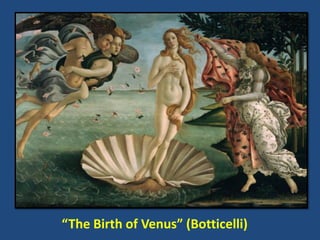
“The Birth of Venus” (Botticelli)
“The School of Athens” (Raphael)
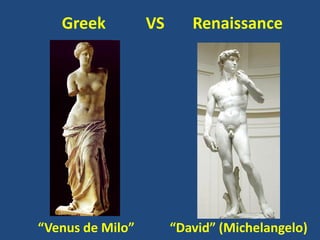
Greek VS Renaissance
“Venus de Milo” “David” (Michelangelo)
San Andres’ Basilica
(Alberti)
Greek/Roman VS Renaissance
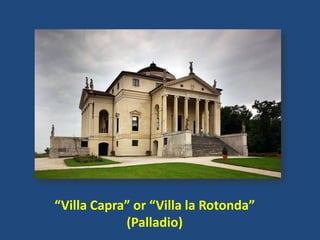
“Villa Capra” or “Villa la Rotonda”
(Palladio)
Emphasis on human figure
• The human figure became very important.
Artists rediscovered the beauty of nature & the
human body, expressing the optimism of this
new age.
• As in classical art, beauty is achieved by
proportion & symmetry.
• Less modest depiction of the human
figure than during the church-
dominated Medieval period….
Naked bodies!!
“Vitruvian Man” or “The canon of proportions”
(Leonardo da Vinci)
It’s a drawing accompanied by notes
based on the work of the Roman
architect Vitruvius.
It depicts the ideal human
proportions described by Vitruvius
in his treatise “De Architectura”.
Vitruvius described the human
figure as being the principal source
of proportion. Vitruvius determined
that the ideal body should be eight
heads high.
“Sistine Chapel”
(Michelangelo)
Realism & expression
• One of the big changes in art was to paint and
sculpt subjects realistically. This is called
realism and involves a number of techniques
that make the subjects and background look
like they would in real life.
• This also meant giving the subjects more
emotional qualities; more expression.
“David” (Bernini)
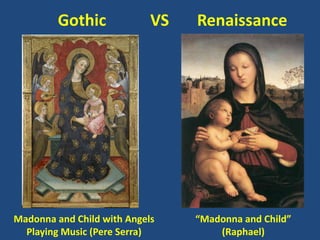
Gothic VS Renaissance
Madonna and Child with Angels
Playing Music (Pere Serra)
“Madonna and Child”
(Raphael)
Perspective
• Perspective is drawing or painting a picture
such that it looks like there are three
dimensions.
• It gives the illusion that some objects in the
painting are further away than others.
“The Last Supper” (Leonardo da Vinci)
“The School of Athens” (Raphael)
“Lamentation of Christ” (Mantegna)
Sfumato technique
“Monna Lisa” or “La Gioconda” (Leonardo da Vinci)
Light & shade
• Renaissance painters used light and shade to:
– Add perspective & make it more realistic. Help
viewers picture the shape of objects and to
imagine what the objects feel like.
– Depict emotions (cheerfulness of a bright day,
darkness of a sad day…)
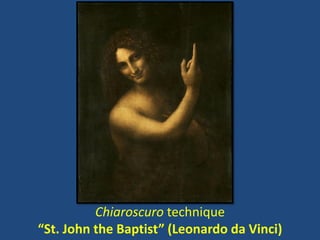
• Some artists used strong contrasts of light &
shade. That technique is called “chiaroscuro”.
However, it will reach its peak in the Baroque.
“The School of Athens” (Raphael)
Chiaroscuro technique
“St. John the Baptist” (Leonardo da Vinci)
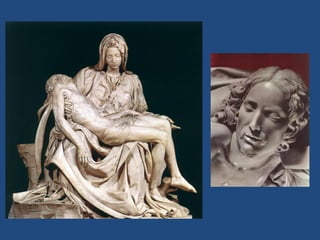
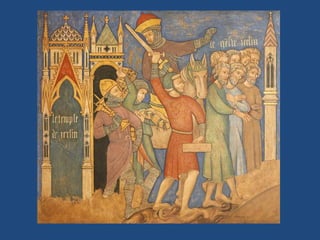
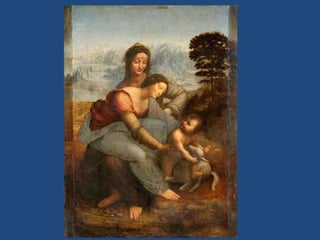
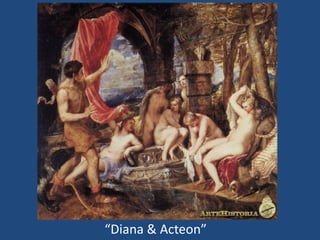
Time to use your brains…!!
• In your notebooks:
–Tell if the image is
“Renaissance”
–Explain using the
characteristics of
Renaissance Art.
“Venus and Mars”
“Diana & Acteon”
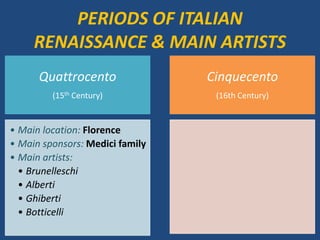
PERIODS OF ITALIAN
RENAISSANCE & MAIN ARTISTS
Quattrocento
(15th Century)
• Main location: Florence
• Main sponsors: Medici family
• Main artists:
• Brunelleschi
• Alberti
• Ghiberti
• Botticelli
Cinquecento
(16th Century)
Brunelleschi
• Dome of Florence Cathedral
• Palazzo Pitti
Alberti
• Façade of Santa
María Novella
Any similarities with the
Roman Pantheon??!
Ghiberti
• Gates of Paradise
(Florence Cathedral)
Botticelli
• The Birth of Venus
PERIODS OF ITALIAN
RENAISSANCE & MAIN ARTISTS
Quattrocento
(15th Century)
• Main location: Florence
• Main sponsors: Medici family
• Main artists:
• Brunelleschi
• Alberti
• Ghiberti
• Botticelli
Cinquecento
(16th Century)
• Main location: Rome
• Main sponsors: Church
• Main artists:
• Bramante
• Michelangelo
• Leonardo Da Vinci
• Raphael
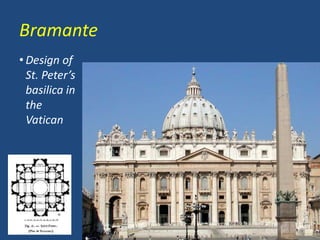
Bramante
• Design of
St. Peter’s
basilica in
the
Vatican
Michelangelo
• Architecture: Dome
of St. Peter in the
Vatican
• Sculpture: David,
Moses & Pieta.
Michelangelo
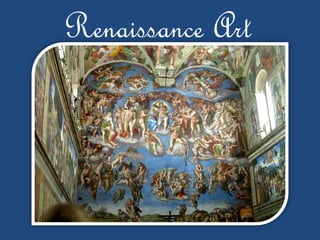
• Painting: Sistine
Chapel (Papal Palace in
the Vatican):
 Last Judgement
 Creation of Adam
Virtual tour
Leonardo Da Vinci
• Invented the sfumato technique,
which blends areas together:
 La Gioconda
 The Last Supper
 The Virgin of the Rocks
Raphael
• The
School of
Athens
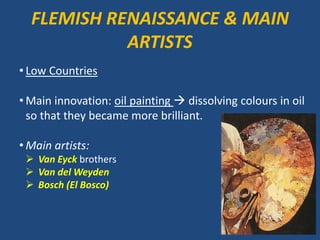
FLEMISH RENAISSANCE & MAIN
ARTISTS
• Low Countries
• Main innovation: oil painting  dissolving colours in oil
so that they became more brilliant.
• Main artists:
 Van Eyck brothers
 Van del Weyden
 Bosch (El Bosco)
 Jan Van Eyck: Arnolfini portrait
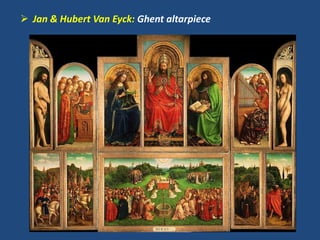
 Jan & Hubert Van Eyck: Ghent altarpiece
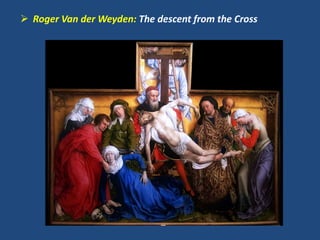
 Roger Van der Weyden: The descent from the Cross
 Hieronymus Bosch (El Bosco): The Garden of the
Earthly Delight
The triptych develops the history of the world and progression of sin. Starts at the outside
tables with the creation of the world, and continues in the interior with the origin of sin
(Adam and Eve) in the left panel, its extension in a world dominated by earthly pleasures in
the center, and ends in the right with the torments of hell.

Renaissance art

  • 1.
  • 2.
    RENAISSANCE ART • Movementthat originated in Italy in the 15th century. – Florence was a cultural leader in the Renaissance period
  • 3.
    • The term“Renaissance” refers to the “rebirth” of Greek and Roman culture – Architecture – Sculpture – Painting – Literature RENAISSANCE ART
  • 4.
    RENAISSANCE ART • Artistsgained prestige, no longer anonymous  became celebrities • Patrons (“mecenas”), financed & protected artists. Patrons commissioned artwork and decided the themes. – Kings & Popes – Medici Family in Florence were the most famous and wealthy patrons of the Renaissance.
  • 5.
    CHARACTERISTICS OF RENAISSANCE ART a)Classicism b) Emphasis on human figure c) Realism & expression d) Perspective e) Light & shade
  • 6.
    Classicism • Artists, architectsand sculptors studied the art of Ancient Greece and Rome and incorporated elements of these civilizations: – Mythological themes – Idealized beauty (proportion) – Classical architectural elements (columns, semicircular arches,…) & techniques (symmetry, proportion, simplicity…). Abandon of complex aspects of Gothic art.
  • 7.
    “The Birth ofVenus” (Botticelli)
  • 8.
    “The School ofAthens” (Raphael)
  • 9.
    Greek VS Renaissance “Venusde Milo” “David” (Michelangelo)
  • 10.
  • 11.
    “Villa Capra” or“Villa la Rotonda” (Palladio)
  • 12.
    Emphasis on humanfigure • The human figure became very important. Artists rediscovered the beauty of nature & the human body, expressing the optimism of this new age. • As in classical art, beauty is achieved by proportion & symmetry. • Less modest depiction of the human figure than during the church- dominated Medieval period…. Naked bodies!!
  • 13.
    “Vitruvian Man” or“The canon of proportions” (Leonardo da Vinci) It’s a drawing accompanied by notes based on the work of the Roman architect Vitruvius. It depicts the ideal human proportions described by Vitruvius in his treatise “De Architectura”. Vitruvius described the human figure as being the principal source of proportion. Vitruvius determined that the ideal body should be eight heads high.
  • 14.
  • 15.
    Realism & expression •One of the big changes in art was to paint and sculpt subjects realistically. This is called realism and involves a number of techniques that make the subjects and background look like they would in real life. • This also meant giving the subjects more emotional qualities; more expression.
  • 16.
  • 17.
    Gothic VS Renaissance Madonnaand Child with Angels Playing Music (Pere Serra) “Madonna and Child” (Raphael)
  • 18.
    Perspective • Perspective isdrawing or painting a picture such that it looks like there are three dimensions. • It gives the illusion that some objects in the painting are further away than others.
  • 19.
    “The Last Supper”(Leonardo da Vinci)
  • 20.
    “The School ofAthens” (Raphael)
  • 21.
  • 22.
    Sfumato technique “Monna Lisa”or “La Gioconda” (Leonardo da Vinci)
  • 23.
    Light & shade •Renaissance painters used light and shade to: – Add perspective & make it more realistic. Help viewers picture the shape of objects and to imagine what the objects feel like. – Depict emotions (cheerfulness of a bright day, darkness of a sad day…) • Some artists used strong contrasts of light & shade. That technique is called “chiaroscuro”. However, it will reach its peak in the Baroque.
  • 24.
    “The School ofAthens” (Raphael)
  • 25.
    Chiaroscuro technique “St. Johnthe Baptist” (Leonardo da Vinci)
  • 26.
    Time to useyour brains…!! • In your notebooks: –Tell if the image is “Renaissance” –Explain using the characteristics of Renaissance Art.
  • 29.
  • 31.
  • 33.
    PERIODS OF ITALIAN RENAISSANCE& MAIN ARTISTS Quattrocento (15th Century) • Main location: Florence • Main sponsors: Medici family • Main artists: • Brunelleschi • Alberti • Ghiberti • Botticelli Cinquecento (16th Century)
  • 34.
    Brunelleschi • Dome ofFlorence Cathedral • Palazzo Pitti
  • 36.
    Alberti • Façade ofSanta María Novella Any similarities with the Roman Pantheon??!
  • 37.
    Ghiberti • Gates ofParadise (Florence Cathedral)
  • 38.
  • 39.
    PERIODS OF ITALIAN RENAISSANCE& MAIN ARTISTS Quattrocento (15th Century) • Main location: Florence • Main sponsors: Medici family • Main artists: • Brunelleschi • Alberti • Ghiberti • Botticelli Cinquecento (16th Century) • Main location: Rome • Main sponsors: Church • Main artists: • Bramante • Michelangelo • Leonardo Da Vinci • Raphael
  • 40.
    Bramante • Design of St.Peter’s basilica in the Vatican
  • 41.
    Michelangelo • Architecture: Dome ofSt. Peter in the Vatican • Sculpture: David, Moses & Pieta.
  • 42.
    Michelangelo • Painting: Sistine Chapel(Papal Palace in the Vatican):  Last Judgement  Creation of Adam Virtual tour
  • 43.
    Leonardo Da Vinci •Invented the sfumato technique, which blends areas together:  La Gioconda  The Last Supper  The Virgin of the Rocks
  • 45.
  • 46.
    FLEMISH RENAISSANCE &MAIN ARTISTS • Low Countries • Main innovation: oil painting  dissolving colours in oil so that they became more brilliant. • Main artists:  Van Eyck brothers  Van del Weyden  Bosch (El Bosco)
  • 47.
     Jan VanEyck: Arnolfini portrait
  • 48.
     Jan &Hubert Van Eyck: Ghent altarpiece
  • 49.
     Roger Vander Weyden: The descent from the Cross
  • 50.
     Hieronymus Bosch(El Bosco): The Garden of the Earthly Delight The triptych develops the history of the world and progression of sin. Starts at the outside tables with the creation of the world, and continues in the interior with the origin of sin (Adam and Eve) in the left panel, its extension in a world dominated by earthly pleasures in the center, and ends in the right with the torments of hell.