Timeline of Egyptian Art
Patronage and Artistic Life
Characteristics of Egyptian Sculpture,
Painting and Architecture
Select Works Artworks from the Timeline
Guide Questions
 Art has been advancing during this period but are
the artist considered as artist?
 What are the distinct elements of Egyptian Art?
C:UsersOwnerDesktopPWC FINE ART
CLASSESWestern Art Understanding VideosQuarter
1Otis Art History 04 - Egyptian Art.mp4
C:UsersOwnerDesktopPWC FINE ART
CLASSESWestern Art Understanding VideosQuarter
1Egyptian Art History from Goodbye-Art
Academy.mp4
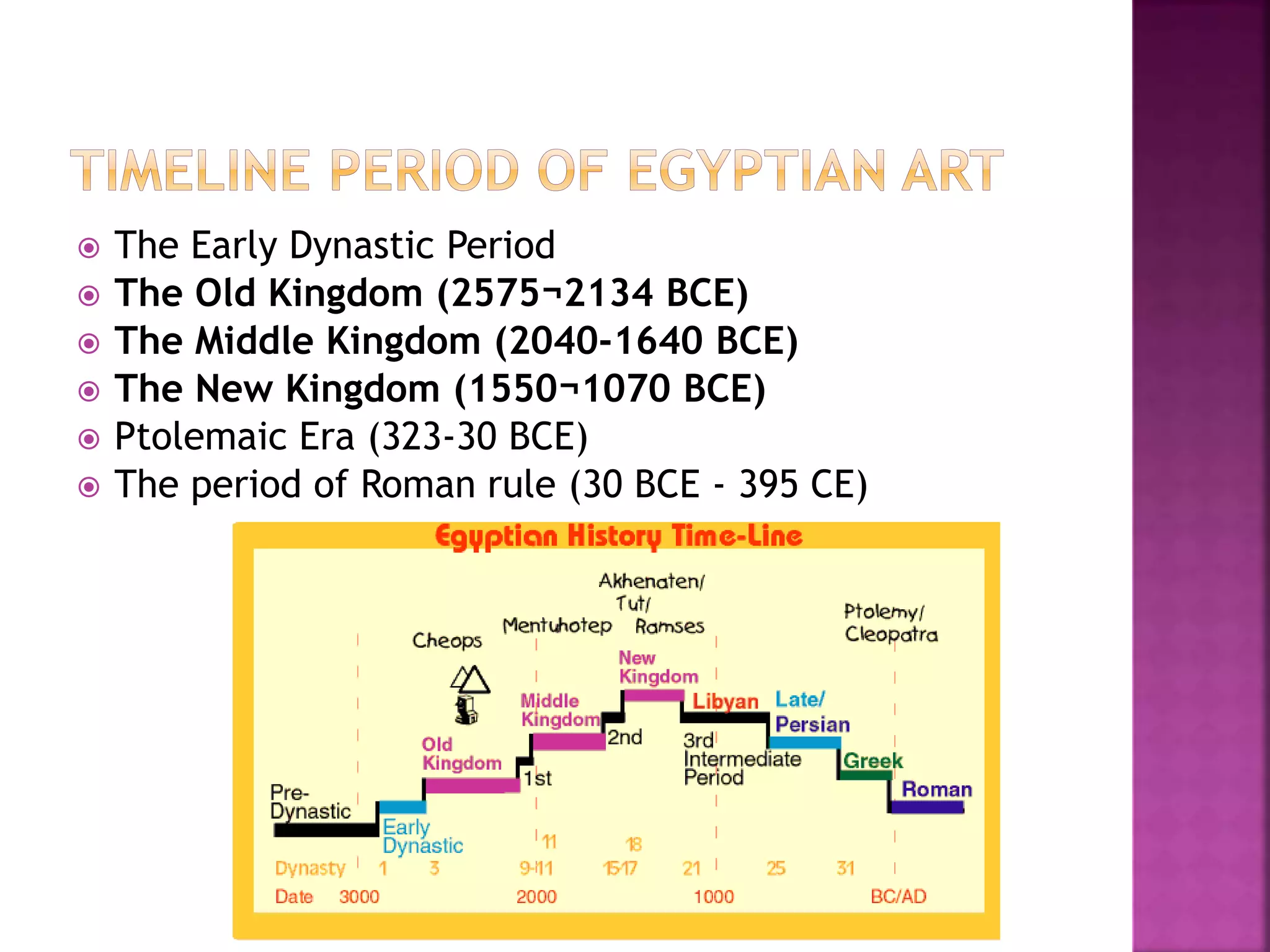
 The Early Dynastic Period
 The Old Kingdom (2575¬2134 BCE)
 The Middle Kingdom (2040-1640 BCE)
 The New Kingdom (1550¬1070 BCE)
 Ptolemaic Era (323-30 BCE)
 The period of Roman rule (30 BCE - 395 CE)
 Egyptian sculptors and
painters were paid artisans
and not as “artists” in the
modern sense of being a
creative individual. They
were trained and worked as
part of a team.
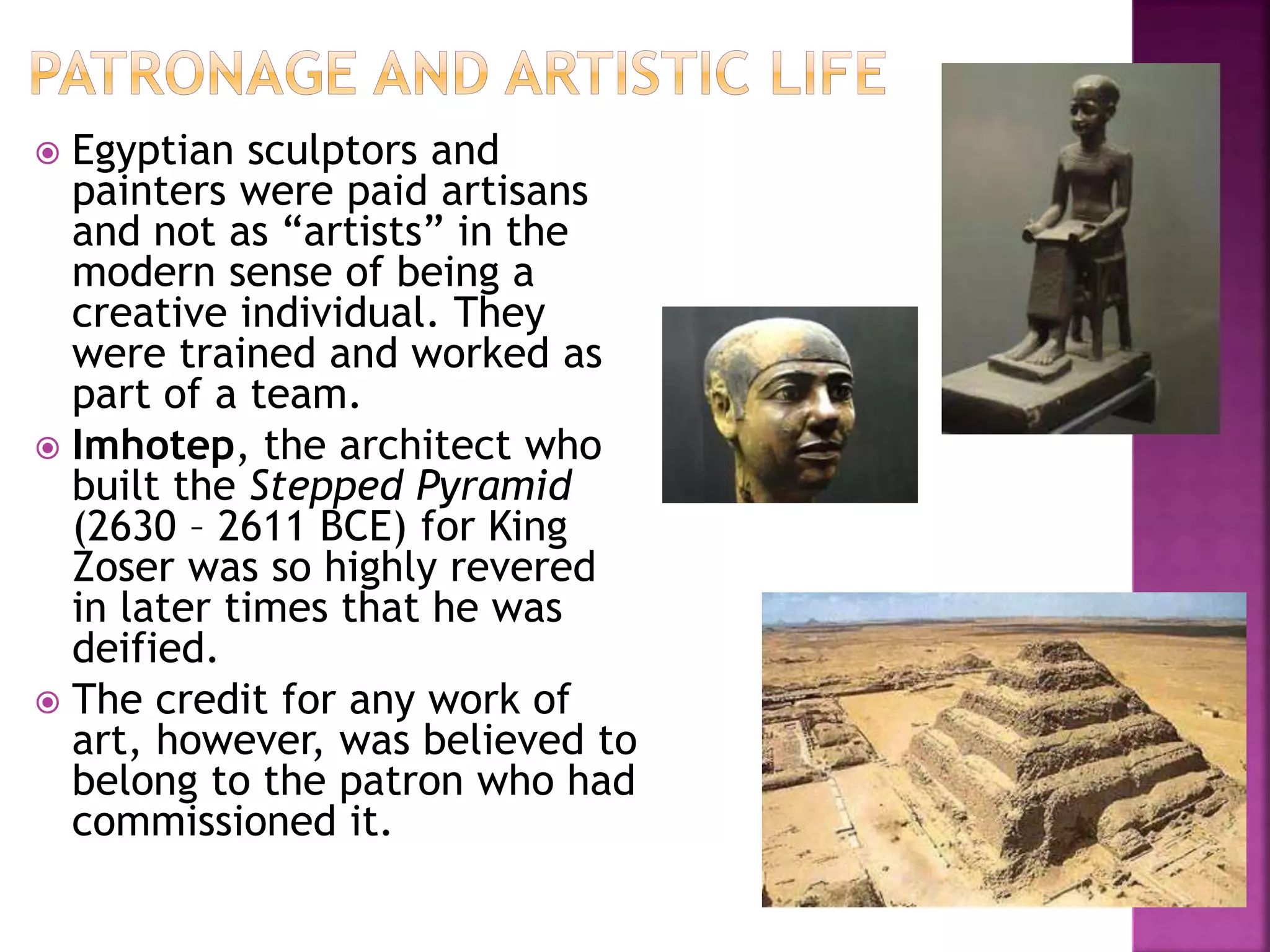
 Imhotep, the architect who
built the Stepped Pyramid
(2630 – 2611 BCE) for King
Zoser was so highly revered
in later times that he was
deified.
 The credit for any work of
art, however, was believed to
belong to the patron who had
commissioned it.
 Most Egyptian Art is a picture of contentment and
stability that shows successful man and woman in a calm
and rational manner
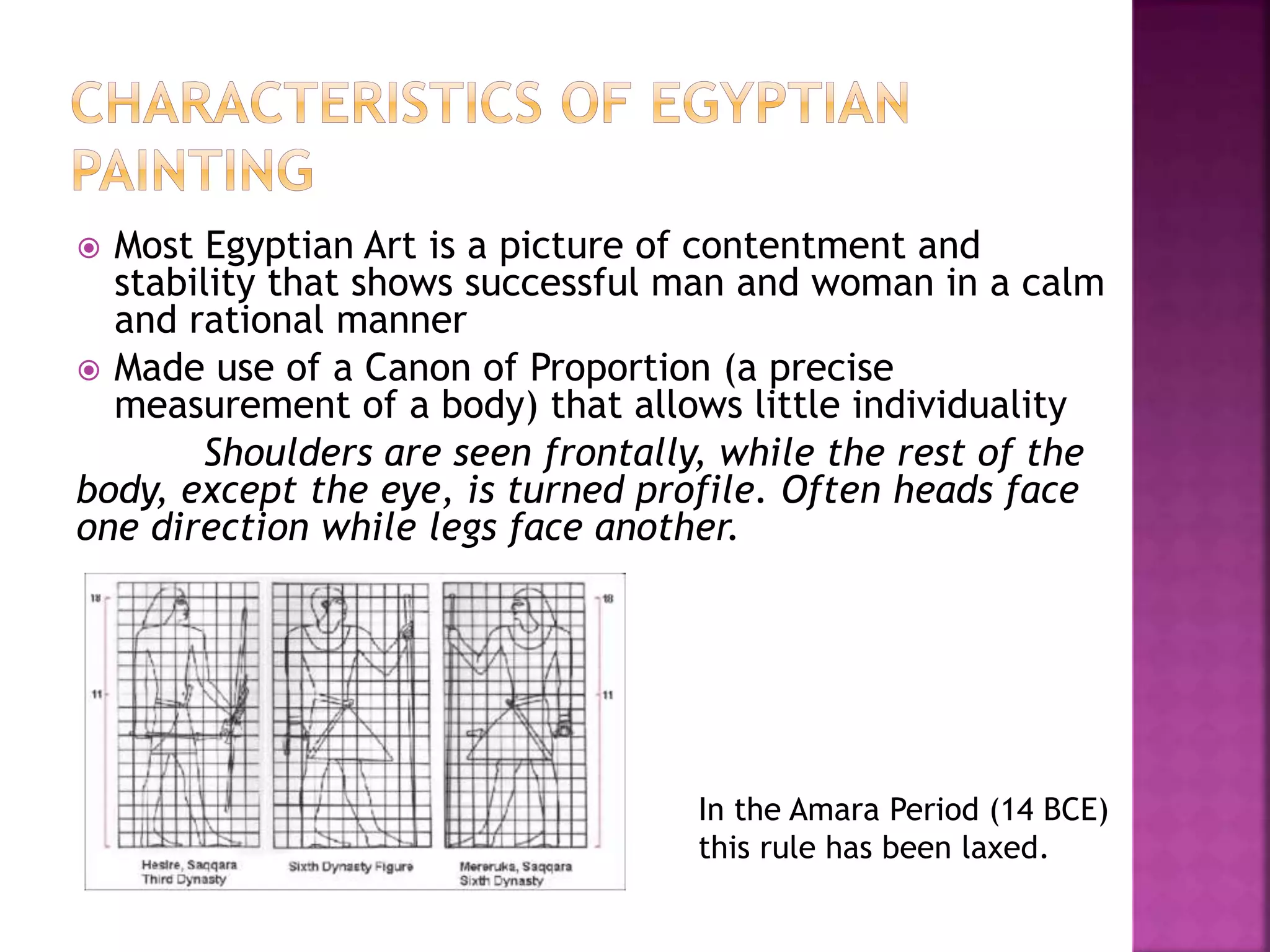
 Made use of a Canon of Proportion (a precise
measurement of a body) that allows little individuality
Shoulders are seen frontally, while the rest of the
body, except the eye, is turned profile. Often heads face
one direction while legs face another.
In the Amara Period (14 BCE)
this rule has been laxed.
 Red, the color of power, symbolized life and victory, as well as anger
and fire.
 Green symbolized new life, growth, and fertility
 Blue symbolized creation and rebirth
 Yellow symbolized the eternal, such as the qualities of the sun and
gold.
 White was the color of purity, symbolizing all things sacred, and was
typically used in religious objects and tools used by the priests.
 Black was the color of death and represented the underworld and
the night
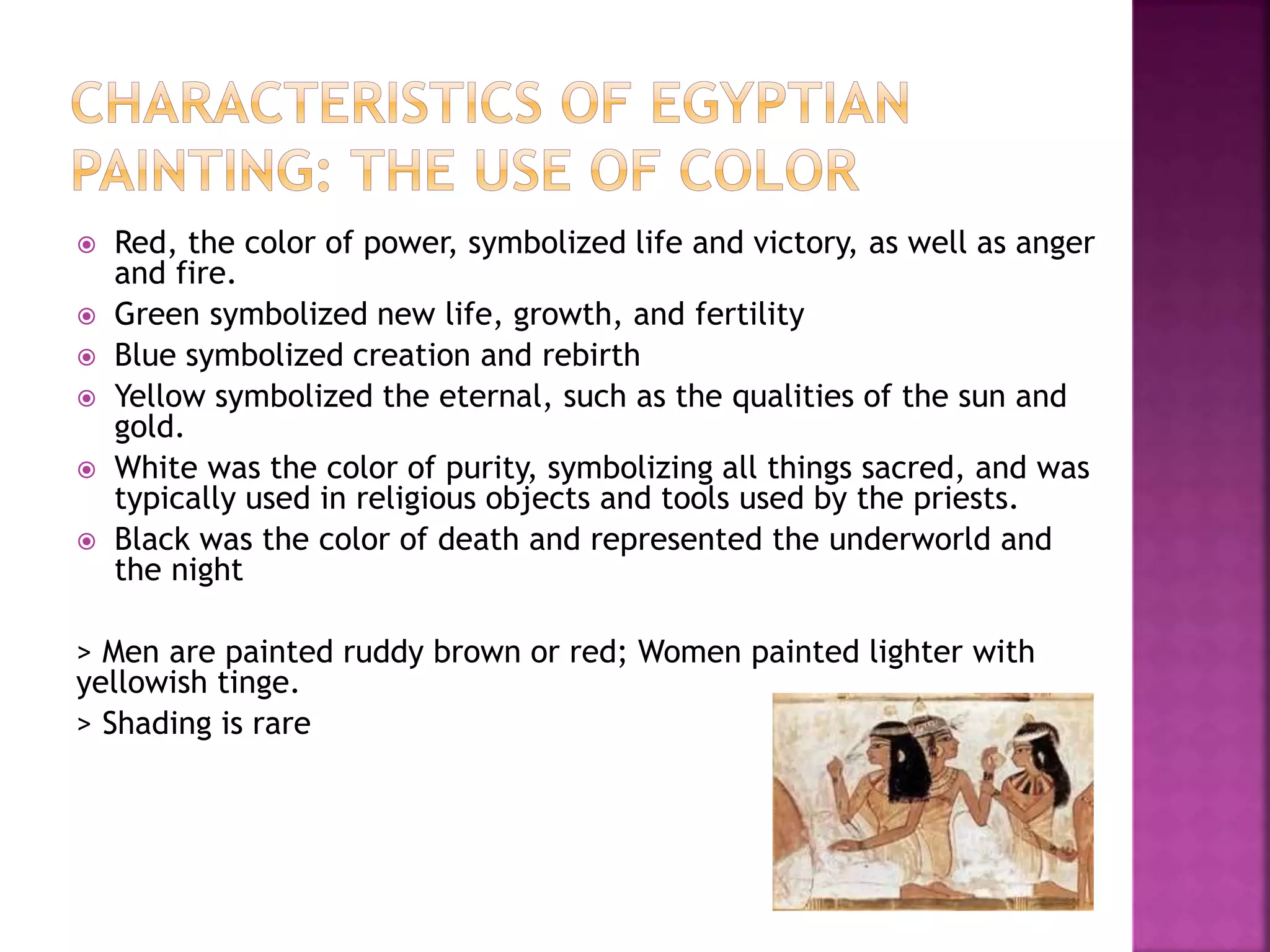
> Men are painted ruddy brown or red; Women painted lighter with
yellowish tinge.
> Shading is rare
 Ranges from intimate jewelry to megalithic sculptures.
 Sculpted portraits of pharaohs are meant to impress and
overwhelm
 Limestone is the primary stone used for sculpting aside
from gypsum and sandstone.
 Wood sculptures are painted
 Copper and Iron are also used in sculpture.
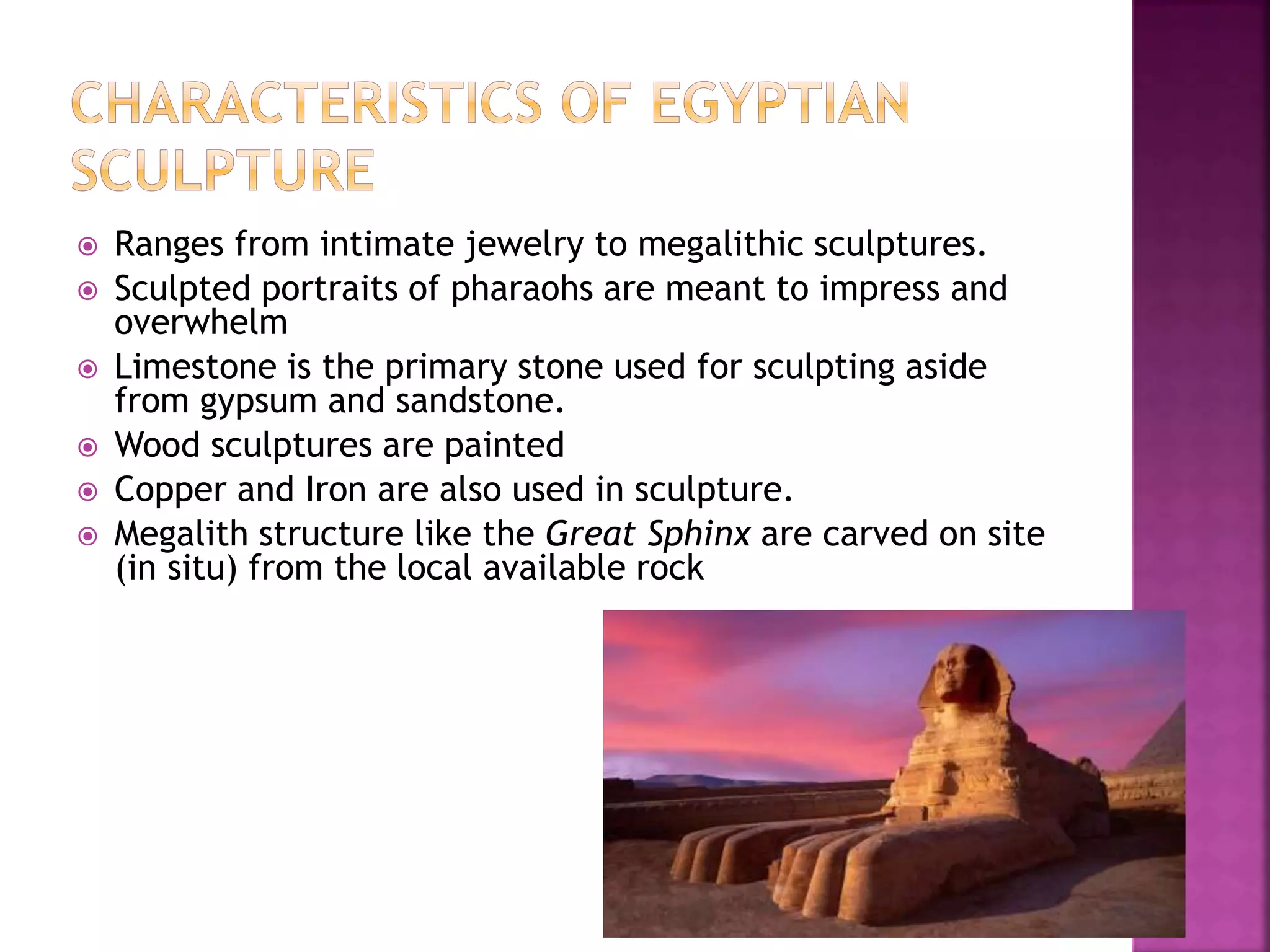
 Megalith structure like the Great Sphinx are carved on site
(in situ) from the local available rock
 Sculpture is three-dimensional artwork created by shaping
or combining hard materials - typically stone such as
marble - or metal, glass, or wood. Softer ("plastic")
materials can also be used, such as clay, textiles, plastics,
polymers and softer metals. The term has been extended to
works including sound, text and light.
 Found objects may be presented as sculptures. Materials
may be worked by removal such as carving; or they may be
assembled such as by welding, hardened such as by firing,
or molded or cast. Surface decoration such as paint may be
applied.
 Sculpture has been described as one of the plastic arts
because it can involve the use of materials that can be
moulded or modulated.
 The word sculpture originates from the Latin word sculpere,
which means "to carve".
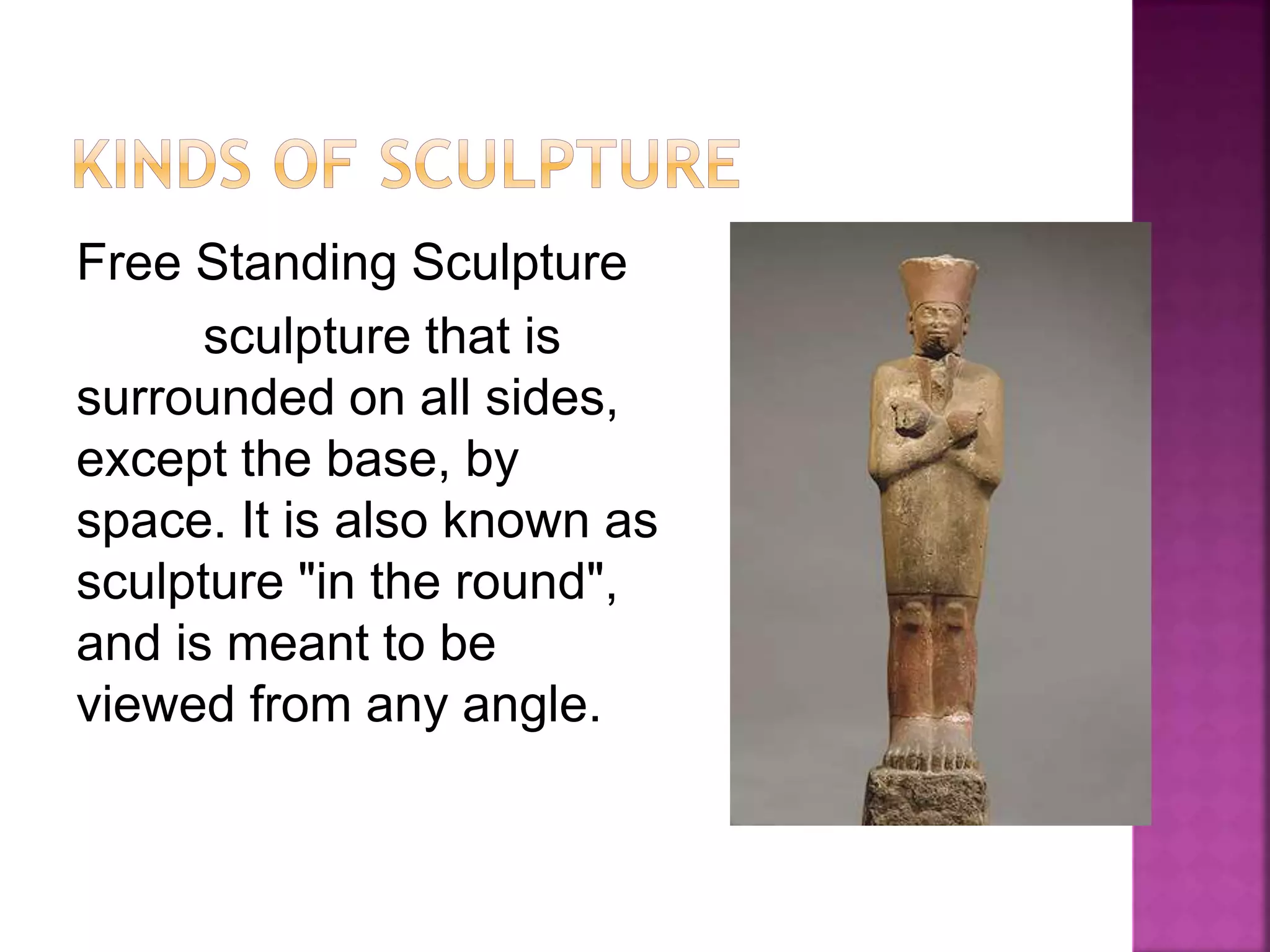
Free Standing Sculpture
sculpture that is
surrounded on all sides,
except the base, by
space. It is also known as
sculpture "in the round",
and is meant to be
viewed from any angle.
Statue - representationalist sculpture
depicting a specific entity, usually a person,
event, animal or object.
Types
 Full statue
 Bust - representation of a person from the
chest up
 Equestrian statue - typically showing a
significant person on horseback
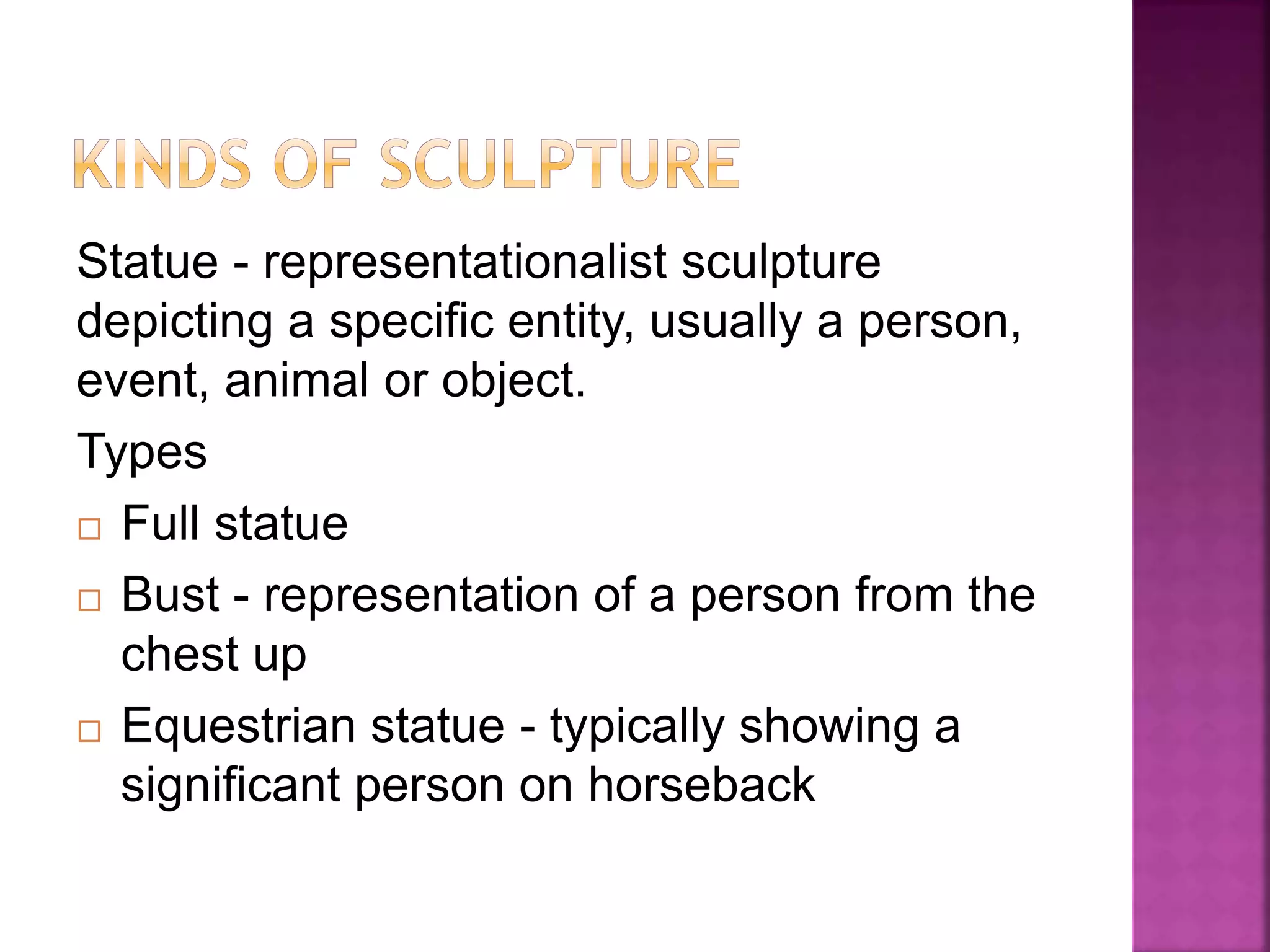
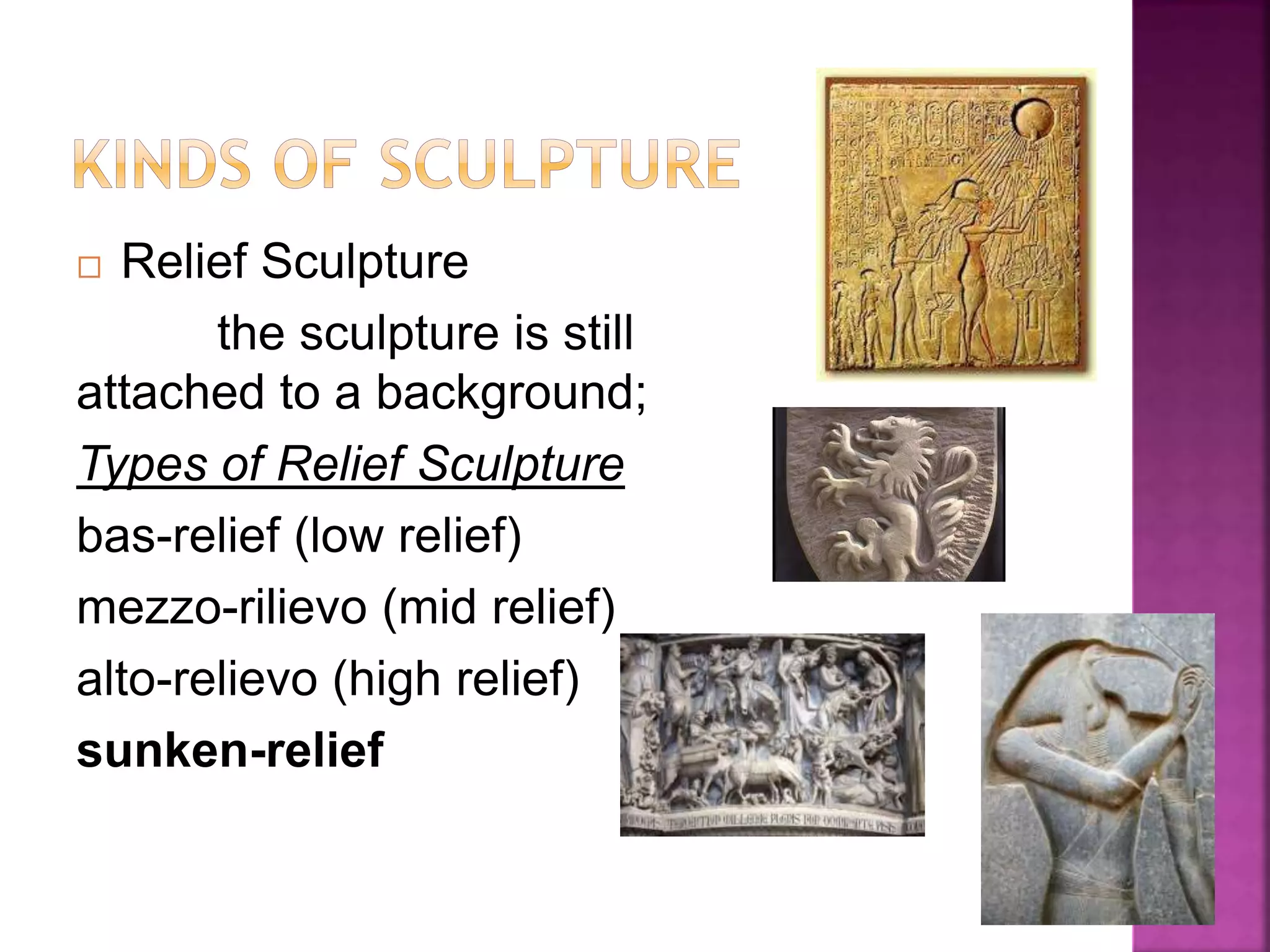
 Relief Sculpture
the sculpture is still
attached to a background;
Types of Relief Sculpture
bas-relief (low relief)
mezzo-rilievo (mid relief)
alto-relievo (high relief)
sunken-relief
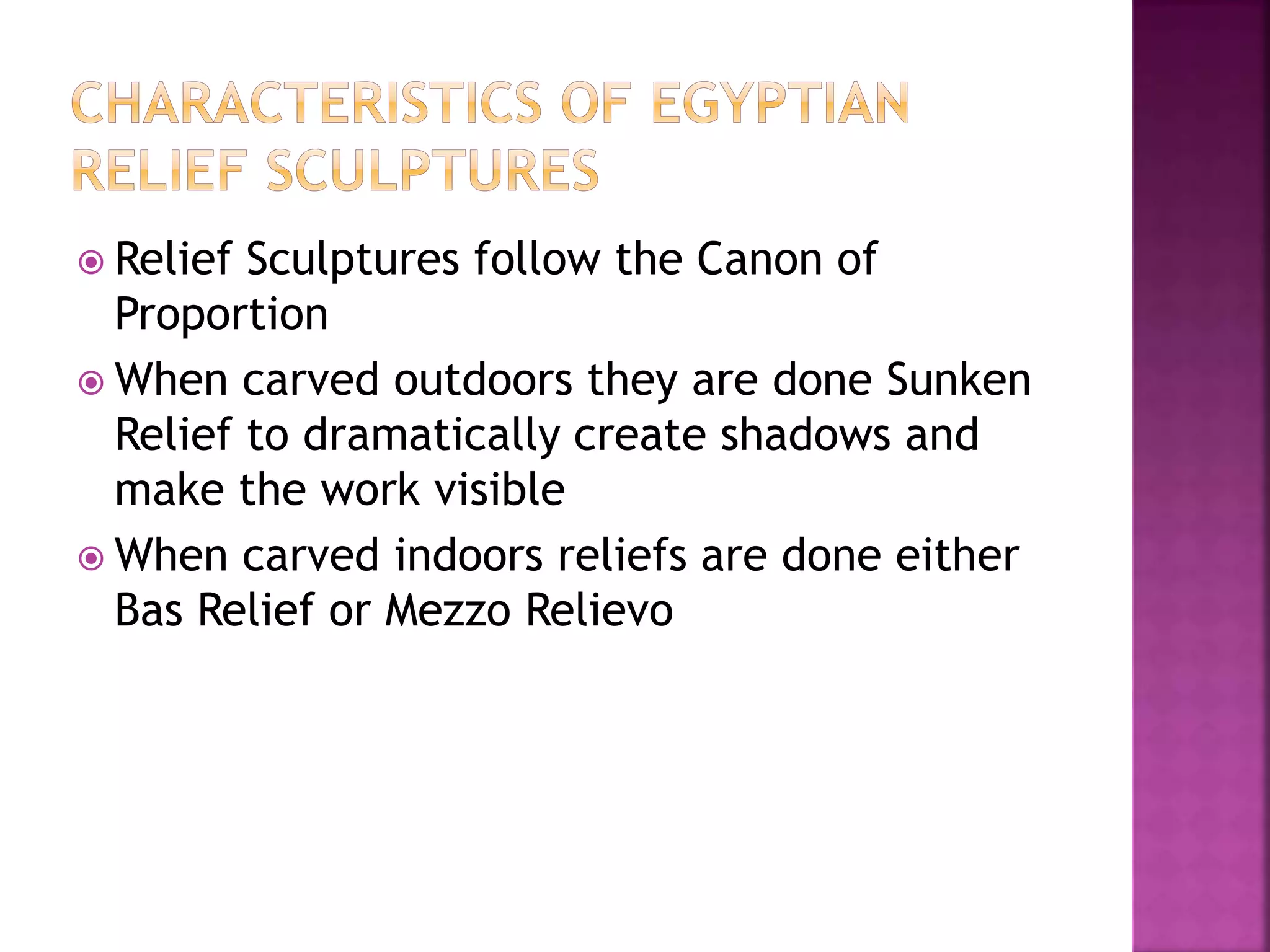
 Relief Sculptures follow the Canon of
Proportion
 When carved outdoors they are done Sunken
Relief to dramatically create shadows and
make the work visible
 When carved indoors reliefs are done either
Bas Relief or Mezzo Relievo
 Egyptian Pyramids are sleek solid surfaces and
monumental scale. Made of stone blocks without
mortar (mortar a mixture of lime, sand and
water used in building for holding bricks or
stones together)
 The sides of the pyramids are oriented to the
four cardinal points of the compass
 Egyptian temples have astronomical orientation.
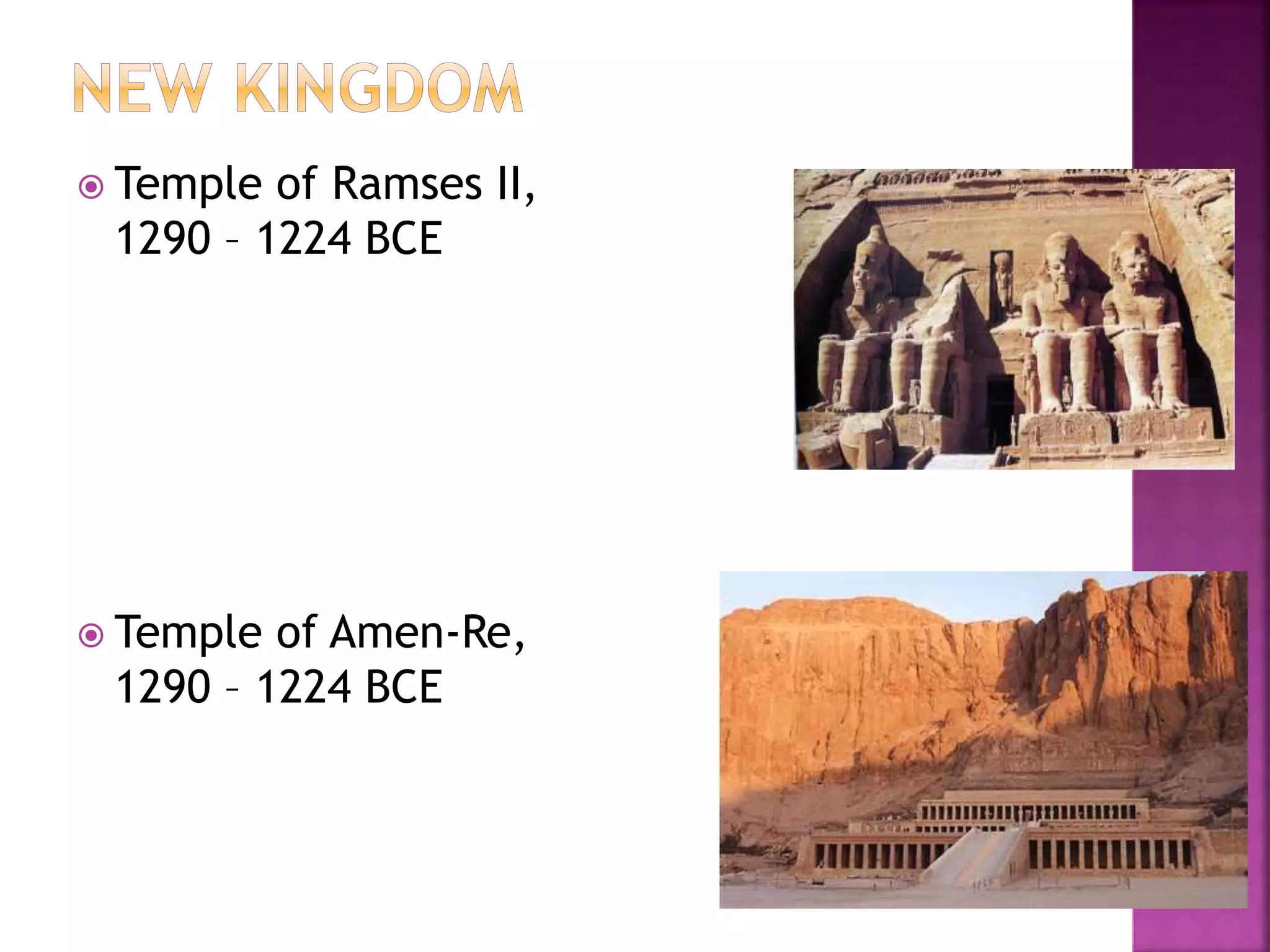
(Temple of Ramses II admits light into the
deepest recesses at dawn on Ramses’ birthday
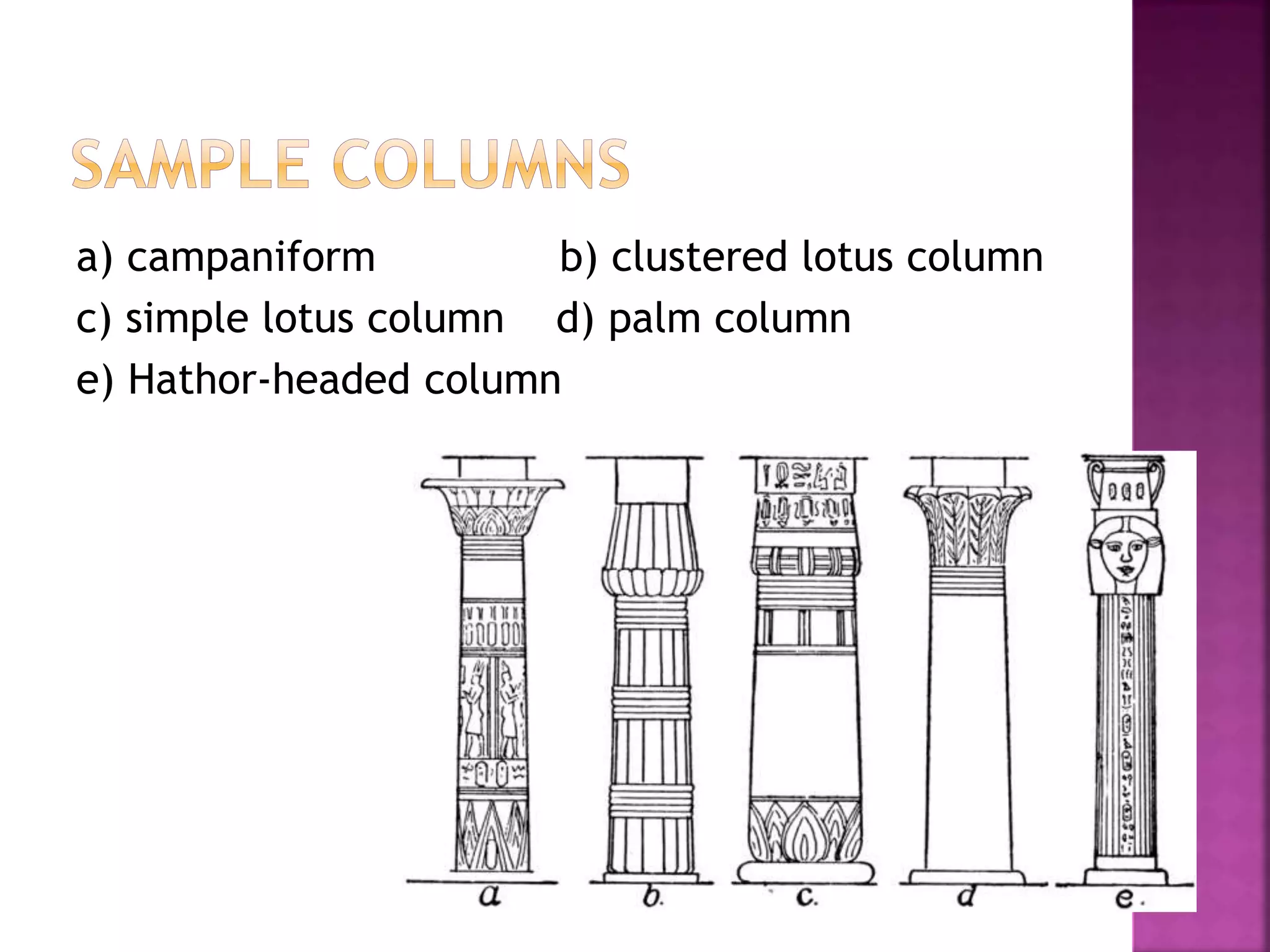
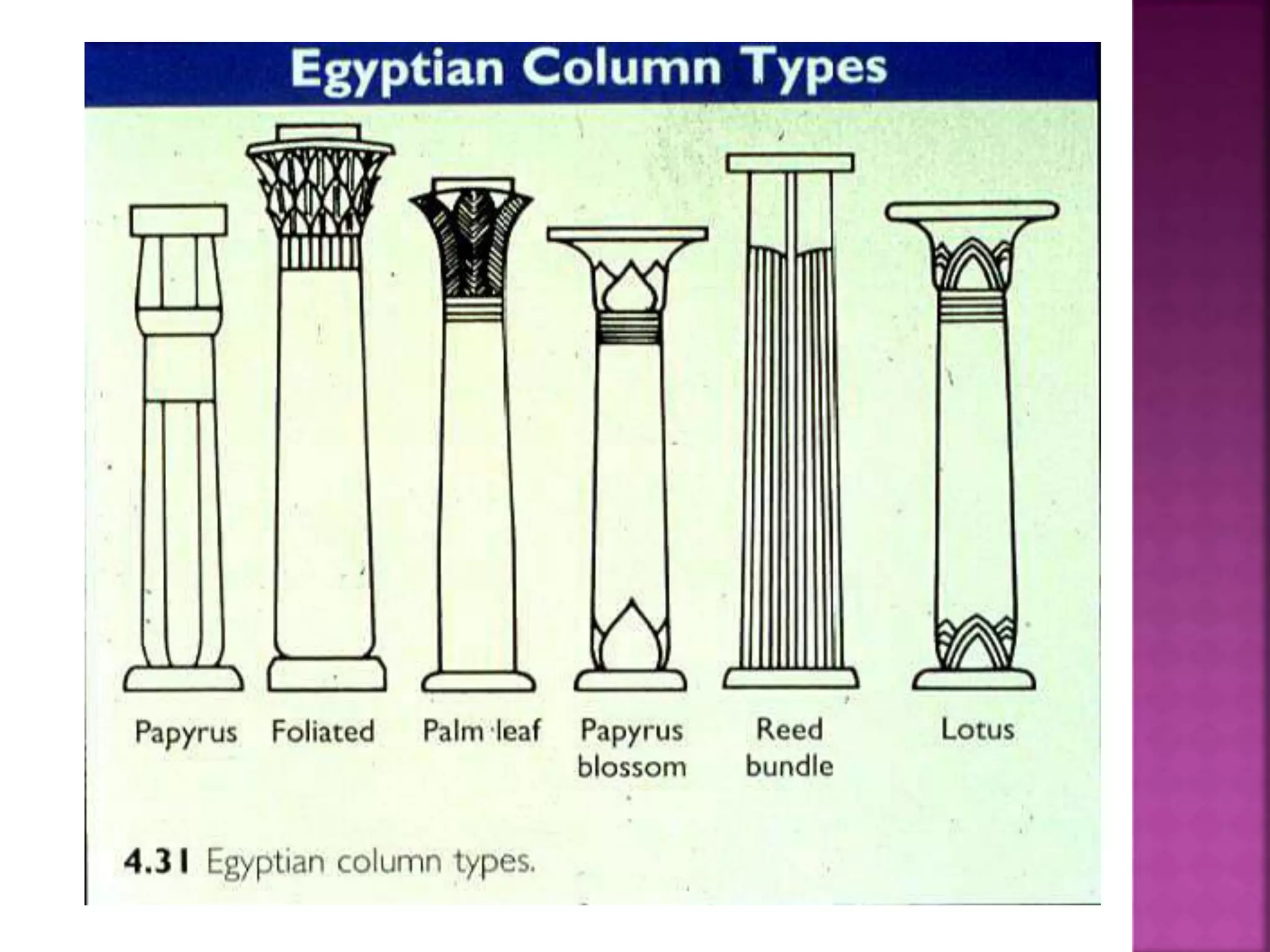
 Columns used in New Kingdom temples are based
on plant shapes: lotus, palm and papyrus.
a) campaniform b) clustered lotus column
c) simple lotus column d) palm column
e) Hathor-headed column
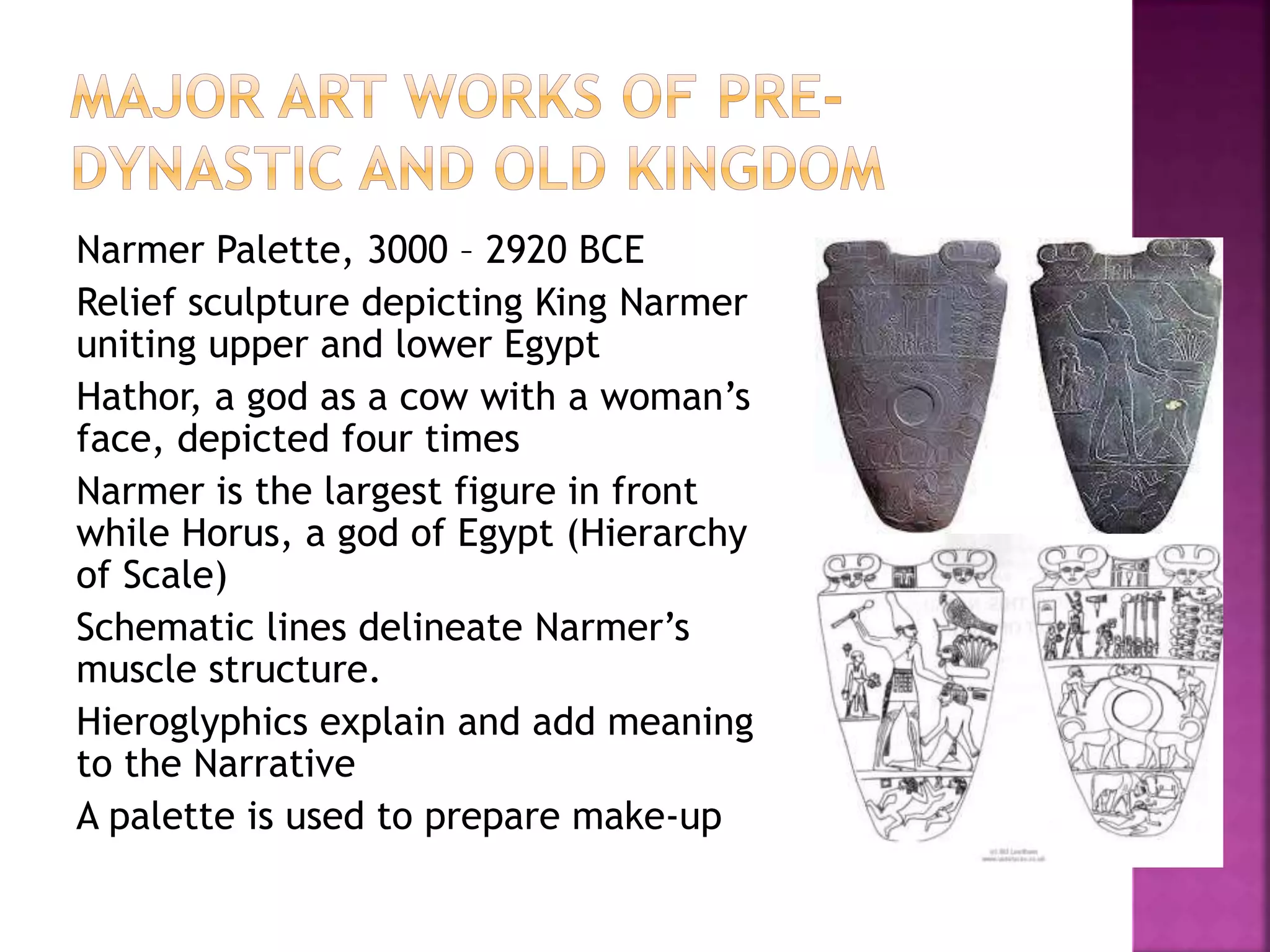
Narmer Palette, 3000 – 2920 BCE
Relief sculpture depicting King Narmer
uniting upper and lower Egypt
Hathor, a god as a cow with a woman’s
face, depicted four times
Narmer is the largest figure in front
while Horus, a god of Egypt (Hierarchy
of Scale)
Schematic lines delineate Narmer’s
muscle structure.
Hieroglyphics explain and add meaning
to the Narrative
A palette is used to prepare make-up
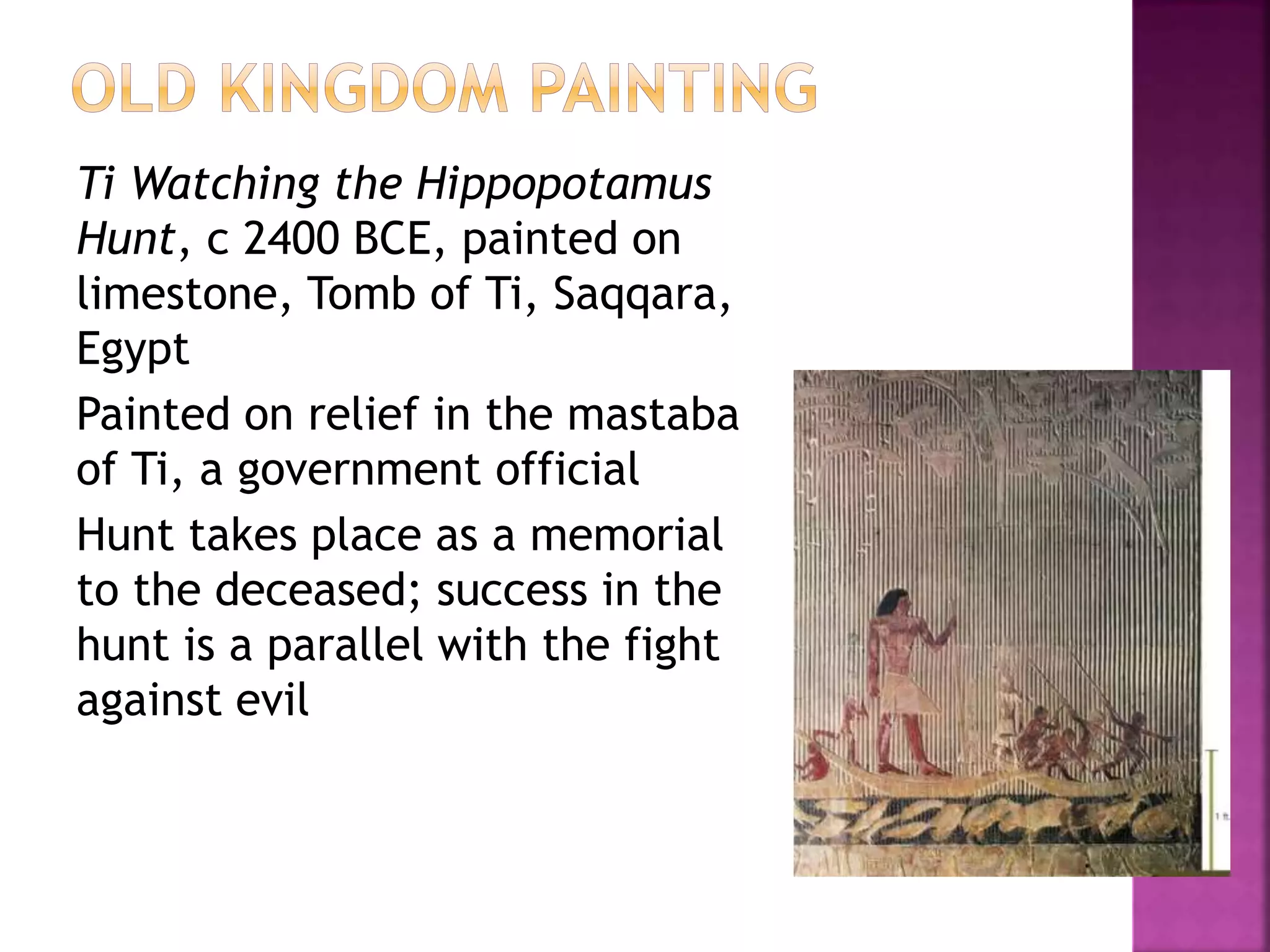
Ti Watching the Hippopotamus
Hunt, c 2400 BCE, painted on
limestone, Tomb of Ti, Saqqara,
Egypt
Painted on relief in the mastaba
of Ti, a government official
Hunt takes place as a memorial
to the deceased; success in the
hunt is a parallel with the fight
against evil
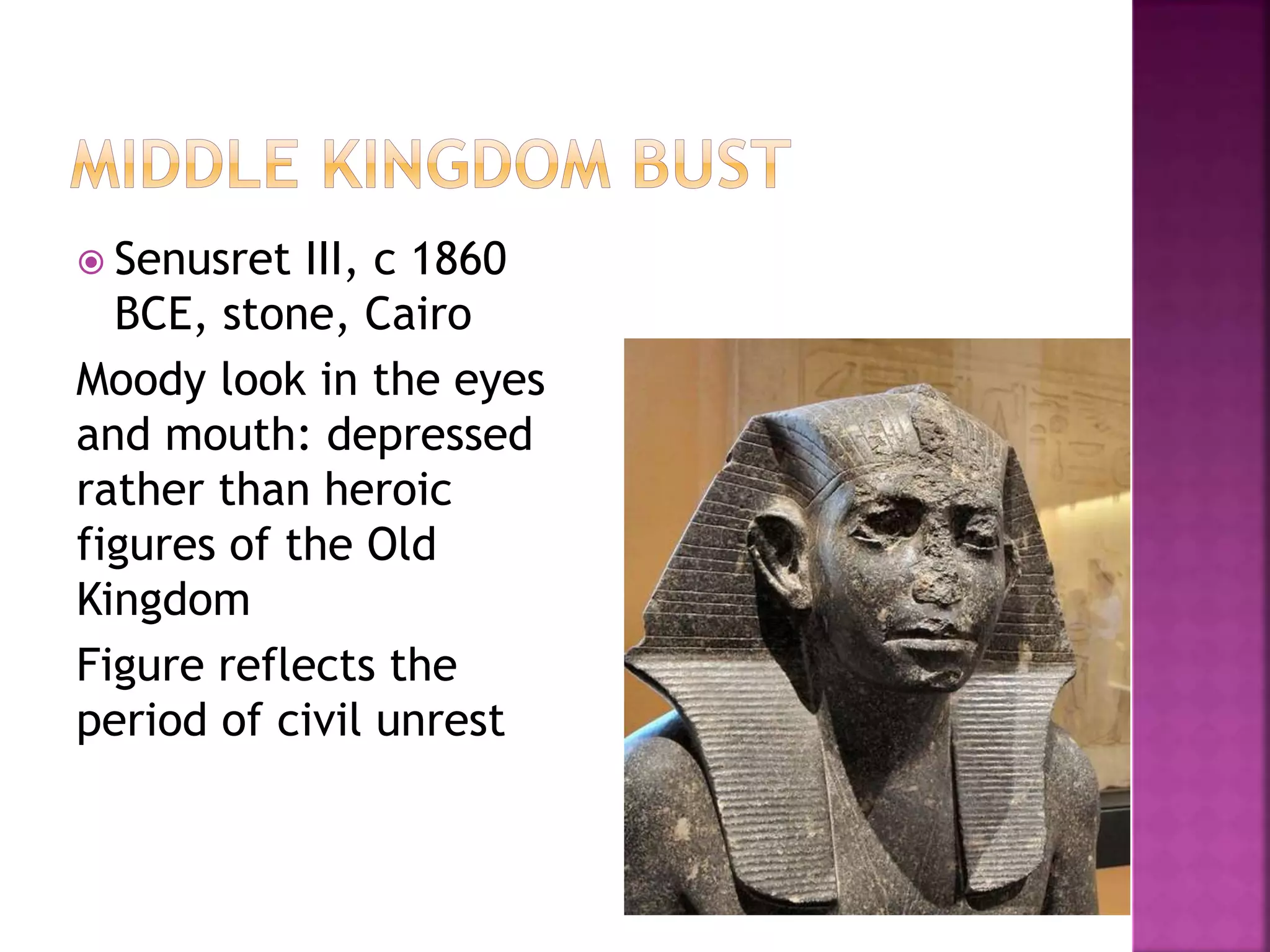
 Senusret III, c 1860
BCE, stone, Cairo
Moody look in the eyes
and mouth: depressed
rather than heroic
figures of the Old
Kingdom
Figure reflects the
period of civil unrest
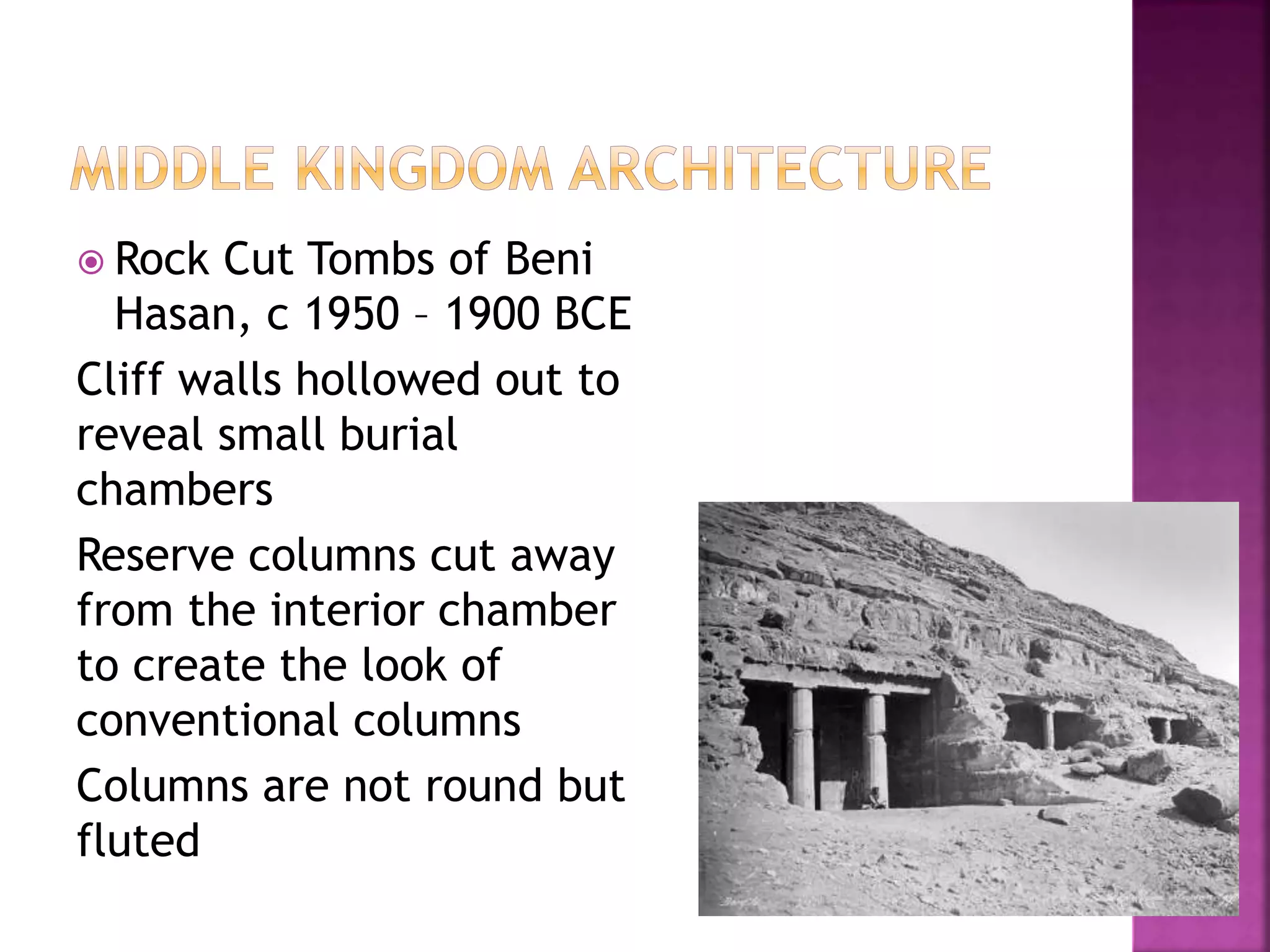
 Rock Cut Tombs of Beni
Hasan, c 1950 – 1900 BCE
Cliff walls hollowed out to
reveal small burial
chambers
Reserve columns cut away
from the interior chamber
to create the look of
conventional columns
Columns are not round but
fluted
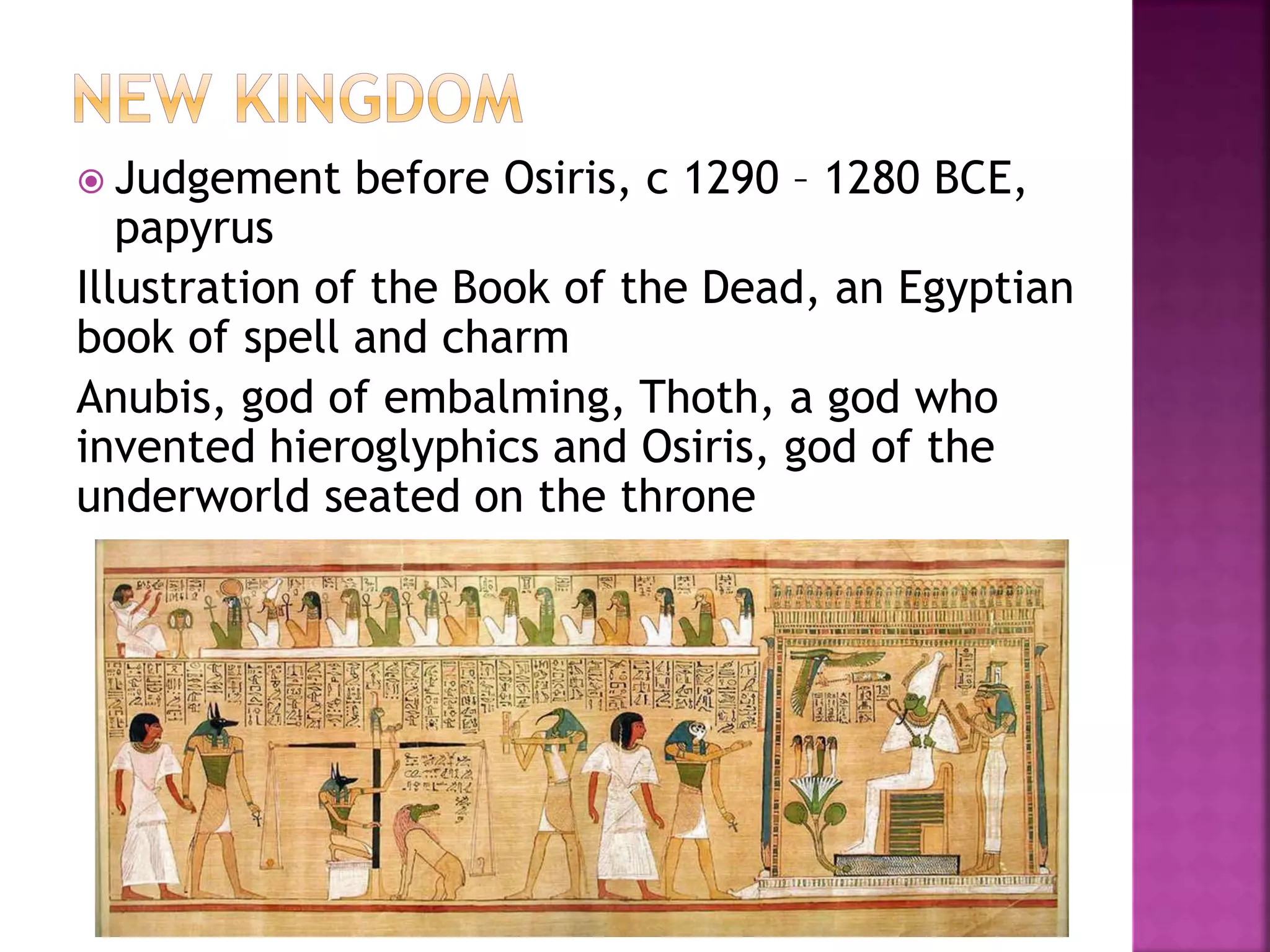
 Judgement before Osiris, c 1290 – 1280 BCE,
papyrus
Illustration of the Book of the Dead, an Egyptian
book of spell and charm
Anubis, god of embalming, Thoth, a god who
invented hieroglyphics and Osiris, god of the
underworld seated on the throne
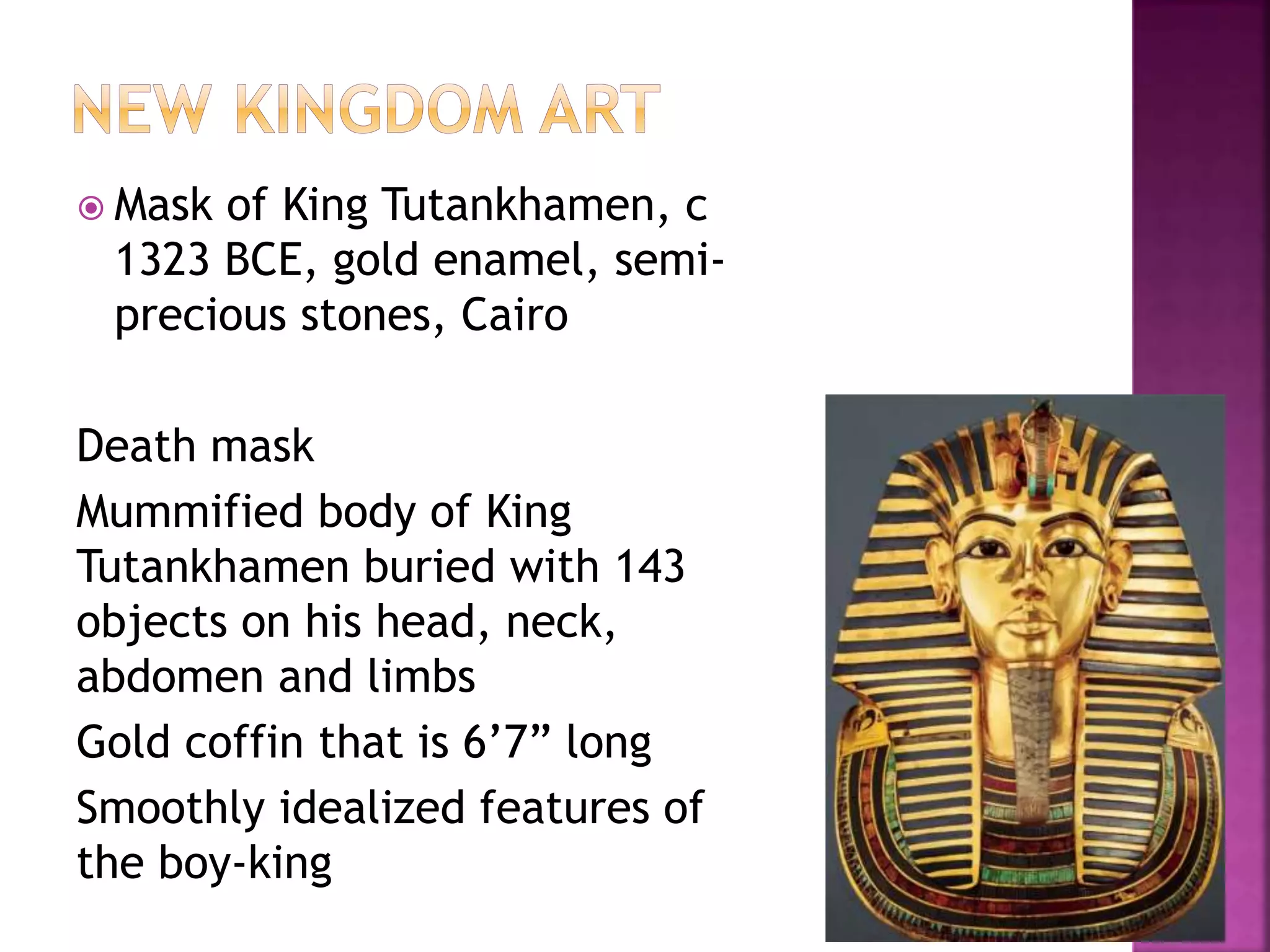
 Mask of King Tutankhamen, c
1323 BCE, gold enamel, semi-
precious stones, Cairo
Death mask
Mummified body of King
Tutankhamen buried with 143
objects on his head, neck,
abdomen and limbs
Gold coffin that is 6’7” long
Smoothly idealized features of
the boy-king
 Temple of Ramses II,
1290 – 1224 BCE
 Temple of Amen-Re,
1290 – 1224 BCE
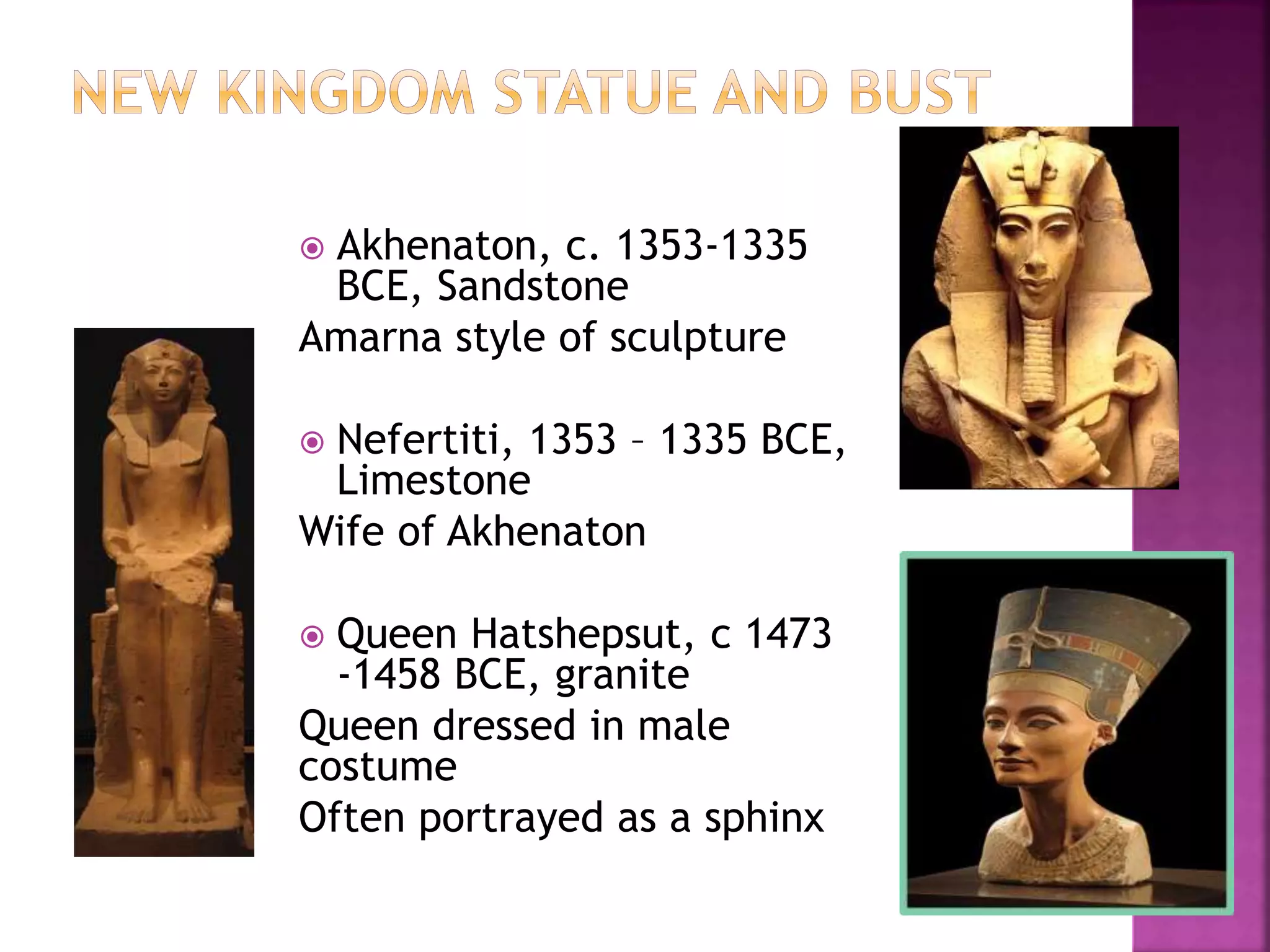
 Akhenaton, c. 1353-1335
BCE, Sandstone
Amarna style of sculpture
 Nefertiti, 1353 – 1335 BCE,
Limestone
Wife of Akhenaton
 Queen Hatshepsut, c 1473
-1458 BCE, granite
Queen dressed in male
costume
Often portrayed as a sphinx
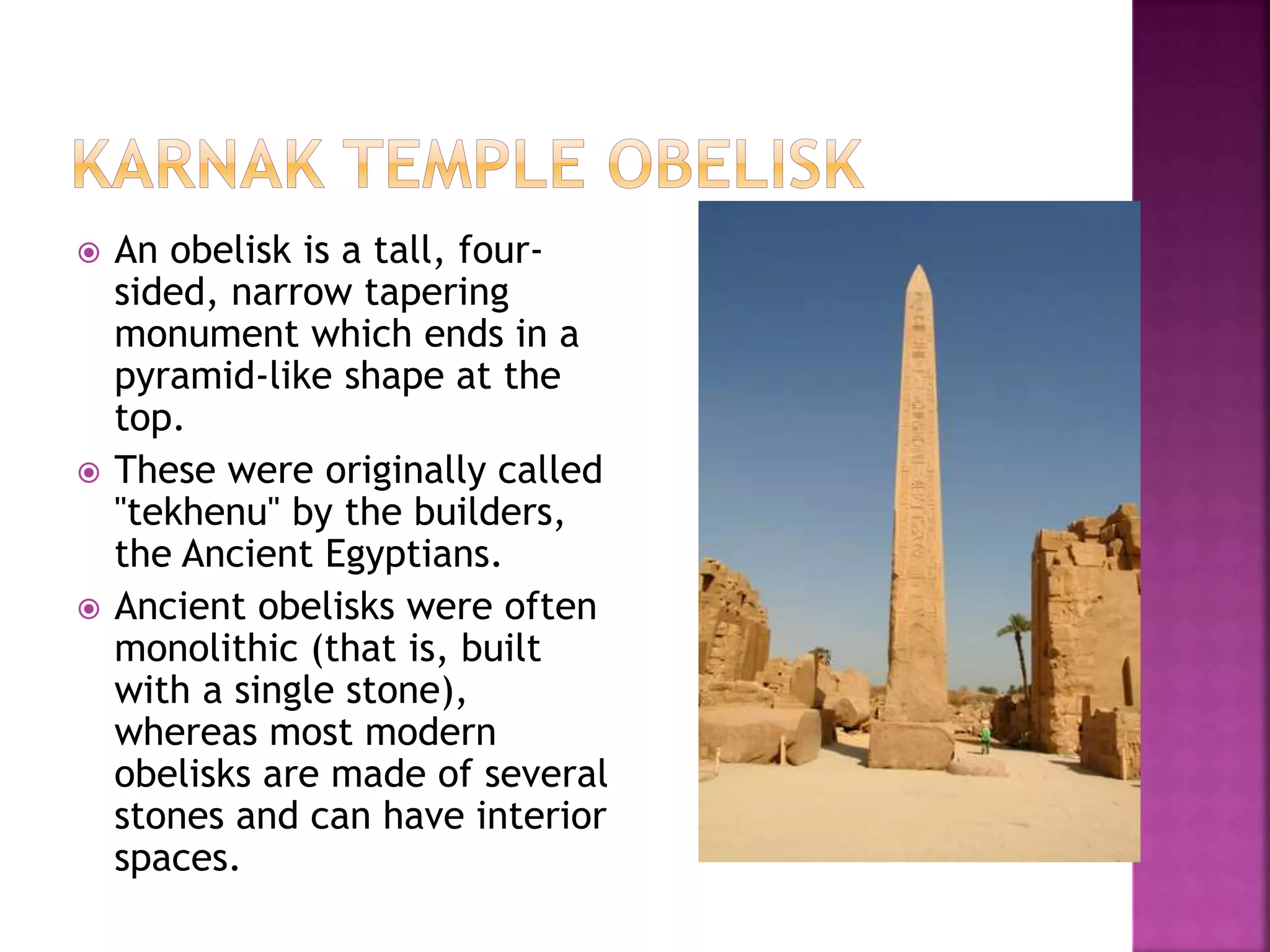
 An obelisk is a tall, four-
sided, narrow tapering
monument which ends in a
pyramid-like shape at the
top.
 These were originally called
"tekhenu" by the builders,
the Ancient Egyptians.
 Ancient obelisks were often
monolithic (that is, built
with a single stone),
whereas most modern
obelisks are made of several
stones and can have interior
spaces.
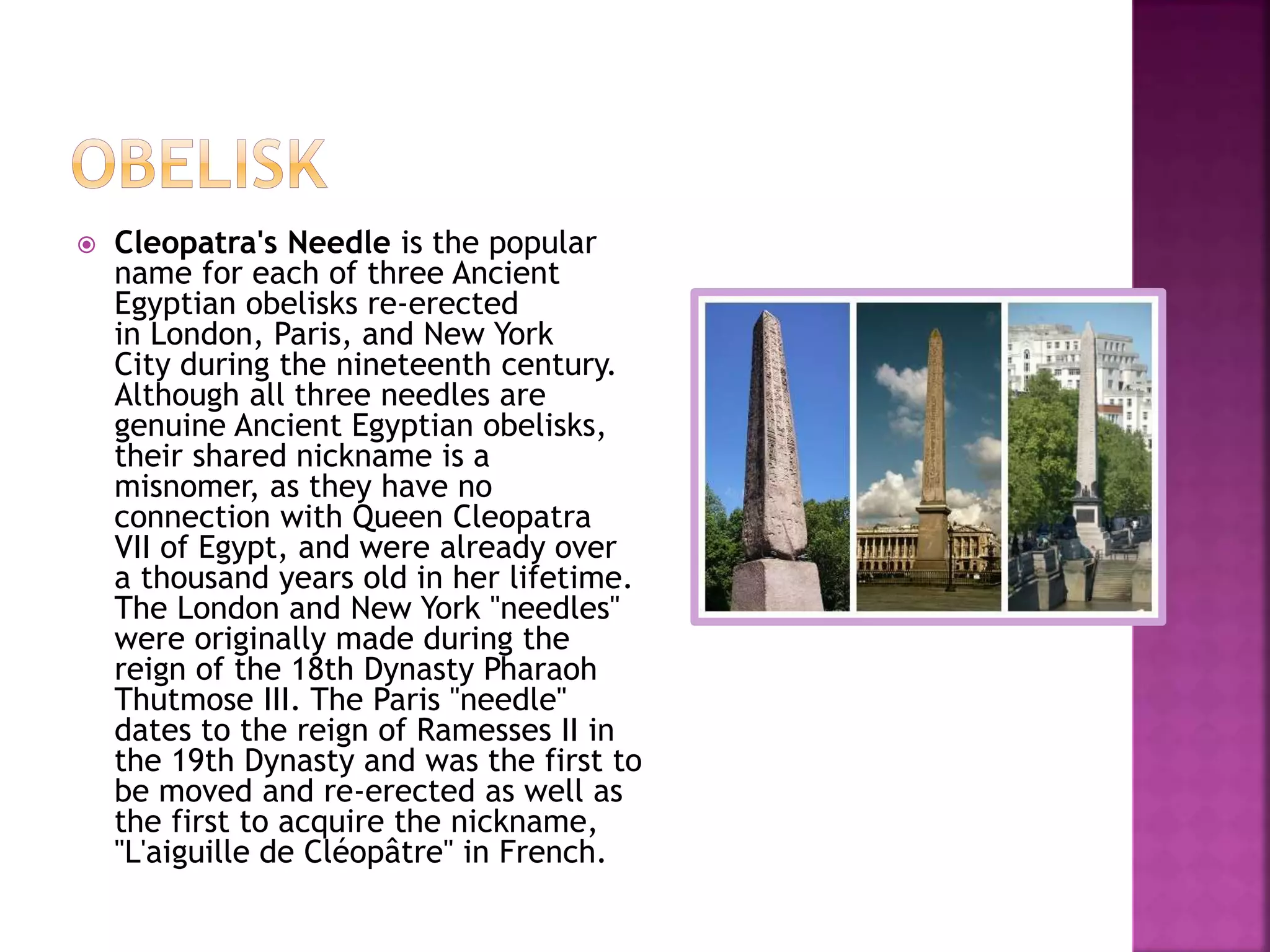
 Cleopatra's Needle is the popular
name for each of three Ancient
Egyptian obelisks re-erected
in London, Paris, and New York
City during the nineteenth century.
Although all three needles are
genuine Ancient Egyptian obelisks,
their shared nickname is a
misnomer, as they have no
connection with Queen Cleopatra
VII of Egypt, and were already over
a thousand years old in her lifetime.
The London and New York "needles"
were originally made during the
reign of the 18th Dynasty Pharaoh
Thutmose III. The Paris "needle"
dates to the reign of Ramesses II in
the 19th Dynasty and was the first to
be moved and re-erected as well as
the first to acquire the nickname,
"L'aiguille de Cléopâtre" in French.
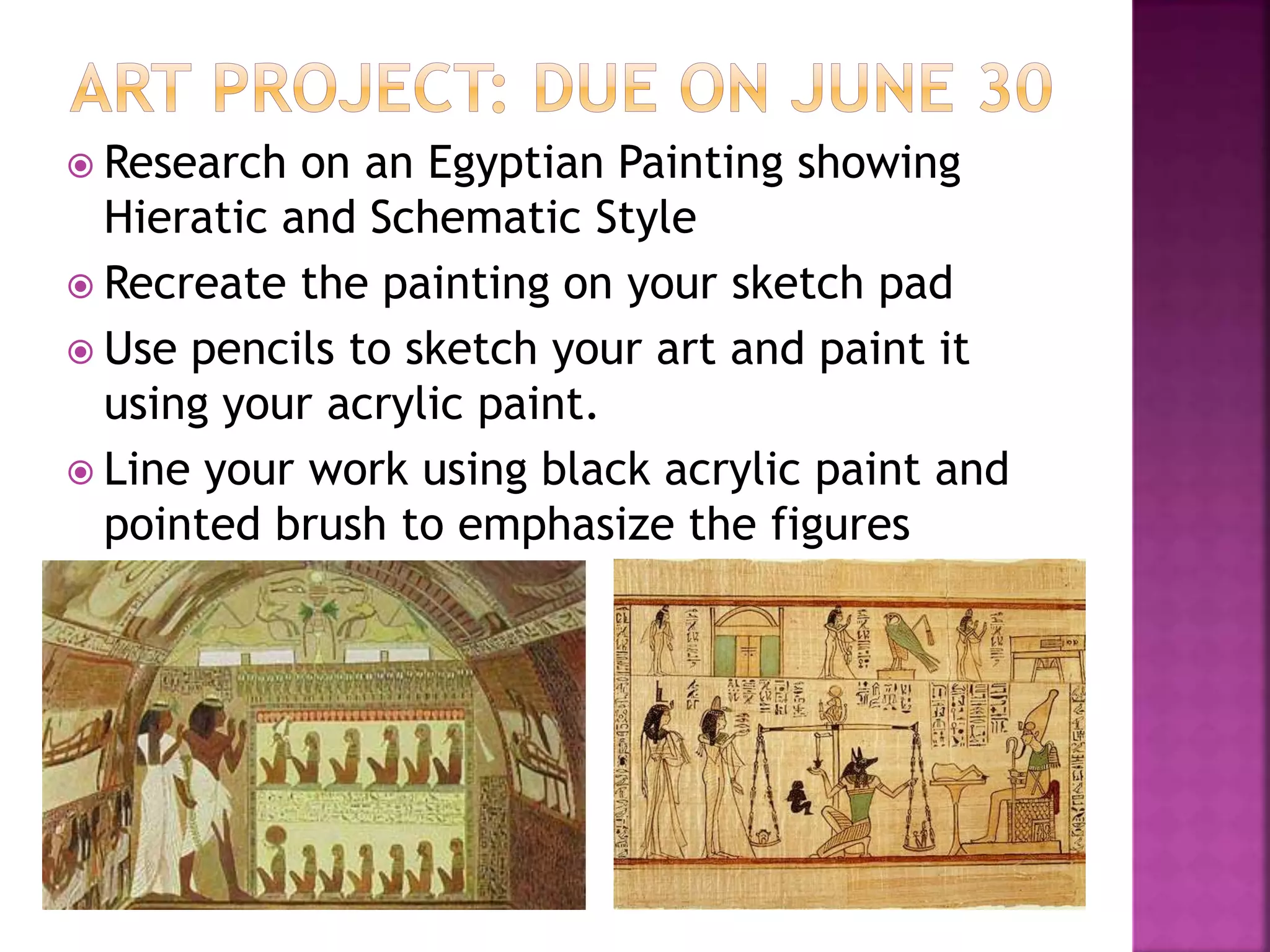
 Research on an Egyptian Painting showing
Hieratic and Schematic Style
 Recreate the painting on your sketch pad
 Use pencils to sketch your art and paint it
using your acrylic paint.
 Line your work using black acrylic paint and
pointed brush to emphasize the figures

Art history lecture 4 egyptian art

  • 1.
    Timeline of EgyptianArt Patronage and Artistic Life Characteristics of Egyptian Sculpture, Painting and Architecture Select Works Artworks from the Timeline
  • 2.
    Guide Questions  Arthas been advancing during this period but are the artist considered as artist?  What are the distinct elements of Egyptian Art? C:UsersOwnerDesktopPWC FINE ART CLASSESWestern Art Understanding VideosQuarter 1Otis Art History 04 - Egyptian Art.mp4 C:UsersOwnerDesktopPWC FINE ART CLASSESWestern Art Understanding VideosQuarter 1Egyptian Art History from Goodbye-Art Academy.mp4
  • 3.
     The EarlyDynastic Period  The Old Kingdom (2575¬2134 BCE)  The Middle Kingdom (2040-1640 BCE)  The New Kingdom (1550¬1070 BCE)  Ptolemaic Era (323-30 BCE)  The period of Roman rule (30 BCE - 395 CE)
  • 4.
     Egyptian sculptorsand painters were paid artisans and not as “artists” in the modern sense of being a creative individual. They were trained and worked as part of a team.  Imhotep, the architect who built the Stepped Pyramid (2630 – 2611 BCE) for King Zoser was so highly revered in later times that he was deified.  The credit for any work of art, however, was believed to belong to the patron who had commissioned it.
  • 5.
     Most EgyptianArt is a picture of contentment and stability that shows successful man and woman in a calm and rational manner  Made use of a Canon of Proportion (a precise measurement of a body) that allows little individuality Shoulders are seen frontally, while the rest of the body, except the eye, is turned profile. Often heads face one direction while legs face another. In the Amara Period (14 BCE) this rule has been laxed.
  • 6.
     Red, thecolor of power, symbolized life and victory, as well as anger and fire.  Green symbolized new life, growth, and fertility  Blue symbolized creation and rebirth  Yellow symbolized the eternal, such as the qualities of the sun and gold.  White was the color of purity, symbolizing all things sacred, and was typically used in religious objects and tools used by the priests.  Black was the color of death and represented the underworld and the night > Men are painted ruddy brown or red; Women painted lighter with yellowish tinge. > Shading is rare
  • 7.
     Ranges fromintimate jewelry to megalithic sculptures.  Sculpted portraits of pharaohs are meant to impress and overwhelm  Limestone is the primary stone used for sculpting aside from gypsum and sandstone.  Wood sculptures are painted  Copper and Iron are also used in sculpture.  Megalith structure like the Great Sphinx are carved on site (in situ) from the local available rock
  • 8.
     Sculpture isthree-dimensional artwork created by shaping or combining hard materials - typically stone such as marble - or metal, glass, or wood. Softer ("plastic") materials can also be used, such as clay, textiles, plastics, polymers and softer metals. The term has been extended to works including sound, text and light.  Found objects may be presented as sculptures. Materials may be worked by removal such as carving; or they may be assembled such as by welding, hardened such as by firing, or molded or cast. Surface decoration such as paint may be applied.  Sculpture has been described as one of the plastic arts because it can involve the use of materials that can be moulded or modulated.  The word sculpture originates from the Latin word sculpere, which means "to carve".
  • 9.
    Free Standing Sculpture sculpturethat is surrounded on all sides, except the base, by space. It is also known as sculpture "in the round", and is meant to be viewed from any angle.
  • 10.
    Statue - representationalistsculpture depicting a specific entity, usually a person, event, animal or object. Types  Full statue  Bust - representation of a person from the chest up  Equestrian statue - typically showing a significant person on horseback
  • 11.
     Relief Sculpture thesculpture is still attached to a background; Types of Relief Sculpture bas-relief (low relief) mezzo-rilievo (mid relief) alto-relievo (high relief) sunken-relief
  • 12.
     Relief Sculpturesfollow the Canon of Proportion  When carved outdoors they are done Sunken Relief to dramatically create shadows and make the work visible  When carved indoors reliefs are done either Bas Relief or Mezzo Relievo
  • 13.
     Egyptian Pyramidsare sleek solid surfaces and monumental scale. Made of stone blocks without mortar (mortar a mixture of lime, sand and water used in building for holding bricks or stones together)  The sides of the pyramids are oriented to the four cardinal points of the compass  Egyptian temples have astronomical orientation. (Temple of Ramses II admits light into the deepest recesses at dawn on Ramses’ birthday  Columns used in New Kingdom temples are based on plant shapes: lotus, palm and papyrus.
  • 14.
    a) campaniform b)clustered lotus column c) simple lotus column d) palm column e) Hathor-headed column
  • 16.
    Narmer Palette, 3000– 2920 BCE Relief sculpture depicting King Narmer uniting upper and lower Egypt Hathor, a god as a cow with a woman’s face, depicted four times Narmer is the largest figure in front while Horus, a god of Egypt (Hierarchy of Scale) Schematic lines delineate Narmer’s muscle structure. Hieroglyphics explain and add meaning to the Narrative A palette is used to prepare make-up
  • 17.
    Ti Watching theHippopotamus Hunt, c 2400 BCE, painted on limestone, Tomb of Ti, Saqqara, Egypt Painted on relief in the mastaba of Ti, a government official Hunt takes place as a memorial to the deceased; success in the hunt is a parallel with the fight against evil
  • 18.
     Senusret III,c 1860 BCE, stone, Cairo Moody look in the eyes and mouth: depressed rather than heroic figures of the Old Kingdom Figure reflects the period of civil unrest
  • 19.
     Rock CutTombs of Beni Hasan, c 1950 – 1900 BCE Cliff walls hollowed out to reveal small burial chambers Reserve columns cut away from the interior chamber to create the look of conventional columns Columns are not round but fluted
  • 20.
     Judgement beforeOsiris, c 1290 – 1280 BCE, papyrus Illustration of the Book of the Dead, an Egyptian book of spell and charm Anubis, god of embalming, Thoth, a god who invented hieroglyphics and Osiris, god of the underworld seated on the throne
  • 21.
     Mask ofKing Tutankhamen, c 1323 BCE, gold enamel, semi- precious stones, Cairo Death mask Mummified body of King Tutankhamen buried with 143 objects on his head, neck, abdomen and limbs Gold coffin that is 6’7” long Smoothly idealized features of the boy-king
  • 22.
     Temple ofRamses II, 1290 – 1224 BCE  Temple of Amen-Re, 1290 – 1224 BCE
  • 23.
     Akhenaton, c.1353-1335 BCE, Sandstone Amarna style of sculpture  Nefertiti, 1353 – 1335 BCE, Limestone Wife of Akhenaton  Queen Hatshepsut, c 1473 -1458 BCE, granite Queen dressed in male costume Often portrayed as a sphinx
  • 24.
     An obeliskis a tall, four- sided, narrow tapering monument which ends in a pyramid-like shape at the top.  These were originally called "tekhenu" by the builders, the Ancient Egyptians.  Ancient obelisks were often monolithic (that is, built with a single stone), whereas most modern obelisks are made of several stones and can have interior spaces.
  • 25.
     Cleopatra's Needleis the popular name for each of three Ancient Egyptian obelisks re-erected in London, Paris, and New York City during the nineteenth century. Although all three needles are genuine Ancient Egyptian obelisks, their shared nickname is a misnomer, as they have no connection with Queen Cleopatra VII of Egypt, and were already over a thousand years old in her lifetime. The London and New York "needles" were originally made during the reign of the 18th Dynasty Pharaoh Thutmose III. The Paris "needle" dates to the reign of Ramesses II in the 19th Dynasty and was the first to be moved and re-erected as well as the first to acquire the nickname, "L'aiguille de Cléopâtre" in French.
  • 26.
     Research onan Egyptian Painting showing Hieratic and Schematic Style  Recreate the painting on your sketch pad  Use pencils to sketch your art and paint it using your acrylic paint.  Line your work using black acrylic paint and pointed brush to emphasize the figures