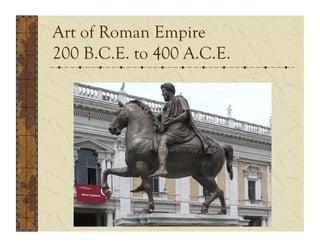
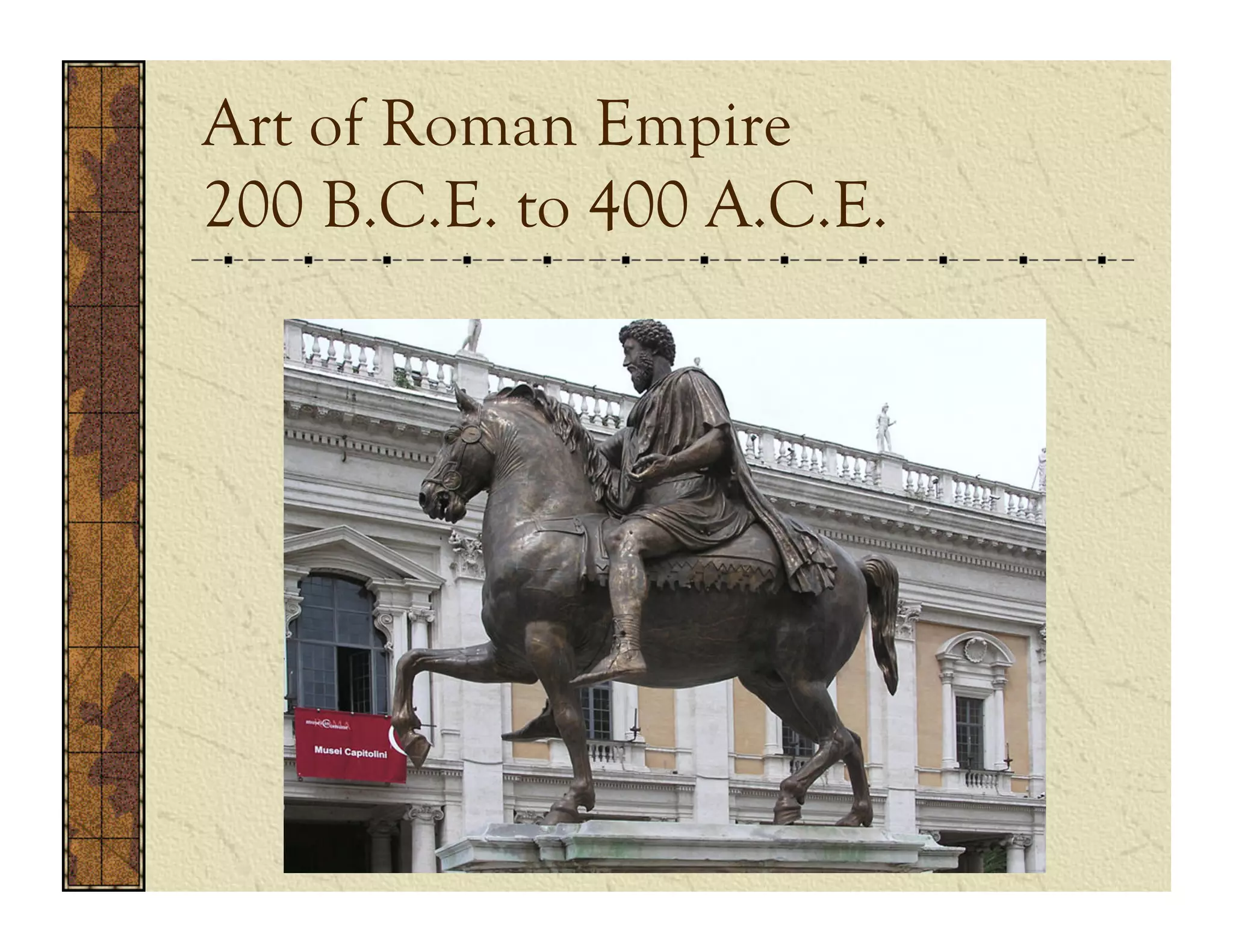
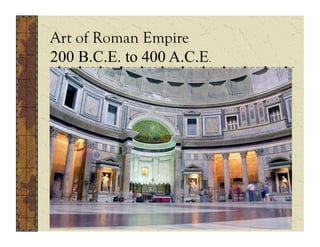
Art of Roman Empire
200 B.C.E. to 400 A.C.E.
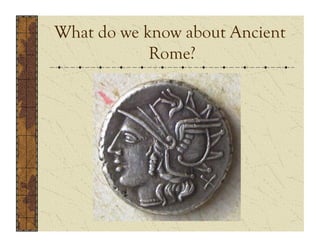
What do we know about Ancient
            Rome?
Art of Roman Empire
  200 B.C.E. to 400 A.C.E.
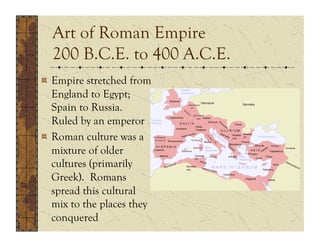
!   Empire stretched from
    England to Egypt;
    Spain to Russia.
    Ruled by an emperor
!   Roman culture was a
    mixture of older
    cultures (primarily
    Greek). Romans
    spread this cultural
    mix to the places they
    conquered
Art of Roman Empire
 200 B.C.E. to 400 A.C.E.
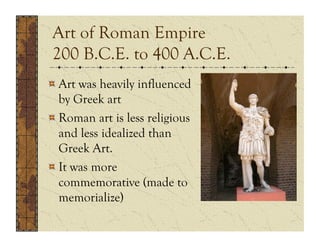
!  Art was heavily influenced
   by Greek art
!  Roman art is less religious
   and less idealized than
   Greek Art.
!  It was more
   commemorative (made to
   memorialize)
Art of Roman Empire
200 B.C.E. to 400 A.C.E.
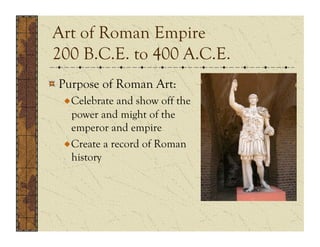
!  Purpose of Roman Art:
  !  Celebrate and show off the
     power and might of the
     emperor and empire
  !  Create a record of Roman
     history
Art of Roman Empire
200 B.C.E. to 400 A.C.E.
!  What kinds or types of art would
   you create if you wanted to show
   your power as an emperor and the
   might of your empire?
!  What might that art look like?
!  Where would you want to place
   that art?
Art of Roman Empire
 200 B.C.E. to 400 A.C.E.
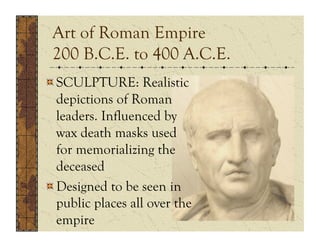
!  SCULPTURE: Realistic
   depictions of Roman
   leaders. Influenced by
   wax death masks used
   for memorializing the
   deceased
!  Designed to be seen in
   public places all over the
   empire
Art of Roman Empire
200 B.C.E. 400 A.C.E.

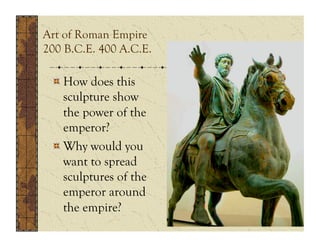
 !  How does this
    sculpture show
    the power of the
    emperor?
 !  Why would you
    want to spread
    sculptures of the
    emperor around
    the empire?
Art of Roman Empire
  200 B.C.E. to 400 A.C.E.
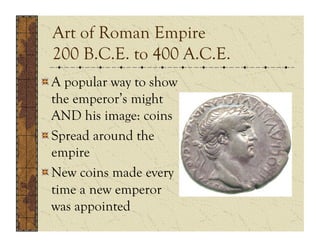
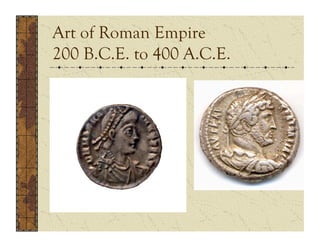
!  A popular way to show
   the emperor’s might
   AND his image: coins
!  Spread around the
   empire
!  New coins made every
   time a new emperor
   was appointed
Art of Roman Empire
200 B.C.E. to 400 A.C.E.
Art of Roman Empire
200 B.C.E. to 400 A.C.E.
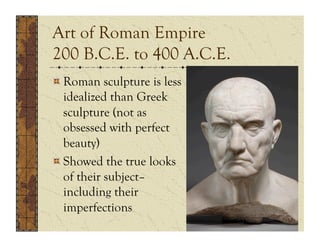
!  Roman sculpture is less
   idealized than Greek
   sculpture (not as
   obsessed with perfect
   beauty)
!  Showed the true looks
   of their subject–
   including their
   imperfections
Art of Roman Empire
200 B.C.E. to 400 A.C.E.
Higher Level Thinking:
Why would Roman artists want to create
super-realistic images of their leaders?
(hint: think back to one of the purposes of
Roman art – creating their history visually)

 What effect would these super realistic
 sculptures have on Roman citizens in far
 reaches of the Empire?
Art of Roman Empire
200 B.C.E. to
400 A.C.E.
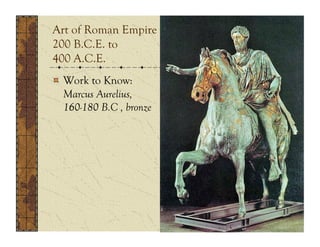
!   Work to Know:
    Marcus Aurelius,
    160-180 B.C , bronze
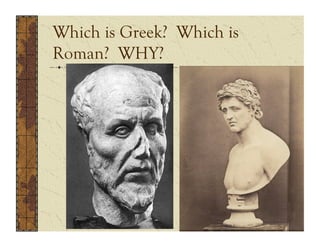
Which is Greek? Which is
Roman? WHY?
Art of Roman Empire
  200 B.C.E. to 400 A.C.E.
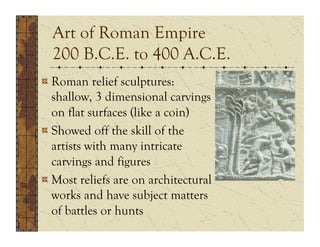
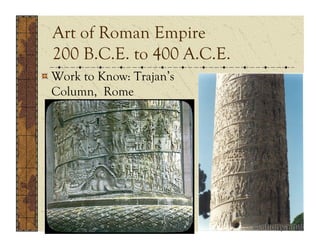
!  Roman relief sculptures:
   shallow, 3 dimensional carvings
   on flat surfaces (like a coin)
!  Showed off the skill of the
   artists with many intricate
   carvings and figures
!  Most reliefs are on architectural
   works and have subject matters
   of battles or hunts
Art of Roman Empire
  200 B.C.E. to 400 A.C.E.
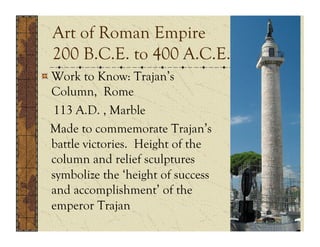
!  Work to Know: Trajan’s
   Column, Rome
   113 A.D. , Marble
  Made to commemorate Trajan’s
   battle victories. Height of the
   column and relief sculptures
   symbolize the ‘height of success
   and accomplishment’ of the
   emperor Trajan
Art of Roman Empire
  200 B.C.E. to 400 A.C.E.
!  Work to Know: Trajan’s
   Column, Rome
   113 A.D. , Marble
Roman Architecture
!  What art history period had the biggest
   influence on Roman architecture?
!  (hint: think about what culture was the
   biggest influence on Roman artwork!)
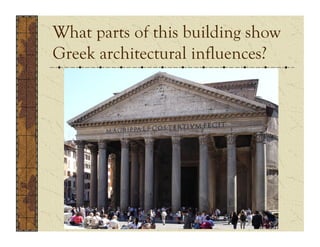
What parts of this building show
Greek architectural influences?
Art of Roman Empire
200 B.C.E. to 400 A.C.E.
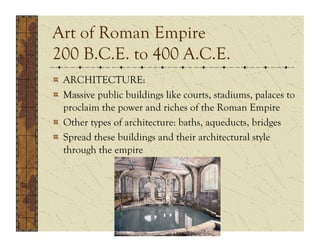
!   ARCHITECTURE:
!   Massive public buildings like courts, stadiums, palaces to
    proclaim the power and riches of the Roman Empire
!   Other types of architecture: baths, aqueducts, bridges
!   Spread these buildings and their architectural style
    through the empire
Art of Roman Empire
200 B.C.E. to 400 A.C.E.
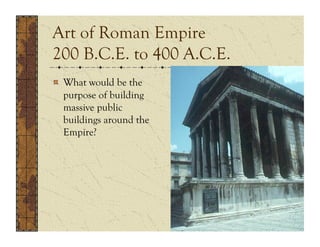
!   What would be the
    purpose of building
    massive public
    buildings around the
    Empire?
Art of Roman Empire
  200 B.C.E. to 400 A.C.E.
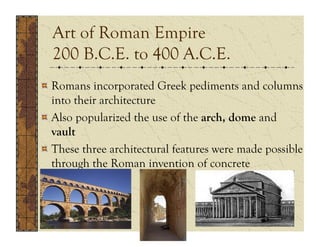
!  Romans incorporated Greek pediments and columns
   into their architecture
!  Also popularized the use of the arch, dome and
   vault
!  These three architectural features were made possible
   through the Roman invention of concrete
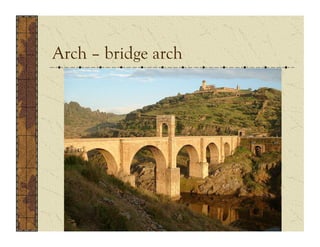
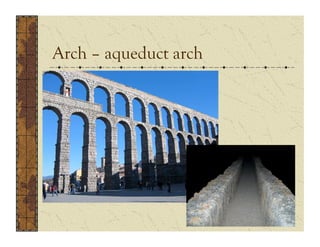
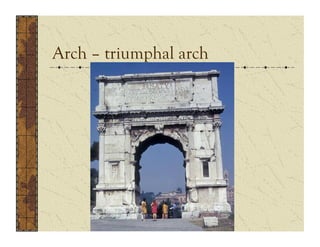
Arch
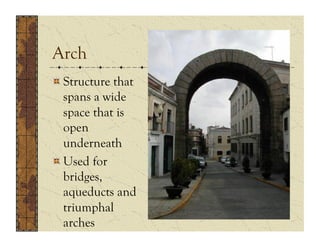
!  Structure that
   spans a wide
   space that is
   open
   underneath
!  Used for
   bridges,
   aqueducts and
   triumphal
   arches
Arch – bridge arch
Arch – aqueduct arch
Arch – triumphal arch
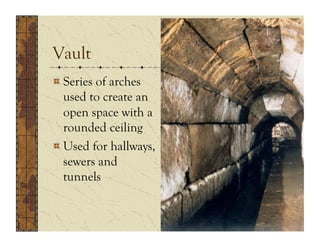
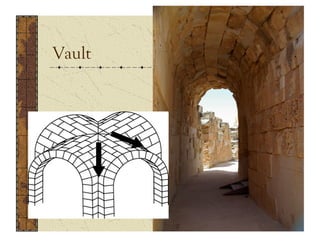
Vault
!  Series of arches
   used to create an
   open space with a
   rounded ceiling
!  Used for hallways,
   sewers and
   tunnels
Vault
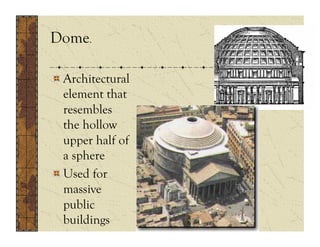
Dome.

!  Architectural
   element that
   resembles
   the hollow
   upper half of
   a sphere
!  Used for
   massive
   public
   buildings
Art of Roman Empire
 200 B.C.E. to 400 A.C.E.
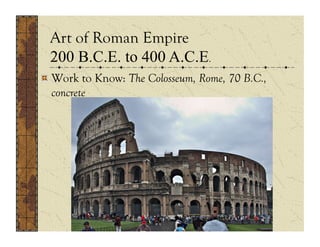
 .
!  Work to Know: The Colosseum, Rome, 70 B.C.,
   concrete
Art of Roman Empire
 200 B.C.E. to 400 A.C.E.
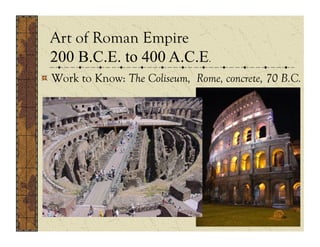
 .
!  Work to Know: The Coliseum, Rome, concrete, 70 B.C.
Art of Roman Empire
  200 B.C.E. to 400 A.C.E.
  .
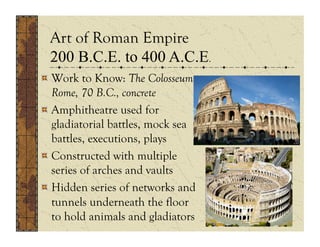
!  Work to Know: The Colosseum,
   Rome, 70 B.C., concrete
!  Amphitheatre used for
   gladiatorial battles, mock sea
   battles, executions, plays
!  Constructed with multiple
   series of arches and vaults
!  Hidden series of networks and
   tunnels underneath the floor
   to hold animals and gladiators
Art of Roman Empire
200 B.C.E. to 400 A.C.E.
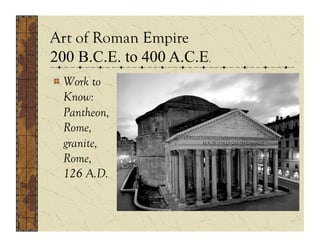
!  Work to
   Know:
   Pantheon,
   Rome,
   granite,
   Rome,
   126 A.D.
Art of Roman Empire
 200 B.C.E. to 400 A.C.E.
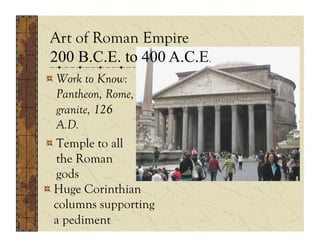
 !  Work to Know:
    Pantheon, Rome,
    granite, 126
    A.D.
 !  Temple to all
    the Roman
    gods
!  Huge Corinthian
   columns supporting
   a pediment
Art of Roman
 Empire
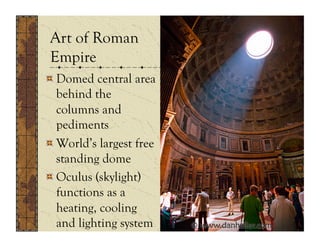
!  Domed central area
   behind the
   columns and
   pediments
!  World’s largest free
   standing dome
!  Oculus (skylight)
   functions as a
   heating, cooling
   and lighting system
Art of Roman Empire
200 B.C.E. to 400 A.C.E.
Discussion:
!  If you were a Roman emperor conquering a
   new territory what are some concerns you
   would have about your new lands and the
   people inhabiting it?
Discussion:
!  What are some ways you could help prevent
   uprisings in your new territories?


!  What are some ways you could use art or
   architecture to spread Roman culture to
   those you’ve conquered?
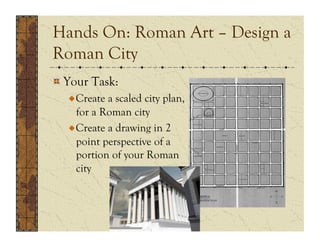
Hands On: Roman Art – Design a
Roman City
!  Your Task:
  !  Create a scaled city plan,
     for a Roman city
  !  Create a drawing in 2
     point perspective of a
     portion of your Roman
     city
Hands On: Roman Art –
Scaled City Plan
 !  Skills Learned:
    • Using a ruler
    • Measuring skills
    • Drawing to scale


 !  Concepts Learned:
    • Thinking about the purpose of Roman Art while you
      work
    • Putting yourself into the mindset of the Ancient
      Romans
Scaled City Plan Requirements
!  Rubric

!  City Requirements in Binder
Before You Begin
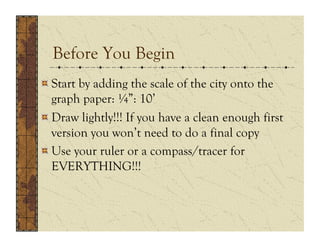
!  Start by adding the scale of the city onto the
   graph paper: ¼”: 10’
!  Draw lightly!!! If you have a clean enough first
   version you won’t need to do a final copy
!  Use your ruler or a compass/tracer for
   EVERYTHING!!!
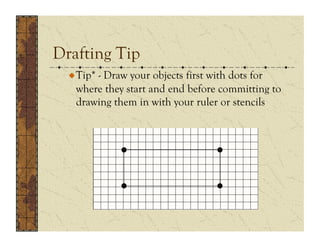
Drafting Tip
 !  Tip* - Draw your objects first with dots for
    where they start and end before committing to
    drawing them in with your ruler or stencils
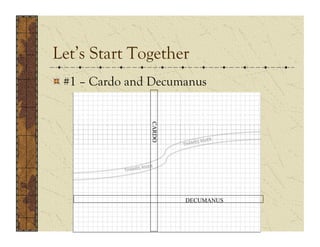
Let’s Start Together
!  #1 – Cardo and Decumanus


                 CARDO


                         DECUMANUS
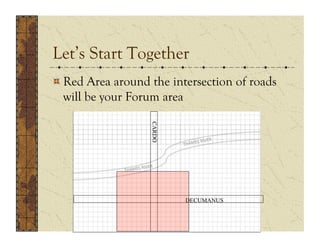
Let’s Start Together
!  Red Area around the intersection of roads
   will be your Forum area


                   CARDO


                           DECUMANUS
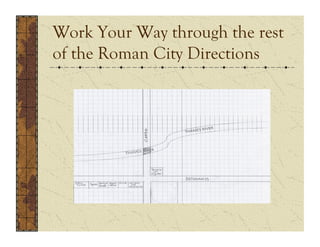
Work Your Way through the rest
of the Roman City Directions

Roman art

  • 1.
    Art of RomanEmpire 200 B.C.E. to 400 A.C.E.
  • 2.
    What do weknow about Ancient Rome?
  • 3.
    Art of RomanEmpire 200 B.C.E. to 400 A.C.E. !   Empire stretched from England to Egypt; Spain to Russia. Ruled by an emperor !   Roman culture was a mixture of older cultures (primarily Greek). Romans spread this cultural mix to the places they conquered
  • 4.
    Art of RomanEmpire 200 B.C.E. to 400 A.C.E. !  Art was heavily influenced by Greek art !  Roman art is less religious and less idealized than Greek Art. !  It was more commemorative (made to memorialize)
  • 5.
    Art of RomanEmpire 200 B.C.E. to 400 A.C.E. !  Purpose of Roman Art: !  Celebrate and show off the power and might of the emperor and empire !  Create a record of Roman history
  • 6.
    Art of RomanEmpire 200 B.C.E. to 400 A.C.E. !  What kinds or types of art would you create if you wanted to show your power as an emperor and the might of your empire? !  What might that art look like? !  Where would you want to place that art?
  • 7.
    Art of RomanEmpire 200 B.C.E. to 400 A.C.E. !  SCULPTURE: Realistic depictions of Roman leaders. Influenced by wax death masks used for memorializing the deceased !  Designed to be seen in public places all over the empire
  • 8.
    Art of RomanEmpire 200 B.C.E. 400 A.C.E. !  How does this sculpture show the power of the emperor? !  Why would you want to spread sculptures of the emperor around the empire?
  • 9.
    Art of RomanEmpire 200 B.C.E. to 400 A.C.E. !  A popular way to show the emperor’s might AND his image: coins !  Spread around the empire !  New coins made every time a new emperor was appointed
  • 10.
    Art of RomanEmpire 200 B.C.E. to 400 A.C.E.
  • 11.
    Art of RomanEmpire 200 B.C.E. to 400 A.C.E. !  Roman sculpture is less idealized than Greek sculpture (not as obsessed with perfect beauty) !  Showed the true looks of their subject– including their imperfections
  • 12.
    Art of RomanEmpire 200 B.C.E. to 400 A.C.E. Higher Level Thinking: Why would Roman artists want to create super-realistic images of their leaders? (hint: think back to one of the purposes of Roman art – creating their history visually) What effect would these super realistic sculptures have on Roman citizens in far reaches of the Empire?
  • 13.
    Art of RomanEmpire 200 B.C.E. to 400 A.C.E. !   Work to Know: Marcus Aurelius, 160-180 B.C , bronze
  • 14.
    Which is Greek?Which is Roman? WHY?
  • 15.
    Art of RomanEmpire 200 B.C.E. to 400 A.C.E. !  Roman relief sculptures: shallow, 3 dimensional carvings on flat surfaces (like a coin) !  Showed off the skill of the artists with many intricate carvings and figures !  Most reliefs are on architectural works and have subject matters of battles or hunts
  • 16.
    Art of RomanEmpire 200 B.C.E. to 400 A.C.E. !  Work to Know: Trajan’s Column, Rome 113 A.D. , Marble Made to commemorate Trajan’s battle victories. Height of the column and relief sculptures symbolize the ‘height of success and accomplishment’ of the emperor Trajan
  • 17.
    Art of RomanEmpire 200 B.C.E. to 400 A.C.E. !  Work to Know: Trajan’s Column, Rome 113 A.D. , Marble
  • 18.
    Roman Architecture !  Whatart history period had the biggest influence on Roman architecture? !  (hint: think about what culture was the biggest influence on Roman artwork!)
  • 19.
    What parts ofthis building show Greek architectural influences?
  • 20.
    Art of RomanEmpire 200 B.C.E. to 400 A.C.E. !   ARCHITECTURE: !   Massive public buildings like courts, stadiums, palaces to proclaim the power and riches of the Roman Empire !   Other types of architecture: baths, aqueducts, bridges !   Spread these buildings and their architectural style through the empire
  • 21.
    Art of RomanEmpire 200 B.C.E. to 400 A.C.E. !   What would be the purpose of building massive public buildings around the Empire?
  • 22.
    Art of RomanEmpire 200 B.C.E. to 400 A.C.E. !  Romans incorporated Greek pediments and columns into their architecture !  Also popularized the use of the arch, dome and vault !  These three architectural features were made possible through the Roman invention of concrete
  • 23.
    Arch !  Structure that spans a wide space that is open underneath !  Used for bridges, aqueducts and triumphal arches
  • 24.
  • 25.
  • 26.
  • 27.
    Vault !  Series ofarches used to create an open space with a rounded ceiling !  Used for hallways, sewers and tunnels
  • 28.
  • 29.
    Dome. !  Architectural element that resembles the hollow upper half of a sphere !  Used for massive public buildings
  • 30.
    Art of RomanEmpire 200 B.C.E. to 400 A.C.E. . !  Work to Know: The Colosseum, Rome, 70 B.C., concrete
  • 31.
    Art of RomanEmpire 200 B.C.E. to 400 A.C.E. . !  Work to Know: The Coliseum, Rome, concrete, 70 B.C.
  • 32.
    Art of RomanEmpire 200 B.C.E. to 400 A.C.E. . !  Work to Know: The Colosseum, Rome, 70 B.C., concrete !  Amphitheatre used for gladiatorial battles, mock sea battles, executions, plays !  Constructed with multiple series of arches and vaults !  Hidden series of networks and tunnels underneath the floor to hold animals and gladiators
  • 33.
    Art of RomanEmpire 200 B.C.E. to 400 A.C.E. !  Work to Know: Pantheon, Rome, granite, Rome, 126 A.D.
  • 34.
    Art of RomanEmpire 200 B.C.E. to 400 A.C.E. !  Work to Know: Pantheon, Rome, granite, 126 A.D. !  Temple to all the Roman gods !  Huge Corinthian columns supporting a pediment
  • 35.
    Art of Roman Empire !  Domed central area behind the columns and pediments !  World’s largest free standing dome !  Oculus (skylight) functions as a heating, cooling and lighting system
  • 36.
    Art of RomanEmpire 200 B.C.E. to 400 A.C.E.
  • 37.
    Discussion: !  If youwere a Roman emperor conquering a new territory what are some concerns you would have about your new lands and the people inhabiting it?
  • 38.
    Discussion: !  What aresome ways you could help prevent uprisings in your new territories? !  What are some ways you could use art or architecture to spread Roman culture to those you’ve conquered?
  • 39.
    Hands On: RomanArt – Design a Roman City !  Your Task: !  Create a scaled city plan, for a Roman city !  Create a drawing in 2 point perspective of a portion of your Roman city
  • 40.
    Hands On: RomanArt – Scaled City Plan !  Skills Learned: • Using a ruler • Measuring skills • Drawing to scale !  Concepts Learned: • Thinking about the purpose of Roman Art while you work • Putting yourself into the mindset of the Ancient Romans
  • 41.
    Scaled City PlanRequirements !  Rubric !  City Requirements in Binder
  • 42.
    Before You Begin ! Start by adding the scale of the city onto the graph paper: ¼”: 10’ !  Draw lightly!!! If you have a clean enough first version you won’t need to do a final copy !  Use your ruler or a compass/tracer for EVERYTHING!!!
  • 43.
    Drafting Tip ! Tip* - Draw your objects first with dots for where they start and end before committing to drawing them in with your ruler or stencils
  • 44.
    Let’s Start Together ! #1 – Cardo and Decumanus CARDO DECUMANUS
  • 45.
    Let’s Start Together ! Red Area around the intersection of roads will be your Forum area CARDO DECUMANUS
  • 46.
    Work Your Waythrough the rest of the Roman City Directions