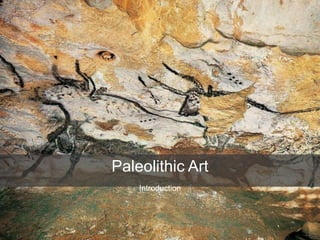
Paleolithic Art
Introduction
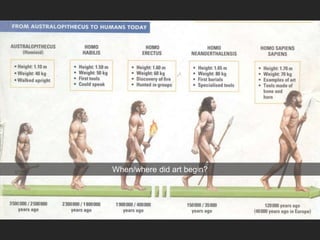
When/where did art begin?
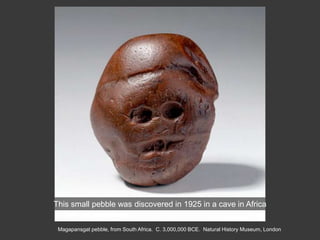
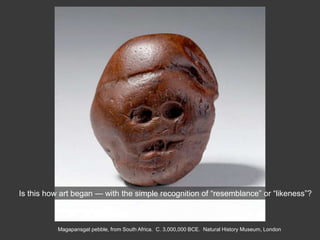
Magapansgat pebble, from South Africa. C. 3,000,000 BCE. Natural History Museum, London
This small pebble was discovered in 1925 in a cave in Africa
It was found amongst the bones of Australopithecus, a predecessor of modern humans
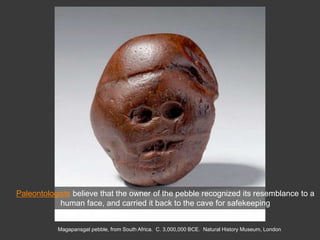
Magapansgat pebble, from South Africa. C. 3,000,000 BCE. Natural History Museum, London
Paleontologists believe that the owner of the pebble recognized its resemblance to a
human face, and carried it back to the cave for safekeeping
Magapansgat pebble, from South Africa. C. 3,000,000 BCE. Natural History Museum, London
Is this how art began — with the simple recognition of “resemblance” or “likeness”?
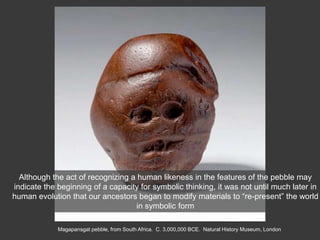
Magapansgat pebble, from South Africa. C. 3,000,000 BCE. Natural History Museum, London
Although the act of recognizing a human likeness in the features of the pebble may
indicate the beginning of a capacity for symbolic thinking, it was not until much later in
human evolution that our ancestors began to modify materials to “re-present” the world
in symbolic form
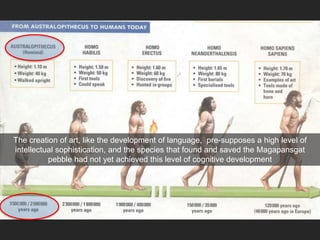
The creation of art, like the development of language, pre-supposes a high level of
intellectual sophistication, and the species that found and saved the Magapansgat
pebble had not yet achieved this level of cognitive development
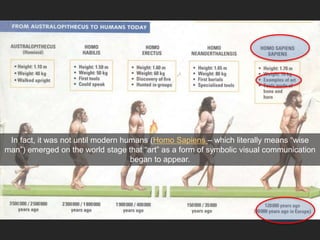
In fact, it was not until modern humans (Homo Sapiens – which literally means “wise
man”) emerged on the world stage that “art” as a form of symbolic visual communication
began to appear.
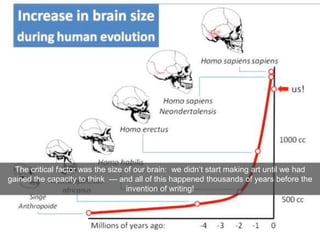
The critical factor was the size of our brain: we didn’t start making art until we had
gained the capacity to think — and all of this happened thousands of years before the
invention of writing!
So art began when the human brain evolved to its modern capacity, and the oldest
examples can be found in Africa, where our ancient ancestors originated
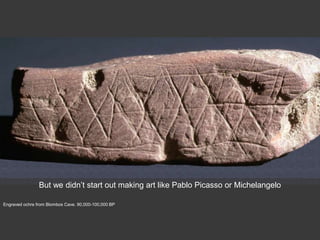
Engraved ochre from Blombos Cave. 90,000-100,000 BP
But we didn’t start out making art like Pablo Picasso or Michelangelo
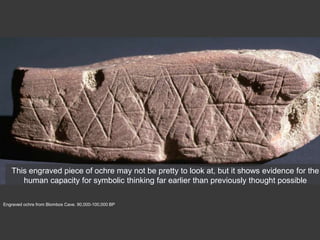
Engraved ochre from Blombos Cave. 90,000-100,000 BP
This engraved piece of ochre may not be pretty to look at, but it shows evidence for the
human capacity for symbolic thinking far earlier than previously thought possible
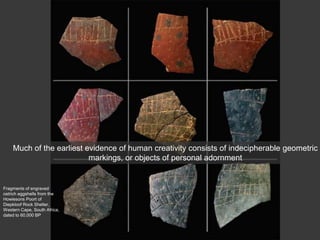
Fragments of engraved
ostrich eggshells from the
Howiesons Poort of
Diepkloof Rock Shelter,
Western Cape, South Africa,
dated to 60,000 BP
Much of the earliest evidence of human creativity consists of indecipherable geometric
markings, or objects of personal adornment
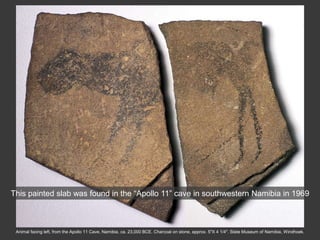
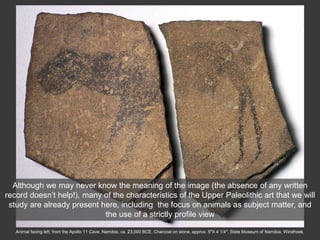
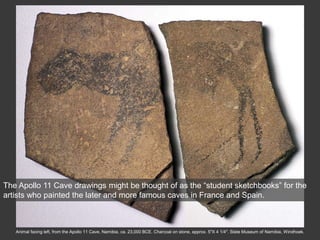
Animal facing left, from the Apollo 11 Cave, Namibia, ca. 23,000 BCE. Charcoal on stone, approx. 5″X 4 1/4″. State Museum of Namibia, Windhoek.
This painted slab was found in the “Apollo 11” cave in southwestern Namibia in 1969
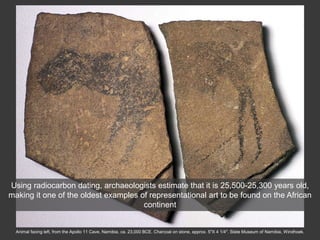
Animal facing left, from the Apollo 11 Cave, Namibia, ca. 23,000 BCE. Charcoal on stone, approx. 5″X 4 1/4″. State Museum of Namibia, Windhoek.
Using radiocarbon dating, archaeologists estimate that it is 25,500-25,300 years old,
making it one of the oldest examples of representational art to be found on the African
continent
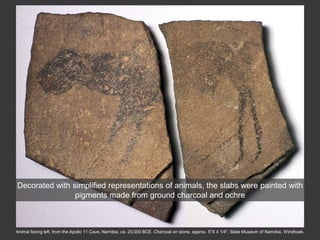
Animal facing left, from the Apollo 11 Cave, Namibia, ca. 23,000 BCE. Charcoal on stone, approx. 5″X 4 1/4″. State Museum of Namibia, Windhoek.
Decorated with simplified representations of animals, the slabs were painted with
pigments made from ground charcoal and ochre
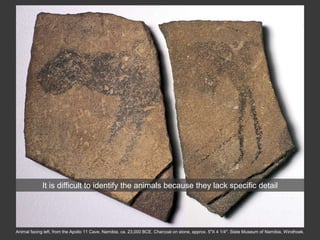
Animal facing left, from the Apollo 11 Cave, Namibia, ca. 23,000 BCE. Charcoal on stone, approx. 5″X 4 1/4″. State Museum of Namibia, Windhoek.
It is difficult to identify the animals because they lack specific detail
Animal facing left, from the Apollo 11 Cave, Namibia, ca. 23,000 BCE. Charcoal on stone, approx. 5″X 4 1/4″. State Museum of Namibia, Windhoek.
Although we may never know the meaning of the image (the absence of any written
record doesn’t help!), many of the characteristics of the Upper Paleolithic art that we will
study are already present here, including the focus on animals as subject matter, and
the use of a strictly profile view
Animal facing left, from the Apollo 11 Cave, Namibia, ca. 23,000 BCE. Charcoal on stone, approx. 5″X 4 1/4″. State Museum of Namibia, Windhoek.
The Apollo 11 Cave drawings might be thought of as the “student sketchbooks” for the
artists who painted the later and more famous caves in France and Spain.
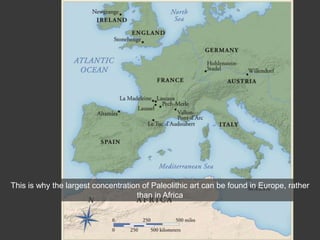
The real story begins in the Upper Paleolithic era, when climate change prompted
migration North (50,000-10,000 years ago)
This is why the largest concentration of Paleolithic art can be found in Europe, rather
than in Africa
VOCABULARY
Before moving to the next section, it might be helpful to define a few vocabulary terms
VOCABULARY
Prehistory/Prehistoric Before recorded history
Paleolithic Old Stone Age
Stone Age Stone tools
Neolithic New Stone Age
Dating
B.C. Before Christ
B.C.E. Before Common Era
BP Before Present
Radiocarbon dating Measure based on
decay rate of carbon in
organic matter
WARNING: Dating always approximate, and
often highly contested!!!!
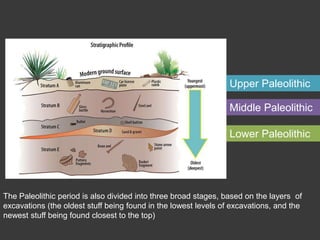
Upper Paleolithic
Middle Paleolithic
Lower Paleolithic
The Paleolithic period is also divided into three broad stages, based on the layers of
excavations (the oldest stuff being found in the lowest levels of excavations, and the
newest stuff being found closest to the top)
Finally, the Upper Paleolithic period is further divided into cultural periods (based on
lifestyles and tool technologies), which are given varying dates by different experts. You
DO NOT have to know these, but I am listing them in case you come across them
Paleolithic Art
Mobiliary Art
Mobiliary Art Small portable carvings and sculptures
made from bones, antlers, stone
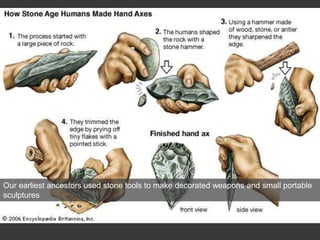
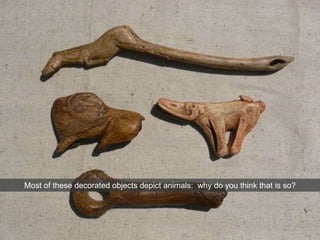
Our earliest ancestors used stone tools to make decorated weapons and small portable
sculptures
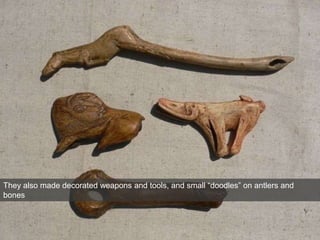
They also made decorated weapons and tools, and small “doodles” on antlers and
bones
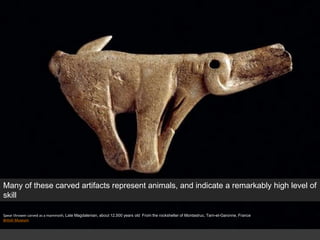
Spear thrower carved as a mammoth, Late Magdalenian, about 12,500 years old From the rockshelter of Montastruc, Tarn-et-Garonne, France
British Museum
Many of these carved artifacts represent animals, and indicate a remarkably high level of
skill
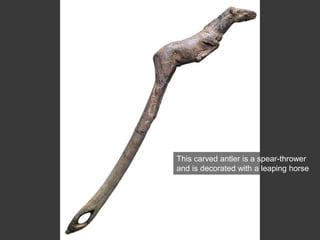
This carved antler is a spear-thrower
and is decorated with a leaping horse
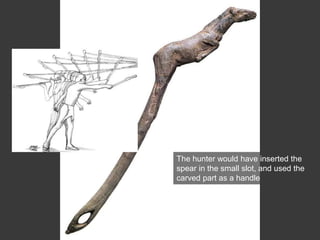
The hunter would have inserted the
spear in the small slot, and used the
carved part as a handle
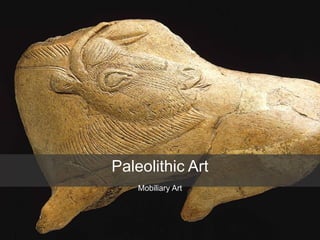
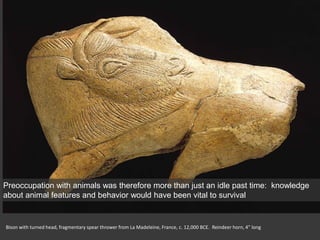
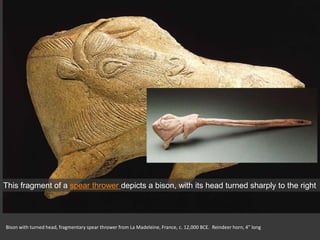
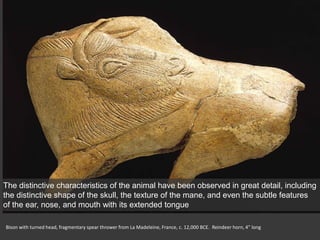
Bison with turned head, fragmentary spear thrower from La Madeleine, France, c. 12,000 BCE. Reindeer horn, 4” long
This fragment of a spear thrower depicts a bison, with its head turned sharply to the right
Bison with turned head, fragmentary spear thrower from La Madeleine, France, c. 12,000 BCE. Reindeer horn, 4” long
The distinctive characteristics of the animal have been observed in great detail, including
the distinctive shape of the skull, the texture of the mane, and even the subtle features
of the ear, nose, and mouth with its extended tongue
Most of these decorated objects depict animals: why do you think that is so?
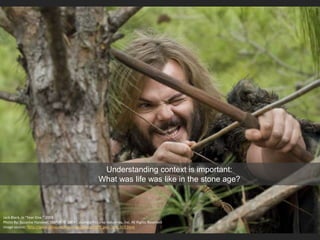
Jack Black, in “Year One,” 2009
Photo By: Suzanne Hanover, SMPSP. © 2009 Columbia Pictures Industries, Inc. All Rights Reserved
Image source: http://www.allmoviephoto.com/photo/2009_year_one_007.html
Understanding context is important:
What was life was like in the stone age?
Andreas Lederer, Hadabel men in Tanzania returning from a hunt
Wikipedia: https://en.wikipedia.org/wiki/Hadza_people#/media/File:Hadazbe_returning_from_hunt.jpg
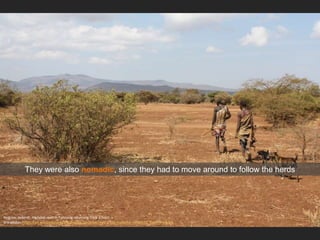
Our prehistoric ancestors were hunter gatherers, which means they hunted animals
and foraged for food
Andreas Lederer, Hadabel men in Tanzania returning from a hunt
Wikipedia: https://en.wikipedia.org/wiki/Hadza_people#/media/File:Hadazbe_returning_from_hunt.jpg
They were also nomadic, since they had to move around to follow the herds
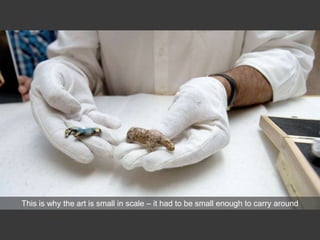
This is why the art is small in scale – it had to be small enough to carry around
No cars
No phones
No Facebook
No fast food
Scene from “Year One,” starring Jack Black
Image source: http://www.collider.com/2009/06/18/year-one-review/
Life was precarious
Animals were vital to human existence as a source of food, and as a constant threat of
danger
Bison with turned head, fragmentary spear thrower from La Madeleine, France, c. 12,000 BCE. Reindeer horn, 4” long
Preoccupation with animals was therefore more than just an idle past time: knowledge
about animal features and behavior would have been vital to survival
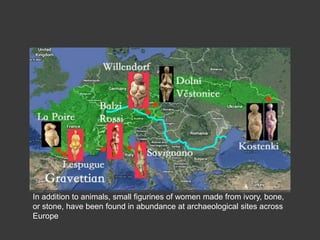
In addition to animals, small figurines of women made from ivory, bone,
or stone, have been found in abundance at archaeological sites across
Europe
Venus of Willendorf, c. 28,000-25,000 BCE
Natural History Museum, Vienna
Female Figurine (Venus of Kostenki), c. 23,000- 21,000 BCE Limestone;
Hermitage Museum
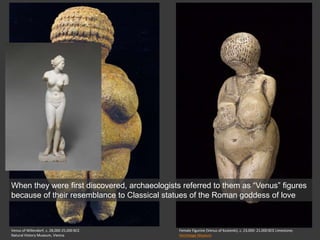
When they were first discovered, archaeologists referred to them as “Venus” figures
because of their resemblance to Classical statues of the Roman goddess of love
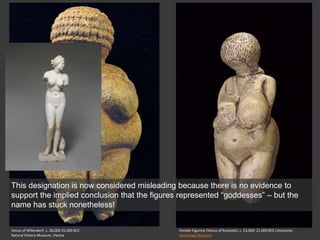
Venus of Willendorf, c. 28,000-25,000 BCE
Natural History Museum, Vienna
Female Figurine (Venus of Kostenki), c. 23,000- 21,000 BCE Limestone;
Hermitage Museum
This designation is now considered misleading because there is no evidence to
support the implied conclusion that the figures represented “goddesses” – but the
name has stuck nonetheless!
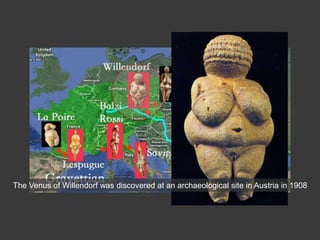
The Venus of Willendorf was discovered at an archaeological site in Austria in 1908
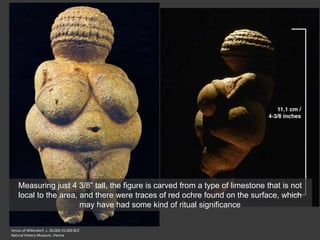
Venus of Willendorf, c. 28,000-25,000 BCE
Natural History Museum, Vienna
Measuring just 4 3/8” tall, the figure is carved from a type of limestone that is not
local to the area, and there were traces of red ochre found on the surface, which
may have had some kind of ritual significance
Venus of Willendorf, c. 28,000-25,000 BCE
Natural History Museum, Vienna
Female Figurine (Venus of Kostenki), c. 23,000- 21,000 BCE Limestone;
Hermitage Museum
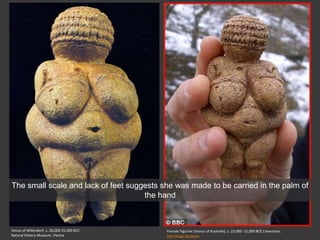
The small scale and lack of feet suggests she was made to be carried in the palm of
the hand
Venus of Willendorf, c. 28,000-25,000 BCE
Natural History Museum, Vienna
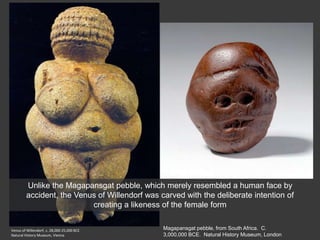
Unlike the Magapansgat pebble, which merely resembled a human face by
accident, the Venus of Willendorf was carved with the deliberate intention of
creating a likeness of the female form
Magapansgat pebble, from South Africa. C.
3,000,000 BCE. Natural History Museum, London
Venus of Willendorf, c. 28,000-25,000 BCE
Natural History Museum, Vienna
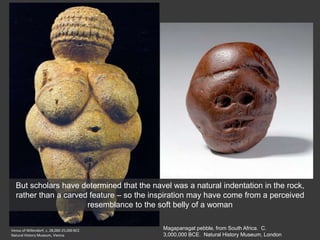
But scholars have determined that the navel was a natural indentation in the rock,
rather than a carved feature – so the inspiration may have come from a perceived
resemblance to the soft belly of a woman
Magapansgat pebble, from South Africa. C.
3,000,000 BCE. Natural History Museum, London
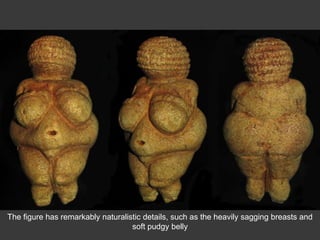
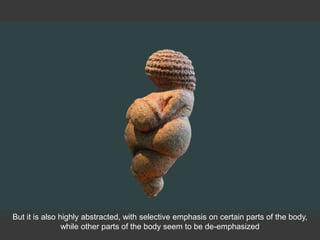
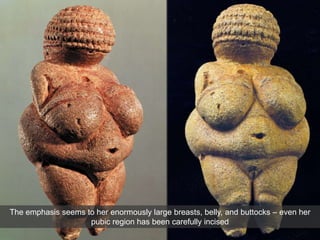
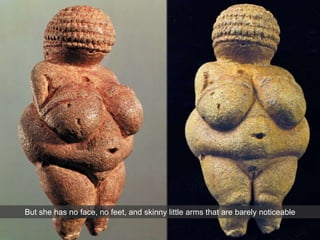
The figure has remarkably naturalistic details, such as the heavily sagging breasts and
soft pudgy belly
But it is also highly abstracted, with selective emphasis on certain parts of the body,
while other parts of the body seem to be de-emphasized
The emphasis seems to her enormously large breasts, belly, and buttocks – even her
pubic region has been carefully incised
But she has no face, no feet, and skinny little arms that are barely noticeable
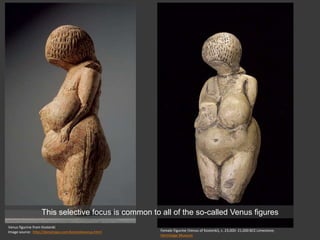
Female Figurine (Venus of Kostenki), c. 23,000- 21,000 BCE Limestone;
Hermitage Museum
Venus figurine from Kostenki
Image source: http://donsmaps.com/kostenkivenus.html
This selective focus is common to all of the so-called Venus figures
Venus von Moravany, Mammoth Ivory, 22 000 - 24 000
Slovak Academy of Sciences in Nitra
Image source: http://www.donsmaps.com/moravanyvenus.html
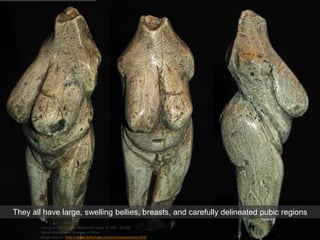
They all have large, swelling bellies, breasts, and carefully delineated pubic regions
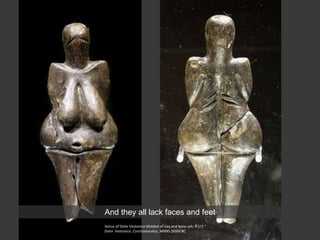
Venus of Dolni Vestonice Molded of clay and bone ash; 4 1/2 “
Dolni Vestonice, Czechoslovakia, 34000-26500 BC
And they all lack faces and feet
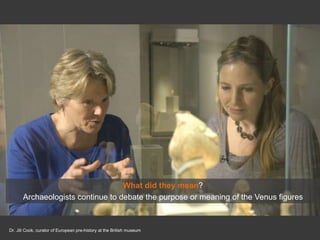
Dr. Jill Cook, curator of European pre-history at the British museum
What did they mean?
Archaeologists continue to debate the purpose or meaning of the Venus figures
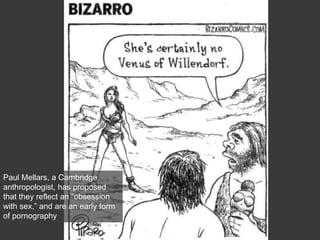
Paul Mellars, a Cambridge
anthropologist, has proposed
that they reflect an “obsession
with sex,” and are an early form
of pornography
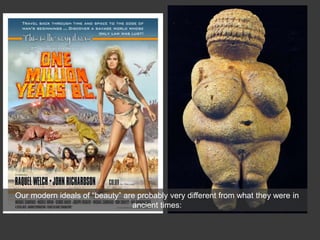
Our modern ideals of “beauty” are probably very different from what they were in
ancient times:
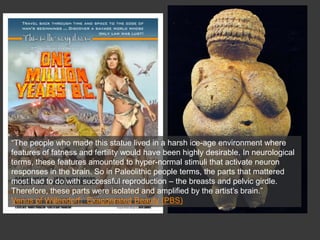
“The people who made this statue lived in a harsh ice-age environment where
features of fatness and fertility would have been highly desirable. In neurological
terms, these features amounted to hyper-normal stimuli that activate neuron
responses in the brain. So in Paleolithic people terms, the parts that mattered
most had to do with successful reproduction – the breasts and pelvic girdle.
Therefore, these parts were isolated and amplified by the artist’s brain.”
Venus of Willendorf: Exaggerated Beauty (PBS)
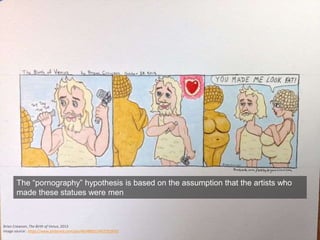
Brian Crowson, The Birth of Venus, 2013
Image source: https://www.pinterest.com/pin/465489311457291876/
The “pornography” hypothesis is based on the assumption that the artists who
made these statues were men
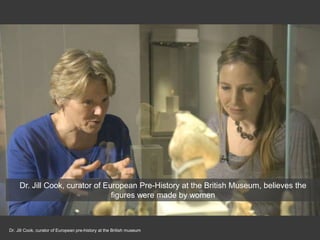
Dr. Jill Cook, curator of European pre-history at the British museum
Dr. Jill Cook, curator of European Pre-History at the British Museum, believes the
figures were made by women
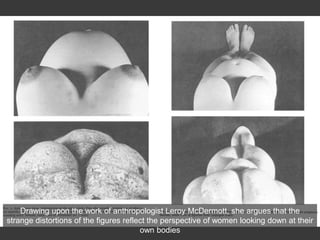
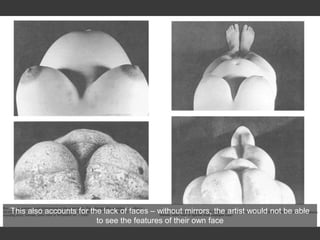
Drawing upon the work of anthropologist Leroy McDermott, she argues that the
strange distortions of the figures reflect the perspective of women looking down at their
own bodies
This also accounts for the lack of faces – without mirrors, the artist would not be able
to see the features of their own face
Venus of Willendorf, c. 28,000-25,000 BCE
Natural History Museum, Vienna
Female Figurine (Venus of Kostenki), c. 23,000- 21,000 BCE Limestone;
Hermitage Museum
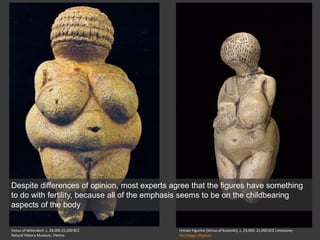
Despite differences of opinion, most experts agree that the figures have something
to do with fertility, because all of the emphasis seems to be on the childbearing
aspects of the body
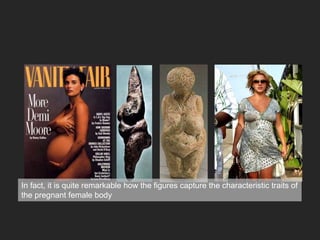
In fact, it is quite remarkable how the figures capture the characteristic traits of
the pregnant female body
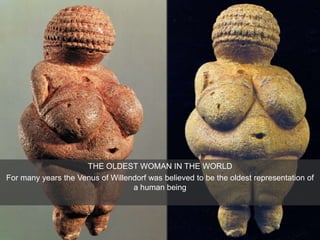
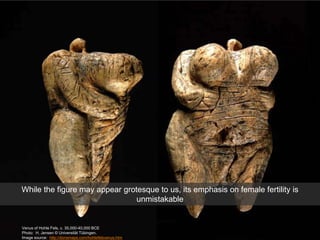
THE OLDEST WOMAN IN THE WORLD
For many years the Venus of Willendorf was believed to be the oldest representation of
a human being
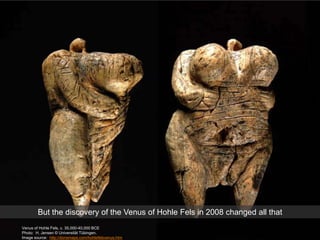
Venus of Hohle Fels, c. 35,000-40,000 BCE
Photo: H. Jensen © Universität Tübingen.
Image source: http://donsmaps.com/hohlefelsvenus.htm
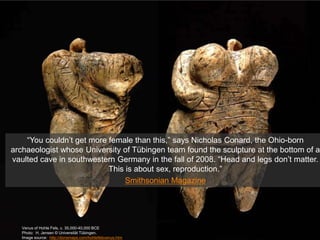
But the discovery of the Venus of Hohle Fels in 2008 changed all that
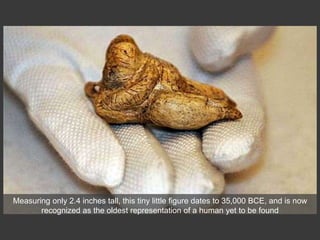
Measuring only 2.4 inches tall, this tiny little figure dates to 35,000 BCE, and is now
recognized as the oldest representation of a human yet to be found
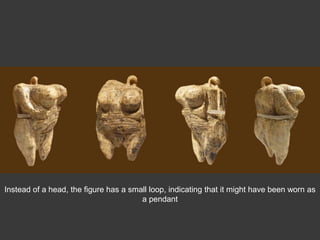
Instead of a head, the figure has a small loop, indicating that it might have been worn as
a pendant
Venus of Hohle Fels, c. 35,000-40,000 BCE
Photo: H. Jensen © Universität Tübingen.
Image source: http://donsmaps.com/hohlefelsvenus.htm
While the figure may appear grotesque to us, its emphasis on female fertility is
unmistakable
Venus of Hohle Fels, c. 35,000-40,000 BCE
Photo: H. Jensen © Universität Tübingen.
Image source: http://donsmaps.com/hohlefelsvenus.htm
“You couldn’t get more female than this,” says Nicholas Conard, the Ohio-born
archaeologist whose University of Tübingen team found the sculpture at the bottom of a
vaulted cave in southwestern Germany in the fall of 2008. “Head and legs don’t matter.
This is about sex, reproduction.”
Smithsonian Magazine
Thanks for listening!
Next up: Paleolithic Cave Paintings
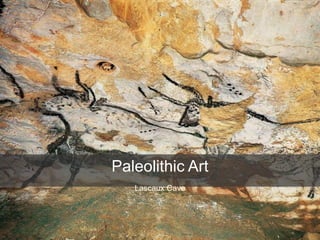
Paleolithic Art
Lascaux Cave
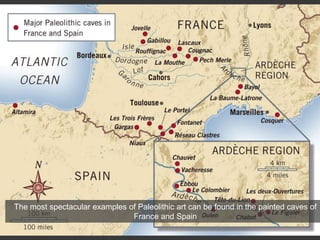
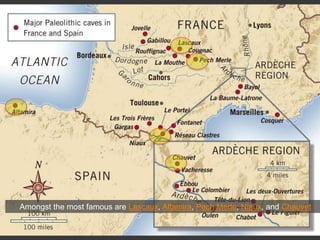
The most spectacular examples of Paleolithic art can be found in the painted caves of
France and Spain
Amongst the most famous are Lascaux, Altamira, Pech Merle, Niaux, and Chauvet
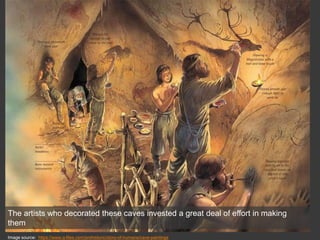
The artists who decorated these caves invested a great deal of effort in making
them
Image source: https://www.q-files.com/prehistoric/story-of-humans/cave-paintings
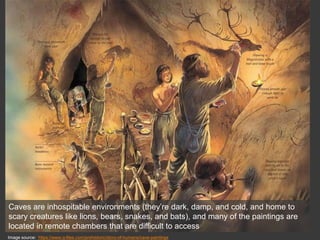
Caves are inhospitable environments (they’re dark, damp, and cold, and home to
scary creatures like lions, bears, snakes, and bats), and many of the paintings are
located in remote chambers that are difficult to access
Image source: https://www.q-files.com/prehistoric/story-of-humans/cave-paintings
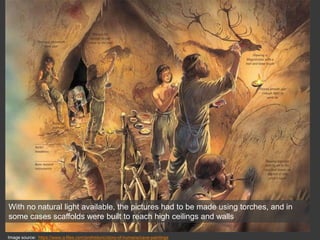
With no natural light available, the pictures had to be made using torches, and in
some cases scaffolds were built to reach high ceilings and walls
Image source: https://www.q-files.com/prehistoric/story-of-humans/cave-paintings
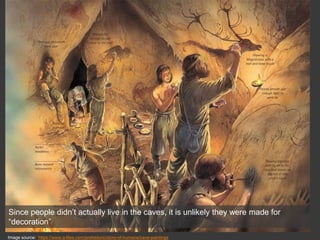
Since people didn’t actually live in the caves, it is unlikely they were made for
“decoration”
Image source: https://www.q-files.com/prehistoric/story-of-humans/cave-paintings
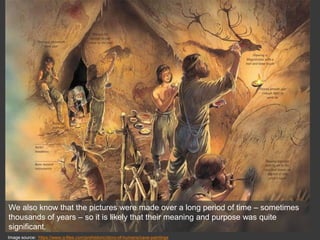
We also know that the pictures were made over a long period of time – sometimes
thousands of years – so it is likely that their meaning and purpose was quite
significant.
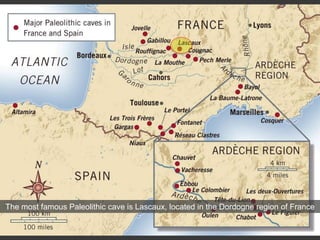
The most famous Paleolithic cave is Lascaux, located in the Dordogne region of France
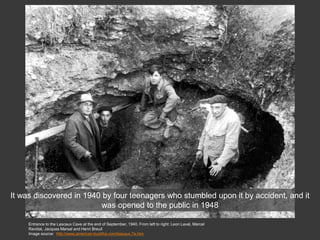
Entrance to the Lascaux Cave at the end of September, 1940. From left to right: Leon Laval, Marcel
Ravidat, Jacques Marsal and Henri Breuil
Image source: http://www.american-buddha.com/lascaux.7a.htm
It was discovered in 1940 by four teenagers who stumbled upon it by accident, and it
was opened to the public in 1948
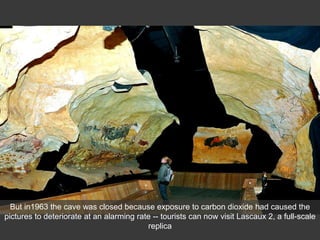
But in1963 the cave was closed because exposure to carbon dioxide had caused the
pictures to deteriorate at an alarming rate -- tourists can now visit Lascaux 2, a full-scale
replica
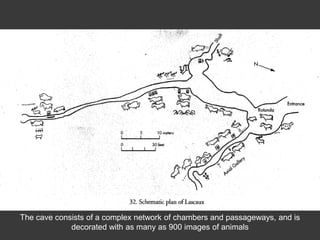
The cave consists of a complex network of chambers and passageways, and is
decorated with as many as 900 images of animals
The pictures were made using mineral chunks for drawing, or ground to a powder and
mixed with water and fat to make paint
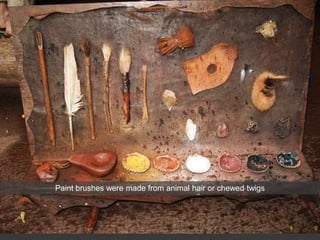
Paint brushes were made from animal hair or chewed twigs
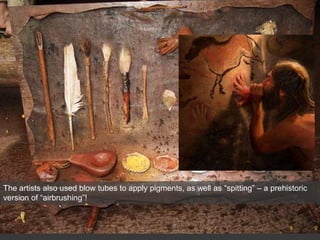
The artists also used blow tubes to apply pigments, as well as “spitting” – a prehistoric
version of “airbrushing”!
Image source:
http://www.schoolsprehistory.co.uk/2014/09/1
9/new-survey-open-for-teachers-on-changes-
in-britain-from-the-stone-age-to-the-iron-age/
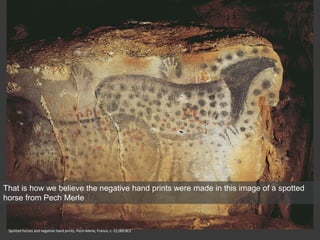
Spotted horses and negative hand prints, Pech-Merle, France, c. 22,000 BCE
That is how we believe the negative hand prints were made in this image of a spotted
horse from Pech Merle
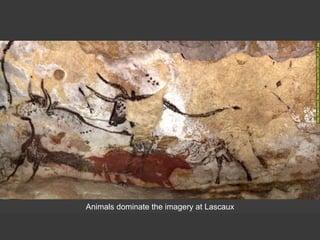
Animals dominate the imagery at Lascaux
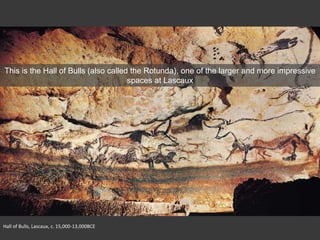
Hall of Bulls, Lascaux, c. 15,000-13,000BCE
This is the Hall of Bulls (also called the Rotunda), one of the larger and more impressive
spaces at Lascaux
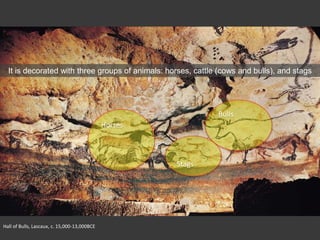
Hall of Bulls, Lascaux, c. 15,000-13,000BCE
It is decorated with three groups of animals: horses, cattle (cows and bulls), and stags
Horses
Bulls
Stags
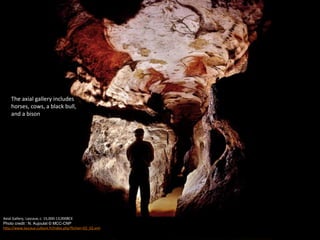
The axial gallery includes
horses, cows, a black bull,
and a bison
Axial Gallery, Lascaux, c. 15,000-13,000BCE
Photo credit : N. Aujoulat © MCC-CNP
http://www.lascaux.culture.fr/index.php?fichier=02_02.xml
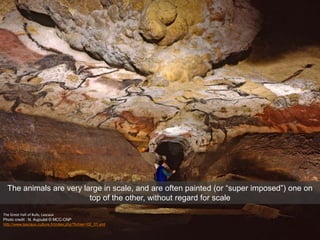
The Great Hall of Bulls, Lascaux
Photo credit : N. Aujoulat © MCC-CNP
http://www.lascaux.culture.fr/index.php?fichier=02_01.xml
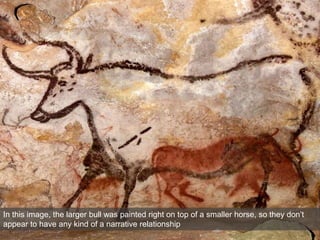
The animals are very large in scale, and are often painted (or “super imposed”) one on
top of the other, without regard for scale
In this image, the larger bull was painted right on top of a smaller horse, so they don’t
appear to have any kind of a narrative relationship
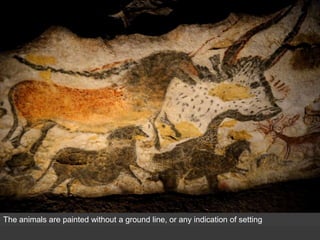
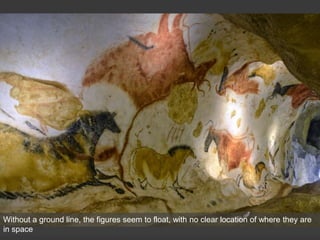
The animals are painted without a ground line, or any indication of setting
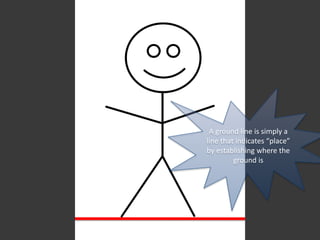
A ground line is simply a
line that indicates “place”
by establishing where the
ground is
Without a ground line, the figures seem to float, with no clear location of where they are
in space
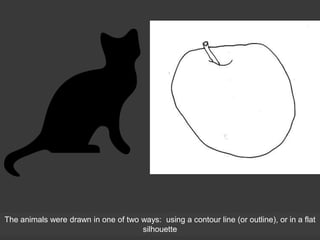
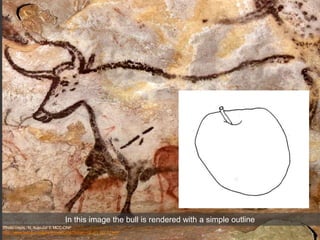
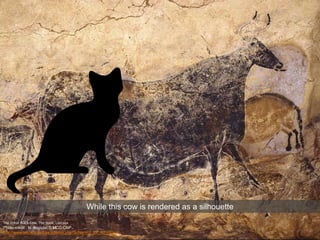
The animals were drawn in one of two ways: using a contour line (or outline), or in a flat
silhouette
Second Bull, Great Hall of Bulls, Lascaux
Photo credit : N. Aujoulat © MCC-CNP
http://www.lascaux.culture.fr/index.php?fichier=02_01_00_07.xml
In this image the bull is rendered with a simple outline
The Great Black Cow, The Nave, Lascaux
Photo credit : N. Aujoulat © MCC-CNP
http://www.lascaux.culture.fr/index.php?fichier=02_04_00_05.xml
While this cow is rendered as a silhouette
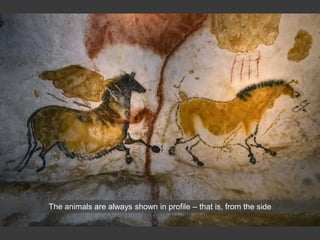
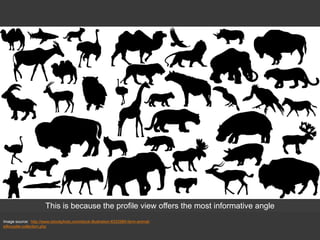
The animals are always shown in profile – that is, from the side
Write
this
down
!
Image source: http://www.istockphoto.com/stock-illustration-6322985-farm-animal-
silhouette-collection.php
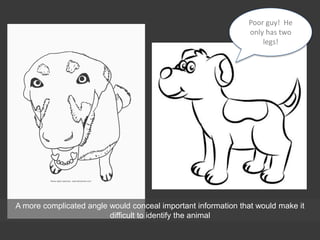
This is because the profile view offers the most informative angle
Poor guy! He
only has two
legs!
A more complicated angle would conceal important information that would make it
difficult to identify the animal
Second Bull, Great Hall of Bulls, Lascaux
Photo credit : N. Aujoulat © MCC-CNP
http://www.lascaux.culture.fr/index.php?fichier=02_01_00_07.xml
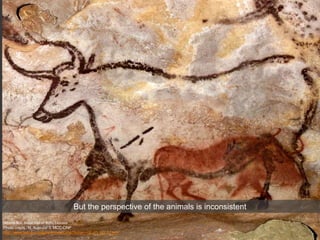
But the perspective of the animals is inconsistent
Second Bull, Great Hall of Bulls, Lascaux
Photo credit : N. Aujoulat © MCC-CNP
http://www.lascaux.culture.fr/index.php?fichier=02_01_00_07.xml
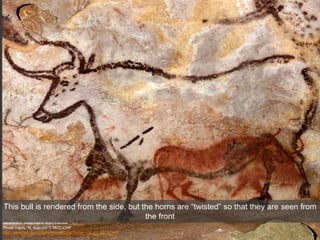
This bull is rendered from the side, but the horns are “twisted” so that they are seen from
the front
Second Bull, Great Hall of Bulls, Lascaux
Photo credit : N. Aujoulat © MCC-CNP
http://www.lascaux.culture.fr/index.php?fichier=02_01_00_07.xml
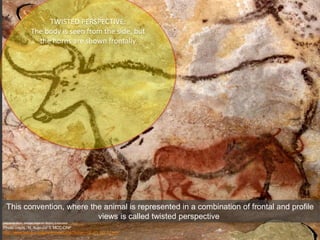
This convention, where the animal is represented in a combination of frontal and profile
views is called twisted perspective
TWISTED PERSPECTIVE:
The body is seen from the side, but
the horns are shown frontally
Second Bull, Great Hall of Bulls, Lascaux
Photo credit : N. Aujoulat © MCC-CNP
http://www.lascaux.culture.fr/index.php?fichier=02_01_00_07.xml
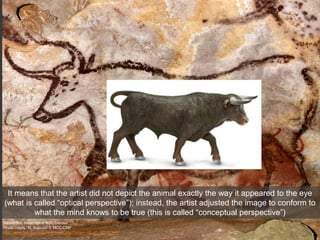
It means that the artist did not depict the animal exactly the way it appeared to the eye
(what is called “optical perspective”); instead, the artist adjusted the image to conform to
what the mind knows to be true (this is called “conceptual perspective”)
So what is the dominant
subject matter of
Paleolithic art?
Doris Day in Teachers Pet (1958)
Image source: http://www.dorisday.net/teacher_s_pet.html
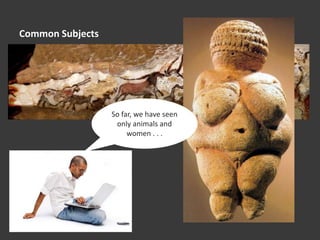
Common Subjects
So far, we have seen
only animals and
women . . .
What, no men?
Men are actually
RARE in Paleolithic art!
Doris Day in Teachers Pet (1958)
Image source: http://www.dorisday.net/teacher_s_pet.html
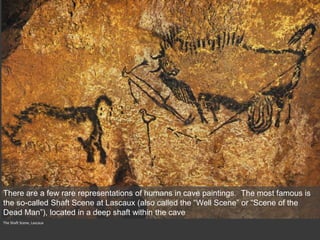
The Shaft Scene, Lascaux
There are a few rare representations of humans in cave paintings. The most famous is
the so-called Shaft Scene at Lascaux (also called the “Well Scene” or “Scene of the
Dead Man”), located in a deep shaft within the cave
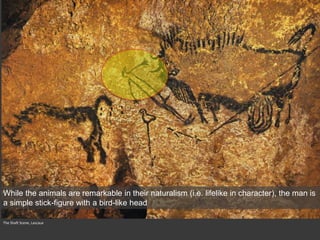
The Shaft Scene, Lascaux
While the animals are remarkable in their naturalism (i.e. lifelike in character), the man is
a simple stick-figure with a bird-like head
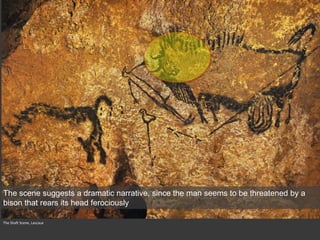
The Shaft Scene, Lascaux
The scene suggests a dramatic narrative, since the man seems to be threatened by a
bison that rears its head ferociously
The Shaft Scene, Lascaux
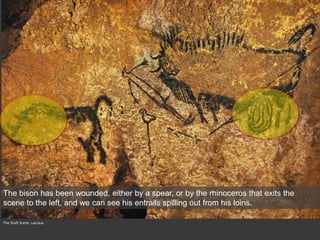
The bison has been wounded, either by a spear, or by the rhinoceros that exits the
scene to the left, and we can see his entrails spilling out from his loins.
The Shaft Scene, Lascaux
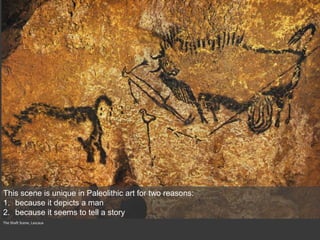
This scene is unique in Paleolithic art for two reasons:
1. because it depicts a man
2. because it seems to tell a story
Thanks for Listening!
Next up: The Cave at Chauvet
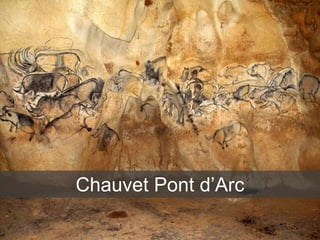
Chauvet Pont d’Arc
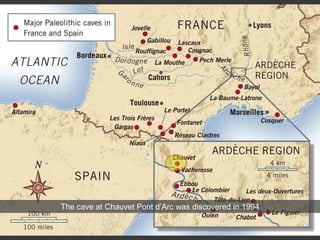
The cave at Chauvet Pont d’Arc was discovered in 1994
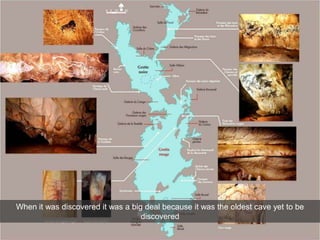
When it was discovered it was a big deal because it was the oldest cave yet to be
discovered
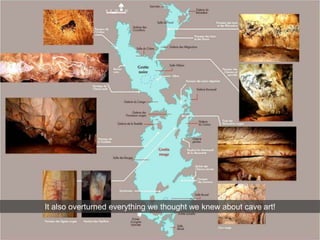
It also overturned everything we thought we knew about cave art!
So let’s review what we have learned about the typical characteristics of cave art so we
can appreciate just how unique the imagery at Chauvet really is
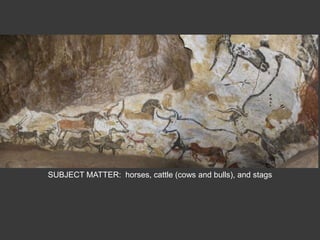
SUBJECT MATTER: horses, cattle (cows and bulls), and stags
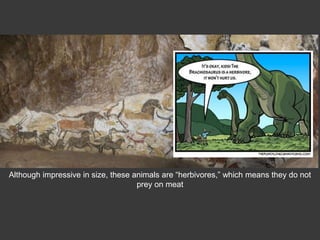
Although impressive in size, these animals are “herbivores,” which means they do not
prey on meat
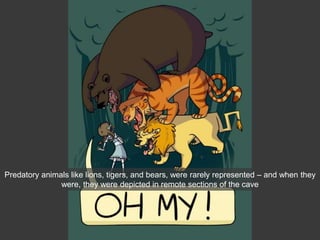
Predatory animals like lions, tigers, and bears, were rarely represented – and when they
were, they were depicted in remote sections of the cave
Second Bull, Great Hall of Bulls, Lascaux
Photo credit : N. Aujoulat © MCC-CNP
http://www.lascaux.culture.fr/index.php?fichier=02_01_00_07.xml
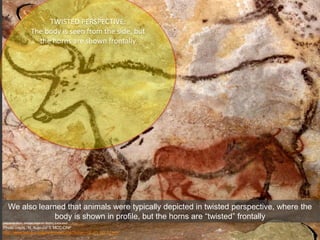
We also learned that animals were typically depicted in twisted perspective, where the
body is shown in profile, but the horns are “twisted” frontally
TWISTED PERSPECTIVE:
The body is seen from the side, but
the horns are shown frontally
The Shaft Scene, Lascaux
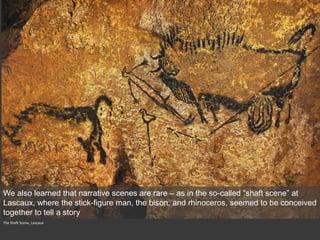
We also learned that narrative scenes are rare – as in the so-called “shaft scene” at
Lascaux, where the stick-figure man, the bison, and rhinoceros, seemed to be conceived
together to tell a story
The Great Hall of Bulls, Lascaux
Photo credit : N. Aujoulat © MCC-CNP
http://www.lascaux.culture.fr/index.php?fichier=02_01.xml
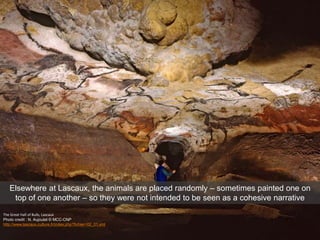
Elsewhere at Lascaux, the animals are placed randomly – sometimes painted one on
top of one another – so they were not intended to be seen as a cohesive narrative
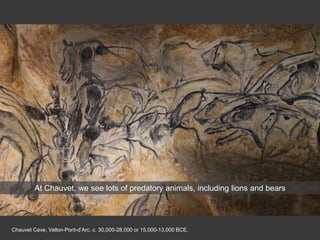
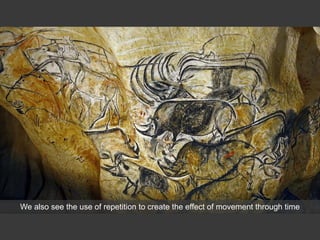
At Chauvet, we see lots of predatory animals, including lions and bears
Chauvet Cave, Vallon-Pont-d’Arc. c. 30,000-28,000 or 15,000-13,000 BCE.
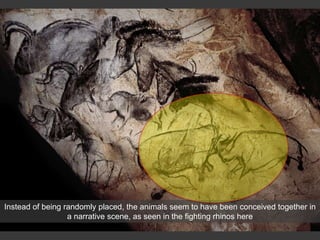
Instead of being randomly placed, the animals seem to have been conceived together in
a narrative scene, as seen in the fighting rhinos here
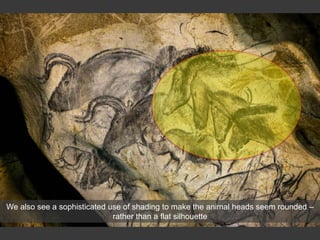
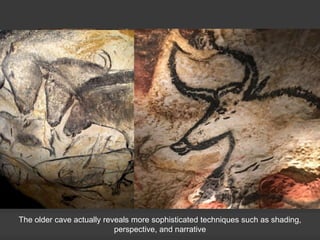
We also see a sophisticated use of shading to make the animal heads seem rounded –
rather than a flat silhouette
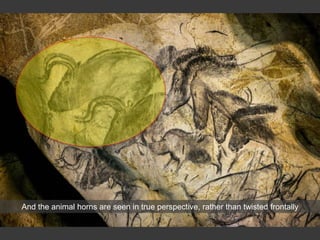
And the animal horns are seen in true perspective, rather than twisted frontally
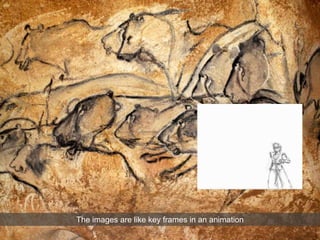
We also see the use of repetition to create the effect of movement through time
The images are like key frames in an animation
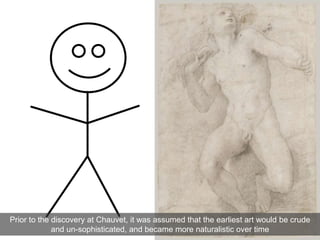
Prior to the discovery at Chauvet, it was assumed that the earliest art would be crude
and un-sophisticated, and became more naturalistic over time
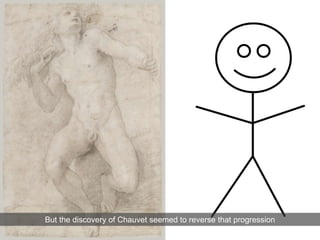
But the discovery of Chauvet seemed to reverse that progression
The older cave actually reveals more sophisticated techniques such as shading,

perspective, and narrative
Thanks for Listening!
Next up: Theories of Interpretation
Paleolithic Art
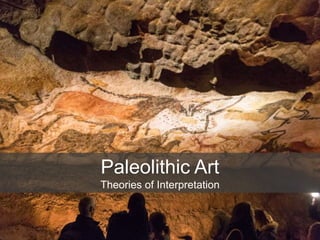
Theories of Interpretation
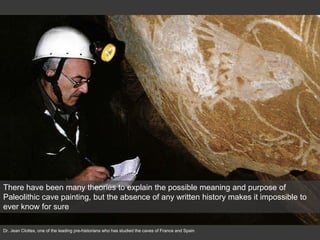
There have been many theories to explain the possible meaning and purpose of
Paleolithic cave painting, but the absence of any written history makes it impossible to
ever know for sure
Dr. Jean Clottes, one of the leading pre-historians who has studied the caves of France and Spain
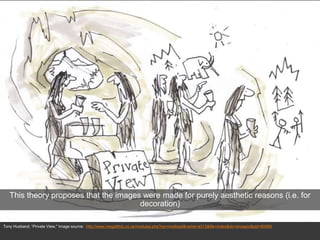
Tony Husband, “Private View,” Image source: http://www.megalithic.co.uk/modules.php?op=modload&name=a312&file=index&do=showpic&pid=80569
Art for Art’s Sake
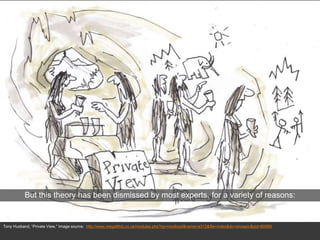
One of the oldest theories is called Art for Art’s Sake
Tony Husband, “Private View,” Image source: http://www.megalithic.co.uk/modules.php?op=modload&name=a312&file=index&do=showpic&pid=80569
This theory proposes that the images were made for purely aesthetic reasons (i.e. for
decoration)
Tony Husband, “Private View,” Image source: http://www.megalithic.co.uk/modules.php?op=modload&name=a312&file=index&do=showpic&pid=80569
But this theory has been dismissed by most experts, for a variety of reasons:
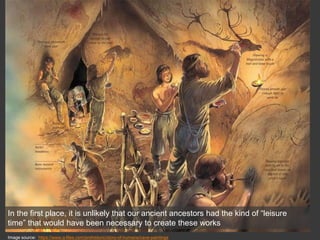
In the first place, it is unlikely that our ancient ancestors had the kind of “leisure
time” that would have been necessary to create these works
Image source: https://www.q-files.com/prehistoric/story-of-humans/cave-paintings
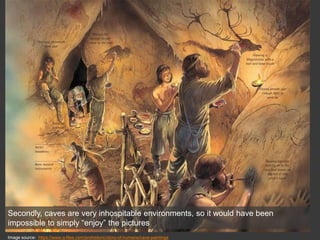
Secondly, caves are very inhospitable environments, so it would have been
impossible to simply “enjoy” the pictures
Image source: https://www.q-files.com/prehistoric/story-of-humans/cave-paintings
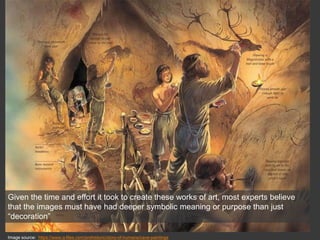
Given the time and effort it took to create these works of art, most experts believe
that the images must have had deeper symbolic meaning or purpose than just
“decoration”
Image source: https://www.q-files.com/prehistoric/story-of-humans/cave-paintings
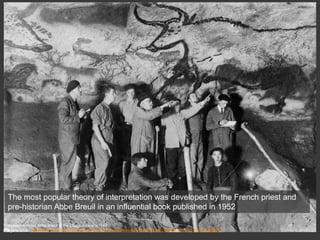
The paleontologist Abbe Breuil in the Lascaux cave in1948
Image source: http://www.la-croix.com/Culture/Simon-Coencas-dernier-aventurier-grotte-Lascaux-2016-12-08-1300808960
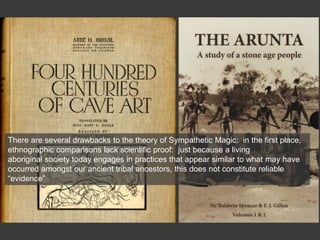
The most popular theory of interpretation was developed by the French priest and
pre-historian Abbe Breuil in an influential book published in 1952
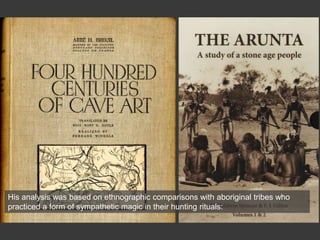
His analysis was based on ethnographic comparisons with aboriginal tribes who
practiced a form of sympathetic magic in their hunting rituals:
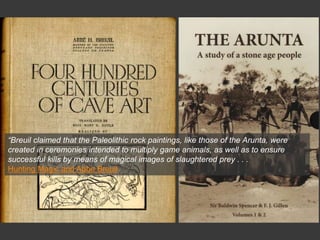
“Breuil claimed that the Paleolithic rock paintings, like those of the Arunta, were
created in ceremonies intended to multiply game animals, as well as to ensure
successful kills by means of magical images of slaughtered prey . . .
Hunting Magic and Abbe Breuil
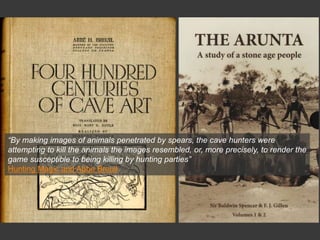
“By making images of animals penetrated by spears, the cave hunters were
attempting to kill the animals the images resembled, or, more precisely, to render the
game susceptible to being killing by hunting parties”
Hunting Magic and Abbe Breuil
Image source: http://www.waitingfornextyear.com/?p=3662
The theory is called Sympathetic Magic, and it is based on the principle of “like produces
like”
Image source: http://www.waitingfornextyear.com/?p=3662
“What is done to the properly made image of an object is done to that object itself, as when a
sorcerer sticks pins in a doll resembling his victim in an effort to destroy him. By making images
of animals penetrated by spears, the cave hunters were attempting to kill the animals the
images resembled, or, more precisely, to render the game susceptible to being killing by hunting
parties.”
Hunting Magic and Abbe Breuil
Second Bull, Great Hall of Bulls, Lascaux
Photo credit : N. Aujoulat © MCC-CNP
http://www.lascaux.culture.fr/index.php?fichier=02_01_00_07.xml
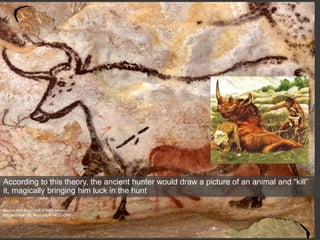
According to this theory, the ancient hunter would draw a picture of an animal and “kill”
it, magically bringing him luck in the hunt
Second Bull, Great Hall of Bulls, Lascaux
Photo credit : N. Aujoulat © MCC-CNP
http://www.lascaux.culture.fr/index.php?fichier=02_01_00_07.xml
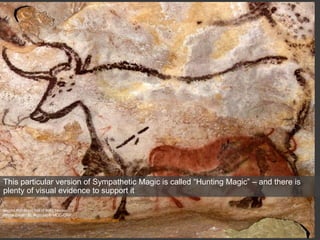
This particular version of Sympathetic Magic is called “Hunting Magic” – and there is
plenty of visual evidence to support it
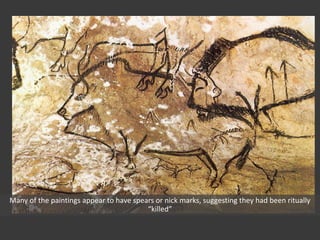
Many of the paintings appear to have spears or nick marks, suggesting they had been ritually
“killed”
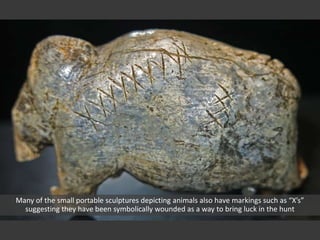
Many of the small portable sculptures depicting animals also have markings such as “X’s”
suggesting they have been symbolically wounded as a way to bring luck in the hunt
There are several drawbacks to the theory of Sympathetic Magic: in the first place,
ethnographic comparisons lack scientific proof: just because a living
aboriginal society today engages in practices that appear similar to what may have
occurred amongst our ancient tribal ancestors, this does not constitute reliable
“evidence”
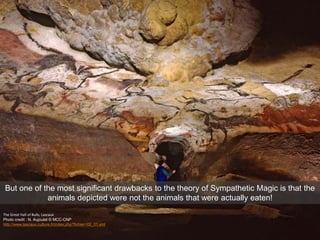
The Great Hall of Bulls, Lascaux
Photo credit : N. Aujoulat © MCC-CNP
http://www.lascaux.culture.fr/index.php?fichier=02_01.xml
But one of the most significant drawbacks to the theory of Sympathetic Magic is that the
animals depicted were not the animals that were actually eaten!
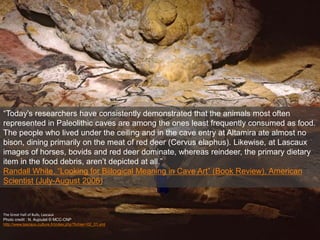
The Great Hall of Bulls, Lascaux
Photo credit : N. Aujoulat © MCC-CNP
http://www.lascaux.culture.fr/index.php?fichier=02_01.xml
“Today’s researchers have consistently demonstrated that the animals most often
represented in Paleolithic caves are among the ones least frequently consumed as food.
The people who lived under the ceiling and in the cave entry at Altamira ate almost no
bison, dining primarily on the meat of red deer (Cervus elaphus). Likewise, at Lascaux
images of horses, bovids and red deer dominate, whereas reindeer, the primary dietary
item in the food debris, aren’t depicted at all.”
Randall White, “Looking for Biilogical Meaning in Cave Art” (Book Review), American
Scientist (July-August 2006)
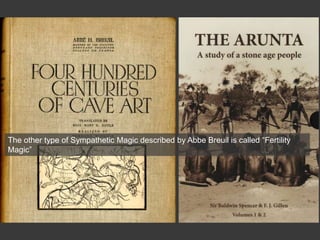
The other type of Sympathetic Magic described by Abbe Breuil is called “Fertility
Magic”
Second Bull, Great Hall of Bulls, Lascaux
Photo credit : N. Aujoulat © MCC-CNP
http://www.lascaux.culture.fr/index.php?fichier=02_01_00_07.xml
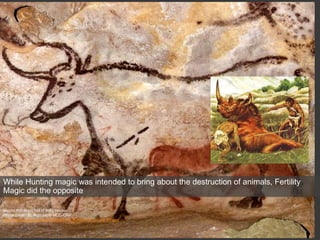
While Hunting magic was intended to bring about the destruction of animals, Fertility
Magic did the opposite
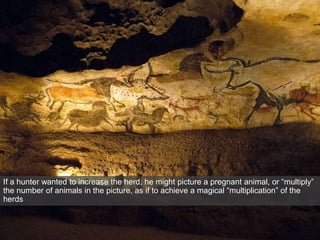
If a hunter wanted to increase the herd, he might picture a pregnant animal, or “multiply”
the number of animals in the picture, as if to achieve a magical “multiplication” of the
herds
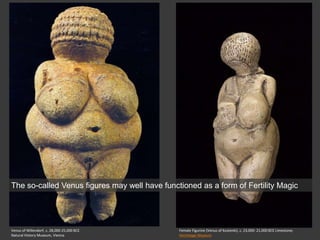
Venus of Willendorf, c. 28,000-25,000 BCE
Natural History Museum, Vienna
Female Figurine (Venus of Kostenki), c. 23,000- 21,000 BCE Limestone;
Hermitage Museum
The so-called Venus figures may well have functioned as a form of Fertility Magic
Before the days of fertility drugs, magic was all they had!
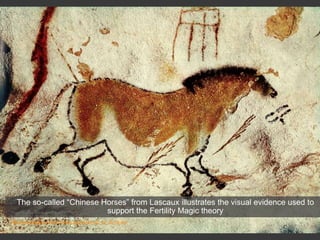
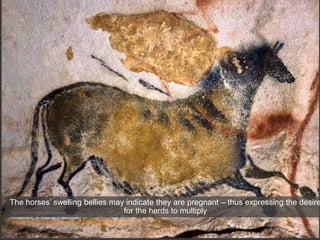
Third Chinese Horse, Axial Gallery
Photo credit : N. Aujoulat © MCC-CNP
http://www.lascaux.culture.fr/index.php?fichier=02_02_00_08.xml
The so-called “Chinese Horses” from Lascaux illustrates the visual evidence used to
support the Fertility Magic theory
Third Chinese Horse, Axial Gallery
Photo credit : N. Aujoulat © MCC-CNP
http://www.lascaux.culture.fr/index.php?fichier=02_02_00_08.xml
The horses’ swelling bellies may indicate they are pregnant – thus expressing the desire
for the herds to multiply
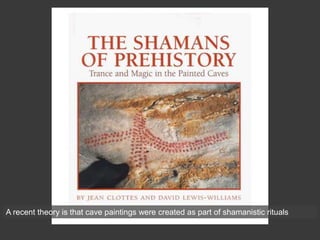
A recent theory is that cave paintings were created as part of shamanistic rituals
San healing ritual, Bradshaw Foundation
http://www.bradshawfoundation.com/rari/page3.php
The theory is based on ethnographic comparison with the San people of Africa
San healing ritual, Bradshaw Foundation
http://www.bradshawfoundation.com/rari/page3.php
“Noting the similarity of prehistoric rock art with that created by some contemporary
traditional societies, archaeologists Jean Clottes and David Lewis-Williams suggest that
the ancient images were created by shamans, powerful individuals who were able to
contact the spirit world through trance and ritual.”
http://www.bradshawfoundation.com/books/shamans_of_prehistory.php
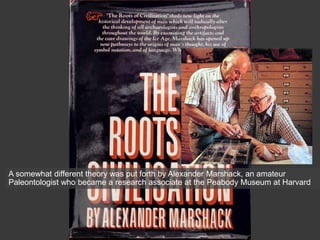
A somewhat different theory was put forth by Alexander Marshack, an amateur
Paleontologist who became a research associate at the Peabody Museum at Harvard
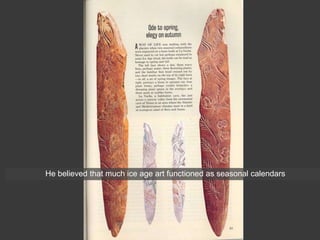
He believed that much ice age art functioned as seasonal calendars
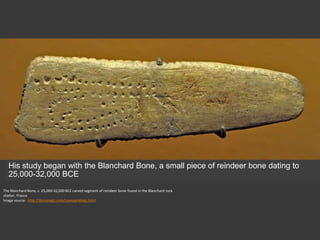
The Blanchard Bone, c. 25,000-32,000 BCE carved segment of reindeer bone found in the Blanchard rock
shelter, France
Image source: http://donsmaps.com/cavepaintings.html
His study began with the Blanchard Bone, a small piece of reindeer bone dating to
25,000-32,000 BCE
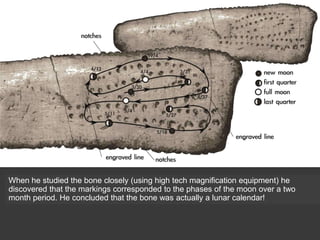
When he studied the bone closely (using high tech magnification equipment) he
discovered that the markings corresponded to the phases of the moon over a two
month period. He concluded that the bone was actually a lunar calendar!
Why would that be
Important?
It means they could
predict the change
of seasons and
when the animals
would begin their
migrations
Which means
they could have
control over
their
environment
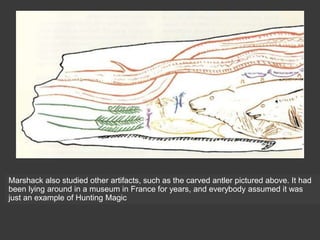
Marshack also studied other artifacts, such as the carved antler pictured above. It had
been lying around in a museum in France for years, and everybody assumed it was
just an example of Hunting Magic
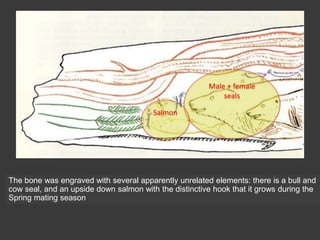
The bone was engraved with several apparently unrelated elements: there is a bull and
cow seal, and an upside down salmon with the distinctive hook that it grows during the
Spring mating season
Male + female
seals
Salmon
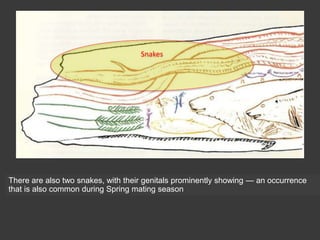
There are also two snakes, with their genitals prominently showing — an occurrence
that is also common during Spring mating season
Snakes
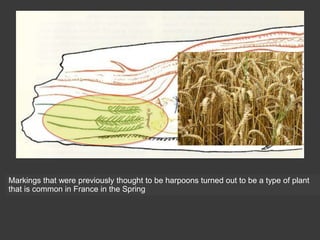
Markings that were previously thought to be harpoons turned out to be a type of plant
that is common in France in the Spring
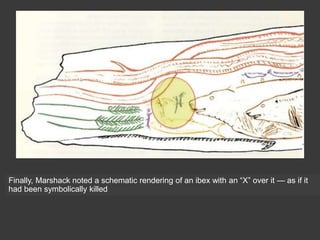
Finally, Marshack noted a schematic rendering of an ibex with an “X” over it — as if it
had been symbolically killed
He observed that even today the ibex come down from the mountains to graze in the
valleys in the (you guessed it) Spring
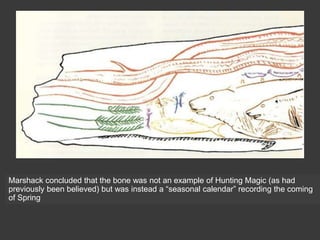
Marshack concluded that the bone was not an example of Hunting Magic (as had
previously been believed) but was instead a “seasonal calendar” recording the coming
of Spring
Ishango Bone, c. 25,000-20,000 BCE
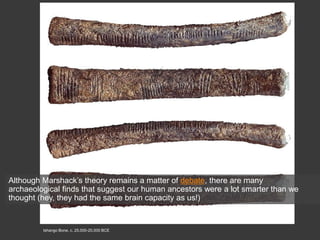
Although Marshack’s theory remains a matter of debate, there are many
archaeological finds that suggest our human ancestors were a lot smarter than we
thought (hey, they had the same brain capacity as us!)
Ishango Bone, c. 25,000-20,000 BCE
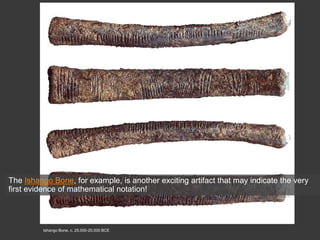
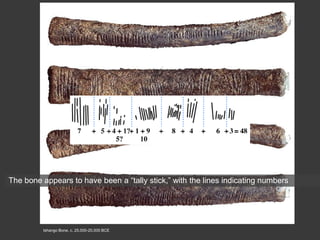
The Ishango Bone, for example, is another exciting artifact that may indicate the very
first evidence of mathematical notation!
Ishango Bone, c. 25,000-20,000 BCE
The bone appears to have been a “tally stick,” with the lines indicating numbers
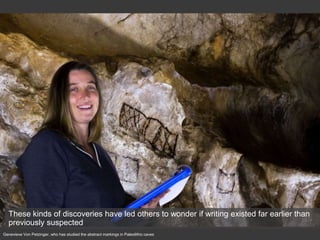
Genevieve Von Petzinger, who has studied the abstract markings in Paleolithic caves
These kinds of discoveries have led others to wonder if writing existed far earlier than
previously suspected
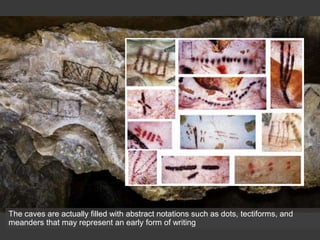
The caves are actually filled with abstract notations such as dots, tectiforms, and
meanders that may represent an early form of writing
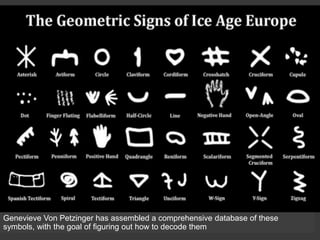
Genevieve Von Petzinger has assembled a comprehensive database of these
symbols, with the goal of figuring out how to decode them
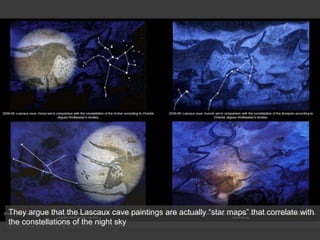
Some experts have proposed that the “dots” that appear on the walls at Lascaux may
refer to stars
They argue that the Lascaux cave paintings are actually “star maps” that correlate with
the constellations of the night sky
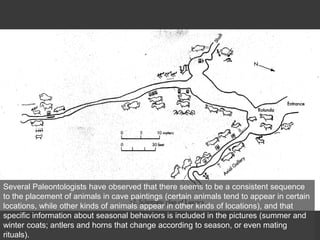
Several Paleontologists have observed that there seems to be a consistent sequence
to the placement of animals in cave paintings (certain animals tend to appear in certain
locations, while other kinds of animals appear in other kinds of locations), and that
specific information about seasonal behaviors is included in the pictures (summer and
winter coats; antlers and horns that change according to season, or even mating
rituals).
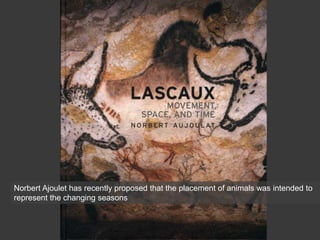
Norbert Ajoulet has recently proposed that the placement of animals was intended to
represent the changing seasons
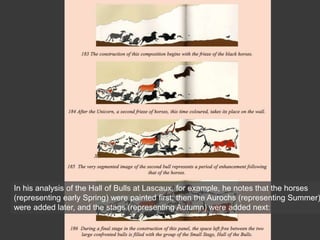
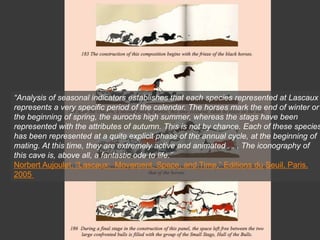
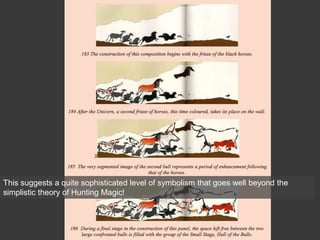
In his analysis of the Hall of Bulls at Lascaux, for example, he notes that the horses
(representing early Spring) were painted first; then the Aurochs (representing Summer)
were added later, and the stags (representing Autumn) were added next:
“Analysis of seasonal indicators establishes that each species represented at Lascaux
represents a very specific period of the calendar. The horses mark the end of winter or
the beginning of spring, the aurochs high summer, whereas the stags have been
represented with the attributes of autumn. This is not by chance. Each of these species
has been represented at a quite explicit phase of the annual cycle, at the beginning of
mating. At this time, they are extremely active and animated . . . The iconography of
this cave is, above all, a fantastic ode to life.”
Norbert Aujoulet, “Lascaux: Movement, Space, and Time,” Editions du Seuil, Paris,
2005
This suggests a quite sophisticated level of symbolism that goes well beyond the
simplistic theory of Hunting Magic!
Calling Lascaux the “Sistine Chapel of Prehistory,” Ajoulet argues that the images
represent a complex cosmology about the origins of time, the cycle of life, and the
changing of the seasons — an epic theme that indeed parallels the grand story of
Creation that Michelangelo depicted on the Sistine Ceiling!
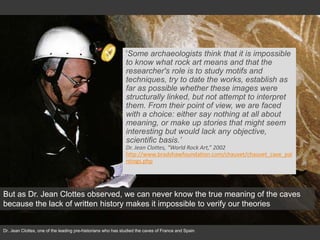
Dr. Jean Clottes, one of the leading pre-historians who has studied the caves of France and Spain
'Some archaeologists think that it is impossible
to know what rock art means and that the
researcher's role is to study motifs and
techniques, try to date the works, establish as
far as possible whether these images were
structurally linked, but not attempt to interpret
them. From their point of view, we are faced
with a choice: either say nothing at all about
meaning, or make up stories that might seem
interesting but would lack any objective,
scientific basis.’
Dr. Jean Clottes, “World Rock Art,” 2002
http://www.bradshawfoundation.com/chauvet/chauvet_cave_pai
ntings.php
But as Dr. Jean Clottes observed, we can never know the true meaning of the caves
because the lack of written history makes it impossible to verify our theories
Dr. Jean Clottes, one of the leading pre-historians who has studied the caves of France and Spain
'Some archaeologists think that it is impossible
to know what rock art means and that the
researcher's role is to study motifs and
techniques, try to date the works, establish as
far as possible whether these images were
structurally linked, but not attempt to interpret
them. From their point of view, we are faced
with a choice: either say nothing at all about
meaning, or make up stories that might seem
interesting but would lack any objective,
scientific basis.’
Dr. Jean Clottes, “World Rock Art,” 2002
http://www.bradshawfoundation.com/chauvet/chauvet_cave_pai
ntings.php
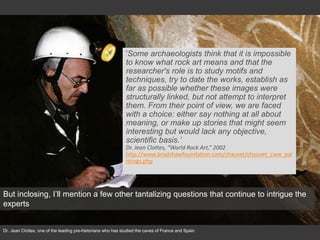
But inclosing, I’ll mention a few other tantalizing questions that continue to intrigue the
experts
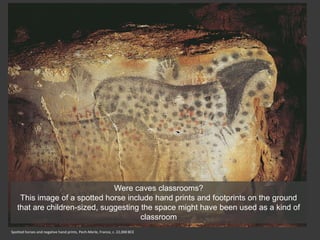
Spotted horses and negative hand prints, Pech-Merle, France, c. 22,000 BCE
Were caves classrooms?
This image of a spotted horse include hand prints and footprints on the ground
that are children-sized, suggesting the space might have been used as a kind of
classroom
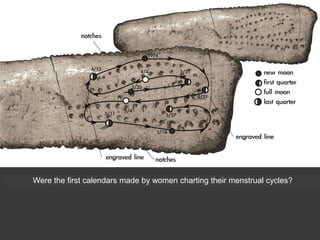
Were the first calendars made by women charting their menstrual cycles?
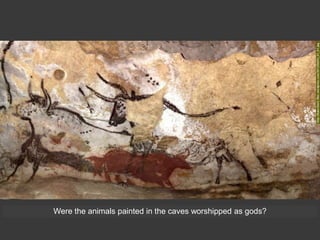
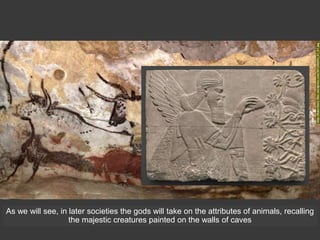
Were the animals painted in the caves worshipped as gods?
As we will see, in later societies the gods will take on the attributes of animals, recalling
the majestic creatures painted on the walls of caves
© www.CartoonStock.com
Thanks for Listening!
Next up: Neolithic Art

Paleolithic Art

  • 1.
  • 2.
  • 3.
    Magapansgat pebble, fromSouth Africa. C. 3,000,000 BCE. Natural History Museum, London This small pebble was discovered in 1925 in a cave in Africa
  • 4.
    It was foundamongst the bones of Australopithecus, a predecessor of modern humans
  • 5.
    Magapansgat pebble, fromSouth Africa. C. 3,000,000 BCE. Natural History Museum, London Paleontologists believe that the owner of the pebble recognized its resemblance to a human face, and carried it back to the cave for safekeeping
  • 6.
    Magapansgat pebble, fromSouth Africa. C. 3,000,000 BCE. Natural History Museum, London Is this how art began — with the simple recognition of “resemblance” or “likeness”?
  • 7.
    Magapansgat pebble, fromSouth Africa. C. 3,000,000 BCE. Natural History Museum, London Although the act of recognizing a human likeness in the features of the pebble may indicate the beginning of a capacity for symbolic thinking, it was not until much later in human evolution that our ancestors began to modify materials to “re-present” the world in symbolic form
  • 8.
    The creation ofart, like the development of language, pre-supposes a high level of intellectual sophistication, and the species that found and saved the Magapansgat pebble had not yet achieved this level of cognitive development
  • 9.
    In fact, itwas not until modern humans (Homo Sapiens – which literally means “wise man”) emerged on the world stage that “art” as a form of symbolic visual communication began to appear.
  • 10.
    The critical factorwas the size of our brain: we didn’t start making art until we had gained the capacity to think — and all of this happened thousands of years before the invention of writing!
  • 11.
    So art beganwhen the human brain evolved to its modern capacity, and the oldest examples can be found in Africa, where our ancient ancestors originated
  • 12.
    Engraved ochre fromBlombos Cave. 90,000-100,000 BP But we didn’t start out making art like Pablo Picasso or Michelangelo
  • 13.
    Engraved ochre fromBlombos Cave. 90,000-100,000 BP This engraved piece of ochre may not be pretty to look at, but it shows evidence for the human capacity for symbolic thinking far earlier than previously thought possible
  • 14.
    Fragments of engraved ostricheggshells from the Howiesons Poort of Diepkloof Rock Shelter, Western Cape, South Africa, dated to 60,000 BP Much of the earliest evidence of human creativity consists of indecipherable geometric markings, or objects of personal adornment
  • 15.
    Animal facing left,from the Apollo 11 Cave, Namibia, ca. 23,000 BCE. Charcoal on stone, approx. 5″X 4 1/4″. State Museum of Namibia, Windhoek. This painted slab was found in the “Apollo 11” cave in southwestern Namibia in 1969
  • 16.
    Animal facing left,from the Apollo 11 Cave, Namibia, ca. 23,000 BCE. Charcoal on stone, approx. 5″X 4 1/4″. State Museum of Namibia, Windhoek. Using radiocarbon dating, archaeologists estimate that it is 25,500-25,300 years old, making it one of the oldest examples of representational art to be found on the African continent
  • 17.
    Animal facing left,from the Apollo 11 Cave, Namibia, ca. 23,000 BCE. Charcoal on stone, approx. 5″X 4 1/4″. State Museum of Namibia, Windhoek. Decorated with simplified representations of animals, the slabs were painted with pigments made from ground charcoal and ochre
  • 18.
    Animal facing left,from the Apollo 11 Cave, Namibia, ca. 23,000 BCE. Charcoal on stone, approx. 5″X 4 1/4″. State Museum of Namibia, Windhoek. It is difficult to identify the animals because they lack specific detail
  • 19.
    Animal facing left,from the Apollo 11 Cave, Namibia, ca. 23,000 BCE. Charcoal on stone, approx. 5″X 4 1/4″. State Museum of Namibia, Windhoek. Although we may never know the meaning of the image (the absence of any written record doesn’t help!), many of the characteristics of the Upper Paleolithic art that we will study are already present here, including the focus on animals as subject matter, and the use of a strictly profile view
  • 20.
    Animal facing left,from the Apollo 11 Cave, Namibia, ca. 23,000 BCE. Charcoal on stone, approx. 5″X 4 1/4″. State Museum of Namibia, Windhoek. The Apollo 11 Cave drawings might be thought of as the “student sketchbooks” for the artists who painted the later and more famous caves in France and Spain.
  • 21.
    The real storybegins in the Upper Paleolithic era, when climate change prompted migration North (50,000-10,000 years ago)
  • 22.
    This is whythe largest concentration of Paleolithic art can be found in Europe, rather than in Africa
  • 23.
    VOCABULARY Before moving tothe next section, it might be helpful to define a few vocabulary terms
  • 24.
    VOCABULARY Prehistory/Prehistoric Before recordedhistory Paleolithic Old Stone Age Stone Age Stone tools Neolithic New Stone Age
  • 25.
    Dating B.C. Before Christ B.C.E.Before Common Era BP Before Present Radiocarbon dating Measure based on decay rate of carbon in organic matter WARNING: Dating always approximate, and often highly contested!!!!
  • 26.
    Upper Paleolithic Middle Paleolithic LowerPaleolithic The Paleolithic period is also divided into three broad stages, based on the layers of excavations (the oldest stuff being found in the lowest levels of excavations, and the newest stuff being found closest to the top)
  • 27.
    Finally, the UpperPaleolithic period is further divided into cultural periods (based on lifestyles and tool technologies), which are given varying dates by different experts. You DO NOT have to know these, but I am listing them in case you come across them
  • 28.
  • 29.
    Mobiliary Art Smallportable carvings and sculptures made from bones, antlers, stone
  • 30.
    Our earliest ancestorsused stone tools to make decorated weapons and small portable sculptures
  • 31.
    They also madedecorated weapons and tools, and small “doodles” on antlers and bones
  • 32.
    Spear thrower carvedas a mammoth, Late Magdalenian, about 12,500 years old From the rockshelter of Montastruc, Tarn-et-Garonne, France British Museum Many of these carved artifacts represent animals, and indicate a remarkably high level of skill
  • 33.
    This carved antleris a spear-thrower and is decorated with a leaping horse
  • 34.
    The hunter wouldhave inserted the spear in the small slot, and used the carved part as a handle
  • 35.
    Bison with turnedhead, fragmentary spear thrower from La Madeleine, France, c. 12,000 BCE. Reindeer horn, 4” long This fragment of a spear thrower depicts a bison, with its head turned sharply to the right
  • 36.
    Bison with turnedhead, fragmentary spear thrower from La Madeleine, France, c. 12,000 BCE. Reindeer horn, 4” long The distinctive characteristics of the animal have been observed in great detail, including the distinctive shape of the skull, the texture of the mane, and even the subtle features of the ear, nose, and mouth with its extended tongue
  • 37.
    Most of thesedecorated objects depict animals: why do you think that is so?
  • 38.
    Jack Black, in“Year One,” 2009 Photo By: Suzanne Hanover, SMPSP. © 2009 Columbia Pictures Industries, Inc. All Rights Reserved Image source: http://www.allmoviephoto.com/photo/2009_year_one_007.html Understanding context is important: What was life was like in the stone age?
  • 39.
    Andreas Lederer, Hadabelmen in Tanzania returning from a hunt Wikipedia: https://en.wikipedia.org/wiki/Hadza_people#/media/File:Hadazbe_returning_from_hunt.jpg Our prehistoric ancestors were hunter gatherers, which means they hunted animals and foraged for food
  • 40.
    Andreas Lederer, Hadabelmen in Tanzania returning from a hunt Wikipedia: https://en.wikipedia.org/wiki/Hadza_people#/media/File:Hadazbe_returning_from_hunt.jpg They were also nomadic, since they had to move around to follow the herds
  • 41.
    This is whythe art is small in scale – it had to be small enough to carry around
  • 42.
    No cars No phones NoFacebook No fast food
  • 43.
    Scene from “YearOne,” starring Jack Black Image source: http://www.collider.com/2009/06/18/year-one-review/ Life was precarious
  • 44.
    Animals were vitalto human existence as a source of food, and as a constant threat of danger
  • 45.
    Bison with turnedhead, fragmentary spear thrower from La Madeleine, France, c. 12,000 BCE. Reindeer horn, 4” long Preoccupation with animals was therefore more than just an idle past time: knowledge about animal features and behavior would have been vital to survival
  • 46.
    In addition toanimals, small figurines of women made from ivory, bone, or stone, have been found in abundance at archaeological sites across Europe
  • 47.
    Venus of Willendorf,c. 28,000-25,000 BCE Natural History Museum, Vienna Female Figurine (Venus of Kostenki), c. 23,000- 21,000 BCE Limestone; Hermitage Museum When they were first discovered, archaeologists referred to them as “Venus” figures because of their resemblance to Classical statues of the Roman goddess of love
  • 48.
    Venus of Willendorf,c. 28,000-25,000 BCE Natural History Museum, Vienna Female Figurine (Venus of Kostenki), c. 23,000- 21,000 BCE Limestone; Hermitage Museum This designation is now considered misleading because there is no evidence to support the implied conclusion that the figures represented “goddesses” – but the name has stuck nonetheless!
  • 49.
    The Venus ofWillendorf was discovered at an archaeological site in Austria in 1908
  • 50.
    Venus of Willendorf,c. 28,000-25,000 BCE Natural History Museum, Vienna Measuring just 4 3/8” tall, the figure is carved from a type of limestone that is not local to the area, and there were traces of red ochre found on the surface, which may have had some kind of ritual significance
  • 51.
    Venus of Willendorf,c. 28,000-25,000 BCE Natural History Museum, Vienna Female Figurine (Venus of Kostenki), c. 23,000- 21,000 BCE Limestone; Hermitage Museum The small scale and lack of feet suggests she was made to be carried in the palm of the hand
  • 52.
    Venus of Willendorf,c. 28,000-25,000 BCE Natural History Museum, Vienna Unlike the Magapansgat pebble, which merely resembled a human face by accident, the Venus of Willendorf was carved with the deliberate intention of creating a likeness of the female form Magapansgat pebble, from South Africa. C. 3,000,000 BCE. Natural History Museum, London
  • 53.
    Venus of Willendorf,c. 28,000-25,000 BCE Natural History Museum, Vienna But scholars have determined that the navel was a natural indentation in the rock, rather than a carved feature – so the inspiration may have come from a perceived resemblance to the soft belly of a woman Magapansgat pebble, from South Africa. C. 3,000,000 BCE. Natural History Museum, London
  • 54.
    The figure hasremarkably naturalistic details, such as the heavily sagging breasts and soft pudgy belly
  • 55.
    But it isalso highly abstracted, with selective emphasis on certain parts of the body, while other parts of the body seem to be de-emphasized
  • 56.
    The emphasis seemsto her enormously large breasts, belly, and buttocks – even her pubic region has been carefully incised
  • 57.
    But she hasno face, no feet, and skinny little arms that are barely noticeable
  • 58.
    Female Figurine (Venusof Kostenki), c. 23,000- 21,000 BCE Limestone; Hermitage Museum Venus figurine from Kostenki Image source: http://donsmaps.com/kostenkivenus.html This selective focus is common to all of the so-called Venus figures
  • 59.
    Venus von Moravany,Mammoth Ivory, 22 000 - 24 000 Slovak Academy of Sciences in Nitra Image source: http://www.donsmaps.com/moravanyvenus.html They all have large, swelling bellies, breasts, and carefully delineated pubic regions
  • 60.
    Venus of DolniVestonice Molded of clay and bone ash; 4 1/2 “ Dolni Vestonice, Czechoslovakia, 34000-26500 BC And they all lack faces and feet
  • 61.
    Dr. Jill Cook,curator of European pre-history at the British museum What did they mean? Archaeologists continue to debate the purpose or meaning of the Venus figures
  • 62.
    Paul Mellars, aCambridge anthropologist, has proposed that they reflect an “obsession with sex,” and are an early form of pornography
  • 63.
    Our modern idealsof “beauty” are probably very different from what they were in ancient times:
  • 64.
    “The people whomade this statue lived in a harsh ice-age environment where features of fatness and fertility would have been highly desirable. In neurological terms, these features amounted to hyper-normal stimuli that activate neuron responses in the brain. So in Paleolithic people terms, the parts that mattered most had to do with successful reproduction – the breasts and pelvic girdle. Therefore, these parts were isolated and amplified by the artist’s brain.” Venus of Willendorf: Exaggerated Beauty (PBS)
  • 65.
    Brian Crowson, TheBirth of Venus, 2013 Image source: https://www.pinterest.com/pin/465489311457291876/ The “pornography” hypothesis is based on the assumption that the artists who made these statues were men
  • 66.
    Dr. Jill Cook,curator of European pre-history at the British museum Dr. Jill Cook, curator of European Pre-History at the British Museum, believes the figures were made by women
  • 67.
    Drawing upon thework of anthropologist Leroy McDermott, she argues that the strange distortions of the figures reflect the perspective of women looking down at their own bodies
  • 68.
    This also accountsfor the lack of faces – without mirrors, the artist would not be able to see the features of their own face
  • 69.
    Venus of Willendorf,c. 28,000-25,000 BCE Natural History Museum, Vienna Female Figurine (Venus of Kostenki), c. 23,000- 21,000 BCE Limestone; Hermitage Museum Despite differences of opinion, most experts agree that the figures have something to do with fertility, because all of the emphasis seems to be on the childbearing aspects of the body
  • 70.
    In fact, itis quite remarkable how the figures capture the characteristic traits of the pregnant female body
  • 71.
    THE OLDEST WOMANIN THE WORLD For many years the Venus of Willendorf was believed to be the oldest representation of a human being
  • 72.
    Venus of HohleFels, c. 35,000-40,000 BCE Photo: H. Jensen © Universität Tübingen. Image source: http://donsmaps.com/hohlefelsvenus.htm But the discovery of the Venus of Hohle Fels in 2008 changed all that
  • 73.
    Measuring only 2.4inches tall, this tiny little figure dates to 35,000 BCE, and is now recognized as the oldest representation of a human yet to be found
  • 74.
    Instead of ahead, the figure has a small loop, indicating that it might have been worn as a pendant
  • 75.
    Venus of HohleFels, c. 35,000-40,000 BCE Photo: H. Jensen © Universität Tübingen. Image source: http://donsmaps.com/hohlefelsvenus.htm While the figure may appear grotesque to us, its emphasis on female fertility is unmistakable
  • 76.
    Venus of HohleFels, c. 35,000-40,000 BCE Photo: H. Jensen © Universität Tübingen. Image source: http://donsmaps.com/hohlefelsvenus.htm “You couldn’t get more female than this,” says Nicholas Conard, the Ohio-born archaeologist whose University of Tübingen team found the sculpture at the bottom of a vaulted cave in southwestern Germany in the fall of 2008. “Head and legs don’t matter. This is about sex, reproduction.” Smithsonian Magazine
  • 77.
    Thanks for listening! Nextup: Paleolithic Cave Paintings
  • 78.
  • 79.
    The most spectacularexamples of Paleolithic art can be found in the painted caves of France and Spain
  • 80.
    Amongst the mostfamous are Lascaux, Altamira, Pech Merle, Niaux, and Chauvet
  • 81.
    The artists whodecorated these caves invested a great deal of effort in making them Image source: https://www.q-files.com/prehistoric/story-of-humans/cave-paintings
  • 82.
    Image source: https://www.q-files.com/prehistoric/story-of-humans/cave-paintings Cavesare inhospitable environments (they’re dark, damp, and cold, and home to scary creatures like lions, bears, snakes, and bats), and many of the paintings are located in remote chambers that are difficult to access
  • 83.
    Image source: https://www.q-files.com/prehistoric/story-of-humans/cave-paintings Withno natural light available, the pictures had to be made using torches, and in some cases scaffolds were built to reach high ceilings and walls
  • 84.
    Image source: https://www.q-files.com/prehistoric/story-of-humans/cave-paintings Sincepeople didn’t actually live in the caves, it is unlikely they were made for “decoration”
  • 85.
    Image source: https://www.q-files.com/prehistoric/story-of-humans/cave-paintings Wealso know that the pictures were made over a long period of time – sometimes thousands of years – so it is likely that their meaning and purpose was quite significant.
  • 86.
    The most famousPaleolithic cave is Lascaux, located in the Dordogne region of France
  • 87.
    Entrance to theLascaux Cave at the end of September, 1940. From left to right: Leon Laval, Marcel Ravidat, Jacques Marsal and Henri Breuil Image source: http://www.american-buddha.com/lascaux.7a.htm It was discovered in 1940 by four teenagers who stumbled upon it by accident, and it was opened to the public in 1948
  • 88.
    But in1963 thecave was closed because exposure to carbon dioxide had caused the pictures to deteriorate at an alarming rate -- tourists can now visit Lascaux 2, a full-scale replica
  • 89.
    The cave consistsof a complex network of chambers and passageways, and is decorated with as many as 900 images of animals
  • 90.
    The pictures weremade using mineral chunks for drawing, or ground to a powder and mixed with water and fat to make paint
  • 91.
    Paint brushes weremade from animal hair or chewed twigs
  • 92.
    The artists alsoused blow tubes to apply pigments, as well as “spitting” – a prehistoric version of “airbrushing”!
  • 93.
  • 94.
    Spotted horses andnegative hand prints, Pech-Merle, France, c. 22,000 BCE That is how we believe the negative hand prints were made in this image of a spotted horse from Pech Merle
  • 95.
    Animals dominate theimagery at Lascaux
  • 96.
    Hall of Bulls,Lascaux, c. 15,000-13,000BCE This is the Hall of Bulls (also called the Rotunda), one of the larger and more impressive spaces at Lascaux
  • 97.
    Hall of Bulls,Lascaux, c. 15,000-13,000BCE It is decorated with three groups of animals: horses, cattle (cows and bulls), and stags Horses Bulls Stags
  • 98.
    The axial galleryincludes horses, cows, a black bull, and a bison Axial Gallery, Lascaux, c. 15,000-13,000BCE Photo credit : N. Aujoulat © MCC-CNP http://www.lascaux.culture.fr/index.php?fichier=02_02.xml
  • 99.
    The Great Hallof Bulls, Lascaux Photo credit : N. Aujoulat © MCC-CNP http://www.lascaux.culture.fr/index.php?fichier=02_01.xml The animals are very large in scale, and are often painted (or “super imposed”) one on top of the other, without regard for scale
  • 100.
    In this image,the larger bull was painted right on top of a smaller horse, so they don’t appear to have any kind of a narrative relationship
  • 101.
    The animals arepainted without a ground line, or any indication of setting
  • 102.
    A ground lineis simply a line that indicates “place” by establishing where the ground is
  • 103.
    Without a groundline, the figures seem to float, with no clear location of where they are in space
  • 104.
    The animals weredrawn in one of two ways: using a contour line (or outline), or in a flat silhouette
  • 105.
    Second Bull, GreatHall of Bulls, Lascaux Photo credit : N. Aujoulat © MCC-CNP http://www.lascaux.culture.fr/index.php?fichier=02_01_00_07.xml In this image the bull is rendered with a simple outline
  • 106.
    The Great BlackCow, The Nave, Lascaux Photo credit : N. Aujoulat © MCC-CNP http://www.lascaux.culture.fr/index.php?fichier=02_04_00_05.xml While this cow is rendered as a silhouette
  • 107.
    The animals arealways shown in profile – that is, from the side
  • 108.
  • 109.
    Poor guy! He onlyhas two legs! A more complicated angle would conceal important information that would make it difficult to identify the animal
  • 110.
    Second Bull, GreatHall of Bulls, Lascaux Photo credit : N. Aujoulat © MCC-CNP http://www.lascaux.culture.fr/index.php?fichier=02_01_00_07.xml But the perspective of the animals is inconsistent
  • 111.
    Second Bull, GreatHall of Bulls, Lascaux Photo credit : N. Aujoulat © MCC-CNP http://www.lascaux.culture.fr/index.php?fichier=02_01_00_07.xml This bull is rendered from the side, but the horns are “twisted” so that they are seen from the front
  • 112.
    Second Bull, GreatHall of Bulls, Lascaux Photo credit : N. Aujoulat © MCC-CNP http://www.lascaux.culture.fr/index.php?fichier=02_01_00_07.xml This convention, where the animal is represented in a combination of frontal and profile views is called twisted perspective TWISTED PERSPECTIVE: The body is seen from the side, but the horns are shown frontally
  • 113.
    Second Bull, GreatHall of Bulls, Lascaux Photo credit : N. Aujoulat © MCC-CNP http://www.lascaux.culture.fr/index.php?fichier=02_01_00_07.xml It means that the artist did not depict the animal exactly the way it appeared to the eye (what is called “optical perspective”); instead, the artist adjusted the image to conform to what the mind knows to be true (this is called “conceptual perspective”)
  • 114.
    So what isthe dominant subject matter of Paleolithic art? Doris Day in Teachers Pet (1958) Image source: http://www.dorisday.net/teacher_s_pet.html
  • 115.
    Common Subjects So far,we have seen only animals and women . . .
  • 116.
  • 117.
    Men are actually RAREin Paleolithic art! Doris Day in Teachers Pet (1958) Image source: http://www.dorisday.net/teacher_s_pet.html
  • 118.
    The Shaft Scene,Lascaux There are a few rare representations of humans in cave paintings. The most famous is the so-called Shaft Scene at Lascaux (also called the “Well Scene” or “Scene of the Dead Man”), located in a deep shaft within the cave
  • 119.
    The Shaft Scene,Lascaux While the animals are remarkable in their naturalism (i.e. lifelike in character), the man is a simple stick-figure with a bird-like head
  • 120.
    The Shaft Scene,Lascaux The scene suggests a dramatic narrative, since the man seems to be threatened by a bison that rears its head ferociously
  • 121.
    The Shaft Scene,Lascaux The bison has been wounded, either by a spear, or by the rhinoceros that exits the scene to the left, and we can see his entrails spilling out from his loins.
  • 122.
    The Shaft Scene,Lascaux This scene is unique in Paleolithic art for two reasons: 1. because it depicts a man 2. because it seems to tell a story
  • 123.
    Thanks for Listening! Nextup: The Cave at Chauvet
  • 124.
  • 125.
    The cave atChauvet Pont d’Arc was discovered in 1994
  • 126.
    When it wasdiscovered it was a big deal because it was the oldest cave yet to be discovered
  • 127.
    It also overturnedeverything we thought we knew about cave art!
  • 128.
    So let’s reviewwhat we have learned about the typical characteristics of cave art so we can appreciate just how unique the imagery at Chauvet really is
  • 129.
    SUBJECT MATTER: horses,cattle (cows and bulls), and stags
  • 130.
    Although impressive insize, these animals are “herbivores,” which means they do not prey on meat
  • 131.
    Predatory animals likelions, tigers, and bears, were rarely represented – and when they were, they were depicted in remote sections of the cave
  • 132.
    Second Bull, GreatHall of Bulls, Lascaux Photo credit : N. Aujoulat © MCC-CNP http://www.lascaux.culture.fr/index.php?fichier=02_01_00_07.xml We also learned that animals were typically depicted in twisted perspective, where the body is shown in profile, but the horns are “twisted” frontally TWISTED PERSPECTIVE: The body is seen from the side, but the horns are shown frontally
  • 133.
    The Shaft Scene,Lascaux We also learned that narrative scenes are rare – as in the so-called “shaft scene” at Lascaux, where the stick-figure man, the bison, and rhinoceros, seemed to be conceived together to tell a story
  • 134.
    The Great Hallof Bulls, Lascaux Photo credit : N. Aujoulat © MCC-CNP http://www.lascaux.culture.fr/index.php?fichier=02_01.xml Elsewhere at Lascaux, the animals are placed randomly – sometimes painted one on top of one another – so they were not intended to be seen as a cohesive narrative
  • 135.
    At Chauvet, wesee lots of predatory animals, including lions and bears Chauvet Cave, Vallon-Pont-d’Arc. c. 30,000-28,000 or 15,000-13,000 BCE.
  • 136.
    Instead of beingrandomly placed, the animals seem to have been conceived together in a narrative scene, as seen in the fighting rhinos here
  • 137.
    We also seea sophisticated use of shading to make the animal heads seem rounded – rather than a flat silhouette
  • 138.
    And the animalhorns are seen in true perspective, rather than twisted frontally
  • 139.
    We also seethe use of repetition to create the effect of movement through time
  • 140.
    The images arelike key frames in an animation
  • 141.
    Prior to thediscovery at Chauvet, it was assumed that the earliest art would be crude and un-sophisticated, and became more naturalistic over time
  • 142.
    But the discoveryof Chauvet seemed to reverse that progression
  • 143.
    The older caveactually reveals more sophisticated techniques such as shading, perspective, and narrative
  • 144.
    Thanks for Listening! Nextup: Theories of Interpretation
  • 145.
  • 146.
    There have beenmany theories to explain the possible meaning and purpose of Paleolithic cave painting, but the absence of any written history makes it impossible to ever know for sure Dr. Jean Clottes, one of the leading pre-historians who has studied the caves of France and Spain
  • 147.
    Tony Husband, “PrivateView,” Image source: http://www.megalithic.co.uk/modules.php?op=modload&name=a312&file=index&do=showpic&pid=80569 Art for Art’s Sake One of the oldest theories is called Art for Art’s Sake
  • 148.
    Tony Husband, “PrivateView,” Image source: http://www.megalithic.co.uk/modules.php?op=modload&name=a312&file=index&do=showpic&pid=80569 This theory proposes that the images were made for purely aesthetic reasons (i.e. for decoration)
  • 149.
    Tony Husband, “PrivateView,” Image source: http://www.megalithic.co.uk/modules.php?op=modload&name=a312&file=index&do=showpic&pid=80569 But this theory has been dismissed by most experts, for a variety of reasons:
  • 150.
    In the firstplace, it is unlikely that our ancient ancestors had the kind of “leisure time” that would have been necessary to create these works Image source: https://www.q-files.com/prehistoric/story-of-humans/cave-paintings
  • 151.
    Secondly, caves arevery inhospitable environments, so it would have been impossible to simply “enjoy” the pictures Image source: https://www.q-files.com/prehistoric/story-of-humans/cave-paintings
  • 152.
    Given the timeand effort it took to create these works of art, most experts believe that the images must have had deeper symbolic meaning or purpose than just “decoration” Image source: https://www.q-files.com/prehistoric/story-of-humans/cave-paintings
  • 153.
    The paleontologist AbbeBreuil in the Lascaux cave in1948 Image source: http://www.la-croix.com/Culture/Simon-Coencas-dernier-aventurier-grotte-Lascaux-2016-12-08-1300808960 The most popular theory of interpretation was developed by the French priest and pre-historian Abbe Breuil in an influential book published in 1952
  • 154.
    His analysis wasbased on ethnographic comparisons with aboriginal tribes who practiced a form of sympathetic magic in their hunting rituals:
  • 155.
    “Breuil claimed thatthe Paleolithic rock paintings, like those of the Arunta, were created in ceremonies intended to multiply game animals, as well as to ensure successful kills by means of magical images of slaughtered prey . . . Hunting Magic and Abbe Breuil
  • 156.
    “By making imagesof animals penetrated by spears, the cave hunters were attempting to kill the animals the images resembled, or, more precisely, to render the game susceptible to being killing by hunting parties” Hunting Magic and Abbe Breuil
  • 157.
    Image source: http://www.waitingfornextyear.com/?p=3662 Thetheory is called Sympathetic Magic, and it is based on the principle of “like produces like”
  • 158.
    Image source: http://www.waitingfornextyear.com/?p=3662 “Whatis done to the properly made image of an object is done to that object itself, as when a sorcerer sticks pins in a doll resembling his victim in an effort to destroy him. By making images of animals penetrated by spears, the cave hunters were attempting to kill the animals the images resembled, or, more precisely, to render the game susceptible to being killing by hunting parties.” Hunting Magic and Abbe Breuil
  • 159.
    Second Bull, GreatHall of Bulls, Lascaux Photo credit : N. Aujoulat © MCC-CNP http://www.lascaux.culture.fr/index.php?fichier=02_01_00_07.xml According to this theory, the ancient hunter would draw a picture of an animal and “kill” it, magically bringing him luck in the hunt
  • 160.
    Second Bull, GreatHall of Bulls, Lascaux Photo credit : N. Aujoulat © MCC-CNP http://www.lascaux.culture.fr/index.php?fichier=02_01_00_07.xml This particular version of Sympathetic Magic is called “Hunting Magic” – and there is plenty of visual evidence to support it
  • 161.
    Many of thepaintings appear to have spears or nick marks, suggesting they had been ritually “killed”
  • 162.
    Many of thesmall portable sculptures depicting animals also have markings such as “X’s” suggesting they have been symbolically wounded as a way to bring luck in the hunt
  • 163.
    There are severaldrawbacks to the theory of Sympathetic Magic: in the first place, ethnographic comparisons lack scientific proof: just because a living aboriginal society today engages in practices that appear similar to what may have occurred amongst our ancient tribal ancestors, this does not constitute reliable “evidence”
  • 164.
    The Great Hallof Bulls, Lascaux Photo credit : N. Aujoulat © MCC-CNP http://www.lascaux.culture.fr/index.php?fichier=02_01.xml But one of the most significant drawbacks to the theory of Sympathetic Magic is that the animals depicted were not the animals that were actually eaten!
  • 165.
    The Great Hallof Bulls, Lascaux Photo credit : N. Aujoulat © MCC-CNP http://www.lascaux.culture.fr/index.php?fichier=02_01.xml “Today’s researchers have consistently demonstrated that the animals most often represented in Paleolithic caves are among the ones least frequently consumed as food. The people who lived under the ceiling and in the cave entry at Altamira ate almost no bison, dining primarily on the meat of red deer (Cervus elaphus). Likewise, at Lascaux images of horses, bovids and red deer dominate, whereas reindeer, the primary dietary item in the food debris, aren’t depicted at all.” Randall White, “Looking for Biilogical Meaning in Cave Art” (Book Review), American Scientist (July-August 2006)
  • 166.
    The other typeof Sympathetic Magic described by Abbe Breuil is called “Fertility Magic”
  • 167.
    Second Bull, GreatHall of Bulls, Lascaux Photo credit : N. Aujoulat © MCC-CNP http://www.lascaux.culture.fr/index.php?fichier=02_01_00_07.xml While Hunting magic was intended to bring about the destruction of animals, Fertility Magic did the opposite
  • 168.
    If a hunterwanted to increase the herd, he might picture a pregnant animal, or “multiply” the number of animals in the picture, as if to achieve a magical “multiplication” of the herds
  • 169.
    Venus of Willendorf,c. 28,000-25,000 BCE Natural History Museum, Vienna Female Figurine (Venus of Kostenki), c. 23,000- 21,000 BCE Limestone; Hermitage Museum The so-called Venus figures may well have functioned as a form of Fertility Magic
  • 170.
    Before the daysof fertility drugs, magic was all they had!
  • 171.
    Third Chinese Horse,Axial Gallery Photo credit : N. Aujoulat © MCC-CNP http://www.lascaux.culture.fr/index.php?fichier=02_02_00_08.xml The so-called “Chinese Horses” from Lascaux illustrates the visual evidence used to support the Fertility Magic theory
  • 172.
    Third Chinese Horse,Axial Gallery Photo credit : N. Aujoulat © MCC-CNP http://www.lascaux.culture.fr/index.php?fichier=02_02_00_08.xml The horses’ swelling bellies may indicate they are pregnant – thus expressing the desire for the herds to multiply
  • 173.
    A recent theoryis that cave paintings were created as part of shamanistic rituals
  • 174.
    San healing ritual,Bradshaw Foundation http://www.bradshawfoundation.com/rari/page3.php The theory is based on ethnographic comparison with the San people of Africa
  • 175.
    San healing ritual,Bradshaw Foundation http://www.bradshawfoundation.com/rari/page3.php “Noting the similarity of prehistoric rock art with that created by some contemporary traditional societies, archaeologists Jean Clottes and David Lewis-Williams suggest that the ancient images were created by shamans, powerful individuals who were able to contact the spirit world through trance and ritual.” http://www.bradshawfoundation.com/books/shamans_of_prehistory.php
  • 176.
    A somewhat differenttheory was put forth by Alexander Marshack, an amateur Paleontologist who became a research associate at the Peabody Museum at Harvard
  • 177.
    He believed thatmuch ice age art functioned as seasonal calendars
  • 178.
    The Blanchard Bone,c. 25,000-32,000 BCE carved segment of reindeer bone found in the Blanchard rock shelter, France Image source: http://donsmaps.com/cavepaintings.html His study began with the Blanchard Bone, a small piece of reindeer bone dating to 25,000-32,000 BCE
  • 179.
    When he studiedthe bone closely (using high tech magnification equipment) he discovered that the markings corresponded to the phases of the moon over a two month period. He concluded that the bone was actually a lunar calendar!
  • 180.
    Why would thatbe Important?
  • 181.
    It means theycould predict the change of seasons and when the animals would begin their migrations Which means they could have control over their environment
  • 182.
    Marshack also studiedother artifacts, such as the carved antler pictured above. It had been lying around in a museum in France for years, and everybody assumed it was just an example of Hunting Magic
  • 183.
    The bone wasengraved with several apparently unrelated elements: there is a bull and cow seal, and an upside down salmon with the distinctive hook that it grows during the Spring mating season Male + female seals Salmon
  • 184.
    There are alsotwo snakes, with their genitals prominently showing — an occurrence that is also common during Spring mating season Snakes
  • 185.
    Markings that werepreviously thought to be harpoons turned out to be a type of plant that is common in France in the Spring
  • 186.
    Finally, Marshack noteda schematic rendering of an ibex with an “X” over it — as if it had been symbolically killed
  • 187.
    He observed thateven today the ibex come down from the mountains to graze in the valleys in the (you guessed it) Spring
  • 188.
    Marshack concluded thatthe bone was not an example of Hunting Magic (as had previously been believed) but was instead a “seasonal calendar” recording the coming of Spring
  • 189.
    Ishango Bone, c.25,000-20,000 BCE Although Marshack’s theory remains a matter of debate, there are many archaeological finds that suggest our human ancestors were a lot smarter than we thought (hey, they had the same brain capacity as us!)
  • 190.
    Ishango Bone, c.25,000-20,000 BCE The Ishango Bone, for example, is another exciting artifact that may indicate the very first evidence of mathematical notation!
  • 191.
    Ishango Bone, c.25,000-20,000 BCE The bone appears to have been a “tally stick,” with the lines indicating numbers
  • 192.
    Genevieve Von Petzinger,who has studied the abstract markings in Paleolithic caves These kinds of discoveries have led others to wonder if writing existed far earlier than previously suspected
  • 193.
    The caves areactually filled with abstract notations such as dots, tectiforms, and meanders that may represent an early form of writing
  • 194.
    Genevieve Von Petzingerhas assembled a comprehensive database of these symbols, with the goal of figuring out how to decode them
  • 195.
    Some experts haveproposed that the “dots” that appear on the walls at Lascaux may refer to stars
  • 196.
    They argue thatthe Lascaux cave paintings are actually “star maps” that correlate with the constellations of the night sky
  • 197.
    Several Paleontologists haveobserved that there seems to be a consistent sequence to the placement of animals in cave paintings (certain animals tend to appear in certain locations, while other kinds of animals appear in other kinds of locations), and that specific information about seasonal behaviors is included in the pictures (summer and winter coats; antlers and horns that change according to season, or even mating rituals).
  • 198.
    Norbert Ajoulet hasrecently proposed that the placement of animals was intended to represent the changing seasons
  • 199.
    In his analysisof the Hall of Bulls at Lascaux, for example, he notes that the horses (representing early Spring) were painted first; then the Aurochs (representing Summer) were added later, and the stags (representing Autumn) were added next:
  • 200.
    “Analysis of seasonalindicators establishes that each species represented at Lascaux represents a very specific period of the calendar. The horses mark the end of winter or the beginning of spring, the aurochs high summer, whereas the stags have been represented with the attributes of autumn. This is not by chance. Each of these species has been represented at a quite explicit phase of the annual cycle, at the beginning of mating. At this time, they are extremely active and animated . . . The iconography of this cave is, above all, a fantastic ode to life.” Norbert Aujoulet, “Lascaux: Movement, Space, and Time,” Editions du Seuil, Paris, 2005
  • 201.
    This suggests aquite sophisticated level of symbolism that goes well beyond the simplistic theory of Hunting Magic!
  • 202.
    Calling Lascaux the“Sistine Chapel of Prehistory,” Ajoulet argues that the images represent a complex cosmology about the origins of time, the cycle of life, and the changing of the seasons — an epic theme that indeed parallels the grand story of Creation that Michelangelo depicted on the Sistine Ceiling!
  • 203.
    Dr. Jean Clottes,one of the leading pre-historians who has studied the caves of France and Spain 'Some archaeologists think that it is impossible to know what rock art means and that the researcher's role is to study motifs and techniques, try to date the works, establish as far as possible whether these images were structurally linked, but not attempt to interpret them. From their point of view, we are faced with a choice: either say nothing at all about meaning, or make up stories that might seem interesting but would lack any objective, scientific basis.’ Dr. Jean Clottes, “World Rock Art,” 2002 http://www.bradshawfoundation.com/chauvet/chauvet_cave_pai ntings.php But as Dr. Jean Clottes observed, we can never know the true meaning of the caves because the lack of written history makes it impossible to verify our theories
  • 204.
    Dr. Jean Clottes,one of the leading pre-historians who has studied the caves of France and Spain 'Some archaeologists think that it is impossible to know what rock art means and that the researcher's role is to study motifs and techniques, try to date the works, establish as far as possible whether these images were structurally linked, but not attempt to interpret them. From their point of view, we are faced with a choice: either say nothing at all about meaning, or make up stories that might seem interesting but would lack any objective, scientific basis.’ Dr. Jean Clottes, “World Rock Art,” 2002 http://www.bradshawfoundation.com/chauvet/chauvet_cave_pai ntings.php But inclosing, I’ll mention a few other tantalizing questions that continue to intrigue the experts
  • 205.
    Spotted horses andnegative hand prints, Pech-Merle, France, c. 22,000 BCE Were caves classrooms? This image of a spotted horse include hand prints and footprints on the ground that are children-sized, suggesting the space might have been used as a kind of classroom
  • 206.
    Were the firstcalendars made by women charting their menstrual cycles?
  • 207.
    Were the animalspainted in the caves worshipped as gods?
  • 208.
    As we willsee, in later societies the gods will take on the attributes of animals, recalling the majestic creatures painted on the walls of caves
  • 209.
  • 210.
    Thanks for Listening! Nextup: Neolithic Art

Editor's Notes

  • #45 Woolly mammoths were driven to extinction by climate change and human impacts. The image depicts a late Pleistocene landscape in northern Spain with woolly mammoths (Mammuthus primigenius), equids, a woolly rhinoceros (Coelodonta antiquitatis), and European cave lions (Panthera leo spelaea) with a reindeer carcass. (Information according to the caption of the same image in Alan Turner (2004)National Geographic Prehistoric Mammals, Washington, D.C.: National Geographic ISBN 9780792271345, ISBN 9780792269977).  
  • #94 Image source: http://www.schoolsprehistory.co.uk/2014/09/19/new-survey-open-for-teachers-on-changes-in-britain-from-the-stone-age-to-the-iron-age/