The Art  of the Renaissance
Art and Power Powerful groups commissioned works of art Represented merchants’ dominant influence in community i.e.  Florentine gov’t hires Michelangelo Despots and Oligarchs began sponsoring works of art A way to glorify themselves or their families, show wealth Subject matter remained religious Intended to spread a particular doctrine, act as a profession of faith, or recall sinners to a moral way of life
Art and Power (cont) As the 15 th  Century moved on, subject matter becomes more secular Pagan gods/goddesses in paintings increased People were conscious of  physical uniqueness and wanted it immortalized Paintings displayed wealth The individual portrait emerged as a distinct genre The rich had themselves painted in a scene of romantic chivalry or courtly society
Art and Power (cont) Narrative artists – depicted the body in more scientific/natural manner Female    sensual and voluptuous Male    strong and heroic
The State of the Artist During the Renaissance, the social status of the artist improved Reputation depended on the support of powerful patrons Usually worked for commission from a prince or family They did  not  produce works for the public Could mean loss of status Artists received a practical education from a master artist
The State of the Artist (cont) Most artists began to sign their works whereas medieval artists rarely did Some even painted themselves into the painting Renaissance artists and humanists came to think that a work of art was the deliberate creation of a new divine personality Artist shared powers of God
The State of the Artist (cont) The Renaissance maintained the gap between the learned minority and the uneducated majority The culture of the Renaissance for the mercantile elite did not affect the middle class
Characteristics of Renaissance Art
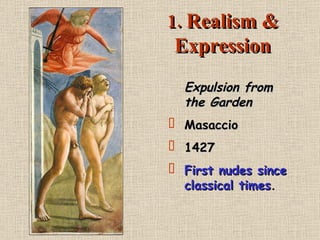
1. Realism & Expression Expulsion from the Garden Masaccio 1427 First nudes since classical times .
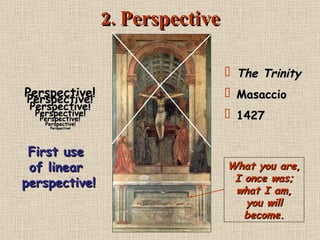
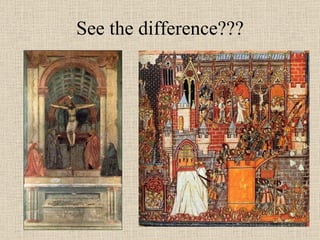
2. Perspective Perspective! Perspective! Perspective! Perspective! Perspective! First use  of linear  perspective! Perspective! Perspective! The Trinity Masaccio 1427 What you are, I once was; what I am, you will become.
See the difference???
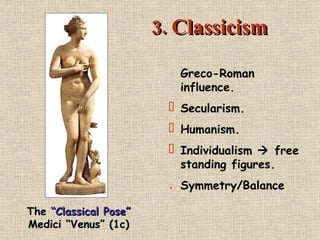
3. Classicism Greco-Roman influence. Secularism. Humanism. Individualism    free standing figures. Symmetry/Balance The  “Classical Pose” Medici “Venus” (1c)
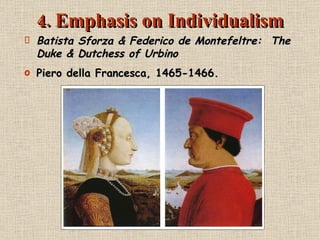
4. Emphasis on Individualism Batista Sforza & Federico de Montefeltre:  The Duke & Dutchess of Urbino Piero della Francesca, 1465-1466.
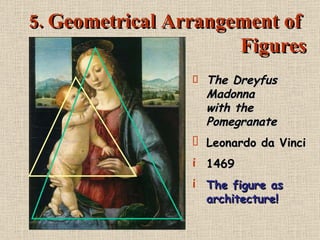
5. Geometrical Arrangement of  Figures The Dreyfus Madonna  with the Pomegranate Leonardo da Vinci 1469 The figure as architecture!
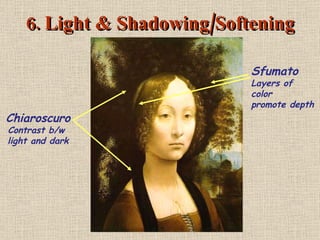
6. Light & Shadowing/Softening Edges Chiaroscuro Contrast b/w  light and dark Sfumato Layers of color  promote depth
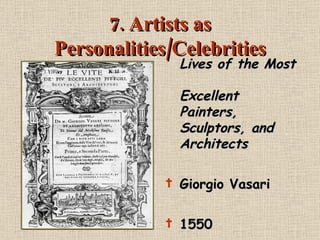
7. Artists as Personalities/Celebrities Lives of the Most  Excellent Painters,  Sculptors, and Architects Giorgio Vasari 1550
Renaissance Florence
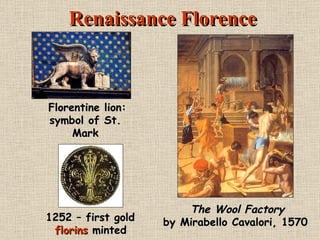
Renaissance Florence The Wool Factory by Mirabello Cavalori, 1570 1252 – first gold  florins  minted Florentine lion: symbol of St. Mark
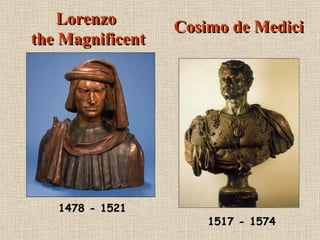
Lorenzo  the Magnificent 1478 - 1521 Cosimo de Medici 1517 - 1574
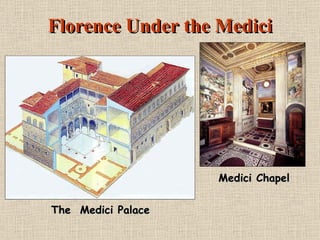
Florence Under the Medici Medici Chapel The  Medici Palace
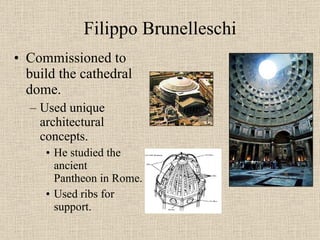
Filippo Brunelleschi Commissioned to build the cathedral dome. Used unique architectural concepts. He studied the ancient  Pantheon in Rome. Used ribs for support.
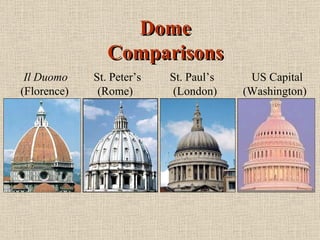
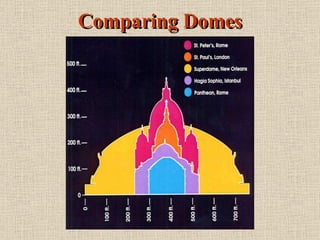
Dome Comparisons   Il Duomo   St. Peter’s  St. Paul’s  US Capital  (Florence)  (Rome)  (London)  (Washington)
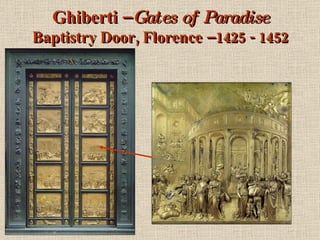
Ghiberti –  Gates of Paradise Baptistry Door, Florence – 1425 - 1452
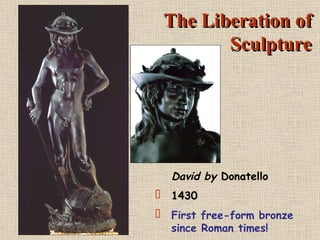
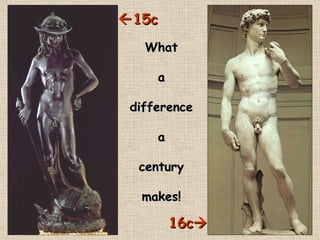
David by  Donatello 1430 First free-form bronze since Roman times! The Liberation of Sculpture
The Renaissance 'Individual'
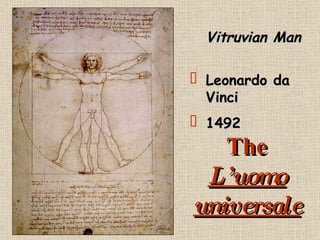
Vitruvian Man  Leonardo da Vinci 1492 The L’uomo universale
The Renaissance “Man” Broad knowledge about many things in different fields. Deep knowledge/skill in one area. Able to link information from different areas/disciplines and create new knowledge. The Greek ideal of the “well-rounded man” was at the heart of Renaissance education.
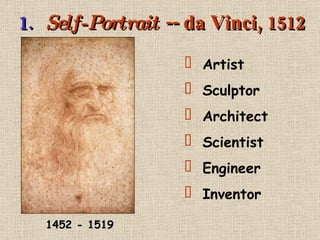
1.   Self-Portrait  -- da Vinci, 1512 1452 - 1519 Artist Sculptor Architect Scientist Engineer Inventor
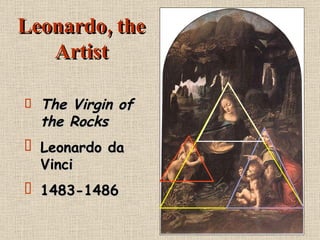
Leonardo, the Artist The Virgin of the Rocks  Leonardo da Vinci 1483-1486
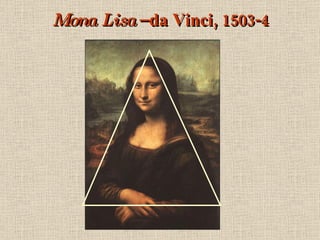
Mona Lisa  – da Vinci, 1503-4
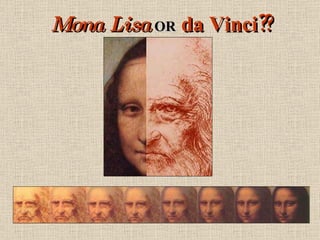
Mona Lisa   OR  da Vinci??
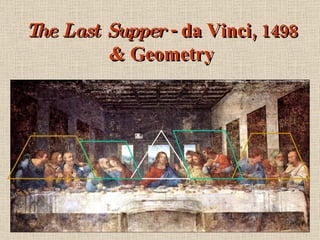
The Last Supper  - da Vinci, 1498 & Geometry
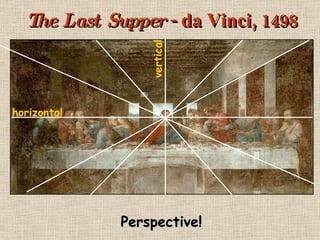
horizontal vertical Perspective! The Last Supper  - da Vinci, 1498
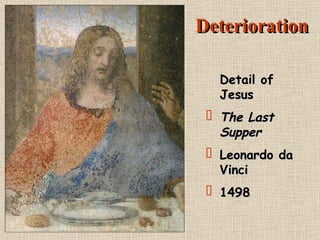
Detail of Jesus The Last Supper   Leonardo da Vinci 1498 Deterioration
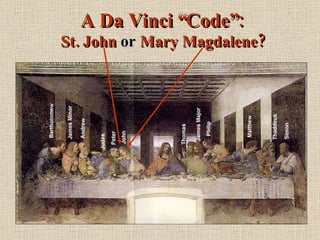
A Da Vinci “Code”: St. John  or  Mary Magdalene?
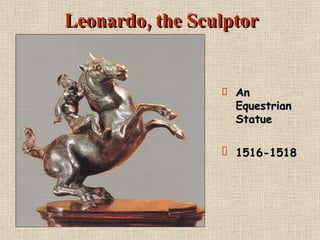
Leonardo, the Sculptor An Equestrian Statue 1516-1518
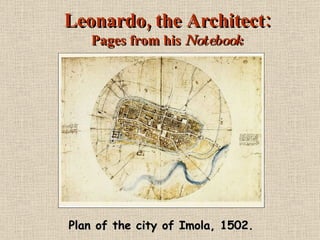
Leonardo, the Architect: Pages from his  Notebook Plan of the city of Imola, 1502.
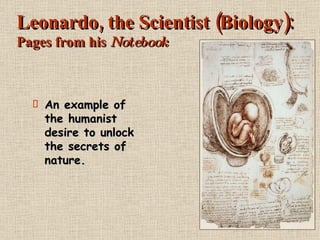
Leonardo, the Scientist (Biology): Pages from his  Notebook An example of the humanist desire to unlock the secrets of nature.
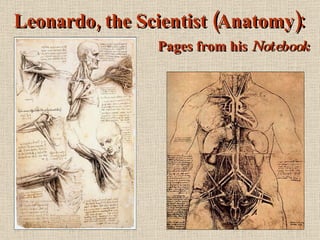
Leonardo, the Scientist (Anatomy):  Pages from his  Notebook
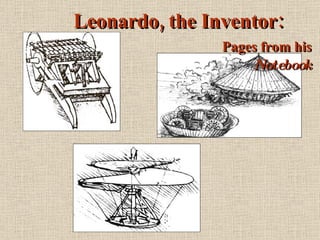
Leonardo, the Inventor:   Pages from his  Notebook
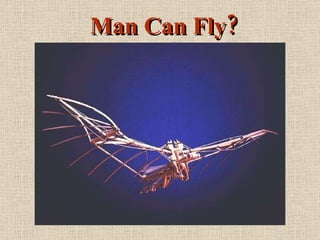
Man Can Fly?
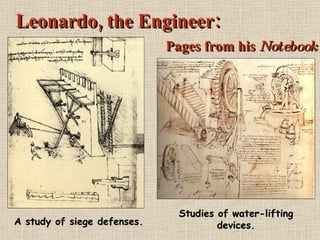
A study of siege defenses. Studies of water-lifting devices. Leonardo, the Engineer:  Pages from his  Notebook
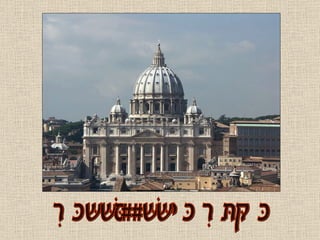
Renaissance Rome
Comparing Domes
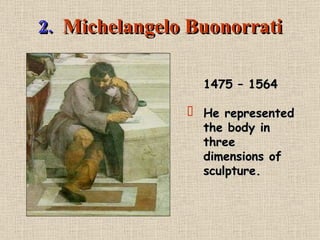
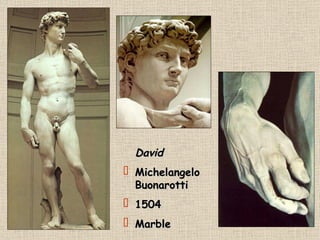
2.   Michelangelo Buonorrati 1475 – 1564 He represented the body in three dimensions of sculpture.
David Michelangelo Buonarotti 1504 Marble
 15c 16c  What a difference a century makes!
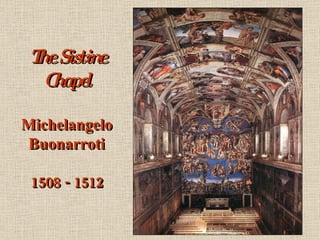
The Sistine Chapel Michelangelo Buonarroti 1508 - 1512
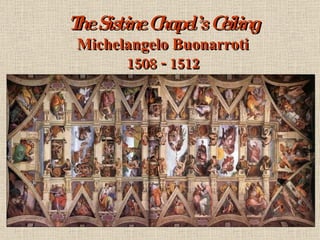
The Sistine Chapel’s Ceiling Michelangelo Buonarroti 1508 - 1512
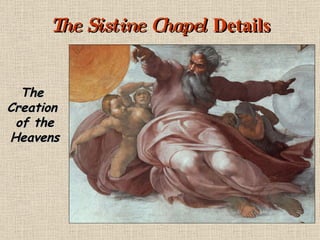
The Sistine Chapel  Details The  Creation  of the Heavens
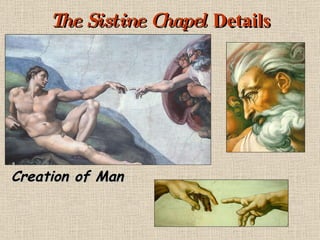
The Sistine Chapel  Details Creation of Man
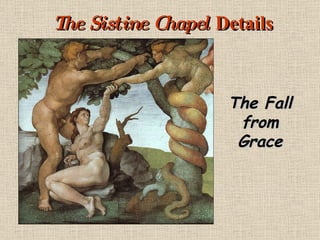
The Sistine Chapel  Details The Fall from Grace
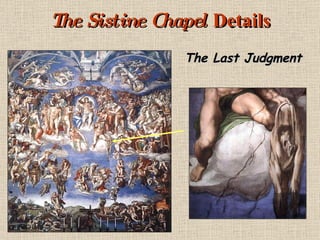
The Sistine Chapel  Details The Last Judgment
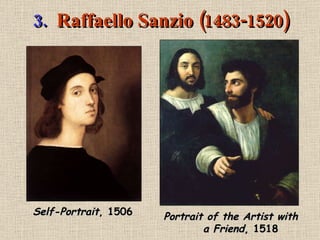
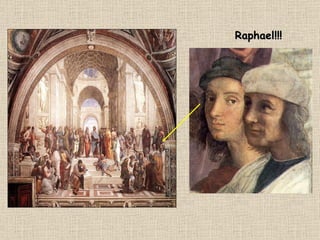
3.   Raffaello Sanzio (1483-1520) Self-Portrait , 1506 Portrait of the Artist with a Friend , 1518
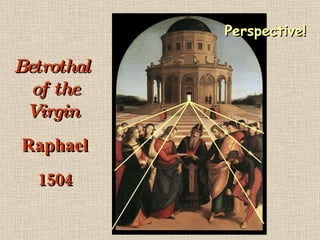
Perspective! Betrothal  of the Virgin  Raphael 1504
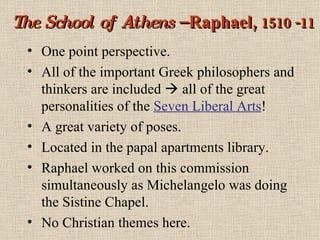
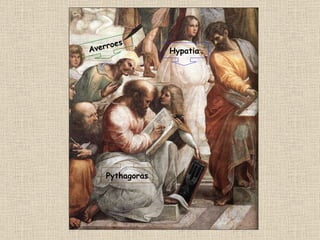
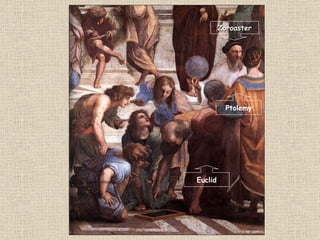
The School of Athens  – Raphael,  1510 -11 One point perspective. All of the important Greek philosophers and thinkers are included    all of the great personalities of the  Seven Liberal Arts ! A great variety of poses. Located in the papal apartments library. Raphael worked on this commission simultaneously as Michelangelo was doing the Sistine Chapel. No Christian themes here.
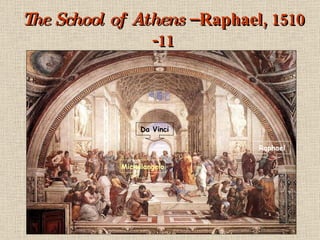
The School of Athens  – Raphael, 1510 -11 Raphael Da Vinci Michelangelo
Aristotle : looks to this earth [the here and now]. Plato : looks to the heavens [or  the IDEAL realm]. The School of Athens  – Raphael, details
Averroes Hypatia Pythagoras
Zoroaster Ptolemy Euclid
Raphael!!!
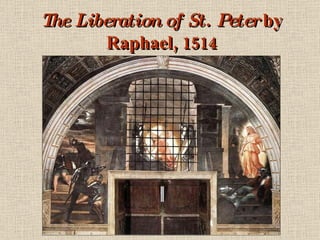
The Liberation of St. Peter  by Raphael, 1514
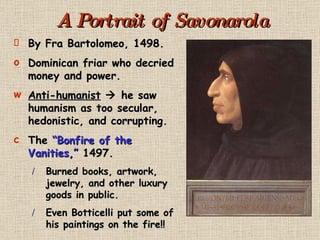
A Portrait of Savonarola By Fra Bartolomeo, 1498. Dominican friar who decried money and power. Anti-humanist     he saw humanism as too secular, hedonistic, and corrupting. The  “Bonfire of the Vanities,”  1497. Burned books, artwork, jewelry, and other luxury goods in public. Even Botticelli put some of his paintings on the fire!!
Pope Leo X with Cardinal Giulio deMedici and Luigi De Rossi  by Raphael, 1518-1519 A Medici Pope. He went through the Vatican treasury in a year! His extravagances offended even some cardinals [ as well as Martin Luther !]. Started selling  indulgences .
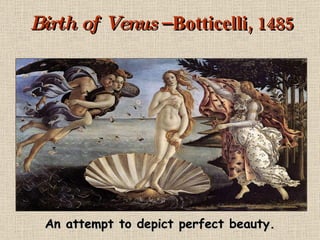
Birth of Venus  – Botticelli, 1485 An attempt to depict perfect beauty.
and now for something completely different…..
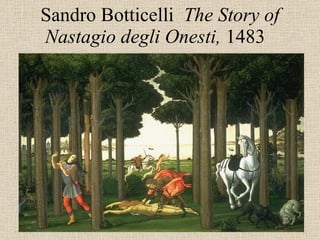
Sandro Botticelli  The Story of Nastagio degli Onesti,  1483
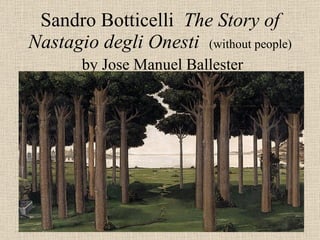
Sandro Botticelli  The Story of Nastagio degli Onesti  (without people)   by Jose Manuel Ballester
The Northern Renaissance
Renaissance Art in Northern Europe Should not be considered an appendage to Italian art. But, Italian influence was strong. Painting in OIL, developed in Flanders, was widely adopted in Italy . The differences between the two cultures: Italy     change was inspired by humanism with its emphasis on the revival of the values of classical antiquity. No. Europe     change was driven by religious reform, the return to Christian values, and the revolt against the authority of the Church. More princes & kings were patrons of artists.
Characteristics of Northern Renaissance Art The continuation of late medieval attention to details. Tendency toward realism & naturalism [less emphasis on the “classical ideal”]. Interest in landscapes. More emphasis on middle-class and peasant life. Details of domestic interiors. Great skill in portraiture.
Flemish Realism
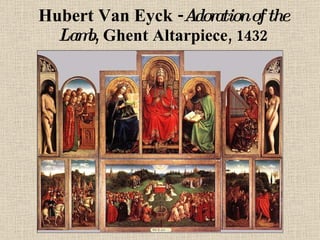
Hubert Van Eyck - Adoration of the Lamb ,  Ghent Altarpiece, 1432
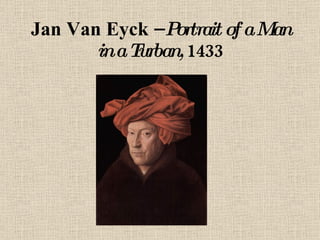
Jan Van Eyck –  Portrait of a Man in a Turban,  1433
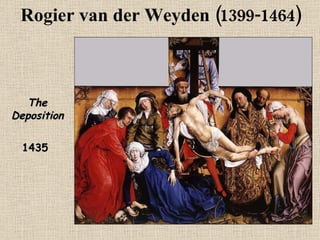
Rogier van der Weyden (1399-1464) The Deposition 1435
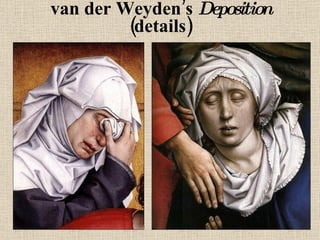
van der Weyden’s  Deposition  (details)
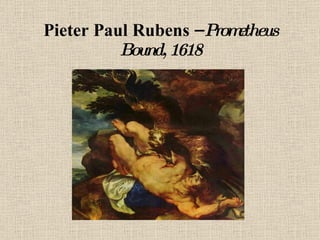
Pieter Paul Rubens –  Prometheus Bound, 1618
The Low Countries
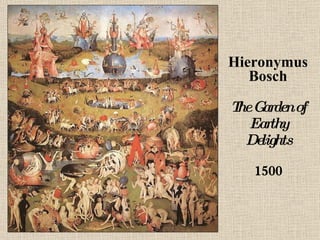
Hieronymus Bosch The Garden of Earthy Delights 1500
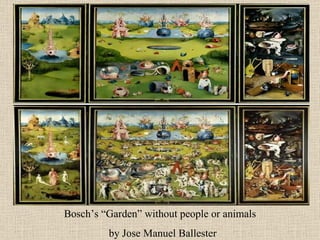
Bosch’s “Garden” without people or animals  by Jose Manuel Ballester
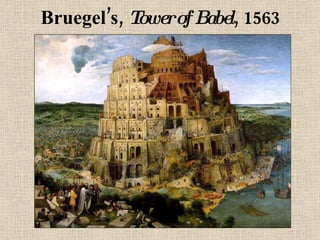
Bruegel’s,  Tower of Babel , 1563
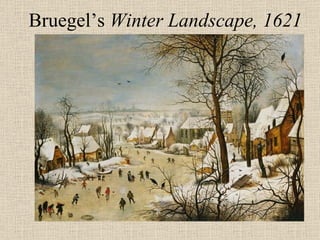
Bruegel’s  Winter Landscape, 1621
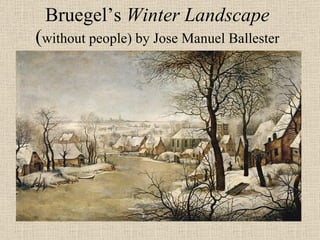
Bruegel’s  Winter Landscape  ( without people) by Jose Manuel Ballester
Germany
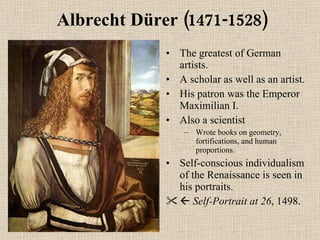
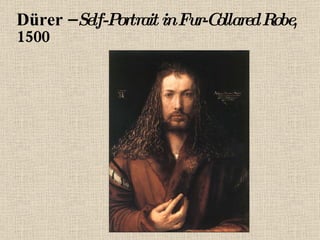
Albrecht Dürer (1471-1528) The greatest of German artists. A scholar as well as an artist. His patron was the Emperor Maximilian I. Also a scientist Wrote books on geometry, fortifications, and human proportions. Self-conscious individualism of the Renaissance is seen in his portraits.    Self-Portrait at 26 , 1498.
Dürer –  Self-Portrait in Fur-Collared Robe , 1500
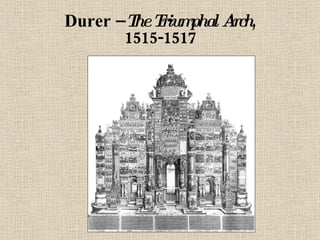
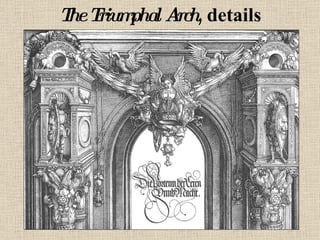
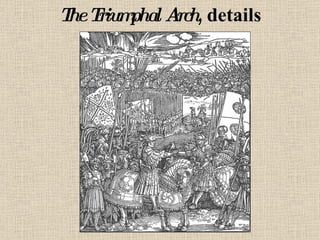
Durer –  The Triumphal Arch , 1515-1517
The Triumphal Arch , details
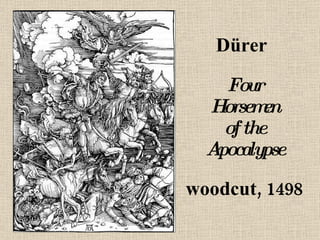
Dürer  Four Horsemen of the Apocalypse woodcut, 1498
England
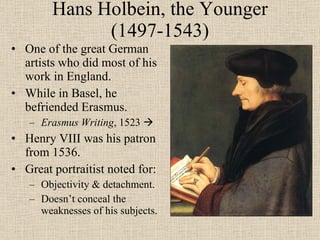
Hans Holbein, the Younger (1497-1543) One of the great German artists who did most of his work in England. While in Basel, he befriended Erasmus. Erasmus Writing , 1523   Henry VIII was his patron from 1536. Great portraitist noted for: Objectivity & detachment. Doesn’t conceal the weaknesses of his subjects.
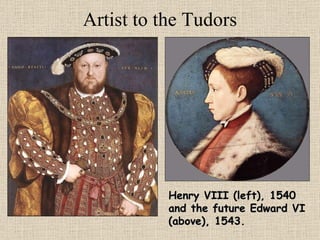
Artist to the Tudors Henry VIII (left), 1540 and the future Edward VI (above), 1543.
The English Were More Interested in Architecture than Painting Hardwick Hall, designed by Robert Smythson in the 1590s, for the Duchess of Shrewsbury [more medieval in style].
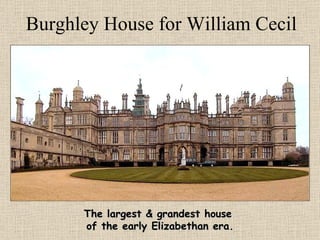
Burghley House for William Cecil The largest & grandest house  of the early Elizabethan era.
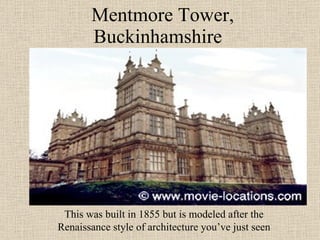
Mentmore Tower, Buckinhamshire  This was built in 1855 but is modeled after the Renaissance style of architecture you’ve just seen
Spain
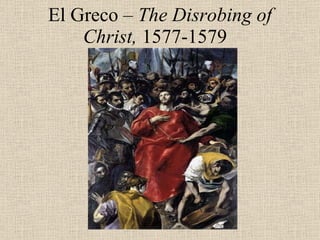
Domenikos Theotokopoulos (El Greco) The most important Spanish artist of this period was Greek. 1541 – 1614. He deliberately distorts & elongates his figures, and seats them in a lurid, unearthly atmosphere. He uses an agitated, flickering light. He ignores the rules of perspective, and heightens the effect by areas of brilliant color. His works were a fitting expression of the Spanish Counter-Reformation.
El Greco –  The Disrobing of Christ,  1577-1579

Renaissance Art

  • 1.
    The Art of the Renaissance
  • 2.
    Art and PowerPowerful groups commissioned works of art Represented merchants’ dominant influence in community i.e. Florentine gov’t hires Michelangelo Despots and Oligarchs began sponsoring works of art A way to glorify themselves or their families, show wealth Subject matter remained religious Intended to spread a particular doctrine, act as a profession of faith, or recall sinners to a moral way of life
  • 3.
    Art and Power(cont) As the 15 th Century moved on, subject matter becomes more secular Pagan gods/goddesses in paintings increased People were conscious of physical uniqueness and wanted it immortalized Paintings displayed wealth The individual portrait emerged as a distinct genre The rich had themselves painted in a scene of romantic chivalry or courtly society
  • 4.
    Art and Power(cont) Narrative artists – depicted the body in more scientific/natural manner Female  sensual and voluptuous Male  strong and heroic
  • 5.
    The State ofthe Artist During the Renaissance, the social status of the artist improved Reputation depended on the support of powerful patrons Usually worked for commission from a prince or family They did not produce works for the public Could mean loss of status Artists received a practical education from a master artist
  • 6.
    The State ofthe Artist (cont) Most artists began to sign their works whereas medieval artists rarely did Some even painted themselves into the painting Renaissance artists and humanists came to think that a work of art was the deliberate creation of a new divine personality Artist shared powers of God
  • 7.
    The State ofthe Artist (cont) The Renaissance maintained the gap between the learned minority and the uneducated majority The culture of the Renaissance for the mercantile elite did not affect the middle class
  • 8.
  • 9.
    1. Realism &Expression Expulsion from the Garden Masaccio 1427 First nudes since classical times .
  • 10.
    2. Perspective Perspective!Perspective! Perspective! Perspective! Perspective! First use of linear perspective! Perspective! Perspective! The Trinity Masaccio 1427 What you are, I once was; what I am, you will become.
  • 11.
  • 12.
    3. Classicism Greco-Romaninfluence. Secularism. Humanism. Individualism  free standing figures. Symmetry/Balance The “Classical Pose” Medici “Venus” (1c)
  • 13.
    4. Emphasis onIndividualism Batista Sforza & Federico de Montefeltre: The Duke & Dutchess of Urbino Piero della Francesca, 1465-1466.
  • 14.
    5. Geometrical Arrangementof Figures The Dreyfus Madonna with the Pomegranate Leonardo da Vinci 1469 The figure as architecture!
  • 15.
    6. Light &Shadowing/Softening Edges Chiaroscuro Contrast b/w light and dark Sfumato Layers of color promote depth
  • 16.
    7. Artists asPersonalities/Celebrities Lives of the Most Excellent Painters, Sculptors, and Architects Giorgio Vasari 1550
  • 17.
  • 18.
    Renaissance Florence TheWool Factory by Mirabello Cavalori, 1570 1252 – first gold florins minted Florentine lion: symbol of St. Mark
  • 19.
    Lorenzo theMagnificent 1478 - 1521 Cosimo de Medici 1517 - 1574
  • 20.
    Florence Under theMedici Medici Chapel The Medici Palace
  • 21.
    Filippo Brunelleschi Commissionedto build the cathedral dome. Used unique architectural concepts. He studied the ancient Pantheon in Rome. Used ribs for support.
  • 22.
    Dome Comparisons Il Duomo St. Peter’s St. Paul’s US Capital (Florence) (Rome) (London) (Washington)
  • 23.
    Ghiberti – Gates of Paradise Baptistry Door, Florence – 1425 - 1452
  • 24.
    David by Donatello 1430 First free-form bronze since Roman times! The Liberation of Sculpture
  • 25.
  • 26.
    Vitruvian Man Leonardo da Vinci 1492 The L’uomo universale
  • 27.
    The Renaissance “Man”Broad knowledge about many things in different fields. Deep knowledge/skill in one area. Able to link information from different areas/disciplines and create new knowledge. The Greek ideal of the “well-rounded man” was at the heart of Renaissance education.
  • 28.
    1. Self-Portrait -- da Vinci, 1512 1452 - 1519 Artist Sculptor Architect Scientist Engineer Inventor
  • 29.
    Leonardo, the ArtistThe Virgin of the Rocks Leonardo da Vinci 1483-1486
  • 30.
    Mona Lisa – da Vinci, 1503-4
  • 31.
    Mona Lisa OR da Vinci??
  • 32.
    The Last Supper - da Vinci, 1498 & Geometry
  • 33.
    horizontal vertical Perspective!The Last Supper - da Vinci, 1498
  • 34.
    Detail of JesusThe Last Supper Leonardo da Vinci 1498 Deterioration
  • 35.
    A Da Vinci“Code”: St. John or Mary Magdalene?
  • 36.
    Leonardo, the SculptorAn Equestrian Statue 1516-1518
  • 37.
    Leonardo, the Architect:Pages from his Notebook Plan of the city of Imola, 1502.
  • 38.
    Leonardo, the Scientist(Biology): Pages from his Notebook An example of the humanist desire to unlock the secrets of nature.
  • 39.
    Leonardo, the Scientist(Anatomy): Pages from his Notebook
  • 40.
    Leonardo, the Inventor: Pages from his Notebook
  • 41.
  • 42.
    A study ofsiege defenses. Studies of water-lifting devices. Leonardo, the Engineer: Pages from his Notebook
  • 43.
  • 44.
  • 45.
    2. Michelangelo Buonorrati 1475 – 1564 He represented the body in three dimensions of sculpture.
  • 46.
  • 47.
     15c 16c What a difference a century makes!
  • 48.
    The Sistine ChapelMichelangelo Buonarroti 1508 - 1512
  • 49.
    The Sistine Chapel’sCeiling Michelangelo Buonarroti 1508 - 1512
  • 50.
    The Sistine Chapel Details The Creation of the Heavens
  • 51.
    The Sistine Chapel Details Creation of Man
  • 52.
    The Sistine Chapel Details The Fall from Grace
  • 53.
    The Sistine Chapel Details The Last Judgment
  • 54.
    3. Raffaello Sanzio (1483-1520) Self-Portrait , 1506 Portrait of the Artist with a Friend , 1518
  • 55.
    Perspective! Betrothal of the Virgin Raphael 1504
  • 56.
    The School ofAthens – Raphael, 1510 -11 One point perspective. All of the important Greek philosophers and thinkers are included  all of the great personalities of the Seven Liberal Arts ! A great variety of poses. Located in the papal apartments library. Raphael worked on this commission simultaneously as Michelangelo was doing the Sistine Chapel. No Christian themes here.
  • 57.
    The School ofAthens – Raphael, 1510 -11 Raphael Da Vinci Michelangelo
  • 58.
    Aristotle : looksto this earth [the here and now]. Plato : looks to the heavens [or the IDEAL realm]. The School of Athens – Raphael, details
  • 59.
  • 60.
  • 61.
  • 62.
    The Liberation ofSt. Peter by Raphael, 1514
  • 63.
    A Portrait ofSavonarola By Fra Bartolomeo, 1498. Dominican friar who decried money and power. Anti-humanist  he saw humanism as too secular, hedonistic, and corrupting. The “Bonfire of the Vanities,” 1497. Burned books, artwork, jewelry, and other luxury goods in public. Even Botticelli put some of his paintings on the fire!!
  • 64.
    Pope Leo Xwith Cardinal Giulio deMedici and Luigi De Rossi by Raphael, 1518-1519 A Medici Pope. He went through the Vatican treasury in a year! His extravagances offended even some cardinals [ as well as Martin Luther !]. Started selling indulgences .
  • 65.
    Birth of Venus – Botticelli, 1485 An attempt to depict perfect beauty.
  • 66.
    and now forsomething completely different…..
  • 67.
    Sandro Botticelli The Story of Nastagio degli Onesti, 1483
  • 68.
    Sandro Botticelli The Story of Nastagio degli Onesti (without people) by Jose Manuel Ballester
  • 69.
  • 70.
    Renaissance Art inNorthern Europe Should not be considered an appendage to Italian art. But, Italian influence was strong. Painting in OIL, developed in Flanders, was widely adopted in Italy . The differences between the two cultures: Italy  change was inspired by humanism with its emphasis on the revival of the values of classical antiquity. No. Europe  change was driven by religious reform, the return to Christian values, and the revolt against the authority of the Church. More princes & kings were patrons of artists.
  • 71.
    Characteristics of NorthernRenaissance Art The continuation of late medieval attention to details. Tendency toward realism & naturalism [less emphasis on the “classical ideal”]. Interest in landscapes. More emphasis on middle-class and peasant life. Details of domestic interiors. Great skill in portraiture.
  • 72.
  • 73.
    Hubert Van Eyck- Adoration of the Lamb , Ghent Altarpiece, 1432
  • 74.
    Jan Van Eyck– Portrait of a Man in a Turban, 1433
  • 75.
    Rogier van derWeyden (1399-1464) The Deposition 1435
  • 76.
    van der Weyden’s Deposition (details)
  • 77.
    Pieter Paul Rubens– Prometheus Bound, 1618
  • 78.
  • 79.
    Hieronymus Bosch TheGarden of Earthy Delights 1500
  • 80.
    Bosch’s “Garden” withoutpeople or animals by Jose Manuel Ballester
  • 81.
    Bruegel’s, Towerof Babel , 1563
  • 82.
    Bruegel’s WinterLandscape, 1621
  • 83.
    Bruegel’s WinterLandscape ( without people) by Jose Manuel Ballester
  • 84.
  • 85.
    Albrecht Dürer (1471-1528)The greatest of German artists. A scholar as well as an artist. His patron was the Emperor Maximilian I. Also a scientist Wrote books on geometry, fortifications, and human proportions. Self-conscious individualism of the Renaissance is seen in his portraits.  Self-Portrait at 26 , 1498.
  • 86.
    Dürer – Self-Portrait in Fur-Collared Robe , 1500
  • 87.
    Durer – The Triumphal Arch , 1515-1517
  • 88.
  • 89.
  • 90.
    Dürer FourHorsemen of the Apocalypse woodcut, 1498
  • 91.
  • 92.
    Hans Holbein, theYounger (1497-1543) One of the great German artists who did most of his work in England. While in Basel, he befriended Erasmus. Erasmus Writing , 1523  Henry VIII was his patron from 1536. Great portraitist noted for: Objectivity & detachment. Doesn’t conceal the weaknesses of his subjects.
  • 93.
    Artist to theTudors Henry VIII (left), 1540 and the future Edward VI (above), 1543.
  • 94.
    The English WereMore Interested in Architecture than Painting Hardwick Hall, designed by Robert Smythson in the 1590s, for the Duchess of Shrewsbury [more medieval in style].
  • 95.
    Burghley House forWilliam Cecil The largest & grandest house of the early Elizabethan era.
  • 96.
    Mentmore Tower, Buckinhamshire This was built in 1855 but is modeled after the Renaissance style of architecture you’ve just seen
  • 97.
  • 98.
    Domenikos Theotokopoulos (ElGreco) The most important Spanish artist of this period was Greek. 1541 – 1614. He deliberately distorts & elongates his figures, and seats them in a lurid, unearthly atmosphere. He uses an agitated, flickering light. He ignores the rules of perspective, and heightens the effect by areas of brilliant color. His works were a fitting expression of the Spanish Counter-Reformation.
  • 99.
    El Greco – The Disrobing of Christ, 1577-1579