Grammar Book
 Cristina Coleman
      1st period
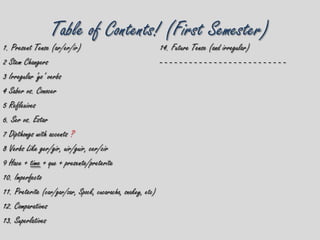
Table of Contents! (First Semester)
1. Present Tense (ar/er/ir)                                14. Future Tense (and irregular)
2 Stem Changers                                            --------------------------
3 Irregular „yo‟ verbs
4 Saber vs. Conocer
5 Reflexives
6. Ser vs. Estar
7 Dipthongs with accents ?
8 Verbs Like ger/gir, uir/guir, cer/cir
9 Hace + time + que + presente/preterite
10. Imperfecto
11. Preterite (car/gar/zar, Spock, cucaracha, snakey, etc)
12. Comparatives
13. Superlatives
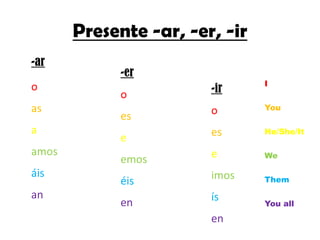
Presente -ar, -er, -ir
-ar
             -er
                                I
o
             o          -ir
as                      o       You
             es
a                       es      He/She/It
             e
amos                    e       We
             emos
áis                     imos    Them
             éis
an                      ís
             en                 You all
                        en
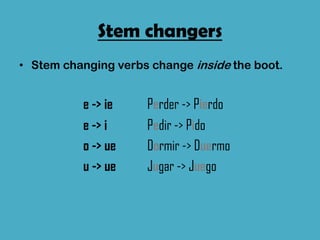
Stem changers
• Stem changing verbs change inside the boot.


          e -> ie    Perder -> Pierdo
          e -> i     Pedir -> Pido
          o -> ue    Dormir -> Duermo
          u -> ue    Jugar -> Juego
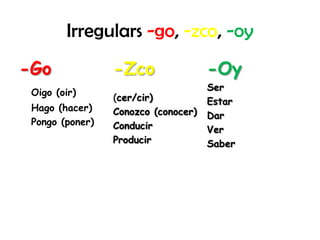
Irregulars -go, -zco, -oy
-Go              -Zco                -Oy
                                     Ser
 Oigo (oir)
                 (cer/cir)           Estar
 Hago (hacer)    Conozco (conocer)   Dar
 Pongo (poner)   Conducir            Ver
                 Producir            Saber
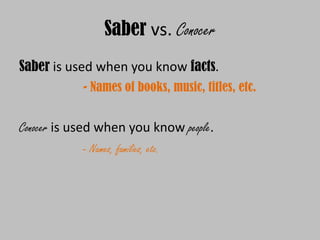
Saber vs. Conocer
Saber is used when you know facts.
            - Names of books, music, titles, etc.


Conocer is used when you know people.
            - Names, families, etc.
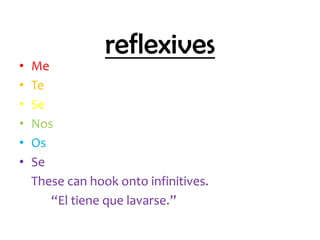
reflexives
•   Me
•   Te
•   Se
•   Nos
•   Os
•   Se
    These can hook onto infinitives.
       “El tiene que lavarse.”
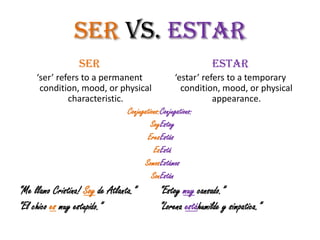
Ser vs. Estar

                  SER                                    Estar
     ‘ser’ refers to a permanent                ‘estar’ refers to a temporary
      condition, mood, or physical                condition, mood, or physical
              characteristic.                              appearance.
                              Conjugations:Conjugations:
                                       SoyEstoy
                                     EresEstás
                                        EsEstá
                                    SomosEstámos
                                       SonEstán
“Me llamo Cristina! Soy de Atlanta.”    “Estoy muy cansado.”
“El chico es muy estupido.”             “Lorena estáhumilde y simpatica.”
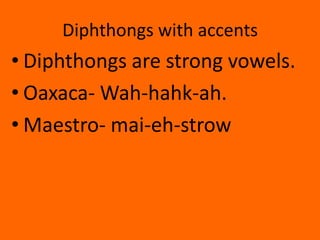
Diphthongs with accents
• Diphthongs are strong vowels.
• Oaxaca- Wah-hahk-ah.
• Maestro- mai-eh-strow
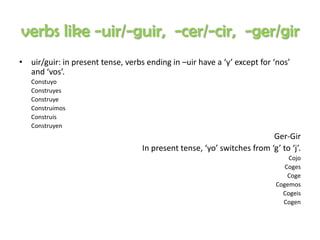
verbs like -uir/-guir, -cer/-cir, -ger/gir
• uir/guir: in present tense, verbs ending in –uir have a ‘y’ except for ‘nos’
  and ‘vos’.
   Constuyo
   Construyes
   Construye
   Construimos
   Construis
   Construyen
                                                                         Ger-Gir
                                   In present tense, ‘yo’ switches from ‘g’ to ‘j’.
                                                                               Cojo
                                                                              Coges
                                                                               Coge
                                                                           Cogemos
                                                                             Cogeis
                                                                             Cogen
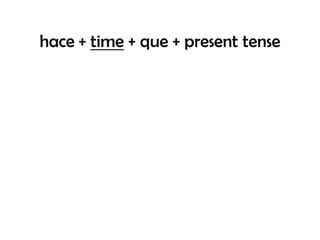
hace + time + que + present tense
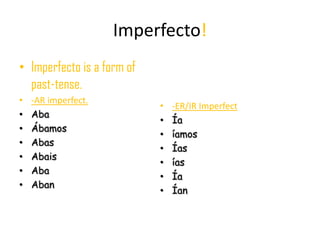
Imperfecto!
• Imperfecto is a form of
  past-tense.
•   -AR imperfect.
                            •   -ER/IR Imperfect
•   Aba
                            •   Ía
•   Ábamos
                            •   íamos
•   Abas
                            •   Ías
•   Abais
                            •   ías
•   Aba
                            •   Ía
•   Aban
                            •   Ían
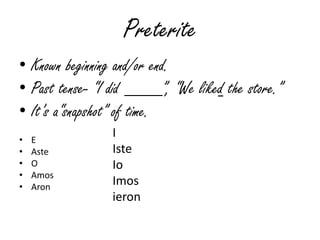
Preterite
• Known beginning and/or end.
• Past tense- “I did ____”, “We liked the store.”
• It‟s a“snapshot” of time.
•   E
                 I
•   Aste         Iste
•   O            Io
•   Amos
•   Aron
                 Imos
                 ieron
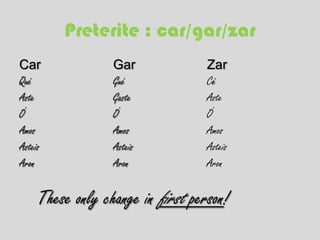
Preterite : car/gar/zar
Car               Gar              Zar
Qué               Gué              Cé
Aste              Gaste            Aste
Ó                 Ó                Ó
Amos              Amos             Amos
Asteis            Asteis           Asteis
Aron              Aron             Aron


     These only change in first person!
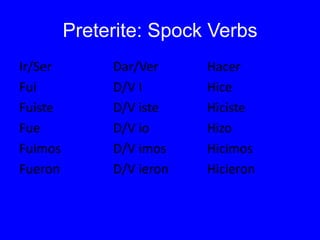
Preterite: Spock Verbs
Ir/Ser        Dar/Ver     Hacer
Fui           D/V I       Hice
Fuiste        D/V iste    Hiciste
Fue           D/V io      Hizo
Fuimos        D/V imos    Hicimos
Fueron        D/V ieron   Hicieron
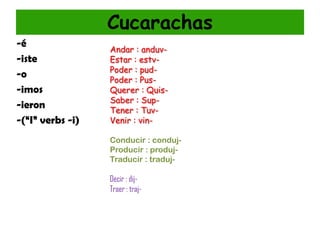
Cucarachas
-é
                  Andar : anduv-
-iste             Estar : estv-
                  Poder : pud-
-o                Poder : Pus-
-imos             Querer : Quis-
                  Saber : Sup-
-ieron            Tener : Tuv-
-(“I” verbs -i)   Venir : vin-

                  Conducir : conduj-
                  Producir : produj-
                  Traducir : traduj-

                  Decir : dij-
                  Traer : traj-
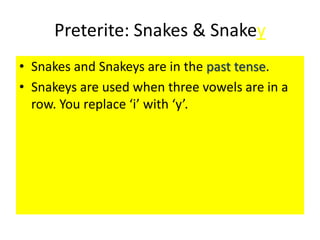
Preterite: Snakes & Snakey
• Snakes and Snakeys are in the past tense.
• Snakeys are used when three vowels are in a
  row. You replace ‘i’ with ‘y’.
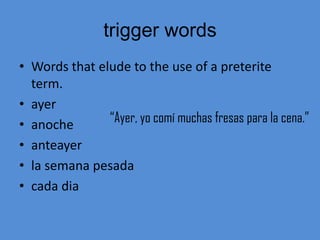
trigger words
• Words that elude to the use of a preterite
  term.
• ayer
• anoche       “Ayer, yo comí muchas fresas para la cena.”
• anteayer
• la semana pesada
• cada dia
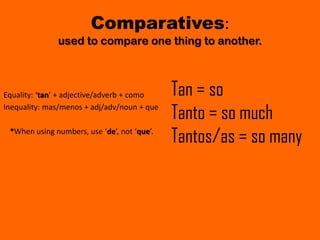
Comparatives:
              used to compare one thing to another.


Equality: ‘tan’ + adjective/adverb + como    Tan = so
Inequality: mas/menos + adj/adv/noun + que
                                             Tanto = so much
 *When using numbers, use ‘de’, not ‘que’.
                                             Tantos/as = so many
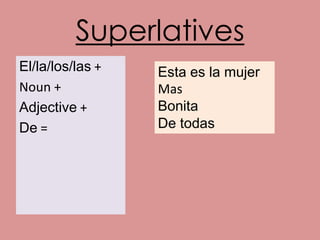
Superlatives
El/la/los/las +   Esta es la mujer
Noun +            Mas
Adjective +       Bonita
De =              De todas
El Futuro.
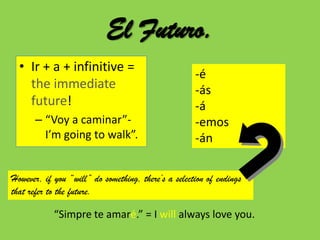
  • Ir + a + infinitive =
                                                     -é
    the immediate                                    -ás
    future!                                          -á
      – “Voy a caminar”-                             -emos
        I’m going to walk”.                          -án

However, if you “will” do something, there’s a selection of endings
that refer to the future.

            “Simpre te amaré.” = I will always love you.
•
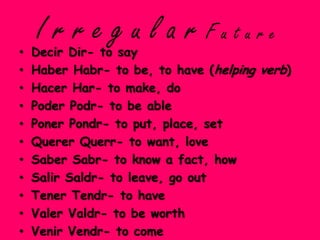
    I r r e g u l a r Future
    Decir Dir- to say
•   Haber Habr- to be, to have (helping verb)
•   Hacer Har- to make, do
•   Poder Podr- to be able
•   Poner Pondr- to put, place, set
•   Querer Querr- to want, love
•   Saber Sabr- to know a fact, how
•   Salir Saldr- to leave, go out
•   Tener Tendr- to have
•   Valer Valdr- to be worth
•   Venir Vendr- to come
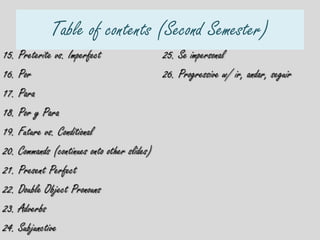
Table of contents (Second Semester)
15. Preterite vs. Imperfect                25. Se impersonal
16. Por                                    26. Progressive w/ ir, andar, seguir
17. Para
18. Por y Para
19. Future vs. Conditional
20. Commands (continues onto other slides)
21. Present Perfect
22. Double Object Pronouns
23. Adverbs
24. Subjunctive
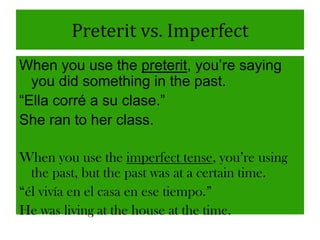
Preterit vs. Imperfect
When you use the preterit, you‟re saying
  you did something in the past.
“Ella corré a su clase.”
She ran to her class.

When you use the imperfect tense, you’re using
  the past, but the past was at a certain time.
“él vivía en el casa en ese tiempo.”
He was living at the house at the time.
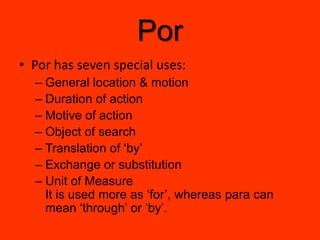
Por
• Por has seven special uses:
  – General location & motion
  – Duration of action
  – Motive of action
  – Object of search
  – Translation of „by‟
  – Exchange or substitution
  – Unit of Measure
    It is used more as „for‟, whereas para can
    mean „through‟ or „by‟.
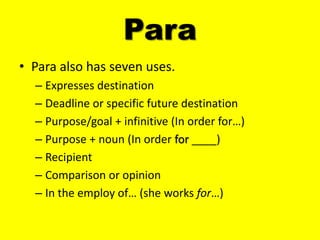
Para
• Para also has seven uses.
  – Expresses destination
  – Deadline or specific future destination
  – Purpose/goal + infinitive (In order for…)
  – Purpose + noun (In order for ____)
  – Recipient
  – Comparison or opinion
  – In the employ of… (she works for…)
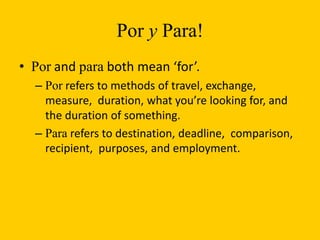
Por y Para!
• Por and para both mean ‘for’.
  – Por refers to methods of travel, exchange,
    measure, duration, what you’re looking for, and
    the duration of something.
  – Para refers to destination, deadline, comparison,
    recipient, purposes, and employment.
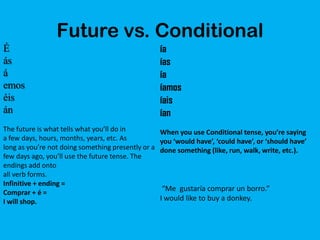
Future vs. Conditional
É                                                   ía
ás                                                  ías
á                                                   ía
emos                                                íamos
éis                                                 íais
án                                                  ían
The future is what tells what you’ll do in          When you use Conditional tense, you’re saying
a few days, hours, months, years, etc. As           you ‘would have’, ‘could have’, or ‘should have’
long as you’re not doing something presently or a   done something (like, run, walk, write, etc.).
few days ago, you’ll use the future tense. The
endings add onto
all verb forms.
Infinitive + ending =
Comprar + é =
                                                     “Me gustaría comprar un borro.”
I will shop.                                        I would like to buy a donkey.
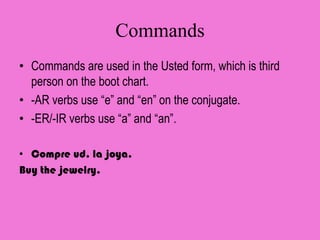
Commands
• Commands are used in the Usted form, which is third
  person on the boot chart.
• -AR verbs use “e” and “en” on the conjugate.
• -ER/-IR verbs use “a” and “an”.

• Compre ud. la joya.
Buy the jewelry.
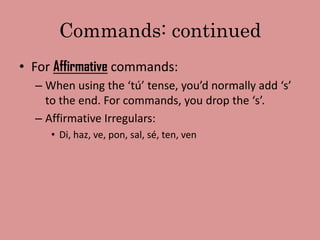
Commands: continued
• For Affirmative commands:
  – When using the ‘tú’ tense, you’d normally add ‘s’
    to the end. For commands, you drop the ‘s’.
  – Affirmative Irregulars:
     • Di, haz, ve, pon, sal, sé, ten, ven
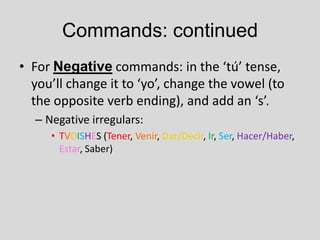
Commands: continued
• For Negative commands: in the ‘tú’ tense,
  you’ll change it to ‘yo’, change the vowel (to
  the opposite verb ending), and add an ‘s’.
  – Negative irregulars:
     • TVDISHES (Tener, Venir, Dar/Decir, Ir, Ser, Hacer/Haber,
       Estar, Saber)
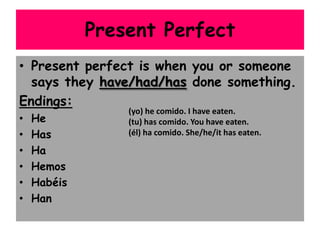
Present Perfect
• Present perfect is when you or someone
  says they have/had/has done something.
Endings:
                 (yo) he comido. I have eaten.
•   He           (tu) has comido. You have eaten.
•   Has          (él) ha comido. She/he/it has eaten.

•   Ha
•   Hemos
•   Habéis
•   Han
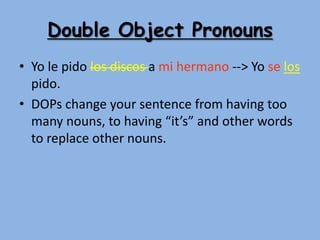
Double Object Pronouns
• Yo le pido los discos a mi hermano --> Yo se los
  pido.
• DOPs change your sentence from having too
  many nouns, to having “it’s” and other words
  to replace other nouns.
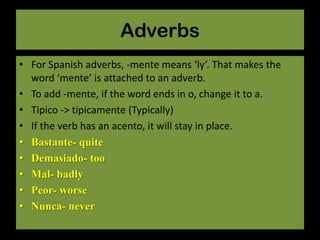
Adverbs
• For Spanish adverbs, -mente means ‘ly’. That makes the
  word ‘mente’ is attached to an adverb.
• To add -mente, if the word ends in o, change it to a.
• Tipico -> tipicamente (Typically)
• If the verb has an acento, it will stay in place.
• Bastante- quite
• Demasiado- too
• Mal- badly
• Peor- worse
• Nunca- never
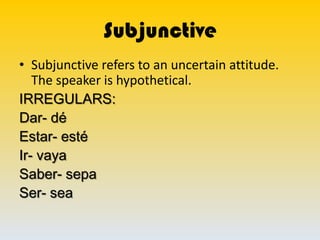
Subjunctive
• Subjunctive refers to an uncertain attitude.
   The speaker is hypothetical.
IRREGULARS:
Dar- dé
Estar- esté
Ir- vaya
Saber- sepa
Ser- sea
Se Impersonal
• ‘Se’ is used to avoid specifying a person in a
  sentence.
• If you use ‘se’, conjugate the verb to third
  person.
• Se can be used in each tense.
  – “Se hable español.”
  – “Se hizo mucho.”
  – “Se hará mucho.”
Progressive with Ir, Andar,
             Seguir
o Ir- ando/iendo/yendo
o Is slowly (but surely) ____ing

o Andar- ando/iendo/yendo
o Is going around ____ing

o Seguir (changes from e to i)- ando/iendo/yendo
o Is still ____ing
¡TERMINADO!

Grammar book cc

  • 1.
    Grammar Book CristinaColeman 1st period
  • 2.
    Table of Contents!(First Semester) 1. Present Tense (ar/er/ir) 14. Future Tense (and irregular) 2 Stem Changers -------------------------- 3 Irregular „yo‟ verbs 4 Saber vs. Conocer 5 Reflexives 6. Ser vs. Estar 7 Dipthongs with accents ? 8 Verbs Like ger/gir, uir/guir, cer/cir 9 Hace + time + que + presente/preterite 10. Imperfecto 11. Preterite (car/gar/zar, Spock, cucaracha, snakey, etc) 12. Comparatives 13. Superlatives
  • 3.
    Presente -ar, -er,-ir -ar -er I o o -ir as o You es a es He/She/It e amos e We emos áis imos Them éis an ís en You all en
  • 4.
    Stem changers • Stemchanging verbs change inside the boot. e -> ie Perder -> Pierdo e -> i Pedir -> Pido o -> ue Dormir -> Duermo u -> ue Jugar -> Juego
  • 5.
    Irregulars -go, -zco,-oy -Go -Zco -Oy Ser Oigo (oir) (cer/cir) Estar Hago (hacer) Conozco (conocer) Dar Pongo (poner) Conducir Ver Producir Saber
  • 6.
    Saber vs. Conocer Saberis used when you know facts. - Names of books, music, titles, etc. Conocer is used when you know people. - Names, families, etc.
  • 7.
    reflexives • Me • Te • Se • Nos • Os • Se These can hook onto infinitives. “El tiene que lavarse.”
  • 8.
    Ser vs. Estar SER Estar ‘ser’ refers to a permanent ‘estar’ refers to a temporary condition, mood, or physical condition, mood, or physical characteristic. appearance. Conjugations:Conjugations: SoyEstoy EresEstás EsEstá SomosEstámos SonEstán “Me llamo Cristina! Soy de Atlanta.” “Estoy muy cansado.” “El chico es muy estupido.” “Lorena estáhumilde y simpatica.”
  • 9.
    Diphthongs with accents •Diphthongs are strong vowels. • Oaxaca- Wah-hahk-ah. • Maestro- mai-eh-strow
  • 10.
    verbs like -uir/-guir,-cer/-cir, -ger/gir • uir/guir: in present tense, verbs ending in –uir have a ‘y’ except for ‘nos’ and ‘vos’. Constuyo Construyes Construye Construimos Construis Construyen Ger-Gir In present tense, ‘yo’ switches from ‘g’ to ‘j’. Cojo Coges Coge Cogemos Cogeis Cogen
  • 11.
    hace + time+ que + present tense
  • 12.
    Imperfecto! • Imperfecto isa form of past-tense. • -AR imperfect. • -ER/IR Imperfect • Aba • Ía • Ábamos • íamos • Abas • Ías • Abais • ías • Aba • Ía • Aban • Ían
  • 13.
    Preterite • Known beginningand/or end. • Past tense- “I did ____”, “We liked the store.” • It‟s a“snapshot” of time. • E I • Aste Iste • O Io • Amos • Aron Imos ieron
  • 14.
    Preterite : car/gar/zar Car Gar Zar Qué Gué Cé Aste Gaste Aste Ó Ó Ó Amos Amos Amos Asteis Asteis Asteis Aron Aron Aron These only change in first person!
  • 15.
    Preterite: Spock Verbs Ir/Ser Dar/Ver Hacer Fui D/V I Hice Fuiste D/V iste Hiciste Fue D/V io Hizo Fuimos D/V imos Hicimos Fueron D/V ieron Hicieron
  • 16.
    Cucarachas -é Andar : anduv- -iste Estar : estv- Poder : pud- -o Poder : Pus- -imos Querer : Quis- Saber : Sup- -ieron Tener : Tuv- -(“I” verbs -i) Venir : vin- Conducir : conduj- Producir : produj- Traducir : traduj- Decir : dij- Traer : traj-
  • 17.
    Preterite: Snakes &Snakey • Snakes and Snakeys are in the past tense. • Snakeys are used when three vowels are in a row. You replace ‘i’ with ‘y’.
  • 18.
    trigger words • Wordsthat elude to the use of a preterite term. • ayer • anoche “Ayer, yo comí muchas fresas para la cena.” • anteayer • la semana pesada • cada dia
  • 19.
    Comparatives: used to compare one thing to another. Equality: ‘tan’ + adjective/adverb + como Tan = so Inequality: mas/menos + adj/adv/noun + que Tanto = so much *When using numbers, use ‘de’, not ‘que’. Tantos/as = so many
  • 20.
    Superlatives El/la/los/las + Esta es la mujer Noun + Mas Adjective + Bonita De = De todas
  • 21.
    El Futuro. • Ir + a + infinitive = -é the immediate -ás future! -á – “Voy a caminar”- -emos I’m going to walk”. -án However, if you “will” do something, there’s a selection of endings that refer to the future. “Simpre te amaré.” = I will always love you.
  • 22.
    I r r e g u l a r Future Decir Dir- to say • Haber Habr- to be, to have (helping verb) • Hacer Har- to make, do • Poder Podr- to be able • Poner Pondr- to put, place, set • Querer Querr- to want, love • Saber Sabr- to know a fact, how • Salir Saldr- to leave, go out • Tener Tendr- to have • Valer Valdr- to be worth • Venir Vendr- to come
  • 24.
    Table of contents(Second Semester) 15. Preterite vs. Imperfect 25. Se impersonal 16. Por 26. Progressive w/ ir, andar, seguir 17. Para 18. Por y Para 19. Future vs. Conditional 20. Commands (continues onto other slides) 21. Present Perfect 22. Double Object Pronouns 23. Adverbs 24. Subjunctive
  • 25.
    Preterit vs. Imperfect Whenyou use the preterit, you‟re saying you did something in the past. “Ella corré a su clase.” She ran to her class. When you use the imperfect tense, you’re using the past, but the past was at a certain time. “él vivía en el casa en ese tiempo.” He was living at the house at the time.
  • 26.
    Por • Por hasseven special uses: – General location & motion – Duration of action – Motive of action – Object of search – Translation of „by‟ – Exchange or substitution – Unit of Measure It is used more as „for‟, whereas para can mean „through‟ or „by‟.
  • 27.
    Para • Para alsohas seven uses. – Expresses destination – Deadline or specific future destination – Purpose/goal + infinitive (In order for…) – Purpose + noun (In order for ____) – Recipient – Comparison or opinion – In the employ of… (she works for…)
  • 28.
    Por y Para! •Por and para both mean ‘for’. – Por refers to methods of travel, exchange, measure, duration, what you’re looking for, and the duration of something. – Para refers to destination, deadline, comparison, recipient, purposes, and employment.
  • 29.
    Future vs. Conditional É ía ás ías á ía emos íamos éis íais án ían The future is what tells what you’ll do in When you use Conditional tense, you’re saying a few days, hours, months, years, etc. As you ‘would have’, ‘could have’, or ‘should have’ long as you’re not doing something presently or a done something (like, run, walk, write, etc.). few days ago, you’ll use the future tense. The endings add onto all verb forms. Infinitive + ending = Comprar + é = “Me gustaría comprar un borro.” I will shop. I would like to buy a donkey.
  • 30.
    Commands • Commands areused in the Usted form, which is third person on the boot chart. • -AR verbs use “e” and “en” on the conjugate. • -ER/-IR verbs use “a” and “an”. • Compre ud. la joya. Buy the jewelry.
  • 31.
    Commands: continued • ForAffirmative commands: – When using the ‘tú’ tense, you’d normally add ‘s’ to the end. For commands, you drop the ‘s’. – Affirmative Irregulars: • Di, haz, ve, pon, sal, sé, ten, ven
  • 32.
    Commands: continued • ForNegative commands: in the ‘tú’ tense, you’ll change it to ‘yo’, change the vowel (to the opposite verb ending), and add an ‘s’. – Negative irregulars: • TVDISHES (Tener, Venir, Dar/Decir, Ir, Ser, Hacer/Haber, Estar, Saber)
  • 33.
    Present Perfect • Presentperfect is when you or someone says they have/had/has done something. Endings: (yo) he comido. I have eaten. • He (tu) has comido. You have eaten. • Has (él) ha comido. She/he/it has eaten. • Ha • Hemos • Habéis • Han
  • 34.
    Double Object Pronouns •Yo le pido los discos a mi hermano --> Yo se los pido. • DOPs change your sentence from having too many nouns, to having “it’s” and other words to replace other nouns.
  • 35.
    Adverbs • For Spanishadverbs, -mente means ‘ly’. That makes the word ‘mente’ is attached to an adverb. • To add -mente, if the word ends in o, change it to a. • Tipico -> tipicamente (Typically) • If the verb has an acento, it will stay in place. • Bastante- quite • Demasiado- too • Mal- badly • Peor- worse • Nunca- never
  • 36.
    Subjunctive • Subjunctive refersto an uncertain attitude. The speaker is hypothetical. IRREGULARS: Dar- dé Estar- esté Ir- vaya Saber- sepa Ser- sea
  • 37.
    Se Impersonal • ‘Se’is used to avoid specifying a person in a sentence. • If you use ‘se’, conjugate the verb to third person. • Se can be used in each tense. – “Se hable español.” – “Se hizo mucho.” – “Se hará mucho.”
  • 38.
    Progressive with Ir,Andar, Seguir o Ir- ando/iendo/yendo o Is slowly (but surely) ____ing o Andar- ando/iendo/yendo o Is going around ____ing o Seguir (changes from e to i)- ando/iendo/yendo o Is still ____ing
  • 44.

Editor's Notes

  • #30 íaíasíaíamosíaisían