Libro De Gramática
Español
    Miguel Lanier
    7th period
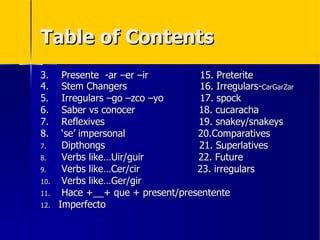
Table of Contents
3.     Presente -ar –er –ir         15. Preterite
4.     Stem Changers                16. Irregulars-CarGarZar
5.     Irregulars –go –zco –yo      17. spock
6.     Saber vs conocer            18. cucaracha
7.     Reflexives                  19. snakey/snakeys
8.     ‘se’ impersonal             20.Comparatives
7.     Dipthongs                   21. Superlatives
8.     Verbs like…Uir/guir         22. Future
9.     Verbs like…Cer/cir          23. irregulars
10.    Verbs like…Ger/gir
11.    Hace +__+ que + present/presentente
12.   Imperfecto
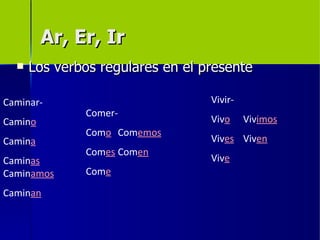
Ar, Er, Ir
     Los verbos regulares en el presente

Caminar-                          Vivir-
              Comer-
Camino                            Vivo     Vivimos
              Como Comemos
Camina                            Vives Viven
              Comes Comen
Caminas                           Vive
Caminamos     Come

Caminan
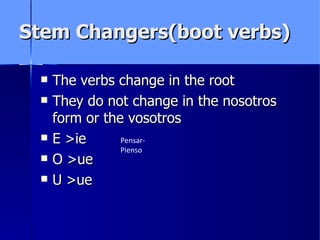
Stem Changers(boot verbs)

    The verbs change in the root
    They do not change in the nosotros
     form or the vosotros
    E >ie      Pensar-
                Pienso
    O >ue
    U >ue
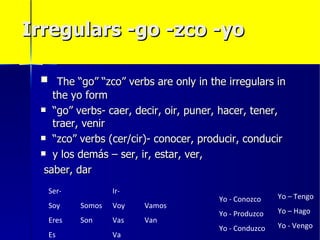
Irregulars -go -zco -yo

  The “go” “zco” verbs are only in the irregulars in
    the yo form
  “go” verbs- caer, decir, oir, puner, hacer, tener,
    traer, venir
  “zco” verbs (cer/cir)- conocer, producir, conducir

  y los demás – ser, ir, estar, ver,

  saber, dar
  Ser-           Ir-
                                       Yo - Conozco    Yo – Tengo
  Soy    Somos   Voy   Vamos
                                       Yo - Produzco   Yo – Hago
  Eres   Son     Vas   Van
                                       Yo - Conduzco   Yo - Vengo
  Es             Va
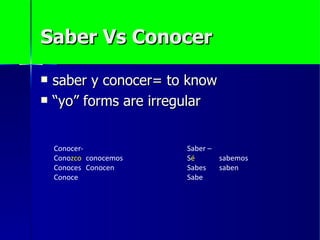
Saber Vs Conocer

   saber y conocer= to know
   “yo” forms are irregular


    Conocer-            Saber –
    Conozco conocemos   Sé      sabemos
    Conoces Conocen     Sabes   saben
    Conoce              Sabe
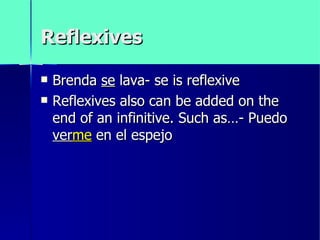
Reflexives

   Brenda se lava- se is reflexive
   Reflexives also can be added on the
    end of an infinitive. Such as…- Puedo
    verme en el espejo
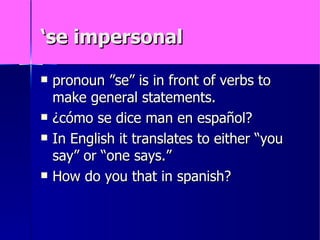
‘se impersonal

   pronoun ”se” is in front of verbs to
    make general statements.
   ¿cómo se dice man en español?
   In English it translates to either “you
    say” or “one says.”
   How do you that in spanish?
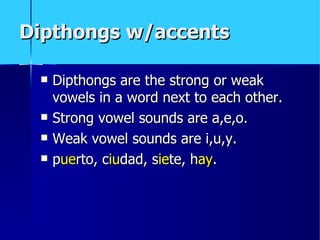
Dipthongs w/accents

    Dipthongs are the strong or weak
     vowels in a word next to each other.
    Strong vowel sounds are a,e,o.
    Weak vowel sounds are i,u,y.
    puerto, ciudad, siete, hay.
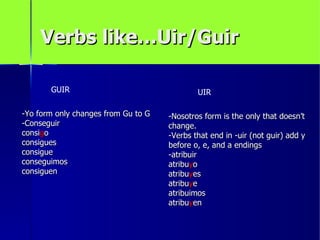
Verbs like…Uir/Guir

       GUIR                                  UIR

-Yo form only changes from Gu to G   -Nosotros form is the only that doesn’t
-Conseguir                           change.
consigo                              -Verbs that end in -uir (not guir) add y
consigues                            before o, e, and a endings
consigue                             -atribuir
conseguimos                          atribuyo
consiguen                            atribuyes
                                     atribuye
                                     atribuimos
                                     atribuyen
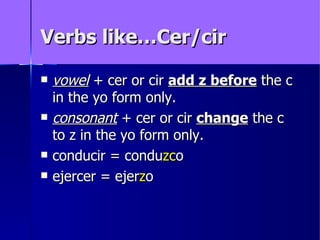
Verbs like…Cer/cir

   vowel + cer or cir add z before the c
    in the yo form only.
   consonant + cer or cir change the c
    to z in the yo form only.
   conducir = conduzco
   ejercer = ejerzo
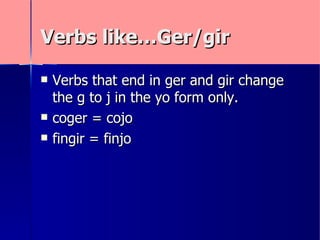
Verbs like…Ger/gir

   Verbs that end in ger and gir change
    the g to j in the yo form only.
   coger = cojo
   fingir = finjo
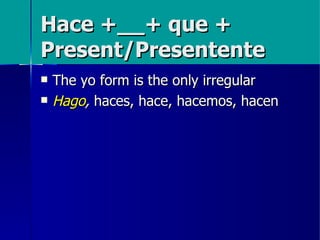
Hace +__+ que +
Present/Presentente
   The yo form is the only irregular
   Hago, haces, hace, hacemos, hacen
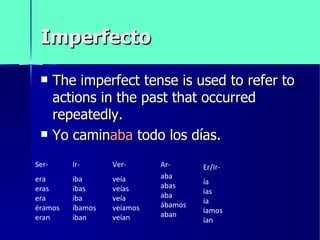
Imperfecto

      The imperfect tense is used to refer to
       actions in the past that occurred
       repeatedly.
      Yo caminaba todo los días.
Ser-      Ir-      Ver-      Ar-      Er/Ir-
era       iba      veía      aba
                             abas     ía
eras      ibas     veías              ías
era       iba      veía      aba
                             ábamos   ía
éramos    íbamos   veíamos            íamos
eran      iban     veían     aban
                                      ían
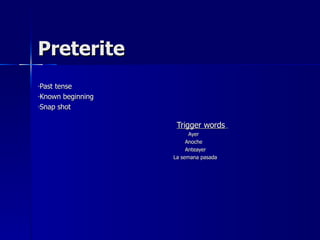
Preterite
-Pasttense
-Known beginning

-Snap shot


                    Trigger words
                         Ayer
                        Anoche
                        Anteayer
                   La semana pasada
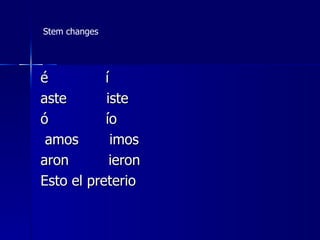
Stem changes


é          í
aste       iste
ó          ío
 amos        imos
aron        ieron
Esto el preterio
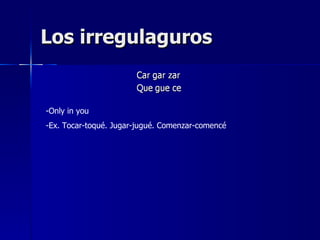
Los irregulaguros


-Only in you
-Ex. Tocar-toqué. Jugar-jugué. Comenzar-comencé
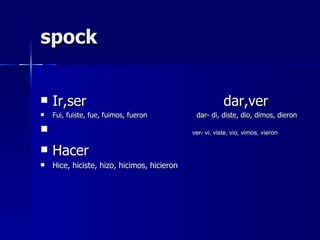
spock


   Ir,ser                                               dar,ver
   Fui, fuiste, fue, fuimos, fueron          dar- di, diste, dio, dimos, dieron

                                            ver- vi, viste, vio, vimos, vieron

   Hacer
   Hice, hiciste, hizo, hicimos, hicieron
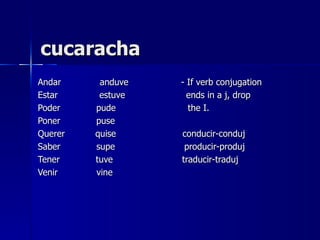
cucaracha
Andar     anduve   - If verb conjugation
Estar     estuve     ends in a j, drop
Poder    pude        the I.
Poner    puse
Querer   quise     conducir-conduj
Saber    supe       producir-produj
Tener    tuve      traducir-traduj
Venir    vine
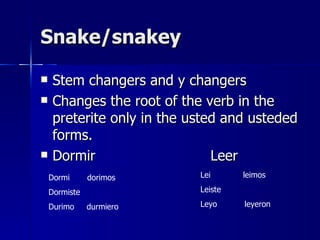
Snake/snakey

    Stem changers and y changers
    Changes the root of the verb in the
     preterite only in the usted and usteded
     forms.
    Dormir                    Leer
    Dormi      dorimos      Lei      leimos

    Dormiste                Leiste

    Durimo     durmiero     Leyo     leyeron
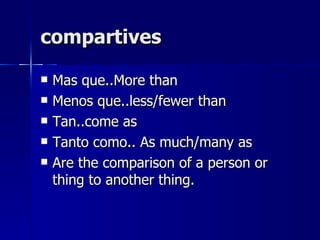
compartives

   Mas que..More than
   Menos que..less/fewer than
   Tan..come as
   Tanto como.. As much/many as
   Are the comparison of a person or
    thing to another thing.
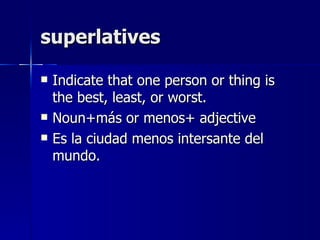
superlatives

   Indicate that one person or thing is
    the best, least, or worst.
   Noun+más or menos+ adjective
   Es la ciudad menos intersante del
    mundo.
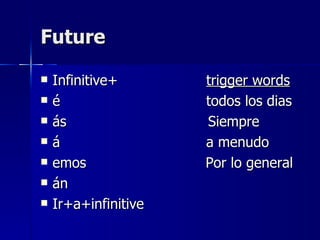
Future

   Infinitive+       trigger words
   é                 todos los dias
   ás                Siempre
   á                 a menudo
   emos              Por lo general
   án
   Ir+a+infinitive
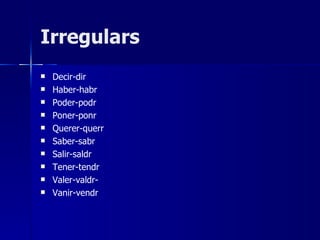
Irregulars
   Decir-dir
   Haber-habr
   Poder-podr
   Poner-ponr
   Querer-querr
   Saber-sabr
   Salir-saldr
   Tener-tendr
   Valer-valdr-
   Vanir-vendr
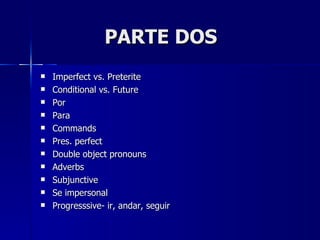
PARTE DOS
   Imperfect vs. Preterite
   Conditional vs. Future
   Por
   Para
   Commands
   Pres. perfect
   Double object pronouns
   Adverbs
   Subjunctive
   Se impersonal
   Progresssive- ir, andar, seguir
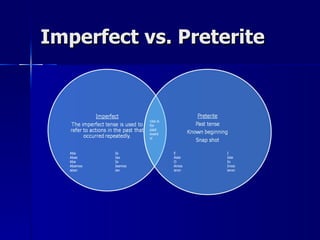
Imperfect vs. Preterite


                    Use is
                    for
                    past
                    event
                    s!


  Aba      Ia                E      I
  Abas     Ias               Aste   Iste
  Aba      Ia                O      Io
  Abamos   Iasmos            Amos   Imos
  aban     ian               aron   ieron
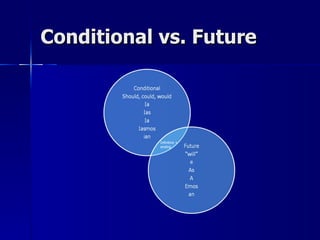
Conditional vs. Future


            Infinitive +
            ending
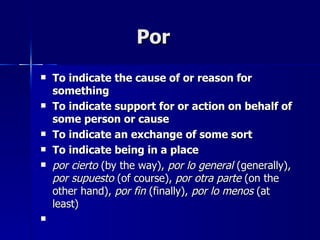
Por
   To indicate the cause of or reason for
    something
   To indicate support for or action on behalf of
    some person or cause
   To indicate an exchange of some sort
   To indicate being in a place
   por cierto (by the way), por lo general (generally),
    por supuesto (of course), por otra parte (on the
    other hand), por fin (finally), por lo menos (at
    least)

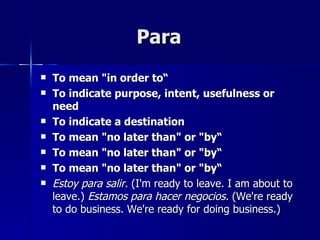
Para
   To mean "in order to“
   To indicate purpose, intent, usefulness or
    need
   To indicate a destination
   To mean "no later than" or "by“
   Estoy para salir. (I'm ready to leave. I am about to
    leave.) Estamos para hacer negocios. (We're ready
    to do business. We're ready for doing business.)
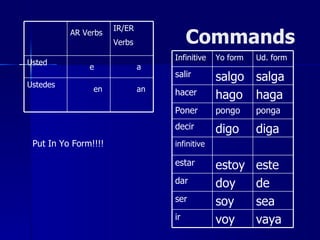
IR/ER
          AR Verbs
                      Verbs             Commands
                                   Infinitive   Yo form   Ud. form
Usted
               e              a
                                   salir        salgo salga
Ustedes
                en            an   hacer        hago haga
                                   Poner        pongo     ponga
                                   decir        digo      diga
 Put In Yo Form!!!!                infinitive

                                   estar        estoy     este
                                   dar          doy       de
                                   ser          soy       sea
                                   ir           voy       vaya
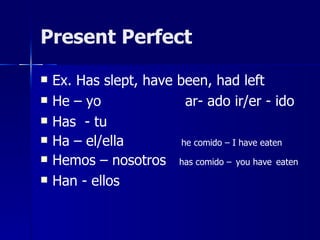
Present Perfect

   Ex. Has slept, have been, had left
   He – yo               ar- ado ir/er - ido
   Has - tu
   Ha – el/ella         he comido – I have eaten
   Hemos – nosotros has comido – you have eaten
   Han - ellos
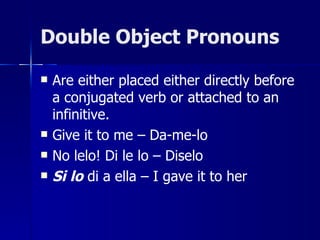
Double Object Pronouns

   Are either placed either directly before
    a conjugated verb or attached to an
    infinitive.
   Give it to me – Da-me-lo
   No lelo! Di le lo – Diselo
   Si lo di a ella – I gave it to her
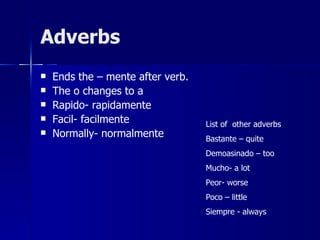
Adverbs
   Ends the – mente after verb.
   The o changes to a
   Rapido- rapidamente
   Facil- facilmente              List of other adverbs
   Normally- normalmente          Bastante – quite
                                   Demoasinado – too
                                   Mucho- a lot
                                   Peor- worse
                                   Poco – little
                                   Siempre - always
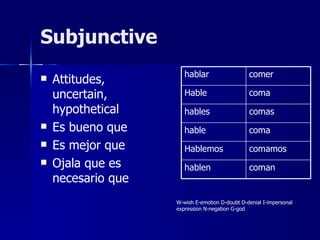
Subjunctive
                       hablar                   comer
   Attitudes,
    uncertain,         Hable                    coma
    hypothetical       hables                   comas
   Es bueno que       hable                    coma
   Es mejor que       Hablemos                 comamos
   Ojala que es       hablen                   coman
    necesario que
                    W-wish E-emotion D-doubt D-denial I-impersonal
                    expression N-negation G-god
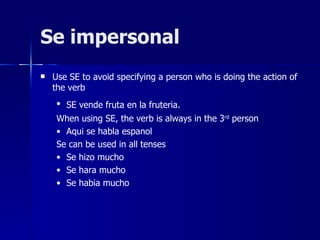
Se impersonal
   Use SE to avoid specifying a person who is doing the action of
    the verb
     • SE vende fruta en la fruteria.
     When using SE, the verb is always in the 3rd person
     • Aqui se habla espanol
     Se can be used in all tenses
     • Se hizo mucho
     • Se hara mucho
     • Se habia mucho
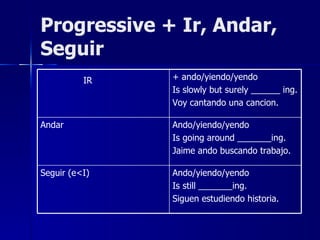
Progressive + Ir, Andar,
Seguir
          IR   + ando/yiendo/yendo
               Is slowly but surely ______ ing.
               Voy cantando una cancion.

Andar          Ando/yiendo/yendo
               Is going around _______ing.
               Jaime ando buscando trabajo.

Seguir (e<I)   Ando/yiendo/yendo
               Is still _______ing.
               Siguen estudiendo historia.

Grammar book 2

  • 1.
    Libro De Gramática Español Miguel Lanier 7th period
  • 2.
    Table of Contents 3. Presente -ar –er –ir 15. Preterite 4. Stem Changers 16. Irregulars-CarGarZar 5. Irregulars –go –zco –yo 17. spock 6. Saber vs conocer 18. cucaracha 7. Reflexives 19. snakey/snakeys 8. ‘se’ impersonal 20.Comparatives 7. Dipthongs 21. Superlatives 8. Verbs like…Uir/guir 22. Future 9. Verbs like…Cer/cir 23. irregulars 10. Verbs like…Ger/gir 11. Hace +__+ que + present/presentente 12. Imperfecto
  • 3.
    Ar, Er, Ir  Los verbos regulares en el presente Caminar- Vivir- Comer- Camino Vivo Vivimos Como Comemos Camina Vives Viven Comes Comen Caminas Vive Caminamos Come Caminan
  • 4.
    Stem Changers(boot verbs)  The verbs change in the root  They do not change in the nosotros form or the vosotros  E >ie Pensar- Pienso  O >ue  U >ue
  • 5.
    Irregulars -go -zco-yo  The “go” “zco” verbs are only in the irregulars in the yo form  “go” verbs- caer, decir, oir, puner, hacer, tener, traer, venir  “zco” verbs (cer/cir)- conocer, producir, conducir  y los demás – ser, ir, estar, ver, saber, dar Ser- Ir- Yo - Conozco Yo – Tengo Soy Somos Voy Vamos Yo - Produzco Yo – Hago Eres Son Vas Van Yo - Conduzco Yo - Vengo Es Va
  • 6.
    Saber Vs Conocer  saber y conocer= to know  “yo” forms are irregular Conocer- Saber – Conozco conocemos Sé sabemos Conoces Conocen Sabes saben Conoce Sabe
  • 7.
    Reflexives  Brenda se lava- se is reflexive  Reflexives also can be added on the end of an infinitive. Such as…- Puedo verme en el espejo
  • 8.
    ‘se impersonal  pronoun ”se” is in front of verbs to make general statements.  ¿cómo se dice man en español?  In English it translates to either “you say” or “one says.”  How do you that in spanish?
  • 9.
    Dipthongs w/accents  Dipthongs are the strong or weak vowels in a word next to each other.  Strong vowel sounds are a,e,o.  Weak vowel sounds are i,u,y.  puerto, ciudad, siete, hay.
  • 10.
    Verbs like…Uir/Guir GUIR UIR -Yo form only changes from Gu to G -Nosotros form is the only that doesn’t -Conseguir change. consigo -Verbs that end in -uir (not guir) add y consigues before o, e, and a endings consigue -atribuir conseguimos atribuyo consiguen atribuyes atribuye atribuimos atribuyen
  • 11.
    Verbs like…Cer/cir  vowel + cer or cir add z before the c in the yo form only.  consonant + cer or cir change the c to z in the yo form only.  conducir = conduzco  ejercer = ejerzo
  • 12.
    Verbs like…Ger/gir  Verbs that end in ger and gir change the g to j in the yo form only.  coger = cojo  fingir = finjo
  • 13.
    Hace +__+ que+ Present/Presentente  The yo form is the only irregular  Hago, haces, hace, hacemos, hacen
  • 14.
    Imperfecto  The imperfect tense is used to refer to actions in the past that occurred repeatedly.  Yo caminaba todo los días. Ser- Ir- Ver- Ar- Er/Ir- era iba veía aba abas ía eras ibas veías ías era iba veía aba ábamos ía éramos íbamos veíamos íamos eran iban veían aban ían
  • 15.
    Preterite -Pasttense -Known beginning -Snap shot Trigger words Ayer Anoche Anteayer La semana pasada
  • 16.
    Stem changes é í aste iste ó ío amos imos aron ieron Esto el preterio
  • 17.
    Los irregulaguros -Only inyou -Ex. Tocar-toqué. Jugar-jugué. Comenzar-comencé
  • 18.
    spock  Ir,ser dar,ver  Fui, fuiste, fue, fuimos, fueron dar- di, diste, dio, dimos, dieron  ver- vi, viste, vio, vimos, vieron  Hacer  Hice, hiciste, hizo, hicimos, hicieron
  • 19.
    cucaracha Andar anduve - If verb conjugation Estar estuve ends in a j, drop Poder pude the I. Poner puse Querer quise conducir-conduj Saber supe producir-produj Tener tuve traducir-traduj Venir vine
  • 20.
    Snake/snakey  Stem changers and y changers  Changes the root of the verb in the preterite only in the usted and usteded forms.  Dormir Leer Dormi dorimos Lei leimos Dormiste Leiste Durimo durmiero Leyo leyeron
  • 21.
    compartives  Mas que..More than  Menos que..less/fewer than  Tan..come as  Tanto como.. As much/many as  Are the comparison of a person or thing to another thing.
  • 22.
    superlatives  Indicate that one person or thing is the best, least, or worst.  Noun+más or menos+ adjective  Es la ciudad menos intersante del mundo.
  • 23.
    Future  Infinitive+ trigger words  é todos los dias  ás Siempre  á a menudo  emos Por lo general  án  Ir+a+infinitive
  • 24.
    Irregulars  Decir-dir  Haber-habr  Poder-podr  Poner-ponr  Querer-querr  Saber-sabr  Salir-saldr  Tener-tendr  Valer-valdr-  Vanir-vendr
  • 25.
    PARTE DOS  Imperfect vs. Preterite  Conditional vs. Future  Por  Para  Commands  Pres. perfect  Double object pronouns  Adverbs  Subjunctive  Se impersonal  Progresssive- ir, andar, seguir
  • 26.
    Imperfect vs. Preterite Use is for past event s! Aba Ia E I Abas Ias Aste Iste Aba Ia O Io Abamos Iasmos Amos Imos aban ian aron ieron
  • 27.
    Conditional vs. Future Infinitive + ending
  • 28.
    Por  To indicate the cause of or reason for something  To indicate support for or action on behalf of some person or cause  To indicate an exchange of some sort  To indicate being in a place  por cierto (by the way), por lo general (generally), por supuesto (of course), por otra parte (on the other hand), por fin (finally), por lo menos (at least) 
  • 29.
    Para  To mean "in order to“  To indicate purpose, intent, usefulness or need  To indicate a destination  To mean "no later than" or "by“  To mean "no later than" or "by“  To mean "no later than" or "by“  Estoy para salir. (I'm ready to leave. I am about to leave.) Estamos para hacer negocios. (We're ready to do business. We're ready for doing business.)
  • 30.
    IR/ER AR Verbs Verbs Commands Infinitive Yo form Ud. form Usted e a salir salgo salga Ustedes en an hacer hago haga Poner pongo ponga decir digo diga Put In Yo Form!!!! infinitive estar estoy este dar doy de ser soy sea ir voy vaya
  • 31.
    Present Perfect  Ex. Has slept, have been, had left  He – yo ar- ado ir/er - ido  Has - tu  Ha – el/ella he comido – I have eaten  Hemos – nosotros has comido – you have eaten  Han - ellos
  • 32.
    Double Object Pronouns  Are either placed either directly before a conjugated verb or attached to an infinitive.  Give it to me – Da-me-lo  No lelo! Di le lo – Diselo  Si lo di a ella – I gave it to her
  • 33.
    Adverbs  Ends the – mente after verb.  The o changes to a  Rapido- rapidamente  Facil- facilmente List of other adverbs  Normally- normalmente Bastante – quite Demoasinado – too Mucho- a lot Peor- worse Poco – little Siempre - always
  • 34.
    Subjunctive hablar comer  Attitudes, uncertain, Hable coma hypothetical hables comas  Es bueno que hable coma  Es mejor que Hablemos comamos  Ojala que es hablen coman necesario que W-wish E-emotion D-doubt D-denial I-impersonal expression N-negation G-god
  • 35.
    Se impersonal  Use SE to avoid specifying a person who is doing the action of the verb • SE vende fruta en la fruteria. When using SE, the verb is always in the 3rd person • Aqui se habla espanol Se can be used in all tenses • Se hizo mucho • Se hara mucho • Se habia mucho
  • 36.
    Progressive + Ir,Andar, Seguir IR + ando/yiendo/yendo Is slowly but surely ______ ing. Voy cantando una cancion. Andar Ando/yiendo/yendo Is going around _______ing. Jaime ando buscando trabajo. Seguir (e<I) Ando/yiendo/yendo Is still _______ing. Siguen estudiendo historia.