By: Brenda Wnukowski

7th Period
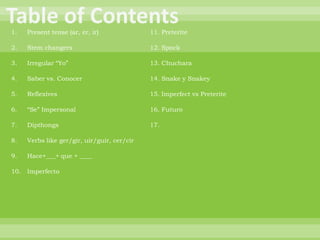
1.    Present tense (ar, er, ir)              11. Preterite

2.    Stem changers                           12. Spock

3.    Irregular “Yo”                          13. Chuchara

4.    Saber vs. Conocer                       14. Snake y Snakey

5.    Reflexives                              15. Imperfect vs Preterite

6.    “Se” Impersonal                         16. Futuro

7.    Dipthongs                               17.

8.    Verbs like ger/gir, uir/guir, cer/cir

9.    Hace+___+ que + ____

10.   Imperfecto
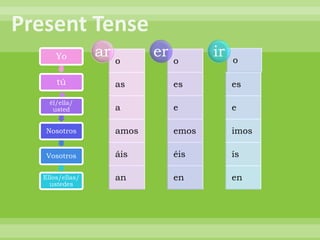
Yo         ar o      er   o
                                     ir   o

    tú            as          es          es
  él/ella/
   usted          a           e           e

 Nosotros         amos        emos        imos

 Vosotros         áis         éis         ís

Ellos/ellas/      an          en          en
  ustedes
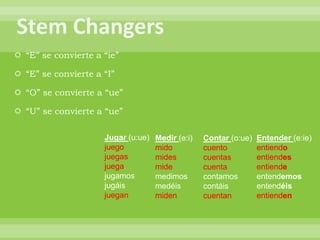
 “E” se convierte a “ie”

 “E” se convierte a “I”

 “O” se convierte a “ue”

 “U” se convierte a “ue”

                     Jugar (u:ue)   Medir (e:i)   Contar (o:ue)   Entender (e:ie)
                     juego          mido          cuento          entiendo
                     juegas         mides         cuentas         entiendes
                     juega          mide          cuenta          entiende
                     jugamos        medimos       contamos        entendemos
                     jugáis         medéis        contáis         entendéis
                     juegan         miden         cuentan         entienden
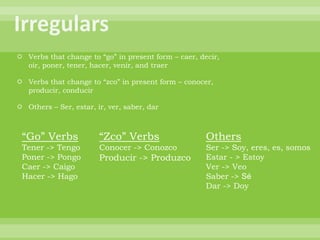
 Verbs that change to “go” in present form – caer, decir,
  oir, poner, tener, hacer, venir, and traer

 Verbs that change to “zco” in present form – conocer,
  producir, conducir

 Others – Ser, estar, ir, ver, saber, dar


 “Go” Verbs             “Zco” Verbs                   Others
 Tener -> Tengo         Conocer -> Conozco            Ser -> Soy, eres, es, somos
 Poner -> Pongo         Producir -> Produzco          Estar - > Estoy
 Caer -> Caigo                                        Ver -> Veo
 Hacer -> Hago                                        Saber -> Sé
                                                      Dar -> Doy
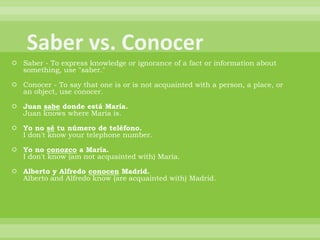
 Saber - To express knowledge or ignorance of a fact or information about
  something, use "saber."

 Conocer - To say that one is or is not acquainted with a person, a place, or
  an object, use conocer.

 Juan sabe donde está María.
  Juan knows where Maria is.

 Yo no sé tu número de teléfono.
  I don't know your telephone number.

 Yo no conozco a María.
  I don't know (am not acquainted with) Maria.

 Alberto y Alfredo conocen Madrid.
  Alberto and Alfredo know (are acquainted with) Madrid.
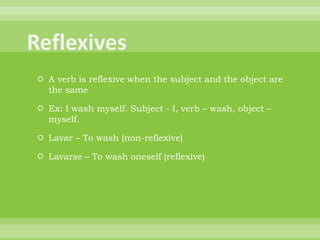
 A verb is reflexive when the subject and the object are
  the same

 Ex: I wash myself. Subject - I, verb – wash, object –
  myself.

 Lavar – To wash (non-reflexive)

 Lavarse – To wash oneself (reflexive)
 Impersonal expressions are used when the subject of a verb
  is unspecified (but is human). They are mostly used to
  make general statements and to express rules

 Se + 3rd person singular

 Se habla español aquí. (Spanish is spoken here)

 Se prohibe fumar. (Smoking is prohibited)
 Diptongos are the combination of two vowels, from
  the Spanish-speaking point of view.

 Example – bueno (bvooeh-noh)

      cuando (kooahn-doh)

      feo (feh-oh)
 vowel + -cer/-cir verbs: c to zc

 consonant + -cer /-cir verbs: c to z

 -ger/-gir verbs: g to j

 -guir verbs: gu to g

 verbs ending in -cer/-cir, -ger/-gir, and -guir
  (but not -uir) undergo the same changes that
  occur in the yo form of the present
 subject (may be implied) + indicative verb + que +
  subject (may be implied) + subjunctive verb

 Obligar: La ley obliga que asistamos. The law requires
  us to attend.

 Quiero que salga. (I want him to leave)
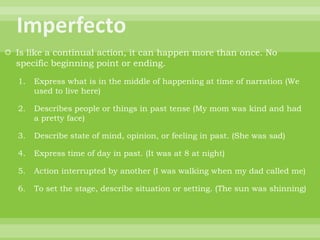
 Is like a continual action, it can happen more than once. No
  specific beginning point or ending.

   1.   Express what is in the middle of happening at time of narration (We
        used to live here)

   2.   Describes people or things in past tense (My mom was kind and had
        a pretty face)

   3.   Describe state of mind, opinion, or feeling in past. (She was sad)

   4.   Express time of day in past. (It was at 8 at night)

   5.   Action interrupted by another (I was walking when my dad called me)

   6.   To set the stage, describe situation or setting. (The sun was shinning)
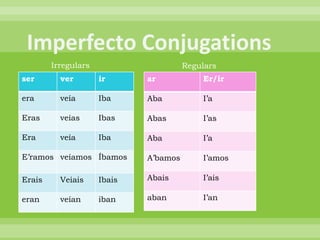
Irregulars                     Regulars
ser       ver        ir      ar            Er/ir

era       veía       Iba     Aba           I‟a

Eras      veías      Ibas    Abas          I‟as

Era       veía       Iba     Aba           I‟a

E‟ramos veíamos Íbamos       A‟bamos       I‟amos

Erais     Veiais     Ibais   Abais         I‟ais

eran      veían      iban    aban          I‟an
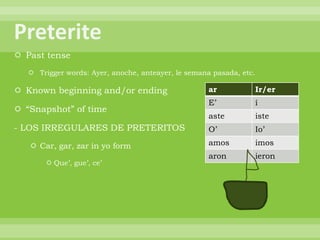
 Past tense
    Trigger words: Ayer, anoche, anteayer, le semana pasada, etc.

 Known beginning and/or ending                      ar              Ir/er
                                                     E‟              í
 “Snapshot” of time
                                                     aste            iste
- LOS IRREGULARES DE PRETERITOS                      O‟              Io‟

    Car, gar, zar in yo form                        amos            imos
                                                     aron            ieron
        Que‟, gue‟, ce‟
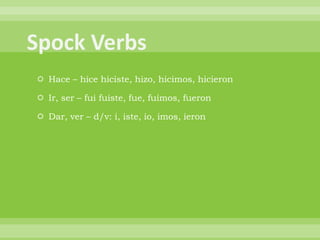
 Hace – hice hiciste, hizo, hicimos, hicieron

 Ir, ser – fui fuiste, fue, fuimos, fueron

 Dar, ver – d/v: i, iste, io, imos, ieron
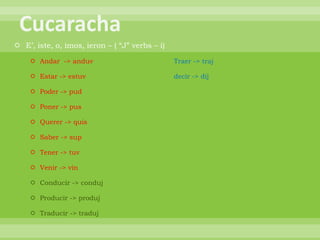
 E‟, iste, o, imos, ieron – ( “J” verbs – i)

     Andar -> anduv                            Traer -> traj

     Estar -> estuv                            decir -> dij

     Poder -> pud

     Poner -> pus

     Querer -> quis

     Saber -> sup

     Tener -> tuv

     Venir -> vin

     Conducir -> conduj

     Producir -> produj

     Traducir -> traduj
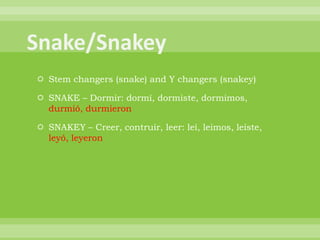
 Stem changers (snake) and Y changers (snakey)

 SNAKE – Dormir: dormí, dormiste, dormimos,
  durmió, durmieron

 SNAKEY – Creer, contruir, leer: leí, leimos, leiste,
  leyó, leyeron
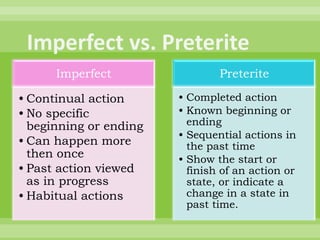
Imperfect                 Preterite

• Continual action      • Completed action
• No specific           • Known beginning or
  beginning or ending     ending
                        • Sequential actions in
• Can happen more         the past time
  then once             • Show the start or
• Past action viewed      finish of an action or
  as in progress          state, or indicate a
• Habitual actions        change in a state in
                          past time.
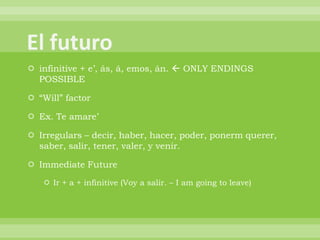
 infinitive + e‟, ás, á, emos, án.  ONLY ENDINGS
  POSSIBLE

 “Will” factor

 Ex. Te amare‟

 Irregulars – decir, haber, hacer, poder, ponerm querer,
  saber, salir, tener, valer, y venir.

 Immediate Future

    Ir + a + infinitive (Voy a salir. – I am going to leave)
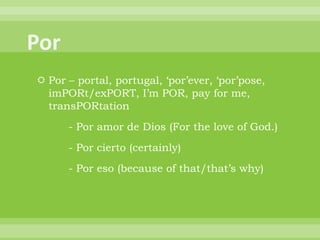
 Por – portal, portugal, „por‟ever, „por‟pose,
  imPORt/exPORT, I‟m POR, pay for me,
  transPORtation
      - Por amor de Dios (For the love of God.)
      - Por cierto (certainly)
      - Por eso (because of that/that‟s why)
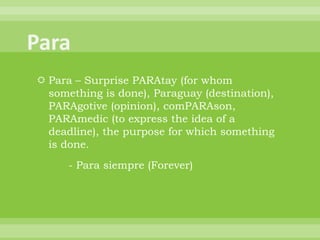
 Para – Surprise PARAtay (for whom
  something is done), Paraguay (destination),
  PARAgotive (opinion), comPARAson,
  PARAmedic (to express the idea of a
  deadline), the purpose for which something
  is done.
      - Para siempre (Forever)
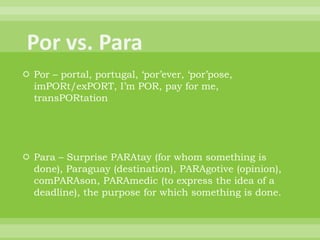
 Por – portal, portugal, „por‟ever, „por‟pose,
  imPORt/exPORT, I‟m POR, pay for me,
  transPORtation


 Para – Surprise PARAtay (for whom something is
  done), Paraguay (destination), PARAgotive (opinion),
  comPARAson, PARAmedic (to express the idea of a
  deadline), the purpose for which something is done.
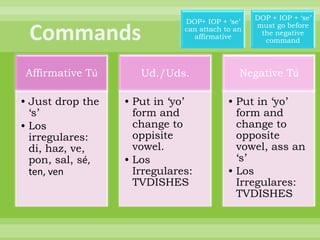
DOP + IOP + „se‟
                              DOP+ IOP + „se‟
                                                 must go before
                              can attach to an
                                                  the negative
                                affirmative
                                                   command


Affirmative Tú       Ud./Uds.                Negative Tú

• Just drop the   • Put in „yo‟           • Put in „yo‟
  „s‟               form and                form and
• Los               change to               change to
  irregulares:      oppisite                opposite
  di, haz, ve,      vowel.                  vowel, ass an
  pon, sal, sé,   • Los                     „s‟
  ten, ven          Irregulares:          • Los
                    TVDISHES                Irregulares:
                                            TVDISHES
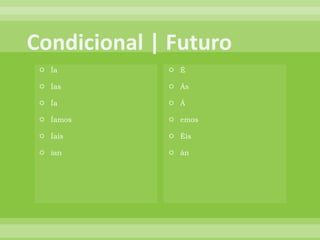
 Ía       É

 Ías      Ás

 Ía       Á

 Íamos    emos

 Íais     Éis

 ían      án
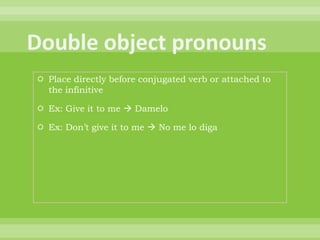
 Place directly before conjugated verb or attached to
  the infinitive

 Ex: Give it to me  Damelo

 Ex: Don‟t give it to me  No me lo diga
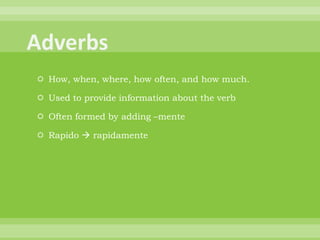
 How, when, where, how often, and how much.

 Used to provide information about the verb

 Often formed by adding –mente

 Rapido  rapidamente
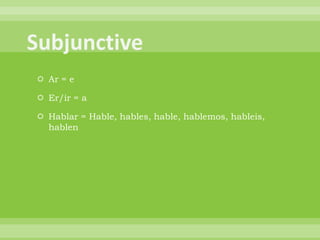
 Ar = e

 Er/ir = a

 Hablar = Hable, hables, hable, hablemos, hableis,
  hablen
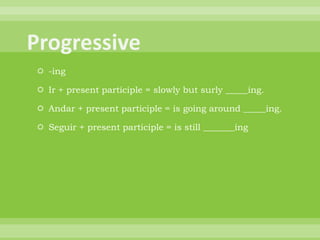
 -ing

 Ir + present participle = slowly but surly _____ing.

 Andar + present participle = is going around _____ing.

 Seguir + present participle = is still _______ing

Grammar book

  • 1.
  • 2.
    1. Present tense (ar, er, ir) 11. Preterite 2. Stem changers 12. Spock 3. Irregular “Yo” 13. Chuchara 4. Saber vs. Conocer 14. Snake y Snakey 5. Reflexives 15. Imperfect vs Preterite 6. “Se” Impersonal 16. Futuro 7. Dipthongs 17. 8. Verbs like ger/gir, uir/guir, cer/cir 9. Hace+___+ que + ____ 10. Imperfecto
  • 3.
    Yo ar o er o ir o tú as es es él/ella/ usted a e e Nosotros amos emos imos Vosotros áis éis ís Ellos/ellas/ an en en ustedes
  • 4.
     “E” seconvierte a “ie”  “E” se convierte a “I”  “O” se convierte a “ue”  “U” se convierte a “ue” Jugar (u:ue) Medir (e:i) Contar (o:ue) Entender (e:ie) juego mido cuento entiendo juegas mides cuentas entiendes juega mide cuenta entiende jugamos medimos contamos entendemos jugáis medéis contáis entendéis juegan miden cuentan entienden
  • 5.
     Verbs thatchange to “go” in present form – caer, decir, oir, poner, tener, hacer, venir, and traer  Verbs that change to “zco” in present form – conocer, producir, conducir  Others – Ser, estar, ir, ver, saber, dar “Go” Verbs “Zco” Verbs Others Tener -> Tengo Conocer -> Conozco Ser -> Soy, eres, es, somos Poner -> Pongo Producir -> Produzco Estar - > Estoy Caer -> Caigo Ver -> Veo Hacer -> Hago Saber -> Sé Dar -> Doy
  • 6.
     Saber -To express knowledge or ignorance of a fact or information about something, use "saber."  Conocer - To say that one is or is not acquainted with a person, a place, or an object, use conocer.  Juan sabe donde está María. Juan knows where Maria is.  Yo no sé tu número de teléfono. I don't know your telephone number.  Yo no conozco a María. I don't know (am not acquainted with) Maria.  Alberto y Alfredo conocen Madrid. Alberto and Alfredo know (are acquainted with) Madrid.
  • 7.
     A verbis reflexive when the subject and the object are the same  Ex: I wash myself. Subject - I, verb – wash, object – myself.  Lavar – To wash (non-reflexive)  Lavarse – To wash oneself (reflexive)
  • 8.
     Impersonal expressionsare used when the subject of a verb is unspecified (but is human). They are mostly used to make general statements and to express rules  Se + 3rd person singular  Se habla español aquí. (Spanish is spoken here)  Se prohibe fumar. (Smoking is prohibited)
  • 9.
     Diptongos arethe combination of two vowels, from the Spanish-speaking point of view.  Example – bueno (bvooeh-noh) cuando (kooahn-doh) feo (feh-oh)
  • 10.
     vowel +-cer/-cir verbs: c to zc  consonant + -cer /-cir verbs: c to z  -ger/-gir verbs: g to j  -guir verbs: gu to g  verbs ending in -cer/-cir, -ger/-gir, and -guir (but not -uir) undergo the same changes that occur in the yo form of the present
  • 11.
     subject (maybe implied) + indicative verb + que + subject (may be implied) + subjunctive verb  Obligar: La ley obliga que asistamos. The law requires us to attend.  Quiero que salga. (I want him to leave)
  • 12.
     Is likea continual action, it can happen more than once. No specific beginning point or ending. 1. Express what is in the middle of happening at time of narration (We used to live here) 2. Describes people or things in past tense (My mom was kind and had a pretty face) 3. Describe state of mind, opinion, or feeling in past. (She was sad) 4. Express time of day in past. (It was at 8 at night) 5. Action interrupted by another (I was walking when my dad called me) 6. To set the stage, describe situation or setting. (The sun was shinning)
  • 13.
    Irregulars Regulars ser ver ir ar Er/ir era veía Iba Aba I‟a Eras veías Ibas Abas I‟as Era veía Iba Aba I‟a E‟ramos veíamos Íbamos A‟bamos I‟amos Erais Veiais Ibais Abais I‟ais eran veían iban aban I‟an
  • 14.
     Past tense  Trigger words: Ayer, anoche, anteayer, le semana pasada, etc.  Known beginning and/or ending ar Ir/er E‟ í  “Snapshot” of time aste iste - LOS IRREGULARES DE PRETERITOS O‟ Io‟  Car, gar, zar in yo form amos imos aron ieron  Que‟, gue‟, ce‟
  • 15.
     Hace –hice hiciste, hizo, hicimos, hicieron  Ir, ser – fui fuiste, fue, fuimos, fueron  Dar, ver – d/v: i, iste, io, imos, ieron
  • 16.
     E‟, iste,o, imos, ieron – ( “J” verbs – i)  Andar -> anduv Traer -> traj  Estar -> estuv decir -> dij  Poder -> pud  Poner -> pus  Querer -> quis  Saber -> sup  Tener -> tuv  Venir -> vin  Conducir -> conduj  Producir -> produj  Traducir -> traduj
  • 17.
     Stem changers(snake) and Y changers (snakey)  SNAKE – Dormir: dormí, dormiste, dormimos, durmió, durmieron  SNAKEY – Creer, contruir, leer: leí, leimos, leiste, leyó, leyeron
  • 18.
    Imperfect Preterite • Continual action • Completed action • No specific • Known beginning or beginning or ending ending • Sequential actions in • Can happen more the past time then once • Show the start or • Past action viewed finish of an action or as in progress state, or indicate a • Habitual actions change in a state in past time.
  • 19.
     infinitive +e‟, ás, á, emos, án.  ONLY ENDINGS POSSIBLE  “Will” factor  Ex. Te amare‟  Irregulars – decir, haber, hacer, poder, ponerm querer, saber, salir, tener, valer, y venir.  Immediate Future  Ir + a + infinitive (Voy a salir. – I am going to leave)
  • 20.
     Por –portal, portugal, „por‟ever, „por‟pose, imPORt/exPORT, I‟m POR, pay for me, transPORtation - Por amor de Dios (For the love of God.) - Por cierto (certainly) - Por eso (because of that/that‟s why)
  • 21.
     Para –Surprise PARAtay (for whom something is done), Paraguay (destination), PARAgotive (opinion), comPARAson, PARAmedic (to express the idea of a deadline), the purpose for which something is done. - Para siempre (Forever)
  • 22.
     Por –portal, portugal, „por‟ever, „por‟pose, imPORt/exPORT, I‟m POR, pay for me, transPORtation  Para – Surprise PARAtay (for whom something is done), Paraguay (destination), PARAgotive (opinion), comPARAson, PARAmedic (to express the idea of a deadline), the purpose for which something is done.
  • 23.
    DOP + IOP+ „se‟ DOP+ IOP + „se‟ must go before can attach to an the negative affirmative command Affirmative Tú Ud./Uds. Negative Tú • Just drop the • Put in „yo‟ • Put in „yo‟ „s‟ form and form and • Los change to change to irregulares: oppisite opposite di, haz, ve, vowel. vowel, ass an pon, sal, sé, • Los „s‟ ten, ven Irregulares: • Los TVDISHES Irregulares: TVDISHES
  • 24.
     Ía  É  Ías  Ás  Ía  Á  Íamos  emos  Íais  Éis  ían  án
  • 25.
     Place directlybefore conjugated verb or attached to the infinitive  Ex: Give it to me  Damelo  Ex: Don‟t give it to me  No me lo diga
  • 26.
     How, when,where, how often, and how much.  Used to provide information about the verb  Often formed by adding –mente  Rapido  rapidamente
  • 27.
     Ar =e  Er/ir = a  Hablar = Hable, hables, hable, hablemos, hableis, hablen
  • 28.
     -ing  Ir+ present participle = slowly but surly _____ing.  Andar + present participle = is going around _____ing.  Seguir + present participle = is still _______ing

Editor's Notes

  • #23 You have hand written notes in your bag. Check there :D (red pen, big words, can’t miss ‘em) Make two separate slides. Look up por idioms