Grammar
Book
Megan McFeron
El Presente
Regular –ar, -er, -ir verbs
 The present tense of regular verbs is formed
  by dropping the infinitive ending –ar, -er, or -ir
  and adding personal endings
 The present tense is used to express actions or
  situations that are going on at the present
  time and to express general truths
 Also used to express habitual actions or
  actions that will take place in the near future
El Presente
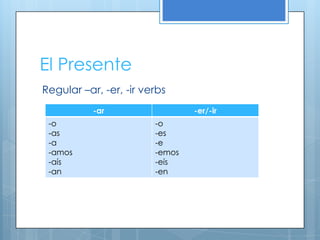
Regular –ar, -er, -ir verbs
           -ar                  -er/-ir
 -o                     -o
 -as                    -es
 -a                     -e
 -amos                  -emos
 -aís                   -eís
 -an                    -en
El Presente
Stem changing verbs
 Some verbs have stem changes in the present
   tense. In many –ar and –er verbs, e changes
   to ie and o changes to i, and u changes to
   ue. The nosotros/as and vosotros/as never
   have stem changes in the present tense.
 Construir, destruir, incluir, and influir add a y
   before the personal endings. The nosotros/as
   and vosotros/as forms still do not change.
El Presente
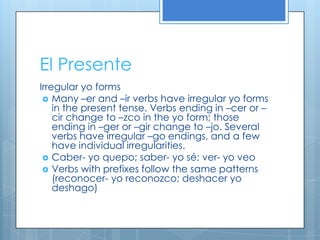
Irregular yo forms
  Many –er and –ir verbs have irregular yo forms
    in the present tense. Verbs ending in –cer or –
    cir change to –zco in the yo form; those
    ending in –ger or –gir change to –jo. Several
    verbs have irregular –go endings, and a few
    have individual irregularities.
  Caber- yo quepo; saber- yo sé; ver- yo veo
  Verbs with prefixes follow the same patterns
    (reconocer- yo reconozco; deshacer yo
    deshago)
El Presente
Irregular verbs
  Other commonly used verbs in Spanish
   are irregular in the present tense or
   combine a stem-change with an irrefular
   to form or other spelling change
El Presente
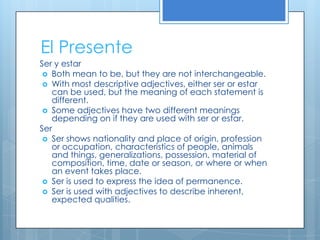
Ser y estar
  Both mean to be, but they are not interchangeable.
  With most descriptive adjectives, either ser or estar
   can be used, but the meaning of each statement is
   different.
  Some adjectives have two different meanings
   depending on if they are used with ser or estar.
Ser
  Ser shows nationality and place of origin, profession
   or occupation, characteristics of people, animals
   and things, generalizations, possession, material of
   composition, time, date or season, or where or when
   an event takes place.
  Ser is used to express the idea of permanence.
  Ser is used with adjectives to describe inherent,
   expected qualities.
El Presente
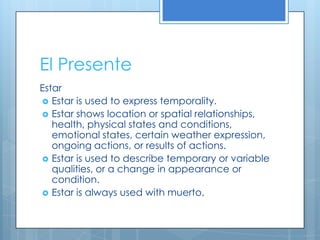
Estar
 Estar is used to express temporality.
 Estar shows location or spatial relationships,
   health, physical states and conditions,
   emotional states, certain weather expression,
   ongoing actions, or results of actions.
 Estar is used to describe temporary or variable
   qualities, or a change in appearance or
   condition.
 Estar is always used with muerto.
El Presente
Verbos como gustar
 Gustar means to please.
 Gustar agrees in person and number with the thing or
   person that pleases that is the subject.
 When gustar is followed by one or more verbs in the
   infinitive, the singular form of gustar is always used.
 Gustar is often used in the conditional to soften a request.
 Many verbs follow the same pattern (aburrir, caer
   bien/mal, disgustar, doler, encantar, faltar, fascinar, hacer
   falta, importar, interesar, molestar, preocupar, quedar,
   sorprender, apetecer)
 The construction a + [prepositional pronoun] or a + [noun]
   can be used to emphasize who is pleased, bothered, etc.
 Faltar expressed what someone or something lacks and
   quedar expressed what someone or something has left.
   Quedar is also used to talk about how clothing fits or looks
   on someone.
Imperfect vs. Preterite
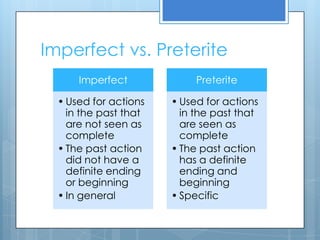
      Imperfect             Preterite

  • Used for actions   • Used for actions
    in the past that     in the past that
    are not seen as      are seen as
    complete             complete
  • The past action    • The past action
    did not have a       has a definite
    definite ending      ending and
    or beginning         beginning
  • In general         • Specific
Imperfect vs. Preterite
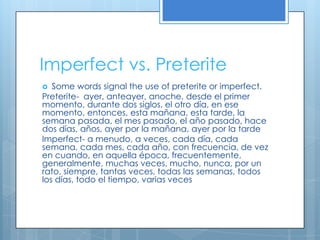
  Some words signal the use of preterite or imperfect.
Preterite- ayer, anteayer, anoche, desde el primer
momento, durante dos siglos, el otro día, en ese
momento, entonces, esta mañana, esta tarde, la
semana pasada, el mes pasado, el año pasado, hace
dos días, años, ayer por la mañana, ayer por la tarde
Imperfect- a menudo, a veces, cada día, cada
semana, cada mes, cada año, con frecuencia, de vez
en cuando, en aquella época, frecuentemente,
generalmente, muchas veces, mucho, nunca, por un
rato, siempre, tantas veces, todas las semanas, todos
los días, todo el tiempo, varias veces
Imperfect vs. Preterite
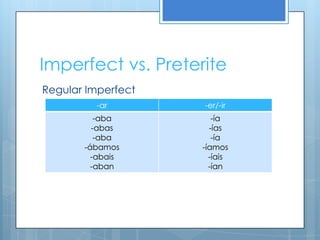
Regular Imperfect
         -ar        -er/-ir
          -aba         -ía
         -abas        -ías
          -aba         -ía
       -ábamos      -íamos
         -abais       -íais
         -aban        -ían
Imperfect vs. Preterite
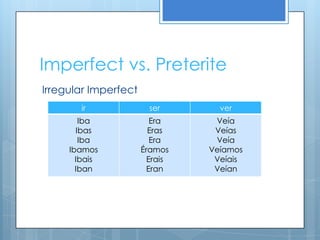
Irregular Imperfect
       ir               ser       ver
        Iba              Era     Veía
       Ibas             Eras     Veías
        Iba              Era     Veía
     Ibamos           Éramos    Veíamos
       Ibais            Erais    Veíais
       Iban             Eran     Veían
Imperfect vs. Preterite
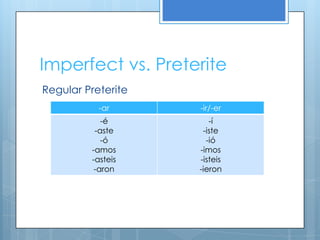
Regular Preterite
           -ar      -ir/-er
            -é         -í
          -aste      -iste
            -ó        -ió
         -amos      -imos
         -asteis    -isteis
          -aron     -ieron
Imperfect vs. Preterite
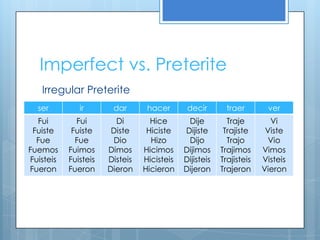
   Irregular Preterite
  ser         ir       dar       hacer       decir        traer       ver
  Fui        Fui        Di        Hice       Dije         Traje        Vi
 Fuiste     Fuiste     Diste     Hiciste    Dijiste      Trajiste     Viste
  Fue        Fue       Dio        Hizo       Dijo         Trajo        Vio
Fuemos     Fuimos     Dimos     Hicimos     Dijimos     Trajimos     Vimos
Fuisteis   Fuisteis   Disteis   Hicisteis   Dijisteis   Trajisteis   Visteis
Fueron     Fueron     Dieron    Hicieron    Dijeron     Trajeron     Vieron
Imperfect vs. Preterite
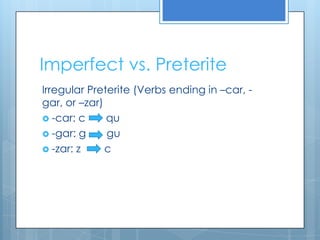
Irregular Preterite (Verbs ending in –car, -
gar, or –zar)
 -car: c     qu
 -gar: g     gu
 -zar: z     c
Impefect vs. Preterite
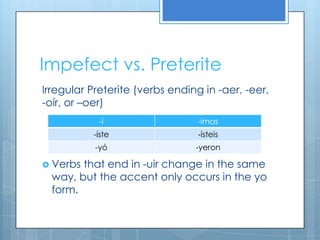
Irregular Preterite (verbs ending in -aer, -eer,
-oír, or –oer)
            -í                  -ímos
          -íste                 -ísteis
           -yó                  -yeron

 Verbs that end in -uir change in the same
  way, but the accent only occurs in the yo
  form.
Imperfect vs. Preterite
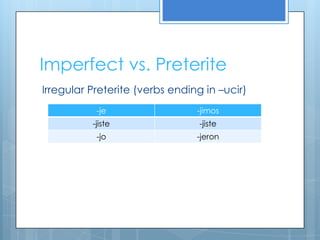
Irregular Preterite (verbs ending in –ucir)
           -je                  -jimos
          -jiste                 -jiste
           -jo                  -jeron
Imperfect vs. Preterite
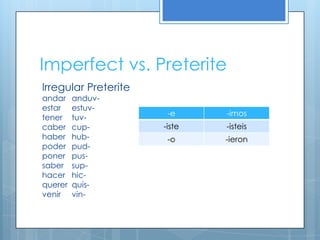
Irregular Preterite
andar    anduv-
estar    estuv-
                       -e     -imos
tener    tuv-
caber    cup-         -iste   -isteis
haber    hub-          -o     -ieron
poder    pud-
poner    pus-
saber    sup-
hacer    hic-
querer   quis-
venir    vin-

Grammar Book

  • 1.
  • 2.
    El Presente Regular –ar,-er, -ir verbs  The present tense of regular verbs is formed by dropping the infinitive ending –ar, -er, or -ir and adding personal endings  The present tense is used to express actions or situations that are going on at the present time and to express general truths  Also used to express habitual actions or actions that will take place in the near future
  • 3.
    El Presente Regular –ar,-er, -ir verbs -ar -er/-ir -o -o -as -es -a -e -amos -emos -aís -eís -an -en
  • 4.
    El Presente Stem changingverbs  Some verbs have stem changes in the present tense. In many –ar and –er verbs, e changes to ie and o changes to i, and u changes to ue. The nosotros/as and vosotros/as never have stem changes in the present tense.  Construir, destruir, incluir, and influir add a y before the personal endings. The nosotros/as and vosotros/as forms still do not change.
  • 5.
    El Presente Irregular yoforms  Many –er and –ir verbs have irregular yo forms in the present tense. Verbs ending in –cer or – cir change to –zco in the yo form; those ending in –ger or –gir change to –jo. Several verbs have irregular –go endings, and a few have individual irregularities.  Caber- yo quepo; saber- yo sé; ver- yo veo  Verbs with prefixes follow the same patterns (reconocer- yo reconozco; deshacer yo deshago)
  • 6.
    El Presente Irregular verbs  Other commonly used verbs in Spanish are irregular in the present tense or combine a stem-change with an irrefular to form or other spelling change
  • 7.
    El Presente Ser yestar  Both mean to be, but they are not interchangeable.  With most descriptive adjectives, either ser or estar can be used, but the meaning of each statement is different.  Some adjectives have two different meanings depending on if they are used with ser or estar. Ser  Ser shows nationality and place of origin, profession or occupation, characteristics of people, animals and things, generalizations, possession, material of composition, time, date or season, or where or when an event takes place.  Ser is used to express the idea of permanence.  Ser is used with adjectives to describe inherent, expected qualities.
  • 8.
    El Presente Estar  Estaris used to express temporality.  Estar shows location or spatial relationships, health, physical states and conditions, emotional states, certain weather expression, ongoing actions, or results of actions.  Estar is used to describe temporary or variable qualities, or a change in appearance or condition.  Estar is always used with muerto.
  • 9.
    El Presente Verbos comogustar  Gustar means to please.  Gustar agrees in person and number with the thing or person that pleases that is the subject.  When gustar is followed by one or more verbs in the infinitive, the singular form of gustar is always used.  Gustar is often used in the conditional to soften a request.  Many verbs follow the same pattern (aburrir, caer bien/mal, disgustar, doler, encantar, faltar, fascinar, hacer falta, importar, interesar, molestar, preocupar, quedar, sorprender, apetecer)  The construction a + [prepositional pronoun] or a + [noun] can be used to emphasize who is pleased, bothered, etc.  Faltar expressed what someone or something lacks and quedar expressed what someone or something has left. Quedar is also used to talk about how clothing fits or looks on someone.
  • 10.
    Imperfect vs. Preterite Imperfect Preterite • Used for actions • Used for actions in the past that in the past that are not seen as are seen as complete complete • The past action • The past action did not have a has a definite definite ending ending and or beginning beginning • In general • Specific
  • 11.
    Imperfect vs. Preterite  Some words signal the use of preterite or imperfect. Preterite- ayer, anteayer, anoche, desde el primer momento, durante dos siglos, el otro día, en ese momento, entonces, esta mañana, esta tarde, la semana pasada, el mes pasado, el año pasado, hace dos días, años, ayer por la mañana, ayer por la tarde Imperfect- a menudo, a veces, cada día, cada semana, cada mes, cada año, con frecuencia, de vez en cuando, en aquella época, frecuentemente, generalmente, muchas veces, mucho, nunca, por un rato, siempre, tantas veces, todas las semanas, todos los días, todo el tiempo, varias veces
  • 12.
    Imperfect vs. Preterite RegularImperfect -ar -er/-ir -aba -ía -abas -ías -aba -ía -ábamos -íamos -abais -íais -aban -ían
  • 13.
    Imperfect vs. Preterite IrregularImperfect ir ser ver Iba Era Veía Ibas Eras Veías Iba Era Veía Ibamos Éramos Veíamos Ibais Erais Veíais Iban Eran Veían
  • 14.
    Imperfect vs. Preterite RegularPreterite -ar -ir/-er -é -í -aste -iste -ó -ió -amos -imos -asteis -isteis -aron -ieron
  • 15.
    Imperfect vs. Preterite Irregular Preterite ser ir dar hacer decir traer ver Fui Fui Di Hice Dije Traje Vi Fuiste Fuiste Diste Hiciste Dijiste Trajiste Viste Fue Fue Dio Hizo Dijo Trajo Vio Fuemos Fuimos Dimos Hicimos Dijimos Trajimos Vimos Fuisteis Fuisteis Disteis Hicisteis Dijisteis Trajisteis Visteis Fueron Fueron Dieron Hicieron Dijeron Trajeron Vieron
  • 16.
    Imperfect vs. Preterite IrregularPreterite (Verbs ending in –car, - gar, or –zar)  -car: c qu  -gar: g gu  -zar: z c
  • 17.
    Impefect vs. Preterite IrregularPreterite (verbs ending in -aer, -eer, -oír, or –oer) -í -ímos -íste -ísteis -yó -yeron  Verbs that end in -uir change in the same way, but the accent only occurs in the yo form.
  • 18.
    Imperfect vs. Preterite IrregularPreterite (verbs ending in –ucir) -je -jimos -jiste -jiste -jo -jeron
  • 19.
    Imperfect vs. Preterite IrregularPreterite andar anduv- estar estuv- -e -imos tener tuv- caber cup- -iste -isteis haber hub- -o -ieron poder pud- poner pus- saber sup- hacer hic- querer quis- venir vin-