Spanish 4 Grammar
     Concepts


    Heli Martin
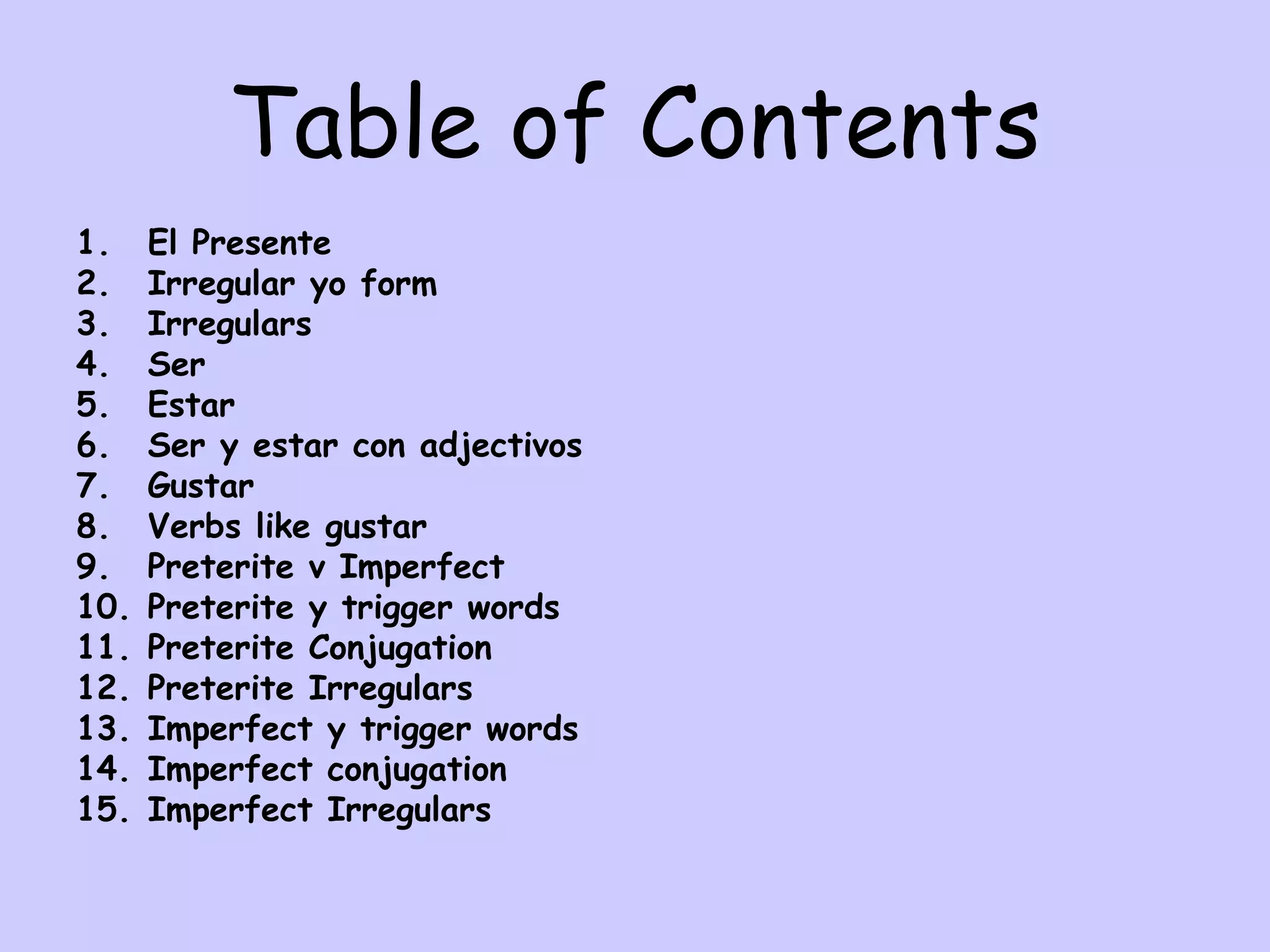
Table of Contents
1.    El Presente
2.    Irregular yo form
3.    Irregulars
4.    Ser
5.    Estar
6.    Ser y estar con adjectivos
7.    Gustar
8.    Verbs like gustar
9.    Preterite v Imperfect
10.   Preterite y trigger words
11.   Preterite Conjugation
12.   Preterite Irregulars
13.   Imperfect y trigger words
14.   Imperfect conjugation
15.   Imperfect Irregulars
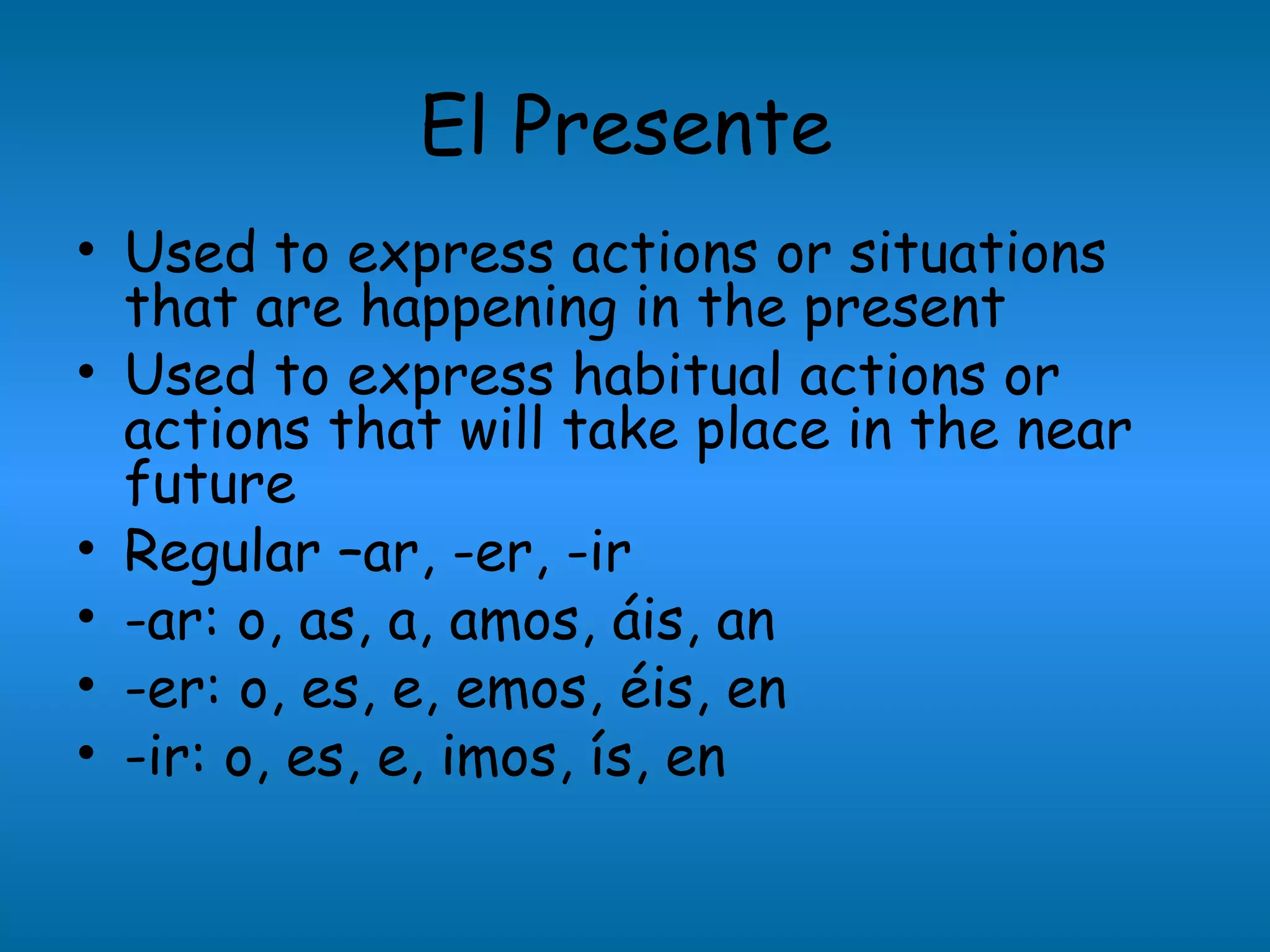
El Presente
• Used to express actions or situations
  that are happening in the present
• Used to express habitual actions or
  actions that will take place in the near
  future
• Regular –ar, -er, -ir
• -ar: o, as, a, amos, áis, an
• -er: o, es, e, emos, éis, en
• -ir: o, es, e, imos, ís, en
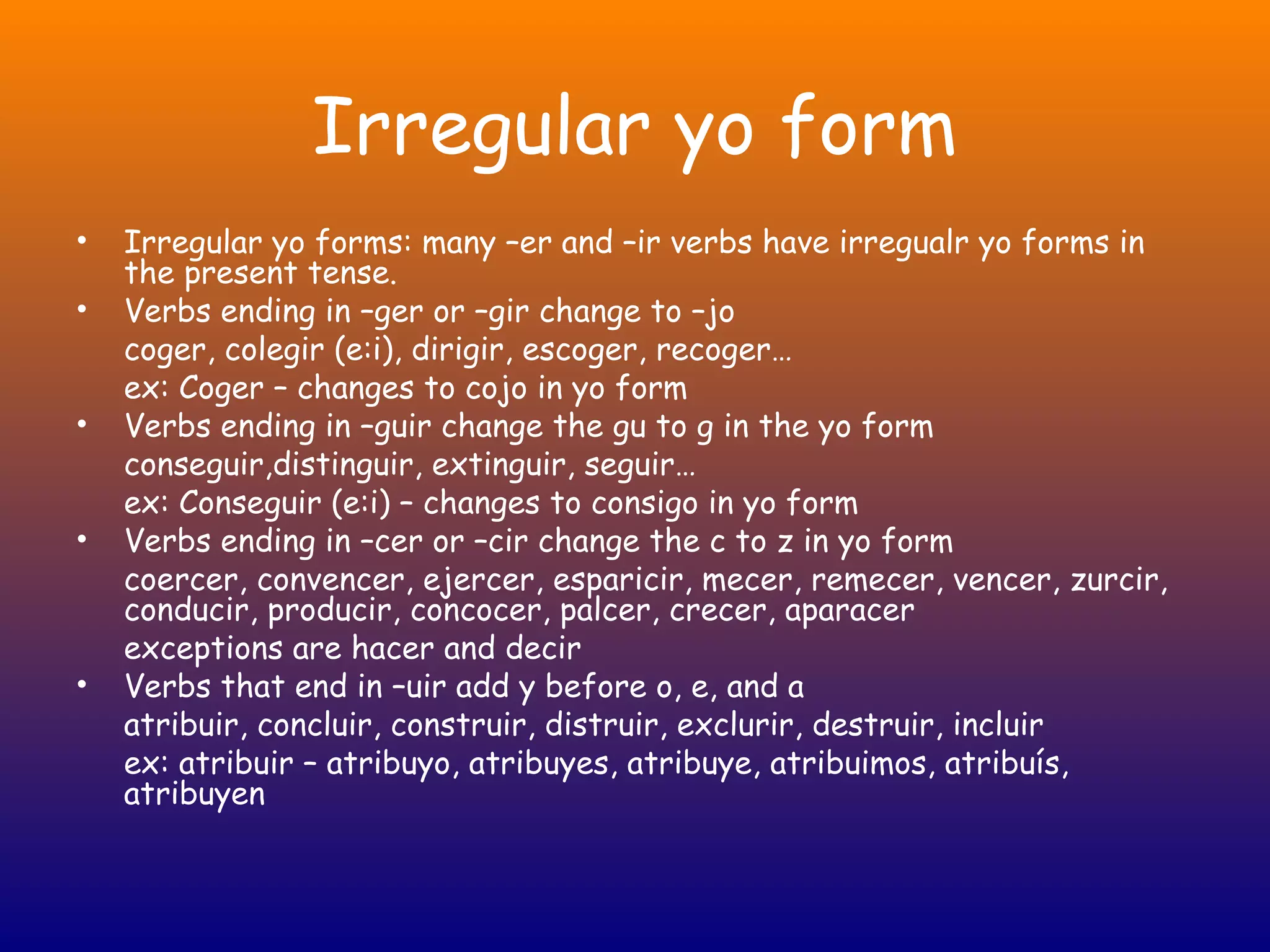
Irregular yo form
•   Irregular yo forms: many –er and –ir verbs have irregualr yo forms in
    the present tense.
•   Verbs ending in –ger or –gir change to –jo
    coger, colegir (e:i), dirigir, escoger, recoger…
    ex: Coger – changes to cojo in yo form
•   Verbs ending in –guir change the gu to g in the yo form
    conseguir,distinguir, extinguir, seguir…
    ex: Conseguir (e:i) – changes to consigo in yo form
•   Verbs ending in –cer or –cir change the c to z in yo form
    coercer, convencer, ejercer, esparicir, mecer, remecer, vencer, zurcir,
    conducir, producir, concocer, palcer, crecer, aparacer
    exceptions are hacer and decir
•   Verbs that end in –uir add y before o, e, and a
    atribuir, concluir, construir, distruir, exclurir, destruir, incluir
    ex: atribuir – atribuyo, atribuyes, atribuye, atribuimos, atribuís,
    atribuyen
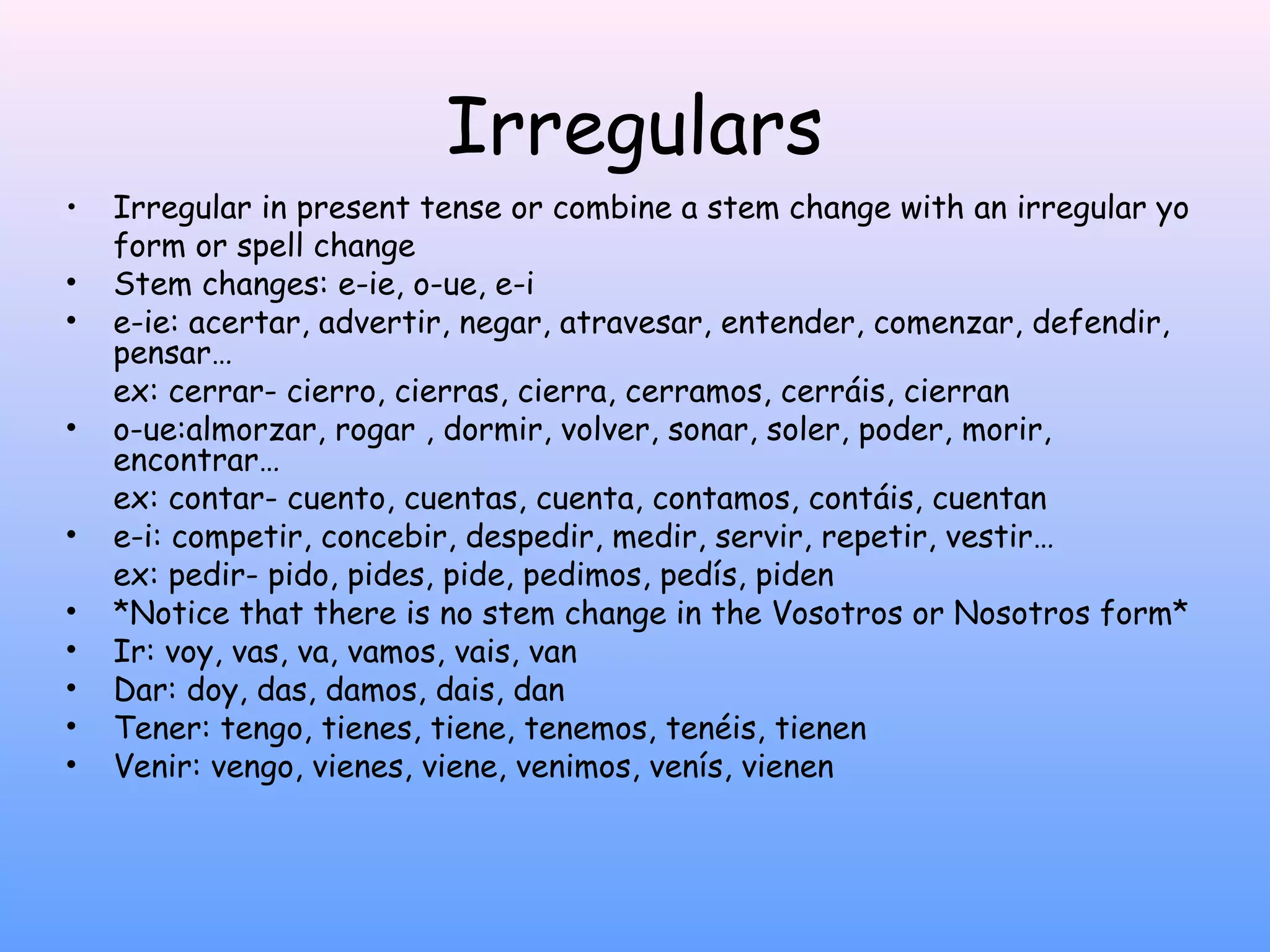
Irregulars
•   Irregular in present tense or combine a stem change with an irregular yo
    form or spell change
•   Stem changes: e-ie, o-ue, e-i
•   e-ie: acertar, advertir, negar, atravesar, entender, comenzar, defendir,
    pensar…
    ex: cerrar- cierro, cierras, cierra, cerramos, cerráis, cierran
•   o-ue:almorzar, rogar , dormir, volver, sonar, soler, poder, morir,
    encontrar…
    ex: contar- cuento, cuentas, cuenta, contamos, contáis, cuentan
•   e-i: competir, concebir, despedir, medir, servir, repetir, vestir…
    ex: pedir- pido, pides, pide, pedimos, pedís, piden
•   *Notice that there is no stem change in the Vosotros or Nosotros form*
•   Ir: voy, vas, va, vamos, vais, van
•   Dar: doy, das, damos, dais, dan
•   Tener: tengo, tienes, tiene, tenemos, tenéis, tienen
•   Venir: vengo, vienes, viene, venimos, venís, vienen
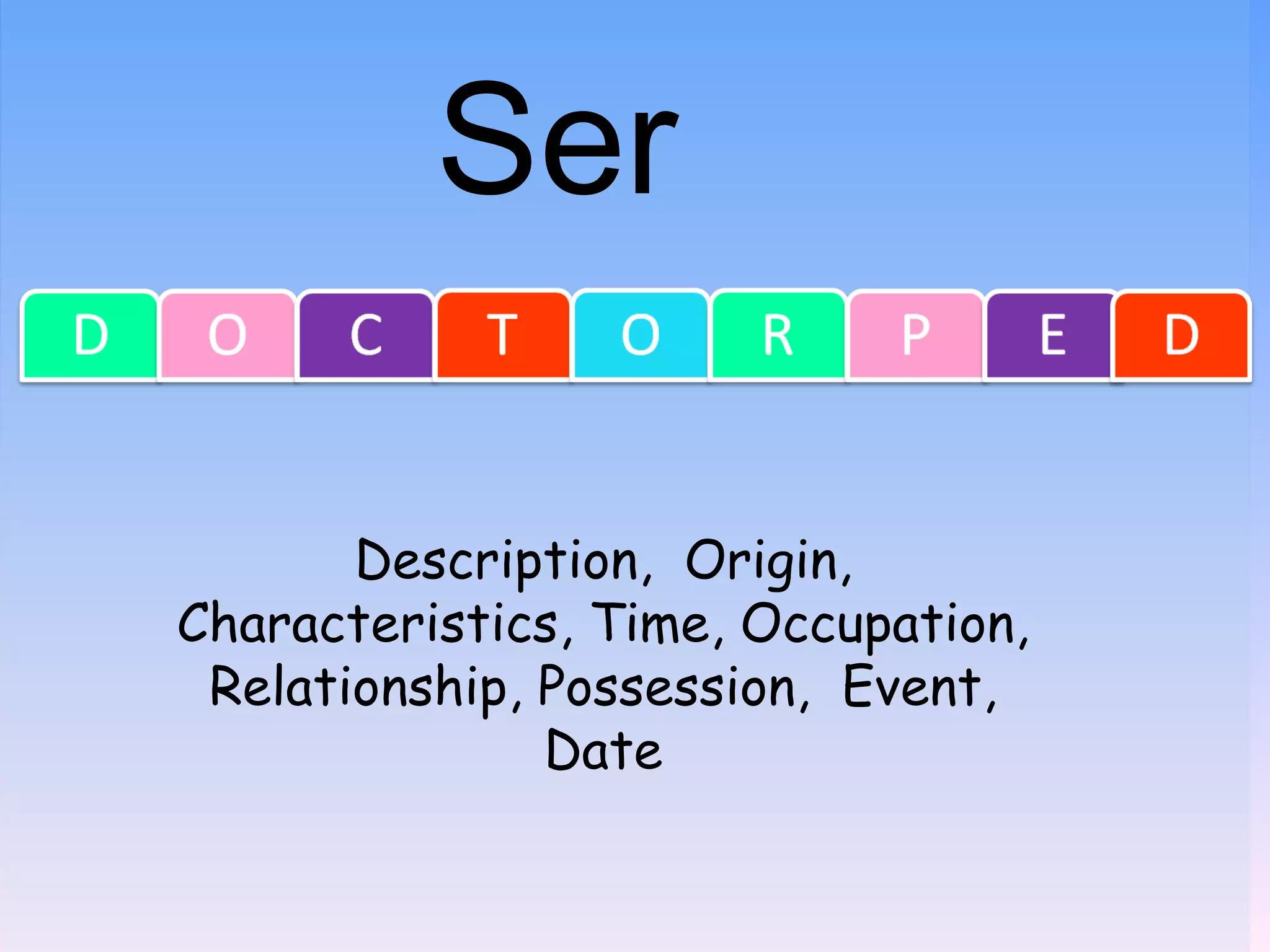
Ser

       Description, Origin,
Characteristics, Time, Occupation,
 Relationship, Possession, Event,
               Date
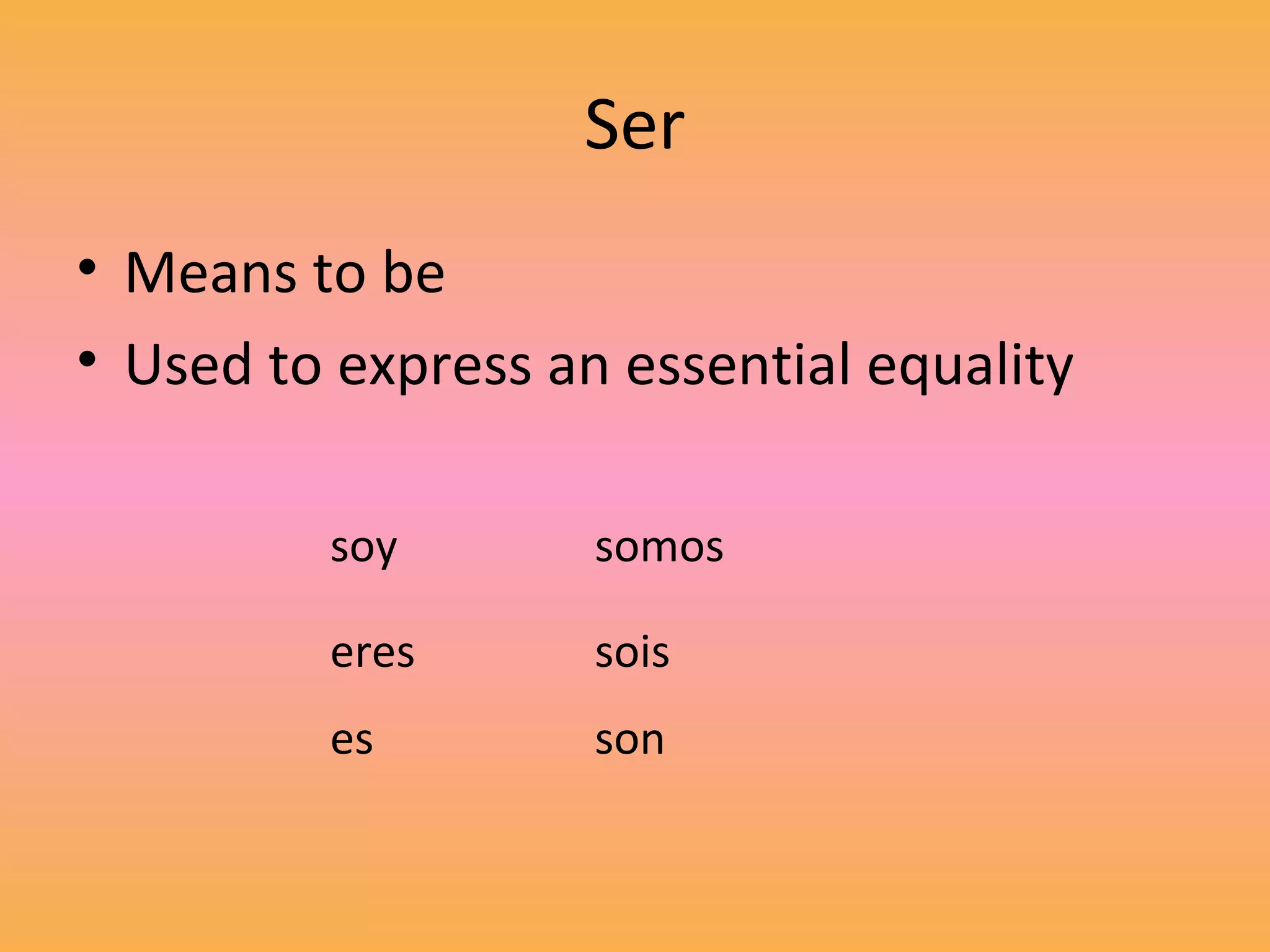
Ser
• Means to be
• Used to express an essential equality

         soy        somos

         eres       sois
         es         son
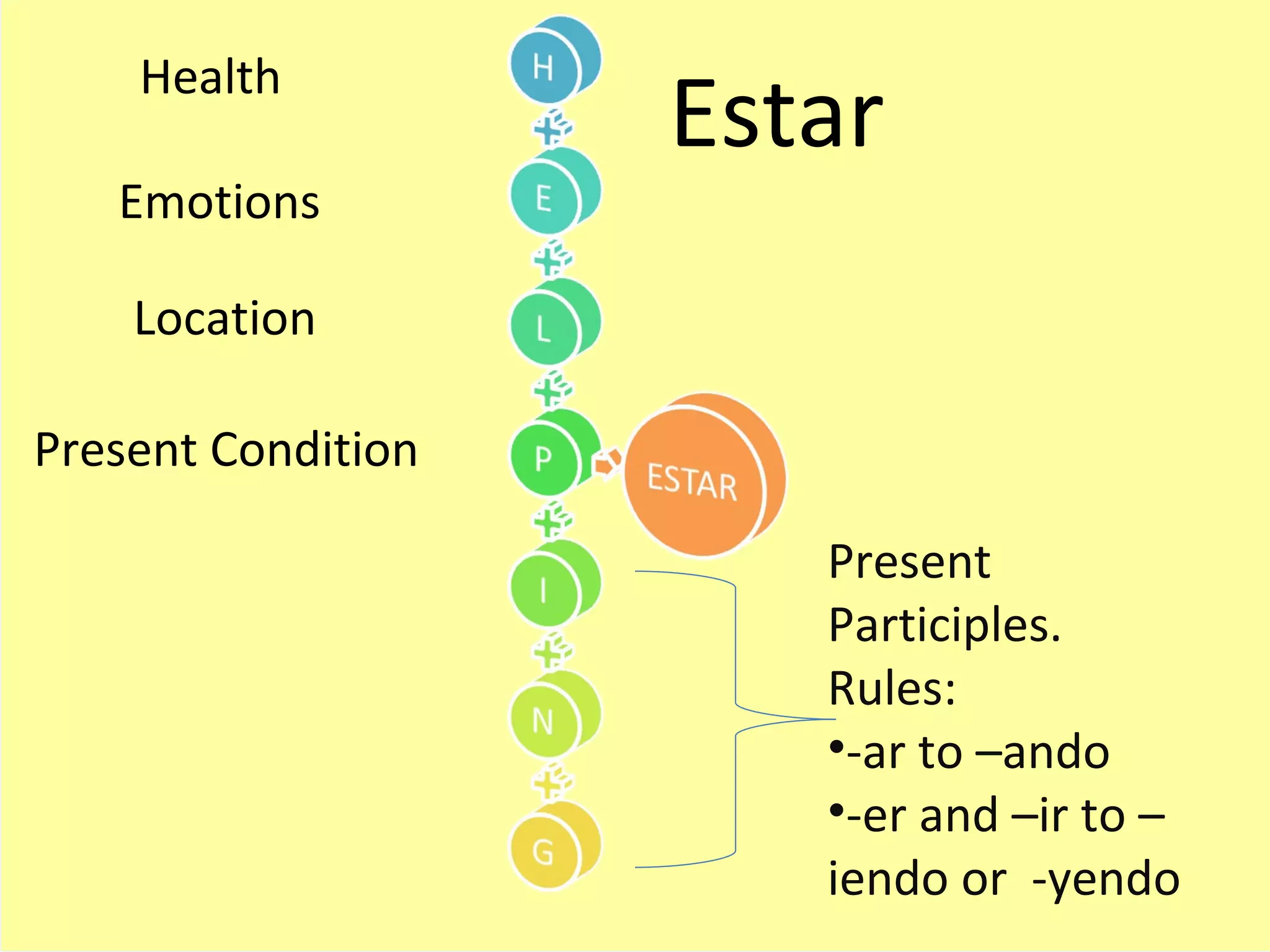
Health
                    Estar
   Emotions

    Location

Present Condition

                       Present
                       Participles.
                       Rules:
                       •-ar to –ando
                       •-er and –ir to –
                       iendo or -yendo
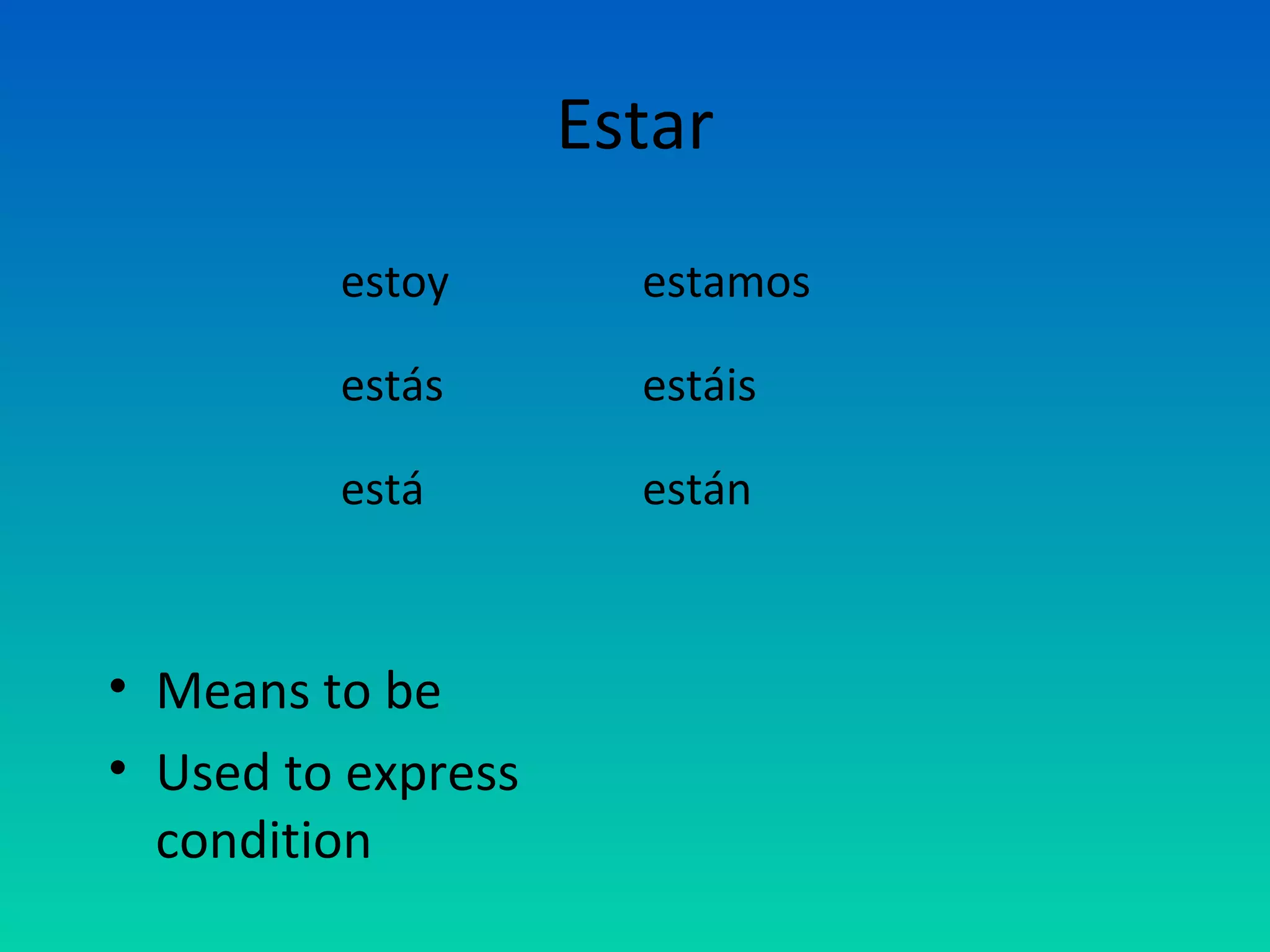
Estar
         estoy        estamos

         estás        estáis

         está         están


• Means to be
• Used to express
  condition
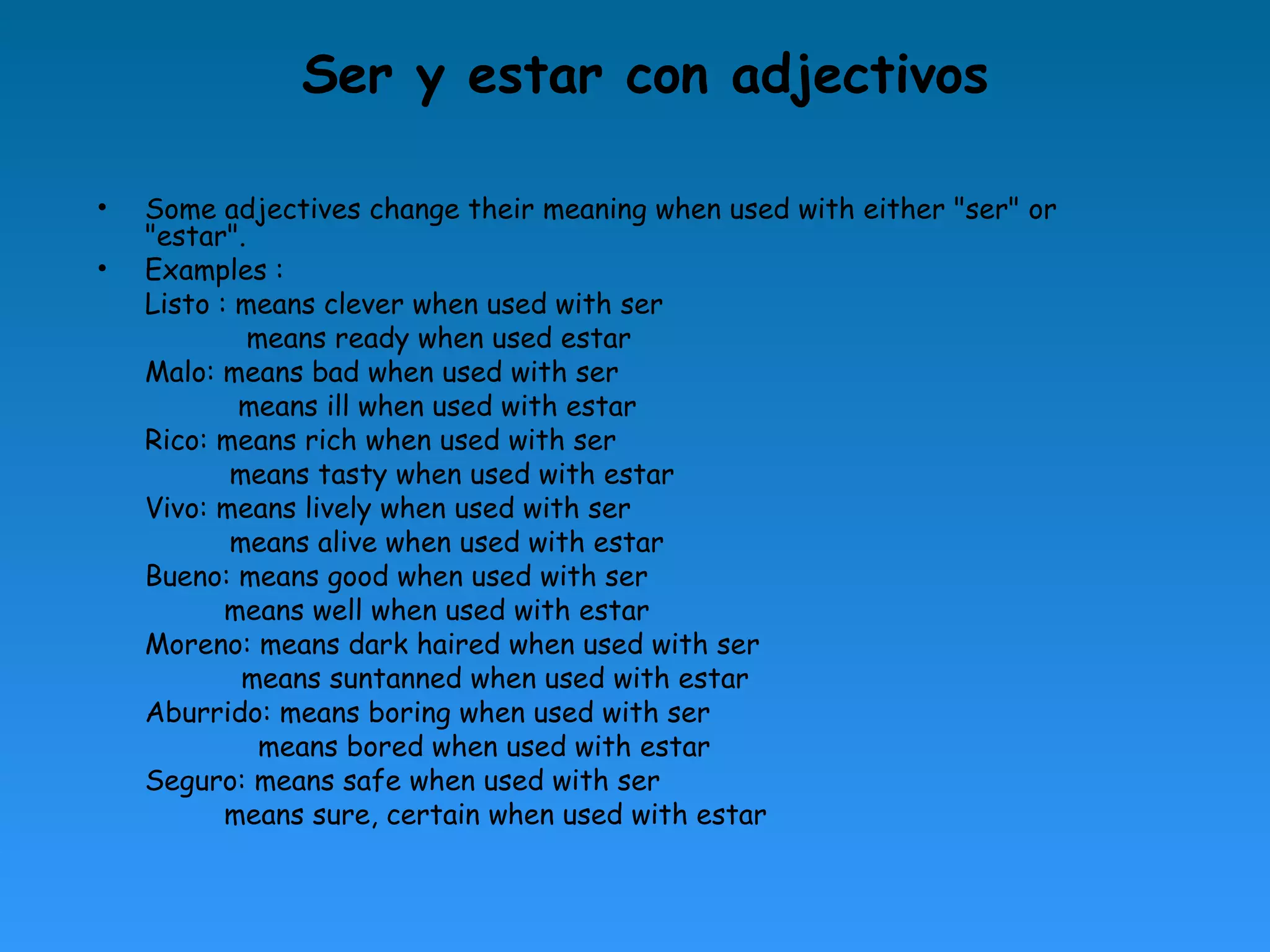
Ser y estar con adjectivos

•   Some adjectives change their meaning when used with either "ser" or
    "estar".
•   Examples :
    Listo : means clever when used with ser
             means ready when used estar
    Malo: means bad when used with ser
            means ill when used with estar
    Rico: means rich when used with ser
           means tasty when used with estar
    Vivo: means lively when used with ser
           means alive when used with estar
    Bueno: means good when used with ser
           means well when used with estar
    Moreno: means dark haired when used with ser
            means suntanned when used with estar
    Aburrido: means boring when used with ser
              means bored when used with estar
    Seguro: means safe when used with ser
           means sure, certain when used with estar
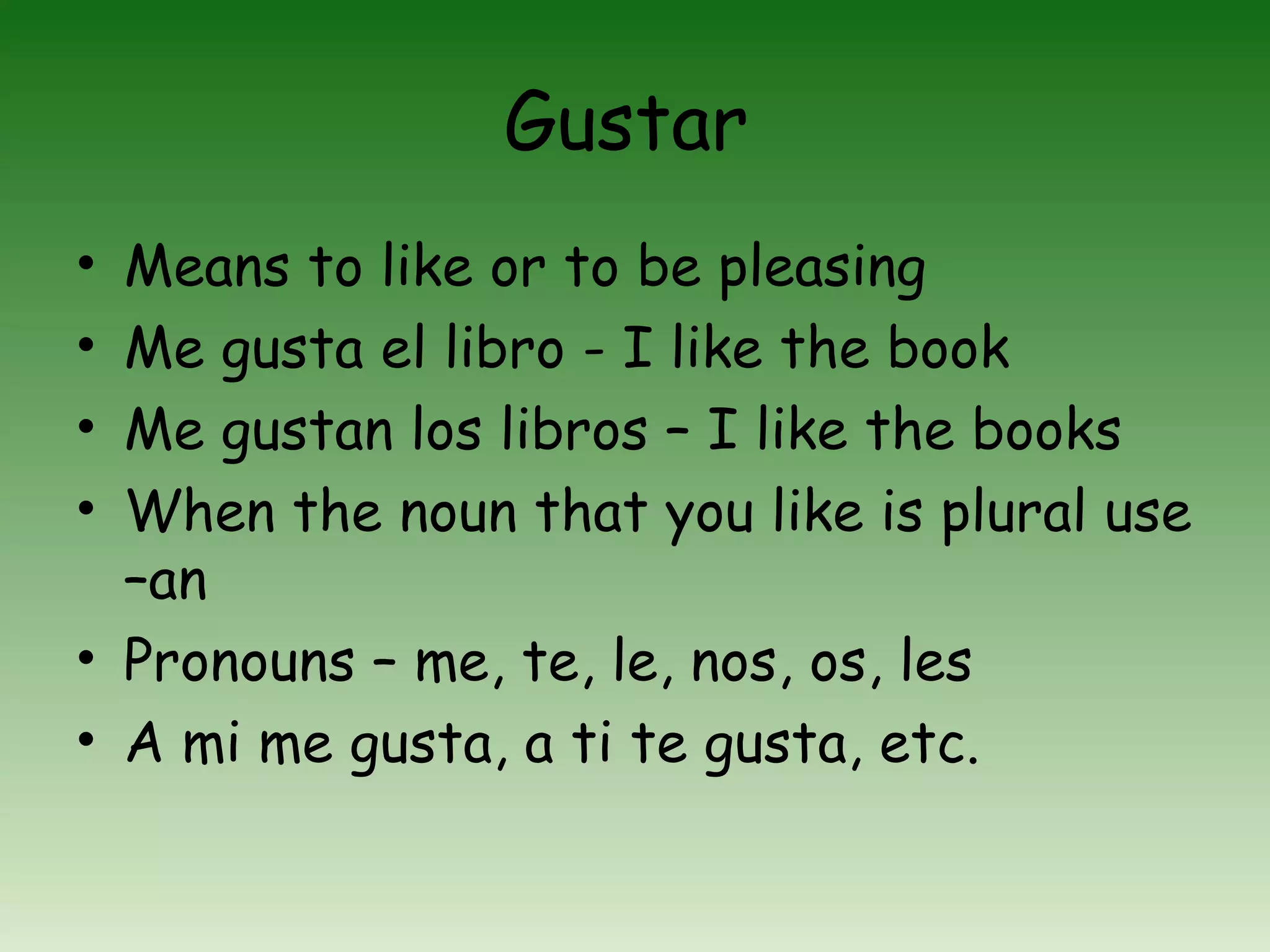
Gustar
• Means to like or to be pleasing
• Me gusta el libro - I like the book
• Me gustan los libros – I like the books
• When the noun that you like is plural use
  –an
• Pronouns – me, te, le, nos, os, les
• A mi me gusta, a ti te gusta, etc.
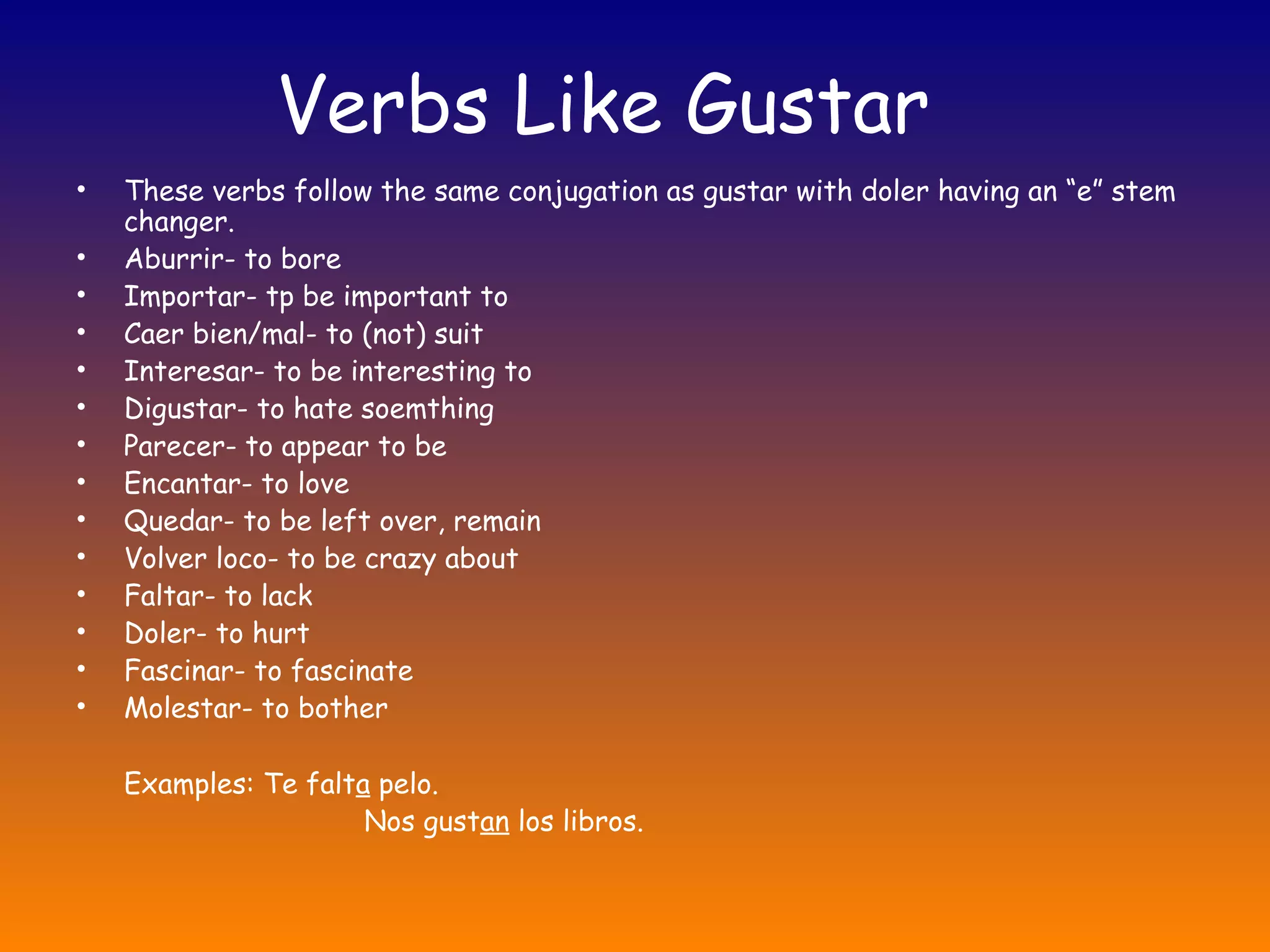
Verbs Like Gustar
•   These verbs follow the same conjugation as gustar with doler having an “e” stem
    changer.
•   Aburrir- to bore
•   Importar- tp be important to
•   Caer bien/mal- to (not) suit
•   Interesar- to be interesting to
•   Digustar- to hate soemthing
•   Parecer- to appear to be
•   Encantar- to love
•   Quedar- to be left over, remain
•   Volver loco- to be crazy about
•   Faltar- to lack
•   Doler- to hurt
•   Fascinar- to fascinate
•   Molestar- to bother

    Examples: Te falta pelo.
                      Nos gustan los libros.
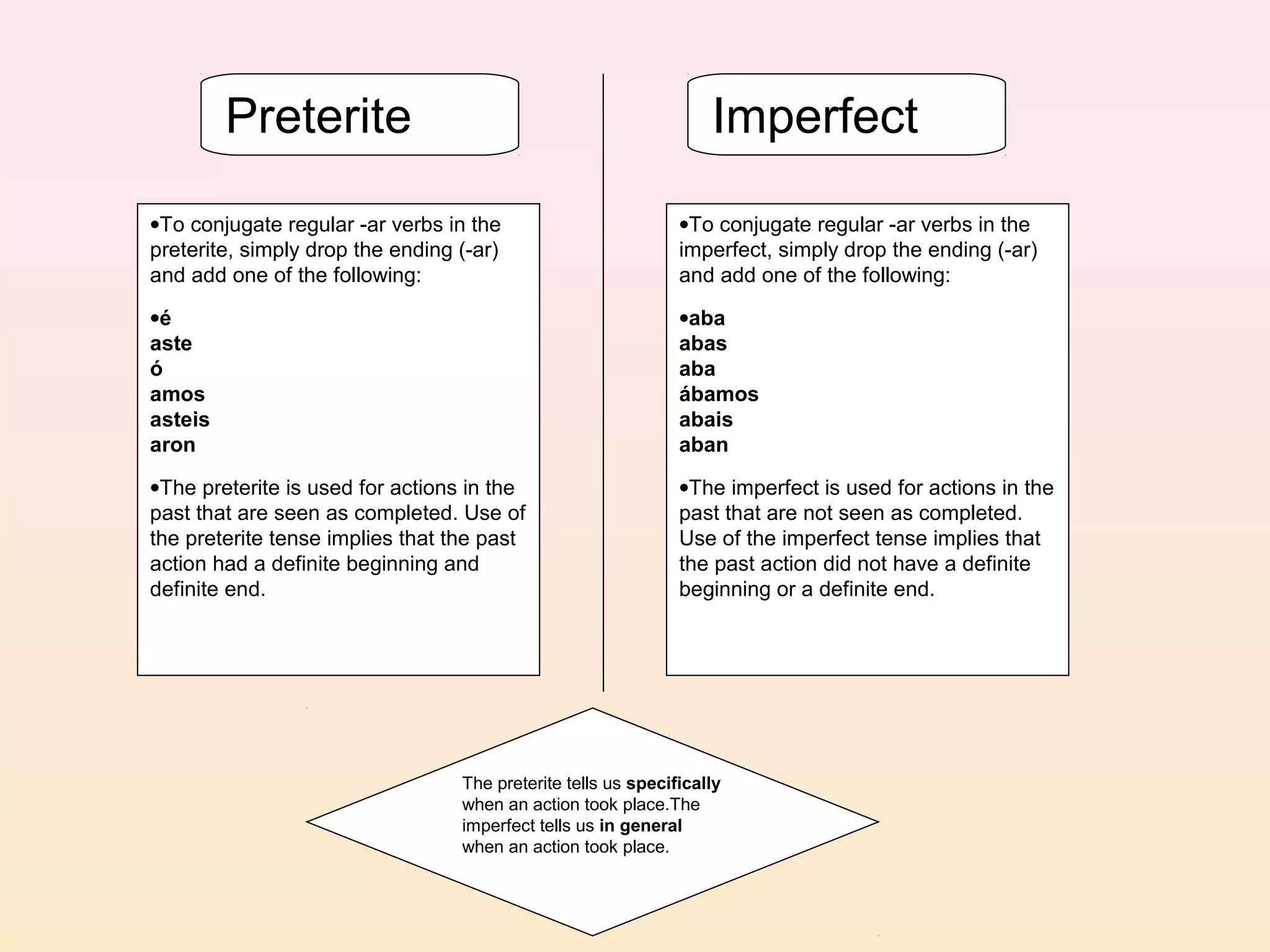
Preterite                                                 Imperfect
•To conjugate regular -ar verbs in the                         •To conjugate regular -ar verbs in the
preterite, simply drop the ending (-ar)                        imperfect, simply drop the ending (-ar)
and add one of the following:                                  and add one of the following:
•é                                                             •aba
aste                                                           abas
ó                                                              aba
amos                                                           ábamos
asteis                                                         abais
aron                                                           aban
•The preterite is used for actions in the                      •The imperfect is used for actions in the
past that are seen as completed. Use of                        past that are not seen as completed.
the preterite tense implies that the past                      Use of the imperfect tense implies that
action had a definite beginning and                            the past action did not have a definite
definite end.                                                  beginning or a definite end.


                                  The preterite tells us specifically
                                  when an action took place.The
                                  imperfect tells us in general
                                  when an action took place.
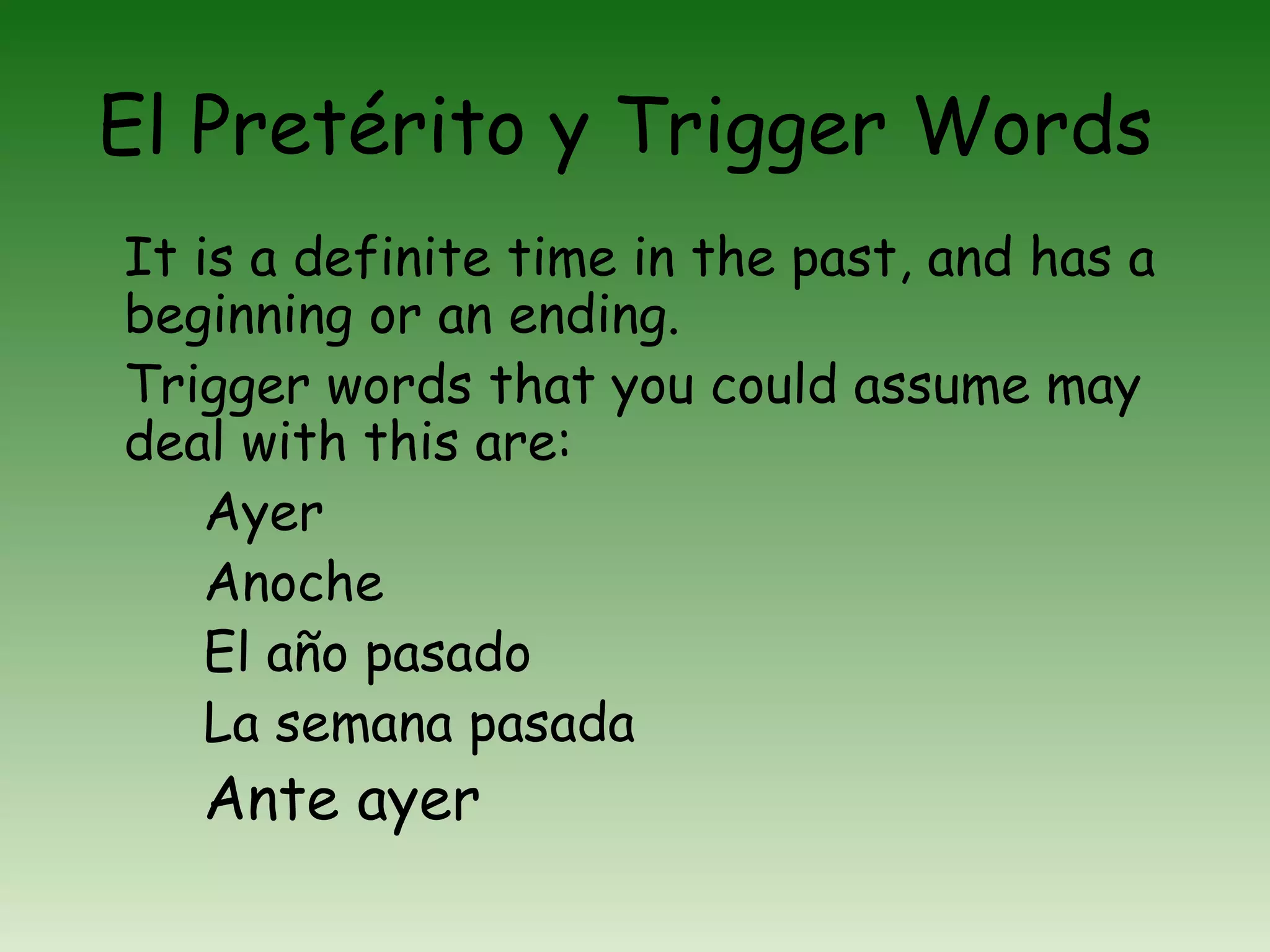
El Pretérito y Trigger Words
It is a definite time in the past, and has a
beginning or an ending.
Trigger words that you could assume may
deal with this are:
    Ayer
    Anoche
    El año pasado
    La semana pasada
   Ante ayer
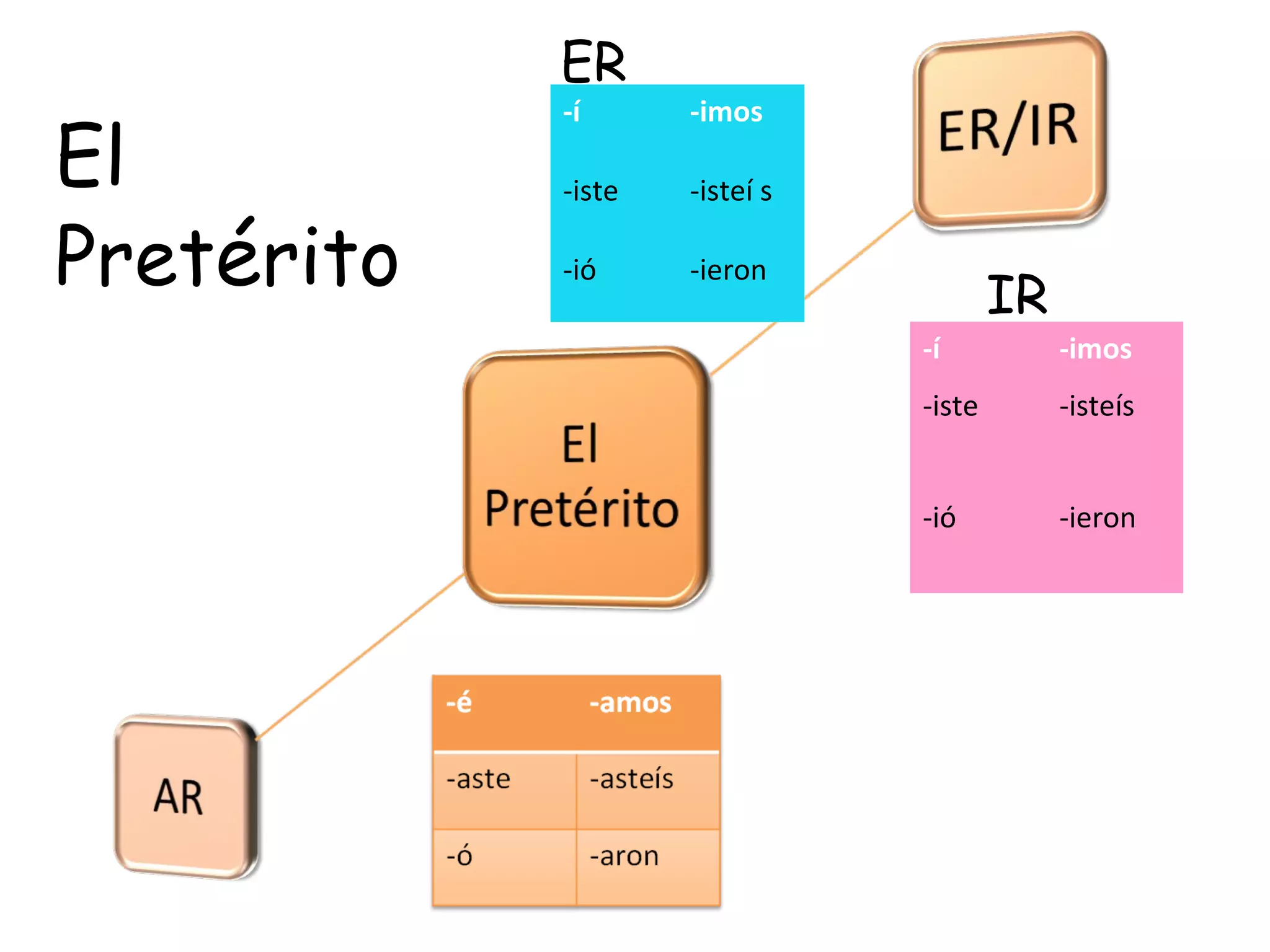
ER
            -í      -imos
El          -iste   -isteí s

Pretérito   -ió     -ieron
                                       IR
                               -í           -imos
                               -iste        -isteís


                               -ió          -ieron
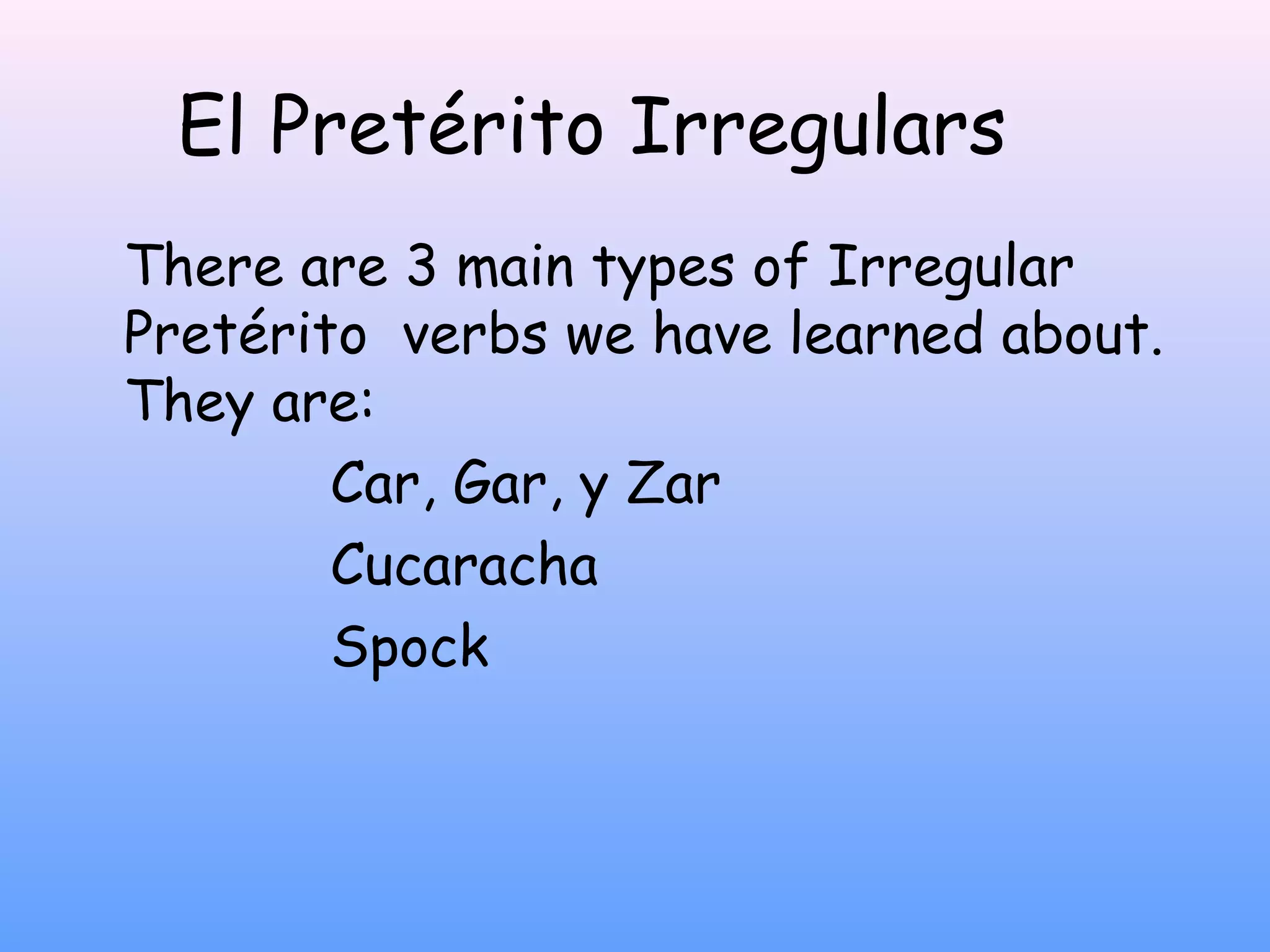
El Pretérito Irregulars
There are 3 main types of Irregular
Pretérito verbs we have learned about.
They are:
        Car, Gar, y Zar
        Cucaracha
        Spock
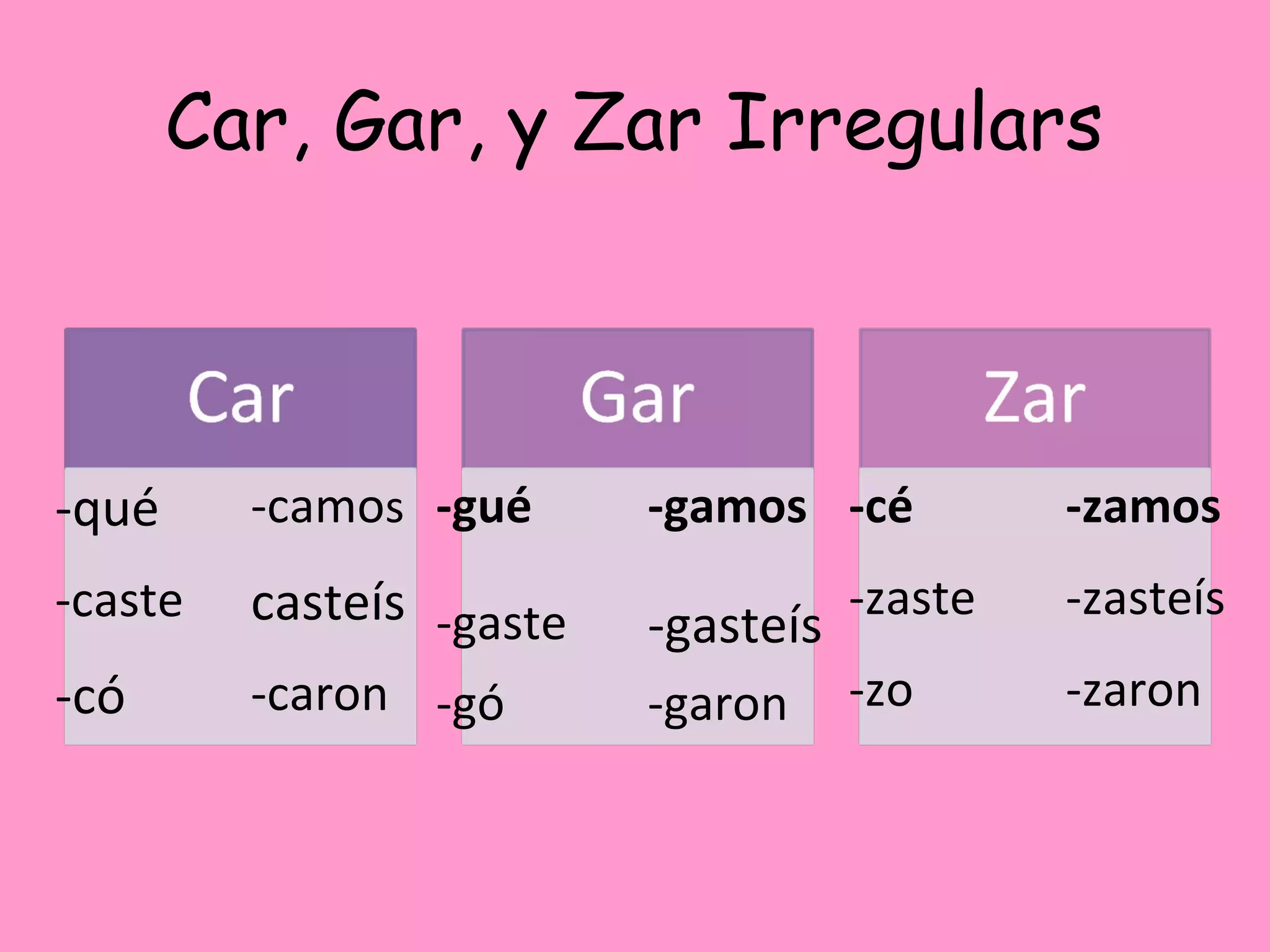
Car, Gar, y Zar Irregulars


-qué     -camos -gué      -gamos -cé          -zamos
-caste   casteís -gaste              -zaste   -zasteís
                          -gasteís
-có      -caron -gó       -garon     -zo      -zaron
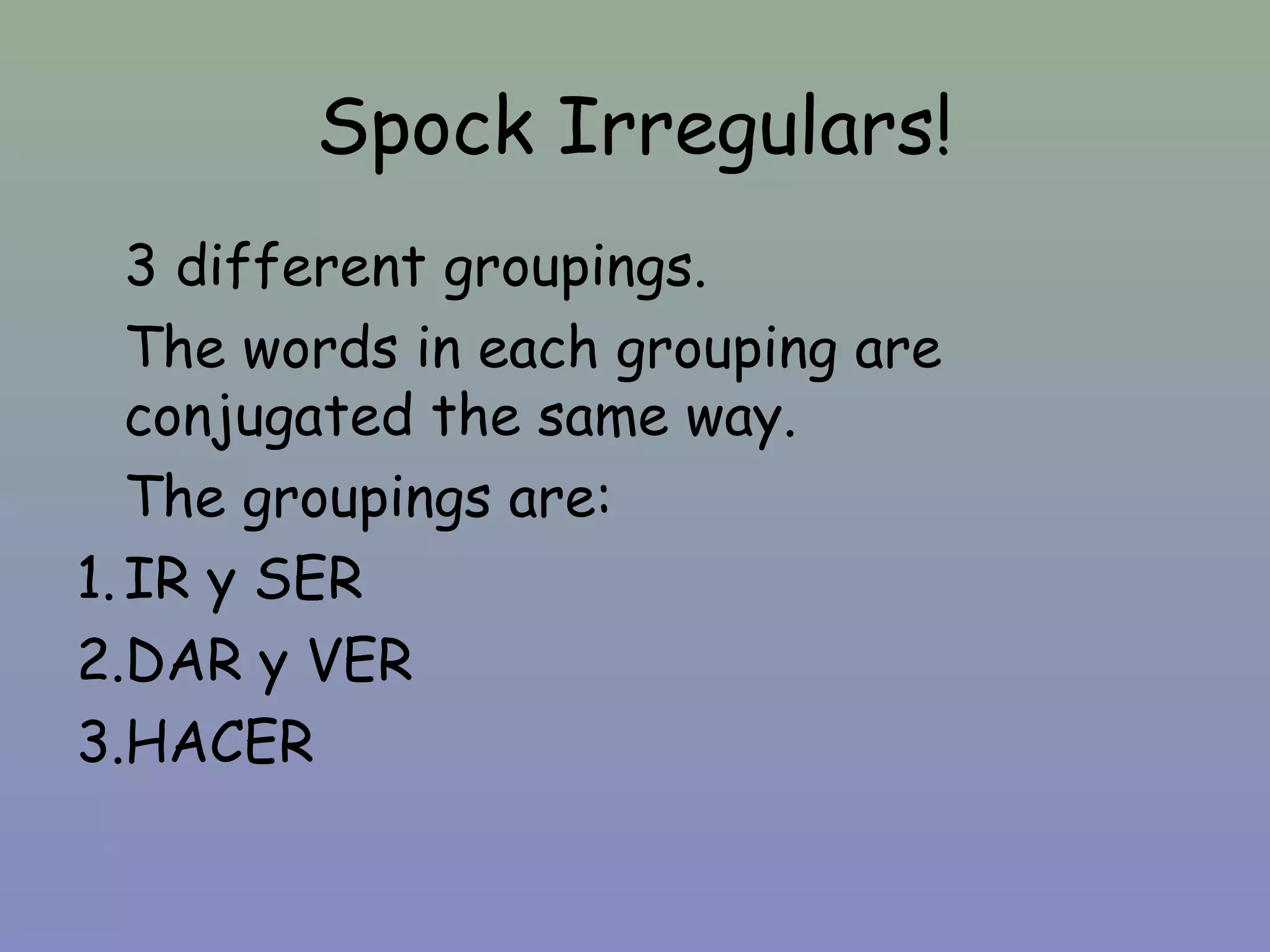
Spock Irregulars!
   3 different groupings.
   The words in each grouping are
   conjugated the same way.
   The groupings are:
1. IR y SER
2.DAR y VER
3.HACER
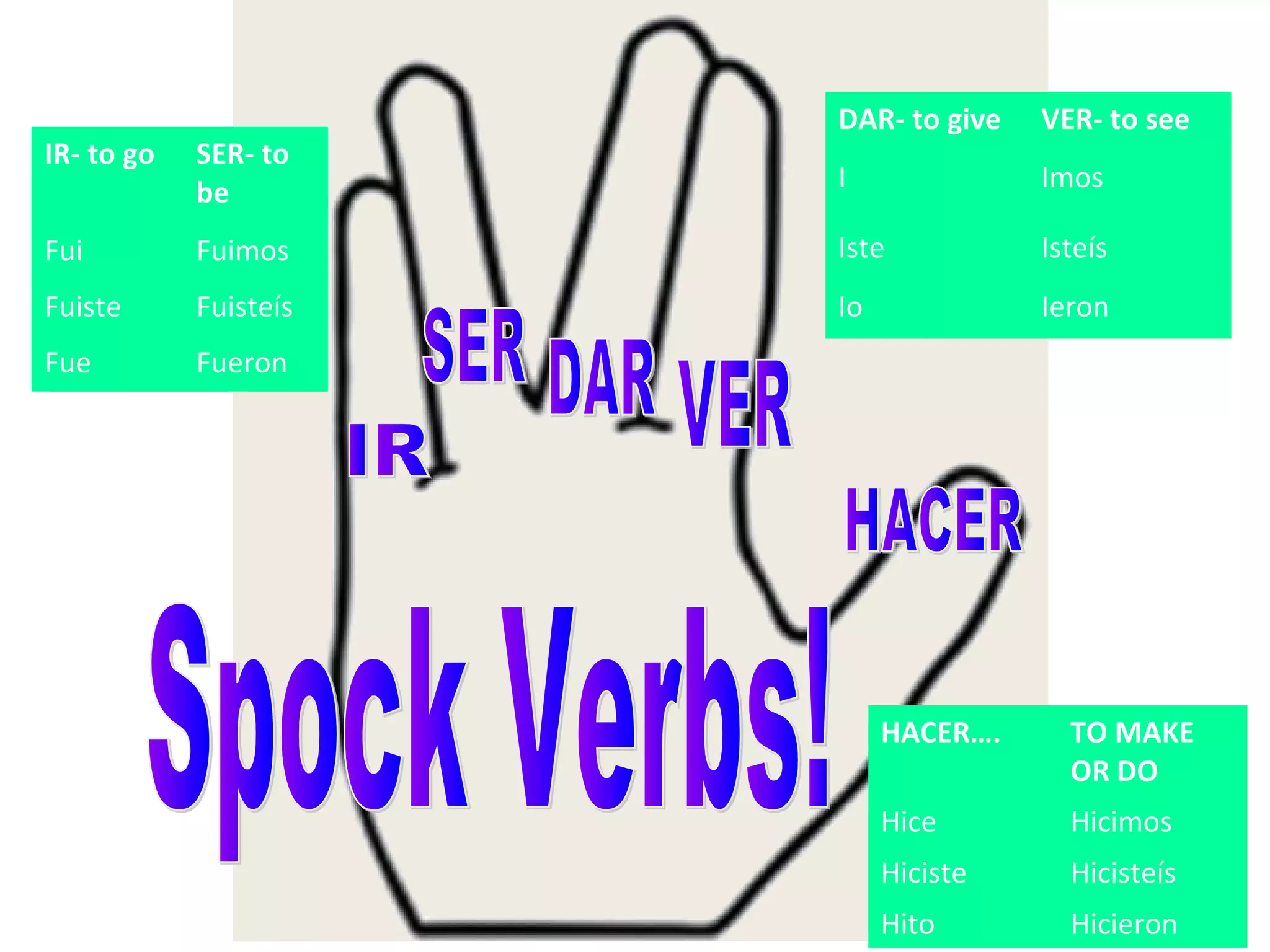
DAR- to give   VER- to see
IR- to go   SER- to
            be         I              Imos

Fui         Fuimos     Iste           Isteís
Fuiste      Fuisteís   Io             Ieron
Fue         Fueron


                            HACER….     TO MAKE
                                        OR DO
                            Hice        Hicimos
                            Hiciste     Hicisteís
                            Hito        Hicieron
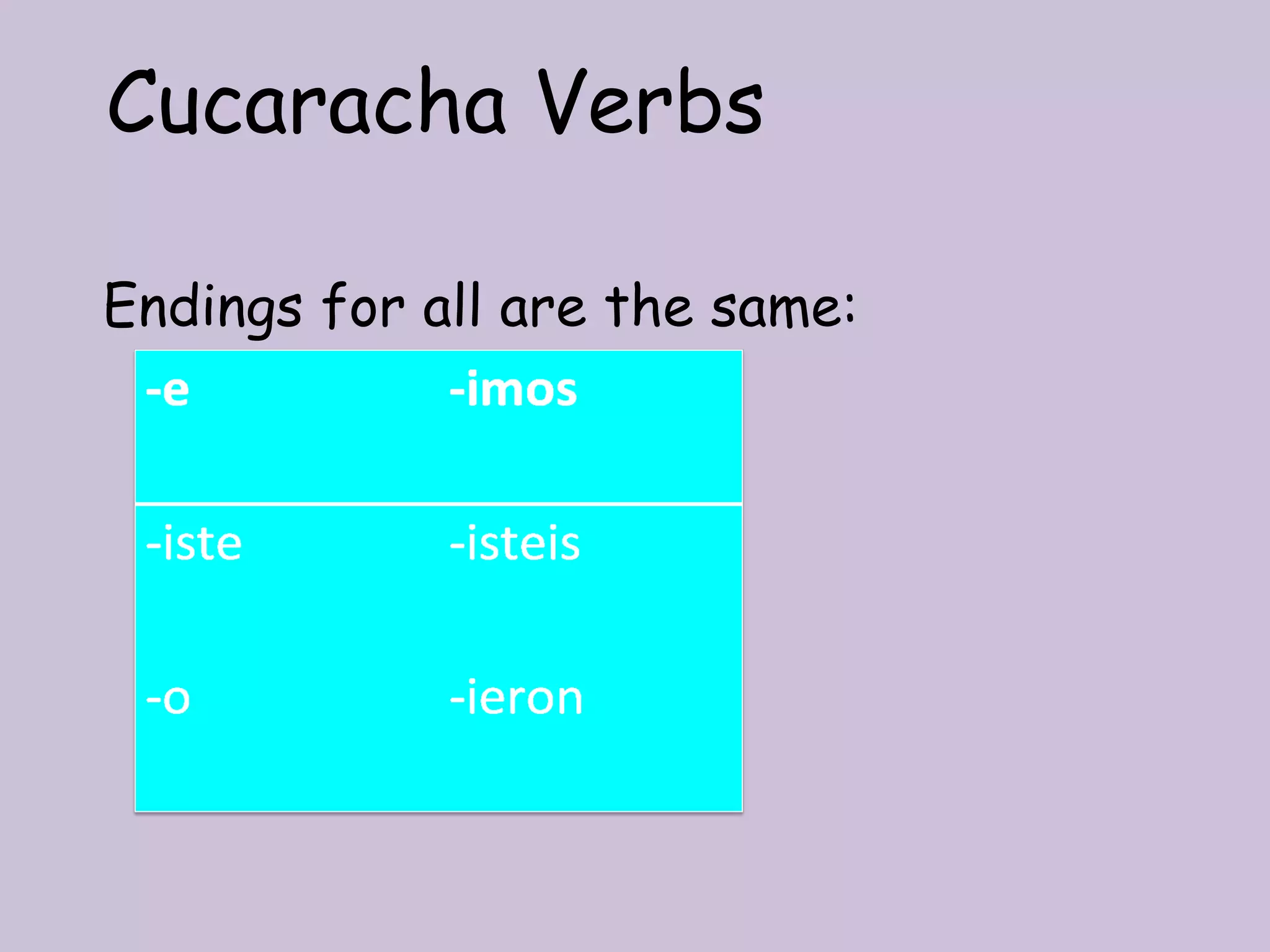
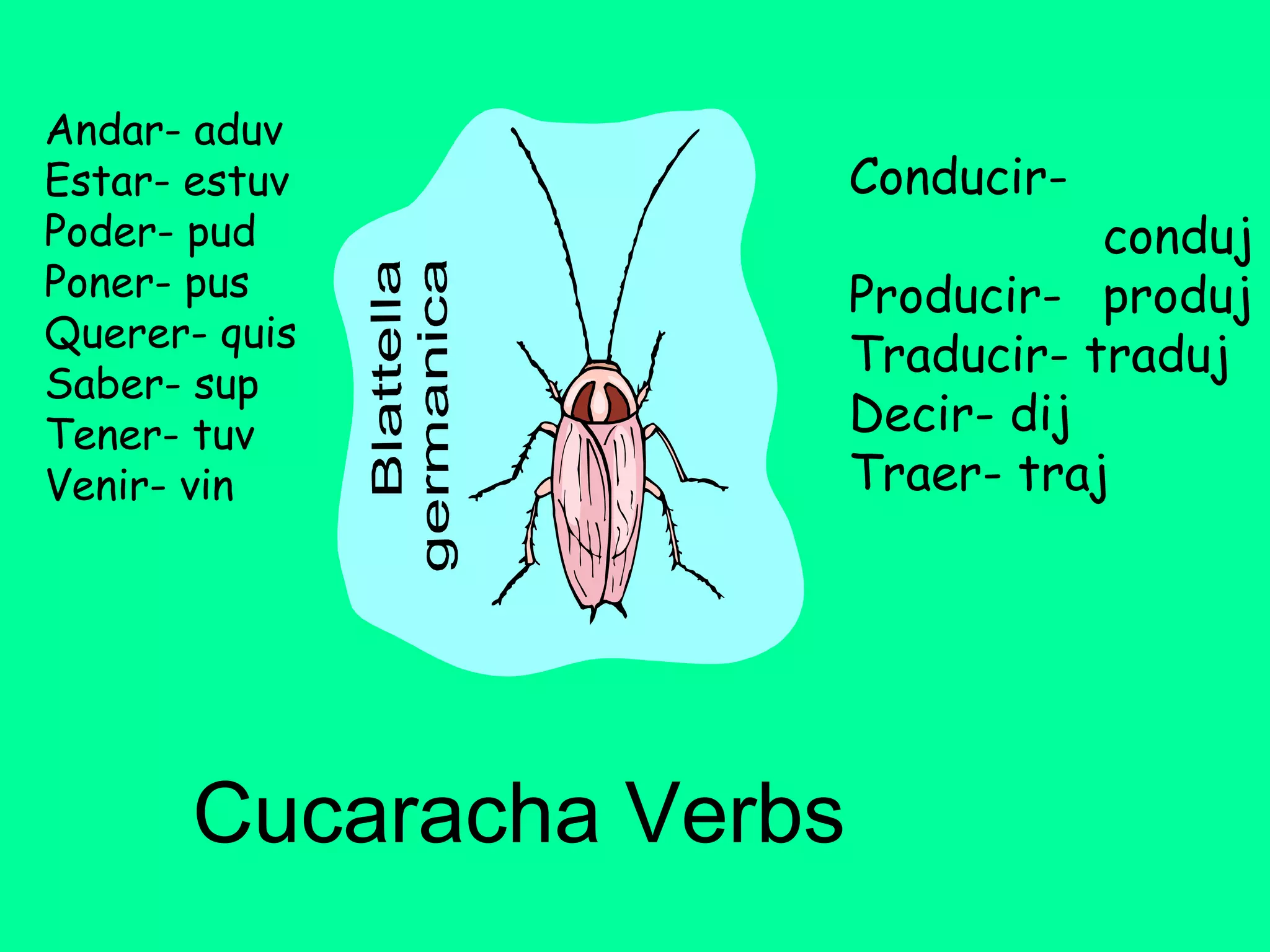
Cucaracha Verbs

Endings for all are the same:
Andar- aduv
Estar- estuv             Conducir-
Poder- pud                          conduj
Poner- pus               Producir- produj
Querer- quis
                         Traducir- traduj
Saber- sup
Tener- tuv               Decir- dij
Venir- vin               Traer- traj


       Cucaracha Verbs
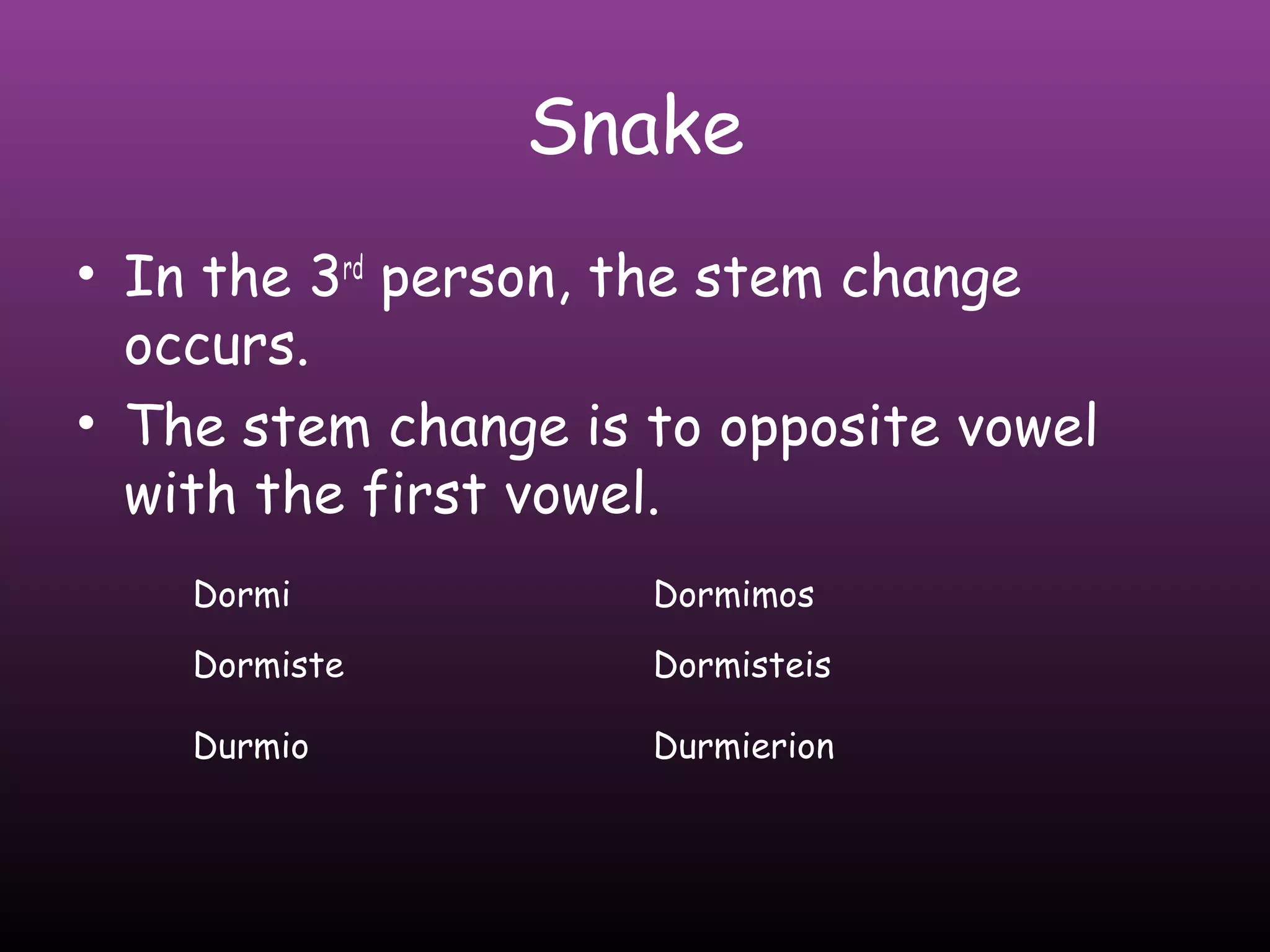
Snake
• In the 3rd person, the stem change
  occurs.
• The stem change is to opposite vowel
  with the first vowel.
    Dormi            Dormimos

    Dormiste         Dormisteis

    Durmio           Durmierion
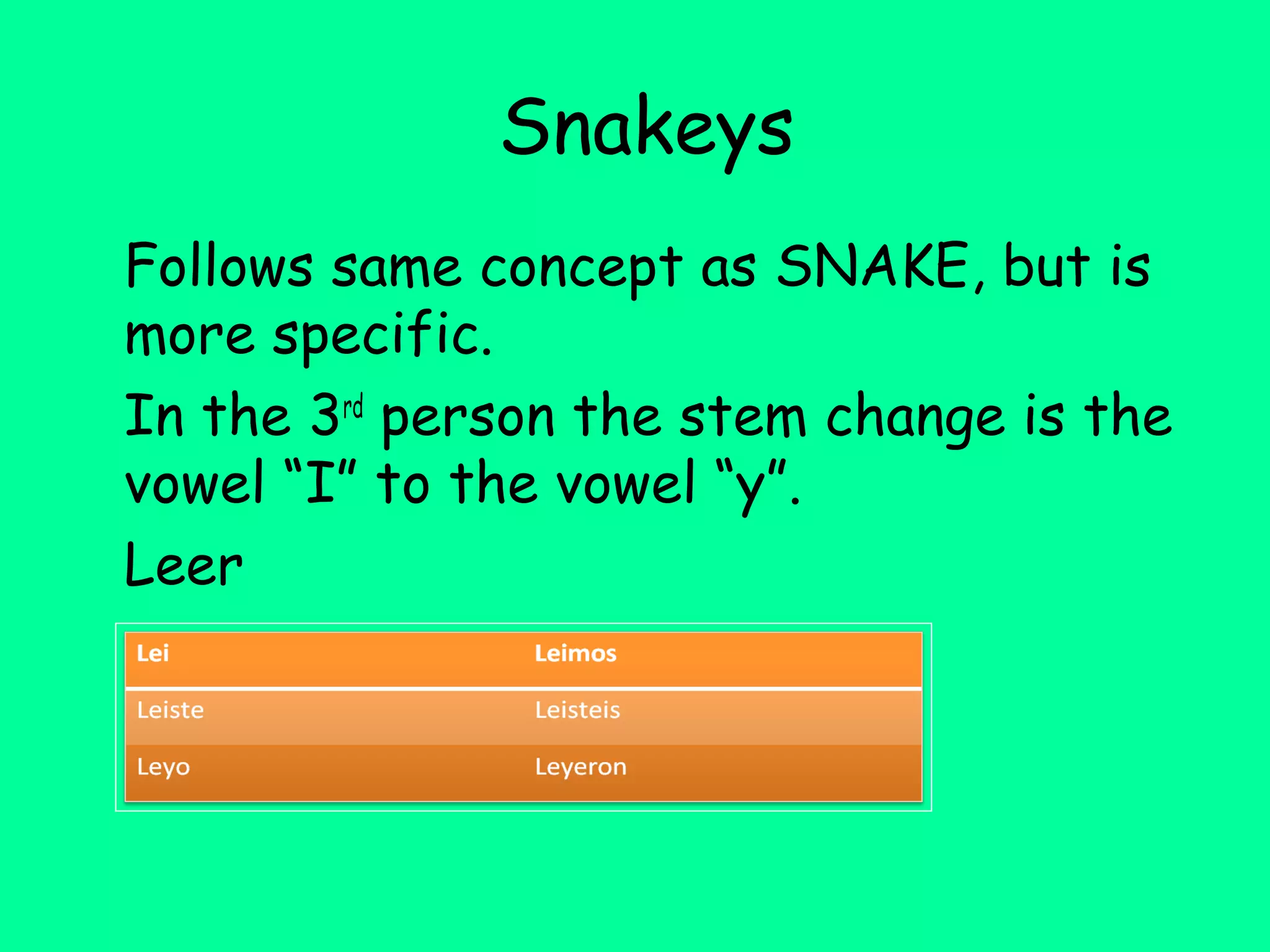
Snakeys
Follows same concept as SNAKE, but is
more specific.
In the 3rd person the stem change is the
vowel “I” to the vowel “y”.
Leer
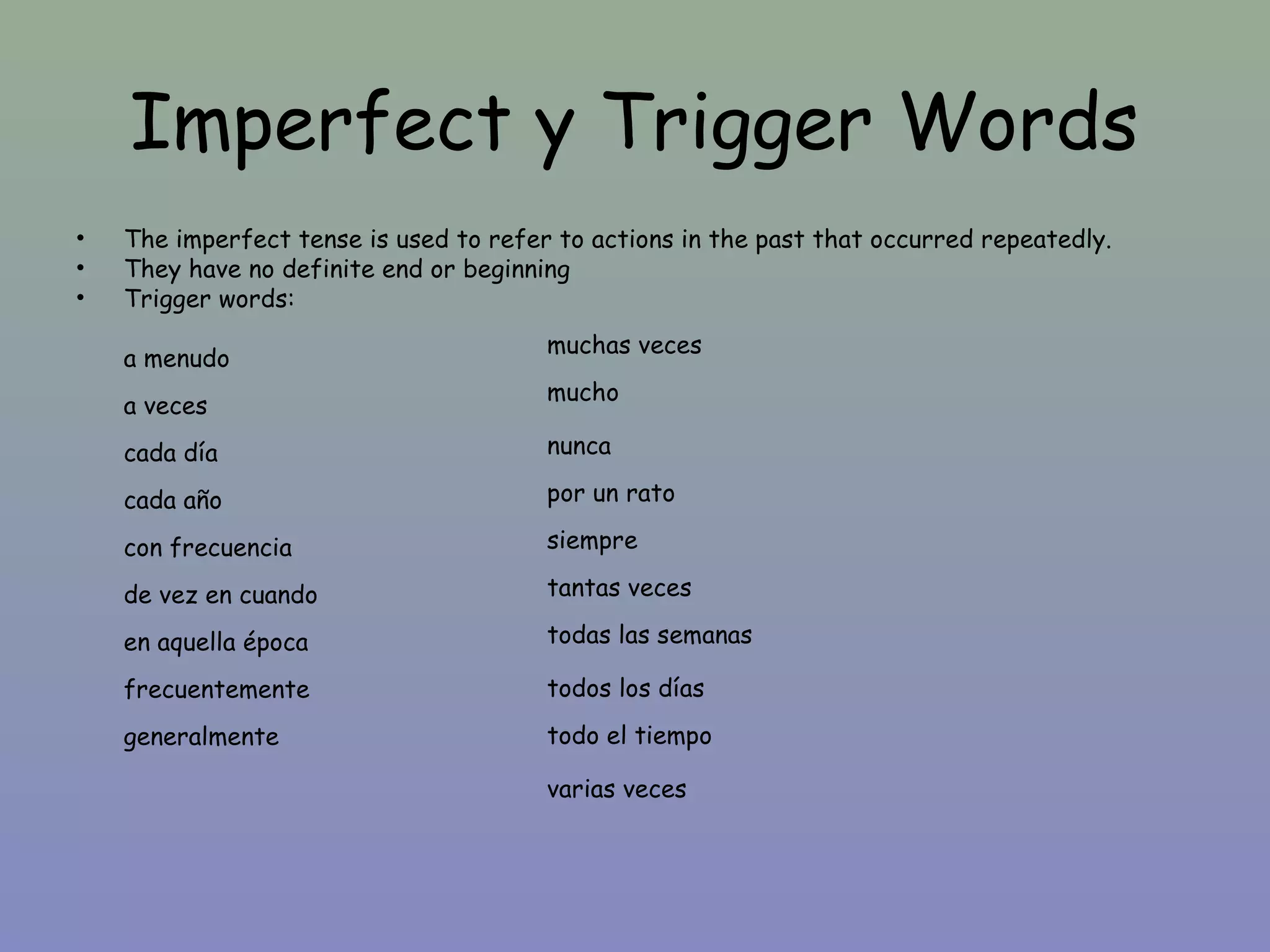
Imperfect y Trigger Words
•   The imperfect tense is used to refer to actions in the past that occurred repeatedly.
•   They have no definite end or beginning
•   Trigger words:
                                        muchas veces
    a menudo
                                        mucho
    a veces
    cada día                            nunca

    cada año                            por un rato

    con frecuencia                      siempre

    de vez en cuando                    tantas veces

    en aquella época                    todas las semanas

    frecuentemente                      todos los días
    generalmente                        todo el tiempo

                                        varias veces
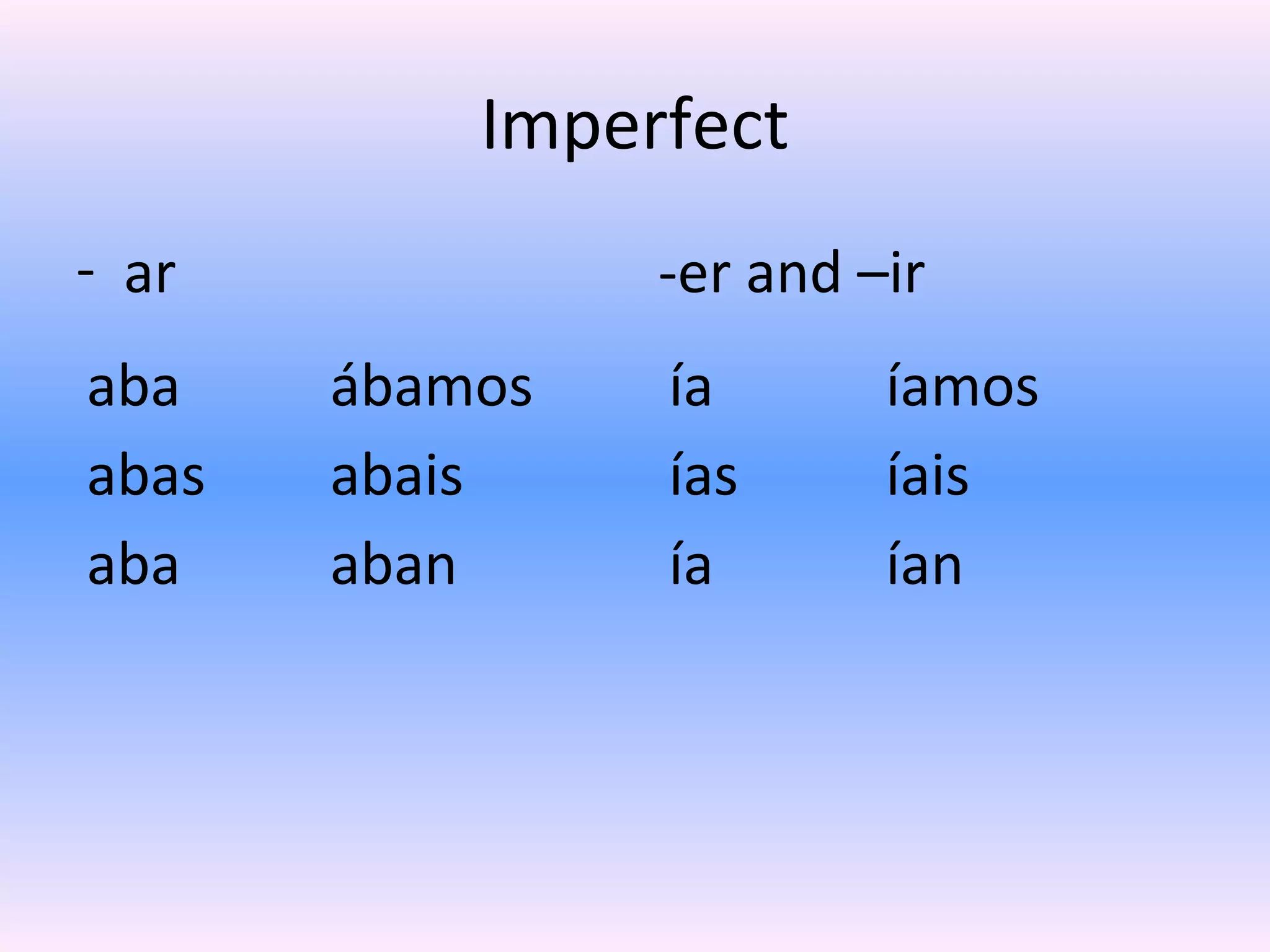
Imperfect
- ar            -er and –ir
aba    ábamos   ía       íamos
abas   abais    ías      íais
aba    aban     ía       ían
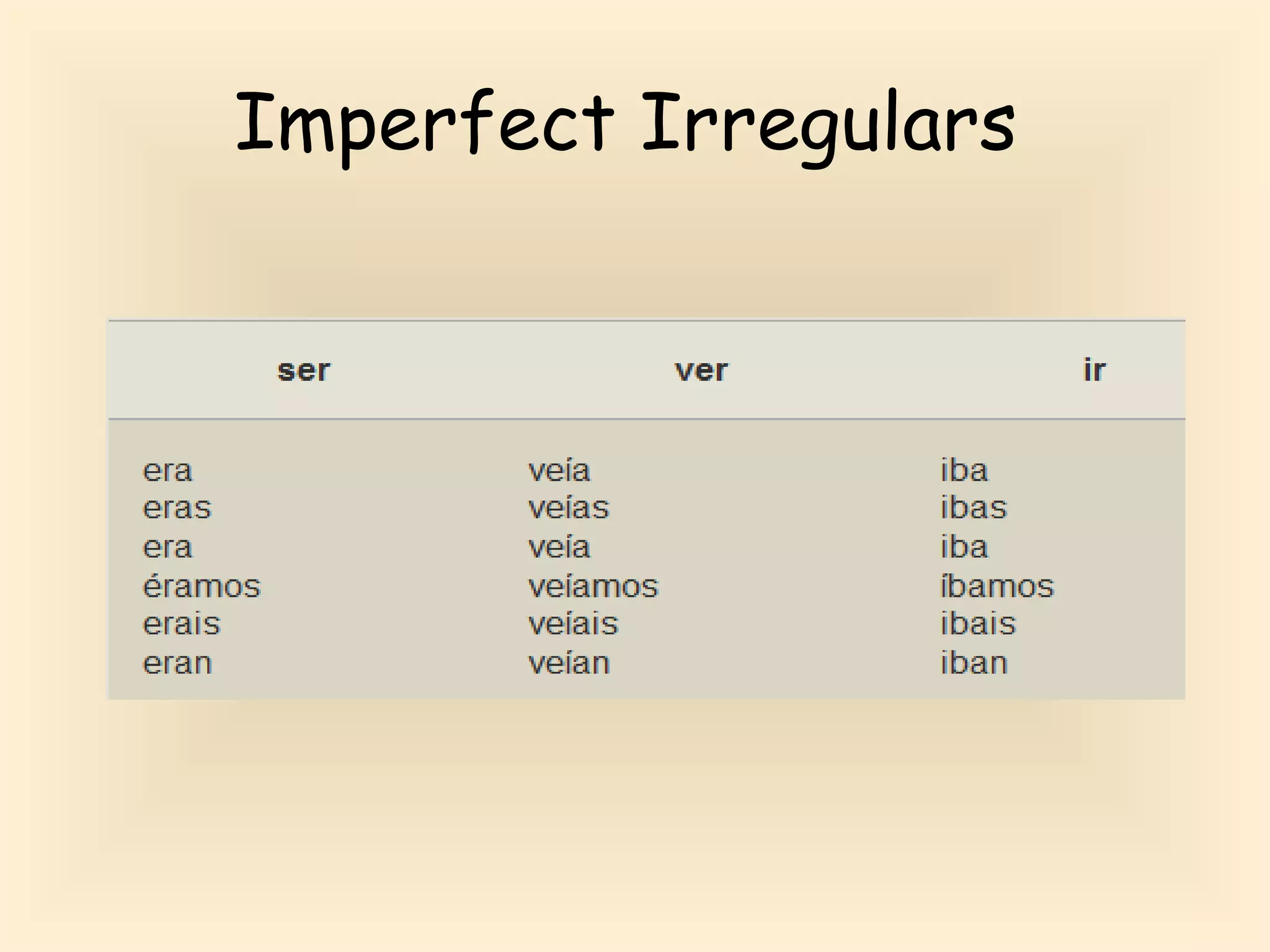
Imperfect Irregulars

G bspanish4 part one

  • 1.
    Spanish 4 Grammar Concepts Heli Martin
  • 2.
    Table of Contents 1. El Presente 2. Irregular yo form 3. Irregulars 4. Ser 5. Estar 6. Ser y estar con adjectivos 7. Gustar 8. Verbs like gustar 9. Preterite v Imperfect 10. Preterite y trigger words 11. Preterite Conjugation 12. Preterite Irregulars 13. Imperfect y trigger words 14. Imperfect conjugation 15. Imperfect Irregulars
  • 3.
    El Presente • Usedto express actions or situations that are happening in the present • Used to express habitual actions or actions that will take place in the near future • Regular –ar, -er, -ir • -ar: o, as, a, amos, áis, an • -er: o, es, e, emos, éis, en • -ir: o, es, e, imos, ís, en
  • 4.
    Irregular yo form • Irregular yo forms: many –er and –ir verbs have irregualr yo forms in the present tense. • Verbs ending in –ger or –gir change to –jo coger, colegir (e:i), dirigir, escoger, recoger… ex: Coger – changes to cojo in yo form • Verbs ending in –guir change the gu to g in the yo form conseguir,distinguir, extinguir, seguir… ex: Conseguir (e:i) – changes to consigo in yo form • Verbs ending in –cer or –cir change the c to z in yo form coercer, convencer, ejercer, esparicir, mecer, remecer, vencer, zurcir, conducir, producir, concocer, palcer, crecer, aparacer exceptions are hacer and decir • Verbs that end in –uir add y before o, e, and a atribuir, concluir, construir, distruir, exclurir, destruir, incluir ex: atribuir – atribuyo, atribuyes, atribuye, atribuimos, atribuís, atribuyen
  • 5.
    Irregulars • Irregular in present tense or combine a stem change with an irregular yo form or spell change • Stem changes: e-ie, o-ue, e-i • e-ie: acertar, advertir, negar, atravesar, entender, comenzar, defendir, pensar… ex: cerrar- cierro, cierras, cierra, cerramos, cerráis, cierran • o-ue:almorzar, rogar , dormir, volver, sonar, soler, poder, morir, encontrar… ex: contar- cuento, cuentas, cuenta, contamos, contáis, cuentan • e-i: competir, concebir, despedir, medir, servir, repetir, vestir… ex: pedir- pido, pides, pide, pedimos, pedís, piden • *Notice that there is no stem change in the Vosotros or Nosotros form* • Ir: voy, vas, va, vamos, vais, van • Dar: doy, das, damos, dais, dan • Tener: tengo, tienes, tiene, tenemos, tenéis, tienen • Venir: vengo, vienes, viene, venimos, venís, vienen
  • 6.
    Ser Description, Origin, Characteristics, Time, Occupation, Relationship, Possession, Event, Date
  • 7.
    Ser • Means tobe • Used to express an essential equality soy somos eres sois es son
  • 8.
    Health Estar Emotions Location Present Condition Present Participles. Rules: •-ar to –ando •-er and –ir to – iendo or -yendo
  • 9.
    Estar estoy estamos estás estáis está están • Means to be • Used to express condition
  • 10.
    Ser y estarcon adjectivos • Some adjectives change their meaning when used with either "ser" or "estar". • Examples : Listo : means clever when used with ser means ready when used estar Malo: means bad when used with ser means ill when used with estar Rico: means rich when used with ser means tasty when used with estar Vivo: means lively when used with ser means alive when used with estar Bueno: means good when used with ser means well when used with estar Moreno: means dark haired when used with ser means suntanned when used with estar Aburrido: means boring when used with ser means bored when used with estar Seguro: means safe when used with ser means sure, certain when used with estar
  • 11.
    Gustar • Means tolike or to be pleasing • Me gusta el libro - I like the book • Me gustan los libros – I like the books • When the noun that you like is plural use –an • Pronouns – me, te, le, nos, os, les • A mi me gusta, a ti te gusta, etc.
  • 12.
    Verbs Like Gustar • These verbs follow the same conjugation as gustar with doler having an “e” stem changer. • Aburrir- to bore • Importar- tp be important to • Caer bien/mal- to (not) suit • Interesar- to be interesting to • Digustar- to hate soemthing • Parecer- to appear to be • Encantar- to love • Quedar- to be left over, remain • Volver loco- to be crazy about • Faltar- to lack • Doler- to hurt • Fascinar- to fascinate • Molestar- to bother Examples: Te falta pelo. Nos gustan los libros.
  • 13.
    Preterite Imperfect •To conjugate regular -ar verbs in the •To conjugate regular -ar verbs in the preterite, simply drop the ending (-ar) imperfect, simply drop the ending (-ar) and add one of the following: and add one of the following: •é •aba aste abas ó aba amos ábamos asteis abais aron aban •The preterite is used for actions in the •The imperfect is used for actions in the past that are seen as completed. Use of past that are not seen as completed. the preterite tense implies that the past Use of the imperfect tense implies that action had a definite beginning and the past action did not have a definite definite end. beginning or a definite end. The preterite tells us specifically when an action took place.The imperfect tells us in general when an action took place.
  • 14.
    El Pretérito yTrigger Words It is a definite time in the past, and has a beginning or an ending. Trigger words that you could assume may deal with this are: Ayer Anoche El año pasado La semana pasada Ante ayer
  • 15.
    ER -í -imos El -iste -isteí s Pretérito -ió -ieron IR -í -imos -iste -isteís -ió -ieron
  • 16.
    El Pretérito Irregulars Thereare 3 main types of Irregular Pretérito verbs we have learned about. They are: Car, Gar, y Zar Cucaracha Spock
  • 17.
    Car, Gar, yZar Irregulars -qué -camos -gué -gamos -cé -zamos -caste casteís -gaste -zaste -zasteís -gasteís -có -caron -gó -garon -zo -zaron
  • 18.
    Spock Irregulars! 3 different groupings. The words in each grouping are conjugated the same way. The groupings are: 1. IR y SER 2.DAR y VER 3.HACER
  • 19.
    DAR- to give VER- to see IR- to go SER- to be I Imos Fui Fuimos Iste Isteís Fuiste Fuisteís Io Ieron Fue Fueron HACER…. TO MAKE OR DO Hice Hicimos Hiciste Hicisteís Hito Hicieron
  • 20.
    Cucaracha Verbs Endings forall are the same:
  • 21.
    Andar- aduv Estar- estuv Conducir- Poder- pud conduj Poner- pus Producir- produj Querer- quis Traducir- traduj Saber- sup Tener- tuv Decir- dij Venir- vin Traer- traj Cucaracha Verbs
  • 22.
    Snake • In the3rd person, the stem change occurs. • The stem change is to opposite vowel with the first vowel. Dormi Dormimos Dormiste Dormisteis Durmio Durmierion
  • 23.
    Snakeys Follows same conceptas SNAKE, but is more specific. In the 3rd person the stem change is the vowel “I” to the vowel “y”. Leer
  • 24.
    Imperfect y TriggerWords • The imperfect tense is used to refer to actions in the past that occurred repeatedly. • They have no definite end or beginning • Trigger words: muchas veces a menudo mucho a veces cada día nunca cada año por un rato con frecuencia siempre de vez en cuando tantas veces en aquella época todas las semanas frecuentemente todos los días generalmente todo el tiempo varias veces
  • 25.
    Imperfect - ar -er and –ir aba ábamos ía íamos abas abais ías íais aba aban ía ían
  • 26.