Christina Hoggs
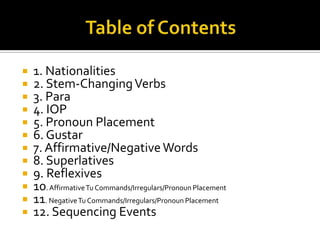
   1. Nationalities
   2. Stem-Changing Verbs
   3. Para
   4. IOP
   5. Pronoun Placement
   6. Gustar
   7. Affirmative/Negative Words
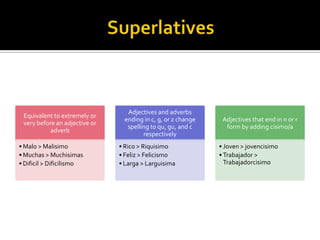
   8. Superlatives
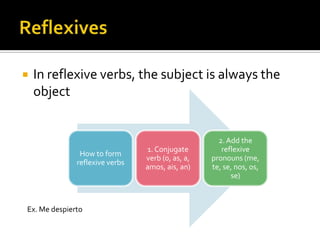
   9. Reflexives
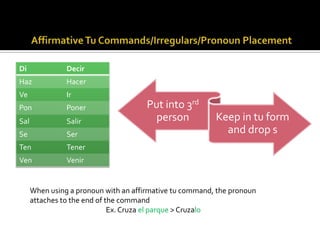
   10. Affirmative Tu Commands/Irregulars/Pronoun Placement
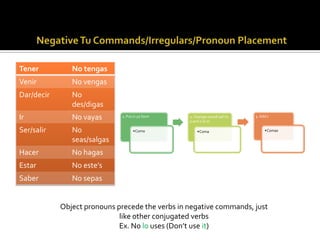
   11. Negative Tu Commands/Irregulars/Pronoun Placement
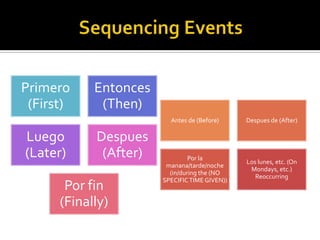
   12. Sequencing Events
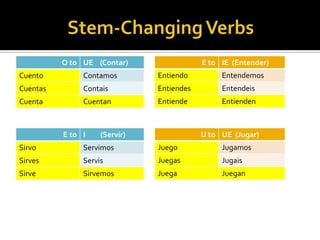
O to UE (Contar)                 E to IE (Entender)
Cuento         Contamos        Entiendo         Entendemos
Cuentas        Contais         Entiendes        Entendeis
Cuenta         Cuentan         Entiende         Entienden


          E to I    (Servir)               U to UE (Jugar)
Sirvo          Servimos        Juego            Jugamos
Sirves         Servis          Juegas           Jugais
Sirve          Sirvemos        Juega            Juegan
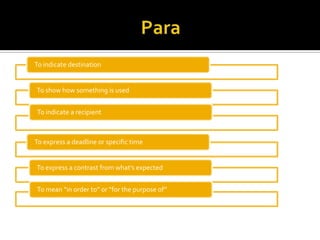
To indicate destination


To show how something is used


To indicate a recipient


To express a deadline or specific time


To express a contrast from what’s expected


To mean “in order to” or “for the purpose of”
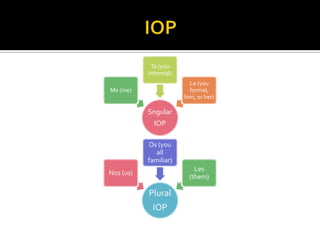
Te (you
           informal)
                         Le (you
Me (me)                  formal,
                       him, or her)

           Sngular
             IOP

           Os (you
              all
           familiar)
                           Les
Nos (us)
                         (them)

           Plural
            IOP
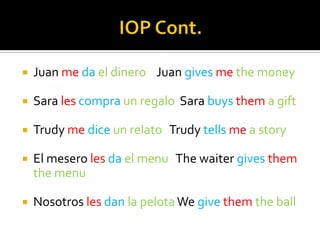
   Juan me da el dinero Juan gives me the money

   Sara les compra un regalo Sara buys them a gift

   Trudy me dice un relato Trudy tells me a story

   El mesero les da el menu The waiter gives them
    the menu

   Nosotros les dan la pelota We give them the ball
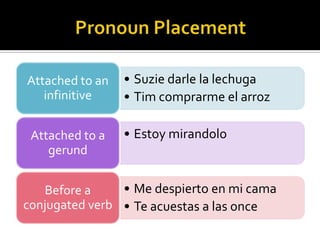
Attached to an   • Suzie darle la lechuga
   infinitive    • Tim comprarme el arroz

 Attached to a   • Estoy mirandolo
    gerund


   Before a     • Me despierto en mi cama
conjugated verb • Te acuestas a las once
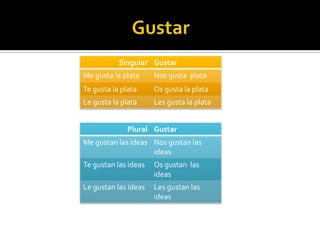
Singular Gustar
Me gusta la plata     Nos gusta plata
Te gusta la plata     Os gusta la plata
Le gusta la plata     Les gusta la plata


              Plural Gustar
Me gustan las ideas Nos gustan las
                    ideas
Te gustan las ideas   Os gustan las
                      ideas
Le gustan las ideas   Les gustan las
                      ideas
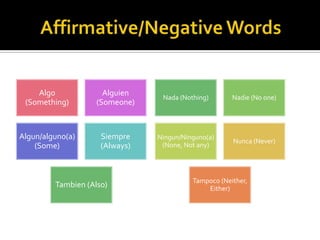
Algo              Alguien
                                 Nada (Nothing)       Nadie (No one)
 (Something)        (Someone)


Algun/alguno(a)      Siempre    Ningun/Ninguno(a)
                                                      Nunca (Never)
    (Some)           (Always)    (None, Not any)


                                          Tampoco (Neither,
         Tambien (Also)                       Either)
Adjectives and adverbs
 Equivalent to extremely or
                                ending in c, g, or z change    Adjectives that end in n or r
 very before an adjective or
                                 spelling to qu, gu, and c      form by adding cisimo/a
           adverb
                                       respectively
• Malo > Malisimo              • Rico > Riquisimo             • Joven > jovencisimo
• Muchas > Muchisimas          • Feliz > Felicismo            • Trabajador >
• Dificil > Dificilismo        • Larga > Larguisima             Trabajadorcisimo
   In reflexive verbs, the subject is always the
    object


                                                    2. Add the
                                1. Conjugate         reflexive
               How to form
                                verb (o, as, a,   pronouns (me,
              reflexive verbs
                                amos, ais, an)    te, se, nos, os,
                                                        se)


Ex. Me despierto
Di              Decir
Haz             Hacer
Ve              Ir
Pon             Poner                  Put into 3rd
Sal             Salir                    person           Keep in tu form
Se              Ser                                         and drop s
Ten             Tener
Ven             Venir


      When using a pronoun with an affirmative tu command, the pronoun
      attaches to the end of the command
                              Ex. Cruza el parque > Cruzalo
Tener          No tengas
Venir          No vengas
Dar/decir      No
               des/digas
Ir             No vayas      1. Put in yo form   2. Change vowell (e/I to
                                                 a and a to e)
                                                                            3. Add s


Ser/salir      No                  •Como             •Coma                       •Comas

               seas/salgas
Hacer          No hagas
Estar          No este’s
Saber          No sepas


            Object pronouns precede the verbs in negative commands, just
                             like other conjugated verbs
                             Ex. No lo uses (Don’t use it)
Primero     Entonces
 (First)     (Then)
                         Antes de (Before)     Despues de (After)

Luego       Despues
(Later)      (After)            Por la
                                               Los lunes, etc. (On
                        manana/tarde/noche
                                                Mondays, etc.)
                         (in/during the (NO
                                                  Reoccurring
                       SPECIFIC TIME GIVEN))
       Por fin
      (Finally)
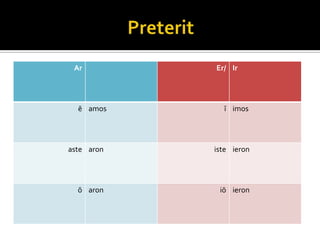
Ar         Er/ Ir


  ē amos      ī imos


aste aron   iste ieron


  ō aron     iō ieron
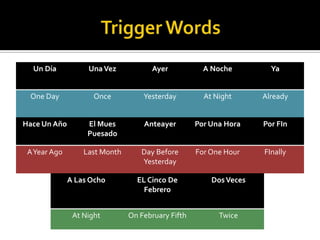
Un Día           Una Vez           Ayer            A Noche         Ya


 One Day             Once          Yesterday         At Night      Already


Hace Un Año        El Mues         Anteayer        Por Una Hora    Por FIn
                   Puesado

 A Year Ago       Last Month      Day Before       For One Hour    FInally
                                  Yesterday

              A Las Ocho         EL Cinco De           Dos Veces
                                   Febrero


               At Night        On February Fifth         Twice
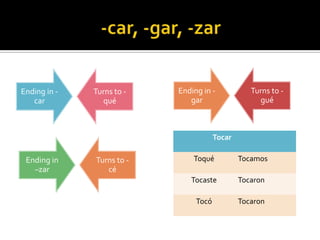
Ending in -   Turns to -   Ending in -            Turns to -
   car          qué           gar                   gué


                                       Tocar

 Ending in    Turns to -       Toqué           Tocamos
   –zar          cé
                              Tocaste          Tocaron

                                Tocó           Tocaron
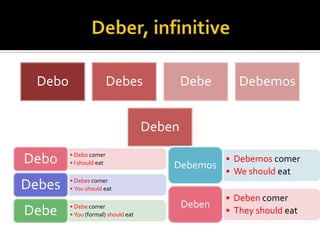
Debo                    Debes              Debe       Debemos


                                     Deben

Debo     • Debo comer
         • I should eat
                                         Debemos
                                                     • Debemos comer
                                                     • We should eat
Debes    • Debes comer
         • You should eat
                                                     • Deben comer
                                             Deben
Debe     • Debe comer
         • You (formal) should eat                   • They should eat
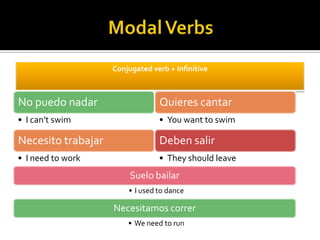
Conjugated verb + Infinitive


No puedo nadar                   Quieres cantar
• I can’t swim                   • You want to swim

Necesito trabajar                Deben salir
• I need to work                 • They should leave
                         Suelo bailar
                        • I used to dance

                    Necesitamos correr
                        • We need to run
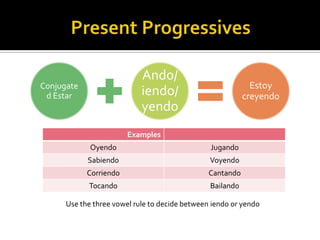
Ando/
Conjugate                                                    Estoy
 d Estar                    iendo/                         creyendo
                            yendo
                        Examples
             Oyendo                             Jugando
            Sabiendo                            Voyendo
            Corriendo                          Cantando
            Tocando                             Bailando

      Use the three vowel rule to decide between iendo or yendo
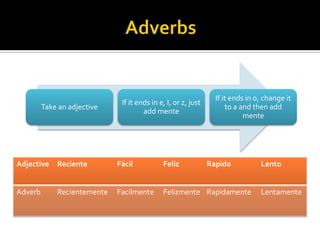
If it ends in o, change it
                              If it ends in e, I, or z, just
         Take an adjective                                           to a and then add
                                      add mente
                                                                           mente


Adjective    Reciente        Fácil           Feliz             Rapido           Lento


Adverb       Recientemente   Facilmente      Felizmente Rapidamente             Lentamente

Grammar book

  • 1.
  • 2.
    1. Nationalities  2. Stem-Changing Verbs  3. Para  4. IOP  5. Pronoun Placement  6. Gustar  7. Affirmative/Negative Words  8. Superlatives  9. Reflexives  10. Affirmative Tu Commands/Irregulars/Pronoun Placement  11. Negative Tu Commands/Irregulars/Pronoun Placement  12. Sequencing Events
  • 4.
    O to UE(Contar) E to IE (Entender) Cuento Contamos Entiendo Entendemos Cuentas Contais Entiendes Entendeis Cuenta Cuentan Entiende Entienden E to I (Servir) U to UE (Jugar) Sirvo Servimos Juego Jugamos Sirves Servis Juegas Jugais Sirve Sirvemos Juega Juegan
  • 5.
    To indicate destination Toshow how something is used To indicate a recipient To express a deadline or specific time To express a contrast from what’s expected To mean “in order to” or “for the purpose of”
  • 6.
    Te (you informal) Le (you Me (me) formal, him, or her) Sngular IOP Os (you all familiar) Les Nos (us) (them) Plural IOP
  • 7.
    Juan me da el dinero Juan gives me the money  Sara les compra un regalo Sara buys them a gift  Trudy me dice un relato Trudy tells me a story  El mesero les da el menu The waiter gives them the menu  Nosotros les dan la pelota We give them the ball
  • 8.
    Attached to an • Suzie darle la lechuga infinitive • Tim comprarme el arroz Attached to a • Estoy mirandolo gerund Before a • Me despierto en mi cama conjugated verb • Te acuestas a las once
  • 9.
    Singular Gustar Me gustala plata Nos gusta plata Te gusta la plata Os gusta la plata Le gusta la plata Les gusta la plata Plural Gustar Me gustan las ideas Nos gustan las ideas Te gustan las ideas Os gustan las ideas Le gustan las ideas Les gustan las ideas
  • 10.
    Algo Alguien Nada (Nothing) Nadie (No one) (Something) (Someone) Algun/alguno(a) Siempre Ningun/Ninguno(a) Nunca (Never) (Some) (Always) (None, Not any) Tampoco (Neither, Tambien (Also) Either)
  • 11.
    Adjectives and adverbs Equivalent to extremely or ending in c, g, or z change Adjectives that end in n or r very before an adjective or spelling to qu, gu, and c form by adding cisimo/a adverb respectively • Malo > Malisimo • Rico > Riquisimo • Joven > jovencisimo • Muchas > Muchisimas • Feliz > Felicismo • Trabajador > • Dificil > Dificilismo • Larga > Larguisima Trabajadorcisimo
  • 12.
    In reflexive verbs, the subject is always the object 2. Add the 1. Conjugate reflexive How to form verb (o, as, a, pronouns (me, reflexive verbs amos, ais, an) te, se, nos, os, se) Ex. Me despierto
  • 13.
    Di Decir Haz Hacer Ve Ir Pon Poner Put into 3rd Sal Salir person Keep in tu form Se Ser and drop s Ten Tener Ven Venir When using a pronoun with an affirmative tu command, the pronoun attaches to the end of the command Ex. Cruza el parque > Cruzalo
  • 14.
    Tener No tengas Venir No vengas Dar/decir No des/digas Ir No vayas 1. Put in yo form 2. Change vowell (e/I to a and a to e) 3. Add s Ser/salir No •Como •Coma •Comas seas/salgas Hacer No hagas Estar No este’s Saber No sepas Object pronouns precede the verbs in negative commands, just like other conjugated verbs Ex. No lo uses (Don’t use it)
  • 15.
    Primero Entonces (First) (Then) Antes de (Before) Despues de (After) Luego Despues (Later) (After) Por la Los lunes, etc. (On manana/tarde/noche Mondays, etc.) (in/during the (NO Reoccurring SPECIFIC TIME GIVEN)) Por fin (Finally)
  • 16.
    Ar Er/ Ir ē amos ī imos aste aron iste ieron ō aron iō ieron
  • 17.
    Un Día Una Vez Ayer A Noche Ya One Day Once Yesterday At Night Already Hace Un Año El Mues Anteayer Por Una Hora Por FIn Puesado A Year Ago Last Month Day Before For One Hour FInally Yesterday A Las Ocho EL Cinco De Dos Veces Febrero At Night On February Fifth Twice
  • 18.
    Ending in - Turns to - Ending in - Turns to - car qué gar gué Tocar Ending in Turns to - Toqué Tocamos –zar cé Tocaste Tocaron Tocó Tocaron
  • 19.
    Debo Debes Debe Debemos Deben Debo • Debo comer • I should eat Debemos • Debemos comer • We should eat Debes • Debes comer • You should eat • Deben comer Deben Debe • Debe comer • You (formal) should eat • They should eat
  • 20.
    Conjugated verb +Infinitive No puedo nadar Quieres cantar • I can’t swim • You want to swim Necesito trabajar Deben salir • I need to work • They should leave Suelo bailar • I used to dance Necesitamos correr • We need to run
  • 21.
    Ando/ Conjugate Estoy d Estar iendo/ creyendo yendo Examples Oyendo Jugando Sabiendo Voyendo Corriendo Cantando Tocando Bailando Use the three vowel rule to decide between iendo or yendo
  • 22.
    If it endsin o, change it If it ends in e, I, or z, just Take an adjective to a and then add add mente mente Adjective Reciente Fácil Feliz Rapido Lento Adverb Recientemente Facilmente Felizmente Rapidamente Lentamente