By: Taciana Key
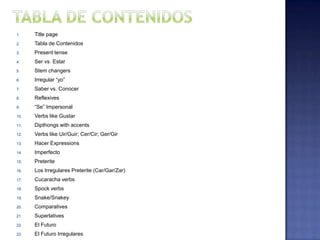
1.    Title page
2.    Tabla de Contenidos
3.    Present tense
4.    Ser vs. Estar
5.    Stem changers
6.    Irregular “yo”
7.    Saber vs. Conocer
8.    Reflexives
9.    “Se” Impersonal
10.   Verbs like Gustar
11.   Dipthongs with accents
12.   Verbs like Uir/Guir; Cer/Cir; Ger/Gir
13.   Hacer Expressions
14.   Imperfecto
15.   Preterite
16.   Los Irregulares Preterite (Car/Gar/Zar)
17.   Cucaracha verbs
18.   Spock verbs
19.   Snake/Snakey
20.   Comparatives
21.   Superlatives
22.   El Futuro
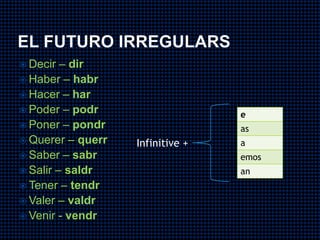
23.   El Futuro Irregulares
 Touse present tense change the ar/er/ir
    ending to the following conjugation:


Yo- o         Nosotros-                                  Yo- o         Nosotros-
              amos                                                     imos
Tu- as                                                   Tu- es
El/Ella/Ust   Ellos/Ellas/   Yo- o         Nosotros-     El/Ella/Ust   Ellos/Ella/
ed- a         Ustedes-                     emos/imos     ed- e         Ustedes-
              an             Tu- es                                    en
                             El/Ella/Ust   Ellos/Ella/
                             ed- e         Ustedes-
                                           en
e=>ie
         •   Quiero
         •   Quieres
         •   Quiere     Everthing
         •   Queremos
                         changes
Querer   •   Quieren
                        except in

e=>I     •
         •
         •
             Pido
             Pides
             Pide
                        nosotros
                          form!
         •   Pedimos
Pedir    •   Piden


o=>ue    •
         •
         •
             Duermo
             Duermes
             Duerme
         •   Dormimos
Dormir   •   Duermen


u=>ue    •
         •
         •
             Juego
             Juegas
             Juega
         •   Jugamos
Jugar    •   Juegan

U
O
IE
EE
t


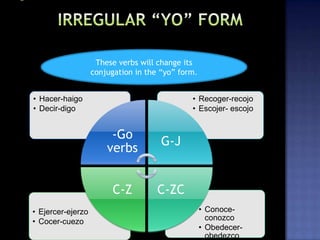
                         These verbs will change its
                        conjugation in the “yo” form.


     • Hacer-haigo                                 • Recoger-recojo
     • Decir-digo                                  • Escojer- escojo


                             -Go
                                           G-J
                            verbs


                              C-Z         C-ZC
     • Ejercer-ejerzo                                   • Conoce-
     • Cocer-cuezo                                        conozco
                                                        • Obedecer-
                                                          obedezco
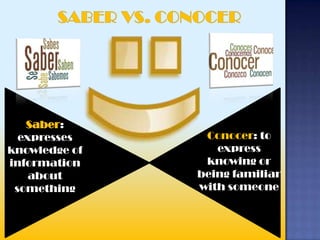
Saber:
  expresses     Conocer: to
knowledge of      express
information     knowing or
    about      being familiar
 something     with someone
 Reflects    action of the verb back to the
 subject.
     Pronouns: me, te, se, nos, se

      Ex- Me rasco el brazo -   (I scratch my arm)


      Ex- Te rascas el brazo – (You scratch your arm)

      Ex- Se rasca el brazo – (He/She scratches his/her arm)

      Ex- Nos rascamos los brazos – (We scratch our arms)

      Ex- Se rascan los brazos – (They scratch their arm)
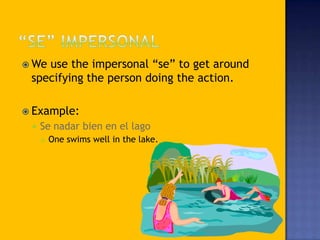
 Weuse the impersonal “se” to get around
 specifying the person doing the action.

 Example:
    Se nadar bien en el lago
        One swims well in the lake.
Yo (Me)              Encantar

Tu (Te)              Fascinar – to be
                     fascinating to

Mi amigo/a (Le)      Molestar – to be a bother

Mi amigos/as (Les)   Faltar – to be lacking
                     something

Usted (Le)           Parecer – to appear to
                     be

Ustedes (Les)        Disgustar – to hate
                     something

Nosostros (Nos)      Importar – to be
                     important to
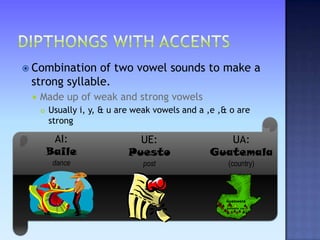
 Combination  of two vowel sounds to make a
 strong syllable.
    Made up of weak and strong vowels
        Usually i, y, & u are weak vowels and a ,e ,& o are
         strong

          AI:                  UE:                  UA:
         Baile               Puesto              Guatemala
          dance                 post                  (country)
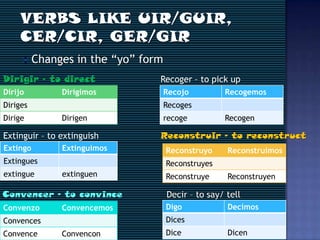
 Changes     in the “yo” form
Dirigir – to direct               Recoger – to pick up
Dirijo         Dirigimos              Recojo         Recogemos
Diriges                               Recoges
Dirige         Dirigen                recoge         Recogen

Extinguir – to extinguish         Reconstruir – to reconstruct
Extingo        Extinguimos            Reconstruyo     Reconstruimos
Extingues                             Reconstruyes
extingue       extinguen              Reconstruye     Reconstruyen

Convencer – to convince               Decir – to say/ tell
Convenzo       Convencemos            Digo            Decimos
Convences                             Dices
Convence       Convencon              Dice            Dicen
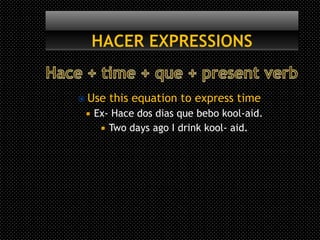
 Use   this equation to express time
    Ex- Hace dos dias que bebo kool-aid.
       Two days ago I drink kool- aid.
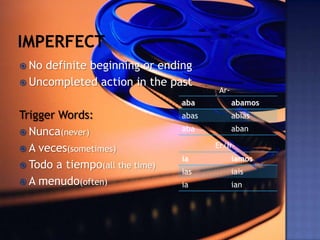
 No definite beginning or ending
 Uncompleted action in the past
                                        Ar-
                                aba           abamos
Trigger Words:                  abas          abias

 Nunca(never)                  aba           aban

 A veces(sometimes)                   Er/Ir-
                                ia            iamos
 Todo a tiempo(all the time)
                                ias           iais
 A menudo(often)               ia            ian
-ar    -er/ir
                                    e      i
                                    aste   iste
                                    o      io
                                    amos   imos
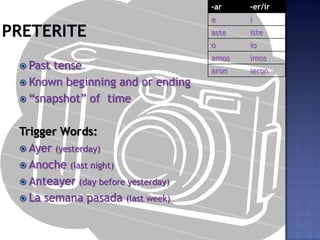
 Pasttense                         aron   ieron
 Known beginning and or ending
 “snapshot” of time


Trigger Words:
 Ayer (yesterday)
 Anoche (last night)
 Anteayer (day before yesterday)
 La semana pasada (last week)
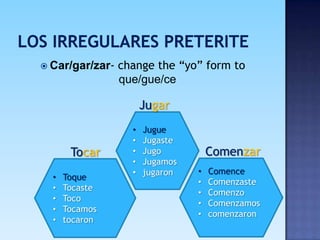
 Car/gar/zar-   change the “yo” form to
                 que/gue/ce

                       Jugar
                   •   Jugue
                   •   Jugaste
       Tocar       •   Jugo          Comenzar
                   •   Jugamos
                   •   jugaron   •   Comence
  •   Toque
                                 •   Comenzaste
  •   Tocaste
                                 •   Comenzo
  •   Toco
                                 •   Comenzamos
  •   Tocamos
                                 •   comenzaron
  •   tocaron
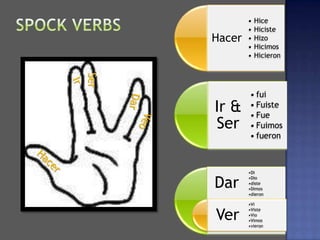
•   Hice
              •   Hiciste
      Hacer   •   Hizo
              •   Hicimos
              •   Hicieron


Ser
              • fui
      Ir &    • Fuiste
              • Fue
      Ser     • Fuimos
              • fueron


              •Di


      Dar
              •Dio
              •diste
              •Dimos
              •dieron

              •Vi


      Ver
              •Viste
              •Vio
              •Vimos
              •vieron
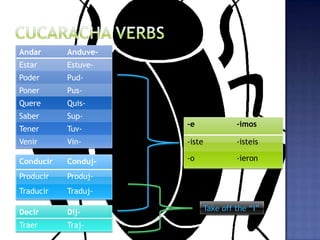
Andar      Anduve-
Estar      Estuve-
Poder      Pud-
Poner      Pus-
Quere      Quis-
Saber      Sup-
                     -e               -imos
Tener      Tuv-
Venir      Vin-      -iste            -isteis

Conducir   Conduj-   -o               -ieron

Producir   Produj-
Traducir   Traduj-

Decir      Dij-              Take off the “I”

Traer      Traj-
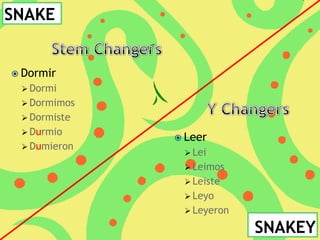
 Dormir
  Dormi
  Dormimos
  Dormiste
  Durmio
               Leer
  Dumieron
                Lei
                Leimos
                Leiste
                Leyo
                Leyeron
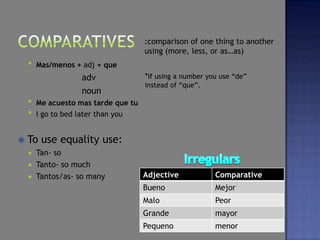
:comparison of one thing to another
                                      using (more, less, or as…as)
       Mas/menos + adj + que
                    adv               *If using a number you use “de”
                                      instead of “que”.
                    noun
       Me acuesto mas tarde que tu
       I go to bed later than you


   To use equality use:
     Tan- so
     Tanto- so much
     Tantos/as- so many              Adjective            Comparative
                                      Bueno                Mejor
                                      Malo                 Peor
                                      Grande               mayor
                                      Pequeno              menor
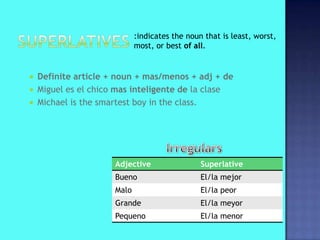
:indicates the noun that is least, worst,
                             most, or best of all.


   Definite article + noun + mas/menos + adj + de
   Miguel es el chico mas inteligente de la clase
   Michael is the smartest boy in the class.


                      Adjective                 Superlative
                      Bueno                     El/la mejor
                      Malo                      El/la peor
                      Grande                    El/la meyor
                      Pequeno                   El/la menor
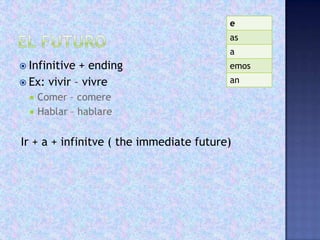
e
                                         as
                                         a
 Infinitive + ending                    emos
 Ex: vivir – vivre                      an
     Comer – comere
     Hablar – hablare


Ir + a + infinitve ( the immediate future)
 Decir  – dir
 Haber – habr
 Hacer – har
 Poder – podr
                                  e
 Poner – pondr                   as
 Querer – querr   Infinitive +   a
 Saber – sabr                    emos
 Salir – saldr                   an
 Tener – tendr
 Valer – valdr
 Venir - vendr

Grammar book

  • 1.
  • 2.
    1. Title page 2. Tabla de Contenidos 3. Present tense 4. Ser vs. Estar 5. Stem changers 6. Irregular “yo” 7. Saber vs. Conocer 8. Reflexives 9. “Se” Impersonal 10. Verbs like Gustar 11. Dipthongs with accents 12. Verbs like Uir/Guir; Cer/Cir; Ger/Gir 13. Hacer Expressions 14. Imperfecto 15. Preterite 16. Los Irregulares Preterite (Car/Gar/Zar) 17. Cucaracha verbs 18. Spock verbs 19. Snake/Snakey 20. Comparatives 21. Superlatives 22. El Futuro 23. El Futuro Irregulares
  • 3.
     Touse presenttense change the ar/er/ir ending to the following conjugation: Yo- o Nosotros- Yo- o Nosotros- amos imos Tu- as Tu- es El/Ella/Ust Ellos/Ellas/ Yo- o Nosotros- El/Ella/Ust Ellos/Ella/ ed- a Ustedes- emos/imos ed- e Ustedes- an Tu- es en El/Ella/Ust Ellos/Ella/ ed- e Ustedes- en
  • 4.
    e=>ie • Quiero • Quieres • Quiere Everthing • Queremos changes Querer • Quieren except in e=>I • • • Pido Pides Pide nosotros form! • Pedimos Pedir • Piden o=>ue • • • Duermo Duermes Duerme • Dormimos Dormir • Duermen u=>ue • • • Juego Juegas Juega • Jugamos Jugar • Juegan
  • 5.
     U O IE EE t These verbs will change its conjugation in the “yo” form. • Hacer-haigo • Recoger-recojo • Decir-digo • Escojer- escojo -Go G-J verbs C-Z C-ZC • Ejercer-ejerzo • Conoce- • Cocer-cuezo conozco • Obedecer- obedezco
  • 7.
    Saber: expresses Conocer: to knowledge of express information knowing or about being familiar something with someone
  • 8.
     Reflects action of the verb back to the subject.  Pronouns: me, te, se, nos, se Ex- Me rasco el brazo - (I scratch my arm) Ex- Te rascas el brazo – (You scratch your arm) Ex- Se rasca el brazo – (He/She scratches his/her arm) Ex- Nos rascamos los brazos – (We scratch our arms) Ex- Se rascan los brazos – (They scratch their arm)
  • 9.
     Weuse theimpersonal “se” to get around specifying the person doing the action.  Example:  Se nadar bien en el lago  One swims well in the lake.
  • 10.
    Yo (Me) Encantar Tu (Te) Fascinar – to be fascinating to Mi amigo/a (Le) Molestar – to be a bother Mi amigos/as (Les) Faltar – to be lacking something Usted (Le) Parecer – to appear to be Ustedes (Les) Disgustar – to hate something Nosostros (Nos) Importar – to be important to
  • 11.
     Combination of two vowel sounds to make a strong syllable.  Made up of weak and strong vowels  Usually i, y, & u are weak vowels and a ,e ,& o are strong AI: UE: UA: Baile Puesto Guatemala dance post (country)
  • 12.
     Changes in the “yo” form Dirigir – to direct Recoger – to pick up Dirijo Dirigimos Recojo Recogemos Diriges Recoges Dirige Dirigen recoge Recogen Extinguir – to extinguish Reconstruir – to reconstruct Extingo Extinguimos Reconstruyo Reconstruimos Extingues Reconstruyes extingue extinguen Reconstruye Reconstruyen Convencer – to convince Decir – to say/ tell Convenzo Convencemos Digo Decimos Convences Dices Convence Convencon Dice Dicen
  • 13.
     Use this equation to express time  Ex- Hace dos dias que bebo kool-aid.  Two days ago I drink kool- aid.
  • 14.
     No definitebeginning or ending  Uncompleted action in the past Ar- aba abamos Trigger Words: abas abias  Nunca(never) aba aban  A veces(sometimes) Er/Ir- ia iamos  Todo a tiempo(all the time) ias iais  A menudo(often) ia ian
  • 15.
    -ar -er/ir e i aste iste o io amos imos  Pasttense aron ieron  Known beginning and or ending  “snapshot” of time Trigger Words:  Ayer (yesterday)  Anoche (last night)  Anteayer (day before yesterday)  La semana pasada (last week)
  • 16.
     Car/gar/zar- change the “yo” form to que/gue/ce Jugar • Jugue • Jugaste Tocar • Jugo Comenzar • Jugamos • jugaron • Comence • Toque • Comenzaste • Tocaste • Comenzo • Toco • Comenzamos • Tocamos • comenzaron • tocaron
  • 17.
    Hice • Hiciste Hacer • Hizo • Hicimos • Hicieron Ser • fui Ir & • Fuiste • Fue Ser • Fuimos • fueron •Di Dar •Dio •diste •Dimos •dieron •Vi Ver •Viste •Vio •Vimos •vieron
  • 18.
    Andar Anduve- Estar Estuve- Poder Pud- Poner Pus- Quere Quis- Saber Sup- -e -imos Tener Tuv- Venir Vin- -iste -isteis Conducir Conduj- -o -ieron Producir Produj- Traducir Traduj- Decir Dij- Take off the “I” Traer Traj-
  • 19.
     Dormir Dormi  Dormimos  Dormiste  Durmio  Leer  Dumieron  Lei  Leimos  Leiste  Leyo  Leyeron
  • 20.
    :comparison of onething to another using (more, less, or as…as)  Mas/menos + adj + que adv *If using a number you use “de” instead of “que”. noun  Me acuesto mas tarde que tu  I go to bed later than you  To use equality use:  Tan- so  Tanto- so much  Tantos/as- so many Adjective Comparative Bueno Mejor Malo Peor Grande mayor Pequeno menor
  • 21.
    :indicates the nounthat is least, worst, most, or best of all.  Definite article + noun + mas/menos + adj + de  Miguel es el chico mas inteligente de la clase  Michael is the smartest boy in the class. Adjective Superlative Bueno El/la mejor Malo El/la peor Grande El/la meyor Pequeno El/la menor
  • 22.
    e as a  Infinitive + ending emos  Ex: vivir – vivre an  Comer – comere  Hablar – hablare Ir + a + infinitve ( the immediate future)
  • 23.
     Decir – dir  Haber – habr  Hacer – har  Poder – podr e  Poner – pondr as  Querer – querr Infinitive + a  Saber – sabr emos  Salir – saldr an  Tener – tendr  Valer – valdr  Venir - vendr