Present tense
  -ar- verbs
   Chapter 2
The magic of second language
             acquisition


•   I grant anyone the right to use this work for any purpose, without any conditions,
    unless such conditions are required by law.
•   Public domain
    http://commons.wikimedia.org/w/index.php?title=File:Hagith.svg&oldid=43289182
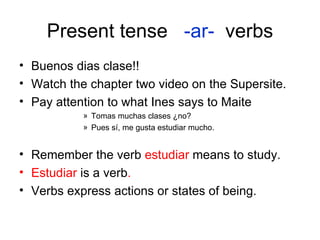
Present tense -ar- verbs
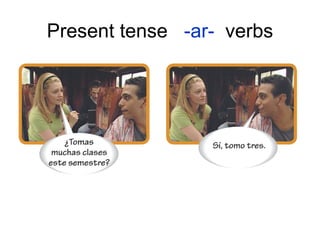
• Buenos dias clase!!
• Watch the chapter two video on the Supersite.
• Pay attention to what Ines says to Maite
           » Tomas muchas clases ¿no?
           » Pues sí, me gusta estudiar mucho.


• Remember the verb estudiar means to study.
• Estudiar is a verb.
• Verbs express actions or states of being.
Present tense -ar- verbs
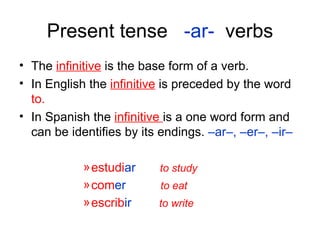
• The infinitive is the base form of a verb.
• In English the infinitive is preceded by the word
  to.
• In Spanish the infinitive is a one word form and
  can be identifies by its endings. –ar–, –er–, –ir–

            » estudiar    to study
            » comer       to eat
            » escribir    to write
Present tense -ar- verbs
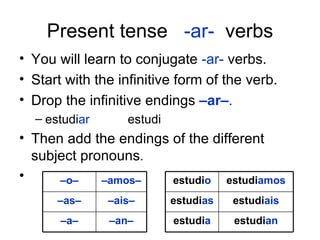
• You will learn to conjugate -ar- verbs.
• Start with the infinitive form of the verb.
• Drop the infinitive endings –ar–.
  – estudiar      estudi
• Then add the endings of the different
  subject pronouns.
•     –o–    –amos–    estudio estudiamos
      –as–     –ais–       estudias   estudiais
       –a–     –an–        estudia    estudian
Present tense -ar- verbs
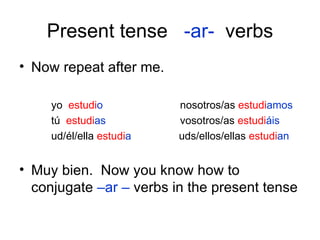
• Now repeat after me.

     yo estudio           nosotros/as estudiamos
     tú estudias          vosotros/as estudiáis
     ud/él/ella estudia   uds/ellos/ellas estudian


• Muy bien. Now you know how to
  conjugate –ar – verbs in the present tense
Present tense -ar- verbs
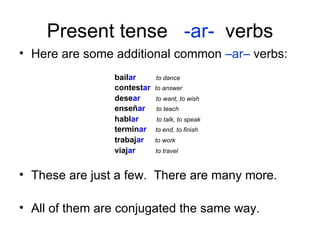
• Here are some additional common –ar– verbs:
                bailar      to dance
                contestar   to answer
                desear      to want, to wish
                enseñar     to teach
                hablar      to talk, to speak
                terminar    to end, to finish
                trabajar    to work
                viajar      to travel


• These are just a few. There are many more.

• All of them are conjugated the same way.
Present tense -ar- verbs
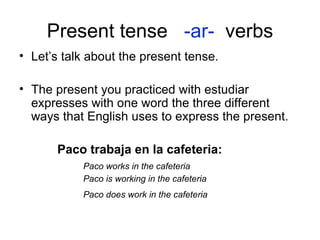
• Let’s talk about the present tense.

• The present you practiced with estudiar
  expresses with one word the three different
  ways that English uses to express the present.

       Paco trabaja en la cafeteria:
           Paco works in the cafeteria
           Paco is working in the cafeteria
           Paco does work in the cafeteria
Present tense -ar- verbs
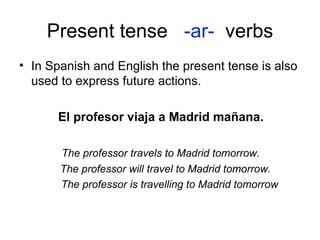
• In Spanish and English the present tense is also
  used to express future actions.

      El profesor viaja a Madrid mañana.

       The professor travels to Madrid tomorrow.
       The professor will travel to Madrid tomorrow.
       The professor is travelling to Madrid tomorrow
Present tense -ar- verbs
• Remember that when two verbs appear
  together with no change of subject, the
  second one is in the infinitive.

      Deseo hablar con don Francisco.
      I wish to speak with Don Francisco.
Present tense -ar- verbs
• How to form a negative sentence in Spanish.

• In the following sentence the word no is placed
  in front of the conjugated verb.
       No deseo hablar con don Francisco
       I do not wish to speak to don Francisco

• Here the Spanish word no means not
Present tense -ar- verbs
• Atención, the Spanish verbs buscar,
  esperar, mirar, esperar do not need to be
  followed by a preposition as they do in
  English.

            Escucho la musica
            I listen to the music.
Present tense -ar- verbs
• Now, look at the following dialogue:

          . ¿Hablas japonés?
            Do you speak Japanese.
            No, no hablo japonés.
            No, I do not speak Japanese.

• Did you notice anything special about the
  subject pronouns?
Present tense -ar- verbs
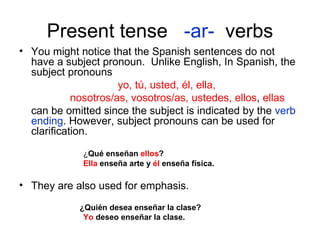
• You might notice that the Spanish sentences do not
  have a subject pronoun. Unlike English, In Spanish, the
  subject pronouns
                      yo, tú, usted, él, ella,
            nosotros/as, vosotros/as, ustedes, ellos, ellas
  can be omitted since the subject is indicated by the verb
  ending. However, subject pronouns can be used for
  clarification.

             ¿Qué enseñan ellos?
             Ella enseña arte y él enseña física.

• They are also used for emphasis.

            ¿Quién desea enseñar la clase?
             Yo deseo enseñar la clase.
Present tense -ar- verbs
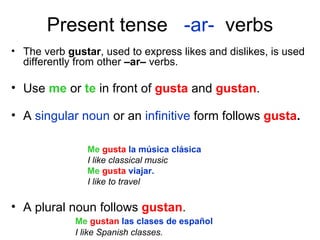
• The verb gustar, used to express likes and dislikes, is used
  differently from other –ar– verbs.

• Use me or te in front of gusta and gustan.

• A singular noun or an infinitive form follows gusta.

                Me gusta la música clásica
                I like classical music
                Me gusta viajar.
                I like to travel

• A plural noun follows gustan.
             Me gustan las clases de español
             I like Spanish classes.
Present tense -ar- verbs
• To say what you don’t like, insert no
  before me or te.
        No me gustan las clases de español.
        I do not like Spanish classes.

• NEVER use the subject pronoun “yo” or
  “tú” with these expressions. Instead, use
  me or te respectively.

• Hasta pronto

Present tense presentation

  • 1.
    Present tense -ar- verbs Chapter 2
  • 2.
    The magic ofsecond language acquisition • I grant anyone the right to use this work for any purpose, without any conditions, unless such conditions are required by law. • Public domain http://commons.wikimedia.org/w/index.php?title=File:Hagith.svg&oldid=43289182
  • 3.
    Present tense -ar-verbs • Buenos dias clase!! • Watch the chapter two video on the Supersite. • Pay attention to what Ines says to Maite » Tomas muchas clases ¿no? » Pues sí, me gusta estudiar mucho. • Remember the verb estudiar means to study. • Estudiar is a verb. • Verbs express actions or states of being.
  • 4.
    Present tense -ar-verbs • The infinitive is the base form of a verb. • In English the infinitive is preceded by the word to. • In Spanish the infinitive is a one word form and can be identifies by its endings. –ar–, –er–, –ir– » estudiar to study » comer to eat » escribir to write
  • 5.
    Present tense -ar-verbs • You will learn to conjugate -ar- verbs. • Start with the infinitive form of the verb. • Drop the infinitive endings –ar–. – estudiar estudi • Then add the endings of the different subject pronouns. • –o– –amos– estudio estudiamos –as– –ais– estudias estudiais –a– –an– estudia estudian
  • 6.
    Present tense -ar-verbs • Now repeat after me. yo estudio nosotros/as estudiamos tú estudias vosotros/as estudiáis ud/él/ella estudia uds/ellos/ellas estudian • Muy bien. Now you know how to conjugate –ar – verbs in the present tense
  • 7.
    Present tense -ar-verbs • Here are some additional common –ar– verbs: bailar to dance contestar to answer desear to want, to wish enseñar to teach hablar to talk, to speak terminar to end, to finish trabajar to work viajar to travel • These are just a few. There are many more. • All of them are conjugated the same way.
  • 8.
    Present tense -ar-verbs • Let’s talk about the present tense. • The present you practiced with estudiar expresses with one word the three different ways that English uses to express the present. Paco trabaja en la cafeteria: Paco works in the cafeteria Paco is working in the cafeteria Paco does work in the cafeteria
  • 9.
    Present tense -ar-verbs • In Spanish and English the present tense is also used to express future actions. El profesor viaja a Madrid mañana. The professor travels to Madrid tomorrow. The professor will travel to Madrid tomorrow. The professor is travelling to Madrid tomorrow
  • 10.
    Present tense -ar-verbs • Remember that when two verbs appear together with no change of subject, the second one is in the infinitive. Deseo hablar con don Francisco. I wish to speak with Don Francisco.
  • 11.
    Present tense -ar-verbs • How to form a negative sentence in Spanish. • In the following sentence the word no is placed in front of the conjugated verb. No deseo hablar con don Francisco I do not wish to speak to don Francisco • Here the Spanish word no means not
  • 12.
    Present tense -ar-verbs • Atención, the Spanish verbs buscar, esperar, mirar, esperar do not need to be followed by a preposition as they do in English. Escucho la musica I listen to the music.
  • 13.
    Present tense -ar-verbs • Now, look at the following dialogue: . ¿Hablas japonés? Do you speak Japanese. No, no hablo japonés. No, I do not speak Japanese. • Did you notice anything special about the subject pronouns?
  • 14.
  • 15.
    Present tense -ar-verbs • You might notice that the Spanish sentences do not have a subject pronoun. Unlike English, In Spanish, the subject pronouns yo, tú, usted, él, ella, nosotros/as, vosotros/as, ustedes, ellos, ellas can be omitted since the subject is indicated by the verb ending. However, subject pronouns can be used for clarification. ¿Qué enseñan ellos? Ella enseña arte y él enseña física. • They are also used for emphasis. ¿Quién desea enseñar la clase? Yo deseo enseñar la clase.
  • 16.
    Present tense -ar-verbs • The verb gustar, used to express likes and dislikes, is used differently from other –ar– verbs. • Use me or te in front of gusta and gustan. • A singular noun or an infinitive form follows gusta. Me gusta la música clásica I like classical music Me gusta viajar. I like to travel • A plural noun follows gustan. Me gustan las clases de español I like Spanish classes.
  • 17.
    Present tense -ar-verbs • To say what you don’t like, insert no before me or te. No me gustan las clases de español. I do not like Spanish classes. • NEVER use the subject pronoun “yo” or “tú” with these expressions. Instead, use me or te respectively. • Hasta pronto