Grammar Book
       Marcela Ray
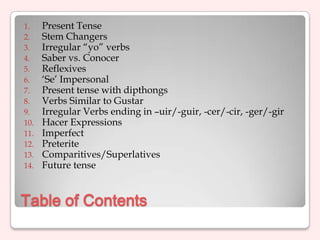
1.    Present Tense
2.    Stem Changers
3.    Irregular “yo” verbs
4.    Saber vs. Conocer
5.    Reflexives
6.    „Se‟ Impersonal
7.    Present tense with dipthongs
8.    Verbs Similar to Gustar
9.    Irregular Verbs ending in –uir/-guir, -cer/-cir, -ger/-gir
10.   Hacer Expressions
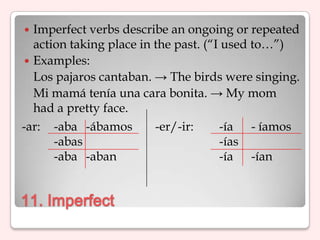
11.   Imperfect
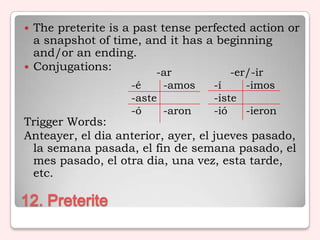
12.   Preterite
13.   Comparitives/Superlatives
14.   Future tense


Table of Contents
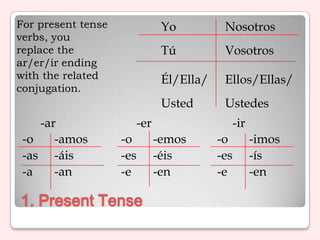
For present tense                Yo          Nosotros
verbs, you
replace the                      Tú          Vosotros
ar/er/ir ending
with the related                 Él/Ella/    Ellos/Ellas/
conjugation.
                                 Usted       Ustedes
    -ar                   -er                     -ir
 -o    -amos        -o          -emos       -o          -imos
 -as -áis           -es         -éis        -es         -ís
 -a    -an          -e          -en         -e          -en

1. Present Tense
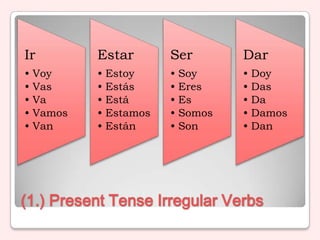
Ir        Estar       Ser       Dar
• Voy     • Estoy     • Soy     • Doy
• Vas     • Estás     • Eres    • Das
• Va      • Está      • Es      • Da
• Vamos   • Estamos   • Somos   • Damos
• Van     • Están     • Son     • Dan


(1.) Present Tense Irregular Verbs
e → ie     (Perder)
e→i        (Pedir)
o → ue     (Dormir)
u → ue     (Jugar)
Example:
 Cerrar (e-ie):   cierro         cerramos
                  cierras        cerráis
                  cierra         cierran

   There is no stem change for nosotros or vosotros.
   These are also called boot verbs.


2. Stem Changers
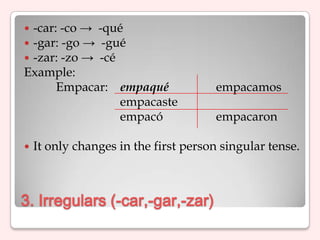
-car: -co → -qué
-gar: -go → -gué
-zar: -zo → -cé
Example:
      Empacar: empaqué                empacamos
                 empacaste
                 empacó               empacaron

   It only changes in the first person singular tense.


3. Irregulars (-car,-gar,-zar)
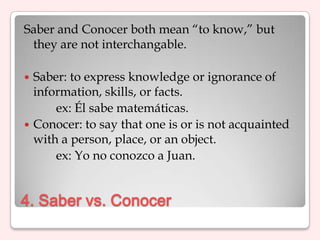
Saber and Conocer both mean “to know,” but
 they are not interchangable.

 Saber: to express knowledge or ignorance of
  information, skills, or facts.
      ex: Él sabe matemáticas.
 Conocer: to say that one is or is not acquainted
  with a person, place, or an object.
      ex: Yo no conozco a Juan.


4. Saber vs. Conocer
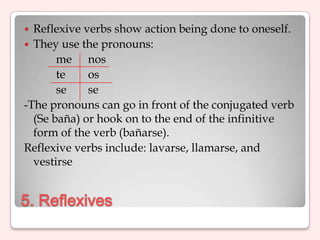
 Reflexive verbs show action being done to oneself.
 They use the pronouns:
       me nos
       te    os
       se    se
-The pronouns can go in front of the conjugated verb
  (Se baña) or hook on to the end of the infinitive
  form of the verb (bañarse).
Reflexive verbs include: lavarse, llamarse, and
  vestirse


5. Reflexives
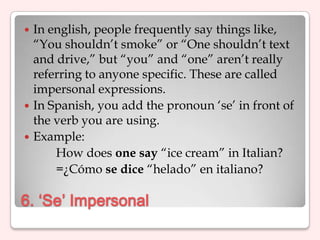
 In english, people frequently say things like,
  “You shouldn‟t smoke” or “One shouldn‟t text
  and drive,” but “you” and “one” aren‟t really
  referring to anyone specific. These are called
  impersonal expressions.
 In Spanish, you add the pronoun „se‟ in front of
  the verb you are using.
 Example:
      How does one say “ice cream” in Italian?
      =¿Cómo se dice “helado” en italiano?

6. ‘Se’ Impersonal
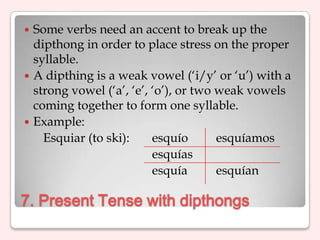
 Some verbs need an accent to break up the
  dipthong in order to place stress on the proper
  syllable.
 A dipthing is a weak vowel („i/y‟ or „u‟) with a
  strong vowel („a‟, „e‟, „o‟), or two weak vowels
  coming together to form one syllable.
 Example:
    Esquiar (to ski):     esquío       esquíamos
                          esquías
                          esquía       esquían

7. Present Tense with dipthongs
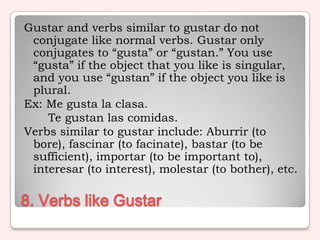
Gustar and verbs similar to gustar do not
 conjugate like normal verbs. Gustar only
 conjugates to “gusta” or “gustan.” You use
 “gusta” if the object that you like is singular,
 and you use “gustan” if the object you like is
 plural.
Ex: Me gusta la clasa.
    Te gustan las comidas.
Verbs similar to gustar include: Aburrir (to
 bore), fascinar (to facinate), bastar (to be
 sufficient), importar (to be important to),
 interesar (to interest), molestar (to bother), etc.

8. Verbs like Gustar
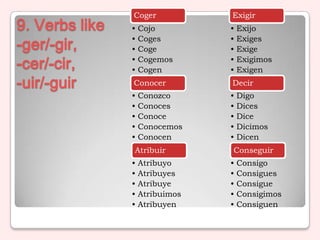
Coger          Exigir
9. Verbs like   • Cojo         • Exijo

-ger/-gir,
                • Coges        • Exiges
                • Coge         • Exige

-cer/-cir,      • Cogemos
                • Cogen
                               • Exigimos
                               • Exigen
-uir/-guir      Conocer        Decir
                • Conozco      • Digo
                • Conoces      • Dices
                • Conoce       • Dice
                • Conocemos    • Dicimos
                • Conocen      • Dicen
                Atribuir       Conseguir
                • Atribuyo     • Consigo
                • Atribuyes    • Consigues
                • Atribuye     • Consigue
                • Atribuimos   • Consigimos
                • Atribuyen    • Consiguen
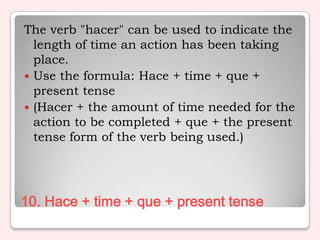
The verb "hacer" can be used to indicate the
  length of time an action has been taking
  place.
 Use the formula: Hace + time + que +
  present tense
 (Hacer + the amount of time needed for the
  action to be completed + que + the present
  tense form of the verb being used.)


10. Hace + time + que + present tense
  Imperfect verbs describe an ongoing or repeated
   action taking place in the past. (“I used to…”)
  Examples:
   Los pajaros cantaban. → The birds were singing.
   Mi mamá tenía una cara bonita. → My mom
   had a pretty face.
-ar: -aba -ábamos         -er/-ir:     -ía - íamos
       -abas                           -ías
       -aba -aban                      -ía -ían


11. Imperfect
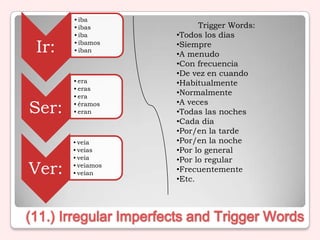
• iba
       • ibas                Trigger Words:
       • iba           •Todos los dias
 Ir:   • íbamos
       • iban
                       •Siempre
                       •A menudo
                       •Con frecuencia
                       •De vez en cuando
       • era           •Habitualmente
       • eras
       • era
                       •Normalmente

Ser:   • éramos
       • eran
                       •A veces
                       •Todas las noches
                       •Cada dia
                       •Por/en la tarde
       • veía          •Por/en la noche
       • veías         •Por lo general
       • veía          •Por lo regular
Ver:   • veíamos
       • veían
                       •Frecuentemente
                       •Etc.


(11.) Irregular Imperfects and Trigger Words
   The preterite is a past tense perfected action or
    a snapshot of time, and it has a beginning
    and/or an ending.
   Conjugations:          -ar          -er/-ir
                      -é    -amos    -í    -imos
                      -aste          -iste
                      -ó    -aron    -ió   -ieron
Trigger Words:
Anteayer, el dia anterior, ayer, el jueves pasado,
 la semana pasada, el fin de semana pasado, el
 mes pasado, el otra dia, una vez, esta tarde,
 etc.

12. Preterite
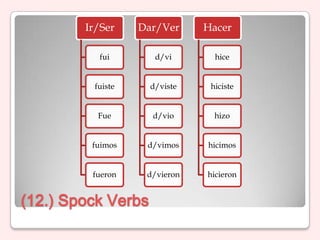
Ir/Ser    Dar/Ver     Hacer

          fui        d/vi       hice


         fuiste     d/viste    hiciste


          Fue       d/vio       hizo


         fuimos    d/vimos    hicimos


         fueron    d/vieron   hicieron


(12.) Spock Verbs
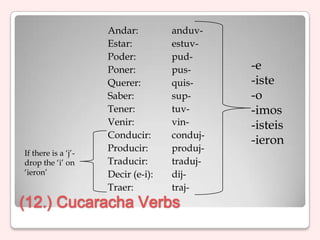
Andar:         anduv-
                     Estar:         estuv-
                     Poder:         pud-
                     Poner:         pus-      -e
                     Querer:        quis-     -iste
                     Saber:         sup-      -o
                     Tener:         tuv-      -imos
                     Venir:         vin-      -isteis
                     Conducir:      conduj-
                                              -ieron
If there is a „j‟-
                     Producir:      produj-
drop the „i‟ on      Traducir:      traduj-
„ieron‟              Decir (e-i):   dij-
                     Traer:         traj-
(12.) Cucaracha Verbs
   Snake and Snakey verbs are verbs that change in the
    third person only.

   Example of snake verbs:
    Pedir:     pedí         pedimos
               pediste
               pidieron     pidieron

   Example of snakey verbs:
    Leer:      leí         leímos
               leíste
               leyó        leyeron

   Snakey verbs change the „i‟ to „y‟ in the third person.

(12.) Snake and Snakey Verbs
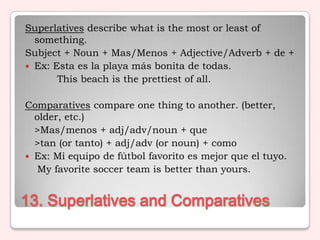
Superlatives describe what is the most or least of
  something.
Subject + Noun + Mas/Menos + Adjective/Adverb + de +
 Ex: Esta es la playa más bonita de todas.
       This beach is the prettiest of all.

Comparatives compare one thing to another. (better,
  older, etc.)
  >Mas/menos + adj/adv/noun + que
  >tan (or tanto) + adj/adv (or noun) + como
 Ex: Mi equipo de fútbol favorito es mejor que el tuyo.
   My favorite soccer team is better than yours.


13. Superlatives and Comparatives
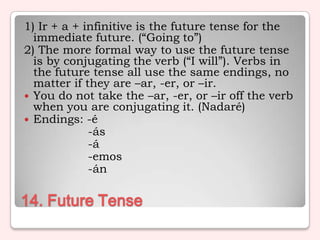
1) Ir + a + infinitive is the future tense for the
  immediate future. (“Going to”)
2) The more formal way to use the future tense
  is by conjugating the verb (“I will”). Verbs in
  the future tense all use the same endings, no
  matter if they are –ar, -er, or –ir.
 You do not take the –ar, -er, or –ir off the verb
  when you are conjugating it. (Nadaré)
 Endings: -é
             -ás
             -á
             -emos
             -án

14. Future Tense
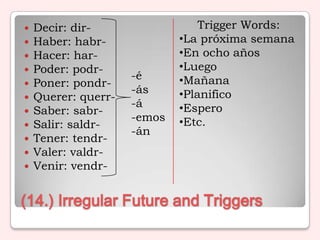
   Decir: dir-                  Trigger Words:
   Haber: habr-             •La próxima semana
   Hacer: har-              •En ocho años
   Poder: podr-             •Luego
                     -é      •Mañana
   Poner: pondr-
                     -ás     •Planifico
   Querer: querr-
                     -á      •Espero
   Saber: sabr-
                     -emos   •Etc.
   Salir: saldr-
                     -án
   Tener: tendr-
   Valer: valdr-
   Venir: vendr-


(14.) Irregular Future and Triggers

Grammar book

  • 1.
    Grammar Book Marcela Ray
  • 2.
    1. Present Tense 2. Stem Changers 3. Irregular “yo” verbs 4. Saber vs. Conocer 5. Reflexives 6. „Se‟ Impersonal 7. Present tense with dipthongs 8. Verbs Similar to Gustar 9. Irregular Verbs ending in –uir/-guir, -cer/-cir, -ger/-gir 10. Hacer Expressions 11. Imperfect 12. Preterite 13. Comparitives/Superlatives 14. Future tense Table of Contents
  • 3.
    For present tense Yo Nosotros verbs, you replace the Tú Vosotros ar/er/ir ending with the related Él/Ella/ Ellos/Ellas/ conjugation. Usted Ustedes -ar -er -ir -o -amos -o -emos -o -imos -as -áis -es -éis -es -ís -a -an -e -en -e -en 1. Present Tense
  • 4.
    Ir Estar Ser Dar • Voy • Estoy • Soy • Doy • Vas • Estás • Eres • Das • Va • Está • Es • Da • Vamos • Estamos • Somos • Damos • Van • Están • Son • Dan (1.) Present Tense Irregular Verbs
  • 5.
    e → ie (Perder) e→i (Pedir) o → ue (Dormir) u → ue (Jugar) Example: Cerrar (e-ie): cierro cerramos cierras cerráis cierra cierran  There is no stem change for nosotros or vosotros.  These are also called boot verbs. 2. Stem Changers
  • 6.
    -car: -co →-qué -gar: -go → -gué -zar: -zo → -cé Example: Empacar: empaqué empacamos empacaste empacó empacaron  It only changes in the first person singular tense. 3. Irregulars (-car,-gar,-zar)
  • 7.
    Saber and Conocerboth mean “to know,” but they are not interchangable.  Saber: to express knowledge or ignorance of information, skills, or facts. ex: Él sabe matemáticas.  Conocer: to say that one is or is not acquainted with a person, place, or an object. ex: Yo no conozco a Juan. 4. Saber vs. Conocer
  • 8.
     Reflexive verbsshow action being done to oneself.  They use the pronouns: me nos te os se se -The pronouns can go in front of the conjugated verb (Se baña) or hook on to the end of the infinitive form of the verb (bañarse). Reflexive verbs include: lavarse, llamarse, and vestirse 5. Reflexives
  • 9.
     In english,people frequently say things like, “You shouldn‟t smoke” or “One shouldn‟t text and drive,” but “you” and “one” aren‟t really referring to anyone specific. These are called impersonal expressions.  In Spanish, you add the pronoun „se‟ in front of the verb you are using.  Example: How does one say “ice cream” in Italian? =¿Cómo se dice “helado” en italiano? 6. ‘Se’ Impersonal
  • 10.
     Some verbsneed an accent to break up the dipthong in order to place stress on the proper syllable.  A dipthing is a weak vowel („i/y‟ or „u‟) with a strong vowel („a‟, „e‟, „o‟), or two weak vowels coming together to form one syllable.  Example: Esquiar (to ski): esquío esquíamos esquías esquía esquían 7. Present Tense with dipthongs
  • 11.
    Gustar and verbssimilar to gustar do not conjugate like normal verbs. Gustar only conjugates to “gusta” or “gustan.” You use “gusta” if the object that you like is singular, and you use “gustan” if the object you like is plural. Ex: Me gusta la clasa. Te gustan las comidas. Verbs similar to gustar include: Aburrir (to bore), fascinar (to facinate), bastar (to be sufficient), importar (to be important to), interesar (to interest), molestar (to bother), etc. 8. Verbs like Gustar
  • 12.
    Coger Exigir 9. Verbs like • Cojo • Exijo -ger/-gir, • Coges • Exiges • Coge • Exige -cer/-cir, • Cogemos • Cogen • Exigimos • Exigen -uir/-guir Conocer Decir • Conozco • Digo • Conoces • Dices • Conoce • Dice • Conocemos • Dicimos • Conocen • Dicen Atribuir Conseguir • Atribuyo • Consigo • Atribuyes • Consigues • Atribuye • Consigue • Atribuimos • Consigimos • Atribuyen • Consiguen
  • 13.
    The verb "hacer"can be used to indicate the length of time an action has been taking place.  Use the formula: Hace + time + que + present tense  (Hacer + the amount of time needed for the action to be completed + que + the present tense form of the verb being used.) 10. Hace + time + que + present tense
  • 14.
     Imperfectverbs describe an ongoing or repeated action taking place in the past. (“I used to…”)  Examples: Los pajaros cantaban. → The birds were singing. Mi mamá tenía una cara bonita. → My mom had a pretty face. -ar: -aba -ábamos -er/-ir: -ía - íamos -abas -ías -aba -aban -ía -ían 11. Imperfect
  • 15.
    • iba • ibas Trigger Words: • iba •Todos los dias Ir: • íbamos • iban •Siempre •A menudo •Con frecuencia •De vez en cuando • era •Habitualmente • eras • era •Normalmente Ser: • éramos • eran •A veces •Todas las noches •Cada dia •Por/en la tarde • veía •Por/en la noche • veías •Por lo general • veía •Por lo regular Ver: • veíamos • veían •Frecuentemente •Etc. (11.) Irregular Imperfects and Trigger Words
  • 16.
    The preterite is a past tense perfected action or a snapshot of time, and it has a beginning and/or an ending.  Conjugations: -ar -er/-ir -é -amos -í -imos -aste -iste -ó -aron -ió -ieron Trigger Words: Anteayer, el dia anterior, ayer, el jueves pasado, la semana pasada, el fin de semana pasado, el mes pasado, el otra dia, una vez, esta tarde, etc. 12. Preterite
  • 17.
    Ir/Ser Dar/Ver Hacer fui d/vi hice fuiste d/viste hiciste Fue d/vio hizo fuimos d/vimos hicimos fueron d/vieron hicieron (12.) Spock Verbs
  • 18.
    Andar: anduv- Estar: estuv- Poder: pud- Poner: pus- -e Querer: quis- -iste Saber: sup- -o Tener: tuv- -imos Venir: vin- -isteis Conducir: conduj- -ieron If there is a „j‟- Producir: produj- drop the „i‟ on Traducir: traduj- „ieron‟ Decir (e-i): dij- Traer: traj- (12.) Cucaracha Verbs
  • 19.
    Snake and Snakey verbs are verbs that change in the third person only.  Example of snake verbs: Pedir: pedí pedimos pediste pidieron pidieron  Example of snakey verbs: Leer: leí leímos leíste leyó leyeron  Snakey verbs change the „i‟ to „y‟ in the third person. (12.) Snake and Snakey Verbs
  • 20.
    Superlatives describe whatis the most or least of something. Subject + Noun + Mas/Menos + Adjective/Adverb + de +  Ex: Esta es la playa más bonita de todas. This beach is the prettiest of all. Comparatives compare one thing to another. (better, older, etc.) >Mas/menos + adj/adv/noun + que >tan (or tanto) + adj/adv (or noun) + como  Ex: Mi equipo de fútbol favorito es mejor que el tuyo. My favorite soccer team is better than yours. 13. Superlatives and Comparatives
  • 21.
    1) Ir +a + infinitive is the future tense for the immediate future. (“Going to”) 2) The more formal way to use the future tense is by conjugating the verb (“I will”). Verbs in the future tense all use the same endings, no matter if they are –ar, -er, or –ir.  You do not take the –ar, -er, or –ir off the verb when you are conjugating it. (Nadaré)  Endings: -é -ás -á -emos -án 14. Future Tense
  • 22.
    Decir: dir- Trigger Words:  Haber: habr- •La próxima semana  Hacer: har- •En ocho años  Poder: podr- •Luego -é •Mañana  Poner: pondr- -ás •Planifico  Querer: querr- -á •Espero  Saber: sabr- -emos •Etc.  Salir: saldr- -án  Tener: tendr-  Valer: valdr-  Venir: vendr- (14.) Irregular Future and Triggers