Grammar Book

  MARA O’BRIEN
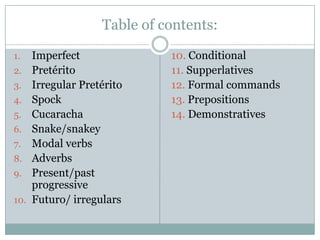
Table of contents:

1.    Imperfect               10. Conditional
2.    Pretérito               11. Supperlatives
3.    Irregular Pretérito     12. Formal commands
4.    Spock                   13. Prepositions
5.    Cucaracha               14. Demonstratives
6.    Snake/snakey
7.    Modal verbs
8.    Adverbs
9.    Present/past
      progressive
10.   Futuro/ irregulars
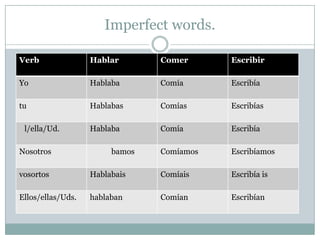
Imperfect words.

Verb               Hablar       Comer      Escribir

Yo                 Hablaba      Comía      Escribía

tu                 Hablabas     Comías     Escribías

 l/ella/Ud.        Hablaba      Comía      Escribía

Nosotros                bamos   Comíamos   Escribíamos

vosortos           Hablabais    Comíais    Escribía is

Ellos/ellas/Uds.   hablaban     Comían     Escribían
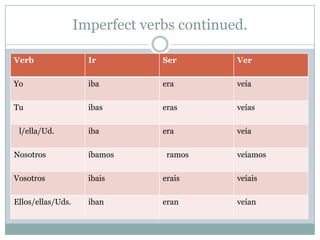
Imperfect verbs continued.

Verb                 Ir         Ser        Ver

Yo                   iba        era        veía

Tu                   ibas       eras       veías

 l/ella/Ud.          iba        era        veía

Nosotros             íbamos      ramos     veíamos

Vosotros             ibais      erais      veíais

Ellos/ellas/Uds.     iban       eran       veían
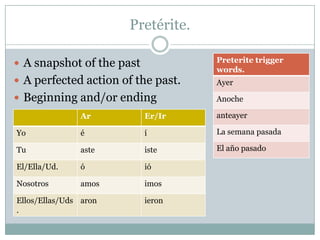
Pretérite.

                                    Preterite trigger
 A snapshot of the past
                                    words.
 A perfected action of the past.   Ayer

 Beginning and/or ending           Anoche

               Ar          Er/Ir    anteayer

Yo             é           í        La semana pasada

Tu             aste        iste     El año pasado

El/Ella/Ud.    ó           ió

Nosotros       amos        imos

Ellos/Ellas/Uds aron       ieron
.
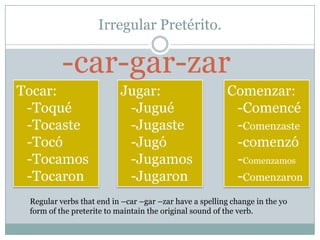
Irregular Pretérito.

          -car-gar-zar
Tocar:                    Jugar:                         Comenzar:
 -Toqué                    -Jugué                         -Comencé
 -Tocaste                  -Jugaste                       -Comenzaste
 -Tocó                     -Jugó                          -comenzó
 -Tocamos                  -Jugamos                       -Comenzamos
 -Tocaron                  -Jugaron                       -Comenzaron
 Regular verbs that end in –car –gar –zar have a spelling change in the yo
 form of the preterite to maintain the original sound of the verb.
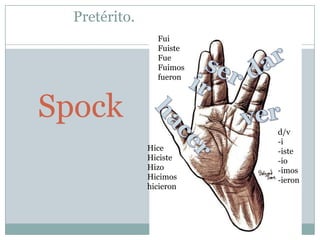
Pretérito.
                 Fui
                 Fuiste
                 Fue
                 Fuimos
                 fueron


Spock
                          d/v
                          -i
               Hice       -iste
               Hiciste    -io
               Hizo       -imos
               Hicimos    -ieron
               hicieron
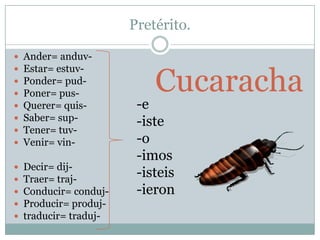
Pretérito.

   Ander= anduv-


                            Cucaracha
   Estar= estuv-
   Ponder= pud-
   Poner= pus-
   Querer= quis-        -e
   Saber= sup-          -iste
   Tener= tuv-
   Venir= vin-          -o
                         -imos
   Decir= dij-
   Traer= traj-
                         -isteis
   Conducir= conduj-    -ieron
   Producir= produj-
   traducir= traduj-
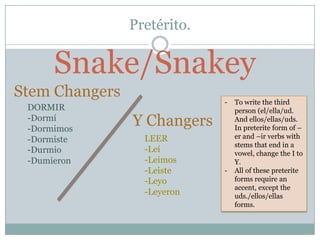
Pretérito.

      Snake/Snakey
Stem Changers
                             -   To write the third
 DORMIR                          person (el/ella/ud.
 -Dormí
 -Dormimos
                Y Changers       And ellos/ellas/uds.
                                 In preterite form of –
                  LEER           er and –ir verbs with
 -Dormiste
                                 stems that end in a
 -Durmio          -Leí           vowel, change the I to
 -Dumieron        -Leimos        Y.
                  -Leiste    -   All of these preterite
                  -Leyo          forms require an
                                 accent, except the
                  -Leyeron       uds./ellos/ellas
                                 forms.
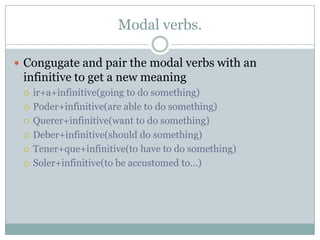
Modal verbs.

 Congugate and pair the modal verbs with an
 infinitive to get a new meaning
    ir+a+infinitive(going to do something)
    Poder+infinitive(are able to do something)
    Querer+infinitive(want to do something)
    Deber+infinitive(should do something)
    Tener+que+infinitive(to have to do something)
    Soler+infinitive(to be accustomed to…)
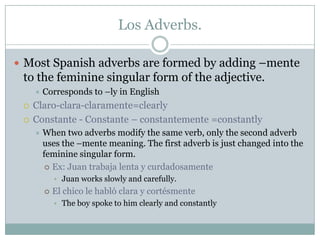
Los Adverbs.

 Most Spanish adverbs are formed by adding –mente
 to the feminine singular form of the adjective.
        Corresponds to –ly in English
    Claro-clara-claramente=clearly
    Constante - Constante – constantemente =constantly
        When two adverbs modify the same verb, only the second adverb
         uses the –mente meaning. The first adverb is just changed into the
         feminine singular form.
           Ex: Juan trabaja lenta y curdadosamente
             • Juan works slowly and carefully.
            El chico le habló clara y cortésmente
             • The boy spoke to him clearly and constantly
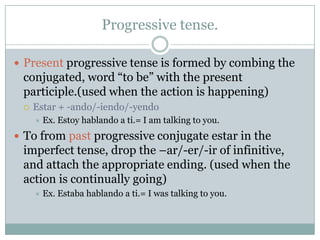
Progressive tense.

 Present progressive tense is formed by combing the
 conjugated, word “to be” with the present
 participle.(used when the action is happening)
    Estar + -ando/-iendo/-yendo
        Ex. Estoy hablando a ti.= I am talking to you.
 To from past progressive conjugate estar in the
 imperfect tense, drop the –ar/-er/-ir of infinitive,
 and attach the appropriate ending. (used when the
 action is continually going)
        Ex. Estaba hablando a ti.= I was talking to you.
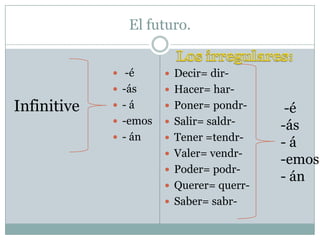
El futuro.


              -é       Decir= dir-
              -ás      Hacer= har-
Infinitive    -á       Poner= pondr-     -é
              -emos    Salir= saldr-
                                          -ás
              - án     Tener =tendr-
                                          -á
                        Valer= vendr-
                                          -emos
                        Poder= podr-
                                          - án
                        Querer= querr-
                        Saber= sabr-
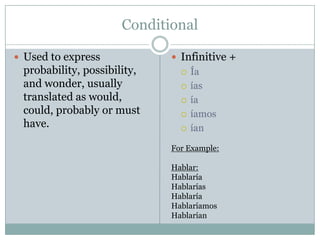
Conditional

 Used to express             Infinitive +
 probability, possibility,        Ía
 and wonder, usually              ías
 translated as would,             ía
 could, probably or must          íamos
 have.                            ían

                             For Example:

                             Hablar:
                             Hablaría
                             Hablarías
                             Hablaría
                             Hablaríamos
                             Hablarían
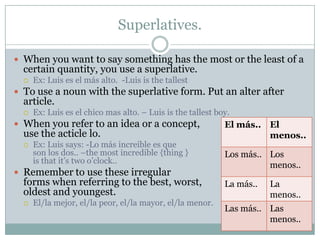
Superlatives.

 When you want to say something has the most or the least of a
  certain quantity, you use a superlative.
     Ex: Luis es el más alto. -Luis is the tallest
 To use a noun with the superlative form. Put an alter after
  article.
     Ex: Luis es el chico mas alto. – Luis is the tallest boy.
 When you refer to an idea or a concept,                    El más.. El
  use the acticle lo.                                                 menos..
     Ex: Luis says: -Lo más increible es que
      son los dos.. –the most incredible {thing }            Los más.. Los
      is that it’s two o’clock..
                                                                       menos..
 Remember to use these irregular
  forms when referring to the best, worst,                   La más..   La
  oldest and youngest.                                                  menos..
     El/la mejor, el/la peor, el/la mayor, el/la menor.
                                                             Las más.. Las
                                                                       menos..
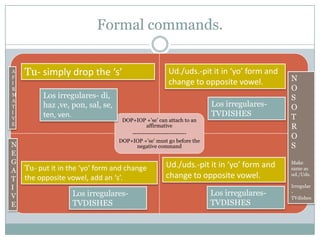
Formal commands.

A   Tu- simply drop the ‘s’                          Ud./uds.-pit it in ‘yo’ form and
F
I                                                    change to opposite vowel.          N
R                                                                                       O
M        Los irregulares- di,                                                           S
A
T        haz ,ve, pon, sal, se,                                      Los irregulares-   O
I
V
         ten, ven.                                                   TVDISHES           T
                                   DOP+IOP +’se’ can attach to an
E                                            affirmative                                R
                                      ---------------------------
                                                                                        O
                                  DOP+IOP +’se’ must go before the
N                                       negative command                                S
E
G                                                   Ud./uds.-pit it in ‘yo’ form and    Make
A   Tu- put it in the ‘yo’ form and change                                              same as

T   the opposite vowel, add an ‘s’.                 change to opposite vowel.           ud./Uds.

I                                                                                       Irregular

V                 Los irregulares-                                   Los irregulares-   -
                                                                                        TVdishes
E                 TVDISHES                                           TVDISHES
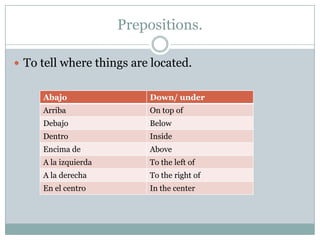
Prepositions.

 To tell where things are located.


     Abajo                Down/ under
     Arriba               On top of
     Debajo               Below
     Dentro               Inside
     Encima de            Above
     A la izquierda       To the left of
     A la derecha         To the right of
     En el centro         In the center
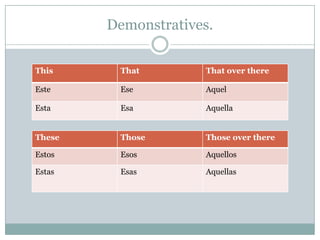
Demonstratives.

This     That        That over there

Este     Ese         Aquel

Esta     Esa         Aquella


These    Those       Those over there

Estos    Esos        Aquellos

Estas    Esas        Aquellas

Grammar book #2

  • 1.
    Grammar Book MARA O’BRIEN
  • 2.
    Table of contents: 1. Imperfect 10. Conditional 2. Pretérito 11. Supperlatives 3. Irregular Pretérito 12. Formal commands 4. Spock 13. Prepositions 5. Cucaracha 14. Demonstratives 6. Snake/snakey 7. Modal verbs 8. Adverbs 9. Present/past progressive 10. Futuro/ irregulars
  • 3.
    Imperfect words. Verb Hablar Comer Escribir Yo Hablaba Comía Escribía tu Hablabas Comías Escribías l/ella/Ud. Hablaba Comía Escribía Nosotros bamos Comíamos Escribíamos vosortos Hablabais Comíais Escribía is Ellos/ellas/Uds. hablaban Comían Escribían
  • 4.
    Imperfect verbs continued. Verb Ir Ser Ver Yo iba era veía Tu ibas eras veías l/ella/Ud. iba era veía Nosotros íbamos ramos veíamos Vosotros ibais erais veíais Ellos/ellas/Uds. iban eran veían
  • 5.
    Pretérite. Preterite trigger  A snapshot of the past words.  A perfected action of the past. Ayer  Beginning and/or ending Anoche Ar Er/Ir anteayer Yo é í La semana pasada Tu aste iste El año pasado El/Ella/Ud. ó ió Nosotros amos imos Ellos/Ellas/Uds aron ieron .
  • 6.
    Irregular Pretérito. -car-gar-zar Tocar: Jugar: Comenzar: -Toqué -Jugué -Comencé -Tocaste -Jugaste -Comenzaste -Tocó -Jugó -comenzó -Tocamos -Jugamos -Comenzamos -Tocaron -Jugaron -Comenzaron Regular verbs that end in –car –gar –zar have a spelling change in the yo form of the preterite to maintain the original sound of the verb.
  • 7.
    Pretérito. Fui Fuiste Fue Fuimos fueron Spock d/v -i Hice -iste Hiciste -io Hizo -imos Hicimos -ieron hicieron
  • 8.
    Pretérito.  Ander= anduv- Cucaracha  Estar= estuv-  Ponder= pud-  Poner= pus-  Querer= quis- -e  Saber= sup- -iste  Tener= tuv-  Venir= vin- -o -imos  Decir= dij-  Traer= traj- -isteis  Conducir= conduj- -ieron  Producir= produj-  traducir= traduj-
  • 9.
    Pretérito. Snake/Snakey Stem Changers - To write the third DORMIR person (el/ella/ud. -Dormí -Dormimos Y Changers And ellos/ellas/uds. In preterite form of – LEER er and –ir verbs with -Dormiste stems that end in a -Durmio -Leí vowel, change the I to -Dumieron -Leimos Y. -Leiste - All of these preterite -Leyo forms require an accent, except the -Leyeron uds./ellos/ellas forms.
  • 10.
    Modal verbs.  Congugateand pair the modal verbs with an infinitive to get a new meaning  ir+a+infinitive(going to do something)  Poder+infinitive(are able to do something)  Querer+infinitive(want to do something)  Deber+infinitive(should do something)  Tener+que+infinitive(to have to do something)  Soler+infinitive(to be accustomed to…)
  • 11.
    Los Adverbs.  MostSpanish adverbs are formed by adding –mente to the feminine singular form of the adjective.  Corresponds to –ly in English  Claro-clara-claramente=clearly  Constante - Constante – constantemente =constantly  When two adverbs modify the same verb, only the second adverb uses the –mente meaning. The first adverb is just changed into the feminine singular form.  Ex: Juan trabaja lenta y curdadosamente • Juan works slowly and carefully.  El chico le habló clara y cortésmente • The boy spoke to him clearly and constantly
  • 12.
    Progressive tense.  Presentprogressive tense is formed by combing the conjugated, word “to be” with the present participle.(used when the action is happening)  Estar + -ando/-iendo/-yendo  Ex. Estoy hablando a ti.= I am talking to you.  To from past progressive conjugate estar in the imperfect tense, drop the –ar/-er/-ir of infinitive, and attach the appropriate ending. (used when the action is continually going)  Ex. Estaba hablando a ti.= I was talking to you.
  • 13.
    El futuro.  -é  Decir= dir-  -ás  Hacer= har- Infinitive  -á  Poner= pondr- -é  -emos  Salir= saldr- -ás  - án  Tener =tendr- -á  Valer= vendr- -emos  Poder= podr- - án  Querer= querr-  Saber= sabr-
  • 14.
    Conditional  Used toexpress  Infinitive + probability, possibility,  Ía and wonder, usually  ías translated as would,  ía could, probably or must  íamos have.  ían For Example: Hablar: Hablaría Hablarías Hablaría Hablaríamos Hablarían
  • 15.
    Superlatives.  When youwant to say something has the most or the least of a certain quantity, you use a superlative.  Ex: Luis es el más alto. -Luis is the tallest  To use a noun with the superlative form. Put an alter after article.  Ex: Luis es el chico mas alto. – Luis is the tallest boy.  When you refer to an idea or a concept, El más.. El use the acticle lo. menos..  Ex: Luis says: -Lo más increible es que son los dos.. –the most incredible {thing } Los más.. Los is that it’s two o’clock.. menos..  Remember to use these irregular forms when referring to the best, worst, La más.. La oldest and youngest. menos..  El/la mejor, el/la peor, el/la mayor, el/la menor. Las más.. Las menos..
  • 16.
    Formal commands. A Tu- simply drop the ‘s’ Ud./uds.-pit it in ‘yo’ form and F I change to opposite vowel. N R O M Los irregulares- di, S A T haz ,ve, pon, sal, se, Los irregulares- O I V ten, ven. TVDISHES T DOP+IOP +’se’ can attach to an E affirmative R --------------------------- O DOP+IOP +’se’ must go before the N negative command S E G Ud./uds.-pit it in ‘yo’ form and Make A Tu- put it in the ‘yo’ form and change same as T the opposite vowel, add an ‘s’. change to opposite vowel. ud./Uds. I Irregular V Los irregulares- Los irregulares- - TVdishes E TVDISHES TVDISHES
  • 17.
    Prepositions.  To tellwhere things are located. Abajo Down/ under Arriba On top of Debajo Below Dentro Inside Encima de Above A la izquierda To the left of A la derecha To the right of En el centro In the center
  • 18.
    Demonstratives. This That That over there Este Ese Aquel Esta Esa Aquella These Those Those over there Estos Esos Aquellos Estas Esas Aquellas