Miguel Hodges

GRAMMAR BOOK
TABLE OF CONTENTS
Content                                           Slide
  number
   Present –ar, -er, -ir endings
    3-4
   Stem changers
    5
   Irregular “yo”
    6
   Saber vs. Conocer
    7
   Reflexives
    8
   “Se” impersonal
    9
   Dipthongs with accents
    10
   Verbs like -ger/-gir, -uir/-guir, -cer/-cir
    11
   Hace +____+ que +______
    12
   Imperfecto
    13
   Preterite                                             14-
PRESENT TENSE –AR/-ER/-IR

   In the present tense for verbs ending in –ar
            Person talked about   Replaces -ar at the end
            Yo                    o
            Tú                    as
            Él/Ella/Usted         a
            Nosotros              amos
            Ellos/Ellas/Ustedes   an


   In the present tense for verbs ending in -er
            Person talked about   Replaces -er at the end
            Yo                    o
            Tú                    es
            Él/Ella/Usted         E
            Nosotros              emos
            Ellos/Ellas/Ustedes   en
PRESENT TENSE –AR/-ER/-IR                                    CONT’D


   In the present tense for verbs ending in -ir

             Person talked about   Replaces -ei at the end
             Yo                    o
             Tú                    Es
             Él/Ella/Usted         E
             Nosotros              imos
             Ellos/Ellas/Ustedes   en
STEM CHANGERS
   Also called “Boot verbs” it changes in all but nosotros.
   More than just the ending changes. The vowel in the stem
    changes.
   3 catergories. eie, o ue, and ei.
   Common e ie verbs- Tener, Preferir
   Common oue verbs- Dormir, Poder, Jugar
   *Common ei verbs- Decir, Repetir, Servir.

   * This stem change only happens in –Ir verbs!
IRREGULAR “YO” FORM
   caber (to fit) yo quepo            poner (to put, to place)yo
   caer (to fall) yo caigo             pongo
   conducir (to drive) yo             saber (to know something -
    conduzco                            a fact)yo sé
   conocer (to know,) yo              salir (to leave)yo salgo
    conozco                            seguir (to follow)yo sigo
   escoger (to choose )yo             traer (to bring)yo traigo
    escojo                             valer (to be worth)yo valgo
   dirigir (to direct) yo dirijo      ver (to see)yo veo
   hacer (to do, to make) yo
    hago
SABER VS. CONOCER

 When using saber it mean that you know a
  fact or how to do something.
 When using conocer it means you know a
  person or are familiar with something.
REFLEXIVES

   When refering to a person doing an action.
           Person talked about   Reflexive pronoun
           Yo                    Me
           Tú                    Te
           Él/Ella/Usted         Se
           Nosotros              Nos
           Ellos/Ellas/Ustedes   Se
“SE” IMPERSONAL

   When using an impersonal voice like “How
    do you spell truck?” in Spanish you place
    “se” in front to make it a general statements.
DIPTHONGS WITH ACCENTS

Here are some fairly common words that
 include diphthongs : puerto, tierra, siete,
 hay, cuida, ciudad, labio, hacia, paisano,
 canción, Europa, aire.
VERBS LIKE GER/GIR, UIR/GUIR, CER/CIR

 For verbs that end in ger/gir, In the first
  person change the g to a j.
 In guir verbs, in the yo form the gu changes
  to g.
 In uir verbs add a y before a, e and, o.

 For cer/cir verbs, in the yo form, change the
  c to a z.
HACE+ ______+QUE+_____

 The second blank is to be filled with a verb in
  either the present or preterite form.
 The First Black is filled with an expression of
  time
IMPERFECTO
   A past tense form for events without a specific time.
   For –er/-ir endings      For –ar endings
    Person talked about      Replaces -ar at the    Person talked            Replaces -ar at the
                             end                    about                    end
    Yo                       ía                     Yo                       aba
    Tú                       Ías                    Tú                       abas
    Él/Ella/Usted            Ía                     Él/Ella/Usted            aba
    Nosotros                 Íamos                  Nosotros                 ábamos
    Ellos/Ellas/Ustedes      ían                    Ellos/Ellas/Ustedes      aban
   Trigger words                                          Irregulars
      Trigger Words       Translation              Ser              Ir                Ver
         a menudo         Often                    Era              iba               Veía
      A veces             Sometimes
                                                   Eras             Ibas              Veías
      Cada dia            everyday
                                                   Era              Iba               Veía
      Cada año            Every year
      Con frecuencia      frequently               éramos           Íbamos            Veíamos

      generalmente        Usually                  Erais            Ibais             Veíais
      siempre             always                   eran             Iban              veían
PRETERITE TENSE IRREGULARS

 In irregular car,gar, zar verbs only the yo
  form changes. Gar g to gu         car c to qu
  zar z to c
                      Spock Verbs Hacer
                  Ir/Ser    Dar/Ver
        Yo             Fui      D/V -i       Hice
        Tú             Fuiste   D/V –iste    Hiciste
        El/Ella/Usted Fue       D/V –io      Hizo
        Nosotros       Fuimos   D/V –imos    Hicimos
        Ustedes/Ello   Fueron   D/V- ieron   Hicieron
        s /Ellas
IRREGULAR PRETERITE CONT’D
Andar       Anduv-
Estar       Estuv-
Poder       Pud-
Poner       Pus-
Querer      Quis-       -e
Saber       Sup-        -iste
Tener       Tuv-        -o
Vener       Vin-        -imos
Conducir    Conduj-     -ieron
Producir    Produj-
Traducir    Traduj-
Decir       Dij-
Traer       Traj-
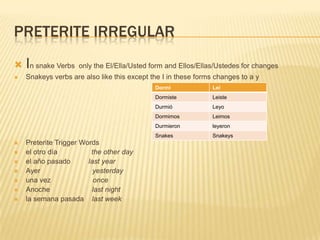
PRETERITE IRREGULAR
   In snake Verbs only the El/Ella/Usted form and Ellos/Ellas/Ustedes for changes
   Snakeys verbs are also like this except the I in these forms changes to a y
                                             Dormí              Leí
                                             Dormiste           Leiste
                                             Durmió             Leyo
                                             Dormimos           Leimos
                                             Durmieron          leyeron
                                             Snakes             Snakeys
   Preterite Trigger Words
   el otro día          the other day
   el año pasado       last year
   Ayer                  yesterday
   una vez               once
   Anoche               last night
   la semana pasada last week
COMPARATIVES AND SUPERLATIVES
   To form the comparisons of equality using adjectives or adverbs, use the following formula:
   tan + adjective (adverb) + como
   To form comparisons of equality with nouns, use the following formula:
   tanto(-a,-os,-as) + noun + como


   In Spanish, inequality is expressed by using one of the following formulae:
   más (menos) + adjective + que
    más (menos) + adverb + que
    más (menos) + noun + que


   The absolute superlative for adjectives has three possible forms.
   muy + adjective
    sumamente + adjective
    adjective + ísimo (-a, -os, -as)

   In Spanish, the relative superlative construction is similar to the comparative.
   definite article + noun + más (menos) + adjective + de
FUTURO

 The future tense is used to tell what "will"
  happen, or what "shall" happen.
 Regular verbs in the future tense are
  conjugated by adding the following endings
  to the infinitive form of the verb: -é, -ás, -á, -
  emos, -éis, -án
FUTURO

   Irregulars            Trigger words
Decir            Dir-      Mañana
Haber            Habr-     Pasado mañana
Hacer            Har-      Año que viene
Poder            Podr-     Año proximo
Poner            Pondr     es un/ dos/tres horas
Querer           Querr-
Saber            Sabr-
Salir            Saldr-
Tener            Tendr-
Valer            Valdr-
Venir            Vendr-
PRETERITE V. IMPERFECT

Preterite is an action that has
 definite beginning and end.
Imperfect has not definite
 beginning or end.
FUTURE V. CONDITIONAL

   Future tense is used when you could say “I
    will” in english. Such as I will go to the
    movies( Yo Iré a la cinema)

   Conditional Is used when you would say
    “Would, Should, or could”
POR V. PARA
   Uses of por                            Uses of Para
         Motion or general                          Destination…toward, in the
    location…around through along by       direction of,
         Duration of an action…for                  Deadline or a specific time
    during in                              in the future
   Reason or motive for an action . . .             Purpose or goal +
    because of, on account of, on          infinitive…. In order to
    behalf of                                        Purpose + noun… for,
   Object of search                       used for
   Means by which something is                      Recipient of
    done… by, by way of, by means of       something…for
   Exchange or substitution…in                      Comparison with others or
    exchange for                           an opinion… for, considering
   Unit of measure…per, by                          In the employ of…for
POR V. PARA CONTD
 Por
                    • Para
 Through portal
                    • Destination
 Location            Paraguay
  Portugal          • Purpose Parasites
 Time Porever        stay in our body to
 Cause of
                      stay alive
                    • To make an opinion
  Porpoise
                      Paradon me
 Exchange
  export/ import
COMMANDS

Negative Tú                                               Affirmative Tú
Used to tell family young people, or friends not to do    Telling family, friends or young people to do a
a certain thing.                                          certain thing.

Formed by taking the yo form of a verb and replacing      Formed by using the third person singular
the o with –as for er and ir verbs and –es for ar verbs


  Negative Usted                                          Affirmative Usted
  Used to tell older people or higher ranking             Used to tell older people or higher ranking
  people not to do something.                             people to do something.

  Formed by taking the yo form and replacing the          Formed by taking the yo form and replacing
  o with a (Singular) or an (Plural) for eri and ir       the o with a (Singular) or an (Plural) for eri and
  verbs and e (Singular) or en (Plural) for ar verbs      ir verbs and e (Singular) or en (Plural) for ar
                                                          verbs
PRESENT PERFECT TENSE
   This form is used when you say” He/She has…”
    or “ I have…” or “We have been…..”

   So combining the auxiliary verb has or have
    with something done in the past.

   Haber changes to he has ha hemos

 Add ado to the end of ar verbs
 And ido to the end of ir and er verbs
DIRECT OBJECT PRONOUNS

 Object that receives the action
 Me=me

 You=te

 Him, her or it= lo, la

 We=nos

 Them= los, las

 I have the pen= La tengo
ADVERBS

   Usually words that end in ly in english
    ex.rapidly

   Mente is added to the end of the feminine
    form of the verb

 Tall=altamente
 Short=Bajamente
SUBJUNTIVE
 Conjugated with opposite vowel
 Used for WEDDING
 W wish
                           Irregulars
 Emotion                  Conducir     conduzca
 Doubt                    Decir        Diga
                           Oir          Oiga
 Denial
                           Dar          De
 Impersonal expressions
                           Estar        Este
 Negation                 Ir           Vaya
 Guesses                  Saber        Sepa
                              Ser       Sea
                              Hacer     Haya
“SE” IMPERSONAL

   When using an impersonal voice like “How
    do you spell truck?” in Spanish you place
    “se” in front to make it a general statements.
PROGRESSIVES USING IR, ANDAR, AND SEGUIR

 Ir+ present participle= is slowly but
  surely___ing
 Andar+present participle=is going
  around____ing
 Seguir+present participle= is still ____ing

Grammar book p2

  • 1.
  • 2.
    TABLE OF CONTENTS Content Slide number  Present –ar, -er, -ir endings 3-4  Stem changers 5  Irregular “yo” 6  Saber vs. Conocer 7  Reflexives 8  “Se” impersonal 9  Dipthongs with accents 10  Verbs like -ger/-gir, -uir/-guir, -cer/-cir 11  Hace +____+ que +______ 12  Imperfecto 13  Preterite 14-
  • 3.
    PRESENT TENSE –AR/-ER/-IR  In the present tense for verbs ending in –ar Person talked about Replaces -ar at the end Yo o Tú as Él/Ella/Usted a Nosotros amos Ellos/Ellas/Ustedes an  In the present tense for verbs ending in -er Person talked about Replaces -er at the end Yo o Tú es Él/Ella/Usted E Nosotros emos Ellos/Ellas/Ustedes en
  • 4.
    PRESENT TENSE –AR/-ER/-IR CONT’D  In the present tense for verbs ending in -ir Person talked about Replaces -ei at the end Yo o Tú Es Él/Ella/Usted E Nosotros imos Ellos/Ellas/Ustedes en
  • 5.
    STEM CHANGERS  Also called “Boot verbs” it changes in all but nosotros.  More than just the ending changes. The vowel in the stem changes.  3 catergories. eie, o ue, and ei.  Common e ie verbs- Tener, Preferir  Common oue verbs- Dormir, Poder, Jugar  *Common ei verbs- Decir, Repetir, Servir.  * This stem change only happens in –Ir verbs!
  • 6.
    IRREGULAR “YO” FORM  caber (to fit) yo quepo  poner (to put, to place)yo  caer (to fall) yo caigo pongo  conducir (to drive) yo  saber (to know something - conduzco a fact)yo sé  conocer (to know,) yo  salir (to leave)yo salgo conozco  seguir (to follow)yo sigo  escoger (to choose )yo  traer (to bring)yo traigo escojo  valer (to be worth)yo valgo  dirigir (to direct) yo dirijo  ver (to see)yo veo  hacer (to do, to make) yo hago
  • 7.
    SABER VS. CONOCER When using saber it mean that you know a fact or how to do something.  When using conocer it means you know a person or are familiar with something.
  • 8.
    REFLEXIVES  When refering to a person doing an action. Person talked about Reflexive pronoun Yo Me Tú Te Él/Ella/Usted Se Nosotros Nos Ellos/Ellas/Ustedes Se
  • 9.
    “SE” IMPERSONAL  When using an impersonal voice like “How do you spell truck?” in Spanish you place “se” in front to make it a general statements.
  • 10.
    DIPTHONGS WITH ACCENTS Hereare some fairly common words that include diphthongs : puerto, tierra, siete, hay, cuida, ciudad, labio, hacia, paisano, canción, Europa, aire.
  • 11.
    VERBS LIKE GER/GIR,UIR/GUIR, CER/CIR  For verbs that end in ger/gir, In the first person change the g to a j.  In guir verbs, in the yo form the gu changes to g.  In uir verbs add a y before a, e and, o.  For cer/cir verbs, in the yo form, change the c to a z.
  • 12.
    HACE+ ______+QUE+_____  Thesecond blank is to be filled with a verb in either the present or preterite form.  The First Black is filled with an expression of time
  • 13.
    IMPERFECTO  A past tense form for events without a specific time.  For –er/-ir endings For –ar endings Person talked about Replaces -ar at the Person talked Replaces -ar at the end about end Yo ía Yo aba Tú Ías Tú abas Él/Ella/Usted Ía Él/Ella/Usted aba Nosotros Íamos Nosotros ábamos Ellos/Ellas/Ustedes ían Ellos/Ellas/Ustedes aban  Trigger words Irregulars Trigger Words Translation Ser Ir Ver a menudo Often Era iba Veía A veces Sometimes Eras Ibas Veías Cada dia everyday Era Iba Veía Cada año Every year Con frecuencia frequently éramos Íbamos Veíamos generalmente Usually Erais Ibais Veíais siempre always eran Iban veían
  • 14.
    PRETERITE TENSE IRREGULARS In irregular car,gar, zar verbs only the yo form changes. Gar g to gu car c to qu zar z to c  Spock Verbs Hacer Ir/Ser Dar/Ver Yo Fui D/V -i Hice Tú Fuiste D/V –iste Hiciste El/Ella/Usted Fue D/V –io Hizo Nosotros Fuimos D/V –imos Hicimos Ustedes/Ello Fueron D/V- ieron Hicieron s /Ellas
  • 15.
    IRREGULAR PRETERITE CONT’D Andar Anduv- Estar Estuv- Poder Pud- Poner Pus- Querer Quis- -e Saber Sup- -iste Tener Tuv- -o Vener Vin- -imos Conducir Conduj- -ieron Producir Produj- Traducir Traduj- Decir Dij- Traer Traj-
  • 16.
    PRETERITE IRREGULAR  In snake Verbs only the El/Ella/Usted form and Ellos/Ellas/Ustedes for changes  Snakeys verbs are also like this except the I in these forms changes to a y Dormí Leí Dormiste Leiste Durmió Leyo Dormimos Leimos Durmieron leyeron Snakes Snakeys  Preterite Trigger Words  el otro día the other day  el año pasado last year  Ayer yesterday  una vez once  Anoche last night  la semana pasada last week
  • 17.
    COMPARATIVES AND SUPERLATIVES  To form the comparisons of equality using adjectives or adverbs, use the following formula:  tan + adjective (adverb) + como  To form comparisons of equality with nouns, use the following formula:  tanto(-a,-os,-as) + noun + como  In Spanish, inequality is expressed by using one of the following formulae:  más (menos) + adjective + que más (menos) + adverb + que más (menos) + noun + que  The absolute superlative for adjectives has three possible forms.  muy + adjective sumamente + adjective adjective + ísimo (-a, -os, -as)  In Spanish, the relative superlative construction is similar to the comparative.  definite article + noun + más (menos) + adjective + de
  • 18.
    FUTURO  The futuretense is used to tell what "will" happen, or what "shall" happen.  Regular verbs in the future tense are conjugated by adding the following endings to the infinitive form of the verb: -é, -ás, -á, - emos, -éis, -án
  • 19.
    FUTURO  Irregulars Trigger words Decir Dir- Mañana Haber Habr- Pasado mañana Hacer Har- Año que viene Poder Podr- Año proximo Poner Pondr es un/ dos/tres horas Querer Querr- Saber Sabr- Salir Saldr- Tener Tendr- Valer Valdr- Venir Vendr-
  • 20.
    PRETERITE V. IMPERFECT Preteriteis an action that has definite beginning and end. Imperfect has not definite beginning or end.
  • 21.
    FUTURE V. CONDITIONAL  Future tense is used when you could say “I will” in english. Such as I will go to the movies( Yo Iré a la cinema)  Conditional Is used when you would say “Would, Should, or could”
  • 22.
    POR V. PARA  Uses of por Uses of Para  Motion or general Destination…toward, in the location…around through along by direction of,  Duration of an action…for Deadline or a specific time during in in the future  Reason or motive for an action . . . Purpose or goal + because of, on account of, on infinitive…. In order to behalf of Purpose + noun… for,  Object of search used for  Means by which something is Recipient of done… by, by way of, by means of something…for  Exchange or substitution…in Comparison with others or exchange for an opinion… for, considering  Unit of measure…per, by In the employ of…for
  • 23.
    POR V. PARACONTD  Por • Para  Through portal • Destination  Location Paraguay Portugal • Purpose Parasites  Time Porever stay in our body to  Cause of stay alive • To make an opinion Porpoise Paradon me  Exchange export/ import
  • 24.
    COMMANDS Negative Tú Affirmative Tú Used to tell family young people, or friends not to do Telling family, friends or young people to do a a certain thing. certain thing. Formed by taking the yo form of a verb and replacing Formed by using the third person singular the o with –as for er and ir verbs and –es for ar verbs Negative Usted Affirmative Usted Used to tell older people or higher ranking Used to tell older people or higher ranking people not to do something. people to do something. Formed by taking the yo form and replacing the Formed by taking the yo form and replacing o with a (Singular) or an (Plural) for eri and ir the o with a (Singular) or an (Plural) for eri and verbs and e (Singular) or en (Plural) for ar verbs ir verbs and e (Singular) or en (Plural) for ar verbs
  • 25.
    PRESENT PERFECT TENSE  This form is used when you say” He/She has…” or “ I have…” or “We have been…..”  So combining the auxiliary verb has or have with something done in the past.  Haber changes to he has ha hemos  Add ado to the end of ar verbs  And ido to the end of ir and er verbs
  • 26.
    DIRECT OBJECT PRONOUNS Object that receives the action  Me=me  You=te  Him, her or it= lo, la  We=nos  Them= los, las  I have the pen= La tengo
  • 27.
    ADVERBS  Usually words that end in ly in english ex.rapidly  Mente is added to the end of the feminine form of the verb  Tall=altamente  Short=Bajamente
  • 28.
    SUBJUNTIVE  Conjugated withopposite vowel  Used for WEDDING  W wish Irregulars  Emotion Conducir conduzca  Doubt Decir Diga Oir Oiga  Denial Dar De  Impersonal expressions Estar Este  Negation Ir Vaya  Guesses Saber Sepa Ser Sea Hacer Haya
  • 29.
    “SE” IMPERSONAL  When using an impersonal voice like “How do you spell truck?” in Spanish you place “se” in front to make it a general statements.
  • 30.
    PROGRESSIVES USING IR,ANDAR, AND SEGUIR  Ir+ present participle= is slowly but surely___ing  Andar+present participle=is going around____ing  Seguir+present participle= is still ____ing