LIBRO DE GRAMÁTICA
ESPAÑOLA
Karina Bereszniewicz
7th period
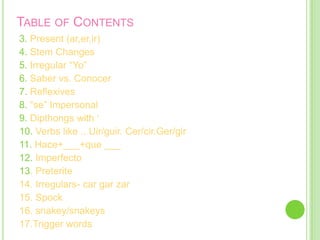
TABLE OF CONTENTS
3. Present (ar,er,ir)
4. Stem Changes
5. Irregular “Yo”
6. Saber vs. Conocer
7. Reflexives
8. “se” Impersonal
9. Dipthongs with „
10. Verbs like .. Uir/guir. Cer/cir.Ger/gir
11. Hace+___+que ___
12. Imperfecto
13. Preterite
14. Irregulars- car gar zar
15. Spock
16. snakey/snakeys
17.Trigger words
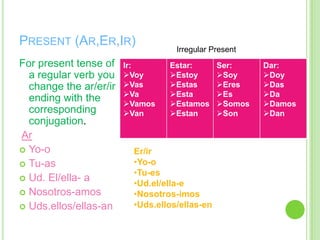
PRESENT (AR,ER,IR)
                                   Irregular Present
For present tense of    Ir:      Estar:        Ser:     Dar:
  a regular verb you    Voy     Estoy        Soy     Doy
  change the ar/er/ir   Vas     Estas        Eres    Das
                        Va      Esta         Es      Da
  ending with the       Vamos   Estamos      Somos   Damos
  corresponding         Van     Estan        Son     Dan
  conjugation.
Ar
 Yo-o                   Er/ir
 Tu-as                  •Yo-o
                         •Tu-es
 Ud. El/ella- a
                         •Ud.el/ella-e
 Nosotros-amos          •Nosotros-imos
 Uds.ellos/ellas-an     •Uds.ellos/ellas-en
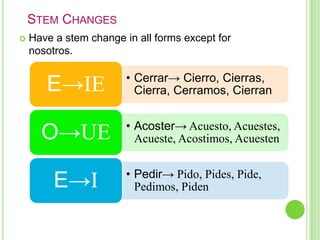
STEM CHANGES
   Have a stem change in all forms except for
    nosotros.

                        • Cerrar→ Cierro, Cierras,
       E→IE               Cierra, Cerramos, Cierran

                        • Acoster→ Acuesto, Acuestes,
      O→UE                Acueste, Acostimos, Acuesten

                        • Pedir→ Pido, Pides, Pide,
         E→I              Pedimos, Piden
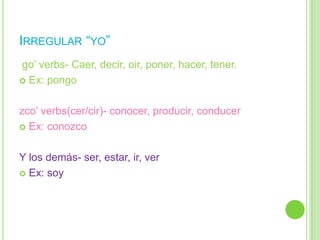
IRREGULAR “YO”
go‟ verbs- Caer, decir, oir, poner, hacer, tener.
 Ex: pongo


zco‟ verbs(cer/cir)- conocer, producir, conducer
 Ex: conozco


Y los demás- ser, estar, ir, ver
 Ex: soy
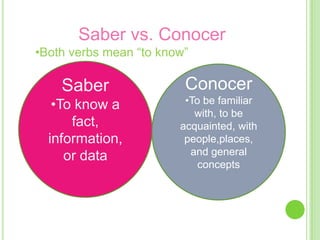
Saber vs. Conocer
•Both verbs mean “to know”

    Saber                Conocer
   •To know a            •To be familiar
                           with, to be
      fact,             acquainted, with
  information,           people,places,
     or data              and general
                            concepts
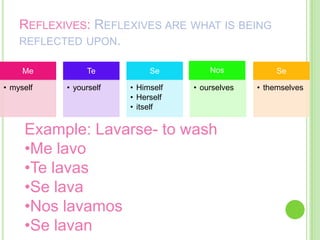
REFLEXIVES: REFLEXIVES ARE WHAT IS BEING
    REFLECTED UPON.

     Me         Te           Se         Nos            Se

• myself   • yourself   • Himself   • ourselves   • themselves
                        • Herself
                        • itself


     Example: Lavarse- to wash
     •Me lavo
     •Te lavas
     •Se lava
     •Nos lavamos
     •Se lavan
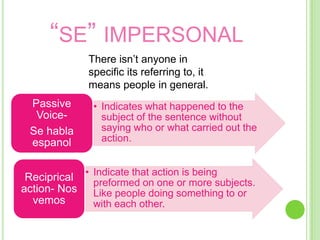
“SE” IMPERSONAL
              There isn‟t anyone in
              specific its referring to, it
              means people in general.
 Passive       • Indicates what happened to the
  Voice-         subject of the sentence without
 Se habla        saying who or what carried out the
 espanol         action.


 Reciprical • Indicate that action ismore subjects.
              preformed on one or
                                     being
action- Nos Like people doing something to or
  vemos       with each other.
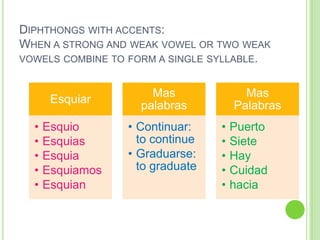
DIPHTHONGS WITH ACCENTS:
WHEN A STRONG AND WEAK VOWEL OR TWO WEAK
VOWELS COMBINE TO FORM A SINGLE SYLLABLE.


                      Mas               Mas
       Esquiar
                    palabras          Palabras
  •   Esquio      • Continuar:    •   Puerto
  •   Esquias       to continue   •   Siete
  •   Esquia      • Graduarse:    •   Hay
  •   Esquiamos     to graduate   •   Cuidad
  •   Esquian                     •   hacia
VERBS LIKE: UIR/GUIR Y CER/CIR Y GER/GIR
 Coger
• Cojo                Conocer                                      Conseguir
• Coges
                  • Conozco         Decir                      •   Consigo
• coge
                  • Conoces                                    •   Consigues
• Cogemos
                  • Conoce      •   Digo                       •   Consigue
• cogen                                           Atribuir
                  • Conocemo    •   Dices                      •   Consigimos
                    s           •   Dice      •   Atribuyo     •   Consiguen
         Exigir   • Conocen     •   Decimos   •   Atribuyes
     • Exijo                    •   Dicen     •   Atribuye
     • Exgiges                                •   Atribumios
     • Exige                                  •   Atribuyen
     • Exigimo
       s
     • Exigen
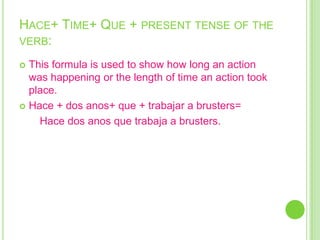
HACE+ TIME+ QUE + PRESENT TENSE OF THE
VERB:

 This formula is used to show how long an action
  was happening or the length of time an action took
  place.
 Hace + dos anos+ que + trabajar a brusters=

    Hace dos anos que trabaja a brusters.
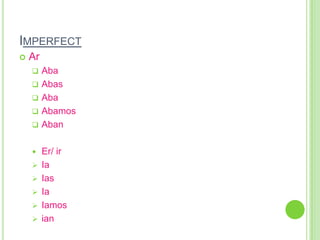
IMPERFECT
   Ar
        Aba
        Abas
        Aba
        Abamos
        Aban

        Er/ ir
        Ia
        Ias
        Ia
        Iamos
        ian
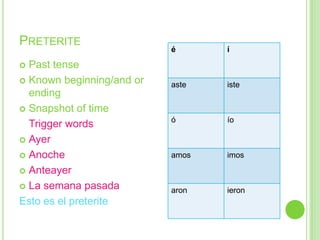
PRETERITE
                           é      í
 Past tense
 Known beginning/and or
                           aste   iste
  ending
 Snapshot of time
                           ó      ío
  Trigger words
 Ayer

 Anoche                   amos   imos
 Anteayer

 La semana pasada
                           aron   ieron
Esto es el preterite
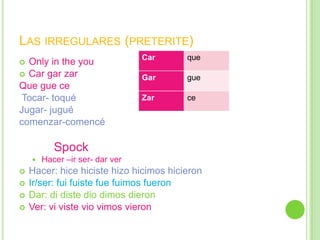
LAS IRREGULARES (PRETERITE)
                                 Car     que
 Only in the you
 Car gar zar                    Gar     gue
Que gue ce
 Tocar- toqué                    Zar     ce
Jugar- jugué
comenzar-comencé

           Spock
       Hacer –ir ser- dar ver
   Hacer: hice hiciste hizo hicimos hicieron
   Ir/ser: fui fuiste fue fuimos fueron
   Dar: di diste dio dimos dieron
   Ver: vi viste vio vimos vieron
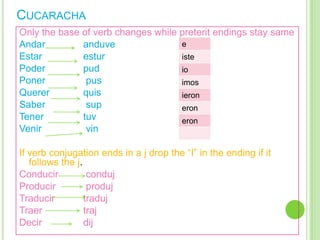
CUCARACHA
Only the base of verb changes while preterit endings stay same
Andar         anduve                e
Estar         estur                 iste
Poder         pud                   io
Poner          pus                  imos
Querer        quis                  ieron
Saber          sup                  eron
Tener         tuv                   eron
Venir          vin

If verb conjugation ends in a j drop the “I” in the ending if it
   follows the j.
Conducir           conduj
Producir           produj
Traducir          traduj
Traer             traj
Decir             dij
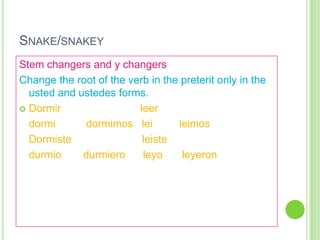
SNAKE/SNAKEY
Stem changers and y changers
Change the root of the verb in the preterit only in the
  usted and ustedes forms.
 Dormir                 leer
  dormi      dormimos lei         leimos
  Dormiste                leiste
  durmio     durmiero     leyo     leyeron
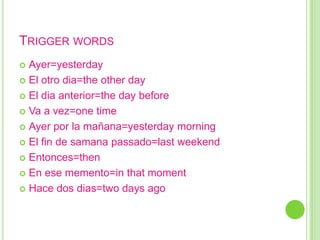
TRIGGER WORDS
 Ayer=yesterday
 El otro dia=the other day

 El dia anterior=the day before

 Va a vez=one time

 Ayer por la mañana=yesterday morning

 El fin de samana passado=last weekend

 Entonces=then

 En ese memento=in that moment

 Hace dos dias=two days ago
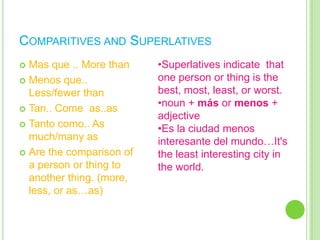
COMPARITIVES AND SUPERLATIVES
 Mas que .. More than    •Superlatives indicate that
 Menos que..             one person or thing is the
  Less/fewer than         best, most, least, or worst.
                          •noun + más or menos +
 Tan.. Come as..as
                          adjective
 Tanto como.. As
                          •Es la ciudad menos
  much/many as            interesante del mundo…It's
 Are the comparison of   the least interesting city in
  a person or thing to    the world.
  another thing. (more,
  less, or as…as)
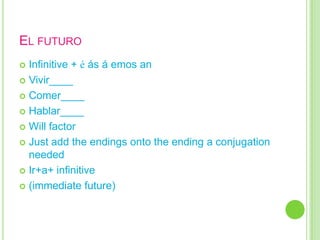
EL FUTURO
 Infinitive + é ás á emos an
 Vivir____

 Comer____

 Hablar____

 Will factor

 Just add the endings onto the ending a conjugation
  needed
 Ir+a+ infinitive

 (immediate future)
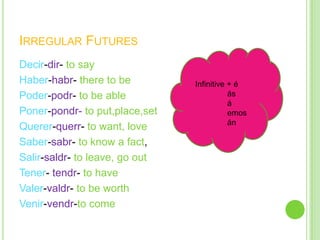
IRREGULAR FUTURES
Decir-dir- to say
Haber-habr- there to be         Infinitive + é
Poder-podr- to be able                     ás
                                           á
Poner-pondr- to put,place,set              emos
                                           án
Querer-querr- to want, love
Saber-sabr- to know a fact,
Salir-saldr- to leave, go out
Tener- tendr- to have
Valer-valdr- to be worth
Venir-vendr-to come
TRIGGER VERBS
 Todos los dias
 Siempre

 A menudo

 Cada dia

 Generalmente

 Por lo general

Libro de gramática española

  • 1.
    LIBRO DE GRAMÁTICA ESPAÑOLA KarinaBereszniewicz 7th period
  • 2.
    TABLE OF CONTENTS 3.Present (ar,er,ir) 4. Stem Changes 5. Irregular “Yo” 6. Saber vs. Conocer 7. Reflexives 8. “se” Impersonal 9. Dipthongs with „ 10. Verbs like .. Uir/guir. Cer/cir.Ger/gir 11. Hace+___+que ___ 12. Imperfecto 13. Preterite 14. Irregulars- car gar zar 15. Spock 16. snakey/snakeys 17.Trigger words
  • 3.
    PRESENT (AR,ER,IR) Irregular Present For present tense of Ir: Estar: Ser: Dar: a regular verb you Voy Estoy Soy Doy change the ar/er/ir Vas Estas Eres Das Va Esta Es Da ending with the Vamos Estamos Somos Damos corresponding Van Estan Son Dan conjugation. Ar  Yo-o Er/ir  Tu-as •Yo-o •Tu-es  Ud. El/ella- a •Ud.el/ella-e  Nosotros-amos •Nosotros-imos  Uds.ellos/ellas-an •Uds.ellos/ellas-en
  • 4.
    STEM CHANGES  Have a stem change in all forms except for nosotros. • Cerrar→ Cierro, Cierras, E→IE Cierra, Cerramos, Cierran • Acoster→ Acuesto, Acuestes, O→UE Acueste, Acostimos, Acuesten • Pedir→ Pido, Pides, Pide, E→I Pedimos, Piden
  • 5.
    IRREGULAR “YO” go‟ verbs-Caer, decir, oir, poner, hacer, tener.  Ex: pongo zco‟ verbs(cer/cir)- conocer, producir, conducer  Ex: conozco Y los demás- ser, estar, ir, ver  Ex: soy
  • 6.
    Saber vs. Conocer •Bothverbs mean “to know” Saber Conocer •To know a •To be familiar with, to be fact, acquainted, with information, people,places, or data and general concepts
  • 7.
    REFLEXIVES: REFLEXIVES AREWHAT IS BEING REFLECTED UPON. Me Te Se Nos Se • myself • yourself • Himself • ourselves • themselves • Herself • itself Example: Lavarse- to wash •Me lavo •Te lavas •Se lava •Nos lavamos •Se lavan
  • 8.
    “SE” IMPERSONAL There isn‟t anyone in specific its referring to, it means people in general. Passive • Indicates what happened to the Voice- subject of the sentence without Se habla saying who or what carried out the espanol action. Reciprical • Indicate that action ismore subjects. preformed on one or being action- Nos Like people doing something to or vemos with each other.
  • 9.
    DIPHTHONGS WITH ACCENTS: WHENA STRONG AND WEAK VOWEL OR TWO WEAK VOWELS COMBINE TO FORM A SINGLE SYLLABLE. Mas Mas Esquiar palabras Palabras • Esquio • Continuar: • Puerto • Esquias to continue • Siete • Esquia • Graduarse: • Hay • Esquiamos to graduate • Cuidad • Esquian • hacia
  • 10.
    VERBS LIKE: UIR/GUIRY CER/CIR Y GER/GIR Coger • Cojo Conocer Conseguir • Coges • Conozco Decir • Consigo • coge • Conoces • Consigues • Cogemos • Conoce • Digo • Consigue • cogen Atribuir • Conocemo • Dices • Consigimos s • Dice • Atribuyo • Consiguen Exigir • Conocen • Decimos • Atribuyes • Exijo • Dicen • Atribuye • Exgiges • Atribumios • Exige • Atribuyen • Exigimo s • Exigen
  • 11.
    HACE+ TIME+ QUE+ PRESENT TENSE OF THE VERB:  This formula is used to show how long an action was happening or the length of time an action took place.  Hace + dos anos+ que + trabajar a brusters= Hace dos anos que trabaja a brusters.
  • 12.
    IMPERFECT  Ar  Aba  Abas  Aba  Abamos  Aban  Er/ ir  Ia  Ias  Ia  Iamos  ian
  • 13.
    PRETERITE é í  Past tense  Known beginning/and or aste iste ending  Snapshot of time ó ío Trigger words  Ayer  Anoche amos imos  Anteayer  La semana pasada aron ieron Esto es el preterite
  • 14.
    LAS IRREGULARES (PRETERITE) Car que  Only in the you  Car gar zar Gar gue Que gue ce Tocar- toqué Zar ce Jugar- jugué comenzar-comencé Spock  Hacer –ir ser- dar ver  Hacer: hice hiciste hizo hicimos hicieron  Ir/ser: fui fuiste fue fuimos fueron  Dar: di diste dio dimos dieron  Ver: vi viste vio vimos vieron
  • 15.
    CUCARACHA Only the baseof verb changes while preterit endings stay same Andar anduve e Estar estur iste Poder pud io Poner pus imos Querer quis ieron Saber sup eron Tener tuv eron Venir vin If verb conjugation ends in a j drop the “I” in the ending if it follows the j. Conducir conduj Producir produj Traducir traduj Traer traj Decir dij
  • 16.
    SNAKE/SNAKEY Stem changers andy changers Change the root of the verb in the preterit only in the usted and ustedes forms.  Dormir leer dormi dormimos lei leimos Dormiste leiste durmio durmiero leyo leyeron
  • 17.
    TRIGGER WORDS  Ayer=yesterday El otro dia=the other day  El dia anterior=the day before  Va a vez=one time  Ayer por la mañana=yesterday morning  El fin de samana passado=last weekend  Entonces=then  En ese memento=in that moment  Hace dos dias=two days ago
  • 18.
    COMPARITIVES AND SUPERLATIVES Mas que .. More than •Superlatives indicate that  Menos que.. one person or thing is the Less/fewer than best, most, least, or worst. •noun + más or menos +  Tan.. Come as..as adjective  Tanto como.. As •Es la ciudad menos much/many as interesante del mundo…It's  Are the comparison of the least interesting city in a person or thing to the world. another thing. (more, less, or as…as)
  • 19.
    EL FUTURO  Infinitive+ é ás á emos an  Vivir____  Comer____  Hablar____  Will factor  Just add the endings onto the ending a conjugation needed  Ir+a+ infinitive  (immediate future)
  • 20.
    IRREGULAR FUTURES Decir-dir- tosay Haber-habr- there to be Infinitive + é Poder-podr- to be able ás á Poner-pondr- to put,place,set emos án Querer-querr- to want, love Saber-sabr- to know a fact, Salir-saldr- to leave, go out Tener- tendr- to have Valer-valdr- to be worth Venir-vendr-to come
  • 21.
    TRIGGER VERBS  Todoslos dias  Siempre  A menudo  Cada dia  Generalmente  Por lo general