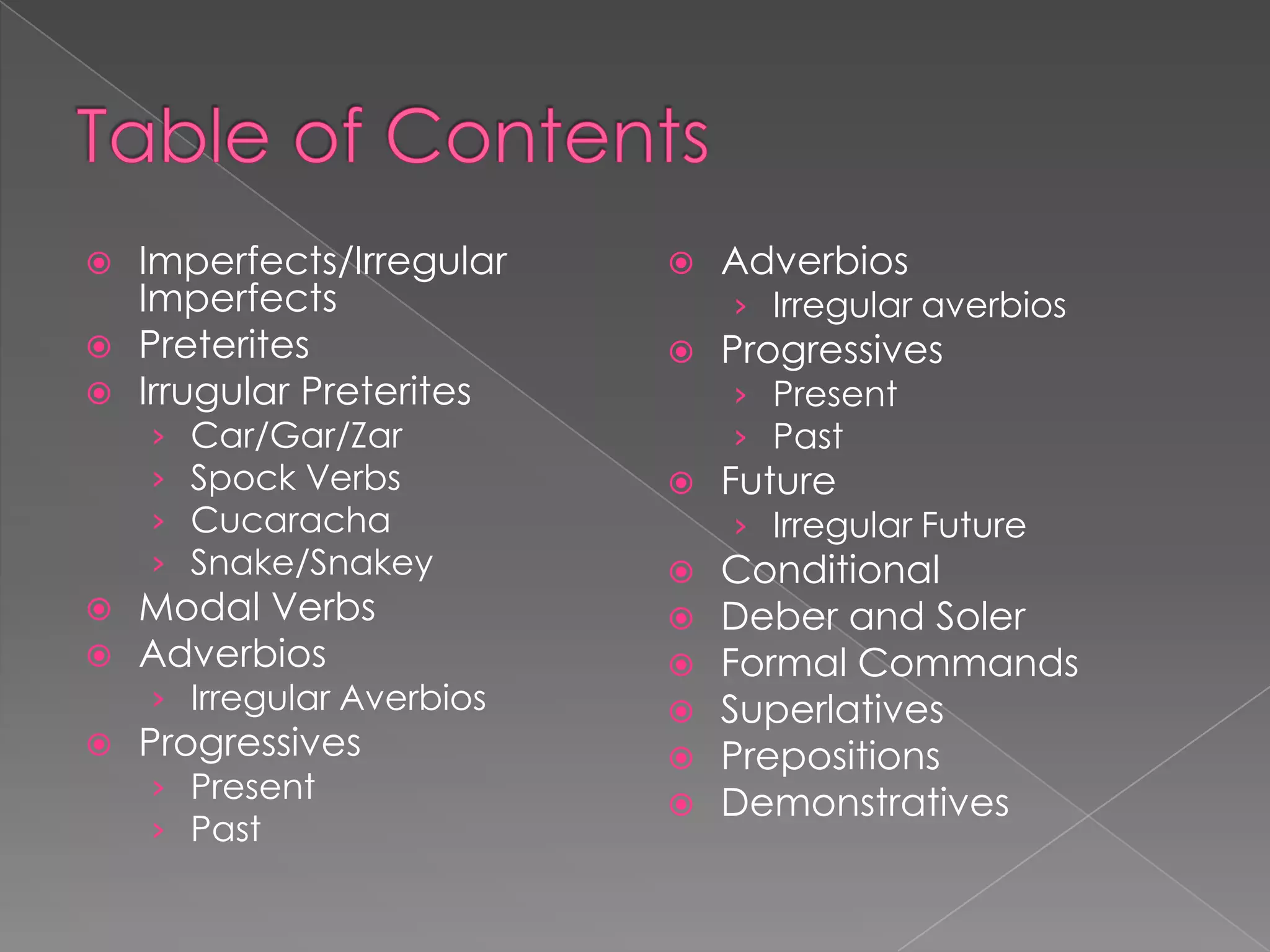
 Imperfects/Irregular        Adverbios
  Imperfects                   › Irregular averbios
 Preterites                  Progressives
 Irrugular Preterites         › Present
    ›   Car/Gar/Zar            › Past
    ›   Spock Verbs           Future
    ›   Cucaracha              › Irregular Future
    ›   Snake/Snakey          Conditional
   Modal Verbs               Deber and Soler
   Adverbios                 Formal Commands
    › Irregular Averbios      Superlatives
   Progressives              Prepositions
    › Present
                              Demonstratives
    › Past
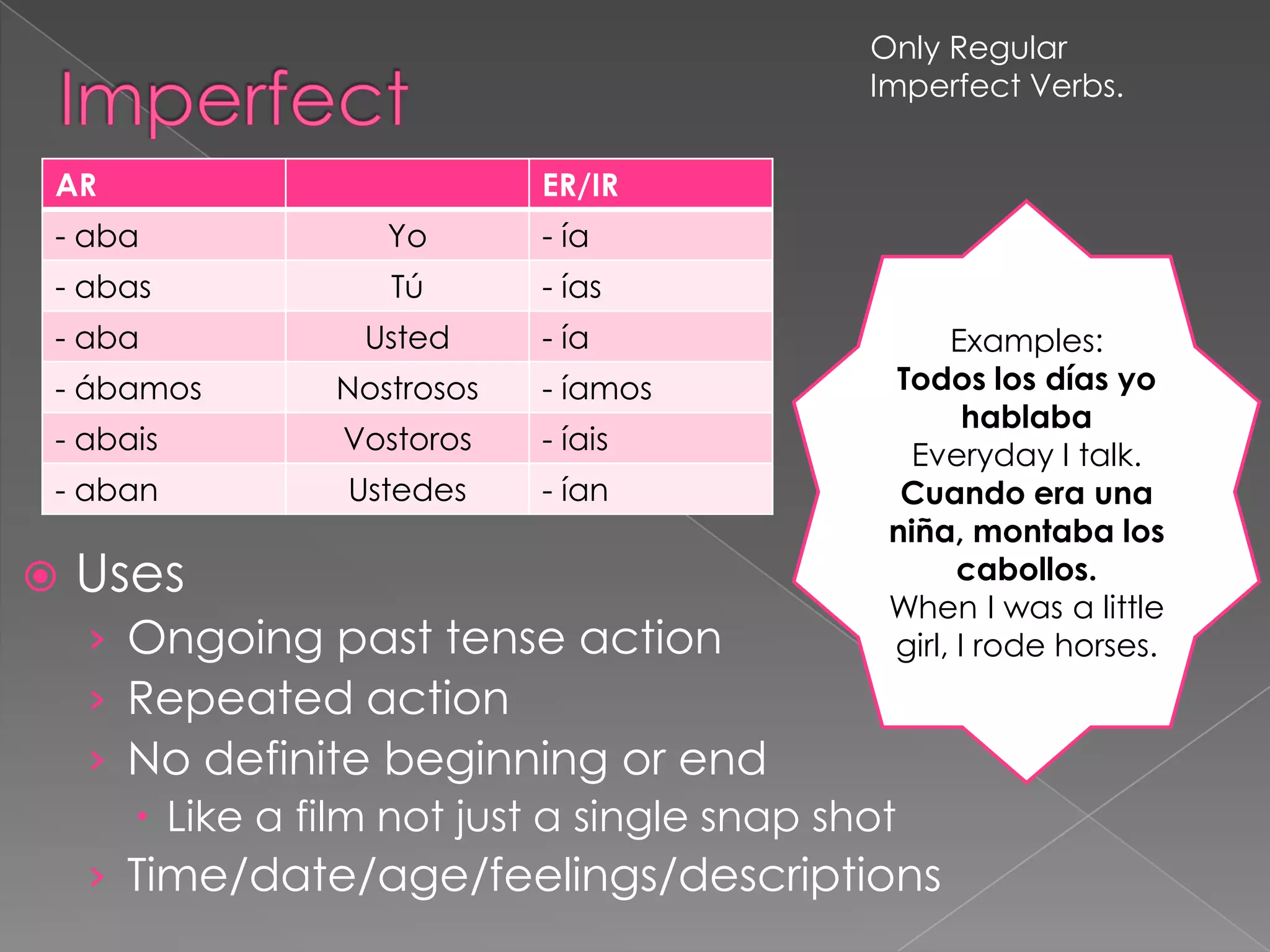
Only Regular
                                           Imperfect Verbs.


AR                          ER/IR
- aba              Yo       - ía
- abas             Tú       - ías
- aba            Usted      - ía                 Examples:
- ábamos        Nostrosos   - íamos         Todos los días yo
                                                   hablaba
- abais         Vostoros    - íais            Everyday I talk.
- aban           Ustedes    - ían            Cuando era una
                                            niña, montaba los
   Uses                                          cabollos.
                                            When I was a little
    › Ongoing past tense action             girl, I rode horses.
    › Repeated action
    › No definite beginning or end
       Like a film not just a single snap shot
    › Time/date/age/feelings/descriptions
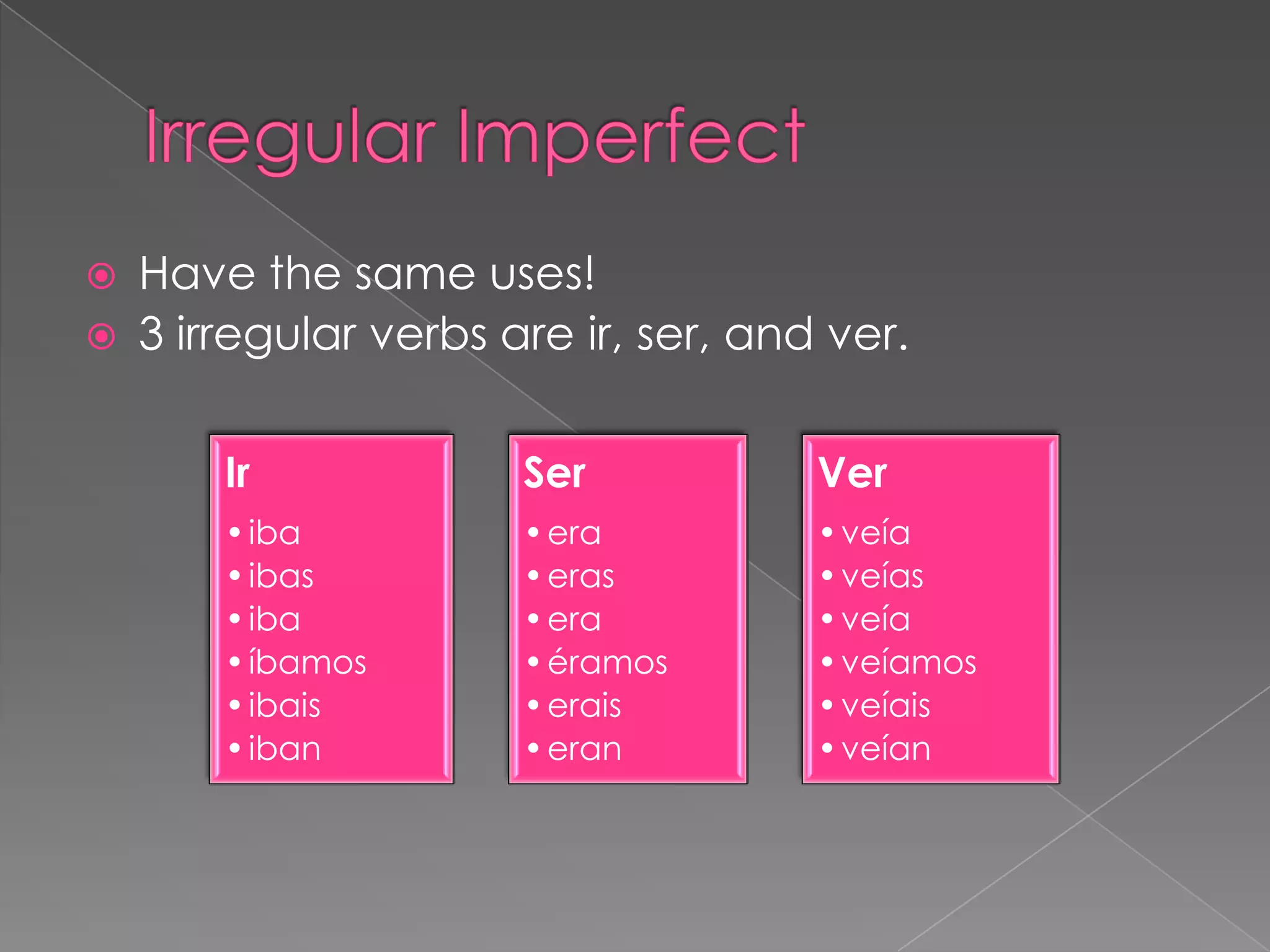
   Have the same uses!
   3 irregular verbs are ir, ser, and ver.

        Ir             Ser            Ver
        • iba          • era          • veía
        • ibas         • eras         • veías
        • iba          • era          • veía
        • íbamos       • éramos       • veíamos
        • ibais        • erais        • veíais
        • iban         • eran         • veían
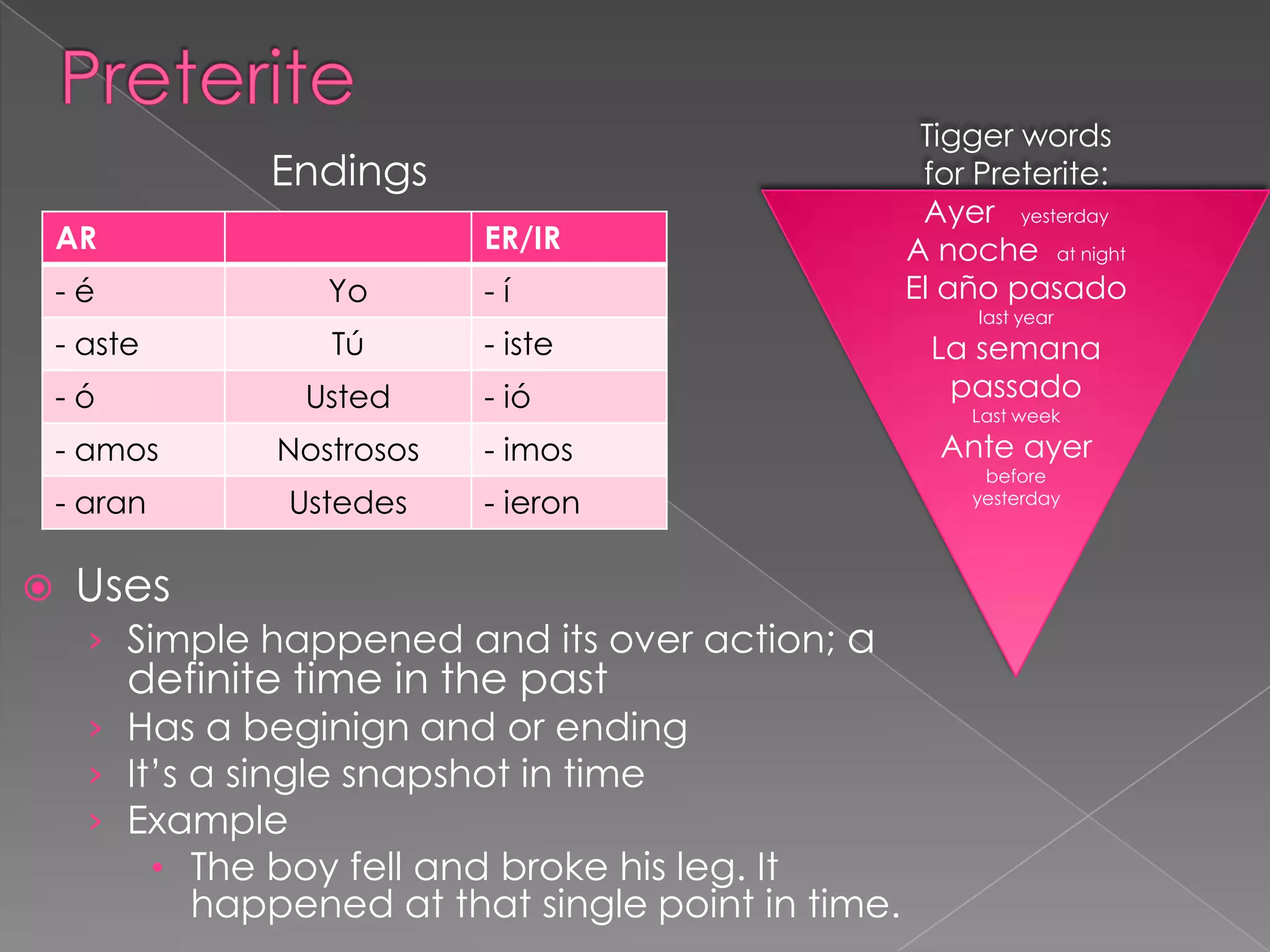
Tigger words
                 Endings                               for Preterite:
                                                       Ayer yesterday
    AR                       ER/IR                    A noche at night
    -é              Yo       -í                       El año pasado
                                                           last year
    - aste          Tú       - iste                    La semana
    -ó             Usted     - ió                       passado
                                                          Last week

    - amos       Nostrosos   - imos                     Ante ayer
                                                           before
    - aran        Ustedes    - ieron                      yesterday


    Uses
      › Simple happened and its over action; a
         definite time in the past
      › Has a beginign and or ending
      › It’s a single snapshot in time
      › Example
          • The boy fell and broke his leg. It
             happened at that single point in time.
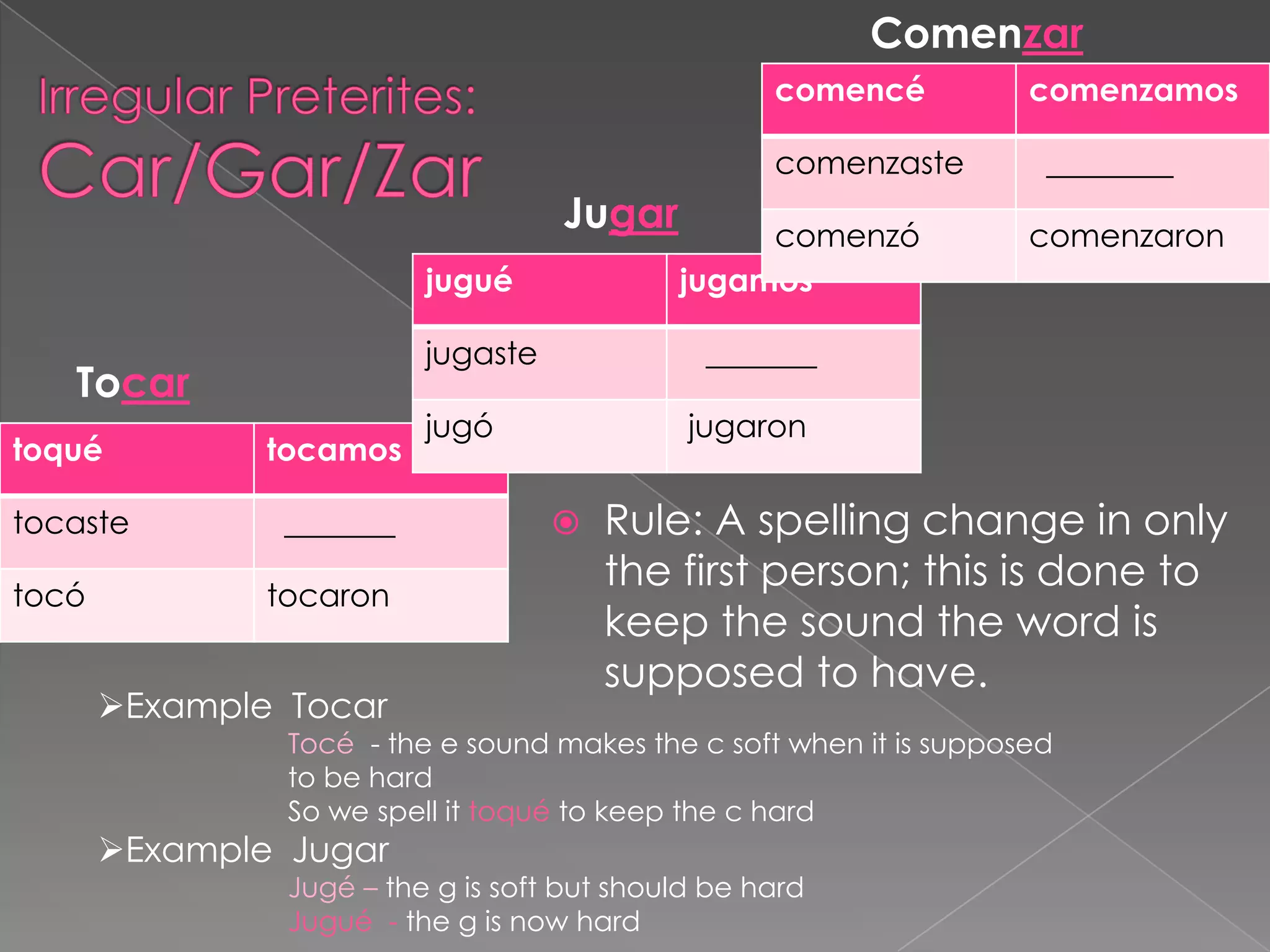
Comenzar
                                                    comencé          comenzamos

                                                    comenzaste        ________
                                    Jugar         comenzó            comenzaron
                          jugué              jugamos

                          jugaste              _______
   Tocar
                          jugó                jugaron
toqué          tocamos

tocaste         _______                Rule: A spelling change in only
tocó           tocaron
                                        the first person; this is done to
                                        keep the sound the word is
                                        supposed to have.
       Example Tocar
                Tocé - the e sound makes the c soft when it is supposed
                to be hard
                So we spell it toqué to keep the c hard
       Example Jugar
                Jugé – the g is soft but should be hard
                Jugué - the g is now hard
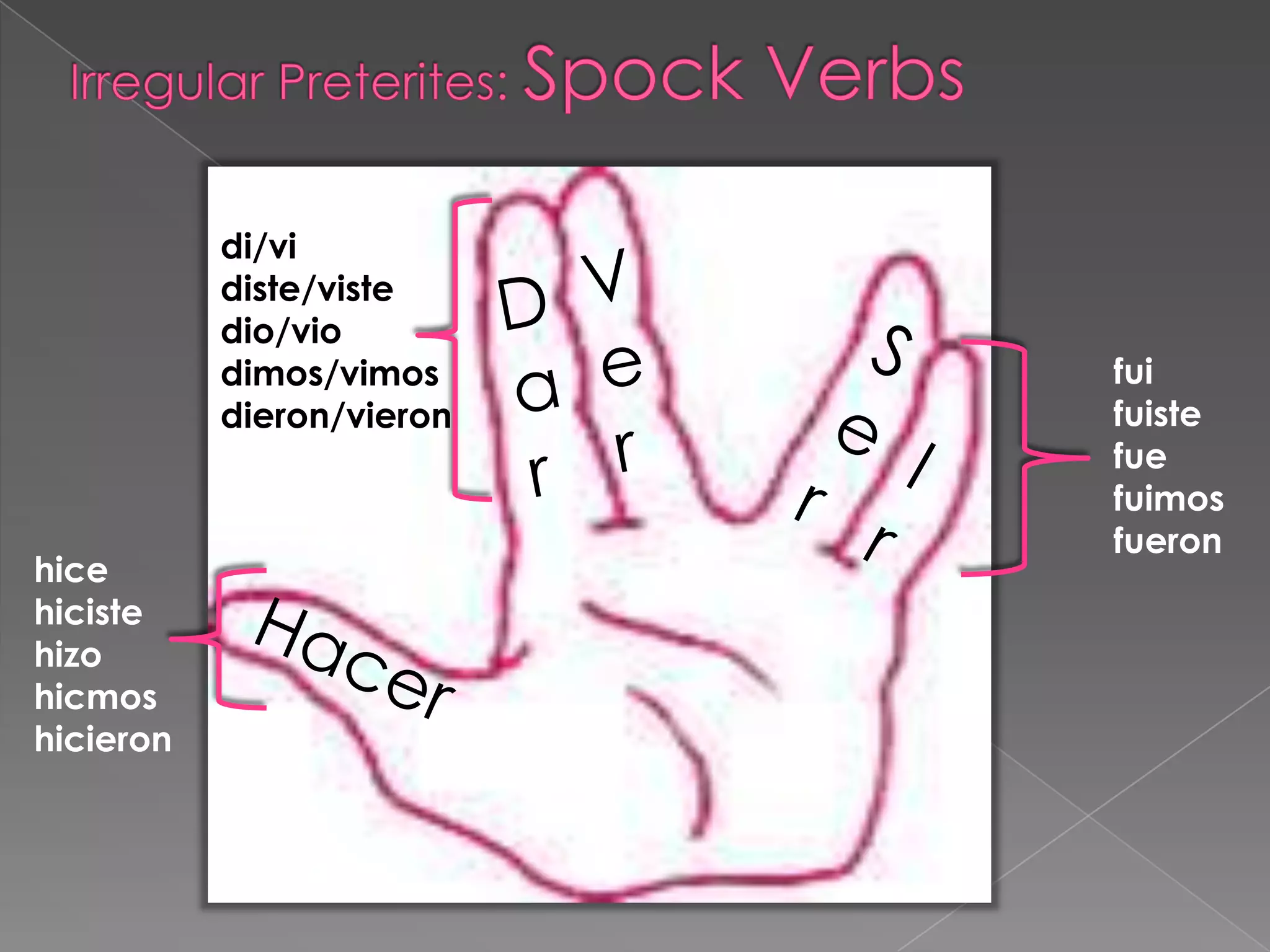
di/vi
           diste/viste
           dio/vio
           dimos/vimos     fui
           dieron/vieron   fuiste
                           fue
                           fuimos
                           fueron
hice
hiciste
hizo
hicmos
hicieron
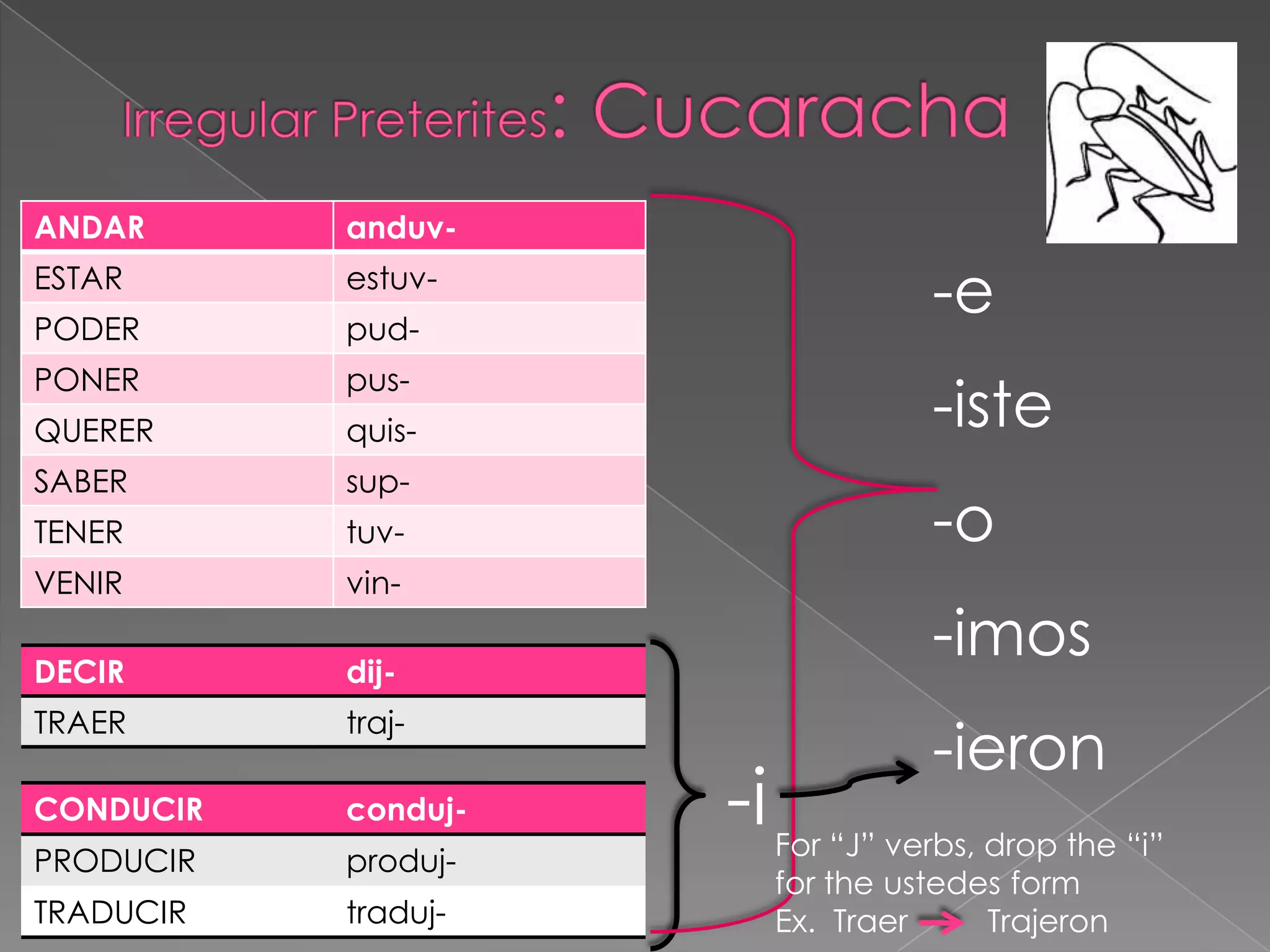
ANDAR      anduv-
ESTAR
PODER
           estuv-
           pud-
                                   -e
PONER      pus-
QUERER     quis-                   -iste
SABER      sup-
TENER      tuv-                    -o
VENIR      vin-

DECIR      dij-
                                   -imos
TRAER      traj-
                                   -ieron
CONDUCIR   conduj-   -i For “J” verbs, drop the “i”
PRODUCIR   produj-
                        for the ustedes form
TRADUCIR   traduj-      Ex. Traer     Trajeron
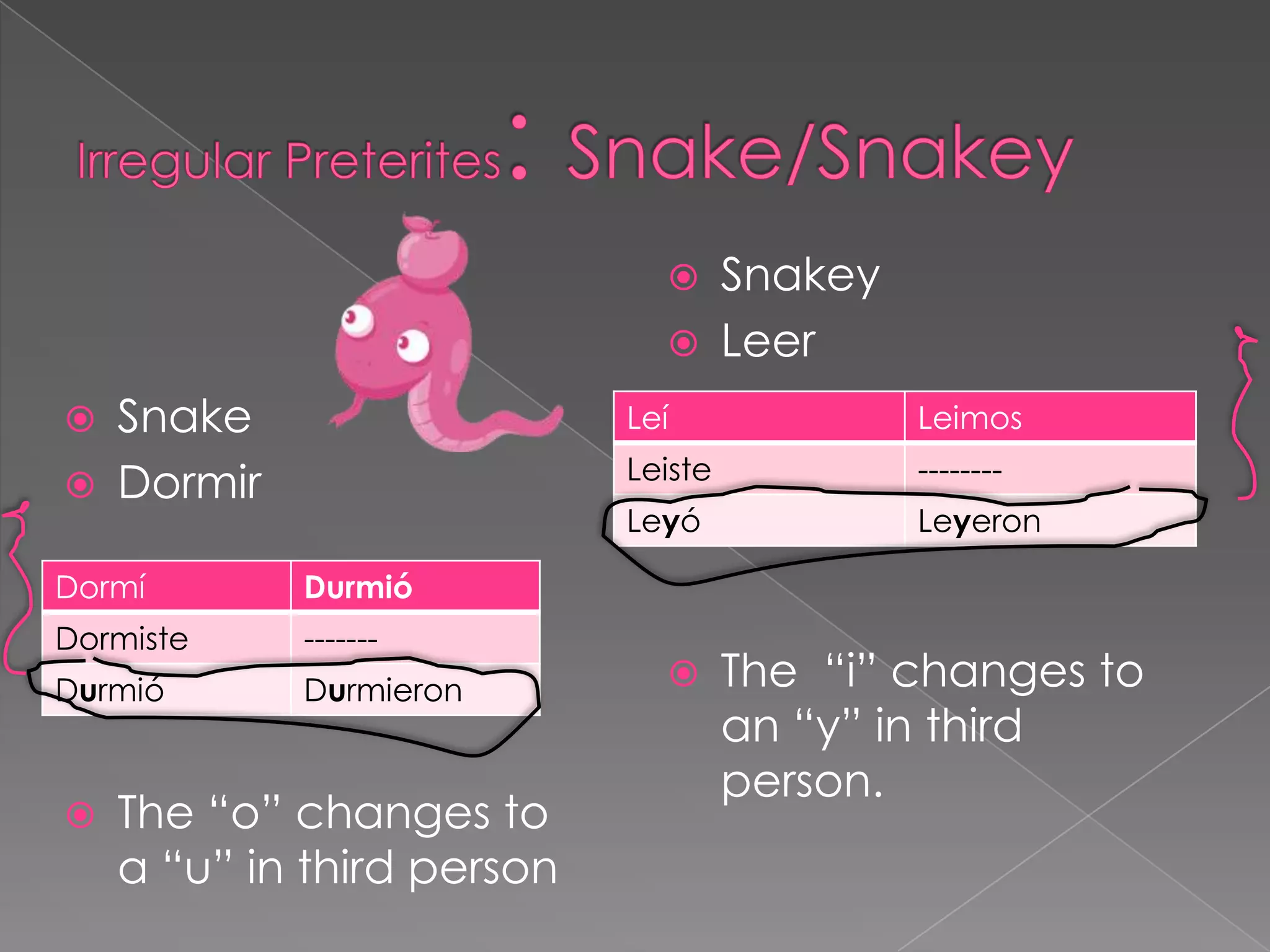
      Snakey
                                    Leer
   Snake                   Leí               Leimos
                            Leiste            --------
   Dormir
                            Leyó              Leyeron

Dormí        Durmió
Dormiste     -------
Durmió       Durmieron              The “i” changes to
                                     an “y” in third
                                     person.
   The “o” changes to
    a “u” in third person
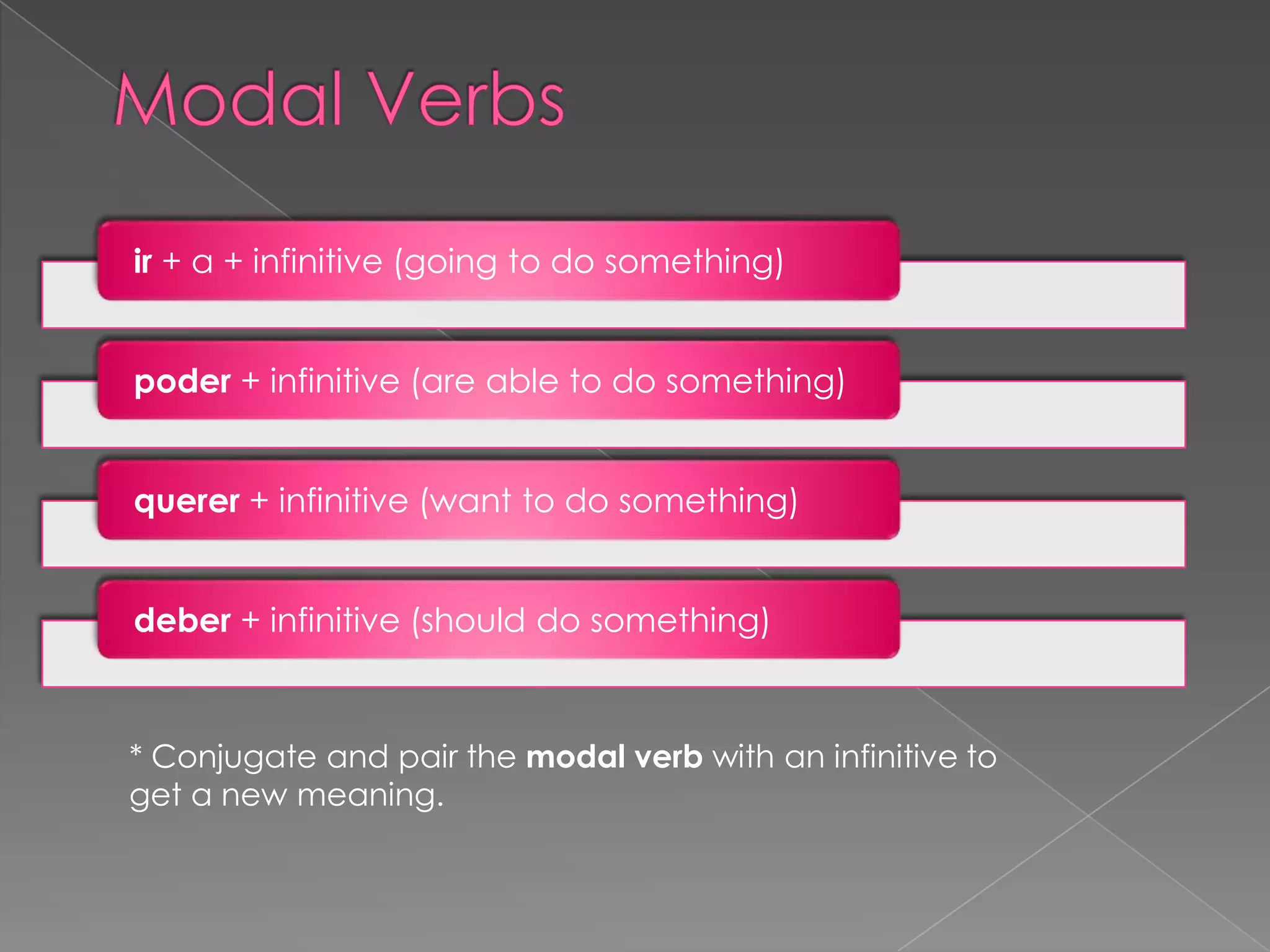
ir + a + infinitive (going to do something)


poder + infinitive (are able to do something)


querer + infinitive (want to do something)


deber + infinitive (should do something)


* Conjugate and pair the modal verb with an infinitive to
get a new meaning.
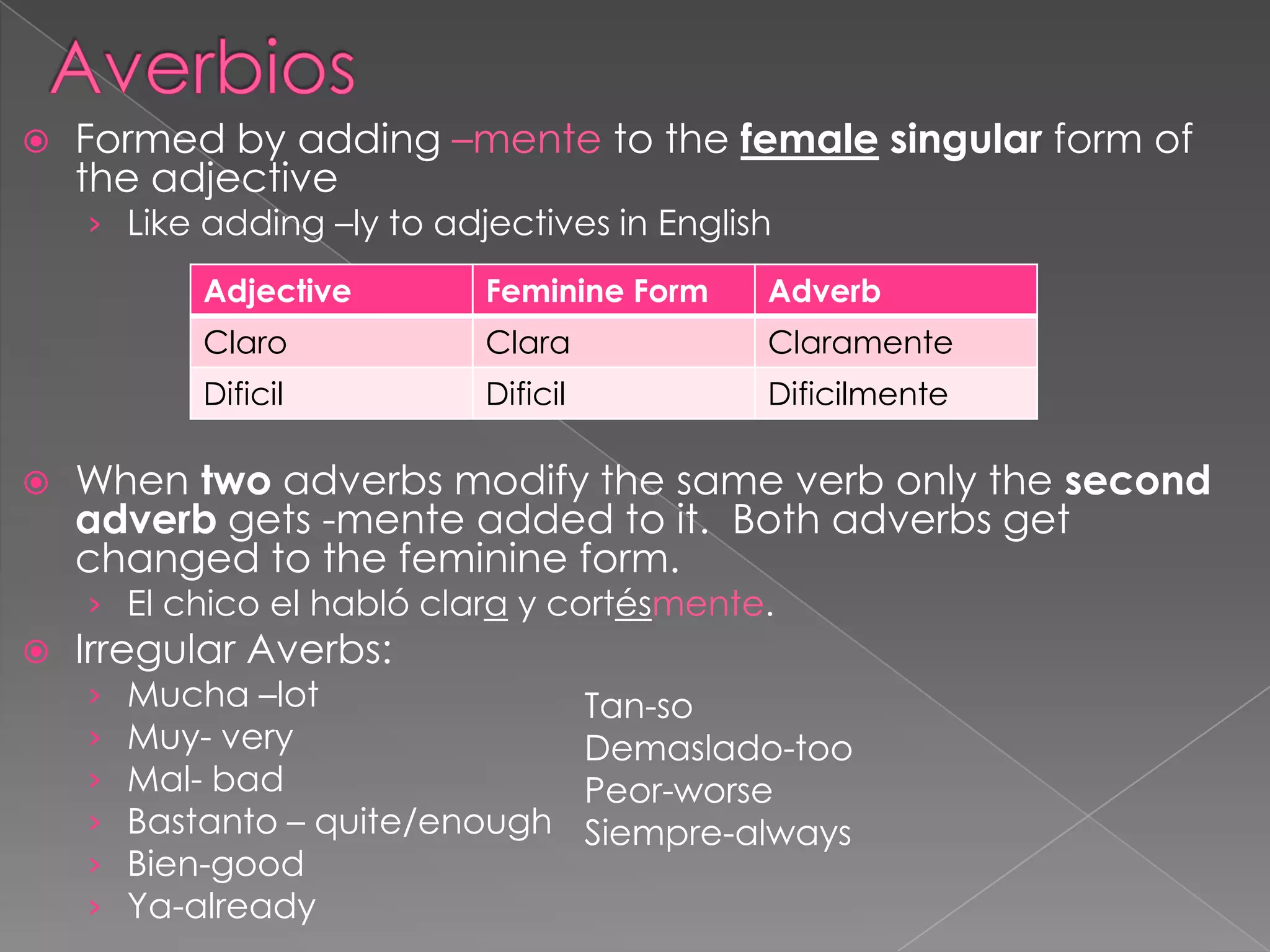
   Formed by adding –mente to the female singular form of
    the adjective
    › Like adding –ly to adjectives in English

            Adjective       Feminine Form      Adverb
            Claro           Clara              Claramente
            Dificil         Dificil            Dificilmente

   When two adverbs modify the same verb only the second
    adverb gets -mente added to it. Both adverbs get
    changed to the feminine form.
    › El chico el habló clara y cortésmente.
   Irregular Averbs:
    ›   Mucha –lot                    Tan-so
    ›   Muy- very                     Demaslado-too
    ›   Mal- bad                      Peor-worse
    ›   Bastanto – quite/enough       Siempre-always
    ›   Bien-good
    ›   Ya-already
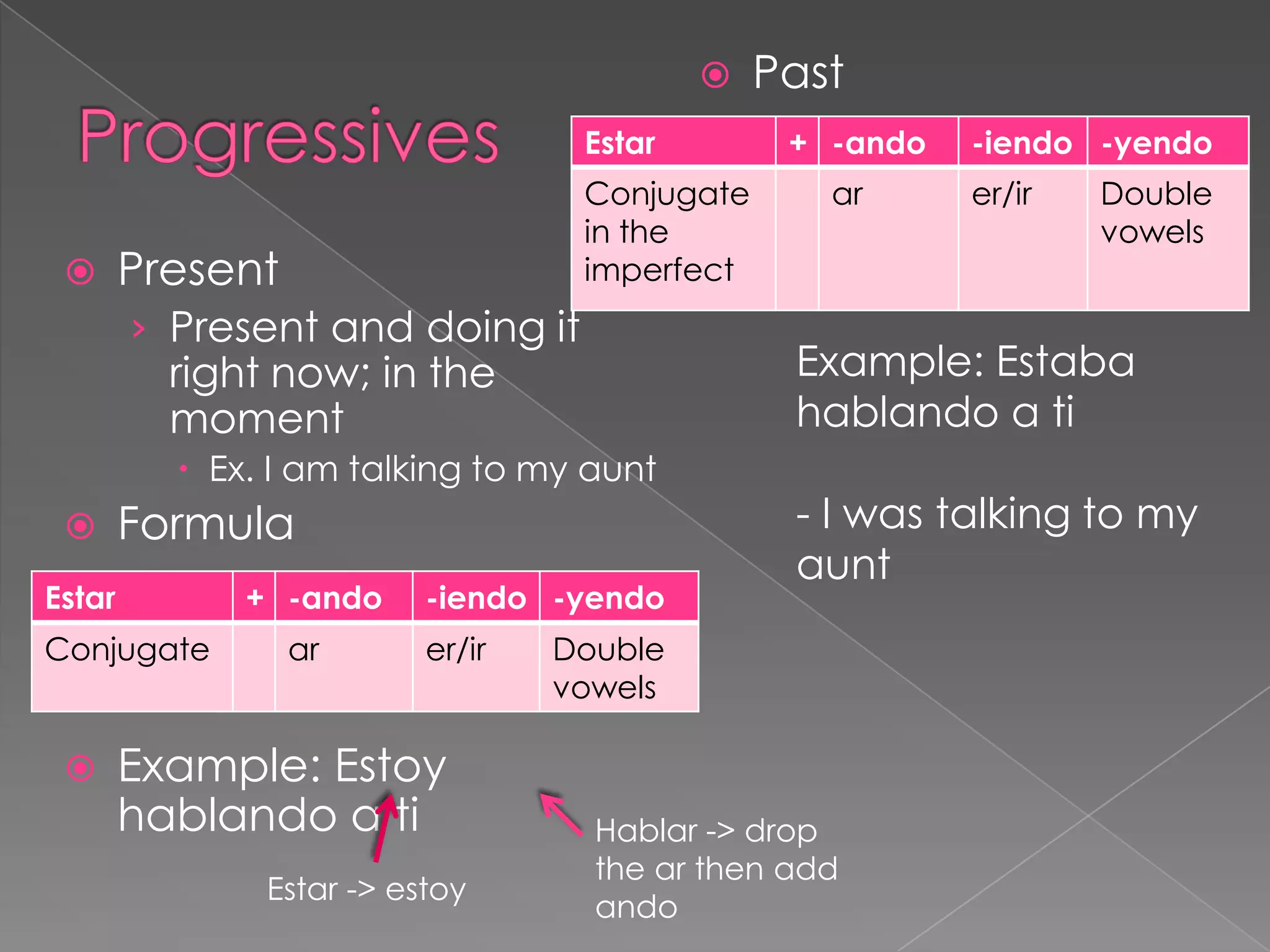
   Past
                                   Estar        + -ando   -iendo -yendo
                                   Conjugate      ar      er/ir   Double
                                   in the                         vowels
       Present                    imperfect
        › Present and doing it
          right now; in the                     Example: Estaba
          moment                                hablando a ti
           Ex. I am talking to my aunt
       Formula                                 - I was talking to my
                                                aunt
Estar         + -ando     -iendo -yendo
Conjugate         ar      er/ir   Double
                                  vowels

       Example: Estoy
        hablando a ti               Hablar -> drop
                                    the ar then add
               Estar -> estoy
                                    ando
Irregulars
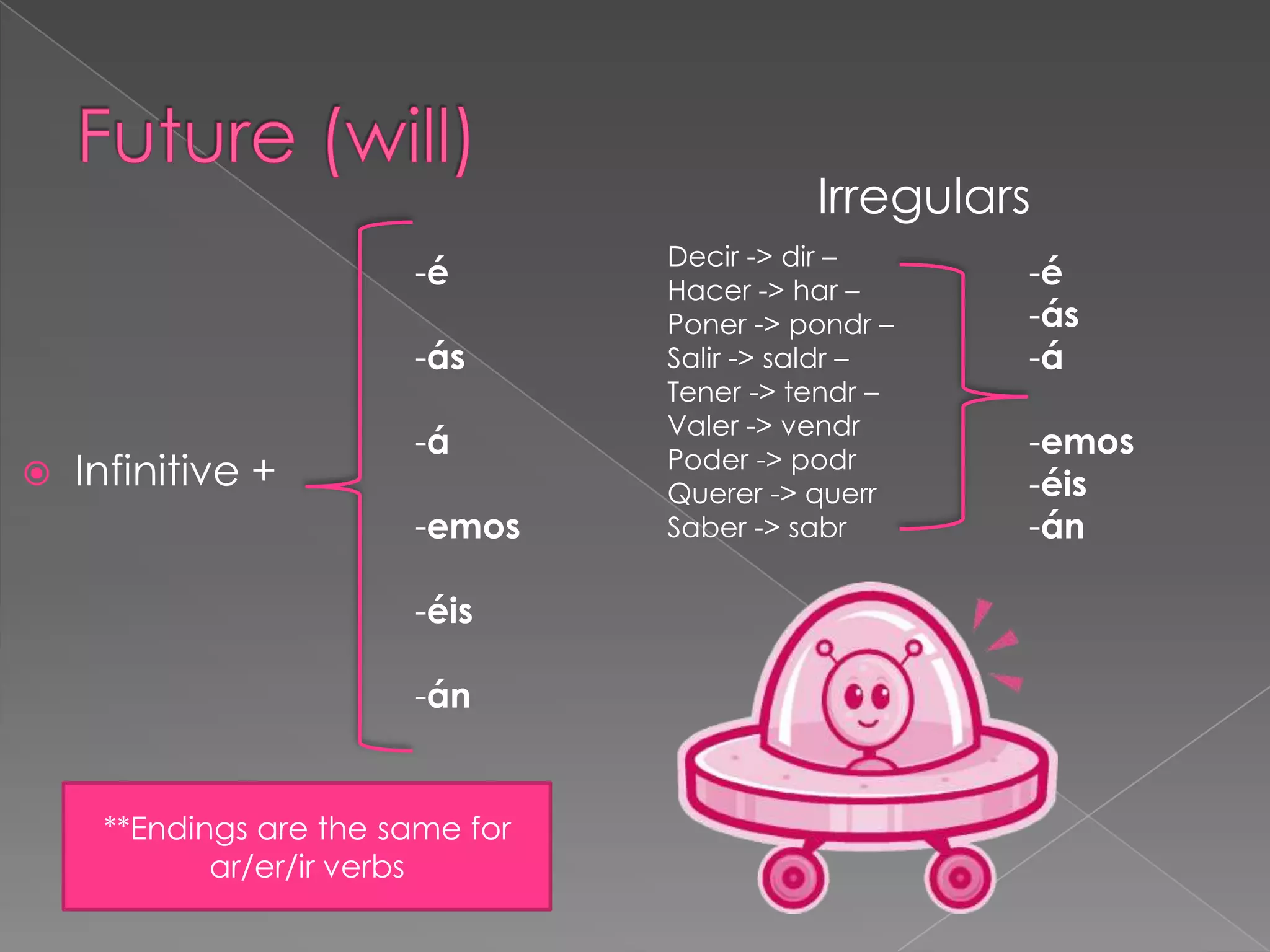
                                  Decir -> dir –
                        -é        Hacer -> har –
                                                     -é
                                  Poner -> pondr –   -ás
                        -ás       Salir -> saldr –   -á
                                  Tener -> tendr –
                                  Valer -> vendr
                        -á        Poder -> podr
                                                     -emos
   Infinitive +                  Querer -> querr    -éis
                        -emos     Saber -> sabr      -án

                        -éis

                        -án


     **Endings are the same for
            ar/er/ir verbs
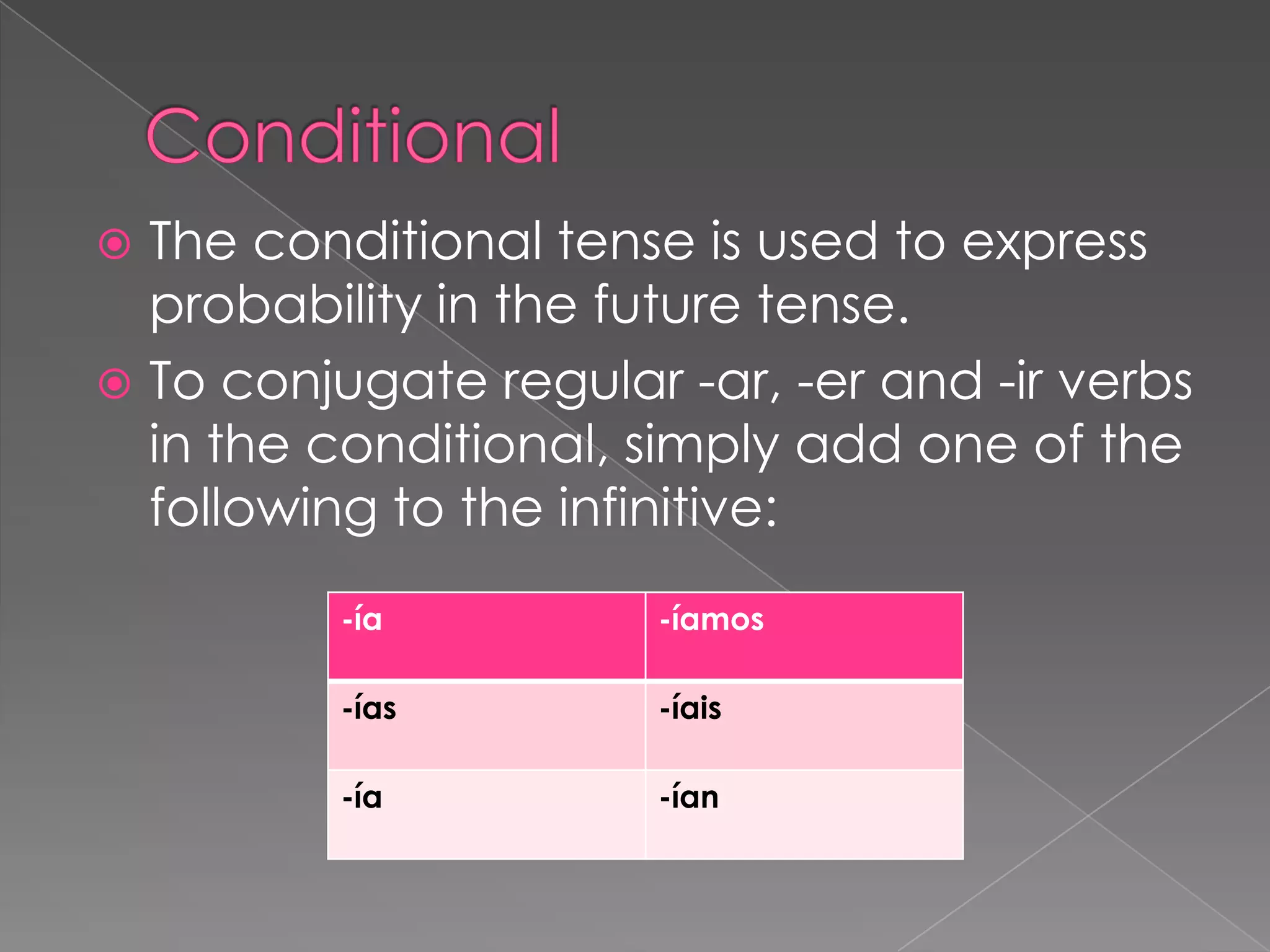
 The conditional tense is used to express
  probability in the future tense.
 To conjugate regular -ar, -er and -ir verbs
  in the conditional, simply add one of the
  following to the infinitive:
          -ía          -íamos

          -ías         -íais

          -ía          -ían
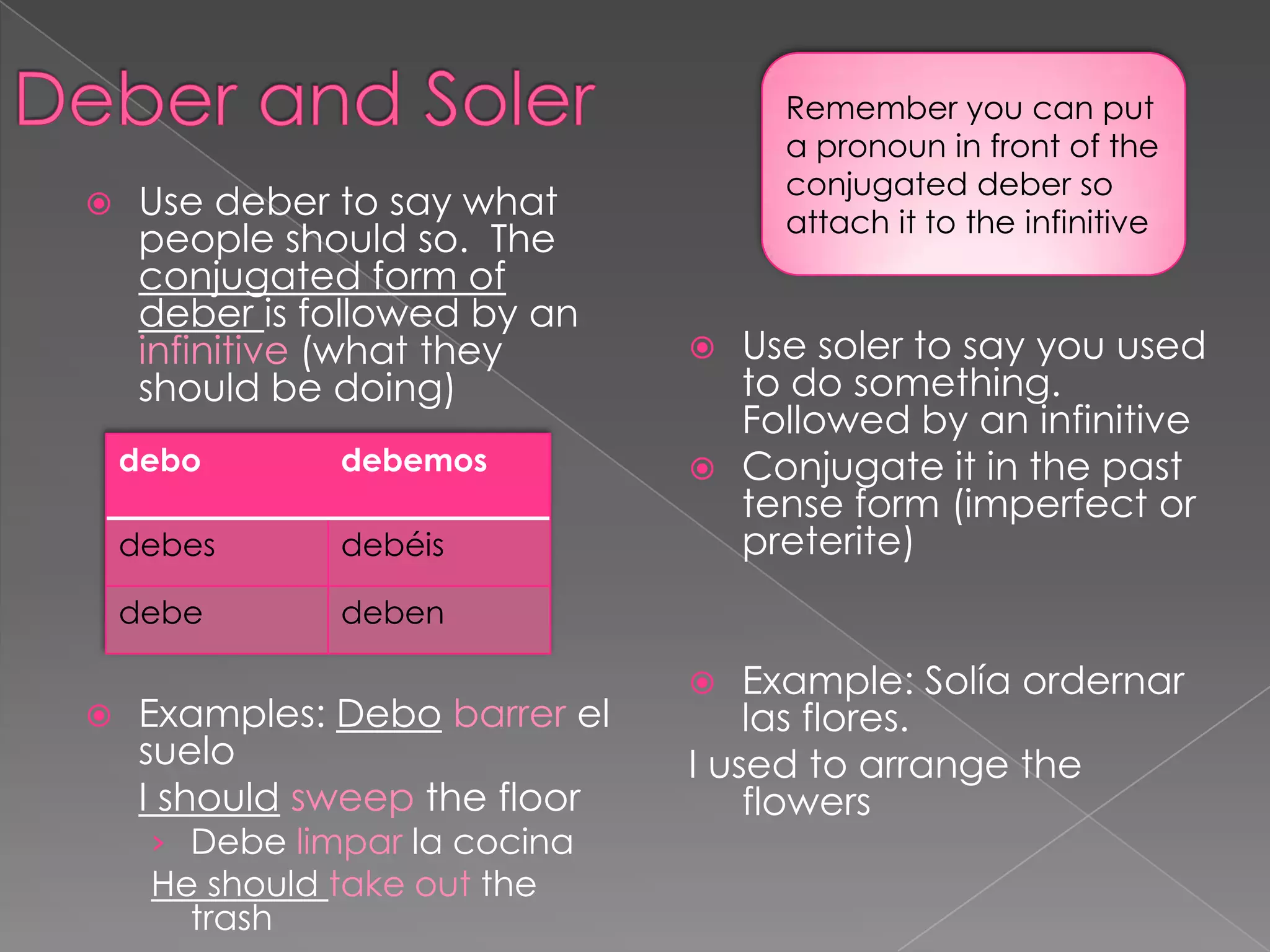
Remember you can put
                                     a pronoun in front of the
                                     conjugated deber so
    Use deber to say what           attach it to the infinitive
     people should so. The
     conjugated form of
     deber is followed by an
     infinitive (what they       Use soler to say you used
     should be doing)             to do something.
                                  Followed by an infinitive
    debo       debemos           Conjugate it in the past
                                  tense form (imperfect or
    debes      debéis             preterite)
    debe       deben

                                   Example: Solía ordernar
    Examples: Debo barrer el       las flores.
     suelo                      I used to arrange the
     I should sweep the floor       flowers
     › Debe limpar la cocina
     He should take out the
       trash
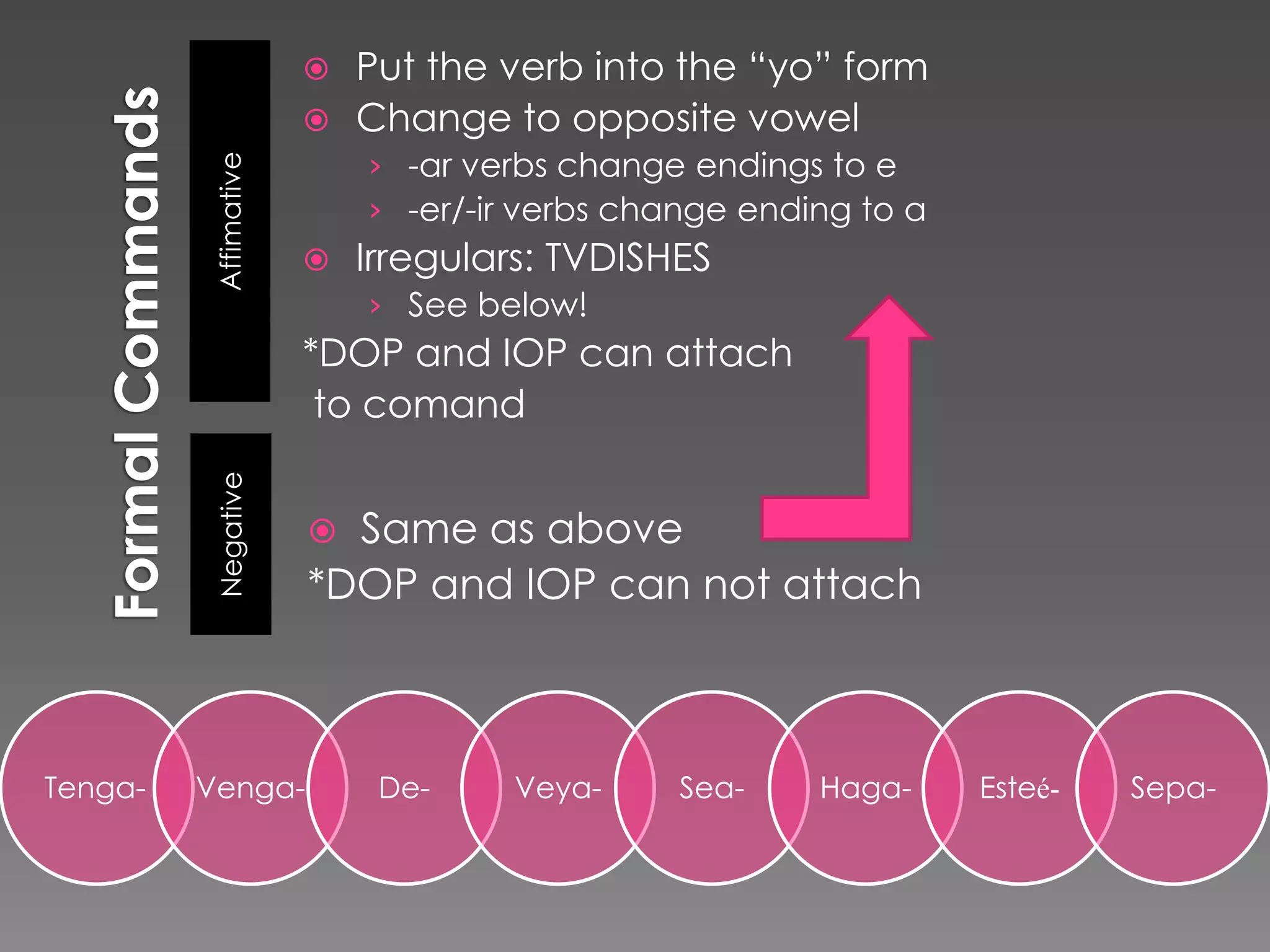
 Put the verb into the “yo” form
                       Change to opposite vowel
                          › -ar verbs change endings to e

         Affimative
                          › -er/-ir verbs change ending to a
                         Irregulars: TVDISHES
                          › See below!
                      *DOP and IOP can attach
                       to comand
         Negative


                       Same as above
                      *DOP and IOP can not attach


Tenga-   Venga-            De-    Veya-     Sea-     Haga-     Esteé-   Sepa-
**Be sure
                                                    the
                                                    adjectives
                                                    matches
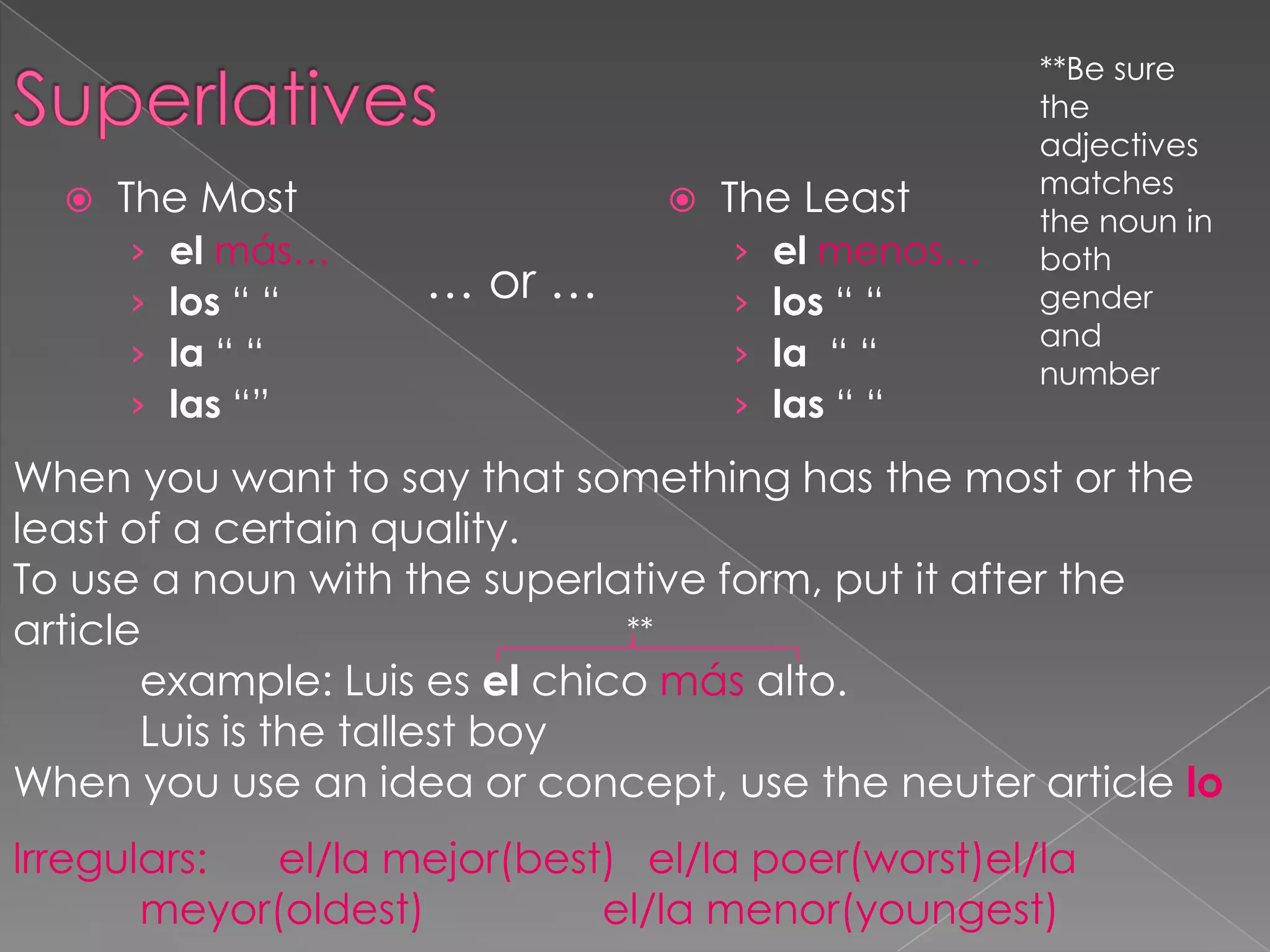
     The Most                     The Least       the noun in
      ›   el más…                   ›   el menos…   both
      ›   los “ “   … or …          ›   los “ “     gender
                                                    and
      ›   la “ “                    ›   la “ “      number
      ›   las “”                    ›   las “ “
When you want to say that something has the most or the
least of a certain quality.
To use a noun with the superlative form, put it after the
article                        **
       example: Luis es el chico más alto.
       Luis is the tallest boy
When you use an idea or concept, use the neuter article lo
Irregulars:  el/la mejor(best) el/la poer(worst)el/la
       meyor(oldest)         el/la menor(youngest)
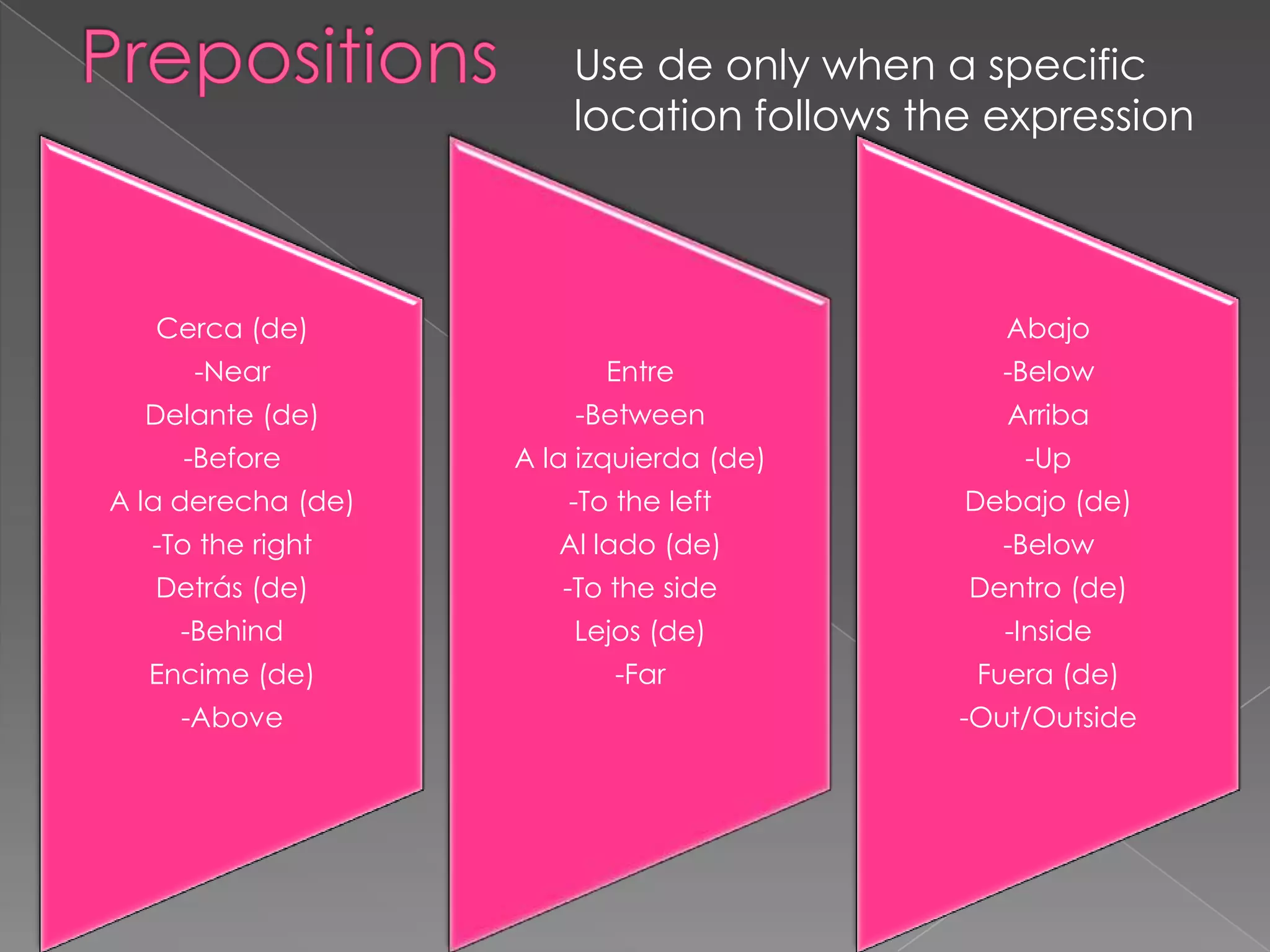
Use de only when a specific
                        location follows the expression


   Cerca (de)                                 Abajo
     -Near                 Entre             -Below
  Delante (de)          -Between              Arriba
     -Before        A la izquierda (de)        -Up
A la derecha (de)       -To the left       Debajo (de)
  -To the right        Al lado (de)          -Below
   Detrás (de)         -To the side        Dentro (de)
    -Behind             Lejos (de)            -Inside
  Encime (de)              -Far             Fuera (de)
    -Above                                 -Out/Outside
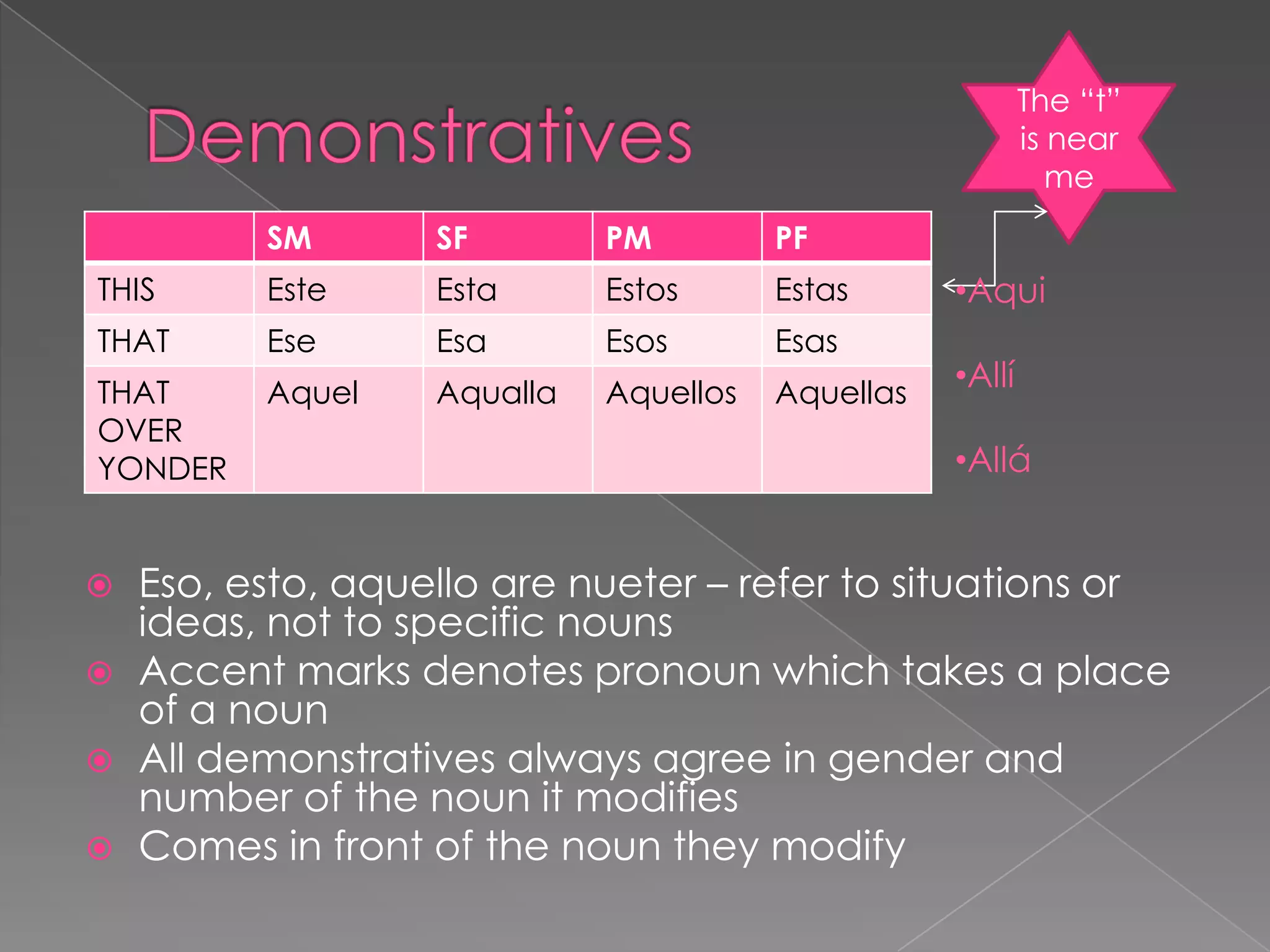
The “t”
                                                           is near
                                                              me
          SM       SF        PM         PF
THIS      Este     Esta      Estos      Estas      •Aqui
THAT      Ese      Esa       Esos       Esas
THAT      Aquel    Aqualla   Aquellos   Aquellas
                                                   •Allí
OVER
YONDER                                             •Allá


   Eso, esto, aquello are nueter – refer to situations or
    ideas, not to specific nouns
   Accent marks denotes pronoun which takes a place
    of a noun
   All demonstratives always agree in gender and
    number of the noun it modifies
   Comes in front of the noun they modify
FIN

Second Semester Grammar Book

  • 2.
     Imperfects/Irregular  Adverbios Imperfects › Irregular averbios  Preterites  Progressives  Irrugular Preterites › Present › Car/Gar/Zar › Past › Spock Verbs  Future › Cucaracha › Irregular Future › Snake/Snakey  Conditional  Modal Verbs  Deber and Soler  Adverbios  Formal Commands › Irregular Averbios  Superlatives  Progressives  Prepositions › Present  Demonstratives › Past
  • 3.
    Only Regular Imperfect Verbs. AR ER/IR - aba Yo - ía - abas Tú - ías - aba Usted - ía Examples: - ábamos Nostrosos - íamos Todos los días yo hablaba - abais Vostoros - íais Everyday I talk. - aban Ustedes - ían Cuando era una niña, montaba los  Uses cabollos. When I was a little › Ongoing past tense action girl, I rode horses. › Repeated action › No definite beginning or end  Like a film not just a single snap shot › Time/date/age/feelings/descriptions
  • 4.
    Have the same uses!  3 irregular verbs are ir, ser, and ver. Ir Ser Ver • iba • era • veía • ibas • eras • veías • iba • era • veía • íbamos • éramos • veíamos • ibais • erais • veíais • iban • eran • veían
  • 5.
    Tigger words Endings for Preterite: Ayer yesterday AR ER/IR A noche at night -é Yo -í El año pasado last year - aste Tú - iste La semana -ó Usted - ió passado Last week - amos Nostrosos - imos Ante ayer before - aran Ustedes - ieron yesterday  Uses › Simple happened and its over action; a definite time in the past › Has a beginign and or ending › It’s a single snapshot in time › Example • The boy fell and broke his leg. It happened at that single point in time.
  • 6.
    Comenzar comencé comenzamos comenzaste ________ Jugar comenzó comenzaron jugué jugamos jugaste _______ Tocar jugó jugaron toqué tocamos tocaste _______  Rule: A spelling change in only tocó tocaron the first person; this is done to keep the sound the word is supposed to have. Example Tocar Tocé - the e sound makes the c soft when it is supposed to be hard So we spell it toqué to keep the c hard Example Jugar Jugé – the g is soft but should be hard Jugué - the g is now hard
  • 7.
    di/vi diste/viste dio/vio dimos/vimos fui dieron/vieron fuiste fue fuimos fueron hice hiciste hizo hicmos hicieron
  • 8.
    ANDAR anduv- ESTAR PODER estuv- pud- -e PONER pus- QUERER quis- -iste SABER sup- TENER tuv- -o VENIR vin- DECIR dij- -imos TRAER traj- -ieron CONDUCIR conduj- -i For “J” verbs, drop the “i” PRODUCIR produj- for the ustedes form TRADUCIR traduj- Ex. Traer Trajeron
  • 9.
    Snakey  Leer  Snake Leí Leimos Leiste --------  Dormir Leyó Leyeron Dormí Durmió Dormiste ------- Durmió Durmieron  The “i” changes to an “y” in third person.  The “o” changes to a “u” in third person
  • 10.
    ir + a+ infinitive (going to do something) poder + infinitive (are able to do something) querer + infinitive (want to do something) deber + infinitive (should do something) * Conjugate and pair the modal verb with an infinitive to get a new meaning.
  • 11.
    Formed by adding –mente to the female singular form of the adjective › Like adding –ly to adjectives in English Adjective Feminine Form Adverb Claro Clara Claramente Dificil Dificil Dificilmente  When two adverbs modify the same verb only the second adverb gets -mente added to it. Both adverbs get changed to the feminine form. › El chico el habló clara y cortésmente.  Irregular Averbs: › Mucha –lot Tan-so › Muy- very Demaslado-too › Mal- bad Peor-worse › Bastanto – quite/enough Siempre-always › Bien-good › Ya-already
  • 12.
    Past Estar + -ando -iendo -yendo Conjugate ar er/ir Double in the vowels  Present imperfect › Present and doing it right now; in the Example: Estaba moment hablando a ti  Ex. I am talking to my aunt  Formula - I was talking to my aunt Estar + -ando -iendo -yendo Conjugate ar er/ir Double vowels  Example: Estoy hablando a ti Hablar -> drop the ar then add Estar -> estoy ando
  • 13.
    Irregulars Decir -> dir – -é Hacer -> har – -é Poner -> pondr – -ás -ás Salir -> saldr – -á Tener -> tendr – Valer -> vendr -á Poder -> podr -emos  Infinitive + Querer -> querr -éis -emos Saber -> sabr -án -éis -án **Endings are the same for ar/er/ir verbs
  • 14.
     The conditionaltense is used to express probability in the future tense.  To conjugate regular -ar, -er and -ir verbs in the conditional, simply add one of the following to the infinitive: -ía -íamos -ías -íais -ía -ían
  • 15.
    Remember you canput a pronoun in front of the conjugated deber so  Use deber to say what attach it to the infinitive people should so. The conjugated form of deber is followed by an infinitive (what they  Use soler to say you used should be doing) to do something. Followed by an infinitive debo debemos  Conjugate it in the past tense form (imperfect or debes debéis preterite) debe deben  Example: Solía ordernar  Examples: Debo barrer el las flores. suelo I used to arrange the I should sweep the floor flowers › Debe limpar la cocina He should take out the trash
  • 16.
     Put theverb into the “yo” form  Change to opposite vowel › -ar verbs change endings to e Affimative › -er/-ir verbs change ending to a  Irregulars: TVDISHES › See below! *DOP and IOP can attach to comand Negative  Same as above *DOP and IOP can not attach Tenga- Venga- De- Veya- Sea- Haga- Esteé- Sepa-
  • 17.
    **Be sure the adjectives matches  The Most  The Least the noun in › el más… › el menos… both › los “ “ … or … › los “ “ gender and › la “ “ › la “ “ number › las “” › las “ “ When you want to say that something has the most or the least of a certain quality. To use a noun with the superlative form, put it after the article ** example: Luis es el chico más alto. Luis is the tallest boy When you use an idea or concept, use the neuter article lo Irregulars: el/la mejor(best) el/la poer(worst)el/la meyor(oldest) el/la menor(youngest)
  • 18.
    Use de onlywhen a specific location follows the expression Cerca (de) Abajo -Near Entre -Below Delante (de) -Between Arriba -Before A la izquierda (de) -Up A la derecha (de) -To the left Debajo (de) -To the right Al lado (de) -Below Detrás (de) -To the side Dentro (de) -Behind Lejos (de) -Inside Encime (de) -Far Fuera (de) -Above -Out/Outside
  • 19.
    The “t” is near me SM SF PM PF THIS Este Esta Estos Estas •Aqui THAT Ese Esa Esos Esas THAT Aquel Aqualla Aquellos Aquellas •Allí OVER YONDER •Allá  Eso, esto, aquello are nueter – refer to situations or ideas, not to specific nouns  Accent marks denotes pronoun which takes a place of a noun  All demonstratives always agree in gender and number of the noun it modifies  Comes in front of the noun they modify
  • 20.