Libra de gramatica

    CARMELTIA HUSKINS
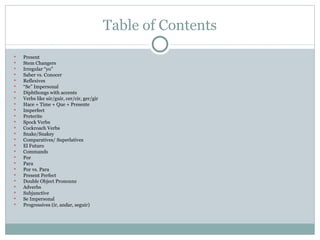
Table of Contents
   Present
   Stem Changers
   Irregular “yo”
   Saber vs. Conocer
   Reflexives
   “Se” Impersonal
   Diphthongs with accents
   Verbs like uir/guir, cer/cir, ger/gir
   Hace + Time + Que + Presente
   Imperfect
   Preterite
   Spock Verbs
   Cockroach Verbs
   Snake/Snakey
   Comparatives/ Superlatives
   El Futuro
   Commands
   Por
   Para
   Por vs. Para
   Present Perfect
   Double Object Pronouns
   Adverbs
   Subjunctive
   Se Impersonal
   Progressives (ir, andar, seguir)
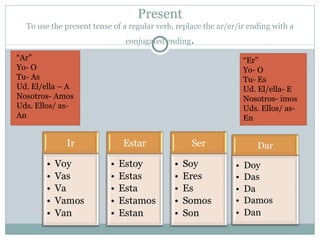
Present
  To use the present tense of a regular verb, replace the ar/er/ir ending with a
                              conjugated ending   .
“Ar”                                                             “Er”
Yo- O                                                            Yo- O
Tu- As                                                           Tu- Es
Ud. El/ella – A                                                  Ud. El/ella- E
Nosotros- Amos                                                   Nosotros- imos
Uds. Ellos/ as-                                                  Uds. Ellos/ as-
An                                                               En
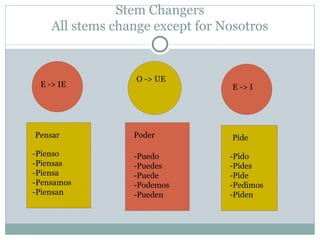
Stem Changers
    All stems change except for Nosotros


                  O -> UE
 E -> IE                          E -> I


Pensar           Poder            Pide

-Pienso          -Puedo          -Pido
-Piensas         -Puedes         -Pides
-Piensa          -Puede          -Pide
-Pensamos        -Podemos        -Pedimos
-Piensan         -Pueden         -Piden
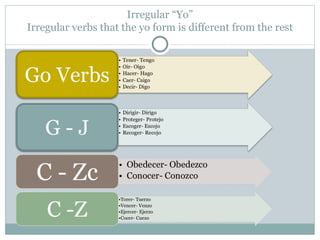
Irregular “Yo”
Irregular verbs that the yo form is different from the rest
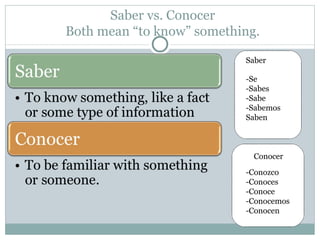
Saber vs. Conocer
Both mean “to know” something.

                           Saber

                           -Se
                           -Sabes
                           -Sabe
                           -Sabemos
                           Saben


                             Conocer

                           -Conozco
                           -Conoces
                           -Conoce
                           -Conocemos
                           -Conocen
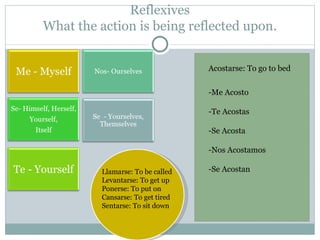
Reflexives
What the action is being reflected upon.


                                   Acostarse: To go to bed


                                   -Me Acosto

                                   -Te Acostas

                                   -Se Acosta

                                   -Nos Acostamos

          Llamarse: To be called   -Se Acostan
          Levantarse: To get up
          Ponerse: To put on
          Cansarse: To get tired
          Sentarse: To sit down
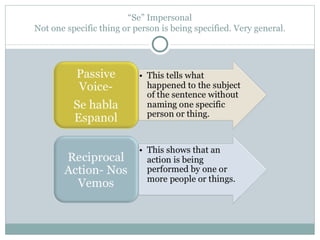
“Se” Impersonal
Not one specific thing or person is being specified. Very general.
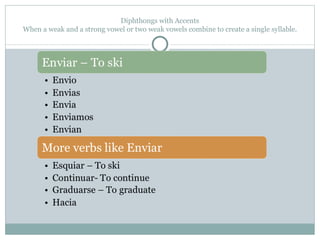
Diphthongs with Accents
When a weak and a strong vowel or two weak vowels combine to create a single syllable.
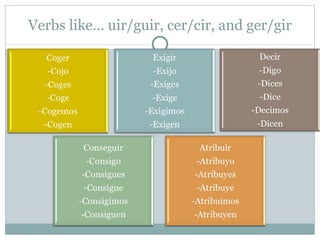
Verbs like… uir/guir, cer/cir, and ger/gir
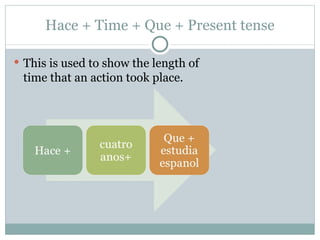
Hace + Time + Que + Present tense

 This is used to show the length of
 time that an action took place.
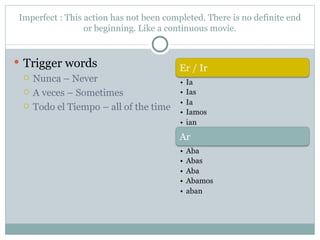
Imperfect : This action has not been completed. There is no definite end
                  or beginning. Like a continuous movie.


 Trigger words
   Nunca – Never

   A veces – Sometimes

   Todo el Tiempo – all of the time
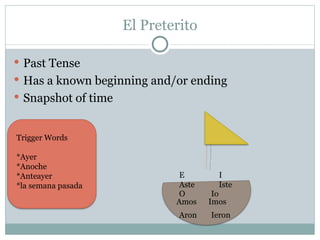
El Preterito

 Past Tense
 Has a known beginning and/or ending
 Snapshot of time


Trigger Words

*Ayer
*Anoche
*Anteayer                     E        I
*la semana pasada             Aste     Iste
                              O       Io
                             Amos    Imos
                              Aron   Ieron
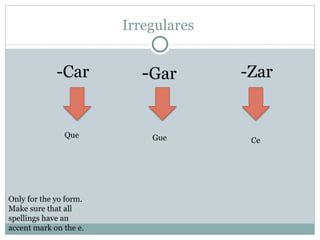
Irregulares


             -Car          -Gar       -Zar


               Que          Gue        Ce


Only for the yo form.
Make sure that all
spellings have an
accent mark on the e.
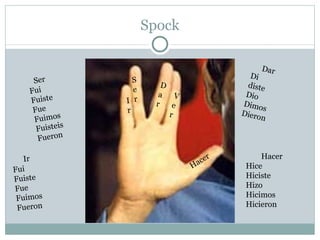
Spock

                                                  Dar
                                               Di
    Ser            S
                          D                   diste
   Fui             e
                         a V                  Dio
   Fuiste        I r    r                    Dimo
                             e                     s
    Fue          r                           Diero
                            r
    Fuimos                                         n
             s
     Fuistei
     Fueron

   Ir                                   er        Hacer
                                    c
Fui                              Ha           Hice
Fuiste                                        Hiciste
Fue                                           Hizo
 Fuimos                                       Hicimos
 Fueron                                       Hicieron
Cucaracha Verbs

   Andar anduve
   Conducir* conduje
   Decir* dije
   Estar estuve
   Hacer hice
   Poner puse
   Poder pude
   Querer quise
   Saber supe
   Tener tuve
   Traer* traje
   Venir vine
Snake / Snakey

 Snake = E to I
   Ex. Pedir, Venir

 Snake = O to U
     Morir
 Snakey = O to Y
   Ex. Oir

 Snakey = E to Y
     Creer
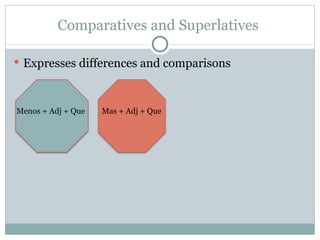
Comparatives and Superlatives

 Expresses differences and comparisons


Menos + Adj + Que   Mas + Adj + Que
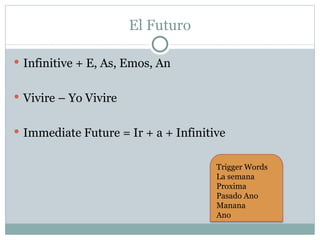
El Futuro

 Infinitive + E, As, Emos, An


 Vivire – Yo Vivire


 Immediate Future = Ir + a + Infinitive


                                      Trigger Words
                                      La semana
                                      Proxima
                                      Pasado Ano
                                      Manana
                                      Ano
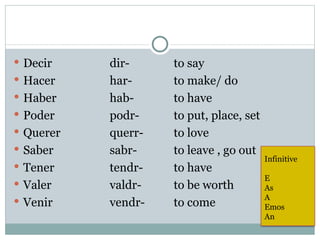
 Decir    dir-     to say
 Hacer    har-     to make/ do
 Haber    hab-     to have
 Poder    podr-    to put, place, set
 Querer   querr-   to love
 Saber    sabr-    to leave , go out
                                         Infinitive
 Tener    tendr-   to have
                                         E
 Valer    valdr-   to be worth          As
                                         A
 Venir    vendr-   to come              Emos
                                         An
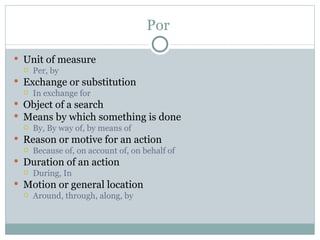
Por

 Unit of measure
   Per, by

 Exchange or substitution
   In exchange for

 Object of a search
 Means by which something is done
   By, By way of, by means of

 Reason or motive for an action
   Because of, on account of, on behalf of

 Duration of an action
   During, In

 Motion or general location
   Around, through, along, by
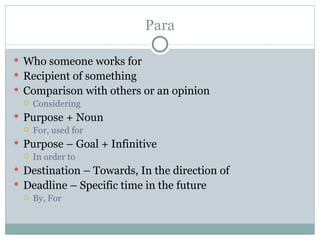
Para

 Who someone works for
 Recipient of something
 Comparison with others or an opinion
    Considering
 Purpose + Noun
    For, used for
 Purpose – Goal + Infinitive
    In order to
 Destination – Towards, In the direction of
 Deadline – Specific time in the future
    By, For
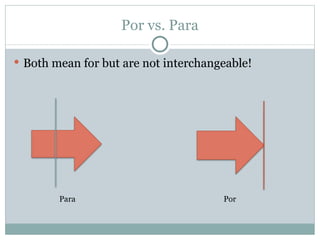
Por vs. Para

 Both mean for but are not interchangeable!


        Para                          Por
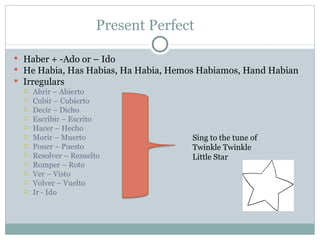
Present Perfect

 Haber + -Ado or – Ido
 He Habia, Has Habias, Ha Habia, Hemos Habiamos, Hand Habian
 Irregulars
   Abrir – Abierto
   Cubir – Cubierto
   Decir – Dicho
   Escribir – Escrito
   Hacer – Hecho
   Morir – Muerto                     Sing to the tune of
   Poner – Puesto                     Twinkle Twinkle
   Resolver – Resuelto                Little Star
   Romper – Roto
   Ver – Visto
   Volver – Vuelto
   Ir - Ido
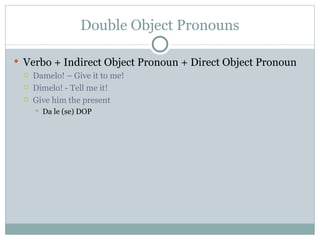
Double Object Pronouns

 Verbo + Indirect Object Pronoun + Direct Object Pronoun
    Damelo! – Give it to me!
    Dimelo! - Tell me it!
    Give him the present
        Da le (se) DOP
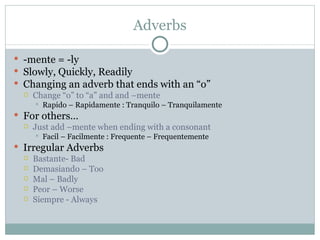
Adverbs

 -mente = -ly
 Slowly, Quickly, Readily
 Changing an adverb that ends with an “o”
   Change “o” to “a” and and –mente
        Rapido – Rapidamente : Tranquilo – Tranquilamente
 For others…
   Just add –mente when ending with a consonant
        Facil – Facilmente : Frequente – Frequentemente
 Irregular Adverbs
   Bastante- Bad
   Demasiando – Too
   Mal – Badly
   Peor – Worse
   Siempre - Always
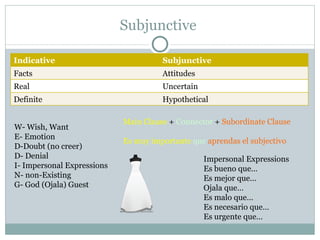
Subjunctive

Indicative                            Subjunctive
Facts                                 Attitudes
Real                                  Uncertain
Definite                              Hypothetical

                            Main Clause + Connector + Subordinate Clause
W- Wish, Want
E- Emotion
                            Es muy importante que aprendas el subjectivo
D-Doubt (no creer)
D- Denial                                         Impersonal Expressions
I- Impersonal Expressions                         Es bueno que…
N- non-Existing                                   Es mejor que…
G- God (Ojala) Guest                              Ojala que…
                                                  Es malo que…
                                                  Es necesario que…
                                                  Es urgente que…
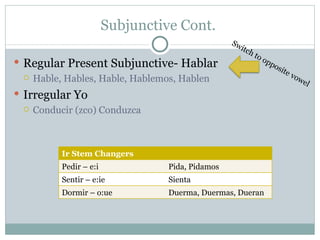
Subjunctive Cont.
                                                   Sw
                                                        itc
                                                              ht
                                                                   oo
 Regular Present Subjunctive- Hablar                                   pp
                                                                             osi
                                                                                   te
   Hable, Hables, Hable, Hablemos, Hablen                                            vow
                                                                                            el
 Irregular Yo
    Conducir (zco) Conduzca


           Ir Stem Changers
           Pedir – e:i             Pida, Pidamos
           Sentir – e:ie           Sienta
           Dormir – o:ue           Duerma, Duermas, Dueran
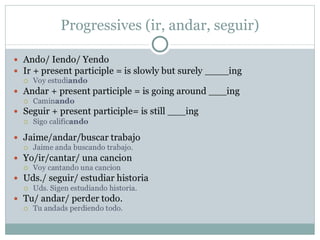
Progressives (ir, andar, seguir)

Grammar book

  • 1.
    Libra de gramatica CARMELTIA HUSKINS
  • 2.
    Table of Contents  Present  Stem Changers  Irregular “yo”  Saber vs. Conocer  Reflexives  “Se” Impersonal  Diphthongs with accents  Verbs like uir/guir, cer/cir, ger/gir  Hace + Time + Que + Presente  Imperfect  Preterite  Spock Verbs  Cockroach Verbs  Snake/Snakey  Comparatives/ Superlatives  El Futuro  Commands  Por  Para  Por vs. Para  Present Perfect  Double Object Pronouns  Adverbs  Subjunctive  Se Impersonal  Progressives (ir, andar, seguir)
  • 3.
    Present Touse the present tense of a regular verb, replace the ar/er/ir ending with a conjugated ending . “Ar” “Er” Yo- O Yo- O Tu- As Tu- Es Ud. El/ella – A Ud. El/ella- E Nosotros- Amos Nosotros- imos Uds. Ellos/ as- Uds. Ellos/ as- An En
  • 4.
    Stem Changers All stems change except for Nosotros O -> UE E -> IE E -> I Pensar Poder Pide -Pienso -Puedo -Pido -Piensas -Puedes -Pides -Piensa -Puede -Pide -Pensamos -Podemos -Pedimos -Piensan -Pueden -Piden
  • 5.
    Irregular “Yo” Irregular verbsthat the yo form is different from the rest
  • 6.
    Saber vs. Conocer Bothmean “to know” something. Saber -Se -Sabes -Sabe -Sabemos Saben Conocer -Conozco -Conoces -Conoce -Conocemos -Conocen
  • 7.
    Reflexives What the actionis being reflected upon. Acostarse: To go to bed -Me Acosto -Te Acostas -Se Acosta -Nos Acostamos Llamarse: To be called -Se Acostan Levantarse: To get up Ponerse: To put on Cansarse: To get tired Sentarse: To sit down
  • 8.
    “Se” Impersonal Not onespecific thing or person is being specified. Very general.
  • 9.
    Diphthongs with Accents Whena weak and a strong vowel or two weak vowels combine to create a single syllable.
  • 10.
    Verbs like… uir/guir,cer/cir, and ger/gir
  • 11.
    Hace + Time+ Que + Present tense  This is used to show the length of time that an action took place.
  • 12.
    Imperfect : Thisaction has not been completed. There is no definite end or beginning. Like a continuous movie.  Trigger words  Nunca – Never  A veces – Sometimes  Todo el Tiempo – all of the time
  • 13.
    El Preterito  PastTense  Has a known beginning and/or ending  Snapshot of time Trigger Words *Ayer *Anoche *Anteayer E I *la semana pasada Aste Iste O Io Amos Imos Aron Ieron
  • 14.
    Irregulares -Car -Gar -Zar Que Gue Ce Only for the yo form. Make sure that all spellings have an accent mark on the e.
  • 15.
    Spock Dar Di Ser S D diste Fui e a V Dio Fuiste I r r Dimo e s Fue r Diero r Fuimos n s Fuistei Fueron Ir er Hacer c Fui Ha Hice Fuiste Hiciste Fue Hizo Fuimos Hicimos Fueron Hicieron
  • 16.
    Cucaracha Verbs  Andar anduve  Conducir* conduje  Decir* dije  Estar estuve  Hacer hice  Poner puse  Poder pude  Querer quise  Saber supe  Tener tuve  Traer* traje  Venir vine
  • 17.
    Snake / Snakey Snake = E to I  Ex. Pedir, Venir  Snake = O to U  Morir  Snakey = O to Y  Ex. Oir  Snakey = E to Y  Creer
  • 18.
    Comparatives and Superlatives Expresses differences and comparisons Menos + Adj + Que Mas + Adj + Que
  • 19.
    El Futuro  Infinitive+ E, As, Emos, An  Vivire – Yo Vivire  Immediate Future = Ir + a + Infinitive Trigger Words La semana Proxima Pasado Ano Manana Ano
  • 20.
     Decir dir- to say  Hacer har- to make/ do  Haber hab- to have  Poder podr- to put, place, set  Querer querr- to love  Saber sabr- to leave , go out Infinitive  Tener tendr- to have E  Valer valdr- to be worth As A  Venir vendr- to come Emos An
  • 21.
    Por  Unit ofmeasure  Per, by  Exchange or substitution  In exchange for  Object of a search  Means by which something is done  By, By way of, by means of  Reason or motive for an action  Because of, on account of, on behalf of  Duration of an action  During, In  Motion or general location  Around, through, along, by
  • 22.
    Para  Who someoneworks for  Recipient of something  Comparison with others or an opinion  Considering  Purpose + Noun  For, used for  Purpose – Goal + Infinitive  In order to  Destination – Towards, In the direction of  Deadline – Specific time in the future  By, For
  • 23.
    Por vs. Para Both mean for but are not interchangeable! Para Por
  • 24.
    Present Perfect  Haber+ -Ado or – Ido  He Habia, Has Habias, Ha Habia, Hemos Habiamos, Hand Habian  Irregulars  Abrir – Abierto  Cubir – Cubierto  Decir – Dicho  Escribir – Escrito  Hacer – Hecho  Morir – Muerto Sing to the tune of  Poner – Puesto Twinkle Twinkle  Resolver – Resuelto Little Star  Romper – Roto  Ver – Visto  Volver – Vuelto  Ir - Ido
  • 25.
    Double Object Pronouns Verbo + Indirect Object Pronoun + Direct Object Pronoun  Damelo! – Give it to me!  Dimelo! - Tell me it!  Give him the present  Da le (se) DOP
  • 26.
    Adverbs  -mente =-ly  Slowly, Quickly, Readily  Changing an adverb that ends with an “o”  Change “o” to “a” and and –mente  Rapido – Rapidamente : Tranquilo – Tranquilamente  For others…  Just add –mente when ending with a consonant  Facil – Facilmente : Frequente – Frequentemente  Irregular Adverbs  Bastante- Bad  Demasiando – Too  Mal – Badly  Peor – Worse  Siempre - Always
  • 27.
    Subjunctive Indicative Subjunctive Facts Attitudes Real Uncertain Definite Hypothetical Main Clause + Connector + Subordinate Clause W- Wish, Want E- Emotion Es muy importante que aprendas el subjectivo D-Doubt (no creer) D- Denial Impersonal Expressions I- Impersonal Expressions Es bueno que… N- non-Existing Es mejor que… G- God (Ojala) Guest Ojala que… Es malo que… Es necesario que… Es urgente que…
  • 28.
    Subjunctive Cont. Sw itc ht oo  Regular Present Subjunctive- Hablar pp osi te  Hable, Hables, Hable, Hablemos, Hablen vow el  Irregular Yo  Conducir (zco) Conduzca Ir Stem Changers Pedir – e:i Pida, Pidamos Sentir – e:ie Sienta Dormir – o:ue Duerma, Duermas, Dueran
  • 29.