EL LIBRO DE LA
 GRAMÁTICA
  Camila Boyd
TABLE OF
                  CONTENTS
    1. PRESENT TENSE          11. IMPERFECT
    2. STEM CHANGERS
                                 12. Preterite
   3. IREEGULARS “YO”
                             13. Irregular Conj.
 4. SABER VS. CONOCER
        5. REFLEXIVE
                                   14. Spock
   6. “SE” IMPERSONAL           15. Cucaracha
         7. DIPTHONGS      16. Snake and Snakey
  8. –UIR/GUIR, -CER/CIR      17. Comparatives
9. -GER/GIR VERBS LIKE…        18. Superlatives
     10. HACE+___+QUE+             19. Future
  PRESENT/ PRETERATE
PRESENT
                TENSE
 AR           ER            IR
 O            O             O
 AS           ES            ES
 A            E             E
 AMOS         EMOS          IMOS
 AN           EN            EN


• HABLO, COMPRAS, BUSCA, CENAMOS, ESPERAN
• APRENDO, PERDES, BEBE, VENDEMOS, COMEN
• PEDO, VIVES, MORE, ADVERTIMOS, SENTEN
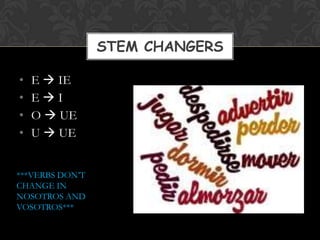
STEM CHANGERS

•   E  IE
•   EI
•   O  UE
•   U  UE


***VERBS DON’T
CHANGE IN
NOSOTROS AND
VOSOTROS***
IRREGULARS
                     “YO”
~ “GO” VERBS: CAER, DECIR, OIR, PONER, HACER, TENER,
TRAER, VENIR
EXAMPLE: HACER  HAGO… TENER  TENGO

~ “ZCO” VERBS (-CER/-CIR): CONOCER, PRODUCIR, CONDUCIR
EXAMPLE: CONOZCO, PRODUZCO

~ Y LOS DEMAS: SER, ESTAR, IR , VER, SABER, DAR
SABER VS. CONOCER

• Both saber y conocer translate to the
  English verb “to know”
Both “yo” forms are irregular

   EX: Conocer            EX: Saber
   Conozco Conocemos      Sé        Sabemos
   Conoces Conocen        Sabes     Saben
   Conoce                 Sabe
REFLEXIVES

• Camila se lava- se is reflexive

**Reflexives also can be added on the end of an
infinitive.**


EX:
Puedo verme en el espejo
“SE” IMPERSONAL

• Pronoun ”se” is in front of verbs to make general
  statements.


¿Cómo se dice cantaloupe en español?
~In English it will regurgitate to either “you say” or
“one says” for the answer.
DIPTHONGS WITH
                           ACCENTS

• Dipthongs are the strong or weak vowels in a word next to
  each other.

**Strong vowel sounds are a,e,o.
**Weak vowel sounds are i,u,y.

EX:                                          *two strong
puerto, ciudad, siete, hay.                  vowels cannot
                                             be in the same
                                             syllable.
-UIR/-GUIR
Guir                                 Uir
                                     -Nosotros form is the only form that
-Yo form only changes from Gu to G
                                     doesn’t change.
                                     -Verbs that end in -uir add y before the
                                     letters o, e, and a .

EX: Conseguir                        EX: Atribuir
consigo                              atribuyo
consigues                            atribuyes
consigue                             atribuye
conseguimos                          atribuimos
consiguen                            atribuyen
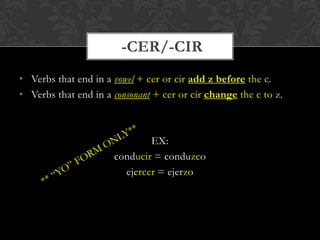
-CER/-CIR
• Verbs that end in a vowel + cer or cir add z before the c.
• Verbs that end in a consonant + cer or cir change the c to z.


                              EX:
                      conducir = conduzco
                        ejercer = ejerzo
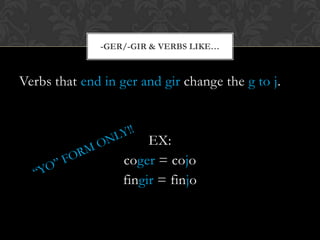
-GER/-GIR & VERBS LIKE…


Verbs that end in ger and gir change the g to j.


                        EX:
                   coger = cojo
                   fingir = finjo
HACE+____+QUE+
                 PRESENT/PRETERATE


The YO form is the only irregular.


                           EX:
            Salgo, sales, sale, salimos, salen
           Hago, haces, hace, hacemos, hacen
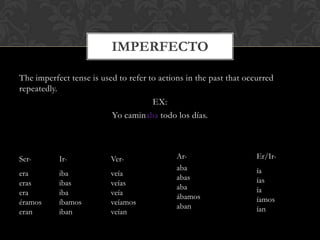
IMPERFECTO

The imperfect tense is used to refer to actions in the past that occurred
repeatedly.
                                      EX:
                          Yo caminaba todo los días.


Ser-       Ir-            Ver-               Ar-                    Er/Ir-
                                             aba                    ía
era        iba            veía
                                             abas                   ías
eras       ibas           veías
                                             aba                    ía
era        iba            veía
                                             ábamos                 íamos
éramos     íbamos         veíamos
                                             aban                   ían
eran       iban           veían
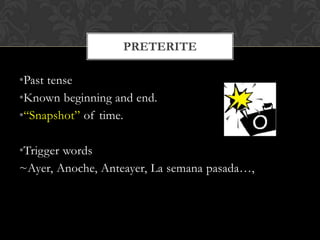
PRETERITE

•Past tense
•Known beginning and end.
•“Snapshot” of time.

•Trigger words
~Ayer, Anoche, Anteayer, La semana pasada…,
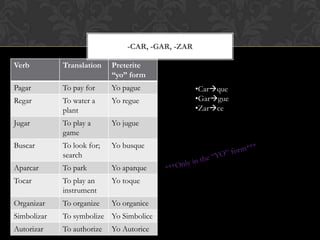
-CAR, -GAR, -ZAR

Verb         Translation    Preterite
                            “yo” form
Pagar        To pay for     Yo pague               •Carque
Regar        To water a     Yo regue               •Gargue
             plant                                 •Zarce
Jugar        To play a      Yo jugue
             game
Buscar       To look for;   Yo busque
             search
Aparcar      To park        Yo aparque
Tocar        To play an     Yo toque
             instrument
Organizar    To organize    Yo organice
Simbolizar   To symbolize Yo Simbolice
Autorizar    To authorize   Yo Autorice
SPOCK


THE HAND
•Thumb- hacer
•Next two fingers- ir, ser
•Net two fingers- dar, ver
SPOCK

Ir      To go
                             Ir       Ser      Dar      Ver      Hacer
Ser     To be
                  Yo         Fui      Fui      Di       Vi       Hice
Dar     To give
                  Tu         Fuiste   Fuiste   Diste    Viste    Hiciste
Ver     To see
                  El/ella/   Fue      Fue      Dio      Vio      Hizo
Hacer   To do;    ud.
        make      Nos.       Fuimos   Fuimos   Dimos    Vimos    Hicimos
                  Ellos/el   Fueron   Fueron   Dieron   Vieron   Hiciero
                  -las/                                          n
                  uds.
CUCARACHA


•Andar anduv
                 •Conducir 
•Estar  estuv   conduj
•Poder  pud     •Producir 
•Poner  pus     produj
•Querer  quis   •Traducir  traduj
•Saber  sup     •Traer  traj
•Tener  tuv     •Decir  dij
•Venir  vin
CUCARACHA

Yo                    E
Tu                    Iste
El/ ella/ ud          O
Nos                   Imos
Ellos/ellas/uds       Ieron
“Snake” only   SNAKE AND SNAKEY
changes in
el/ella/ud.
Dormi                     Dormimos
Dormiste
Durmio                    Durmieron


                                      “Snakey” changes
                                      “I” to a “y” to
                                      make a “tongue”

 Lei            Leimos
 Leiste
 Leyo           Leyeron
COMPARATIVES/SUPERLATIVES


• I am happier than you. ( Soy mas feliz que tu.)
• Camila is taller than Sabrina. ( Camila es mas alto que Sabrina.)


• Today is the coldest day of fall. ( Hoy es el dia mas frio del Otono.)
• Camila is the tallest in the senior class. ( Camila es el mas alto en la clase de
  senior.)
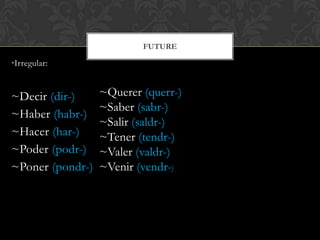
FUTURE

•Irregular:


~Decir (dir-)     ~Querer (querr-)
                  ~Saber (sabr-)
~Haber (habr-)
                  ~Salir (saldr-)
~Hacer (har-)     ~Tener (tendr-)
~Poder (podr-)    ~Valer (valdr-)
~Poner (pondr-)   ~Venir (vendr-)

Gramm

  • 1.
    EL LIBRO DELA GRAMÁTICA Camila Boyd
  • 2.
    TABLE OF CONTENTS 1. PRESENT TENSE 11. IMPERFECT 2. STEM CHANGERS 12. Preterite 3. IREEGULARS “YO” 13. Irregular Conj. 4. SABER VS. CONOCER 5. REFLEXIVE 14. Spock 6. “SE” IMPERSONAL 15. Cucaracha 7. DIPTHONGS 16. Snake and Snakey 8. –UIR/GUIR, -CER/CIR 17. Comparatives 9. -GER/GIR VERBS LIKE… 18. Superlatives 10. HACE+___+QUE+ 19. Future PRESENT/ PRETERATE
  • 3.
    PRESENT TENSE AR ER IR O O O AS ES ES A E E AMOS EMOS IMOS AN EN EN • HABLO, COMPRAS, BUSCA, CENAMOS, ESPERAN • APRENDO, PERDES, BEBE, VENDEMOS, COMEN • PEDO, VIVES, MORE, ADVERTIMOS, SENTEN
  • 4.
    STEM CHANGERS • E  IE • EI • O  UE • U  UE ***VERBS DON’T CHANGE IN NOSOTROS AND VOSOTROS***
  • 5.
    IRREGULARS “YO” ~ “GO” VERBS: CAER, DECIR, OIR, PONER, HACER, TENER, TRAER, VENIR EXAMPLE: HACER  HAGO… TENER  TENGO ~ “ZCO” VERBS (-CER/-CIR): CONOCER, PRODUCIR, CONDUCIR EXAMPLE: CONOZCO, PRODUZCO ~ Y LOS DEMAS: SER, ESTAR, IR , VER, SABER, DAR
  • 6.
    SABER VS. CONOCER •Both saber y conocer translate to the English verb “to know” Both “yo” forms are irregular EX: Conocer EX: Saber Conozco Conocemos Sé Sabemos Conoces Conocen Sabes Saben Conoce Sabe
  • 7.
    REFLEXIVES • Camila selava- se is reflexive **Reflexives also can be added on the end of an infinitive.** EX: Puedo verme en el espejo
  • 8.
    “SE” IMPERSONAL • Pronoun”se” is in front of verbs to make general statements. ¿Cómo se dice cantaloupe en español? ~In English it will regurgitate to either “you say” or “one says” for the answer.
  • 9.
    DIPTHONGS WITH ACCENTS • Dipthongs are the strong or weak vowels in a word next to each other. **Strong vowel sounds are a,e,o. **Weak vowel sounds are i,u,y. EX: *two strong puerto, ciudad, siete, hay. vowels cannot be in the same syllable.
  • 10.
    -UIR/-GUIR Guir Uir -Nosotros form is the only form that -Yo form only changes from Gu to G doesn’t change. -Verbs that end in -uir add y before the letters o, e, and a . EX: Conseguir EX: Atribuir consigo atribuyo consigues atribuyes consigue atribuye conseguimos atribuimos consiguen atribuyen
  • 11.
    -CER/-CIR • Verbs thatend in a vowel + cer or cir add z before the c. • Verbs that end in a consonant + cer or cir change the c to z. EX: conducir = conduzco ejercer = ejerzo
  • 12.
    -GER/-GIR & VERBSLIKE… Verbs that end in ger and gir change the g to j. EX: coger = cojo fingir = finjo
  • 13.
    HACE+____+QUE+ PRESENT/PRETERATE The YO form is the only irregular. EX: Salgo, sales, sale, salimos, salen Hago, haces, hace, hacemos, hacen
  • 14.
    IMPERFECTO The imperfect tenseis used to refer to actions in the past that occurred repeatedly. EX: Yo caminaba todo los días. Ser- Ir- Ver- Ar- Er/Ir- aba ía era iba veía abas ías eras ibas veías aba ía era iba veía ábamos íamos éramos íbamos veíamos aban ían eran iban veían
  • 15.
    PRETERITE •Past tense •Known beginningand end. •“Snapshot” of time. •Trigger words ~Ayer, Anoche, Anteayer, La semana pasada…,
  • 16.
    -CAR, -GAR, -ZAR Verb Translation Preterite “yo” form Pagar To pay for Yo pague •Carque Regar To water a Yo regue •Gargue plant •Zarce Jugar To play a Yo jugue game Buscar To look for; Yo busque search Aparcar To park Yo aparque Tocar To play an Yo toque instrument Organizar To organize Yo organice Simbolizar To symbolize Yo Simbolice Autorizar To authorize Yo Autorice
  • 17.
    SPOCK THE HAND •Thumb- hacer •Nexttwo fingers- ir, ser •Net two fingers- dar, ver
  • 18.
    SPOCK Ir To go Ir Ser Dar Ver Hacer Ser To be Yo Fui Fui Di Vi Hice Dar To give Tu Fuiste Fuiste Diste Viste Hiciste Ver To see El/ella/ Fue Fue Dio Vio Hizo Hacer To do; ud. make Nos. Fuimos Fuimos Dimos Vimos Hicimos Ellos/el Fueron Fueron Dieron Vieron Hiciero -las/ n uds.
  • 19.
    CUCARACHA •Andar anduv •Conducir  •Estar  estuv conduj •Poder  pud •Producir  •Poner  pus produj •Querer  quis •Traducir  traduj •Saber  sup •Traer  traj •Tener  tuv •Decir  dij •Venir  vin
  • 20.
    CUCARACHA Yo E Tu Iste El/ ella/ ud O Nos Imos Ellos/ellas/uds Ieron
  • 21.
    “Snake” only SNAKE AND SNAKEY changes in el/ella/ud. Dormi Dormimos Dormiste Durmio Durmieron “Snakey” changes “I” to a “y” to make a “tongue” Lei Leimos Leiste Leyo Leyeron
  • 22.
    COMPARATIVES/SUPERLATIVES • I amhappier than you. ( Soy mas feliz que tu.) • Camila is taller than Sabrina. ( Camila es mas alto que Sabrina.) • Today is the coldest day of fall. ( Hoy es el dia mas frio del Otono.) • Camila is the tallest in the senior class. ( Camila es el mas alto en la clase de senior.)
  • 23.
    FUTURE •Irregular: ~Decir (dir-) ~Querer (querr-) ~Saber (sabr-) ~Haber (habr-) ~Salir (saldr-) ~Hacer (har-) ~Tener (tendr-) ~Poder (podr-) ~Valer (valdr-) ~Poner (pondr-) ~Venir (vendr-)