


For more Visit us: www.dentaltutor.in
 Gluconeogenesis makes glucose from
non-carbohydrate starting materials
◦ Lactate
◦ Glycerol
◦ Most amino acids (not leucine, lysine)
◦ Glycerol and amino acids are used only in
starvation conditions
 Process occurs primarily in the liver
For more Visit us: www.dentaltutor.in
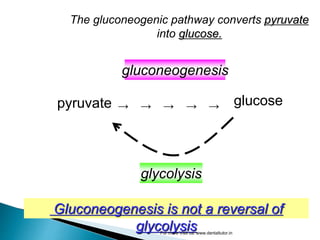
The gluconeogenic pathway converts pyruvate
into glucose.
pyruvate glucose→→ → → →
gluconeogenesis
glycolysis
Gluconeogenesis is not a reversal of
glycolysisFor more Visit us: www.dentaltutor.in
 While basically opposite processes
glycolysis and gluconeogenesis are not a
simple reversal of each other
 The three nonreversible steps of
glycolysis must be bypassed with new
routes
◦ Pyruvate  Phosphoenolpyruvate
◦ Fructose-1,6-bisphosphate  Fructose-6-
phosphate
◦ Glucose-6-phosphate  Glucose
For more Visit us: www.dentaltutor.in
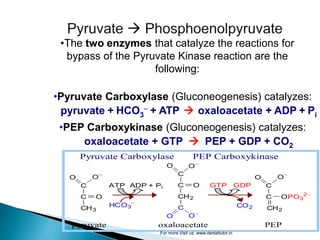
•The two enzymes that catalyze the reactions for
bypass of the Pyruvate Kinase reaction are the
following:
•Pyruvate Carboxylase (Gluconeogenesis) catalyzes:
pyruvate + HCO3
- + ATP  oxaloacetate + ADP + Pi
•PEP Carboxykinase (Gluconeogenesis) catalyzes:
oxaloacetate + GTP  PEP + GDP + CO2
C
C
CH2
O O-
OPO3
2-
C
C
CH3
O O-
O
ATP ADP + Pi C
CH2
C
C
O
O O-
O-
O
HCO3
-
GTP GDP
CO2
pyruvate oxaloacetate PEP
Pyruvate Carboxylase PEP Carboxykinase
For more Visit us: www.dentaltutor.in
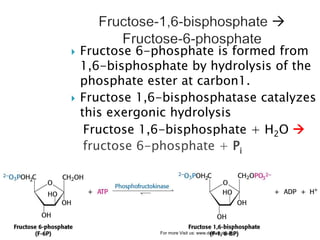
 Fructose 6-phosphate is formed from
1,6-bisphosphate by hydrolysis of the
phosphate ester at carbon1.
 Fructose 1,6-bisphosphatase catalyzes
this exergonic hydrolysis
Fructose 1,6-bisphosphate + H2O 
fructose 6-phosphate + Pi
For more Visit us: www.dentaltutor.in
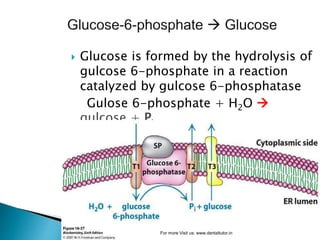
 Glucose is formed by the hydrolysis of
gulcose 6-phosphate in a reaction
catalyzed by gulcose 6-phosphatase
Gulose 6-phosphate + H2O 
gulcose + Pi
For more Visit us: www.dentaltutor.in
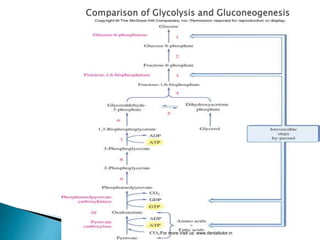
Glyceraldehyde-3-phosphate
Dehydrogenase
Phosphoglycerate Kinase
Enolase
PEP Carboxykinase
glyceraldehyde-3-phosphate
NAD+
+ Pi
NADH + H+
1,3-bisphosphoglycerate
ADP
ATP
3-phosphoglycerate
Phosphoglycerate Mutase
2-phosphoglycerate
H2O
phosphoenolpyruvate
CO2 + GDP
GTP
oxaloacetate
Pi + ADP
HCO3
-
+ ATP
pyruvate
Pyruvate Carboxylase
Gluconeogenesis
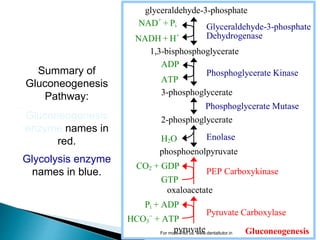
Summary of
Gluconeogenesis
Pathway:
Gluconeogenesis
enzyme names in
red.
Glycolysis enzyme
names in blue.
For more Visit us: www.dentaltutor.in
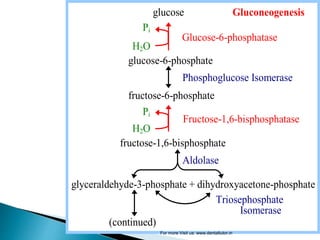
Glucose-6-phosphatase
Fructose-1,6-bisphosphatase
glucose Gluconeogenesis
Pi
H2O
glucose-6-phosphate
Phosphoglucose Isomerase
fructose-6-phosphate
Pi
H2O
fructose-1,6-bisphosphate
Aldolase
glyceraldehyde-3-phosphate + dihydroxyacetone-phosphate
Triosephosphate
Isomerase
(continued)
For more Visit us: www.dentaltutor.in
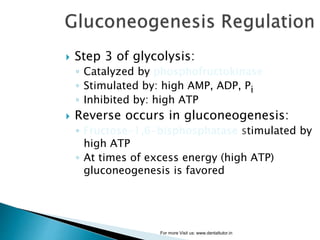
 Step 3 of glycolysis:
◦ Catalyzed by phosphofructokinase
◦ Stimulated by: high AMP, ADP, Pi
◦ Inhibited by: high ATP
 Reverse occurs in gluconeogenesis:
◦ Fructose-1,6-bisphosphatase stimulated by
high ATP
◦ At times of excess energy (high ATP)
gluconeogenesis is favored
For more Visit us: www.dentaltutor.in
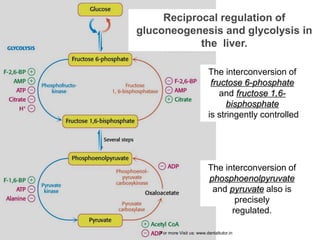
Reciprocal regulation of
gluconeogenesis and glycolysis in
the liver.
The interconversion of
fructose 6-phosphate
and fructose 1,6-
bisphosphate
is stringently controlled
The interconversion of
phosphoenolpyruvate
and pyruvate also is
precisely
regulated.
For more Visit us: www.dentaltutor.in
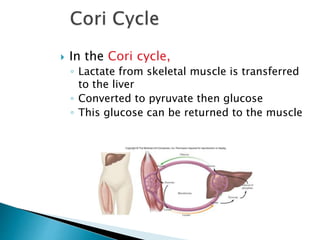
 In the Cori cycle,
◦ Lactate from skeletal muscle is transferred
to the liver
◦ Converted to pyruvate then glucose
◦ This glucose can be returned to the muscle
THANKS
 For more Visit us: www.dentaltutor.in

Gluconeogenesis

  • 1.
    For more Visitus: www.dentaltutor.in For more Visit us: www.dentaltutor.in
  • 2.
     Gluconeogenesis makesglucose from non-carbohydrate starting materials ◦ Lactate ◦ Glycerol ◦ Most amino acids (not leucine, lysine) ◦ Glycerol and amino acids are used only in starvation conditions  Process occurs primarily in the liver For more Visit us: www.dentaltutor.in
  • 3.
    The gluconeogenic pathwayconverts pyruvate into glucose. pyruvate glucose→→ → → → gluconeogenesis glycolysis Gluconeogenesis is not a reversal of glycolysisFor more Visit us: www.dentaltutor.in
  • 4.
     While basicallyopposite processes glycolysis and gluconeogenesis are not a simple reversal of each other  The three nonreversible steps of glycolysis must be bypassed with new routes ◦ Pyruvate  Phosphoenolpyruvate ◦ Fructose-1,6-bisphosphate  Fructose-6- phosphate ◦ Glucose-6-phosphate  Glucose For more Visit us: www.dentaltutor.in
  • 5.
    For more Visitus: www.dentaltutor.in
  • 6.
    •The two enzymesthat catalyze the reactions for bypass of the Pyruvate Kinase reaction are the following: •Pyruvate Carboxylase (Gluconeogenesis) catalyzes: pyruvate + HCO3 - + ATP  oxaloacetate + ADP + Pi •PEP Carboxykinase (Gluconeogenesis) catalyzes: oxaloacetate + GTP  PEP + GDP + CO2 C C CH2 O O- OPO3 2- C C CH3 O O- O ATP ADP + Pi C CH2 C C O O O- O- O HCO3 - GTP GDP CO2 pyruvate oxaloacetate PEP Pyruvate Carboxylase PEP Carboxykinase For more Visit us: www.dentaltutor.in
  • 7.
     Fructose 6-phosphateis formed from 1,6-bisphosphate by hydrolysis of the phosphate ester at carbon1.  Fructose 1,6-bisphosphatase catalyzes this exergonic hydrolysis Fructose 1,6-bisphosphate + H2O  fructose 6-phosphate + Pi For more Visit us: www.dentaltutor.in
  • 8.
     Glucose isformed by the hydrolysis of gulcose 6-phosphate in a reaction catalyzed by gulcose 6-phosphatase Gulose 6-phosphate + H2O  gulcose + Pi For more Visit us: www.dentaltutor.in
  • 9.
    Glyceraldehyde-3-phosphate Dehydrogenase Phosphoglycerate Kinase Enolase PEP Carboxykinase glyceraldehyde-3-phosphate NAD+ +Pi NADH + H+ 1,3-bisphosphoglycerate ADP ATP 3-phosphoglycerate Phosphoglycerate Mutase 2-phosphoglycerate H2O phosphoenolpyruvate CO2 + GDP GTP oxaloacetate Pi + ADP HCO3 - + ATP pyruvate Pyruvate Carboxylase Gluconeogenesis Summary of Gluconeogenesis Pathway: Gluconeogenesis enzyme names in red. Glycolysis enzyme names in blue. For more Visit us: www.dentaltutor.in
  • 10.
  • 11.
     Step 3of glycolysis: ◦ Catalyzed by phosphofructokinase ◦ Stimulated by: high AMP, ADP, Pi ◦ Inhibited by: high ATP  Reverse occurs in gluconeogenesis: ◦ Fructose-1,6-bisphosphatase stimulated by high ATP ◦ At times of excess energy (high ATP) gluconeogenesis is favored For more Visit us: www.dentaltutor.in
  • 12.
    Reciprocal regulation of gluconeogenesisand glycolysis in the liver. The interconversion of fructose 6-phosphate and fructose 1,6- bisphosphate is stringently controlled The interconversion of phosphoenolpyruvate and pyruvate also is precisely regulated. For more Visit us: www.dentaltutor.in
  • 13.
     In theCori cycle, ◦ Lactate from skeletal muscle is transferred to the liver ◦ Converted to pyruvate then glucose ◦ This glucose can be returned to the muscle
  • 14.
    THANKS  For moreVisit us: www.dentaltutor.in