Electron
Transport Chain
Reported by: Stephanie Lee
Electron Transport
• The passage of energetic electrons through a series
of membrane associated electron carrier molecules
to proton pumps embedded within mitochondrial
or chloroplast membrane
• As the electrons reach the proton pumping
channels, their energy drives the transport of
protons out across the membrane, leading to the
synthesis of ATP
Enzymes
• NADH – Nicotinamide Adenine Dinucleotide
• FADH – Flavin Adenine Dinucleotide
• CoEnzyme Q
• Cytochrome C
Electron Transport
• After Glycolysis and Krebs Cycle, we are left with 10
NADH and 2 FADH₂
• These will undergo oxidation – losing of electrons
• NADH NAD⁺ + H⁺ + 2e⁻
• Electrons during this point has high energy state
• Electrons will go to a lower energy state
• 2e⁻ Coenzyme Q Cytochrome C 2e⁻
• Co Q and Cyt C is used for the reduction of oxygen
• Electrons bind with Co Q and Cyt C to release energy
Electron Transport
• 2e⁻ + H⁺ + ½O₂ H₂O
• Electrons are used to reduce oxygen to 1 molecule of oxygen
• 2 hydrogen atoms and 1 oxygen atom
Electron Transport
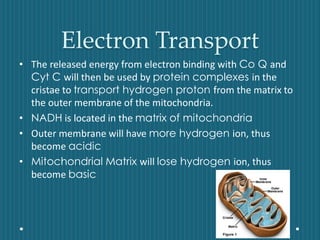
• The released energy from electron binding with Co Q and
Cyt C will then be used by protein complexes in the
cristae to transport hydrogen proton from the matrix to
the outer membrane of the mitochondria.
• NADH is located in the matrix of mitochondria
• Outer membrane will have more hydrogen ion, thus
become acidic
• Mitochondrial Matrix will lose hydrogen ion, thus
become basic
Electron Transport
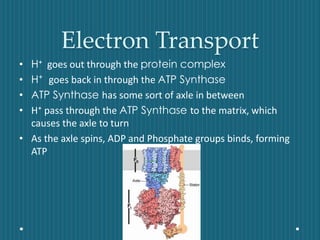
• H⁺ goes out through the protein complex
• H⁺ goes back in through the ATP Synthase
• ATP Synthase has some sort of axle in between
• H⁺ pass through the ATP Synthase to the matrix, which
causes the axle to turn
• As the axle spins, ADP and Phosphate groups binds, forming
ATP
Electron Transport
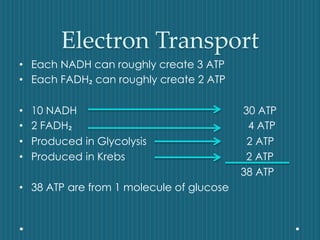
• Each NADH can roughly create 3 ATP
• Each FADH₂ can roughly create 2 ATP
• 10 NADH 30 ATP
• 2 FADH₂ 4 ATP
• Produced in Glycolysis 2 ATP
• Produced in Krebs 2 ATP
38 ATP
• 38 ATP are from 1 molecule of glucose
Animations
• http://www.science.smith.edu/departments/Biolog
y/Bio231/etc.html
• http://www.johnkyrk.com/mitochondrion.html
The End
Thank you for Listening!

14 electron transport chain

  • 1.
  • 2.
    Electron Transport • Thepassage of energetic electrons through a series of membrane associated electron carrier molecules to proton pumps embedded within mitochondrial or chloroplast membrane • As the electrons reach the proton pumping channels, their energy drives the transport of protons out across the membrane, leading to the synthesis of ATP
  • 3.
    Enzymes • NADH –Nicotinamide Adenine Dinucleotide • FADH – Flavin Adenine Dinucleotide • CoEnzyme Q • Cytochrome C
  • 4.
    Electron Transport • AfterGlycolysis and Krebs Cycle, we are left with 10 NADH and 2 FADH₂ • These will undergo oxidation – losing of electrons • NADH NAD⁺ + H⁺ + 2e⁻ • Electrons during this point has high energy state • Electrons will go to a lower energy state • 2e⁻ Coenzyme Q Cytochrome C 2e⁻ • Co Q and Cyt C is used for the reduction of oxygen • Electrons bind with Co Q and Cyt C to release energy
  • 5.
    Electron Transport • 2e⁻+ H⁺ + ½O₂ H₂O • Electrons are used to reduce oxygen to 1 molecule of oxygen • 2 hydrogen atoms and 1 oxygen atom
  • 6.
    Electron Transport • Thereleased energy from electron binding with Co Q and Cyt C will then be used by protein complexes in the cristae to transport hydrogen proton from the matrix to the outer membrane of the mitochondria. • NADH is located in the matrix of mitochondria • Outer membrane will have more hydrogen ion, thus become acidic • Mitochondrial Matrix will lose hydrogen ion, thus become basic
  • 7.
    Electron Transport • H⁺goes out through the protein complex • H⁺ goes back in through the ATP Synthase • ATP Synthase has some sort of axle in between • H⁺ pass through the ATP Synthase to the matrix, which causes the axle to turn • As the axle spins, ADP and Phosphate groups binds, forming ATP
  • 8.
    Electron Transport • EachNADH can roughly create 3 ATP • Each FADH₂ can roughly create 2 ATP • 10 NADH 30 ATP • 2 FADH₂ 4 ATP • Produced in Glycolysis 2 ATP • Produced in Krebs 2 ATP 38 ATP • 38 ATP are from 1 molecule of glucose
  • 9.
  • 10.
    The End Thank youfor Listening!