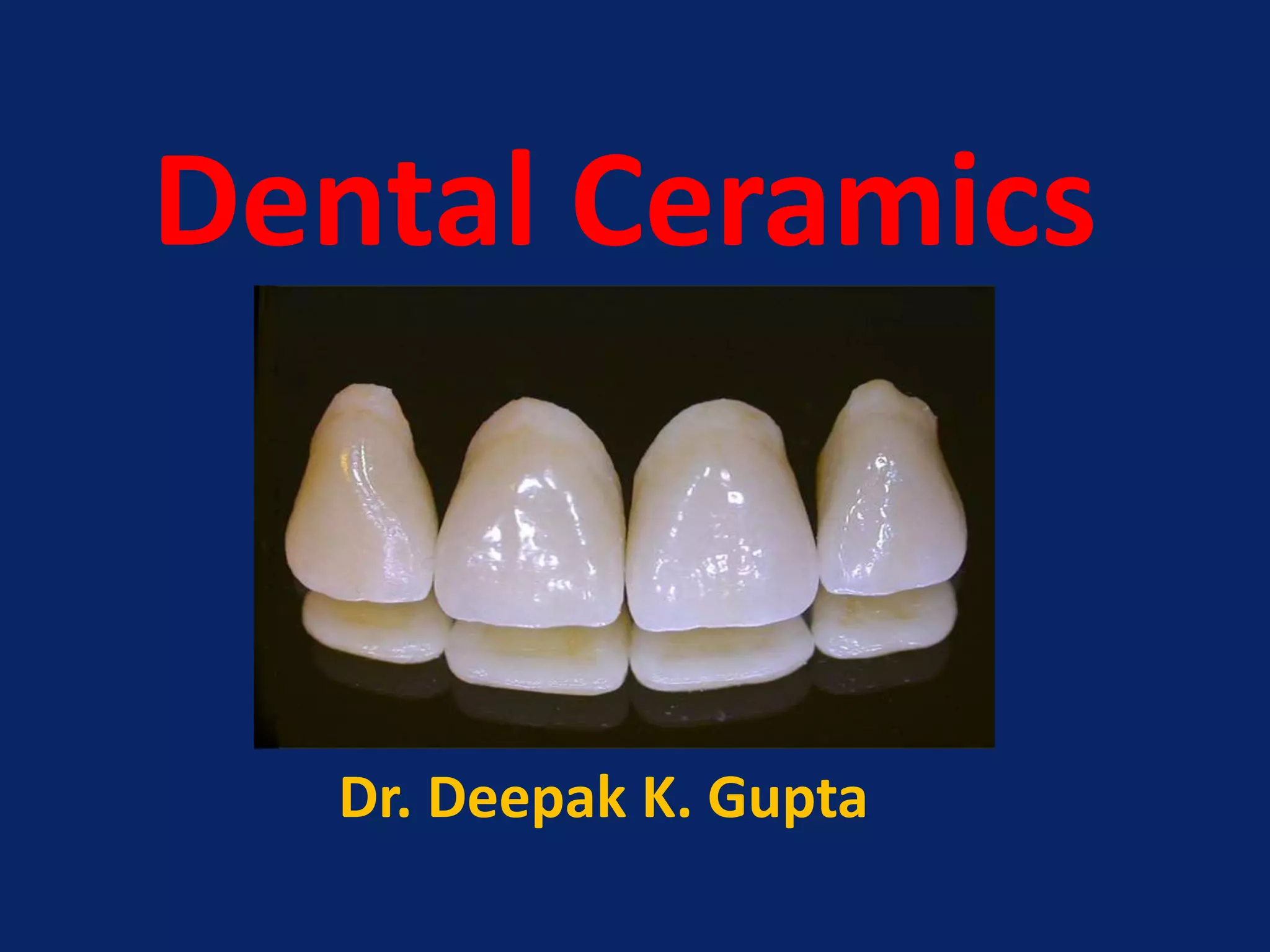
Dental Ceramics
Dr. Deepak K. Gupta
Introduction
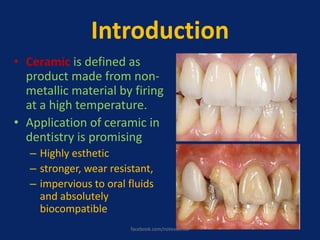
• Ceramic is defined as
product made from non-
metallic material by firing
at a high temperature.
• Application of ceramic in
dentistry is promising
– Highly esthetic
– stronger, wear resistant,
– impervious to oral fluids
and absolutely
biocompatible
facebook.com/notesdental
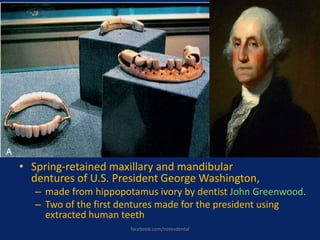
• Spring-retained maxillary and mandibular
dentures of U.S. President George Washington,
– made from hippopotamus ivory by dentist John Greenwood.
– Two of the first dentures made for the president using
extracted human teeth
facebook.com/notesdental
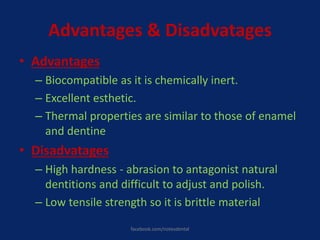
Advantages & Disadvatages
• Advantages
– Biocompatible as it is chemically inert.
– Excellent esthetic.
– Thermal properties are similar to those of enamel
and dentine
• Disadvatages
– High hardness - abrasion to antagonist natural
dentitions and difficult to adjust and polish.
– Low tensile strength so it is brittle material
facebook.com/notesdental
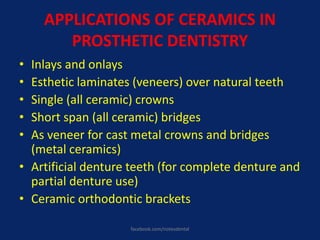
APPLICATIONS OF CERAMICS IN
PROSTHETIC DENTISTRY
• Inlays and onlays
• Esthetic laminates (veneers) over natural teeth
• Single (all ceramic) crowns
• Short span (all ceramic) bridges
• As veneer for cast metal crowns and bridges
(metal ceramics)
• Artificial denture teeth (for complete denture and
partial denture use)
• Ceramic orthodontic brackets
facebook.com/notesdental
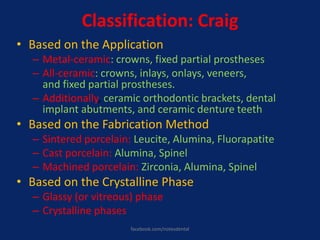
Classification: Craig
• Based on the Application
– Metal-ceramic: crowns, fixed partial prostheses
– All-ceramic: crowns, inlays, onlays, veneers,
and fixed partial prostheses.
– Additionally, ceramic orthodontic brackets, dental
implant abutments, and ceramic denture teeth
• Based on the Fabrication Method
– Sintered porcelain: Leucite, Alumina, Fluorapatite
– Cast porcelain: Alumina, Spinel
– Machined porcelain: Zirconia, Alumina, Spinel
• Based on the Crystalline Phase
– Glassy (or vitreous) phase
– Crystalline phases
facebook.com/notesdental
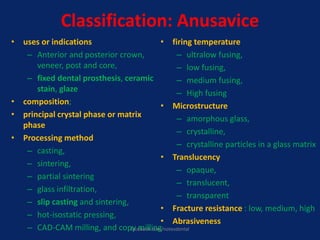
Classification: Anusavice
• uses or indications
– Anterior and posterior crown,
veneer, post and core,
– fixed dental prosthesis, ceramic
stain, glaze
• composition;
• principal crystal phase or matrix
phase
• Processing method
– casting,
– sintering,
– partial sintering
– glass infiltration,
– slip casting and sintering,
– hot-isostatic pressing,
– CAD-CAM milling, and copy milling
• firing temperature
– ultralow fusing,
– low fusing,
– medium fusing,
– High fusing
• Microstructure
– amorphous glass,
– crystalline,
– crystalline particles in a glass matrix
• Translucency
– opaque,
– translucent,
– transparent
• Fracture resistance : low, medium, high
• Abrasiveness
facebook.com/notesdental
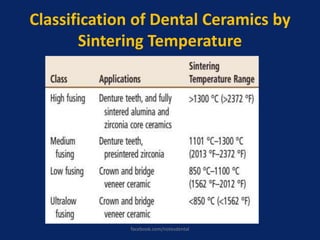
Classification of Dental Ceramics by
Sintering Temperature
facebook.com/notesdental
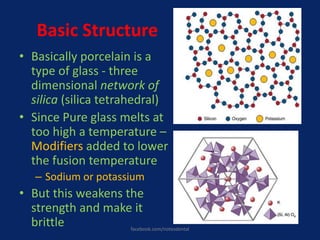
Basic Structure
• Basically porcelain is a
type of glass - three
dimensional network of
silica (silica tetrahedral)
• Since Pure glass melts at
too high a temperature –
Modifiers added to lower
the fusion temperature
– Sodium or potassium
• But this weakens the
strength and make it
brittle facebook.com/notesdental
Composition
• It mainly consist of silicate glasses, porcelains,
glass ceramics, or highly crystalline solids.
• Wide variety of porcelain products available in
the market
• So its virtually impossible to provide a single
composition for them all.
• So we will discuss about traditional porcelains
- feldspathic porcelains
facebook.com/notesdental
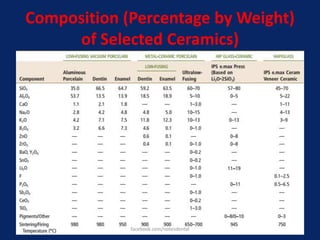
Composition (Percentage by Weight)
of Selected Ceramics)
facebook.com/notesdental
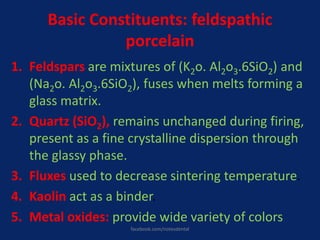
Basic Constituents: feldspathic
porcelain
1. Feldspars are mixtures of (K2o. Al2o3.6SiO2) and
(Na2o. Al2o3.6SiO2), fuses when melts forming a
glass matrix.
2. Quartz (SiO2), remains unchanged during firing,
present as a fine crystalline dispersion through
the glassy phase.
3. Fluxes used to decrease sintering temperature.
4. Kaolin act as a binder.
5. Metal oxides: provide wide variety of colors
facebook.com/notesdental
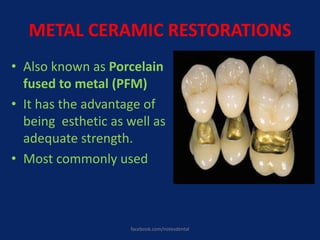
METAL CERAMIC RESTORATIONS
• Also known as Porcelain
fused to metal (PFM)
• It has the advantage of
being esthetic as well as
adequate strength.
• Most commonly used
facebook.com/notesdental
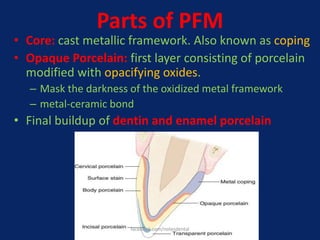
Parts of PFM
• Core: cast metallic framework. Also known as coping
• Opaque Porcelain: first layer consisting of porcelain
modified with opacifying oxides.
– Mask the darkness of the oxidized metal framework
– metal-ceramic bond
• Final buildup of dentin and enamel porcelain
facebook.com/notesdental
METAL-CERAMIC BOND
• Most important requirement for good long-term
performance.
• The bond is a result of chemisorption by diffusion
between the surface oxide layer on the alloy and the
porcelain.
• Roughening of surface interface also increases the
bond strength
– increases surface area of wetting for porcelain.
– Micromechanical retention
• Noble metal alloys, which are resistant to oxidizing –
easily oxidising metal like indium (In) and tin (Sn):
form an oxide layer
facebook.com/notesdental
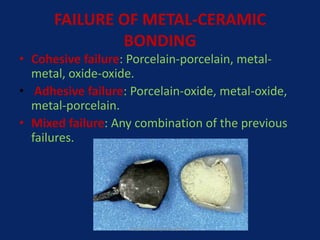
FAILURE OF METAL-CERAMIC
BONDING
• Cohesive failure: Porcelain-porcelain, metal-
metal, oxide-oxide.
• Adhesive failure: Porcelain-oxide, metal-oxide,
metal-porcelain.
• Mixed failure: Any combination of the previous
failures.
facebook.com/notesdental
CERAMICS FOR METAL-CERAMIC
RESTORATIONS
• Must fulfill five requirements:
– simulate the appearance of natural teeth,
– fuse at relatively low temperatures,
– have thermal expansion coefficients compatible with alloys
used for metal frameworks,
– Compatible in the oral environment,
– have low abrasiveness.
• Composition: silica (SiO2), alumina (Al2O3), sodium oxide
(Na2O), and potassium oxide (K2O)
• Opacifiers (TiO2, ZrO2, SnO2),
• Various heat-stable coloring oxides
• Small amounts of fluorescing oxides (CeO2) - appearance of the
dentin/enamel complex structure
facebook.com/notesdental
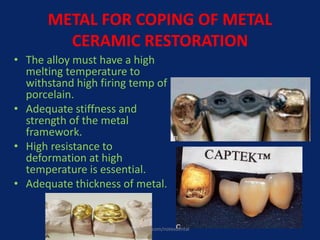
METAL FOR COPING OF METAL
CERAMIC RESTORATION
• The alloy must have a high
melting temperature to
withstand high firing temp of
porcelain.
• Adequate stiffness and
strength of the metal
framework.
• High resistance to
deformation at high
temperature is essential.
• Adequate thickness of metal.
facebook.com/notesdental
FABRICATION OF METAL-CERAMIC
PROSTHESES
• Casting of Metal Core
– Wax framework is fabricated on the die.
– The framework is cast by lost wax technique.
– Sandblasting of the cast metal copy.
– Degassing is done to form oxide layer to improve
bonding to ceramic.
• Processing of Porcelain over metal core
– Condensation and Build-up
– Firing or sintering
– Glazing
– Cooling
facebook.com/notesdental
Condensation
• The plastic mass of powder and water is applied
to the metal coping.
Function of condensation
– Adapt the porcelain to the required shape.
– Remove as much water from the material as possible
to decrease firing shrinkage.
Methods of condensation
– Vibration
– Spatulation
– Brush
facebook.com/notesdental
Build-up
There are three types of porcelain used
a. Opaque porcelain: Mask the color of the
cement used for adhesion of the restoration.
b. Body or dentin porcelain: Makes up the bulk
of the restoration by providing most of the
color or shade.
c. Enamel porcelain: It provides the translucent
layer of porcelain in the incisal portion of the
tooth.
facebook.com/notesdental
FIRING OR SINTERING
• It is to fuse the particles of porcelain powder producing
hard mass.
Stages of firing:
a. Low bisque stage: Particles lack complete adhesion,
low amount of shrinkage occur, and very porous.
b. Medium bisque stage: water evaporates with better
cohesion to the powder particles and some porosity.
Most of the firing shrinkage occurs in this stage.
c. High bisque stage: fusion of particles to form a
continuous mass, complete cohesion and no more
shrinkage.
facebook.com/notesdental
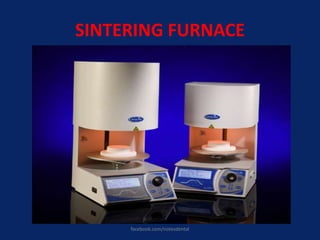
SINTERING FURNACE
facebook.com/notesdental
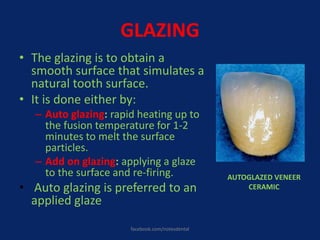
GLAZING
• The glazing is to obtain a
smooth surface that simulates a
natural tooth surface.
• It is done either by:
– Auto glazing: rapid heating up to
the fusion temperature for 1-2
minutes to melt the surface
particles.
– Add on glazing: applying a glaze
to the surface and re-firing.
• Auto glazing is preferred to an
applied glaze
AUTOGLAZED VENEER
CERAMIC
facebook.com/notesdental
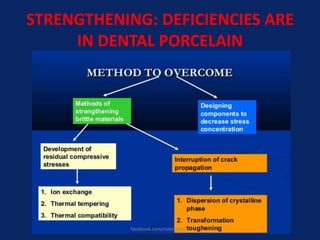
STRENGTHENING: DEFICIENCIES ARE
IN DENTAL PORCELAIN
facebook.com/notesdental
ALL-CERAMIC RESTORATION
• All-ceramic restorations use a
wide variety of crystalline
phases.
• Several processing techniques
are available for fabricating all-
ceramic restorations:
– Sintering: Alumina and leucite
– Heat-pressing: Inceram and IPS
impress
– Casting: Dicor
– Slip-casting: Inceram Alumina,
Iceram spinell, in-ceram zirconica
– CAD/CAM: VitaBlock, Dicor MGC
Lava DVS Cross-Section
facebook.com/notesdental
Sintered All-Ceramic Materials
• Two main types of all-ceramic materials
• Alumina-Based Ceramic
– developed by McLean in 1965
– aluminous core ceramic used in the aluminous porcelain
crown
– high modulus of elasticity and relatively high fracture
toughness, compared to feldspathic porcelains
• Leucite-Reinforced Ceramic
– 45% by volume tetragonal leucite
– higher flexural strength (104 MPa) and compressive
strength
– increased resistance to crack propagation
facebook.com/notesdental
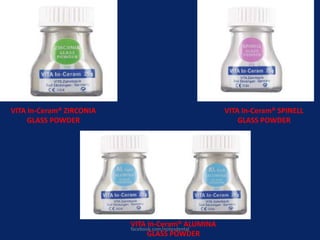
VITA In-Ceram® SPINELL
GLASS POWDER
VITA In-Ceram® ALUMINA
GLASS POWDER
VITA In-Ceram® ZIRCONIA
GLASS POWDER
facebook.com/notesdental
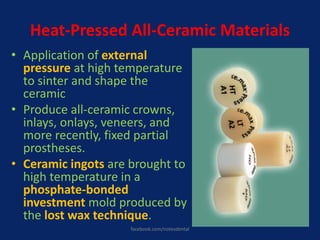
Heat-Pressed All-Ceramic Materials
• Application of external
pressure at high temperature
to sinter and shape the
ceramic
• Produce all-ceramic crowns,
inlays, onlays, veneers, and
more recently, fixed partial
prostheses.
• Ceramic ingots are brought to
high temperature in a
phosphate-bonded
investment mold produced by
the lost wax technique.
facebook.com/notesdental
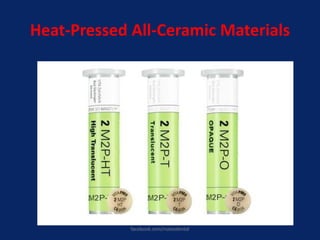
Heat-Pressed All-Ceramic Materials
facebook.com/notesdental
Heat-Pressed All-Ceramic Materials
• Leucite-Based Ceramic
– First-generation heat-pressed ceramics contain
leucite (KAlSi2O6 or K2O • Al2O3 • 4SiO2) as reinforcer
– Heat-pressing temperatures: 1150° and 1180° C for 20 minutes.
– ceramic ingots: variety of shades
– amount of porosity in the heatpressed ceramic is 9 vol %
• Lithium Disilicate–Based Materials
– second generation of heat-pressed ceramics
contain lithium disilicate (Li2Si2O5)
– major crystalline phase: 890° to 920° C temperature range
– 65% by volume of highly interlocking prismatic lithium disilicate
crystals
– amount of porosity after heat-pressing is about 1 vol %
– Higher resistance to crack propagation
facebook.com/notesdental
Slip-Cast All-Ceramic Materials
• Introduced in dentistry in the 1990s
• Condensation of a porcelain slip on a refractory die -
aqueous slurry containing fine ceramic particles.
• Porosity of the refractory die helps condensation by
absorbing the water from the slip by capillary action.
• Restoration is incrementally built up, shaped
• Finally sintered at high temperature on the refractory die
• Usually the refractory die shrinks more than the
condensed slip
• Restoration can be separated easily after sintering
• Sintered porous core is later glass-infiltrated
facebook.com/notesdental
Slip-Cast All-Ceramic Materials
• Alumina and Spinel-Based Slip-Cast Ceramics
– alumina content of the slip: more than 90%, with a
particle size between 0.5 and 3.5 μm
– 1st stage: drying at 120° C for 6 hrs
– 2nd stage: sintering for 2 hours at 1120° C and 2 hours
at 1180° C
– 3rd stage: porous alumina coping is infiltrated with a
lanthanum-containing glass during a third firing at
1140° C for 2 hours
– 68 vol% alumina, 27 vol% glass, and 5 vol% porosity
– Indication: short-span anterior fixed partial prostheses
facebook.com/notesdental
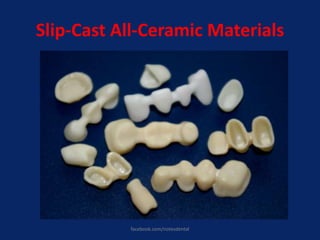
Slip-Cast All-Ceramic Materials
facebook.com/notesdental
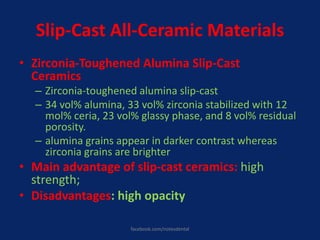
Slip-Cast All-Ceramic Materials
• Zirconia-Toughened Alumina Slip-Cast
Ceramics
– Zirconia-toughened alumina slip-cast
– 34 vol% alumina, 33 vol% zirconia stabilized with 12
mol% ceria, 23 vol% glassy phase, and 8 vol% residual
porosity.
– alumina grains appear in darker contrast whereas
zirconia grains are brighter
• Main advantage of slip-cast ceramics: high
strength;
• Disadvantages: high opacity
facebook.com/notesdental
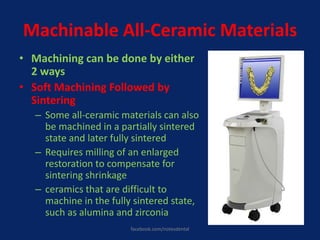
Machinable All-Ceramic Materials
• Machining can be done by either
2 ways
• Soft Machining Followed by
Sintering
– Some all-ceramic materials can also
be machined in a partially sintered
state and later fully sintered
– Requires milling of an enlarged
restoration to compensate for
sintering shrinkage
– ceramics that are difficult to
machine in the fully sintered state,
such as alumina and zirconia
facebook.com/notesdental
Machinable All-Ceramic Materials:
Hard Machining
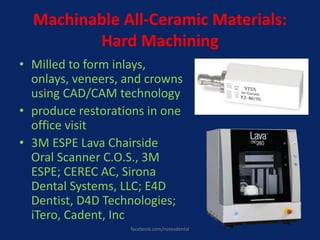
• Milled to form inlays,
onlays, veneers, and crowns
using CAD/CAM technology
• produce restorations in one
office visit
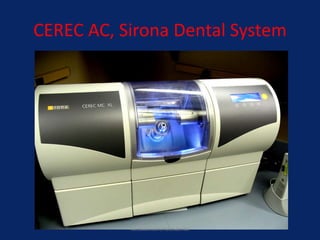
• 3M ESPE Lava Chairside
Oral Scanner C.O.S., 3M
ESPE; CEREC AC, Sirona
Dental Systems, LLC; E4D
Dentist, D4D Technologies;
iTero, Cadent, Inc
facebook.com/notesdental
Computer Aided Designing/Computer
Aided Milling (CAD/CAM)
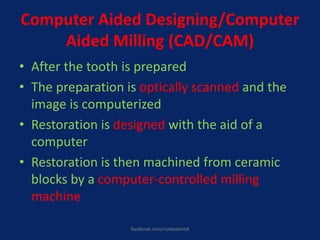
• After the tooth is prepared
• The preparation is optically scanned and the
image is computerized
• Restoration is designed with the aid of a
computer
• Restoration is then machined from ceramic
blocks by a computer-controlled milling
machine
facebook.com/notesdental
CEREC AC, Sirona Dental System
facebook.com/notesdental
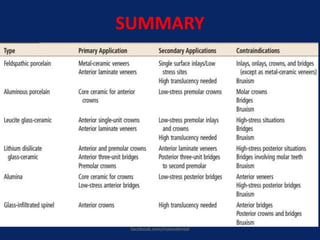
SUMMARY
facebook.com/notesdental
References
• Phillips' Science of Dental Materials- Phillip
Anusavice_12th
• Basic Dental Materials -2nd.ed Mannapalli
• Clinical Aspects of Dental Materials Theory,
Practice, and Cases, 4th Edition
• Craig's Restorative Dental Material 13th
edition
facebook.com/notesdental
THANKS……
Like, share and comment on
https://www.facebook.com/notesdental
http://www.slideshare.net/DeepakKumarGupta2
facebook.com/notesdental

Dental ceramics

  • 1.
  • 2.
    Introduction • Ceramic isdefined as product made from non- metallic material by firing at a high temperature. • Application of ceramic in dentistry is promising – Highly esthetic – stronger, wear resistant, – impervious to oral fluids and absolutely biocompatible facebook.com/notesdental
  • 3.
    • Spring-retained maxillaryand mandibular dentures of U.S. President George Washington, – made from hippopotamus ivory by dentist John Greenwood. – Two of the first dentures made for the president using extracted human teeth facebook.com/notesdental
  • 4.
    Advantages & Disadvatages •Advantages – Biocompatible as it is chemically inert. – Excellent esthetic. – Thermal properties are similar to those of enamel and dentine • Disadvatages – High hardness - abrasion to antagonist natural dentitions and difficult to adjust and polish. – Low tensile strength so it is brittle material facebook.com/notesdental
  • 5.
    APPLICATIONS OF CERAMICSIN PROSTHETIC DENTISTRY • Inlays and onlays • Esthetic laminates (veneers) over natural teeth • Single (all ceramic) crowns • Short span (all ceramic) bridges • As veneer for cast metal crowns and bridges (metal ceramics) • Artificial denture teeth (for complete denture and partial denture use) • Ceramic orthodontic brackets facebook.com/notesdental
  • 6.
    Classification: Craig • Basedon the Application – Metal-ceramic: crowns, fixed partial prostheses – All-ceramic: crowns, inlays, onlays, veneers, and fixed partial prostheses. – Additionally, ceramic orthodontic brackets, dental implant abutments, and ceramic denture teeth • Based on the Fabrication Method – Sintered porcelain: Leucite, Alumina, Fluorapatite – Cast porcelain: Alumina, Spinel – Machined porcelain: Zirconia, Alumina, Spinel • Based on the Crystalline Phase – Glassy (or vitreous) phase – Crystalline phases facebook.com/notesdental
  • 7.
    Classification: Anusavice • usesor indications – Anterior and posterior crown, veneer, post and core, – fixed dental prosthesis, ceramic stain, glaze • composition; • principal crystal phase or matrix phase • Processing method – casting, – sintering, – partial sintering – glass infiltration, – slip casting and sintering, – hot-isostatic pressing, – CAD-CAM milling, and copy milling • firing temperature – ultralow fusing, – low fusing, – medium fusing, – High fusing • Microstructure – amorphous glass, – crystalline, – crystalline particles in a glass matrix • Translucency – opaque, – translucent, – transparent • Fracture resistance : low, medium, high • Abrasiveness facebook.com/notesdental
  • 8.
    Classification of DentalCeramics by Sintering Temperature facebook.com/notesdental
  • 9.
    Basic Structure • Basicallyporcelain is a type of glass - three dimensional network of silica (silica tetrahedral) • Since Pure glass melts at too high a temperature – Modifiers added to lower the fusion temperature – Sodium or potassium • But this weakens the strength and make it brittle facebook.com/notesdental
  • 10.
    Composition • It mainlyconsist of silicate glasses, porcelains, glass ceramics, or highly crystalline solids. • Wide variety of porcelain products available in the market • So its virtually impossible to provide a single composition for them all. • So we will discuss about traditional porcelains - feldspathic porcelains facebook.com/notesdental
  • 11.
    Composition (Percentage byWeight) of Selected Ceramics) facebook.com/notesdental
  • 12.
    Basic Constituents: feldspathic porcelain 1.Feldspars are mixtures of (K2o. Al2o3.6SiO2) and (Na2o. Al2o3.6SiO2), fuses when melts forming a glass matrix. 2. Quartz (SiO2), remains unchanged during firing, present as a fine crystalline dispersion through the glassy phase. 3. Fluxes used to decrease sintering temperature. 4. Kaolin act as a binder. 5. Metal oxides: provide wide variety of colors facebook.com/notesdental
  • 13.
    METAL CERAMIC RESTORATIONS •Also known as Porcelain fused to metal (PFM) • It has the advantage of being esthetic as well as adequate strength. • Most commonly used facebook.com/notesdental
  • 14.
    Parts of PFM •Core: cast metallic framework. Also known as coping • Opaque Porcelain: first layer consisting of porcelain modified with opacifying oxides. – Mask the darkness of the oxidized metal framework – metal-ceramic bond • Final buildup of dentin and enamel porcelain facebook.com/notesdental
  • 15.
    METAL-CERAMIC BOND • Mostimportant requirement for good long-term performance. • The bond is a result of chemisorption by diffusion between the surface oxide layer on the alloy and the porcelain. • Roughening of surface interface also increases the bond strength – increases surface area of wetting for porcelain. – Micromechanical retention • Noble metal alloys, which are resistant to oxidizing – easily oxidising metal like indium (In) and tin (Sn): form an oxide layer facebook.com/notesdental
  • 16.
    FAILURE OF METAL-CERAMIC BONDING •Cohesive failure: Porcelain-porcelain, metal- metal, oxide-oxide. • Adhesive failure: Porcelain-oxide, metal-oxide, metal-porcelain. • Mixed failure: Any combination of the previous failures. facebook.com/notesdental
  • 17.
    CERAMICS FOR METAL-CERAMIC RESTORATIONS •Must fulfill five requirements: – simulate the appearance of natural teeth, – fuse at relatively low temperatures, – have thermal expansion coefficients compatible with alloys used for metal frameworks, – Compatible in the oral environment, – have low abrasiveness. • Composition: silica (SiO2), alumina (Al2O3), sodium oxide (Na2O), and potassium oxide (K2O) • Opacifiers (TiO2, ZrO2, SnO2), • Various heat-stable coloring oxides • Small amounts of fluorescing oxides (CeO2) - appearance of the dentin/enamel complex structure facebook.com/notesdental
  • 18.
    METAL FOR COPINGOF METAL CERAMIC RESTORATION • The alloy must have a high melting temperature to withstand high firing temp of porcelain. • Adequate stiffness and strength of the metal framework. • High resistance to deformation at high temperature is essential. • Adequate thickness of metal. facebook.com/notesdental
  • 19.
    FABRICATION OF METAL-CERAMIC PROSTHESES •Casting of Metal Core – Wax framework is fabricated on the die. – The framework is cast by lost wax technique. – Sandblasting of the cast metal copy. – Degassing is done to form oxide layer to improve bonding to ceramic. • Processing of Porcelain over metal core – Condensation and Build-up – Firing or sintering – Glazing – Cooling facebook.com/notesdental
  • 20.
    Condensation • The plasticmass of powder and water is applied to the metal coping. Function of condensation – Adapt the porcelain to the required shape. – Remove as much water from the material as possible to decrease firing shrinkage. Methods of condensation – Vibration – Spatulation – Brush facebook.com/notesdental
  • 21.
    Build-up There are threetypes of porcelain used a. Opaque porcelain: Mask the color of the cement used for adhesion of the restoration. b. Body or dentin porcelain: Makes up the bulk of the restoration by providing most of the color or shade. c. Enamel porcelain: It provides the translucent layer of porcelain in the incisal portion of the tooth. facebook.com/notesdental
  • 22.
    FIRING OR SINTERING •It is to fuse the particles of porcelain powder producing hard mass. Stages of firing: a. Low bisque stage: Particles lack complete adhesion, low amount of shrinkage occur, and very porous. b. Medium bisque stage: water evaporates with better cohesion to the powder particles and some porosity. Most of the firing shrinkage occurs in this stage. c. High bisque stage: fusion of particles to form a continuous mass, complete cohesion and no more shrinkage. facebook.com/notesdental
  • 23.
  • 24.
    GLAZING • The glazingis to obtain a smooth surface that simulates a natural tooth surface. • It is done either by: – Auto glazing: rapid heating up to the fusion temperature for 1-2 minutes to melt the surface particles. – Add on glazing: applying a glaze to the surface and re-firing. • Auto glazing is preferred to an applied glaze AUTOGLAZED VENEER CERAMIC facebook.com/notesdental
  • 25.
    STRENGTHENING: DEFICIENCIES ARE INDENTAL PORCELAIN facebook.com/notesdental
  • 26.
    ALL-CERAMIC RESTORATION • All-ceramicrestorations use a wide variety of crystalline phases. • Several processing techniques are available for fabricating all- ceramic restorations: – Sintering: Alumina and leucite – Heat-pressing: Inceram and IPS impress – Casting: Dicor – Slip-casting: Inceram Alumina, Iceram spinell, in-ceram zirconica – CAD/CAM: VitaBlock, Dicor MGC Lava DVS Cross-Section facebook.com/notesdental
  • 27.
    Sintered All-Ceramic Materials •Two main types of all-ceramic materials • Alumina-Based Ceramic – developed by McLean in 1965 – aluminous core ceramic used in the aluminous porcelain crown – high modulus of elasticity and relatively high fracture toughness, compared to feldspathic porcelains • Leucite-Reinforced Ceramic – 45% by volume tetragonal leucite – higher flexural strength (104 MPa) and compressive strength – increased resistance to crack propagation facebook.com/notesdental
  • 28.
    VITA In-Ceram® SPINELL GLASSPOWDER VITA In-Ceram® ALUMINA GLASS POWDER VITA In-Ceram® ZIRCONIA GLASS POWDER facebook.com/notesdental
  • 29.
    Heat-Pressed All-Ceramic Materials •Application of external pressure at high temperature to sinter and shape the ceramic • Produce all-ceramic crowns, inlays, onlays, veneers, and more recently, fixed partial prostheses. • Ceramic ingots are brought to high temperature in a phosphate-bonded investment mold produced by the lost wax technique. facebook.com/notesdental
  • 30.
  • 31.
    Heat-Pressed All-Ceramic Materials •Leucite-Based Ceramic – First-generation heat-pressed ceramics contain leucite (KAlSi2O6 or K2O • Al2O3 • 4SiO2) as reinforcer – Heat-pressing temperatures: 1150° and 1180° C for 20 minutes. – ceramic ingots: variety of shades – amount of porosity in the heatpressed ceramic is 9 vol % • Lithium Disilicate–Based Materials – second generation of heat-pressed ceramics contain lithium disilicate (Li2Si2O5) – major crystalline phase: 890° to 920° C temperature range – 65% by volume of highly interlocking prismatic lithium disilicate crystals – amount of porosity after heat-pressing is about 1 vol % – Higher resistance to crack propagation facebook.com/notesdental
  • 32.
    Slip-Cast All-Ceramic Materials •Introduced in dentistry in the 1990s • Condensation of a porcelain slip on a refractory die - aqueous slurry containing fine ceramic particles. • Porosity of the refractory die helps condensation by absorbing the water from the slip by capillary action. • Restoration is incrementally built up, shaped • Finally sintered at high temperature on the refractory die • Usually the refractory die shrinks more than the condensed slip • Restoration can be separated easily after sintering • Sintered porous core is later glass-infiltrated facebook.com/notesdental
  • 33.
    Slip-Cast All-Ceramic Materials •Alumina and Spinel-Based Slip-Cast Ceramics – alumina content of the slip: more than 90%, with a particle size between 0.5 and 3.5 μm – 1st stage: drying at 120° C for 6 hrs – 2nd stage: sintering for 2 hours at 1120° C and 2 hours at 1180° C – 3rd stage: porous alumina coping is infiltrated with a lanthanum-containing glass during a third firing at 1140° C for 2 hours – 68 vol% alumina, 27 vol% glass, and 5 vol% porosity – Indication: short-span anterior fixed partial prostheses facebook.com/notesdental
  • 34.
  • 35.
    Slip-Cast All-Ceramic Materials •Zirconia-Toughened Alumina Slip-Cast Ceramics – Zirconia-toughened alumina slip-cast – 34 vol% alumina, 33 vol% zirconia stabilized with 12 mol% ceria, 23 vol% glassy phase, and 8 vol% residual porosity. – alumina grains appear in darker contrast whereas zirconia grains are brighter • Main advantage of slip-cast ceramics: high strength; • Disadvantages: high opacity facebook.com/notesdental
  • 36.
    Machinable All-Ceramic Materials •Machining can be done by either 2 ways • Soft Machining Followed by Sintering – Some all-ceramic materials can also be machined in a partially sintered state and later fully sintered – Requires milling of an enlarged restoration to compensate for sintering shrinkage – ceramics that are difficult to machine in the fully sintered state, such as alumina and zirconia facebook.com/notesdental
  • 37.
    Machinable All-Ceramic Materials: HardMachining • Milled to form inlays, onlays, veneers, and crowns using CAD/CAM technology • produce restorations in one office visit • 3M ESPE Lava Chairside Oral Scanner C.O.S., 3M ESPE; CEREC AC, Sirona Dental Systems, LLC; E4D Dentist, D4D Technologies; iTero, Cadent, Inc facebook.com/notesdental
  • 38.
    Computer Aided Designing/Computer AidedMilling (CAD/CAM) • After the tooth is prepared • The preparation is optically scanned and the image is computerized • Restoration is designed with the aid of a computer • Restoration is then machined from ceramic blocks by a computer-controlled milling machine facebook.com/notesdental
  • 39.
    CEREC AC, SironaDental System facebook.com/notesdental
  • 40.
  • 41.
  • 42.
    References • Phillips' Scienceof Dental Materials- Phillip Anusavice_12th • Basic Dental Materials -2nd.ed Mannapalli • Clinical Aspects of Dental Materials Theory, Practice, and Cases, 4th Edition • Craig's Restorative Dental Material 13th edition facebook.com/notesdental
  • 43.
    THANKS…… Like, share andcomment on https://www.facebook.com/notesdental http://www.slideshare.net/DeepakKumarGupta2 facebook.com/notesdental