For more Visit us:
www.dentaltutor.in
For more Visit us:
www.dentaltutor.in
 Metabolism is the term used to describe
◦ The interconversion of chemical compounds in the
body
◦ The pathways taken by individual molecules,
◦ Their interrelationships, and the mechanisms that
regulate the flow of metabolites through the
pathways
• It falls mainly in 3 categories:
catabolism, anabolism and amphibolic
pathways
For more Visit us:
www.dentaltutor.in
 Anabolic pathways
◦ Involved in the synthesis of larger and more complex
compounds from smaller precursors
◦ Ex: Synthesis of protein from amino acids and the synthesis
of reserves of tri-acylglycerol and glycogen.
◦ Anabolic pathways are endothermic.
 Catabolic pathways
◦ Involved in the breakdown of larger molecules, commonly
involving oxidative reactions;
◦ They are exothermic, producing reducing equivalents, and,
mainly
via the respiratory chain
 Amphibolic pathways
◦ Occur at the “crossroads” of metabolism, acting as links
between the anabolic and catabolic pathways
◦ Ex: Citric acid cycle
For more Visit us:
www.dentaltutor.in
 A 70-kg adult human being requires about 1920-
2900 kcal from metabolic fuels each day, depending
on physical activity.
 This energy requirement is met from
◦ Carbohydrates (40%-60%)
◦ Lipids (mainly triacylglycerol, 30%-40%)
◦ Protein (10%-15%), as well as alcohol.
• There is a constant requirement for metabolic
fuels
throughout the day
• Most people consume their daily intake of
metabolic fuels in two or three meals, so
there is a need to form reserves
For more Visit us:
www.dentaltutor.in
 Reserves of
◦ Carbohydrate: glycogen in liver and muscle
◦ Lipid: triacylglycerol in adipose tissue
◦ Labile protein
 If the intake of metabolic fuels is consistently
greater than energy expenditure.
◦ Surplus is stored, largely as triacylglycerol in adipose
tissue,
◦ Leading to the development of obesity
 If the intake of metabolic fuels is consistently
lower than energy expenditure
◦ Reserves of fat and carbohydrate, and amino acids are
used for energy-yielding metabolism
◦ This leads to emaciation, wasting, and, eventually, death
For more Visit us:
www.dentaltutor.in
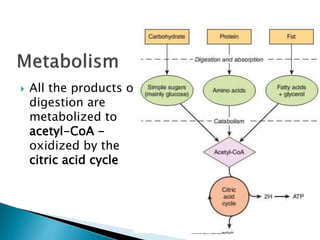
 All the products of
digestion are
metabolized to
acetyl-CoA -
oxidized by the
citric acid cycle
For more Visit us:
www.dentaltutor.in
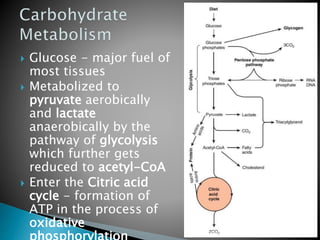
 Glucose - major fuel of
most tissues
 Metabolized to
pyruvate aerobically
and lactate
anaerobically by the
pathway of glycolysis
which further gets
reduced to acetyl-CoA
 Enter the Citric acid
cycle - formation of
ATP in the process of
oxidative For more Visit us:
www.dentaltutor.in
 Glucose may also undergo Glycogenesis -
synthesis of the storage polymer glycogen in
skeletal muscle and liver
 It may also enter Pentose Phosphate Pathway (PPP)
◦ source of reducing equivalents (NADPH) for fatty acid
synthesis
◦ ribose for nucleotide and nucleic acid synthesis
• Pyruvate and intermediates of the Citric Acid Cycle
- carbon skeletons for the synthesis of
nonessential amino acids
• Acetyl-CoA is the precursor of fatty acids and
cholesterol (steroid hormones synthesized in the
body)
• Gluconeogenesis - process of synthesizing
glucose from noncarbohydrate precursors such as,
lactate, amino acids, and glycerol
For more Visit us:
www.dentaltutor.in
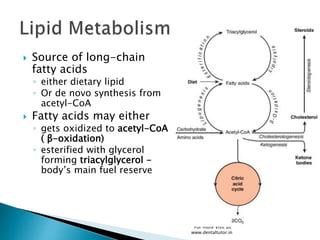
 Source of long-chain
fatty acids
◦ either dietary lipid
◦ Or de novo synthesis from
acetyl-CoA
 Fatty acids may either
◦ gets oxidized to acetyl-CoA
( β-oxidation)
◦ esterified with glycerol
forming triacylglycerol -
body’s main fuel reserve
For more Visit us:
www.dentaltutor.in
 Acetyl-CoA formed by β-oxidation of fatty
acids may undergo three fates
◦ oxidized via the citric acid cycle
◦ precursor for synthesis of cholesterol and other
steroids.
◦ In the liver, it is used to form the ketone bodies,
acetoacetate and 3-hydroxybutyrate - important
fuels in prolonged fasting and starvation.
For more Visit us:
www.dentaltutor.in
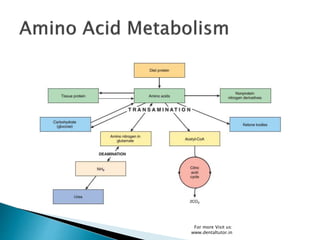
 AA forms metabolic intermediates by transamination
using the amino group from other amino acids
 Deamination – removal of amino nitrogen as urea via Urea
cycle,
 The carbon skeletons that remain after transamination
◦ oxidized via the citric acid cycle,
◦ used to synthesize glucose (gluconeogenesis)
◦ form ketone bodies or acetyl CoA, which may be oxidized
or used for synthesis of fatty acids
• AA may also be precursors of other compounds
 Purines and pyrimidines,
 Hormones such as epinephrine and thyroxine,
 Neurotransmitters.
For more Visit us:
www.dentaltutor.in
For more Visit us:
www.dentaltutor.in
For more Visit us:
www.dentaltutor.in
For more Visit us:
www.dentaltutor.in

Metabolism

  • 1.
    For more Visitus: www.dentaltutor.in For more Visit us: www.dentaltutor.in
  • 2.
     Metabolism isthe term used to describe ◦ The interconversion of chemical compounds in the body ◦ The pathways taken by individual molecules, ◦ Their interrelationships, and the mechanisms that regulate the flow of metabolites through the pathways • It falls mainly in 3 categories: catabolism, anabolism and amphibolic pathways For more Visit us: www.dentaltutor.in
  • 3.
     Anabolic pathways ◦Involved in the synthesis of larger and more complex compounds from smaller precursors ◦ Ex: Synthesis of protein from amino acids and the synthesis of reserves of tri-acylglycerol and glycogen. ◦ Anabolic pathways are endothermic.  Catabolic pathways ◦ Involved in the breakdown of larger molecules, commonly involving oxidative reactions; ◦ They are exothermic, producing reducing equivalents, and, mainly via the respiratory chain  Amphibolic pathways ◦ Occur at the “crossroads” of metabolism, acting as links between the anabolic and catabolic pathways ◦ Ex: Citric acid cycle For more Visit us: www.dentaltutor.in
  • 4.
     A 70-kgadult human being requires about 1920- 2900 kcal from metabolic fuels each day, depending on physical activity.  This energy requirement is met from ◦ Carbohydrates (40%-60%) ◦ Lipids (mainly triacylglycerol, 30%-40%) ◦ Protein (10%-15%), as well as alcohol. • There is a constant requirement for metabolic fuels throughout the day • Most people consume their daily intake of metabolic fuels in two or three meals, so there is a need to form reserves For more Visit us: www.dentaltutor.in
  • 5.
     Reserves of ◦Carbohydrate: glycogen in liver and muscle ◦ Lipid: triacylglycerol in adipose tissue ◦ Labile protein  If the intake of metabolic fuels is consistently greater than energy expenditure. ◦ Surplus is stored, largely as triacylglycerol in adipose tissue, ◦ Leading to the development of obesity  If the intake of metabolic fuels is consistently lower than energy expenditure ◦ Reserves of fat and carbohydrate, and amino acids are used for energy-yielding metabolism ◦ This leads to emaciation, wasting, and, eventually, death For more Visit us: www.dentaltutor.in
  • 6.
     All theproducts of digestion are metabolized to acetyl-CoA - oxidized by the citric acid cycle For more Visit us: www.dentaltutor.in
  • 7.
     Glucose -major fuel of most tissues  Metabolized to pyruvate aerobically and lactate anaerobically by the pathway of glycolysis which further gets reduced to acetyl-CoA  Enter the Citric acid cycle - formation of ATP in the process of oxidative For more Visit us: www.dentaltutor.in
  • 8.
     Glucose mayalso undergo Glycogenesis - synthesis of the storage polymer glycogen in skeletal muscle and liver  It may also enter Pentose Phosphate Pathway (PPP) ◦ source of reducing equivalents (NADPH) for fatty acid synthesis ◦ ribose for nucleotide and nucleic acid synthesis • Pyruvate and intermediates of the Citric Acid Cycle - carbon skeletons for the synthesis of nonessential amino acids • Acetyl-CoA is the precursor of fatty acids and cholesterol (steroid hormones synthesized in the body) • Gluconeogenesis - process of synthesizing glucose from noncarbohydrate precursors such as, lactate, amino acids, and glycerol For more Visit us: www.dentaltutor.in
  • 9.
     Source oflong-chain fatty acids ◦ either dietary lipid ◦ Or de novo synthesis from acetyl-CoA  Fatty acids may either ◦ gets oxidized to acetyl-CoA ( β-oxidation) ◦ esterified with glycerol forming triacylglycerol - body’s main fuel reserve For more Visit us: www.dentaltutor.in
  • 10.
     Acetyl-CoA formedby β-oxidation of fatty acids may undergo three fates ◦ oxidized via the citric acid cycle ◦ precursor for synthesis of cholesterol and other steroids. ◦ In the liver, it is used to form the ketone bodies, acetoacetate and 3-hydroxybutyrate - important fuels in prolonged fasting and starvation. For more Visit us: www.dentaltutor.in
  • 11.
     AA formsmetabolic intermediates by transamination using the amino group from other amino acids  Deamination – removal of amino nitrogen as urea via Urea cycle,  The carbon skeletons that remain after transamination ◦ oxidized via the citric acid cycle, ◦ used to synthesize glucose (gluconeogenesis) ◦ form ketone bodies or acetyl CoA, which may be oxidized or used for synthesis of fatty acids • AA may also be precursors of other compounds  Purines and pyrimidines,  Hormones such as epinephrine and thyroxine,  Neurotransmitters. For more Visit us: www.dentaltutor.in
  • 12.
    For more Visitus: www.dentaltutor.in
  • 13.
    For more Visitus: www.dentaltutor.in
  • 14.
    For more Visitus: www.dentaltutor.in