GLYCOGENESISGLYCOGENESIS
GLYCOGENOLYSISGLYCOGENOLYSIS
Prof. Dr. Khalid HussainProf. Dr. Khalid Hussain
hussain_761@yahoo.comhussain_761@yahoo.com
Learning objectives
Understand glycogenesis: Definition and pathway
Understand glycogenolysis: Definition and pathway
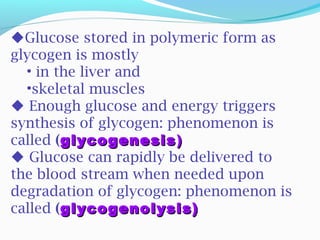
• A highly branched polymer
of glucose;
• Chains have glycosidic links
α 14
• At branching linkage α 16
GlycogenGlycogen
Glucose stored in polymeric form as
glycogen is mostly
• in the liver and
•skeletal muscles
 Enough glucose and energy triggers
synthesis of glycogen: phenomenon is
called (glycogenesisglycogenesis))
 Glucose can rapidly be delivered to
the blood stream when needed upon
degradation of glycogen: phenomenon is
called (glycogenolysis)glycogenolysis)
GlycogenesisGlycogenesis (Glycogen biosynthesis)
==============================
Glucose is transported into the
liver cells by a specific glucose
transporter, whereby it is
immediately phosphorylated. Hence,
==============================
Most of the glucose in a cell is in
the form of glucose-6-phosphate
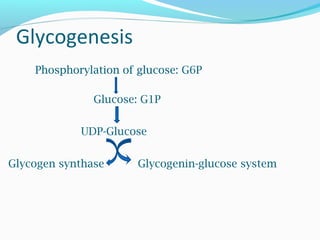
Glycogenesis
Phosphorylation of glucose: G6P
Glucose: G1P
Phosphorylation of glucose
UDP-Glucose
Glycogen synthase Glycogenin-glucose system
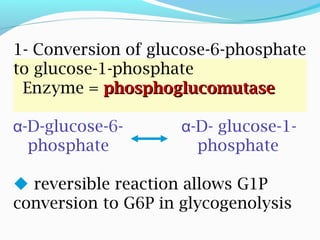
1- Conversion of glucose-6-phosphate
to glucose-1-phosphate
Enzyme = phosphoglucomutasephosphoglucomutase
-D-glucose-6- -D- glucose-1-α α
phosphate phosphate
 reversible reaction allows G1P
conversion to G6P in glycogenolysis
2- Synthesis of Uridine Diphosphoglucose
Enzyme: UDP-glucose pyrophosphorylase
Glucose-1-phosphate + UTP  + PPi
UDP-glucose
Then PPi
 2 Pi
UDP-glucose
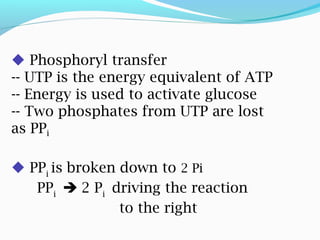
 Phosphoryl transfer
-- UTP is the energy equivalent of ATP
-- Energy is used to activate glucose
-- Two phosphates from UTP are lost
as PPi
 PPi
is broken down to 2 Pi
PPi
 2 Pi
driving the reaction
to the right
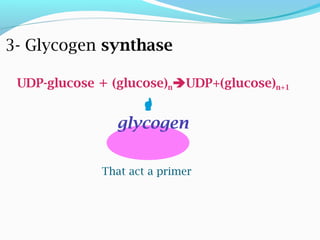
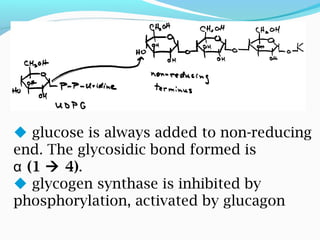
3- Glycogen synthase
 
UDP-glucose + (glucose)nUDP+(glucose)n+1

glycogen
That act a primer
 glucose is always added to non-reducing
end. The glycosidic bond formed is
(1α  4).
 glycogen synthase is inhibited by
phosphorylation, activated by glucagon
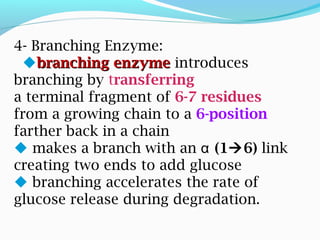
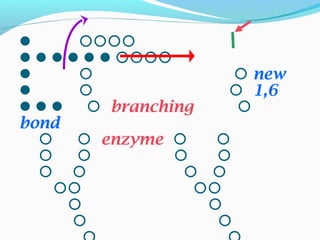
4- Branching Enzyme:
 branching enzymebranching enzyme introduces
branching by transferring
a terminal fragment of 6-7 residues
from a growing chain to a 6-position
farther back in a chain
 makes a branch with an (1α 6) link
creating two ends to add glucose
 branching accelerates the rate of
glucose release during degradation.
 

   new
   1,6
  branching 
bond
  enzyme  
   
   
 
 
 
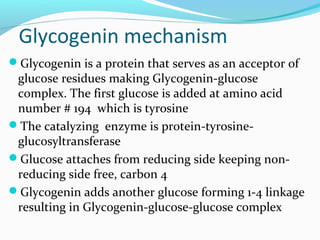
Glycogenin mechanism
Glycogenin is a protein that serves as an acceptor of
glucose residues making Glycogenin-glucose
complex. The first glucose is added at amino acid
number # 194 which is tyrosine
The catalyzing enzyme is protein-tyrosine-
glucosyltransferase
Glucose attaches from reducing side keeping non-
reducing side free, carbon 4
Glycogenin adds another glucose forming 1-4 linkage
resulting in Glycogenin-glucose-glucose complex
By the same mechanism 6 more glusoe molecules are
added, one by one, producing Glycogenin-(glucose)8
complex
Action of Glycogenin ends and further elongation
takes place by glycogen synthase
When chain becomes more than 11 glucose residues
branching starts with the help of enzyme amylo(1-6)
transglucosylase (branching enzyme)
-- GLYCOGENOLYSISGLYCOGENOLYSIS--
DEGRADATION OF GLYCOGEN
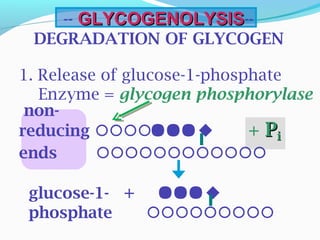
1. Release of glucose-1-phosphate
Enzyme = glycogen phosphorylase
non-
reducing  + PPii
ends 
glucose-1- + 
phosphate 
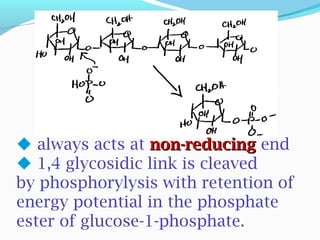
 always acts at non-reducingnon-reducing end
 1,4 glycosidic link is cleaved
by phosphorylysis with retention of
energy potential in the phosphate
ester of glucose-1-phosphate.
 stopsstops at fourth glucose from a
1,6 branch point
 contrast to enzymes acting on
starch and glycogen in the gut, which
yield sugars, not sugar phosphates,
as products
 activated by phosphorylation,
regulated by glucagon and
epinephrine
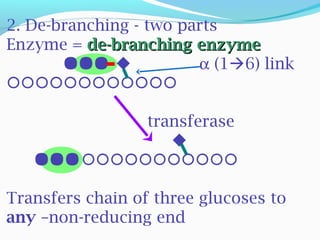
2. De-branching - two parts
Enzyme = de-branching enzymede-branching enzyme
  α (16) link

transferase


Transfers chain of three glucoses to
any –non-reducing end
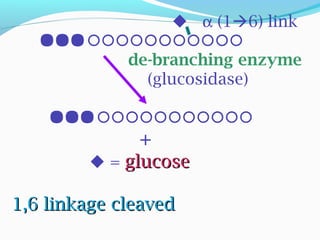
 α (16) link

de-branching enzyme
(glucosidase)

+
 = glucoseglucose
1,6 linkage cleaved1,6 linkage cleaved

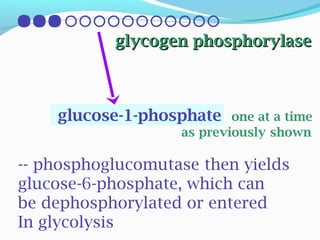
glycogen phosphorylaseglycogen phosphorylase
glucose-1-phosphate one at a time
as previously shown
-- phosphoglucomutase then yields
glucose-6-phosphate, which can
be dephosphorylated or entered
In glycolysis
Metabolic Regulation of Glycogen LevelsMetabolic Regulation of Glycogen Levels
  
•Glycogen reserves are the most
immediately available large source of
metabolic energy
•Its storage and utilization is under
dietary and hormonal control
Primary responsible hormones are;
1- epinephrine (adrenaline)
2- glucagon
3- insulin
 Primary enzyme targets
in glycogen metabolism are;
1- glycogen phosphorylase
2- glycogen synthase

Glycogenesis ---Sir Khalid (Biochem)

  • 1.
    GLYCOGENESISGLYCOGENESIS GLYCOGENOLYSISGLYCOGENOLYSIS Prof. Dr. KhalidHussainProf. Dr. Khalid Hussain hussain_761@yahoo.comhussain_761@yahoo.com
  • 2.
    Learning objectives Understand glycogenesis:Definition and pathway Understand glycogenolysis: Definition and pathway
  • 3.
    • A highlybranched polymer of glucose; • Chains have glycosidic links α 14 • At branching linkage α 16 GlycogenGlycogen
  • 4.
    Glucose stored inpolymeric form as glycogen is mostly • in the liver and •skeletal muscles  Enough glucose and energy triggers synthesis of glycogen: phenomenon is called (glycogenesisglycogenesis))  Glucose can rapidly be delivered to the blood stream when needed upon degradation of glycogen: phenomenon is called (glycogenolysis)glycogenolysis)
  • 5.
    GlycogenesisGlycogenesis (Glycogen biosynthesis) ============================== Glucoseis transported into the liver cells by a specific glucose transporter, whereby it is immediately phosphorylated. Hence, ============================== Most of the glucose in a cell is in the form of glucose-6-phosphate
  • 6.
    Glycogenesis Phosphorylation of glucose:G6P Glucose: G1P Phosphorylation of glucose UDP-Glucose Glycogen synthase Glycogenin-glucose system
  • 7.
    1- Conversion ofglucose-6-phosphate to glucose-1-phosphate Enzyme = phosphoglucomutasephosphoglucomutase -D-glucose-6- -D- glucose-1-α α phosphate phosphate  reversible reaction allows G1P conversion to G6P in glycogenolysis
  • 8.
    2- Synthesis ofUridine Diphosphoglucose Enzyme: UDP-glucose pyrophosphorylase Glucose-1-phosphate + UTP  + PPi UDP-glucose Then PPi  2 Pi UDP-glucose
  • 9.
     Phosphoryl transfer --UTP is the energy equivalent of ATP -- Energy is used to activate glucose -- Two phosphates from UTP are lost as PPi  PPi is broken down to 2 Pi PPi  2 Pi driving the reaction to the right
  • 10.
    3- Glycogen synthase   UDP-glucose+ (glucose)nUDP+(glucose)n+1  glycogen That act a primer
  • 11.
     glucose isalways added to non-reducing end. The glycosidic bond formed is (1α  4).  glycogen synthase is inhibited by phosphorylation, activated by glucagon
  • 12.
    4- Branching Enzyme:  branchingenzymebranching enzyme introduces branching by transferring a terminal fragment of 6-7 residues from a growing chain to a 6-position farther back in a chain  makes a branch with an (1α 6) link creating two ends to add glucose  branching accelerates the rate of glucose release during degradation.
  • 13.
         new    1,6   branching  bond   enzyme                
  • 14.
    Glycogenin mechanism Glycogenin isa protein that serves as an acceptor of glucose residues making Glycogenin-glucose complex. The first glucose is added at amino acid number # 194 which is tyrosine The catalyzing enzyme is protein-tyrosine- glucosyltransferase Glucose attaches from reducing side keeping non- reducing side free, carbon 4 Glycogenin adds another glucose forming 1-4 linkage resulting in Glycogenin-glucose-glucose complex
  • 15.
    By the samemechanism 6 more glusoe molecules are added, one by one, producing Glycogenin-(glucose)8 complex Action of Glycogenin ends and further elongation takes place by glycogen synthase When chain becomes more than 11 glucose residues branching starts with the help of enzyme amylo(1-6) transglucosylase (branching enzyme)
  • 16.
    -- GLYCOGENOLYSISGLYCOGENOLYSIS-- DEGRADATION OFGLYCOGEN 1. Release of glucose-1-phosphate Enzyme = glycogen phosphorylase non- reducing  + PPii ends  glucose-1- +  phosphate 
  • 17.
     always actsat non-reducingnon-reducing end  1,4 glycosidic link is cleaved by phosphorylysis with retention of energy potential in the phosphate ester of glucose-1-phosphate.
  • 18.
     stopsstops atfourth glucose from a 1,6 branch point  contrast to enzymes acting on starch and glycogen in the gut, which yield sugars, not sugar phosphates, as products  activated by phosphorylation, regulated by glucagon and epinephrine
  • 19.
    2. De-branching -two parts Enzyme = de-branching enzymede-branching enzyme   α (16) link  transferase   Transfers chain of three glucoses to any –non-reducing end
  • 20.
     α (16)link  de-branching enzyme (glucosidase)  +  = glucoseglucose 1,6 linkage cleaved1,6 linkage cleaved
  • 21.
     glycogen phosphorylaseglycogen phosphorylase glucose-1-phosphateone at a time as previously shown -- phosphoglucomutase then yields glucose-6-phosphate, which can be dephosphorylated or entered In glycolysis
  • 22.
    Metabolic Regulation ofGlycogen LevelsMetabolic Regulation of Glycogen Levels    •Glycogen reserves are the most immediately available large source of metabolic energy •Its storage and utilization is under dietary and hormonal control
  • 23.
    Primary responsible hormonesare; 1- epinephrine (adrenaline) 2- glucagon 3- insulin  Primary enzyme targets in glycogen metabolism are; 1- glycogen phosphorylase 2- glycogen synthase