Vector data
Dr. Hans van der Kwast
OpenCourseWare
ocw.unesco-ihe.org
Learning objectives
After this lecture you will be able to:
• understand vector data models as used in GIS
2
GIS Basics
2 common data models
to represent reality in a
GIS:
• Vector
• Raster
Vector data
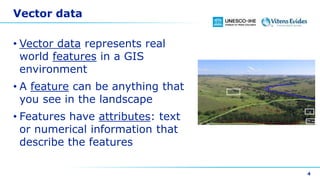
• Vector data represents real
world features in a GIS
environment
• A feature can be anything that
you see in the landscape
• Features have attributes: text
or numerical information that
describe the features
4
Vector types
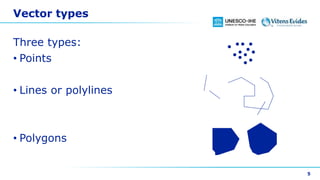
Three types:
• Points
• Lines or polylines
• Polygons
5
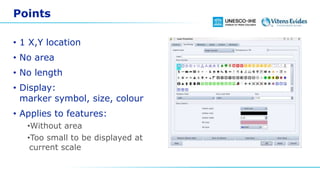
Points
• 1 X,Y location
• No area
• No length
• Display:
marker symbol, size, colour
• Applies to features:
•Without area
•Too small to be displayed at
current scale
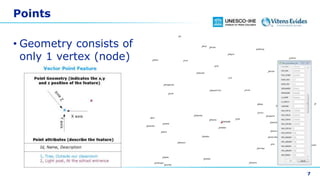
Points
• Geometry consists of
only 1 vertex (node)
7
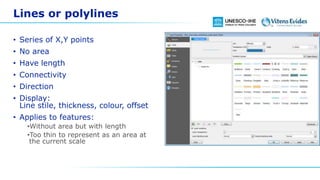
Lines or polylines
• Series of X,Y points
• No area
• Have length
• Connectivity
• Direction
• Display:
Line stile, thickness, colour, offset
• Applies to features:
•Without area but with length
•Too thin to represent as an area at
the current scale
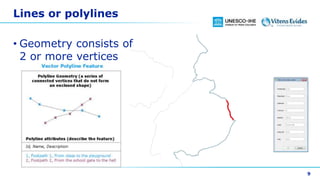
Lines or polylines
• Geometry consists of
2 or more vertices
9
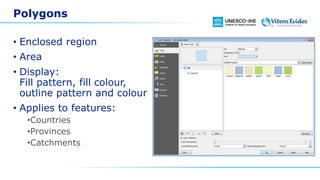
Polygons
• Enclosed region
• Area
• Display:
Fill pattern, fill colour,
outline pattern and colour
• Applies to features:
•Countries
•Provinces
•Catchments
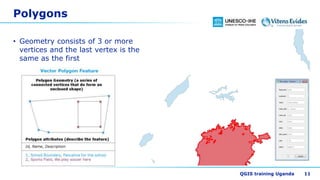
Polygons
• Geometry consists of 3 or more
vertices and the last vertex is the
same as the first
QGIS training Uganda 11
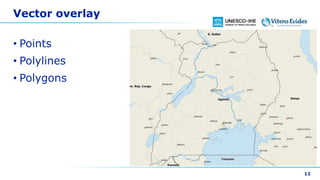
Vector overlay
12
• Points
• Polylines
• Polygons
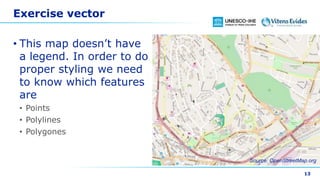
Exercise vector
13
• This map doesn’t have
a legend. In order to do
proper styling we need
to know which features
are
• Points
• Polylines
• Polygones
Source: OpenStreetMap.org
What can we do with vector data?
• Spatial queries, e.g.:
• Which houses are within the 100 year flood level of a river?
• Where is the best place to put a hospital so that it is easily
accessible to as many people as possible?
• Which learners live in a particular suburb?
14
Common problems with vector data
• Accuracy of vectors depend on scale of digitizing
15
Digitized from 1/1000000 map Digitized from 1/50000 map
Common problems with vector data
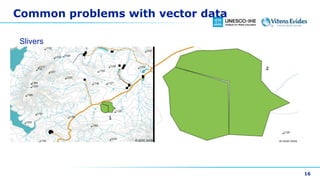
16
Slivers
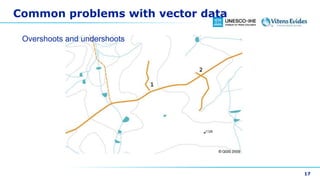
Common problems with vector data
17
Overshoots and undershoots
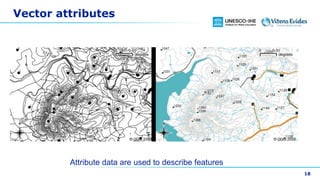
Vector attributes
18
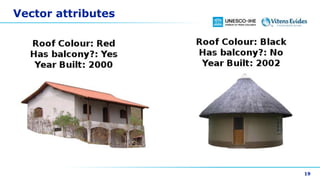
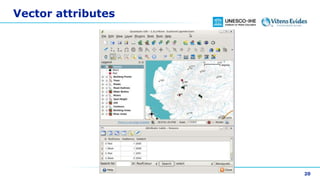
Attribute data are used to describe features
Vector attributes
19
Vector attributes
20
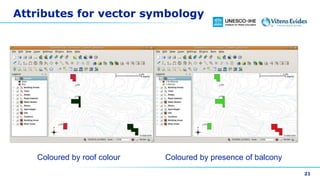
Attributes for vector symbology
21
Coloured by roof colour Coloured by presence of balcony
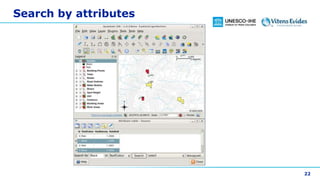
Search by attributes
22
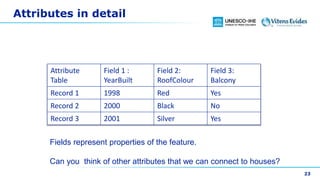
Attributes in detail
Attribute
Table
Field 1 :
YearBuilt
Field 2:
RoofColour
Field 3:
Balcony
Record 1 1998 Red Yes
Record 2 2000 Black No
Record 3 2001 Silver Yes
23
Fields represent properties of the feature.
Can you think of other attributes that we can connect to houses?
24
Acknowledgements
• Examples were taken from:
A Gentle Introduction to GIS
http://docs.qgis.org/2.6/en/docs/gentle_gis_intro
duction/
25

GIS fundamentals - vector