Spatial
Databases
Presented By:
Nazir Ahmad
facebook.com/king.seraphi
c
Outline
 Introduction
 Spatial data mining
 Spatial Data warehouse and OLAP
 Mining Spatial Association Patterns
 Spatial Clustering
 Spatial Classification
 Spatial Trend Analysis
Spatial Databases: Introduction
 A Spatial Database large amount of space-related
data. data, such as maps, preprocessed remote
sensing or medical imaging data, and VLSI chip layout
data.
 It offers spatial data types (SDTs) in its data model and
query language; e.g. POINT, LINE, REGION.
What is represented
 Objects in space e.g. forests , rivers
 Space
Spatial Data Mining
 Spatial data mining refers to the extraction of
knowledge, spatial relationships, or other interesting
patterns not explicitly stored in spatial databases. Such
mining demands an integration of data mining with
spatial database technologies.
 It can be used for understanding spatial data, discovering
spatial relationships and relationships between spatial and
non-spatial data, constructing spatial knowledge
bases, reorganizing spatial databases, and optimizing
spatial queries.
Spatial Data Warehouse
Schema and spatial OLAP
 A spatial data warehouse is a subject-
oriented, integrated, time-variant, and nonvolatile
collection of both spatial and non-spatial data in
support of spatial data mining and spatial-data
related decision-making processes.
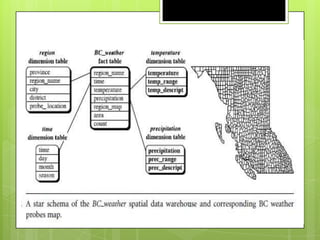
 Star schema is a good choice for modeling spatial
data warehouse. However, in a spatial
warehouse, both dimensions and measures may
contain spatial components.
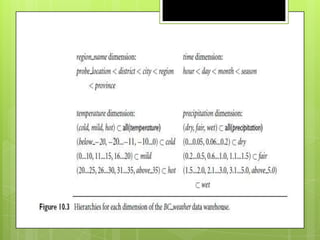
There are three types of dimensions in a spatial data cube:
o A non-spatial dimension contains only non-spatial data.
E.g. Temperature , Precipitation.
 A spatial-to-nonspatial dimension is a dimension whose
primitive-level data are spatial but whose
generalization, starting at a certain high level, becomes
non-spatial.
 A spatial-to-spatial dimension is a dimension whose
primitive level and all of its high level generalized data are
spatial.
two types of measures in a spatial data cube:
 A numerical measure contains only numerical data. For
example, one measure in a spatial data warehouse could
be the monthly revenue of a region, so that a roll-up may
compute the total revenue by year, by county, and so on.
 A spatial measure contains a collection of pointers to
spatial objects.
Mining Spatial Association
Patterns
 A spatial association rule is of the form A)B [s%;c%], where
A and B are sets of spatial or non-spatial predicates, s% is
the support of the rule, and c% is the confidence of the
rule. For example, the following is a spatial association
rule:
is_a(X; “school”)^close_to(X; “sports center”)=> close_to(X;
“park”) [0.5%, 80%].
This rule states that 80% of schools that are close to sports centers
are also close to parks, and 0.5% of the data belongs to such a
case.
Progressive Refinement
 It is a mining Optimization method which can be adopted
in spatial analysis.
 The method first mines large data sets roughly using a fast
algorithm and then improves the quality of mining in a
pruned data set using a more expensive algorithm.
 To ensure that the pruned data set covers the
complete set of answers when applying the high-
quality data mining algorithms at a later stage, an
important requirement for the rough mining
algorithm applied in the early stage is the superset
coverage property: that is, it preserves all of the
potential answers. In other words, it should allow a
false-positive test.
Clustering
 Spatial data clustering identifies clusters, or densely
populated regions, according to some distance
measurement in a large, multidimensional data set.
Spatial Classification
 Spatial classification analyzes spatial objects to derive
classification schemes in relevance to certain spatial
properties, such as the neighborhood of a
district, highway, or river.
 Spatial
Spatial Trend Analysis
 Spatial trend analysis deals with another issue: the detection
of changes and trends along a spatial dimension.
Typically, trend analysis detects changes with time, such as
the changes of temporal patterns in time-series data.
 Spatial trend analysis replaces time with space and studies
the trend of nonspatial or spatial data changing with
space. E.g. you may observe the trend of changes of the
climate or vegetation with the increasing distance from an
ocean.
Thank You
?

Spatial databases

  • 1.
  • 2.
    Outline  Introduction  Spatialdata mining  Spatial Data warehouse and OLAP  Mining Spatial Association Patterns  Spatial Clustering  Spatial Classification  Spatial Trend Analysis
  • 3.
    Spatial Databases: Introduction A Spatial Database large amount of space-related data. data, such as maps, preprocessed remote sensing or medical imaging data, and VLSI chip layout data.  It offers spatial data types (SDTs) in its data model and query language; e.g. POINT, LINE, REGION.
  • 4.
    What is represented Objects in space e.g. forests , rivers  Space
  • 5.
    Spatial Data Mining Spatial data mining refers to the extraction of knowledge, spatial relationships, or other interesting patterns not explicitly stored in spatial databases. Such mining demands an integration of data mining with spatial database technologies.  It can be used for understanding spatial data, discovering spatial relationships and relationships between spatial and non-spatial data, constructing spatial knowledge bases, reorganizing spatial databases, and optimizing spatial queries.
  • 6.
    Spatial Data Warehouse Schemaand spatial OLAP  A spatial data warehouse is a subject- oriented, integrated, time-variant, and nonvolatile collection of both spatial and non-spatial data in support of spatial data mining and spatial-data related decision-making processes.
  • 7.
     Star schemais a good choice for modeling spatial data warehouse. However, in a spatial warehouse, both dimensions and measures may contain spatial components.
  • 8.
    There are threetypes of dimensions in a spatial data cube: o A non-spatial dimension contains only non-spatial data. E.g. Temperature , Precipitation.  A spatial-to-nonspatial dimension is a dimension whose primitive-level data are spatial but whose generalization, starting at a certain high level, becomes non-spatial.  A spatial-to-spatial dimension is a dimension whose primitive level and all of its high level generalized data are spatial.
  • 9.
    two types ofmeasures in a spatial data cube:  A numerical measure contains only numerical data. For example, one measure in a spatial data warehouse could be the monthly revenue of a region, so that a roll-up may compute the total revenue by year, by county, and so on.  A spatial measure contains a collection of pointers to spatial objects.
  • 12.
    Mining Spatial Association Patterns A spatial association rule is of the form A)B [s%;c%], where A and B are sets of spatial or non-spatial predicates, s% is the support of the rule, and c% is the confidence of the rule. For example, the following is a spatial association rule: is_a(X; “school”)^close_to(X; “sports center”)=> close_to(X; “park”) [0.5%, 80%]. This rule states that 80% of schools that are close to sports centers are also close to parks, and 0.5% of the data belongs to such a case.
  • 13.
    Progressive Refinement  Itis a mining Optimization method which can be adopted in spatial analysis.  The method first mines large data sets roughly using a fast algorithm and then improves the quality of mining in a pruned data set using a more expensive algorithm.
  • 14.
     To ensurethat the pruned data set covers the complete set of answers when applying the high- quality data mining algorithms at a later stage, an important requirement for the rough mining algorithm applied in the early stage is the superset coverage property: that is, it preserves all of the potential answers. In other words, it should allow a false-positive test.
  • 15.
    Clustering  Spatial dataclustering identifies clusters, or densely populated regions, according to some distance measurement in a large, multidimensional data set.
  • 16.
    Spatial Classification  Spatialclassification analyzes spatial objects to derive classification schemes in relevance to certain spatial properties, such as the neighborhood of a district, highway, or river.  Spatial
  • 17.
    Spatial Trend Analysis Spatial trend analysis deals with another issue: the detection of changes and trends along a spatial dimension. Typically, trend analysis detects changes with time, such as the changes of temporal patterns in time-series data.  Spatial trend analysis replaces time with space and studies the trend of nonspatial or spatial data changing with space. E.g. you may observe the trend of changes of the climate or vegetation with the increasing distance from an ocean.
  • 18.