Vector (discrete)
and
Raster (continuous) Models
GIS works with three fundamentally
different types of geographic data models:
Vector (discrete), Raster (continuous) and
TIN
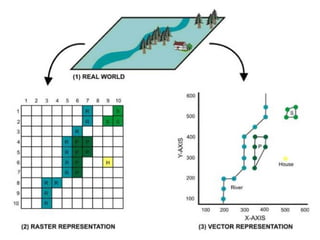
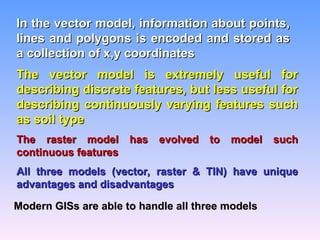
In the vector model, information about points,
lines and polygons is encoded and stored as
a collection of x,y coordinates
The vector model is extremely useful for
describing discrete features, but less useful for
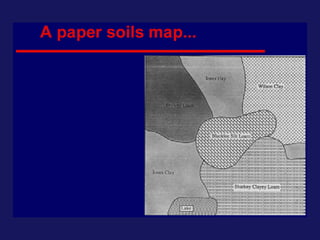
describing continuously varying features such
as soil type
as soil type
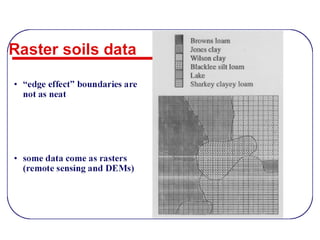
The raster model has evolved to model such
continuous features
continuous features
All three models (vector, raster & TIN) have unique
advantages and disadvantages
Modern GISs are able to handle all three models
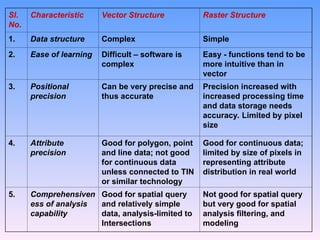
Sl.
No.
Characteristic Vector Structure Raster Structure
1. Data structure Complex Simple
2. Ease of learning Difficult – software is
complex
Easy - functions tend to be
more intuitive than in
vector
3. Positional
precision
Can be very precise and
thus accurate
Precision increased with
increased processing time
and data storage needs­
accuracy. Limited by pixel
size
4. Attribute
precision
Good for polygon, point
and line data; not good
for continuous data
unless connected to TIN
or similar technology
Good for continuous data;
limited by size of pixels in
representing attribute
distribution in real world
5. Comprehensiven
ess of analysis
capability
Good for spatial query
and relatively simple
data, analysis-limited to
Intersections
Not good for spatial query
but very good for spatial
analysis filtering, and
modeling
Sl.
No.
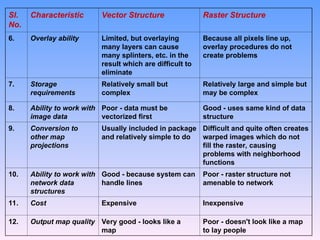
Characteristic Vector Structure Raster Structure
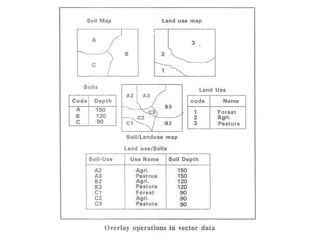
6. Overlay ability Limited, but overlaying
many layers can cause
many splinters, etc. in the
result which are difficult to
eliminate
Because all pixels line up,
overlay procedures do not
create problems
7. Storage
requirements
Relatively small but
complex
Relatively large and simple but
may be complex
8. Ability to work with
image data
Poor - data must be
vectorized first
Good - uses same kind of data
structure
9. Conversion to
other map
projections
Usually included in package
and relatively simple to do
Difficult and quite often creates
warped images which do not
fill the raster, causing
problems with neighborhood
functions
10. Ability to work with
network data
structures
Good - because system can
handle lines
Poor - raster structure not
amenable to network
11. Cost Expensive Inexpensive
12. Output map quality Very good - looks like a
map
Poor - doesn't look like a map
to lay people
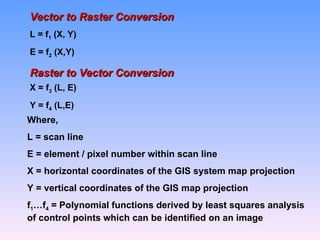
Vector to Raster Conversion
L = f1 (X, Y)
E = f2 (X,Y)
Raster to Vector Conversion
X = f3 (L, E)
Y = f4 (L,E)
Where,
L = scan line
E = element / pixel number within scan line
X = horizontal coordinates of the GIS system map projection
Y = vertical coordinates of the GIS map projection
f1…f4 = Polynomial functions derived by least squares analysis
of control points which can be identified on an image
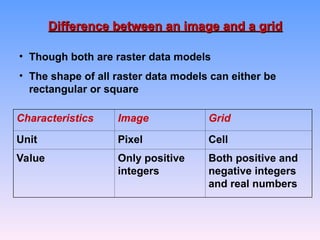
Difference between an image and a grid
• Though both are raster data models
• The shape of all raster data models can either be
rectangular or square
Characteristics Image Grid
Unit Pixel Cell
Value Only positive
integers
Both positive and
negative integers
and real numbers
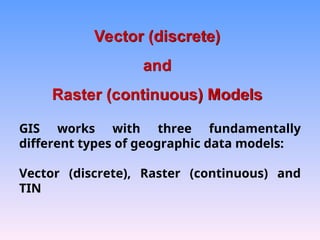
The measure of how closely pixels
can be resolved in an image is called
spatial resolution, and it depends on
properties of the system creating the
image.
image.
For practical purposes the clarity of
the image is decided by its spatial
resolution.
resolution.
Spatial resolution
Spatial resolution
Lecture-2 Vector and Raster data models.ppt

Lecture-2 Vector and Raster data models.ppt

  • 1.
    Vector (discrete) and Raster (continuous)Models GIS works with three fundamentally different types of geographic data models: Vector (discrete), Raster (continuous) and TIN
  • 3.
    In the vectormodel, information about points, In the vector model, information about points, lines and polygons is encoded and stored as lines and polygons is encoded and stored as a collection of x,y coordinates a collection of x,y coordinates The vector model is extremely useful for The vector model is extremely useful for describing discrete features, but less useful for describing discrete features, but less useful for describing continuously varying features such describing continuously varying features such as soil type as soil type The raster model has evolved to model such The raster model has evolved to model such continuous features continuous features All three models (vector, raster & TIN) have unique All three models (vector, raster & TIN) have unique advantages and disadvantages advantages and disadvantages Modern GISs are able to handle all three models Modern GISs are able to handle all three models
  • 8.
    Sl. No. Characteristic Vector StructureRaster Structure 1. Data structure Complex Simple 2. Ease of learning Difficult – software is complex Easy - functions tend to be more intuitive than in vector 3. Positional precision Can be very precise and thus accurate Precision increased with increased processing time and data storage needs­ accuracy. Limited by pixel size 4. Attribute precision Good for polygon, point and line data; not good for continuous data unless connected to TIN or similar technology Good for continuous data; limited by size of pixels in representing attribute distribution in real world 5. Comprehensiven ess of analysis capability Good for spatial query and relatively simple data, analysis-limited to Intersections Not good for spatial query but very good for spatial analysis filtering, and modeling
  • 9.
    Sl. No. Characteristic Vector StructureRaster Structure 6. Overlay ability Limited, but overlaying many layers can cause many splinters, etc. in the result which are difficult to eliminate Because all pixels line up, overlay procedures do not create problems 7. Storage requirements Relatively small but complex Relatively large and simple but may be complex 8. Ability to work with image data Poor - data must be vectorized first Good - uses same kind of data structure 9. Conversion to other map projections Usually included in package and relatively simple to do Difficult and quite often creates warped images which do not fill the raster, causing problems with neighborhood functions 10. Ability to work with network data structures Good - because system can handle lines Poor - raster structure not amenable to network 11. Cost Expensive Inexpensive 12. Output map quality Very good - looks like a map Poor - doesn't look like a map to lay people
  • 11.
    Vector to RasterConversion Vector to Raster Conversion L = f1 (X, Y) E = f2 (X,Y) Raster to Vector Conversion Raster to Vector Conversion X = f3 (L, E) Y = f4 (L,E) Where, L = scan line E = element / pixel number within scan line X = horizontal coordinates of the GIS system map projection Y = vertical coordinates of the GIS map projection f1…f4 = Polynomial functions derived by least squares analysis of control points which can be identified on an image
  • 12.
    Difference between animage and a grid Difference between an image and a grid • Though both are raster data models • The shape of all raster data models can either be rectangular or square Characteristics Image Grid Unit Pixel Cell Value Only positive integers Both positive and negative integers and real numbers
  • 13.
    The measure ofhow closely pixels The measure of how closely pixels can be resolved in an image is called can be resolved in an image is called spatial resolution, and it depends on spatial resolution, and it depends on properties of the system creating the properties of the system creating the image. image. For practical purposes the clarity of For practical purposes the clarity of the image is decided by its spatial the image is decided by its spatial resolution. resolution. Spatial resolution Spatial resolution