RASTER AND VECTOR
DATA
ADVANTAGES AND
DISADVANTAGES
CONTENTS
1. INTRODUCTION
a. RASTER
b. VECTOR
2. DEFINITIONS
3. CHARACTERISTICS
4. ADVANTAGES OF RASTER AND VECTOR
5. DISADVANTAGES OF RASTER AND VECTOR DATA
6. COMPARISION BETWEEN RASTER AND VECTOR
7. EXAMPLES
8. CONCLUSION
RASTER AND VECTOR DATA
• Geographic features stored in a GIS can be
considered as one of three types:
• points: no area at this scale (e.g. building,
tower)
• lines (arcs): no width at this scale (e.g. river,
road, administrative boundary)
• areas (polygons): line surrounding enclosed
area (e.g. forest stand, census district)
• Spatial characteristics of features can be stored
in a GIS in one of two ways:
as raster data or as vector data.
 Thus geographically referenced data is stored in: -
· Raster (grid or cellular-based) data structure.
· x, y coordinate reference-based (vector) data
structure.
 Raster data structure
 Grid or cellular-based
 Grid representation of a measured image property in
which each grid cell (pixel) comprises a digital
number. The larger the area represented the lower the
resolution of the data. The smaller the area covered the
greater the resolution and the more accurately features
are represented.
Vector data structure
Arc-node model
Arcs represent the shape of lines and
are split at their intersections with other
arcs, where nodes occur; nodes
represent the beginning and ending
vertex of each arc. Vector format-
representation of features on the earth as
lines, points, or polygons as a series or
XY Cartesian coordinates
DEFINITIONS:
• RASTER DATA MODEL
A spatial data model that uses a
grid and cells to represent the spatial
variation of a feature.
• VECTOR DATA MODEL
A data model that uses points and
their x-, y- coordinates to construct
spatial features.
Characteristics Of Raster Data Model
• Simple 'grid' structure of rows and
columns.
• Based on cells or picture elements
(pixels).
• Linear feature (e.g. a road) is a
contiguous set of cells.
• Resolution based on size of grid (cell)
the smaller the cell, the higher the
resolution.
• Features are considered homogenous
within a pixel.
• Storage increases with the square of the
resolution.
Characteristics Of Vector Data Model
• Based on objects (points, lines, areas).
• Constructed using arcs, nodes and
vertices.
• Resolution can be independent of detail.
• Every point has a unique location.
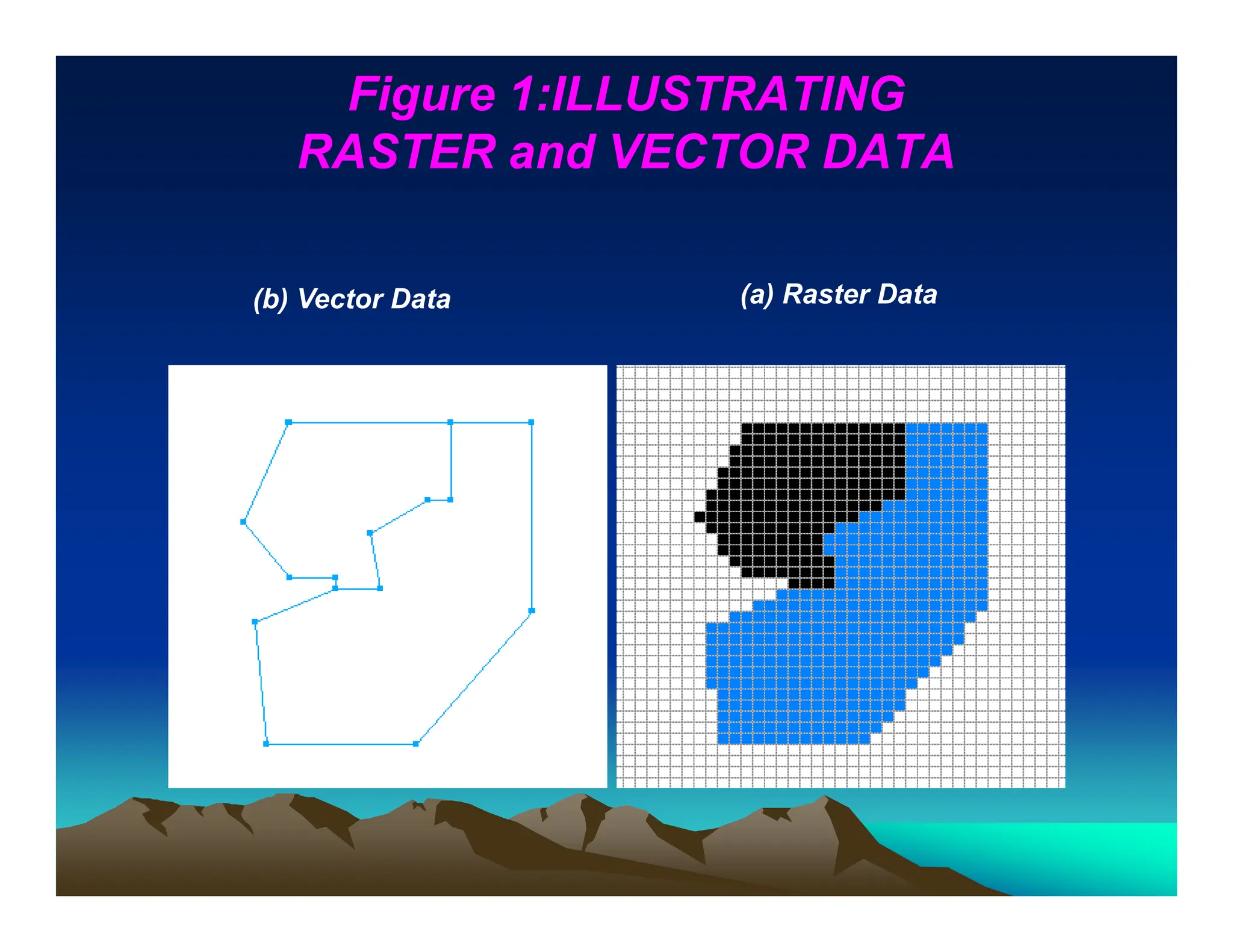
Figure 1:ILLUSTRATING
RASTER and VECTOR DATA
(a) Raster Data
(b) Vector Data
Advantages of Raster Data
Structures
• Simple data structures.
• Overlay and combination of maps and remote sensed
images easy.
• Some spatial analysis methods simple to perform.
• Simulation easy, because cells have the same size and
shape.
• Technology is cheap.
• Compatible with remote sensing.
• High spatial variability available which is efficiently
represented (e.g. relief).
• Only raster can store image data (e.g. photos).
Advantages of Vector Data
Structures
• Good representation of phenomenonology.
• Topology can be completely described and
easy to maintain.
• Accurate graphics, retrieval, updating and
generalization of graphics and attributes
possible.
• Requires less disk storage.
• Graphical maps more closely represent hand-
drawn.
• Compact data structure for homogenous areas.
• Better suited for map output.
Disadvantages of Raster Data Structures
• Crude raster maps are considerably less beautiful than
line maps.
• Projection transformations are time consuming
• Requires more storage space.
• Boundaries has more blocky appearance.
• More difficult to represent topology.
• Data structure is not compact (though it can be
modified).
• Topological relationships are harder to represent.
• Map output can appear 'blocky‘, less accurate maps.
• The use of large cells to reduce data volumes means
that recognizable structures can be lost and there can be
a serious loss of information (drop out).
Disadvantages of Vector Data Structures
• More complex Data Structures.
• Combination of several vector polygon maps or polygon and raster maps
through overlay creates difficulties.
• Simulation is difficult because each unit has a different topological form.
• Display and plotting can be expensive, particularly for high quality, color and
cross-hatching.
• Spatial analysis and filtering within polygons are impossible.
• Not as compatible with remote sensing as raster data.
• Overlay analysis more time-consuming than raster data.
• High spatial variability is less efficiently stored.
• Cannot store (continuously varying) image data.
COMPARISON OF RASTER AND VECTOR
DATA MODELS
 The primary focus of the vector data model is the
geographic feature; the primary focus of the raster
data model is location.
 The vector data model is more suited to the
question of “What do I know about this geographic
feature? The raster data model answers the
question, “What geographic phenomenon occurs at
this location.”
 The vector model uses x, y coordinates to represent
geographic features, raster store rows and columns
of cell values.
 The vector data model defines boundaries. There
are no boundaries defined in the raster data model.
 The vector data model represents location as x, y
coordinates in a Cartesian coordinate systems. The raster
model represents location as cells, also in a Cartesian
coordinate system.
 The vector model represents feature shape accurately;
the raster model represents rectangular areas and thus is
more generalized and less accurate.
Continue…
 The vector model represents features with well-defined
boundaries; the raster model represents a more generalized
view. The raster model can also represent gradual transition
between features and surfaces, such as soil classification and
elevation
 The vector model is used for high-quality cartography and
where accuracy and precision are important, such as for
cadastral (property) applications. The raster data model is useful
for image/picture storage and is well suited to many spatial
modeling operations (as optimum corridor route selection,
modeling surface storm runoff, and forest fire spread).
Continue…
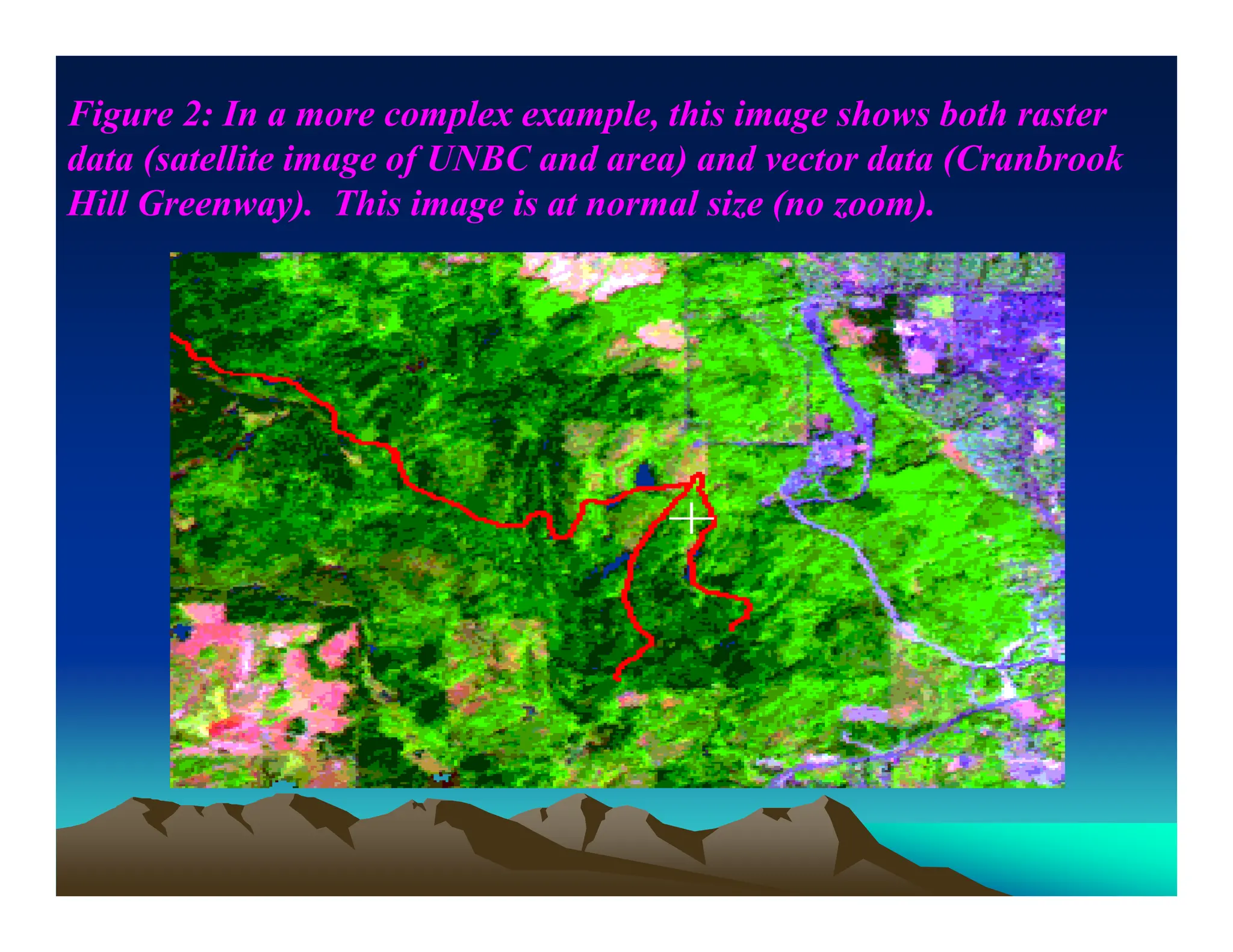
Figure 2: In a more complex example, this image shows both raster
data (satellite image of UNBC and area) and vector data (Cranbrook
Hill Greenway). This image is at normal size (no zoom).
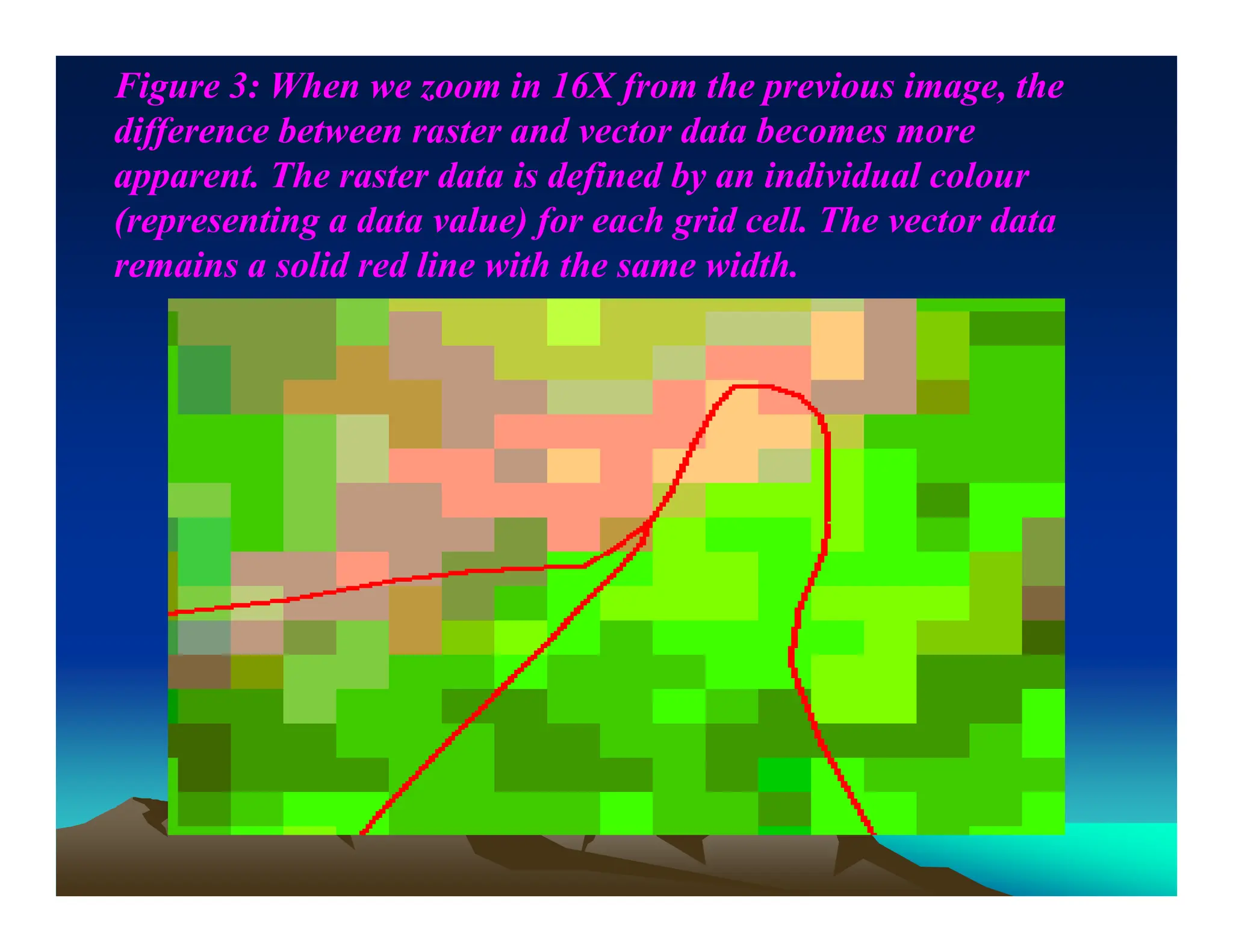
Figure 3: When we zoom in 16X from the previous image, the
difference between raster and vector data becomes more
apparent. The raster data is defined by an individual colour
(representing a data value) for each grid cell. The vector data
remains a solid red line with the same width.
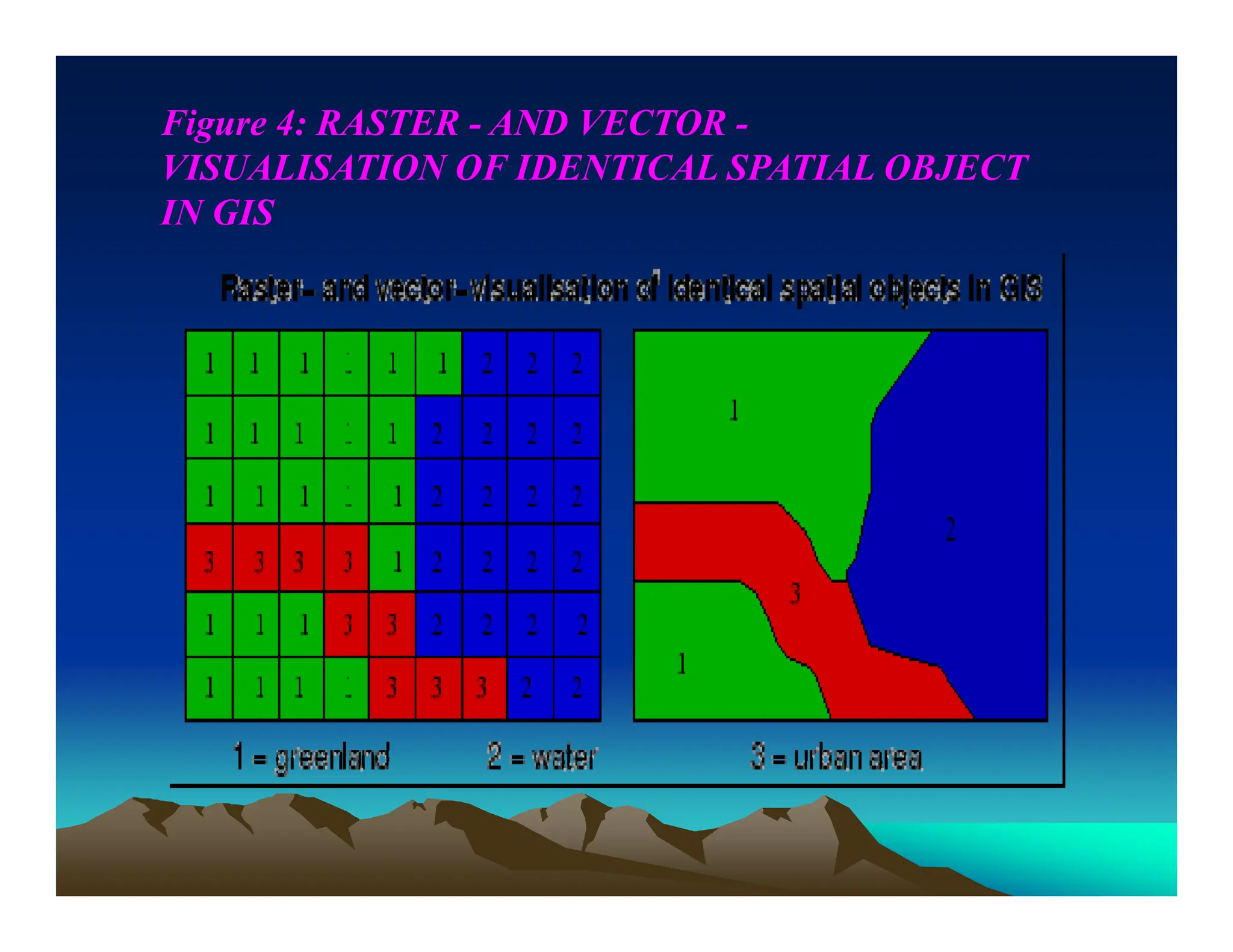
Figure 4: RASTER - AND VECTOR -
VISUALISATION OF IDENTICAL SPATIAL OBJECT
IN GIS
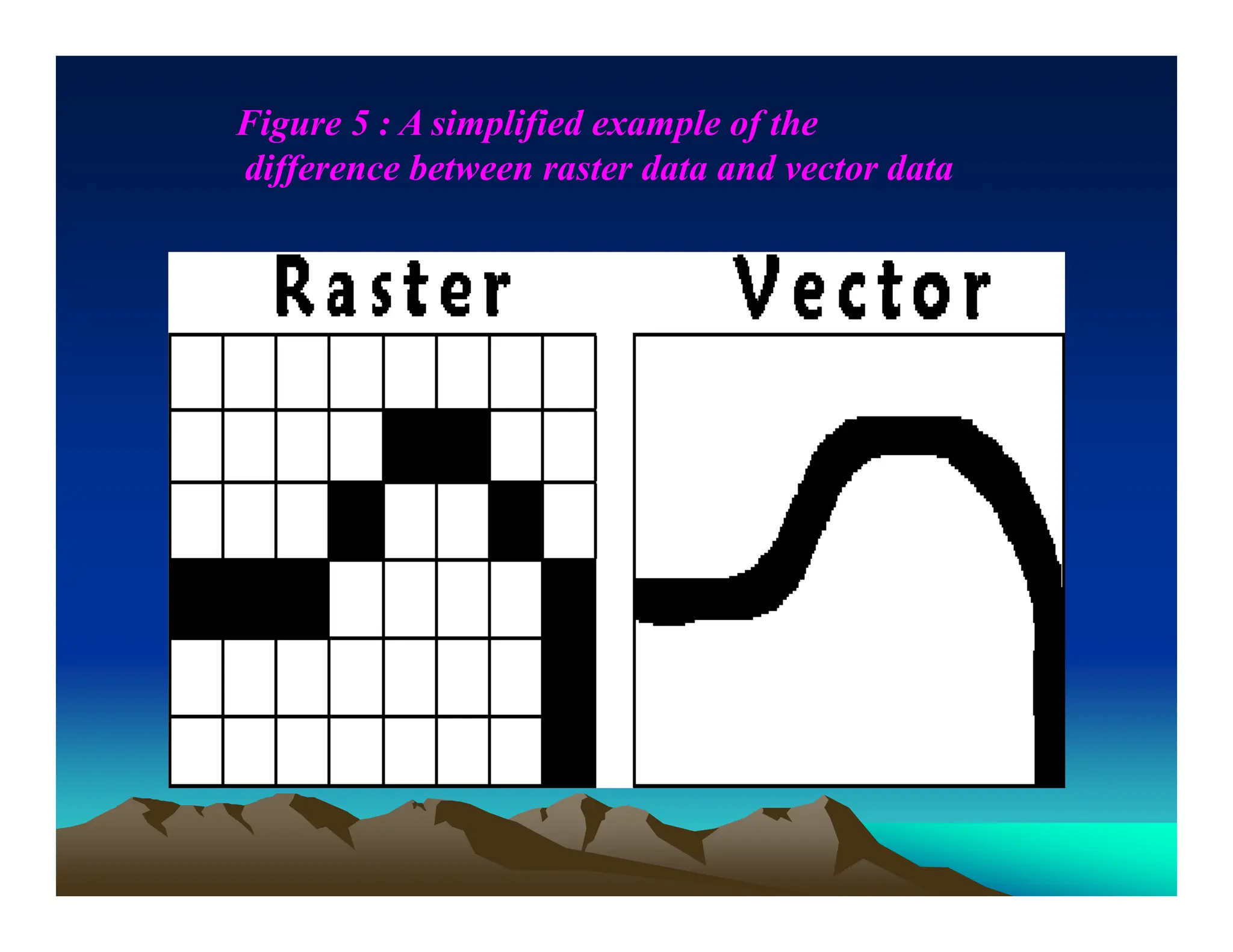
Figure 5 : A simplified example of the
difference between raster data and vector data
Examples of vector and raster data
• Examples of vector data: DLGs (digital line
graphs), TIGER files (U.S census data)
• Examples of raster data: DRGs, Remotely
sensed data (imagery); DOQs (photos);
DEMs (grids)
CONCLUSION
• Raster data are data continuously spread in space,
which are structured in a measured matrix of usually
quadratic cells and cells with the same size. Each
cell gets an attribute (property, attribute date), which
represents an appropriate phenomenon.
• Vector data are used for the storage of line
information and/or for the storage of homogeneous
areas at closed lines (polygons). Each vector object
can be assigned with none, one or several attributes
(property).
ADVANTAGES OF RASTER AND VECTOR DISADVANTAGES OF RASTER AND VECTOR DATA

  • 1.
  • 2.
    CONTENTS 1. INTRODUCTION a. RASTER b.VECTOR 2. DEFINITIONS 3. CHARACTERISTICS 4. ADVANTAGES OF RASTER AND VECTOR 5. DISADVANTAGES OF RASTER AND VECTOR DATA 6. COMPARISION BETWEEN RASTER AND VECTOR 7. EXAMPLES 8. CONCLUSION
  • 3.
    RASTER AND VECTORDATA • Geographic features stored in a GIS can be considered as one of three types: • points: no area at this scale (e.g. building, tower) • lines (arcs): no width at this scale (e.g. river, road, administrative boundary) • areas (polygons): line surrounding enclosed area (e.g. forest stand, census district) • Spatial characteristics of features can be stored in a GIS in one of two ways: as raster data or as vector data.
  • 4.
     Thus geographicallyreferenced data is stored in: - · Raster (grid or cellular-based) data structure. · x, y coordinate reference-based (vector) data structure.  Raster data structure  Grid or cellular-based  Grid representation of a measured image property in which each grid cell (pixel) comprises a digital number. The larger the area represented the lower the resolution of the data. The smaller the area covered the greater the resolution and the more accurately features are represented.
  • 5.
    Vector data structure Arc-nodemodel Arcs represent the shape of lines and are split at their intersections with other arcs, where nodes occur; nodes represent the beginning and ending vertex of each arc. Vector format- representation of features on the earth as lines, points, or polygons as a series or XY Cartesian coordinates
  • 6.
    DEFINITIONS: • RASTER DATAMODEL A spatial data model that uses a grid and cells to represent the spatial variation of a feature. • VECTOR DATA MODEL A data model that uses points and their x-, y- coordinates to construct spatial features.
  • 7.
    Characteristics Of RasterData Model • Simple 'grid' structure of rows and columns. • Based on cells or picture elements (pixels). • Linear feature (e.g. a road) is a contiguous set of cells. • Resolution based on size of grid (cell) the smaller the cell, the higher the resolution. • Features are considered homogenous within a pixel. • Storage increases with the square of the resolution.
  • 8.
    Characteristics Of VectorData Model • Based on objects (points, lines, areas). • Constructed using arcs, nodes and vertices. • Resolution can be independent of detail. • Every point has a unique location.
  • 9.
    Figure 1:ILLUSTRATING RASTER andVECTOR DATA (a) Raster Data (b) Vector Data
  • 10.
    Advantages of RasterData Structures • Simple data structures. • Overlay and combination of maps and remote sensed images easy. • Some spatial analysis methods simple to perform. • Simulation easy, because cells have the same size and shape. • Technology is cheap. • Compatible with remote sensing. • High spatial variability available which is efficiently represented (e.g. relief). • Only raster can store image data (e.g. photos).
  • 11.
    Advantages of VectorData Structures • Good representation of phenomenonology. • Topology can be completely described and easy to maintain. • Accurate graphics, retrieval, updating and generalization of graphics and attributes possible. • Requires less disk storage. • Graphical maps more closely represent hand- drawn. • Compact data structure for homogenous areas. • Better suited for map output.
  • 12.
    Disadvantages of RasterData Structures • Crude raster maps are considerably less beautiful than line maps. • Projection transformations are time consuming • Requires more storage space. • Boundaries has more blocky appearance. • More difficult to represent topology. • Data structure is not compact (though it can be modified). • Topological relationships are harder to represent. • Map output can appear 'blocky‘, less accurate maps. • The use of large cells to reduce data volumes means that recognizable structures can be lost and there can be a serious loss of information (drop out).
  • 13.
    Disadvantages of VectorData Structures • More complex Data Structures. • Combination of several vector polygon maps or polygon and raster maps through overlay creates difficulties. • Simulation is difficult because each unit has a different topological form. • Display and plotting can be expensive, particularly for high quality, color and cross-hatching. • Spatial analysis and filtering within polygons are impossible. • Not as compatible with remote sensing as raster data. • Overlay analysis more time-consuming than raster data. • High spatial variability is less efficiently stored. • Cannot store (continuously varying) image data.
  • 14.
    COMPARISON OF RASTERAND VECTOR DATA MODELS  The primary focus of the vector data model is the geographic feature; the primary focus of the raster data model is location.  The vector data model is more suited to the question of “What do I know about this geographic feature? The raster data model answers the question, “What geographic phenomenon occurs at this location.”  The vector model uses x, y coordinates to represent geographic features, raster store rows and columns of cell values.  The vector data model defines boundaries. There are no boundaries defined in the raster data model.
  • 15.
     The vectordata model represents location as x, y coordinates in a Cartesian coordinate systems. The raster model represents location as cells, also in a Cartesian coordinate system.  The vector model represents feature shape accurately; the raster model represents rectangular areas and thus is more generalized and less accurate. Continue…
  • 16.
     The vectormodel represents features with well-defined boundaries; the raster model represents a more generalized view. The raster model can also represent gradual transition between features and surfaces, such as soil classification and elevation  The vector model is used for high-quality cartography and where accuracy and precision are important, such as for cadastral (property) applications. The raster data model is useful for image/picture storage and is well suited to many spatial modeling operations (as optimum corridor route selection, modeling surface storm runoff, and forest fire spread). Continue…
  • 17.
    Figure 2: Ina more complex example, this image shows both raster data (satellite image of UNBC and area) and vector data (Cranbrook Hill Greenway). This image is at normal size (no zoom).
  • 18.
    Figure 3: Whenwe zoom in 16X from the previous image, the difference between raster and vector data becomes more apparent. The raster data is defined by an individual colour (representing a data value) for each grid cell. The vector data remains a solid red line with the same width.
  • 19.
    Figure 4: RASTER- AND VECTOR - VISUALISATION OF IDENTICAL SPATIAL OBJECT IN GIS
  • 20.
    Figure 5 :A simplified example of the difference between raster data and vector data
  • 21.
    Examples of vectorand raster data • Examples of vector data: DLGs (digital line graphs), TIGER files (U.S census data) • Examples of raster data: DRGs, Remotely sensed data (imagery); DOQs (photos); DEMs (grids)
  • 22.
    CONCLUSION • Raster dataare data continuously spread in space, which are structured in a measured matrix of usually quadratic cells and cells with the same size. Each cell gets an attribute (property, attribute date), which represents an appropriate phenomenon. • Vector data are used for the storage of line information and/or for the storage of homogeneous areas at closed lines (polygons). Each vector object can be assigned with none, one or several attributes (property).