JOINTS 
  inherently important in the study of fluid flow 
through rocks. 
                                                 
                              JOINTS-                                    
-Fractures  
 -no measurable shear displacement 
-Thought to represent Mode I fractures 
(tensile stress features)   
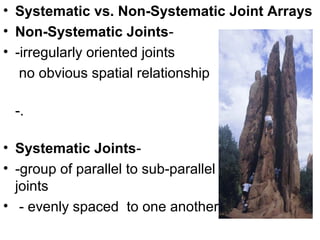
• Systematic vs. Non-Systematic Joint Arrays 
• Non-Systematic Joints- 
• -irregularly oriented joints
    no obvious spatial relationship
                                                                            
-.            
                                                                        
• Systematic Joints-                                    
• -group of parallel to sub-parallel                    
joints
•  - evenly spaced  to one another
 
• Joint Sets- a group of systematic joints              


• Joint System-
•     -defined by two or more joint sets 
•    - joint sets intersect at constant angles.   
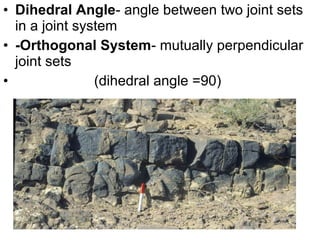
• Dihedral Angle- angle between two joint sets 
in a joint system 
• -Orthogonal System- mutually perpendicular 
joint sets 
•                     (dihedral angle =90)
• -Conjugate System- dihedral angle ~ 30-60.
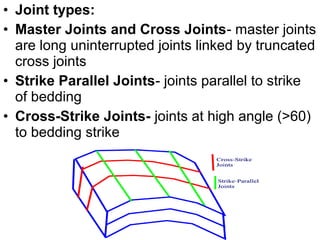
• Joint types:
• Master Joints and Cross Joints- master joints
are long uninterrupted joints linked by truncated
cross joints
• Strike Parallel Joints- joints parallel to strike
of bedding
• Cross-Strike Joints- joints at high angle (>60)
to bedding strike
• Sheeting Joints (Exfoliation Joints)-
• -Common in intrusive/metamorphic rocks
• -Particularly in rocks that lack strong foliations.
• Exfoliation Domes- -Spherical joint surfaces of
intrusive/metamorphic rocks; Common in steep
topography
 
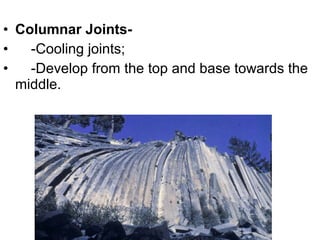
• Columnar Joints- 
•     -Cooling joints;                
•     -Develop from the top and base towards the 
middle.
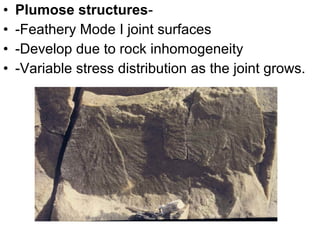
• Plumose structures- 
• -Feathery Mode I joint surfaces
• -Develop due to rock inhomogeneity
• -Variable stress distribution as the joint grows. 
 
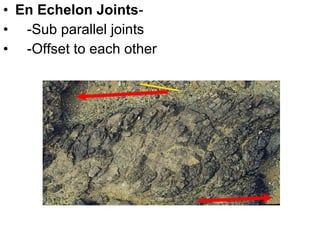
• En Echelon Joints-  
•    -Sub parallel joints
•    -Offset to each other
• Joint spacing- 
•    -Average distance between joint surfaces;  
•      dependent upon: 
• 1)Bed thickness-
•     -Joints  closely spaced in thinner beds 
• 2)Lithology- 
•     -Stiffer lithologies ~ closer spacing
•     -Less stiff rocks  ~wide joint spacing. 
• 3)Tensile strength of the rock- 
•     -Lower tensile strength ~ more joints 
• 4)Magnitude of extensional strain
• Origin and Tectonic Interpretation of
Joints:
• Uplift and Unroofing
• Hydraulic Fracturing
• Tectonic Denudation
• Joint Analysis:
• Points to consider & data to collect in the analysis of
joints.
• Are the joints systematic or non-systematic?
• Determine the orientation of joints present
• How many different joint sets are present?
• Determine cross-cutting relationships
• Describe the appearance of the joints.
• Describe the dimensions of the joints
• Describe joint spacing and density
• Describe relationship of joints & lithology
• Do joints vary with changes in lithology.
• Are joints isolated or connected to regional network?
• How do joints relate to geologic structures?

Geological Joints