FOLIATION AND THEIR TYPES
Guided By- Presented By-
Dr. Poonam Bhatnagar Parag Sonwane
Class – M.Sc.(1st Sem.)
Govt. Holkar Science College Indore (M.P.)
1
CONTENT
 What is foliation.
 Fabric and cleavage.
 Development and effects of foliation.
 Classification of foliation.
1. Genetic classification.
1.a) primary foliation.
1.b) secondary foliation.
1.c) inherited foliation.
2. Morphological classification.
2.a) spaced foliation.
2.b) continuous foliation
 Significance of foliation.
 Conclusion.
 References.
2
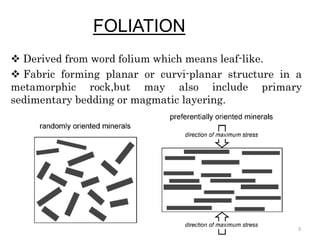
FOLIATION
 Derived from word folium which means leaf-like.
 Fabric forming planar or curvi-planar structure in a
metamorphic rock,but may also include primary
sedimentary bedding or magmatic layering.
3
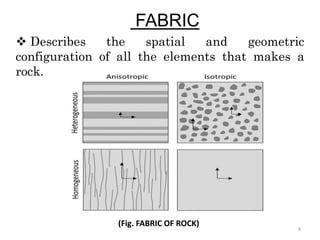
(Fig. FABRIC OF ROCK)
FABRIC
 Describes the spatial and geometric
configuration of all the elements that makes a
rock.
4
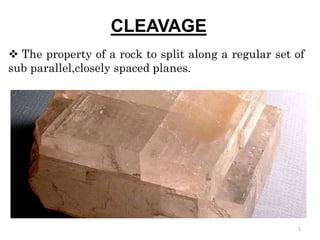
CLEAVAGE
 The property of a rock to split along a regular set of
sub parallel,closely spaced planes.
5
6
7
EFFECTS ON ROCKS
• Rhythmic bedding in sedimentary rocks.
• Compositional layering in igneous rock.
• Planar alignment of sedimentary clasts.
• Parallel alignment of conglomerate
pebbles.
• S-C foliation in metamorphic rocks.
8
GENETIC CLASSIFICATION
• PRIMARY FOLIATION
• Form during the deposition of sediments and
formation of magmatic rocks.
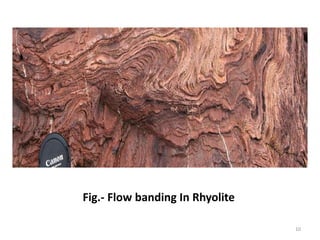
• Eg:bedding in sedimentary rocks,flow banding in
lavas and magmatic layering in intrusive rocks.
9
Fig.- Flow banding In Rhyolite
10
SECONDARY FOLIATION
• Products of stress and strain and most are
tectonic foliations.They form in response to
tectonic stress.
• Eg:axial plane cleavages in metamorphic rocks.
11
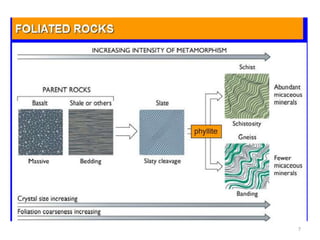
The two basic forms of secondary
foliation are -
• Rock cleavage.
• Schistosity.
12
Type of secondary foliation
• Bedding cleavage.
• Fracture cleavage.
• Slaty cleavage or schistosity.
• Slip cleavage.
• Shear cleavage.
• Axial plane cleavage.
13
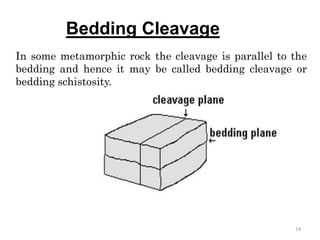
Bedding Cleavage
In some metamorphic rock the cleavage is parallel to the
bedding and hence it may be called bedding cleavage or
bedding schistosity.
14
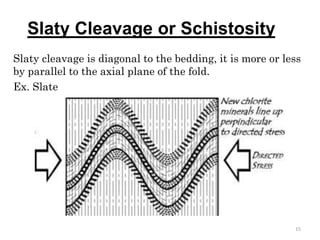
Slaty Cleavage or Schistosity
Slaty cleavage is diagonal to the bedding, it is more or less
by parallel to the axial plane of the fold.
Ex. Slate
15
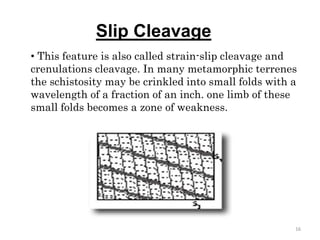
Slip Cleavage
• This feature is also called strain-slip cleavage and
crenulations cleavage. In many metamorphic terrenes
the schistosity may be crinkled into small folds with a
wavelength of a fraction of an inch. one limb of these
small folds becomes a zone of weakness.
16
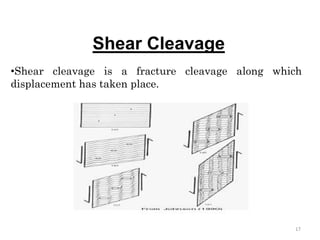
Shear Cleavage
•Shear cleavage is a fracture cleavage along which
displacement has taken place.
17
Fracture Cleavage
• Fracture cleavage is essentially a closed
spaced jointing; the minerals in the rocks are
not parallel to the cleavage.
18
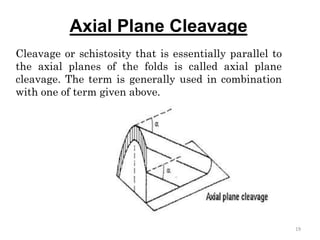
Axial Plane Cleavage
Cleavage or schistosity that is essentially parallel to
the axial planes of the folds is called axial plane
cleavage. The term is generally used in combination
with one of term given above.
19
Inherited Foliation
• The primary foliation is giving in the igneous
rocks. Then the igneous rocks may be changes
in the metamorphic rocks. After present
foliation it is inherited foliation.
20
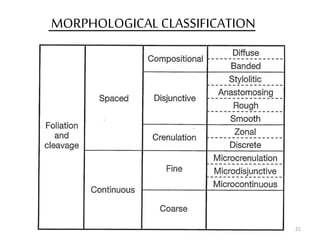
MORPHOLOGICAL CLASSIFICATION
21
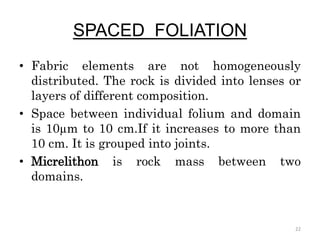
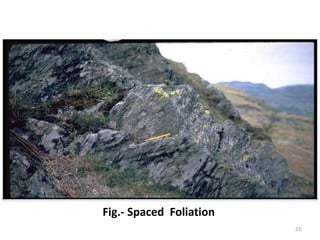
SPACED FOLIATION
• Fabric elements are not homogeneously
distributed. The rock is divided into lenses or
layers of different composition.
• Space between individual folium and domain
is 10µm to 10 cm.If it increases to more than
10 cm. It is grouped into joints.
• Micrelithon is rock mass between two
domains.
22
Fig.- Spaced Foliation
23
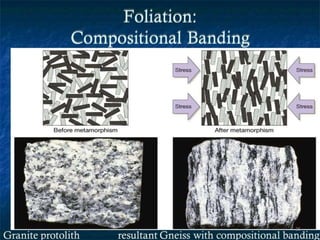
COMPOSITIONAL FOLIATION
• Compositional foliations are marked by the
layers or lamina of different mineralogical
composition.
• A planar alignment of platy or niddle like
crystals may be present.
24
25
COMPOSITIONAL FOLIATIONS
a. Diffused
Characterised by,
• Widely spaced
• Weak concentrations
of minerals
predominately of
single lithology
• Common in ultra-
mafic rocks
b. BANDED
Characterised by,
• Relatively closed
spaced compositional
layers
• Minerologocally
distinct and compare-
able abundance
• Common in high grade
metamorphic gneisses
26
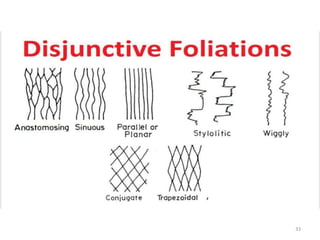
DISJUNCTIVE FOLIATION
• Disjunctive word derived from disjunctus a latin
word which means disjoined.
• A foliation that is formed in sedimentary rocks
that have been subjected to tectonic differential
stress under metamorphic conditions.
• It is defined by array of subparallel fabric
elements called cleavage domain, in which the
original rock fabric and composition have been
markedly changed by the process of pressure
solution.
27
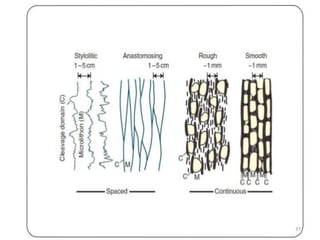
0n the basis of smoothnessor regularity of cleavage domains,
disjunctivefoliationis divided into four groups.
A. STYLOLITIC
B. ANASTOMOSING
C. ROUGH
D. SMOOTH
28
STYLOLITIC DISJUNCTIVE
FOLIATIONS
• Cleavage domain are long, continuous but
very irregular.
• This type of foliations is typically in limestone
in which cleavage domains are
characteristically are thin,dark,clay seams.
29
ANASTOMOSING DISJUNCTIVE
FOLIATIONS
• Cleavage domains are long,continuous,wavey
forming and irregular network outlining
lenticular microlithons.
• Such foliations are common in limestone and
in phyllites and schists.
30
ROUGH DISJUNCTIVE
FOLIATIONS
• Cleavage domains are short.
• Discontinuous concentration of highly oriented
platy minerals.
• Typically abundant in rocks containing sand
sized minerals.
31
SMOOTH DISJUNCTIVE FOLIATIONS
• Cleavage domains are long, continuous and
smooth.
• Have the concentrations of highly oriented
platy minerals.
32
33
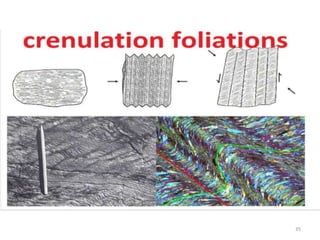
CRENULATION FOLIATIONS
• Microlithons contains the micro folds of an
earlier foliation.
• Crenulations foliation are formed by the
harmonic wrinkles or chevron folds in pre-
existing foliation, the new foliation cut across
the old foliation.
34
35
CONTINEOUS FOLIATIONS
• Continuous foliation are defined either by
with a spacing less than 10 micro-meter or by
non-domain structure.
• Fabric element are homogeneously
distributed.
• Consists of a non-layered homogeneous
distribution of platy mineral grains with a
preferred orientation.
36
37
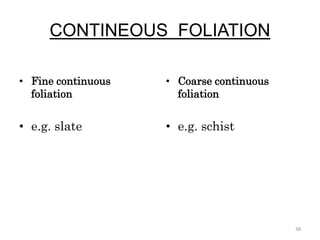
CONTINEOUS FOLIATION
• Fine continuous
foliation
• e.g. slate
• Coarse continuous
foliation
• e.g. schist
38
SIGNIFICANCE OF FOLIATION
• Can help to unravel the tectonic and
metamorphic evolution of an area.
• Relative growth periods of metamorphic
minerals.
• Deformation phases in an area.
• Help to determine the geometry of folding.
39
Relation to major structure
• Foliations have the major relation with the
fold and folded structure.
• Foliation are generally related to linear
structure.
40
CONCLUSION
• Foliations are common in metamorphic rocks.
• Without foliations it would be difficult to do
proper structural analysis.
• Give us important strain information where
regular strain markers are absent.
• Different types of foliations reflect variations
in lithology and temperature or depth of burial
during deformation.
41
REFERENCES
• Jain A.K(2014), An introduction to Structural
Geology,( Geological society of india),pp. 361-388
• Twiss R.J. and Moores E.M.,Structural
Geology,(W.H. Freeman & Company), New York,
pp. 298-306
• Website(02/10/2019)-https://www.slideshare.net.
42
Thank you.
43

Foliation

  • 1.
    FOLIATION AND THEIRTYPES Guided By- Presented By- Dr. Poonam Bhatnagar Parag Sonwane Class – M.Sc.(1st Sem.) Govt. Holkar Science College Indore (M.P.) 1
  • 2.
    CONTENT  What isfoliation.  Fabric and cleavage.  Development and effects of foliation.  Classification of foliation. 1. Genetic classification. 1.a) primary foliation. 1.b) secondary foliation. 1.c) inherited foliation. 2. Morphological classification. 2.a) spaced foliation. 2.b) continuous foliation  Significance of foliation.  Conclusion.  References. 2
  • 3.
    FOLIATION  Derived fromword folium which means leaf-like.  Fabric forming planar or curvi-planar structure in a metamorphic rock,but may also include primary sedimentary bedding or magmatic layering. 3
  • 4.
    (Fig. FABRIC OFROCK) FABRIC  Describes the spatial and geometric configuration of all the elements that makes a rock. 4
  • 5.
    CLEAVAGE  The propertyof a rock to split along a regular set of sub parallel,closely spaced planes. 5
  • 6.
  • 7.
  • 8.
    EFFECTS ON ROCKS •Rhythmic bedding in sedimentary rocks. • Compositional layering in igneous rock. • Planar alignment of sedimentary clasts. • Parallel alignment of conglomerate pebbles. • S-C foliation in metamorphic rocks. 8
  • 9.
    GENETIC CLASSIFICATION • PRIMARYFOLIATION • Form during the deposition of sediments and formation of magmatic rocks. • Eg:bedding in sedimentary rocks,flow banding in lavas and magmatic layering in intrusive rocks. 9
  • 10.
    Fig.- Flow bandingIn Rhyolite 10
  • 11.
    SECONDARY FOLIATION • Productsof stress and strain and most are tectonic foliations.They form in response to tectonic stress. • Eg:axial plane cleavages in metamorphic rocks. 11
  • 12.
    The two basicforms of secondary foliation are - • Rock cleavage. • Schistosity. 12
  • 13.
    Type of secondaryfoliation • Bedding cleavage. • Fracture cleavage. • Slaty cleavage or schistosity. • Slip cleavage. • Shear cleavage. • Axial plane cleavage. 13
  • 14.
    Bedding Cleavage In somemetamorphic rock the cleavage is parallel to the bedding and hence it may be called bedding cleavage or bedding schistosity. 14
  • 15.
    Slaty Cleavage orSchistosity Slaty cleavage is diagonal to the bedding, it is more or less by parallel to the axial plane of the fold. Ex. Slate 15
  • 16.
    Slip Cleavage • Thisfeature is also called strain-slip cleavage and crenulations cleavage. In many metamorphic terrenes the schistosity may be crinkled into small folds with a wavelength of a fraction of an inch. one limb of these small folds becomes a zone of weakness. 16
  • 17.
    Shear Cleavage •Shear cleavageis a fracture cleavage along which displacement has taken place. 17
  • 18.
    Fracture Cleavage • Fracturecleavage is essentially a closed spaced jointing; the minerals in the rocks are not parallel to the cleavage. 18
  • 19.
    Axial Plane Cleavage Cleavageor schistosity that is essentially parallel to the axial planes of the folds is called axial plane cleavage. The term is generally used in combination with one of term given above. 19
  • 20.
    Inherited Foliation • Theprimary foliation is giving in the igneous rocks. Then the igneous rocks may be changes in the metamorphic rocks. After present foliation it is inherited foliation. 20
  • 21.
  • 22.
    SPACED FOLIATION • Fabricelements are not homogeneously distributed. The rock is divided into lenses or layers of different composition. • Space between individual folium and domain is 10µm to 10 cm.If it increases to more than 10 cm. It is grouped into joints. • Micrelithon is rock mass between two domains. 22
  • 23.
  • 24.
    COMPOSITIONAL FOLIATION • Compositionalfoliations are marked by the layers or lamina of different mineralogical composition. • A planar alignment of platy or niddle like crystals may be present. 24
  • 25.
  • 26.
    COMPOSITIONAL FOLIATIONS a. Diffused Characterisedby, • Widely spaced • Weak concentrations of minerals predominately of single lithology • Common in ultra- mafic rocks b. BANDED Characterised by, • Relatively closed spaced compositional layers • Minerologocally distinct and compare- able abundance • Common in high grade metamorphic gneisses 26
  • 27.
    DISJUNCTIVE FOLIATION • Disjunctiveword derived from disjunctus a latin word which means disjoined. • A foliation that is formed in sedimentary rocks that have been subjected to tectonic differential stress under metamorphic conditions. • It is defined by array of subparallel fabric elements called cleavage domain, in which the original rock fabric and composition have been markedly changed by the process of pressure solution. 27
  • 28.
    0n the basisof smoothnessor regularity of cleavage domains, disjunctivefoliationis divided into four groups. A. STYLOLITIC B. ANASTOMOSING C. ROUGH D. SMOOTH 28
  • 29.
    STYLOLITIC DISJUNCTIVE FOLIATIONS • Cleavagedomain are long, continuous but very irregular. • This type of foliations is typically in limestone in which cleavage domains are characteristically are thin,dark,clay seams. 29
  • 30.
    ANASTOMOSING DISJUNCTIVE FOLIATIONS • Cleavagedomains are long,continuous,wavey forming and irregular network outlining lenticular microlithons. • Such foliations are common in limestone and in phyllites and schists. 30
  • 31.
    ROUGH DISJUNCTIVE FOLIATIONS • Cleavagedomains are short. • Discontinuous concentration of highly oriented platy minerals. • Typically abundant in rocks containing sand sized minerals. 31
  • 32.
    SMOOTH DISJUNCTIVE FOLIATIONS •Cleavage domains are long, continuous and smooth. • Have the concentrations of highly oriented platy minerals. 32
  • 33.
  • 34.
    CRENULATION FOLIATIONS • Microlithonscontains the micro folds of an earlier foliation. • Crenulations foliation are formed by the harmonic wrinkles or chevron folds in pre- existing foliation, the new foliation cut across the old foliation. 34
  • 35.
  • 36.
    CONTINEOUS FOLIATIONS • Continuousfoliation are defined either by with a spacing less than 10 micro-meter or by non-domain structure. • Fabric element are homogeneously distributed. • Consists of a non-layered homogeneous distribution of platy mineral grains with a preferred orientation. 36
  • 37.
  • 38.
    CONTINEOUS FOLIATION • Finecontinuous foliation • e.g. slate • Coarse continuous foliation • e.g. schist 38
  • 39.
    SIGNIFICANCE OF FOLIATION •Can help to unravel the tectonic and metamorphic evolution of an area. • Relative growth periods of metamorphic minerals. • Deformation phases in an area. • Help to determine the geometry of folding. 39
  • 40.
    Relation to majorstructure • Foliations have the major relation with the fold and folded structure. • Foliation are generally related to linear structure. 40
  • 41.
    CONCLUSION • Foliations arecommon in metamorphic rocks. • Without foliations it would be difficult to do proper structural analysis. • Give us important strain information where regular strain markers are absent. • Different types of foliations reflect variations in lithology and temperature or depth of burial during deformation. 41
  • 42.
    REFERENCES • Jain A.K(2014),An introduction to Structural Geology,( Geological society of india),pp. 361-388 • Twiss R.J. and Moores E.M.,Structural Geology,(W.H. Freeman & Company), New York, pp. 298-306 • Website(02/10/2019)-https://www.slideshare.net. 42
  • 43.