









Submitted To:
         Sir Fahad Hameed
Submitted By:
         Ahmed Younhais Tariq
         5th Semester
         Evening “B”
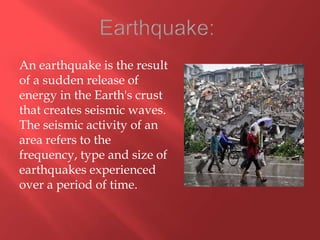
An earthquake is the result
of a sudden release of
energy in the Earth's crust
that creates seismic waves.
The seismic activity of an
area refers to the
frequency, type and size of
earthquakes experienced
over a period of time.
For Example:
If you throw stone in a pond of still
water, series of waves are produced on the
surface of water, these waves spread out in all
directions from the point where the stone
strikes the water similarly, any sudden
disturbances in the earth’s crust may produce
vibrations in the crust which travel in all
directions from point of disturbances.
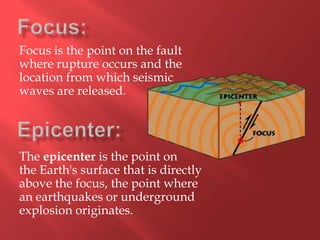
Focus is the point on the fault
where rupture occurs and the
location from which seismic
waves are released.


The epicenter is the point on
the Earth's surface that is directly
above the focus, the point where
an earthquakes or underground
explosion originates.
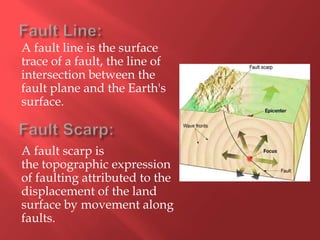
A fault line is the surface
trace of a fault, the line of
intersection between the
fault plane and the Earth's
surface.


A fault scarp is
the topographic expression
of faulting attributed to the
displacement of the land
surface by movement along
faults.
The primary cause of an earthquake is faults
on the crust of the earth. The cracks or sudden
slips of the land are known as faults or fault
planes. Some major causes of earthquakes on
basic of its causes are:
 Surface causes.

 Volcanic causes.

 Tectonic causes.
   Great explosions, landslides, slips on steep
    coasts, dashing of sea
    waves, avalanches, railway trains, heavy
    trucks, some large engineering projects cause
    minor tremors. Some of them are man
    made, others are natural.
   Volcanic eruptions produce earthquakes.
    Earthquakes may precede, accompany and
    frequently follow volcanic eruptions. They
    are caused by sudden violent displacements
    of lava within or beneath the earth crust.
   Structural disturbances resulting in the relative
    displacements of the parts of the lithosphere is
    the main cause of this type of earthquake.
    Most of the disastrous earthquakes belong to
    this category and occur in areas of great faults
    and fractures. Sudden yielding to strain
    produced on the rocks of accumulating stress
    causes displacements especially along old fault
    zones known as great transform faults.
    Stresses accumulate on the two sides of the
    fault plane and produce strain. The rock
    deforms bends and when the stress crosses the
    elastic limit, sudden displacement of the two
    sides of the fault plane takes place. This results
    in a strong blow to the rocks Elastic rebound
    and produces tremors.
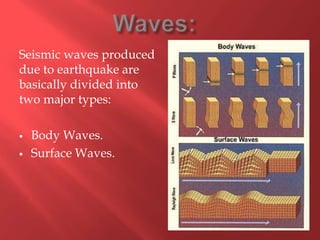
Seismic waves produced
due to earthquake are
basically divided into
two major types:

   Body Waves.
   Surface Waves.
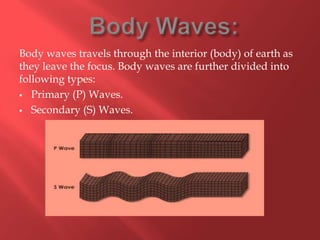
Body waves travels through the interior (body) of earth as
they leave the focus. Body waves are further divided into
following types:
 Primary (P) Waves.

 Secondary (S) Waves.
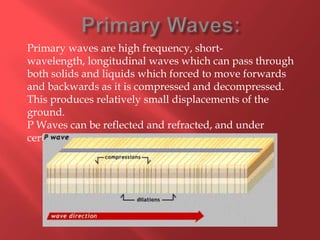
Primary waves are high frequency, short-
wavelength, longitudinal waves which can pass through
both solids and liquids which forced to move forwards
and backwards as it is compressed and decompressed.
This produces relatively small displacements of the
ground.
P Waves can be reflected and refracted, and under
certain circumstances can change into S-Waves.
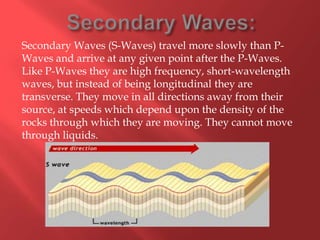
Secondary Waves (S-Waves) travel more slowly than P-
Waves and arrive at any given point after the P-Waves.
Like P-Waves they are high frequency, short-wavelength
waves, but instead of being longitudinal they are
transverse. They move in all directions away from their
source, at speeds which depend upon the density of the
rocks through which they are moving. They cannot move
through liquids.
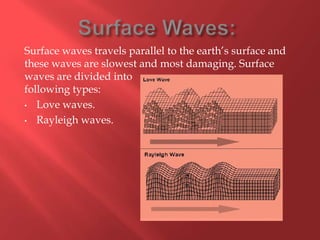
Surface waves travels parallel to the earth’s surface and
these waves are slowest and most damaging. Surface
waves are divided into
following types:
• Love waves.

• Rayleigh waves.
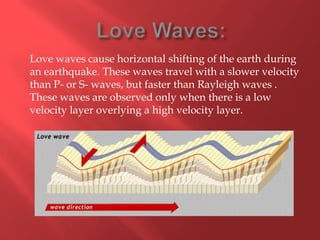
Love waves cause horizontal shifting of the earth during
an earthquake. These waves travel with a slower velocity
than P- or S- waves, but faster than Rayleigh waves .
These waves are observed only when there is a low
velocity layer overlying a high velocity layer.
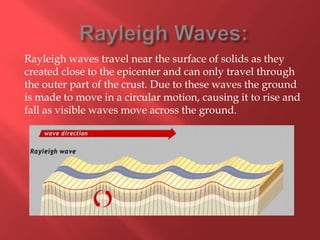
Rayleigh waves travel near the surface of solids as they
created close to the epicenter and can only travel through
the outer part of the crust. Due to these waves the ground
is made to move in a circular motion, causing it to rise and
fall as visible waves move across the ground.
Earthquakes are basically
divided into two types on the basic
of difference in causes which are
following:

   Tectonic Earthquake.
   Volcanic Earthquake.
   Tectonic earthquakes are triggered when the
    crust becomes subjected to strain, and
    eventually moves. The theory of plate tectonics
    explains how the crust of the Earth is made of
    several plates, large areas of crust which float
    on the Mantle. Since these plates are free to
    slowly move, they can either drift towards each
    other, away from each other or slide past each
    other. Many of the earthquakes which we feel
    are located in the areas where plates collide or
    try to slide past each other.
   Major earthquakes are sometimes occur by a period of
    changed activity. This might take the form of more
    frequent minor shocks as the rocks begin to move , called
    foreshocks , or a period of less frequent shocks as the two
    rock masses temporarily 'stick' and become locked
    together. Detailed surveys longitudinal features very
    slowly become deformed as the pressure builds up in the
    rocks, then become noticeably offset when a movement
    occurs along the fault. Following the main shock, there
    may be further movements, called aftershocks, which occur
    as the rock masses 'settle down' in their new positions.
    Such aftershocks cause problems for rescue
    services, bringing down buildings already weakened by
    the main earthquake.
   Volcanic earthquakes are far less common than
    Tectonic ones. They are triggered by the
    explosive eruption of a volcano. Given that not
    all volcanoes are prone to violent eruption, and
    that most are 'quiet' for the majority of the
    time, it is not surprising to find that they are
    comparatively rare.
   When a volcano explodes, it is likely that the
    associated earthquake effects will be confined
    to an area 10 to 20 miles around its base, where
    as a tectonic earthquake may be felt around the
    globe.
   By contrast, volcanoes producing free flowing basic
    lava rarely cause earthquakes. The lava flows freely out
    of the vent and down the sides of the volcano, releasing
    pressure evenly and constantly. Since pressure doesn't
    build up, violent explosions do not occur.
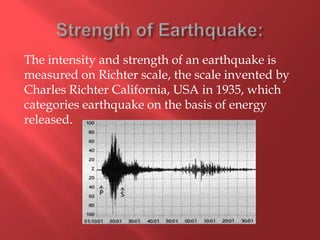
The intensity and strength of an earthquake is
measured on Richter scale, the scale invented by
Charles Richter California, USA in 1935, which
categories earthquake on the basis of energy
released.
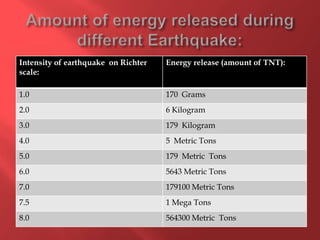
Intensity of earthquake on Richter   Energy release (amount of TNT):
scale:

1.0                                  170 Grams
2.0                                  6 Kilogram
3.0                                  179 Kilogram
4.0                                  5 Metric Tons
5.0                                  179 Metric Tons
6.0                                  5643 Metric Tons
7.0                                  179100 Metric Tons
7.5                                  1 Mega Tons
8.0                                  564300 Metric Tons
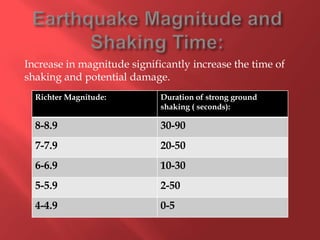
Increase in magnitude significantly increase the time of
shaking and potential damage.
  Richter Magnitude:         Duration of strong ground
                             shaking ( seconds):

  8-8.9                      30-90
  7-7.9                      20-50
  6-6.9                      10-30
  5-5.9                      2-50
  4-4.9                      0-5
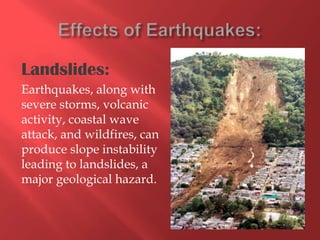
Landslides:
Earthquakes, along with
severe storms, volcanic
activity, coastal wave
attack, and wildfires, can
produce slope instability
leading to landslides, a
major geological hazard.
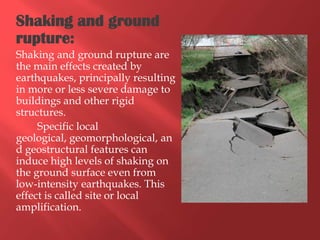
Shaking and ground
rupture:
Shaking and ground rupture are
the main effects created by
earthquakes, principally resulting
in more or less severe damage to
buildings and other rigid
structures.
     Specific local
geological, geomorphological, an
d geostructural features can
induce high levels of shaking on
the ground surface even from
low-intensity earthquakes. This
effect is called site or local
amplification.
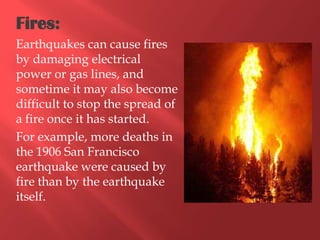
Fires:
Earthquakes can cause fires
by damaging electrical
power or gas lines, and
sometime it may also become
difficult to stop the spread of
a fire once it has started.
For example, more deaths in
the 1906 San Francisco
earthquake were caused by
fire than by the earthquake
itself.
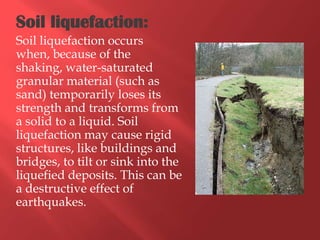
Soil liquefaction:
Soil liquefaction occurs
when, because of the
shaking, water-saturated
granular material (such as
sand) temporarily loses its
strength and transforms from
a solid to a liquid. Soil
liquefaction may cause rigid
structures, like buildings and
bridges, to tilt or sink into the
liquefied deposits. This can be
a destructive effect of
earthquakes.
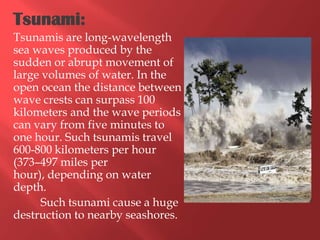
Tsunami:
Tsunamis are long-wavelength
sea waves produced by the
sudden or abrupt movement of
large volumes of water. In the
open ocean the distance between
wave crests can surpass 100
kilometers and the wave periods
can vary from five minutes to
one hour. Such tsunamis travel
600-800 kilometers per hour
(373–497 miles per
hour), depending on water
depth.
      Such tsunami cause a huge
destruction to nearby seashores.
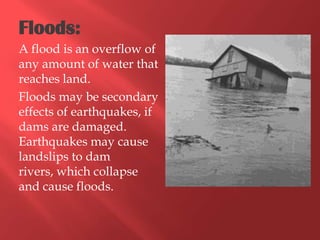
Floods:
A flood is an overflow of
any amount of water that
reaches land.
Floods may be secondary
effects of earthquakes, if
dams are damaged.
Earthquakes may cause
landslips to dam
rivers, which collapse
and cause floods.
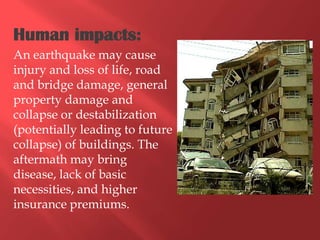
Human impacts:
An earthquake may cause
injury and loss of life, road
and bridge damage, general
property damage and
collapse or destabilization
(potentially leading to future
collapse) of buildings. The
aftermath may bring
disease, lack of basic
necessities, and higher
insurance premiums.
Earthquake prediction is usually defined as the
specification of the time, location, and magnitude of
a future earthquake within stated limits. Many
methods have been developed for predicting the
time and place in which earthquakes will occur.
Despite considerable research efforts by
seismologists, scientifically reproducible predictions
cannot yet be made to a specific day or month. Major
earthquakes are often followed by reports that they
were predicted, but no claim of a successful
prediction of a major earthquake has survived close
inquiry.
But some evidence of upcoming Earthquake are
following:


   Animal Behavior: Unusual and anomalous behavior of
    animals is evidence of coming earthquake.

   Water Level in Wells: Water level in wells changes also
    produce possibility of an earthquake.

   Foreshocks: Minor shocks before major earthquake.
   Oil Production: Large scale fluctuations of oil from oil
    wells are also show a chance of possible coming
    earthquake.
 Emission of Radon Gas: Radon gas is inert produced by
 the decay of uranium . Radon remain within rocks until
 some event force it out. So emission of radon gas is evidence
 of earthquake.

 Uplifting of Earth surface: Uplifting of earth’s surface
 is also use for prediction of earthquake.
If you are in a house;
 Don’t use lift for getting down from building.

 Be prepared to move with your family.


If you are in shop, school or office;
 Don’t run for an exit.

 Take cover under a desk/table.

 Move away from window glass.

 Do not go near electric points and cable. Keep away from
   weak portion of the building and false ceiling.
If you are outside;
   Avoid high buildings, walls, power lines and other
    objects that could fall and create block.
   Don’t run through streets.
   If possible, move on to an open area away from hazard
    including trees.

If you are in vehicle;
   Stop in a safe and open place.
   Remain inside vehicle.
   Close windows, doors and vents.
Earthquake

Earthquake

  • 2.
    Submitted To: Sir Fahad Hameed Submitted By: Ahmed Younhais Tariq 5th Semester Evening “B”
  • 4.
    An earthquake isthe result of a sudden release of energy in the Earth's crust that creates seismic waves. The seismic activity of an area refers to the frequency, type and size of earthquakes experienced over a period of time.
  • 5.
    For Example: If youthrow stone in a pond of still water, series of waves are produced on the surface of water, these waves spread out in all directions from the point where the stone strikes the water similarly, any sudden disturbances in the earth’s crust may produce vibrations in the crust which travel in all directions from point of disturbances.
  • 7.
    Focus is thepoint on the fault where rupture occurs and the location from which seismic waves are released. The epicenter is the point on the Earth's surface that is directly above the focus, the point where an earthquakes or underground explosion originates.
  • 8.
    A fault lineis the surface trace of a fault, the line of intersection between the fault plane and the Earth's surface. A fault scarp is the topographic expression of faulting attributed to the displacement of the land surface by movement along faults.
  • 10.
    The primary causeof an earthquake is faults on the crust of the earth. The cracks or sudden slips of the land are known as faults or fault planes. Some major causes of earthquakes on basic of its causes are:  Surface causes.  Volcanic causes.  Tectonic causes.
  • 11.
    Great explosions, landslides, slips on steep coasts, dashing of sea waves, avalanches, railway trains, heavy trucks, some large engineering projects cause minor tremors. Some of them are man made, others are natural.
  • 12.
    Volcanic eruptions produce earthquakes. Earthquakes may precede, accompany and frequently follow volcanic eruptions. They are caused by sudden violent displacements of lava within or beneath the earth crust.
  • 13.
    Structural disturbances resulting in the relative displacements of the parts of the lithosphere is the main cause of this type of earthquake. Most of the disastrous earthquakes belong to this category and occur in areas of great faults and fractures. Sudden yielding to strain produced on the rocks of accumulating stress causes displacements especially along old fault zones known as great transform faults.
  • 14.
    Stresses accumulate on the two sides of the fault plane and produce strain. The rock deforms bends and when the stress crosses the elastic limit, sudden displacement of the two sides of the fault plane takes place. This results in a strong blow to the rocks Elastic rebound and produces tremors.
  • 16.
    Seismic waves produced dueto earthquake are basically divided into two major types:  Body Waves.  Surface Waves.
  • 17.
    Body waves travelsthrough the interior (body) of earth as they leave the focus. Body waves are further divided into following types:  Primary (P) Waves.  Secondary (S) Waves.
  • 18.
    Primary waves arehigh frequency, short- wavelength, longitudinal waves which can pass through both solids and liquids which forced to move forwards and backwards as it is compressed and decompressed. This produces relatively small displacements of the ground. P Waves can be reflected and refracted, and under certain circumstances can change into S-Waves.
  • 19.
    Secondary Waves (S-Waves)travel more slowly than P- Waves and arrive at any given point after the P-Waves. Like P-Waves they are high frequency, short-wavelength waves, but instead of being longitudinal they are transverse. They move in all directions away from their source, at speeds which depend upon the density of the rocks through which they are moving. They cannot move through liquids.
  • 20.
    Surface waves travelsparallel to the earth’s surface and these waves are slowest and most damaging. Surface waves are divided into following types: • Love waves. • Rayleigh waves.
  • 21.
    Love waves causehorizontal shifting of the earth during an earthquake. These waves travel with a slower velocity than P- or S- waves, but faster than Rayleigh waves . These waves are observed only when there is a low velocity layer overlying a high velocity layer.
  • 22.
    Rayleigh waves travelnear the surface of solids as they created close to the epicenter and can only travel through the outer part of the crust. Due to these waves the ground is made to move in a circular motion, causing it to rise and fall as visible waves move across the ground.
  • 24.
    Earthquakes are basically dividedinto two types on the basic of difference in causes which are following:  Tectonic Earthquake.  Volcanic Earthquake.
  • 25.
    Tectonic earthquakes are triggered when the crust becomes subjected to strain, and eventually moves. The theory of plate tectonics explains how the crust of the Earth is made of several plates, large areas of crust which float on the Mantle. Since these plates are free to slowly move, they can either drift towards each other, away from each other or slide past each other. Many of the earthquakes which we feel are located in the areas where plates collide or try to slide past each other.
  • 26.
    Major earthquakes are sometimes occur by a period of changed activity. This might take the form of more frequent minor shocks as the rocks begin to move , called foreshocks , or a period of less frequent shocks as the two rock masses temporarily 'stick' and become locked together. Detailed surveys longitudinal features very slowly become deformed as the pressure builds up in the rocks, then become noticeably offset when a movement occurs along the fault. Following the main shock, there may be further movements, called aftershocks, which occur as the rock masses 'settle down' in their new positions. Such aftershocks cause problems for rescue services, bringing down buildings already weakened by the main earthquake.
  • 27.
    Volcanic earthquakes are far less common than Tectonic ones. They are triggered by the explosive eruption of a volcano. Given that not all volcanoes are prone to violent eruption, and that most are 'quiet' for the majority of the time, it is not surprising to find that they are comparatively rare.  When a volcano explodes, it is likely that the associated earthquake effects will be confined to an area 10 to 20 miles around its base, where as a tectonic earthquake may be felt around the globe.
  • 28.
    By contrast, volcanoes producing free flowing basic lava rarely cause earthquakes. The lava flows freely out of the vent and down the sides of the volcano, releasing pressure evenly and constantly. Since pressure doesn't build up, violent explosions do not occur.
  • 30.
    The intensity andstrength of an earthquake is measured on Richter scale, the scale invented by Charles Richter California, USA in 1935, which categories earthquake on the basis of energy released.
  • 31.
    Intensity of earthquakeon Richter Energy release (amount of TNT): scale: 1.0 170 Grams 2.0 6 Kilogram 3.0 179 Kilogram 4.0 5 Metric Tons 5.0 179 Metric Tons 6.0 5643 Metric Tons 7.0 179100 Metric Tons 7.5 1 Mega Tons 8.0 564300 Metric Tons
  • 32.
    Increase in magnitudesignificantly increase the time of shaking and potential damage. Richter Magnitude: Duration of strong ground shaking ( seconds): 8-8.9 30-90 7-7.9 20-50 6-6.9 10-30 5-5.9 2-50 4-4.9 0-5
  • 34.
    Landslides: Earthquakes, along with severestorms, volcanic activity, coastal wave attack, and wildfires, can produce slope instability leading to landslides, a major geological hazard.
  • 35.
    Shaking and ground rupture: Shakingand ground rupture are the main effects created by earthquakes, principally resulting in more or less severe damage to buildings and other rigid structures. Specific local geological, geomorphological, an d geostructural features can induce high levels of shaking on the ground surface even from low-intensity earthquakes. This effect is called site or local amplification.
  • 36.
    Fires: Earthquakes can causefires by damaging electrical power or gas lines, and sometime it may also become difficult to stop the spread of a fire once it has started. For example, more deaths in the 1906 San Francisco earthquake were caused by fire than by the earthquake itself.
  • 37.
    Soil liquefaction: Soil liquefactionoccurs when, because of the shaking, water-saturated granular material (such as sand) temporarily loses its strength and transforms from a solid to a liquid. Soil liquefaction may cause rigid structures, like buildings and bridges, to tilt or sink into the liquefied deposits. This can be a destructive effect of earthquakes.
  • 38.
    Tsunami: Tsunamis are long-wavelength seawaves produced by the sudden or abrupt movement of large volumes of water. In the open ocean the distance between wave crests can surpass 100 kilometers and the wave periods can vary from five minutes to one hour. Such tsunamis travel 600-800 kilometers per hour (373–497 miles per hour), depending on water depth. Such tsunami cause a huge destruction to nearby seashores.
  • 39.
    Floods: A flood isan overflow of any amount of water that reaches land. Floods may be secondary effects of earthquakes, if dams are damaged. Earthquakes may cause landslips to dam rivers, which collapse and cause floods.
  • 40.
    Human impacts: An earthquakemay cause injury and loss of life, road and bridge damage, general property damage and collapse or destabilization (potentially leading to future collapse) of buildings. The aftermath may bring disease, lack of basic necessities, and higher insurance premiums.
  • 42.
    Earthquake prediction isusually defined as the specification of the time, location, and magnitude of a future earthquake within stated limits. Many methods have been developed for predicting the time and place in which earthquakes will occur. Despite considerable research efforts by seismologists, scientifically reproducible predictions cannot yet be made to a specific day or month. Major earthquakes are often followed by reports that they were predicted, but no claim of a successful prediction of a major earthquake has survived close inquiry.
  • 43.
    But some evidenceof upcoming Earthquake are following:  Animal Behavior: Unusual and anomalous behavior of animals is evidence of coming earthquake.  Water Level in Wells: Water level in wells changes also produce possibility of an earthquake.  Foreshocks: Minor shocks before major earthquake.  Oil Production: Large scale fluctuations of oil from oil wells are also show a chance of possible coming earthquake.
  • 44.
     Emission ofRadon Gas: Radon gas is inert produced by the decay of uranium . Radon remain within rocks until some event force it out. So emission of radon gas is evidence of earthquake.  Uplifting of Earth surface: Uplifting of earth’s surface is also use for prediction of earthquake.
  • 46.
    If you arein a house;  Don’t use lift for getting down from building.  Be prepared to move with your family. If you are in shop, school or office;  Don’t run for an exit.  Take cover under a desk/table.  Move away from window glass.  Do not go near electric points and cable. Keep away from weak portion of the building and false ceiling.
  • 47.
    If you areoutside;  Avoid high buildings, walls, power lines and other objects that could fall and create block.  Don’t run through streets.  If possible, move on to an open area away from hazard including trees. If you are in vehicle;  Stop in a safe and open place.  Remain inside vehicle.  Close windows, doors and vents.