*STRUCTURAL 
GEOLOGY 
Lecture # 10
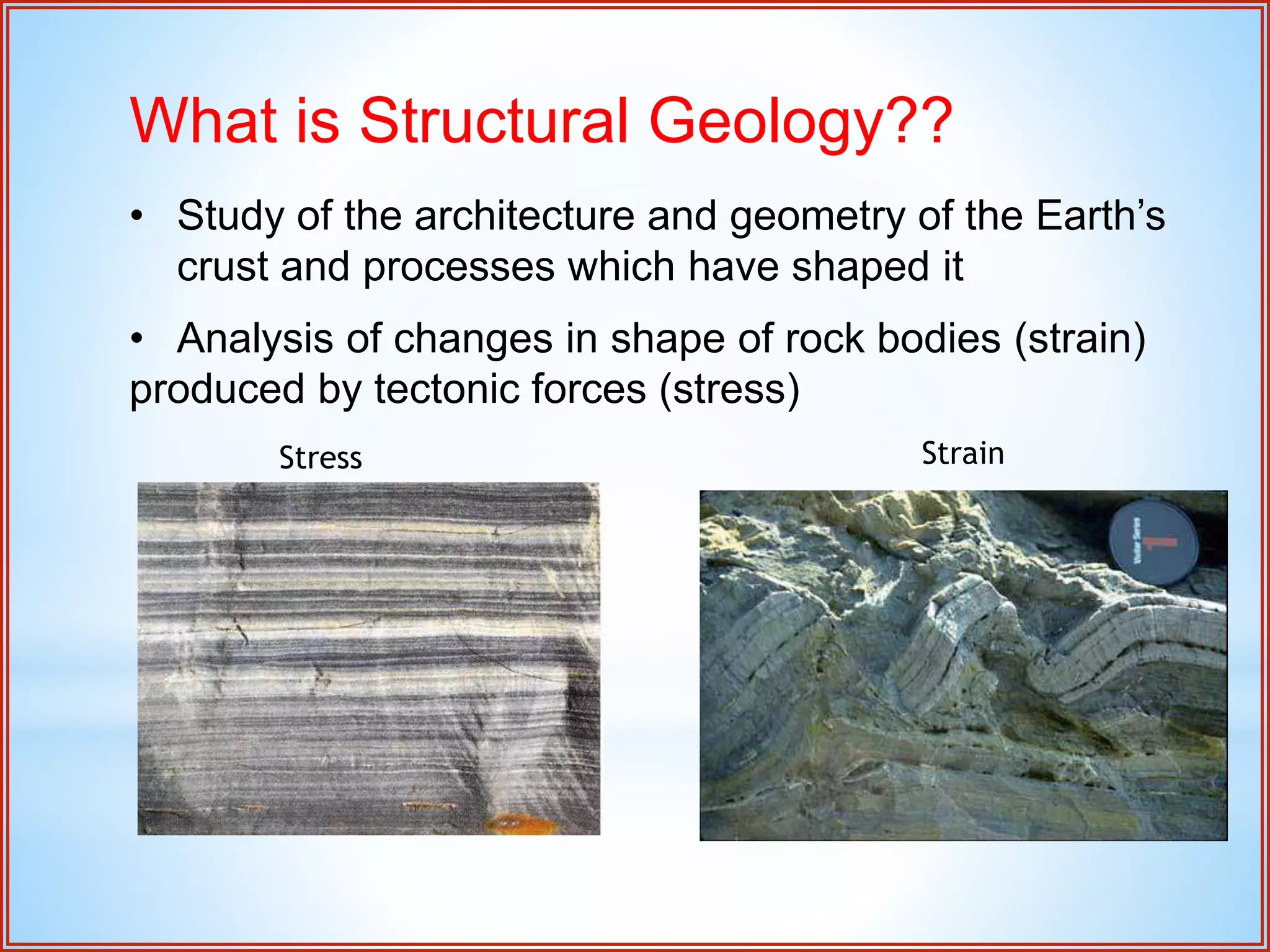
What is Structural Geology?? 
• Study of the architecture and geometry of the Earth’s 
crust and processes which have shaped it 
• Analysis of changes in shape of rock bodies (strain) 
produced by tectonic forces (stress) 
Stress Strain
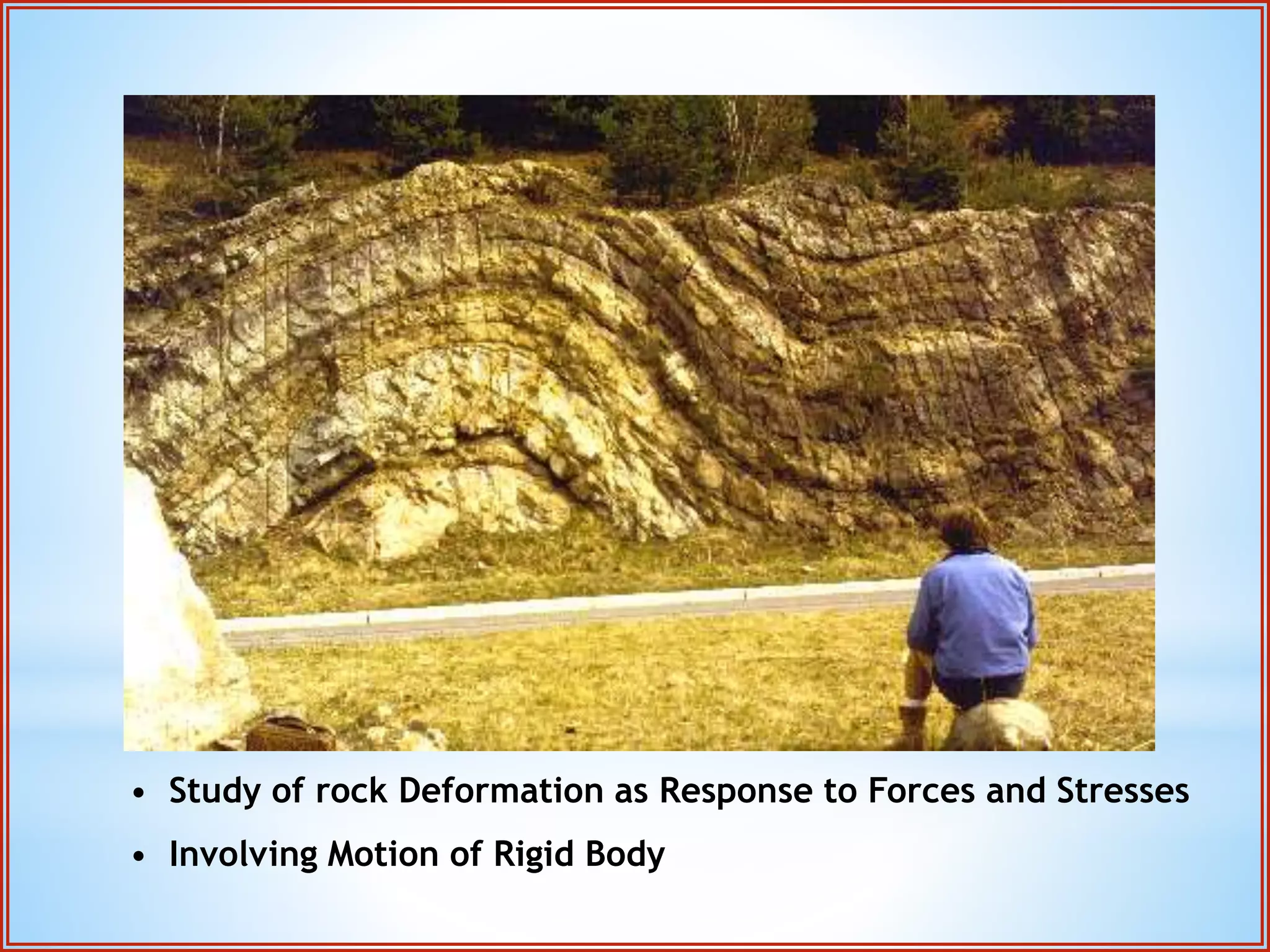
• Study of rock Deformation as Response to Forces and Stresses 
• Involving Motion of Rigid Body
Structural Analysis 
Structural analysis generally involves three tasks: 
1. Descriptive Analysis: physical and geometrical 
description of rock structures (e.g. folds, faults etc) 
2. Kinematic Analysis: evaluation of the displacement 
and 
change in shape, orientation and size that rocks undergo 
as a result of deformation (strain) 
3. Dynamic Analysis: reconstruct forces and stresses 
which resulting rock deformation and failure (stress)
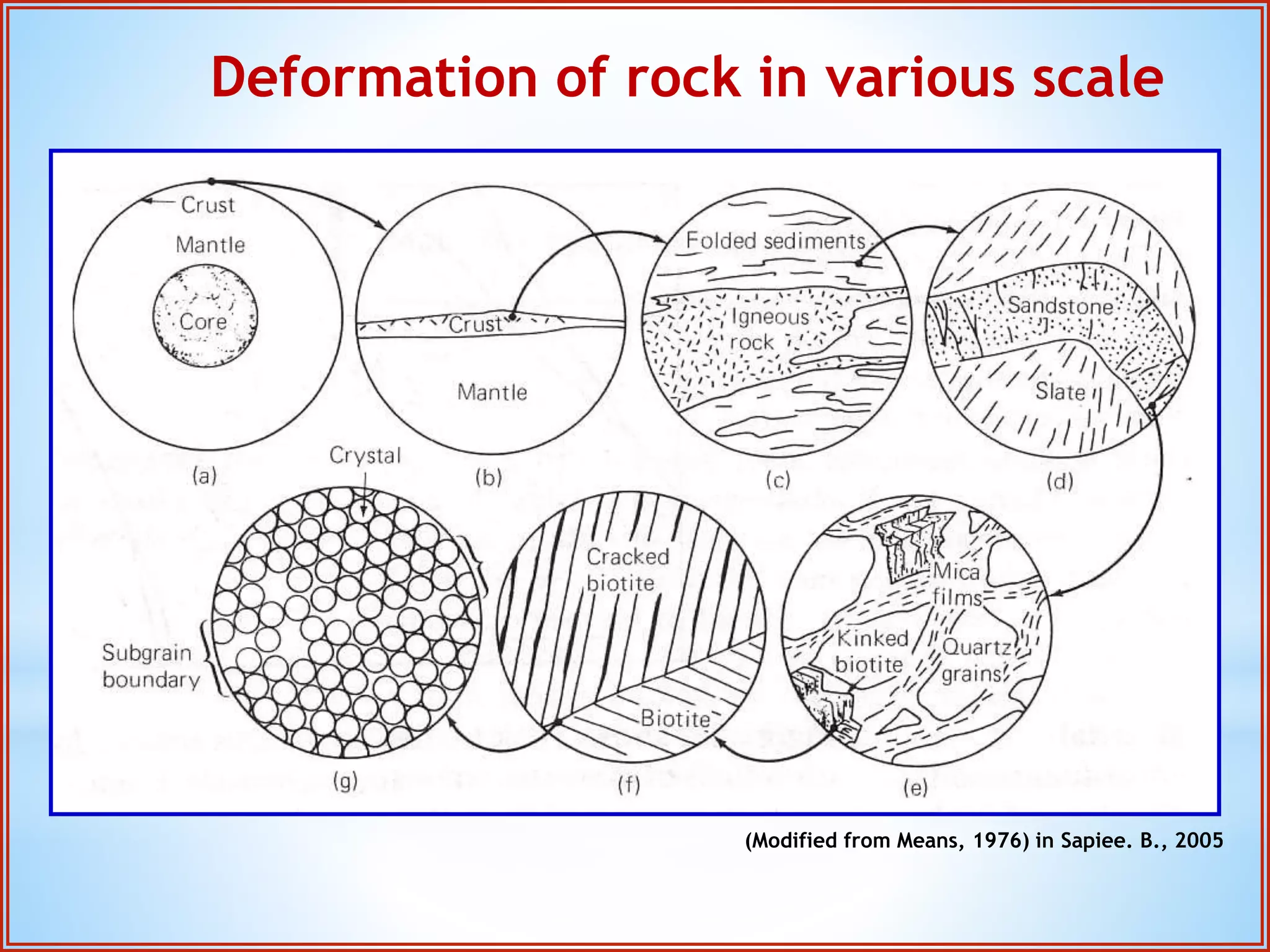
Deformation of rock in various scale 
(Modified from Means, 1976) in Sapiee. B., 2005
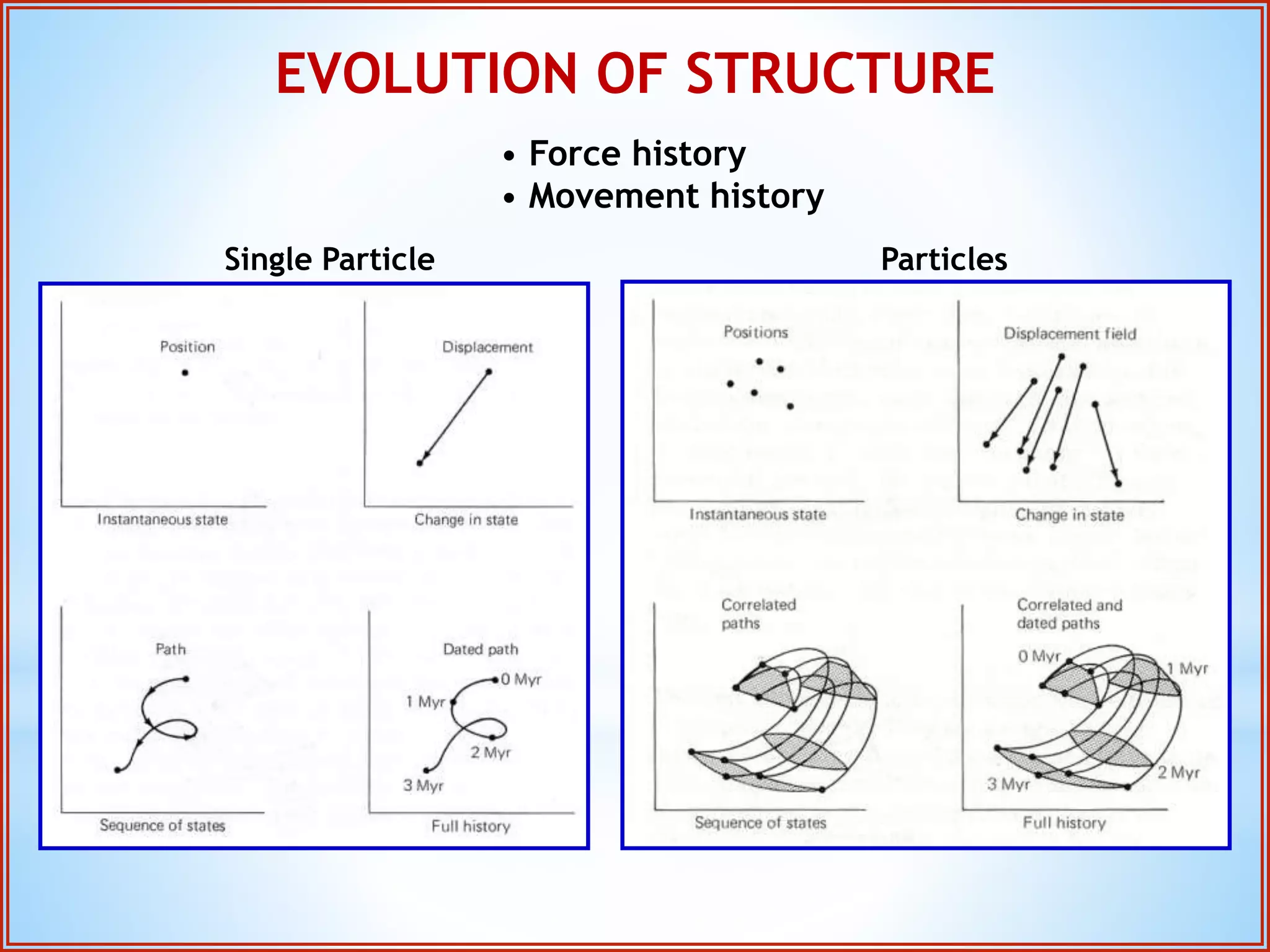
EVOLUTION OF STRUCTURE 
• Force history 
• Movement history 
Single Particle Particles
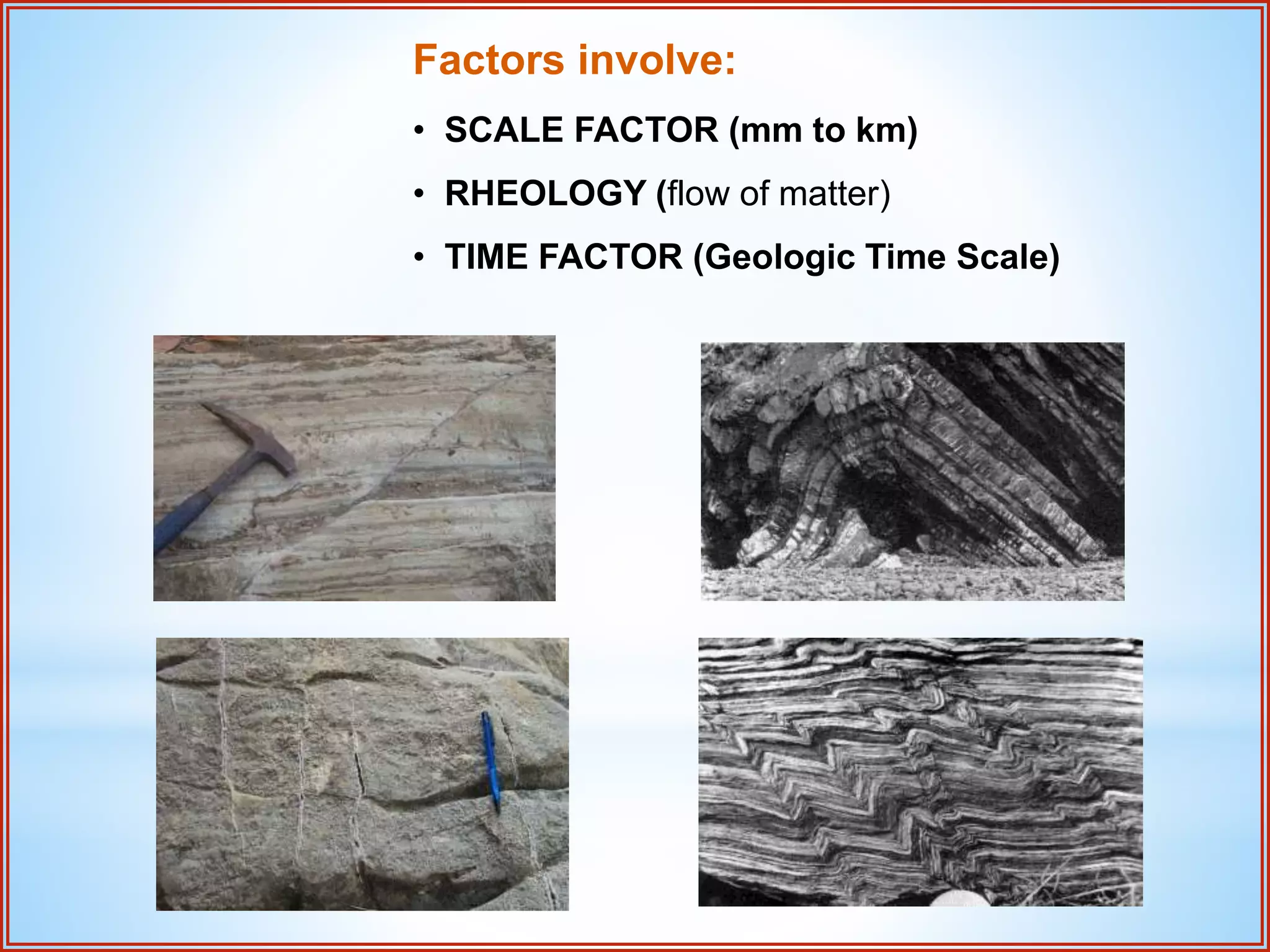
Factors involve: 
• SCALE FACTOR (mm to km) 
• RHEOLOGY (flow of matter) 
• TIME FACTOR (Geologic Time Scale)
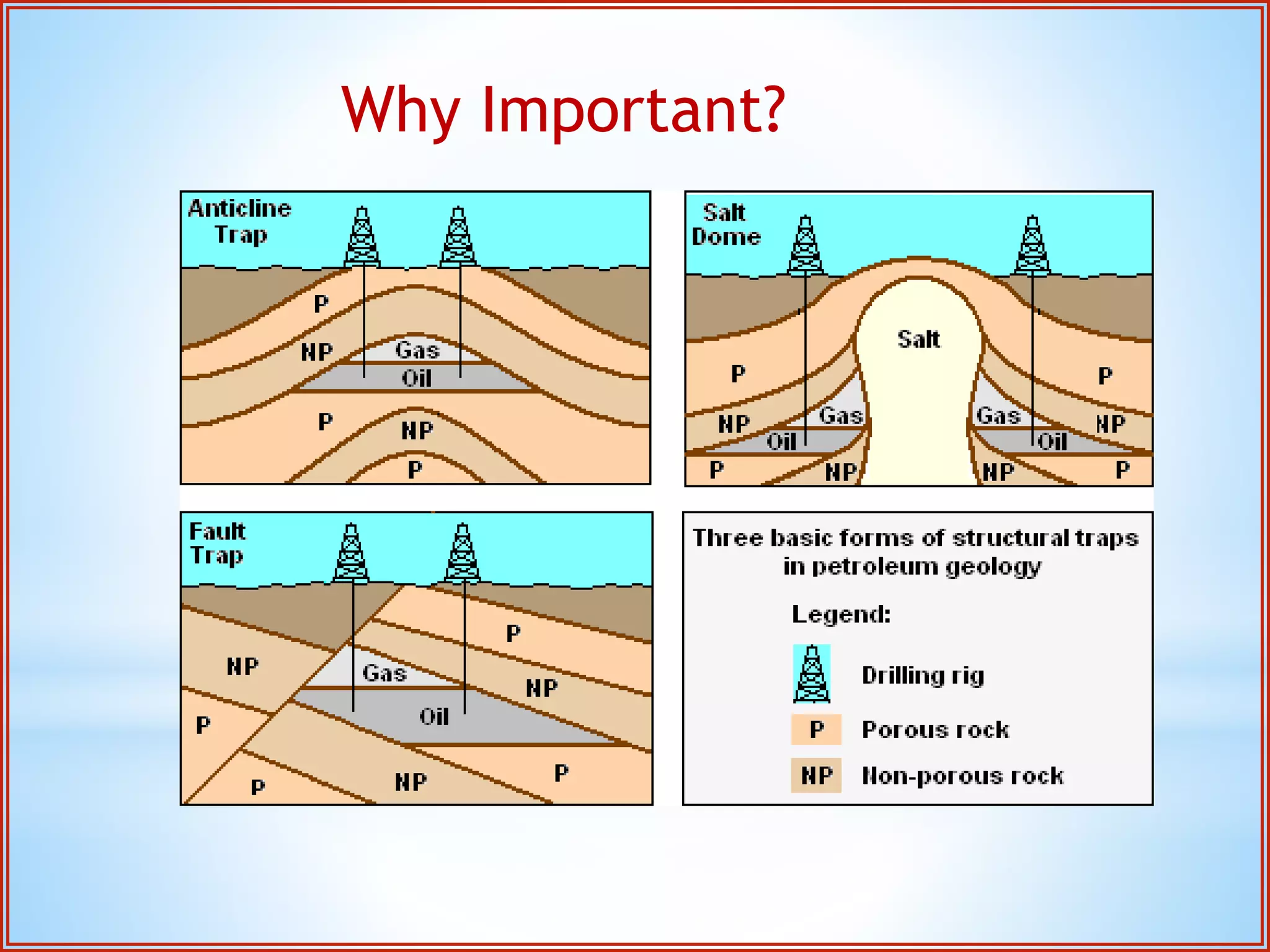
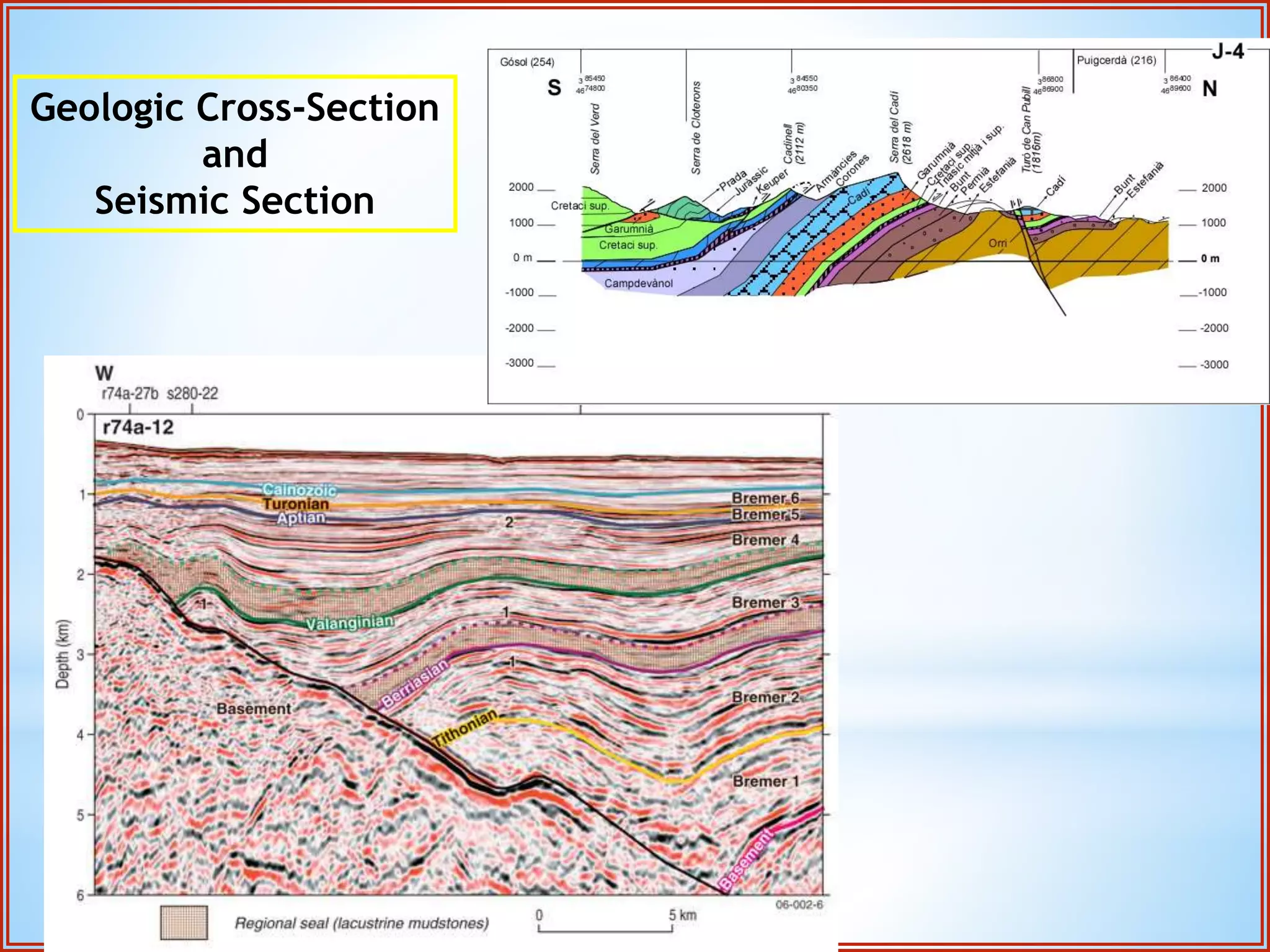
Why Important?
Geologic Cross-Section 
and 
Seismic Section 
5 Km
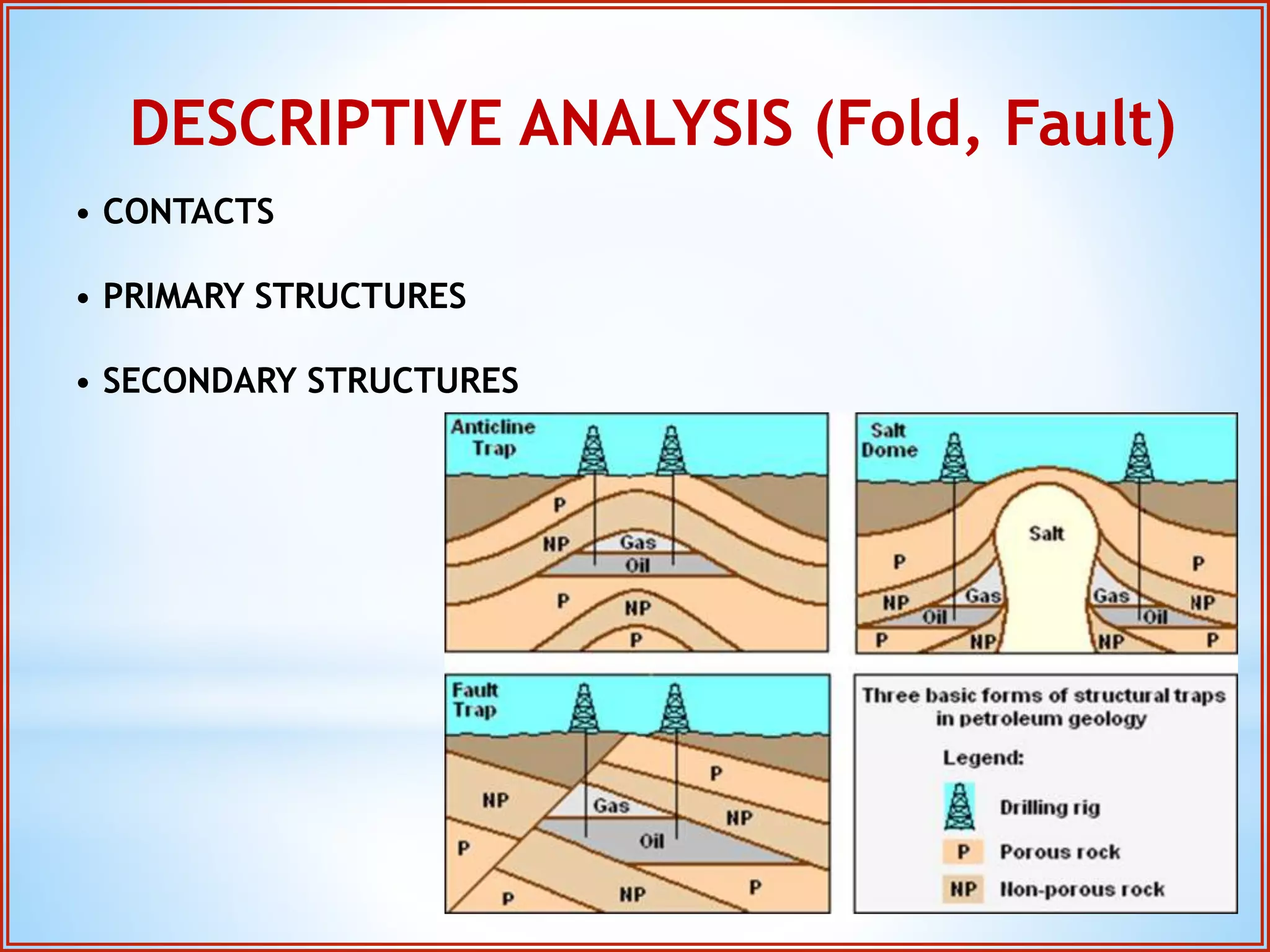
DESCRIPTIVE ANALYSIS (Fold, Fault) 
• CONTACTS 
• PRIMARY STRUCTURES 
• SECONDARY STRUCTURES
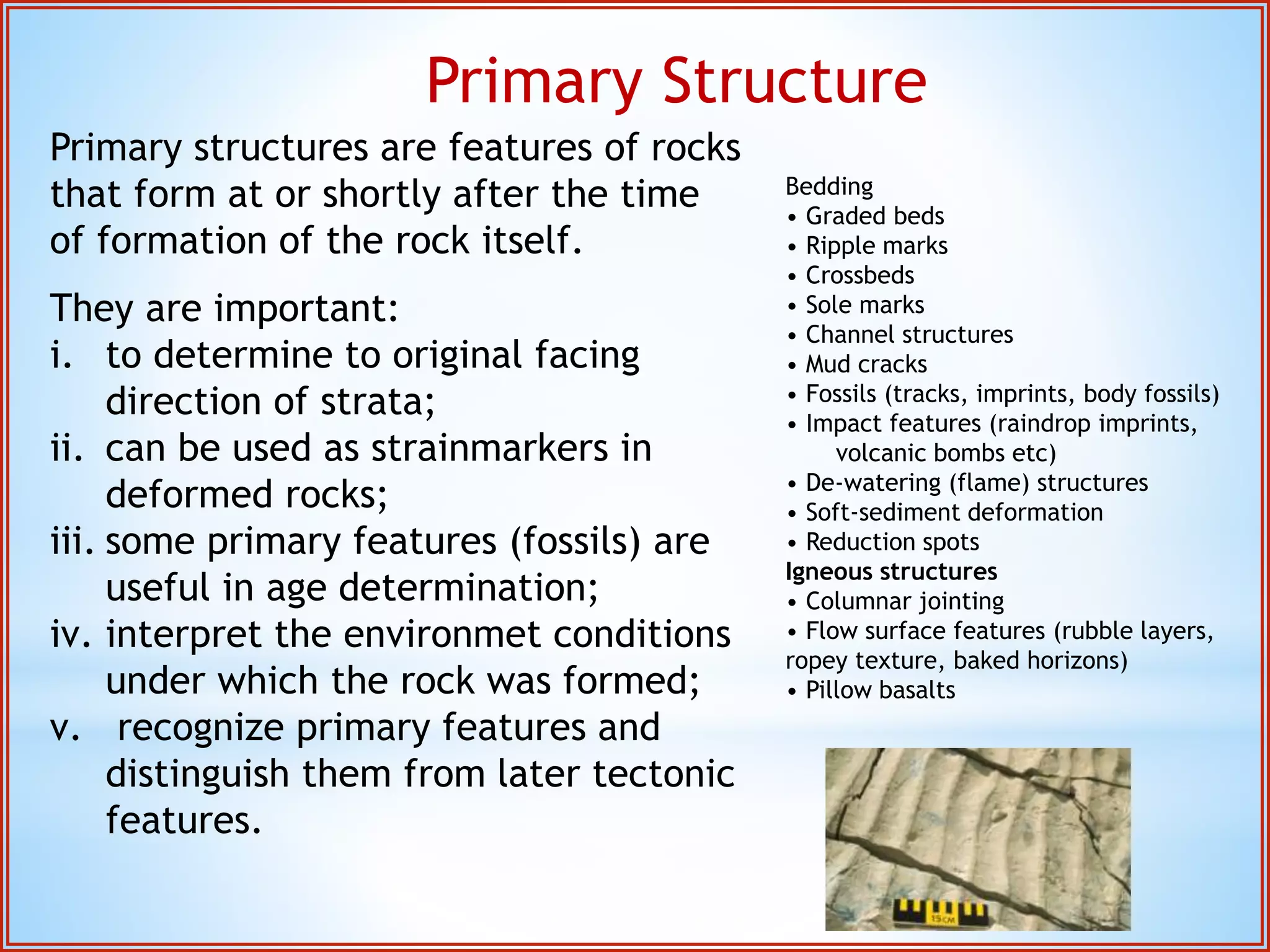
Primary Structure 
Primary structures are features of rocks 
that form at or shortly after the time 
of formation of the rock itself. 
They are important: 
i. to determine to original facing 
direction of strata; 
ii. can be used as strainmarkers in 
deformed rocks; 
iii. some primary features (fossils) are 
useful in age determination; 
iv. interpret the environmet conditions 
under which the rock was formed; 
v. recognize primary features and 
distinguish them from later tectonic 
features. 
Bedding 
• Graded beds 
• Ripple marks 
• Crossbeds 
• Sole marks 
• Channel structures 
• Mud cracks 
• Fossils (tracks, imprints, body fossils) 
• Impact features (raindrop imprints, 
volcanic bombs etc) 
• De-watering (flame) structures 
• Soft-sediment deformation 
• Reduction spots 
Igneous structures 
• Columnar jointing 
• Flow surface features (rubble layers, 
ropey texture, baked horizons) 
• Pillow basalts
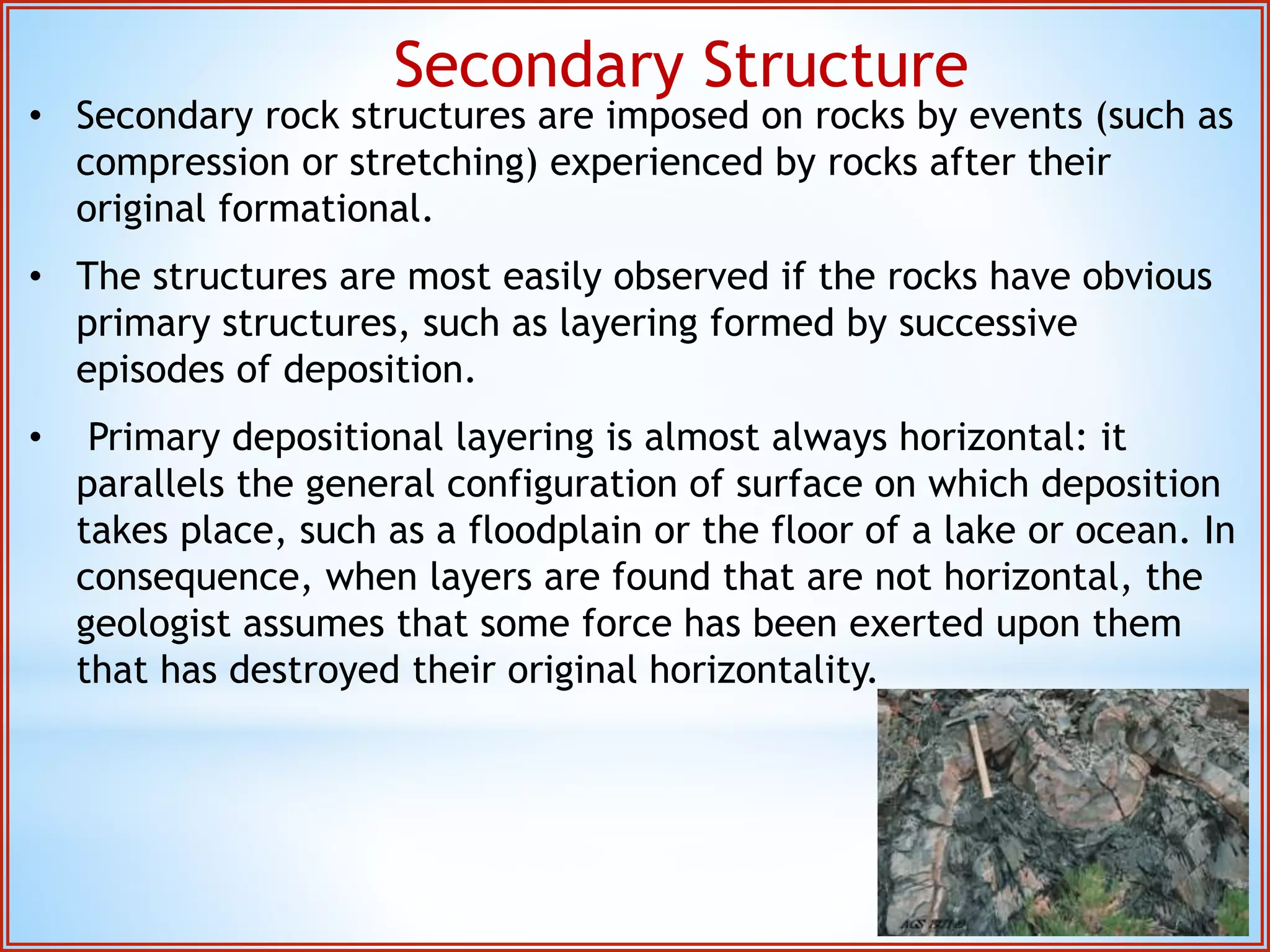
Secondary Structure 
• Secondary rock structures are imposed on rocks by events (such as 
compression or stretching) experienced by rocks after their 
original formational. 
• The structures are most easily observed if the rocks have obvious 
primary structures, such as layering formed by successive 
episodes of deposition. 
• Primary depositional layering is almost always horizontal: it 
parallels the general configuration of surface on which deposition 
takes place, such as a floodplain or the floor of a lake or ocean. In 
consequence, when layers are found that are not horizontal, the 
geologist assumes that some force has been exerted upon them 

that has destroyed their original horizontality.
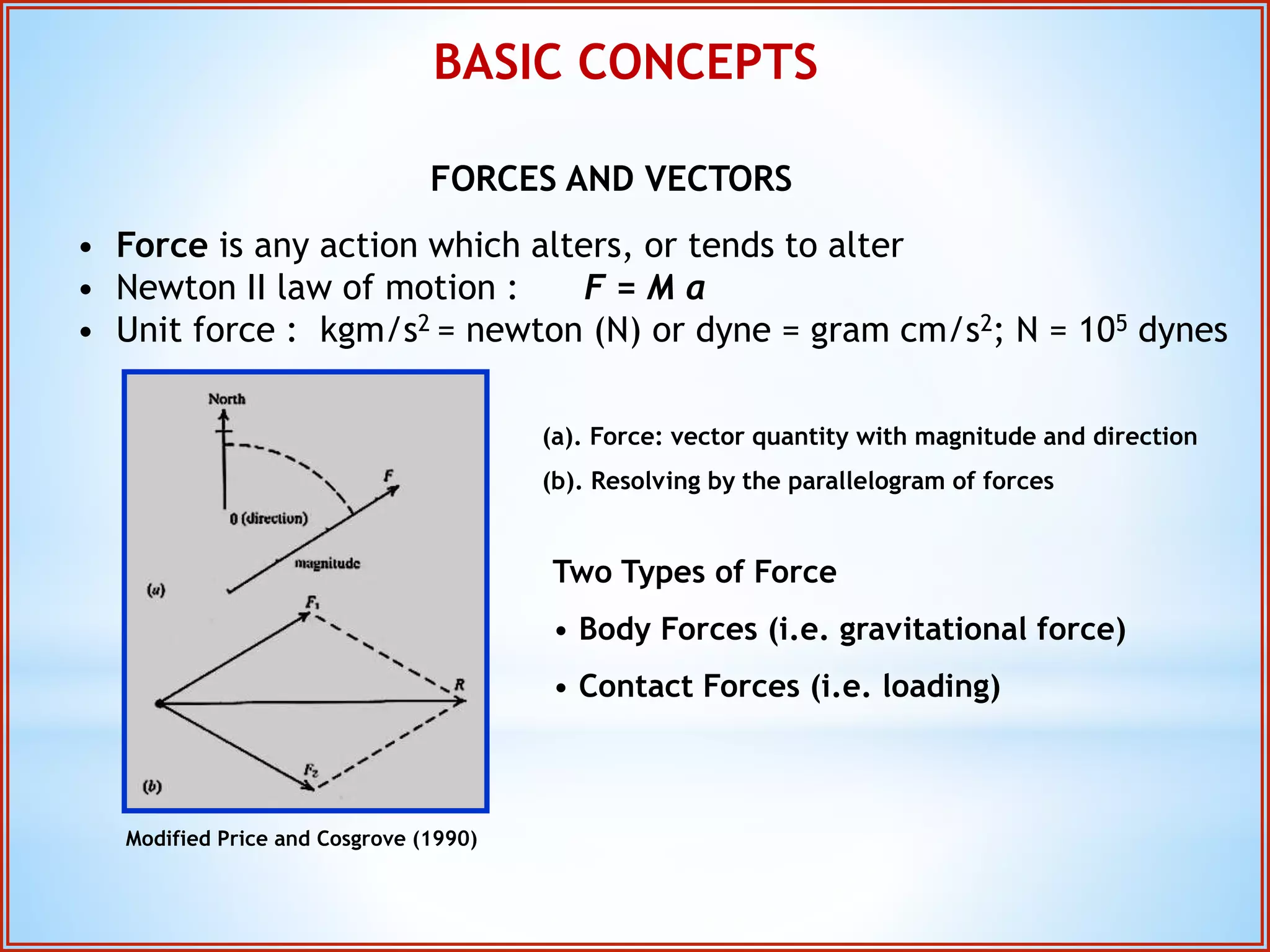
BASIC CONCEPTS 
FORCES AND VECTORS 
• Force is any action which alters, or tends to alter 
• Newton II law of motion : F = M a 
• Unit force : kgm/s2 = newton (N) or dyne = gram cm/s2; N = 105 dynes 
(a). Force: vector quantity with magnitude and direction 
(b). Resolving by the parallelogram of forces 
Modified Price and Cosgrove (1990) 
Two Types of Force 
• Body Forces (i.e. gravitational force) 
• Contact Forces (i.e. loading)
• F= m x a , gravitational acceleration: 9.8 m/sec2 
•vector quantity: orientation and size. 
•can be applied to any plane. 
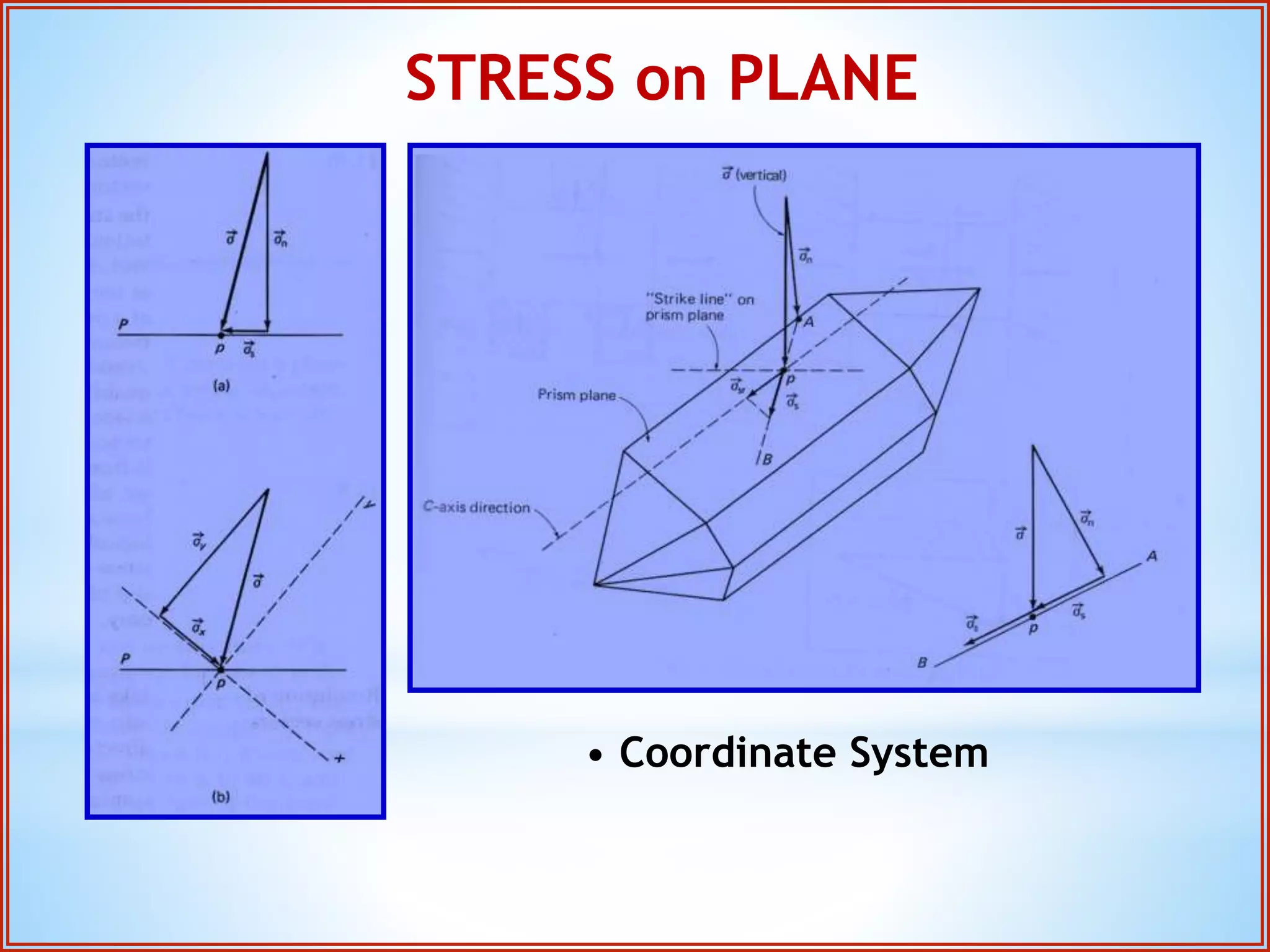
•normal and shear components on a plane can be resolved from an oblique 
force (see diagram to the right). 
•shear component promotes slip on the plane and the normal component 
inhibits slip on a plane, and the ratio of the two at which slip occurs 
describes the 'friction' on the plane. 
Pressure within a geologic context: 
•describes multitude of forces at a point within a fluid. 
•limit of F/area as area goes to 0 
•fluids can not withstand a shear stress for a significant period of time, 
therefore if static non-flowing, all force vectors equal in size, and all must 
be normal vectors acting perpendicular to any given plane. Hence can be 
described by one number. 
•this is a special simple stress state - hydrostatic stress state. 
•geologic pressures: pore fluid pressures, magmatic pressures, 'rock 
pressure' = nondeviatoric component. 
•related strain? change in volume, no distortion (unless material is 
anisotropic with respect to mechanical properties).
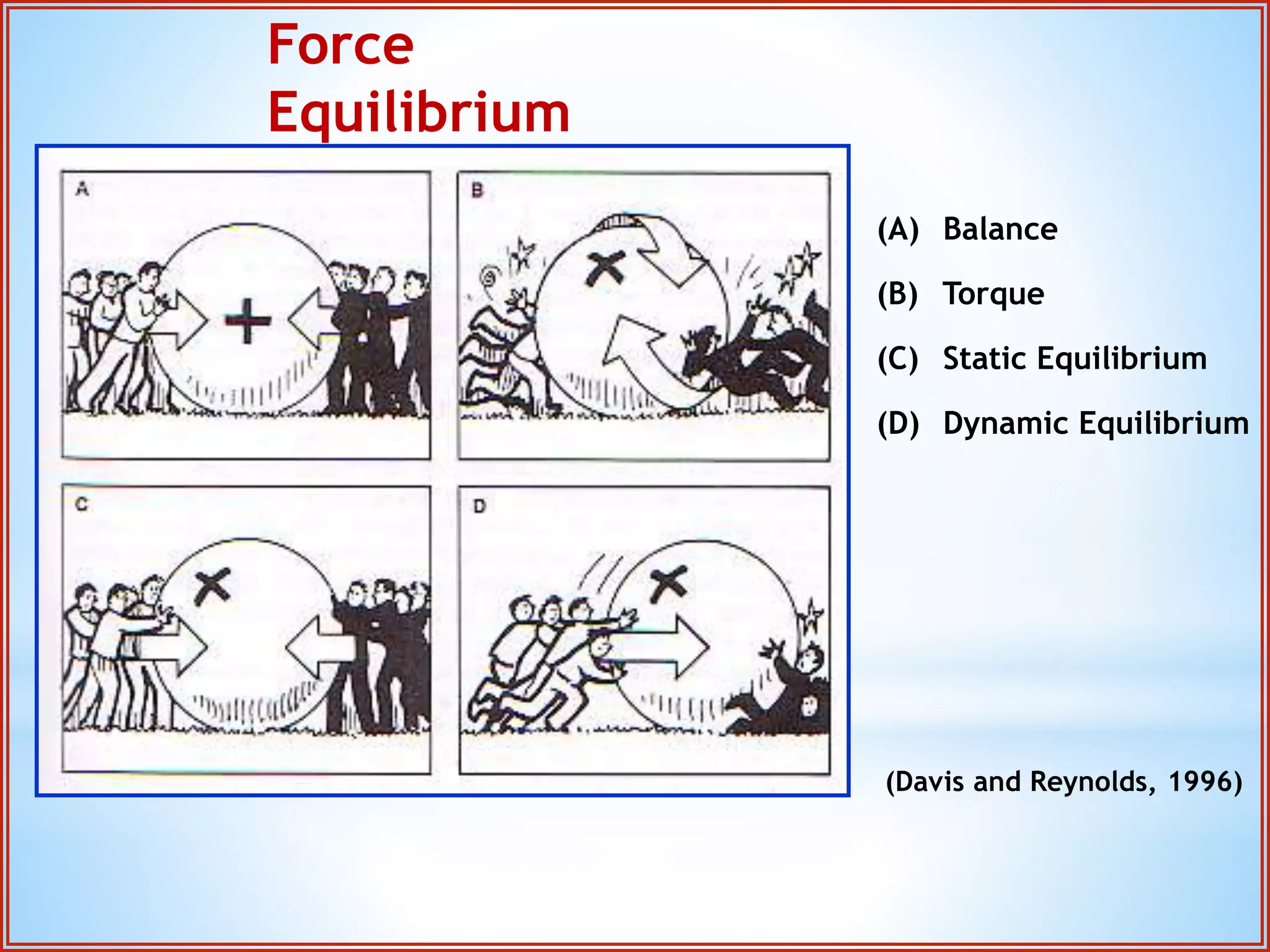
Force 
Equilibrium 
(A) Balance 
(B) Torque 
(C) Static Equilibrium 
(D) Dynamic Equilibrium 
(Davis and Reynolds, 1996)
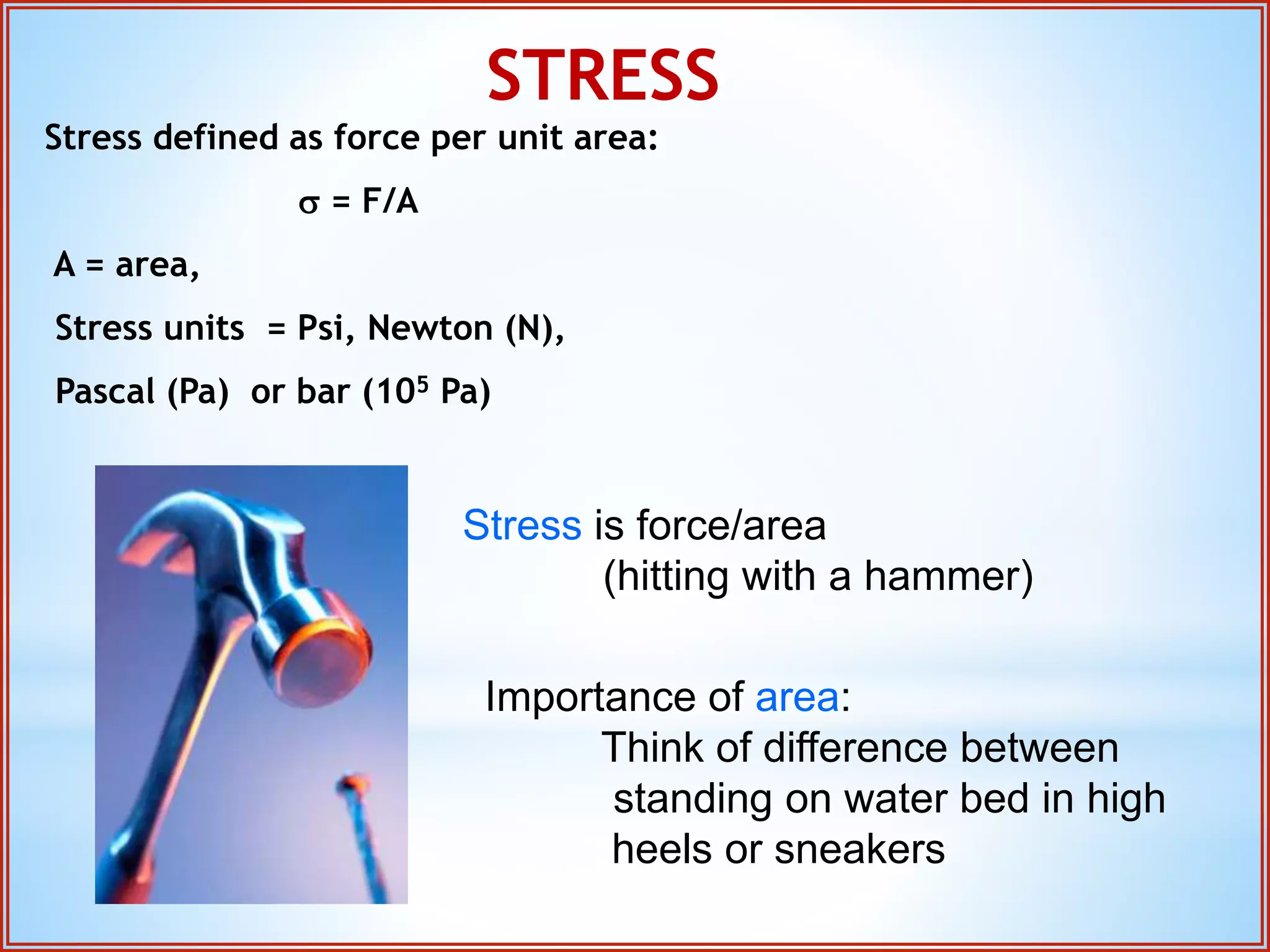
STRESS 
Stress defined as force per unit area: 
s = F/A 
A = area, 
Stress units = Psi, Newton (N), 
Pascal (Pa) or bar (105 Pa) 
Stress is force/area 
(hitting with a hammer) 
Importance of area: 
Think of difference between 
standing on water bed in high 
heels or sneakers
Stress 
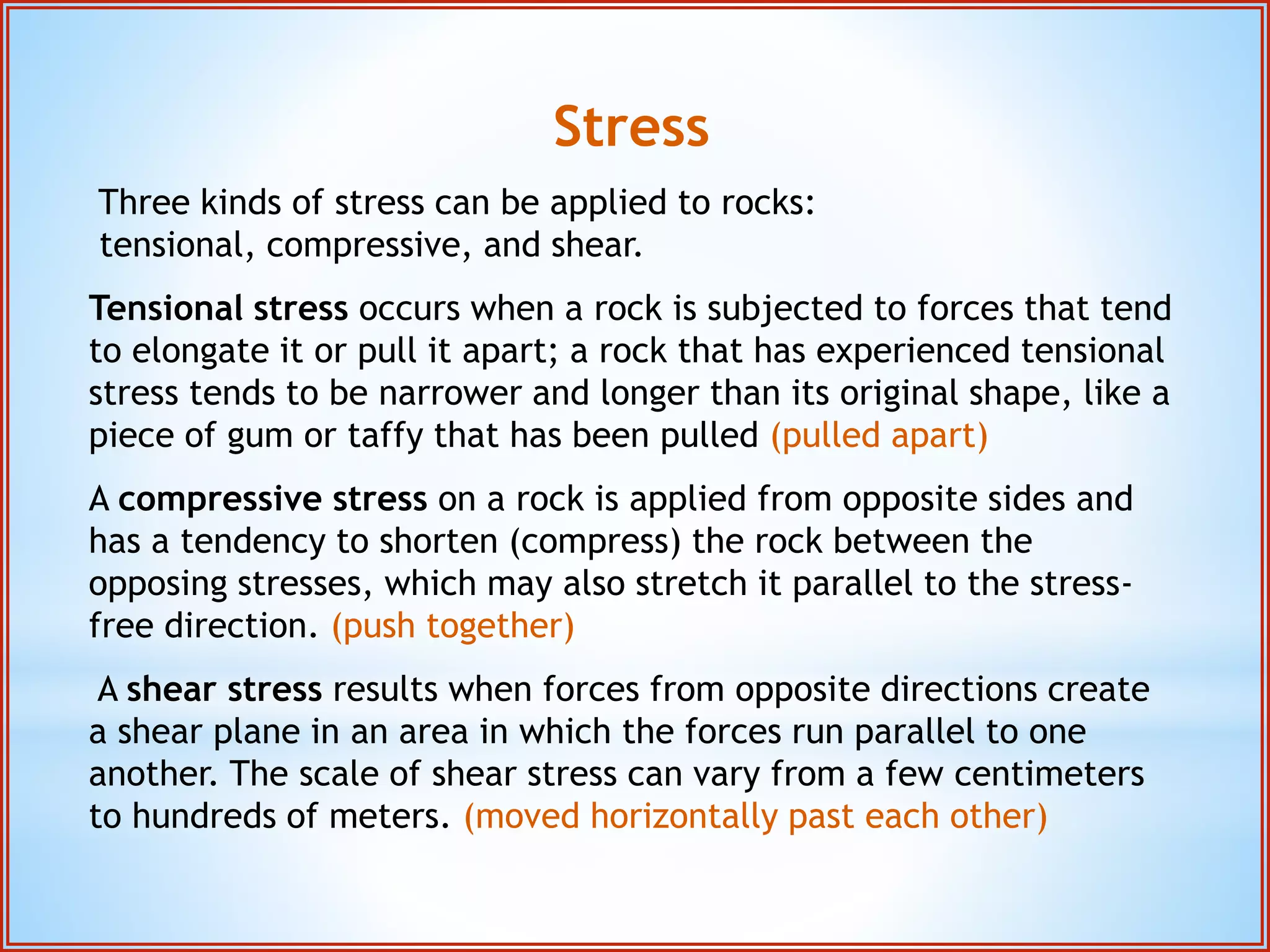
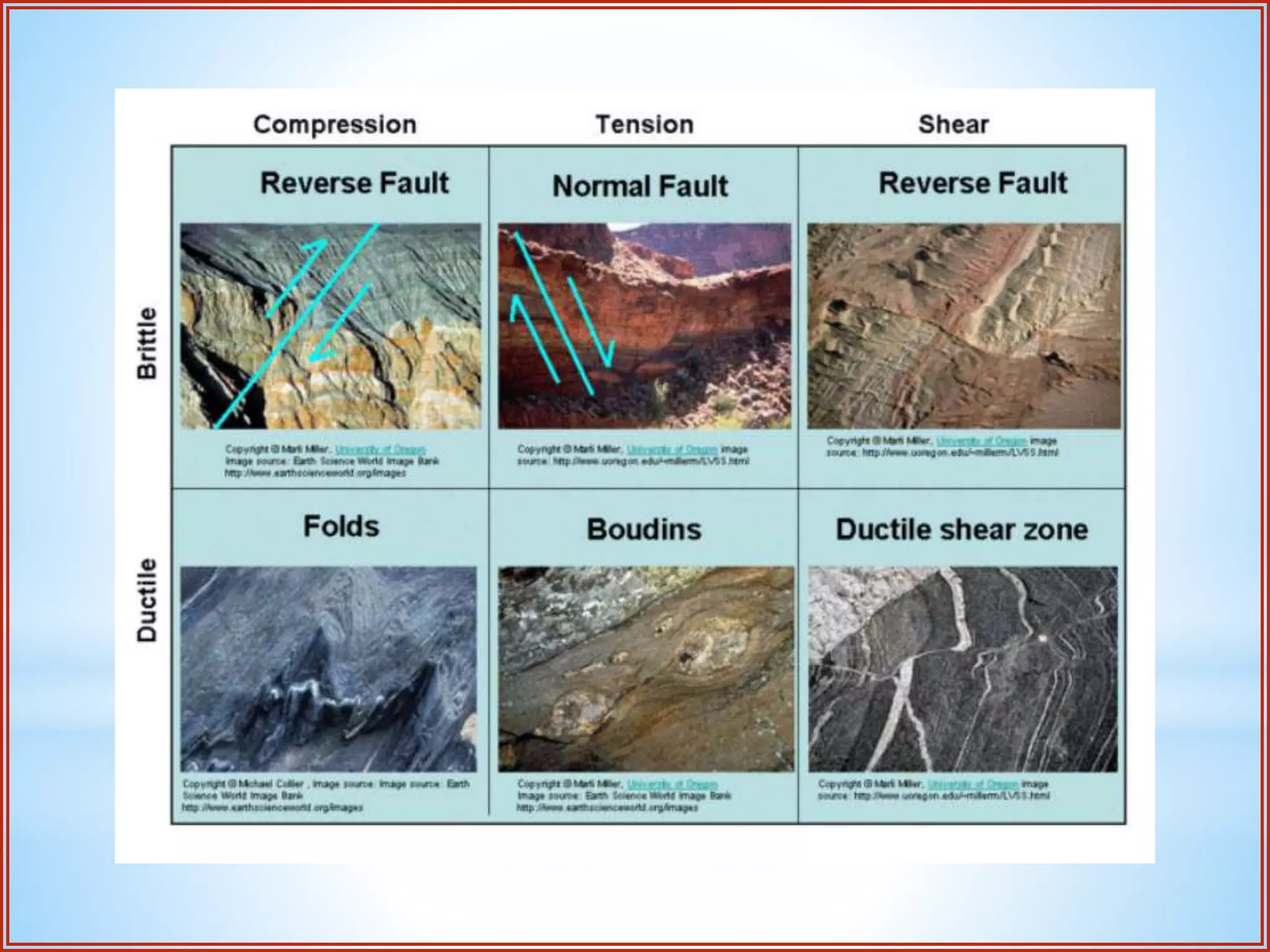
Three kinds of stress can be applied to rocks: 
tensional, compressive, and shear. 
Tensional stress occurs when a rock is subjected to forces that tend 
to elongate it or pull it apart; a rock that has experienced tensional 
stress tends to be narrower and longer than its original shape, like a 
piece of gum or taffy that has been pulled (pulled apart) 
A compressive stress on a rock is applied from opposite sides and 
has a tendency to shorten (compress) the rock between the 
opposing stresses, which may also stretch it parallel to the stress-free 
direction. (push together) 
A shear stress results when forces from opposite directions create 
a shear plane in an area in which the forces run parallel to one 
another. The scale of shear stress can vary from a few centimeters 
to hundreds of meters. (moved horizontally past each other)
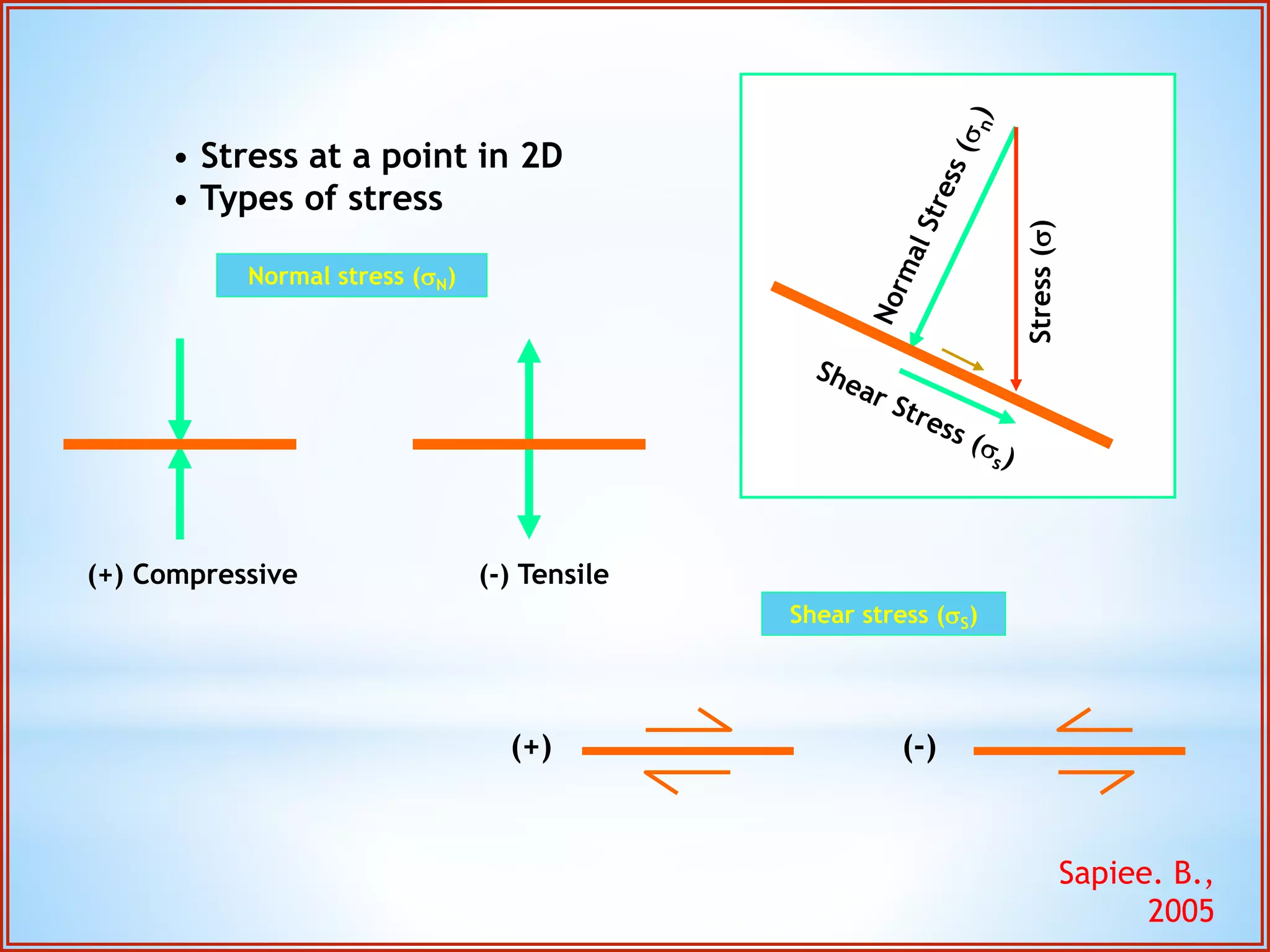
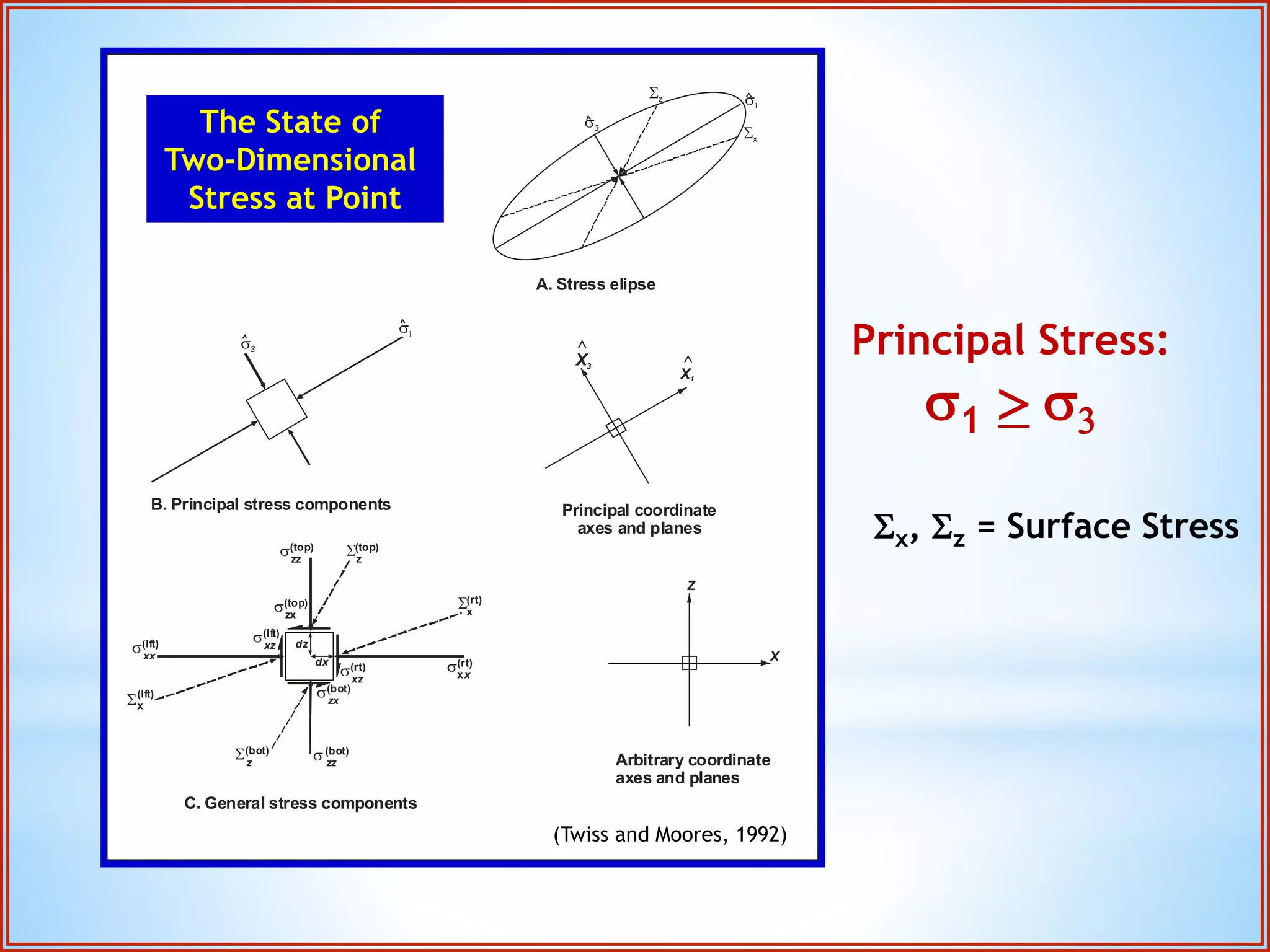
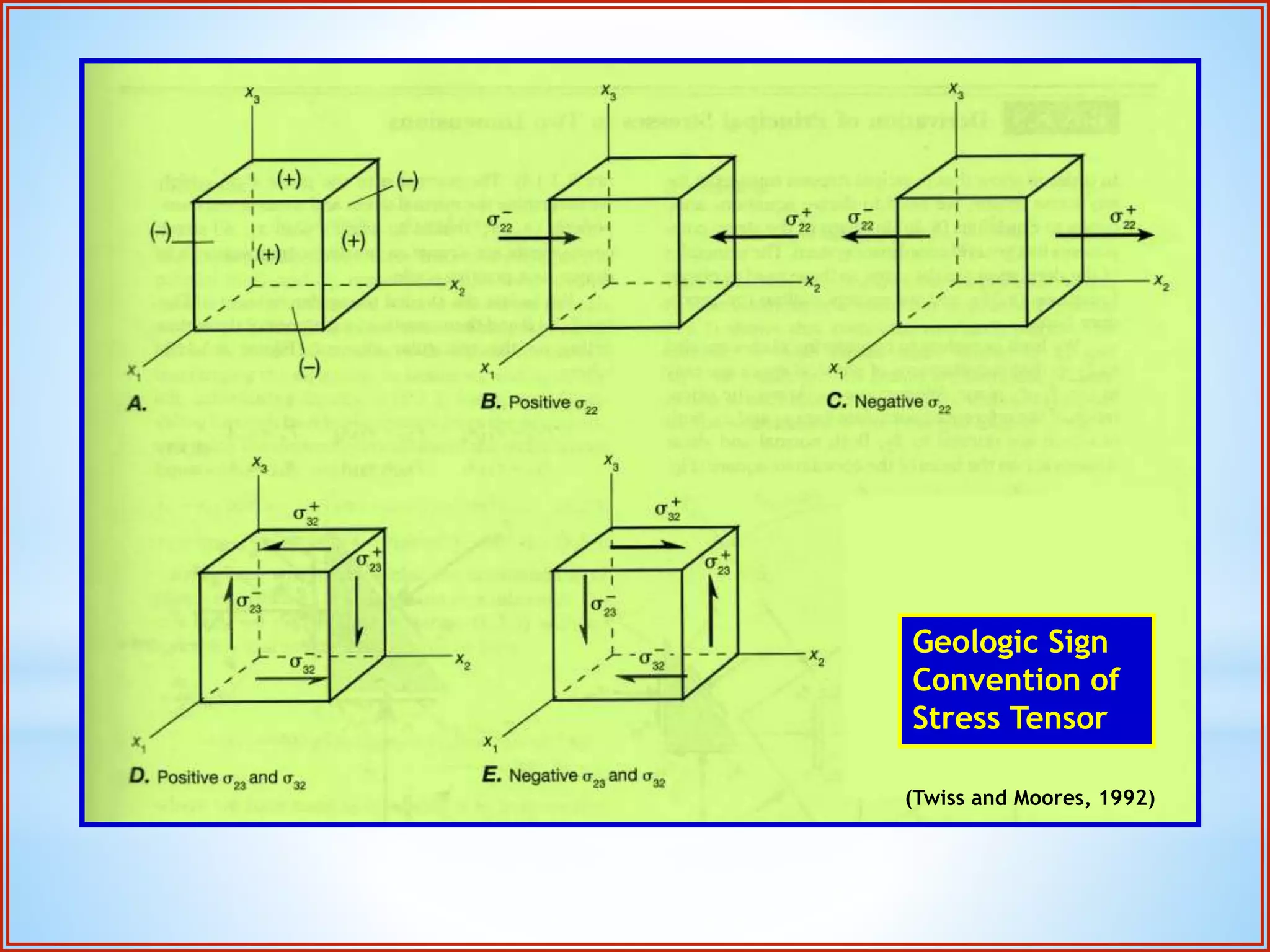
• Stress at a point in 2D 
• Types of stress 
Stress (s) 
Normal stress (sN) 
(+) Compressive (-) Tensile 
Shear stress (sS) 
(+) (-) 
Sapiee. B., 
2005
STRESS on PLANE 
• Coordinate System
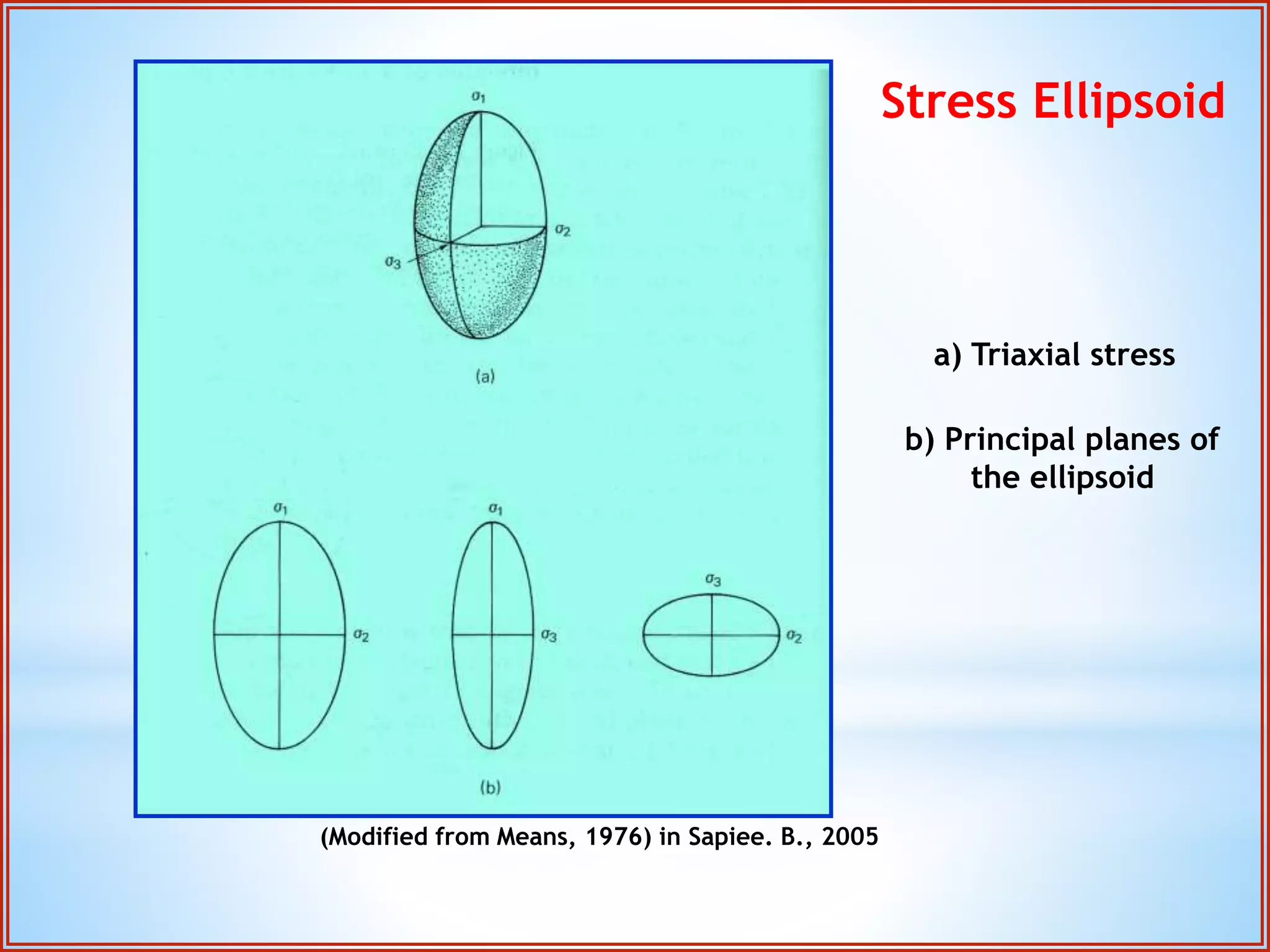
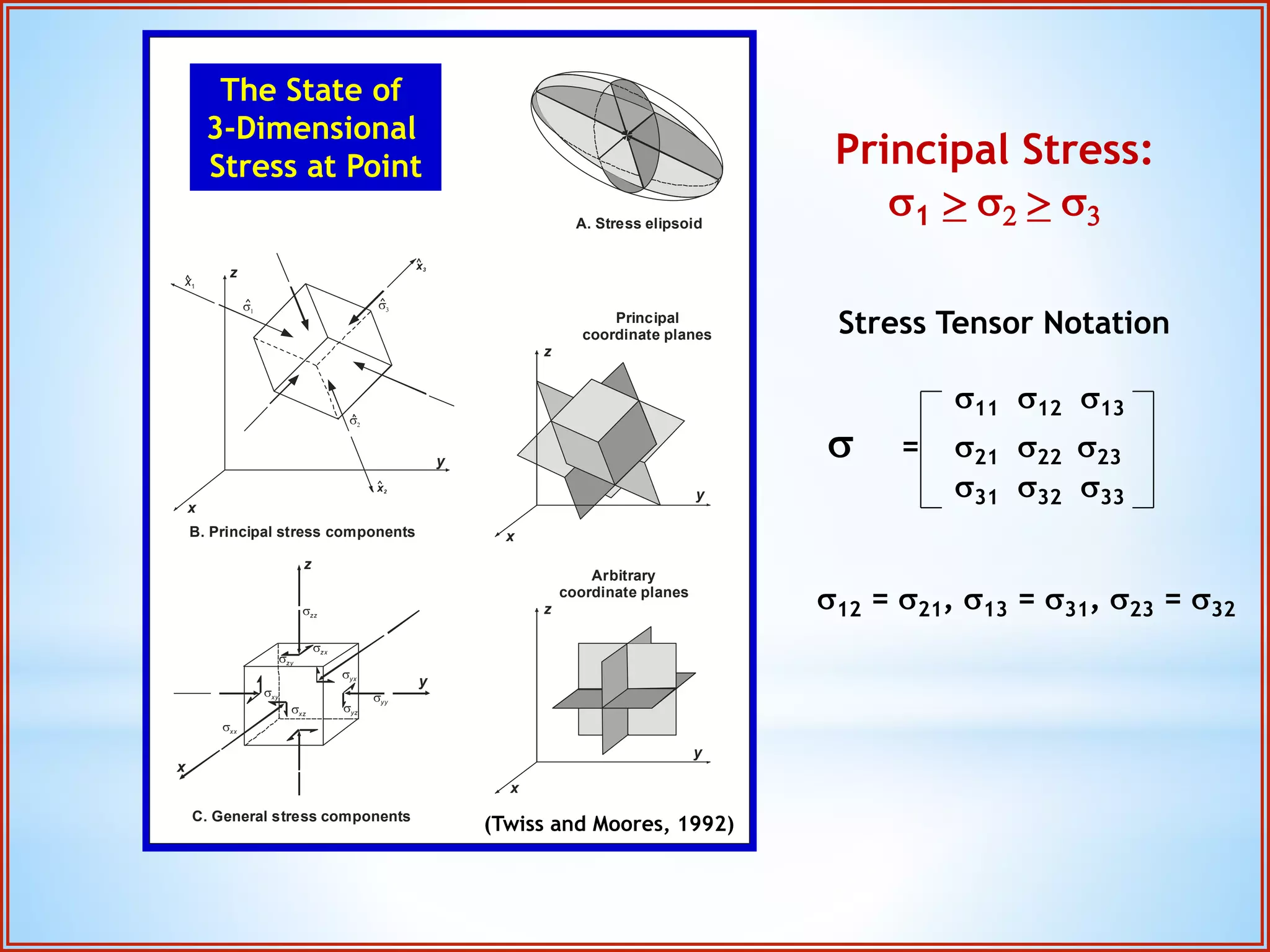
Stress Ellipsoid 
a) Triaxial stress 
b) Principal planes of 
the ellipsoid 
(Modified from Means, 1976) in Sapiee. B., 2005
z s 
s3 x 
X1 
Arbitrary coordinate 
axes and planes 
B. Principal stress components 
s(top) 
zx 
C. General stress components 
X 
Principal coordinate 
axes and planes 
Z 
s 
s 
 
(lft) 
xx 
(lft) 
x 
(top) 
zz 
s 
dx 
s (bot) 
zz 
dz 
s(rt) 
xz 
(bot) 
z 
s(rt) 
xx 
s(bot) 
zx 
(lft) 
xz 
s 
(rt) 
x 
X3 
s3 
(top) 
z 
A. Stress elipse 
The State of 
Two-Dimensional 
Stress at Point 
(Twiss and Moores, 1992) 
Principal Stress: 
s1 > s3 
x, z = Surface Stress
The State of 
3-Dimensional 
Stress at Point Principal Stress: 
s 
z 
x1 
x 
s3 
B. Principal stress components 
x3 
y 
A. Stress elipsoid 
y x2 
x 
x 
y 
z 
s 
x 
szy 
syx 
z 
szz 
sxy syy 
syz 
sxx 
szx 
sxz 
y 
Arbitrary 
coordinate planes 
C. General stress components 
z 
Principal 
coordinate planes 
s1 > s > s3 
Stress Tensor Notation 
s11 s12 s13 
s = s21 s22 s23 
s31 s32 s33 
s12 = s21, s13 = s31, s23 = s32 
(Twiss and Moores, 1992)
Geologic Sign 
Convention of 
Stress Tensor 
(Twiss and Moores, 1992)
sn 
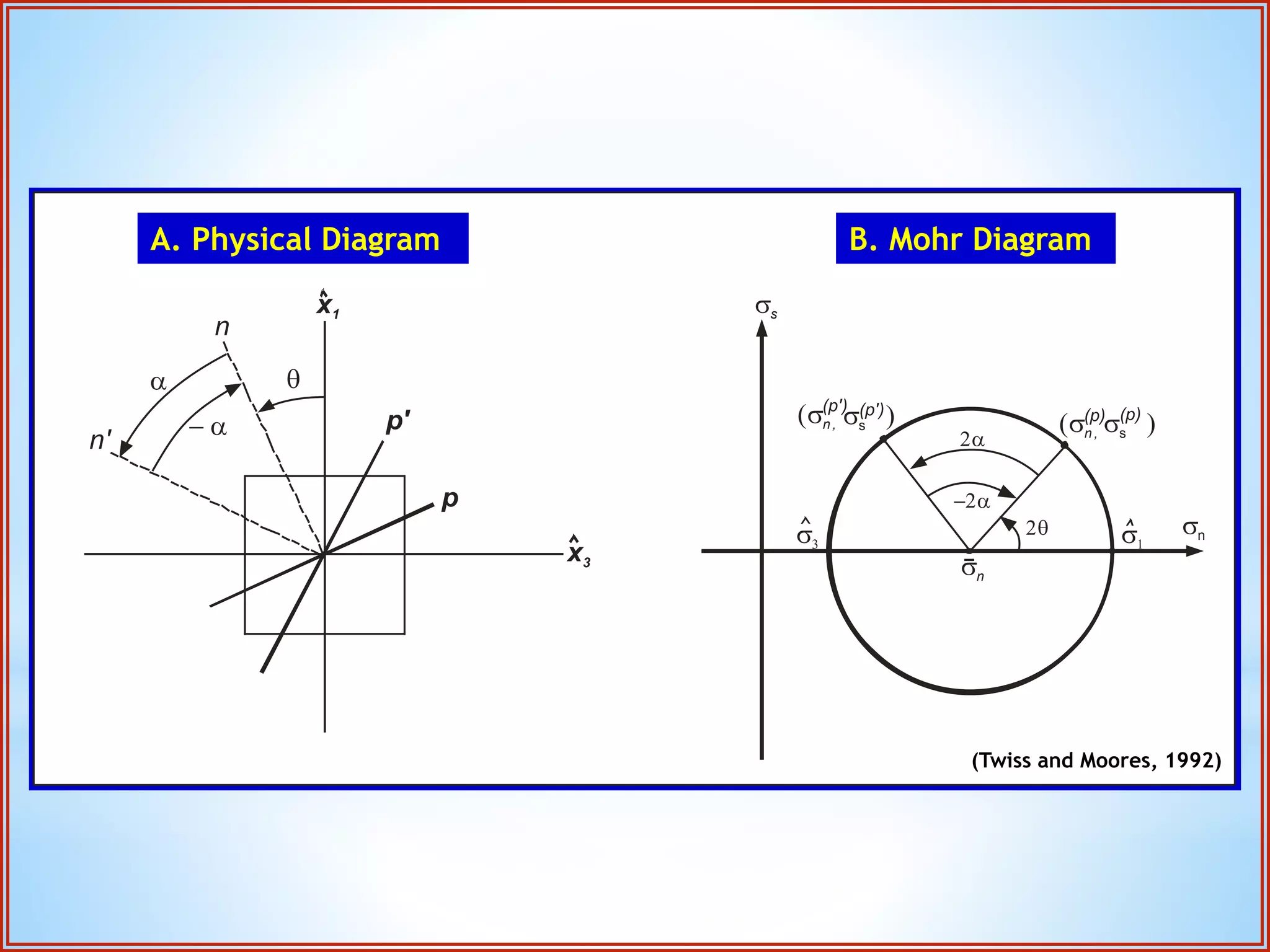
A. Physical Diagram A. Mohr Diagram 
r 
n 
(p) s  s 
(p) 
(p) 
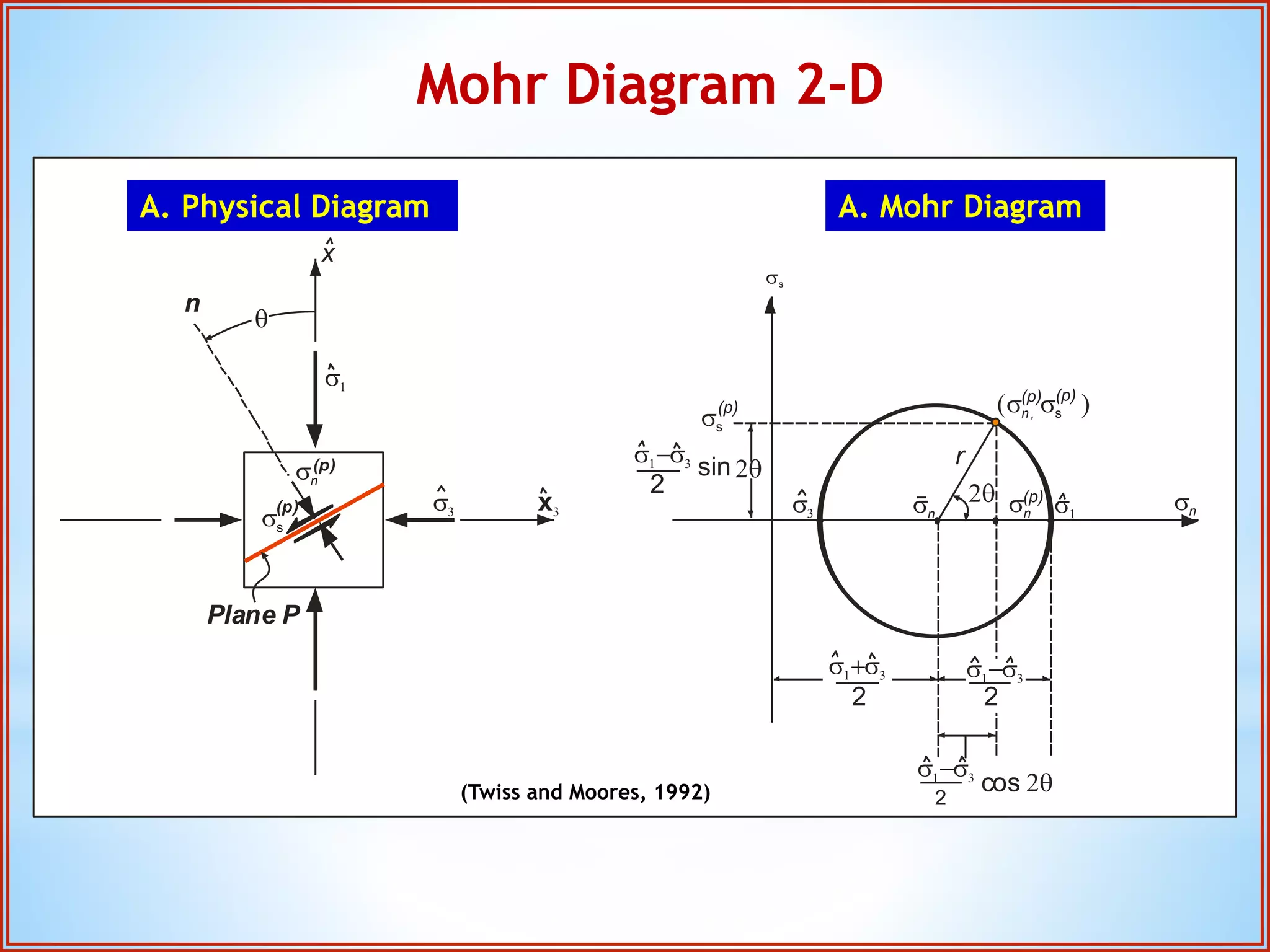
Mohr Diagram 2-D 
(p) s  s 
(p) sn 
s  s 
2 
2 
s s   3 
2 
sn 
s s   3 
sn , 
s 
s s   
  3 cos 
2 
s s   
  3 sin 
ss 
x  3 
s(p) n 
s3 
 
s 
Plane P 
x 
s3 
(Twiss and Moores, 1992)
A. Physical Diagram B. Mohr Diagram 
 
x3 
n' 
p 
(p') 
 
p' 
n 
x1 
 
 
(p') 
sn , 
ss 
sn 
 
s  s 
s 
sn 
s3 
(p) sn , 
(p)s  s 
 
(Twiss and Moores, 1992)
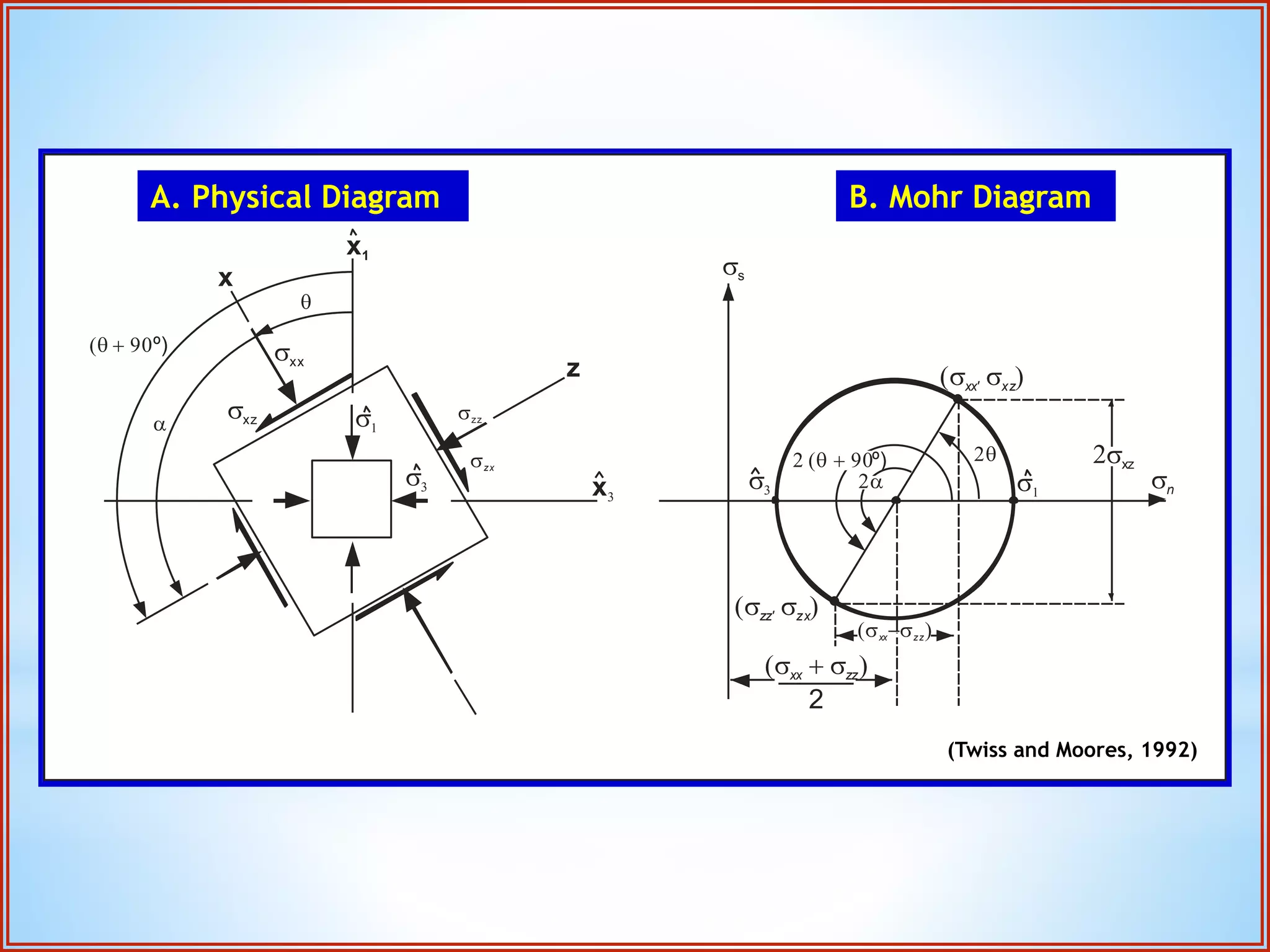
A. Physical Diagram B. Mohr Diagram 
s s  xx' xz 
 
sxx 
s s  zz' zx 
s s  xx zz 
2 
s s  xx zz 
ss 
sxz 
s sn 
 º) 
 s 
s3 
szz 
szx 
z 
s3 
 
x3 
x1 
x 
sxz 
º) 
 
(Twiss and Moores, 1992)
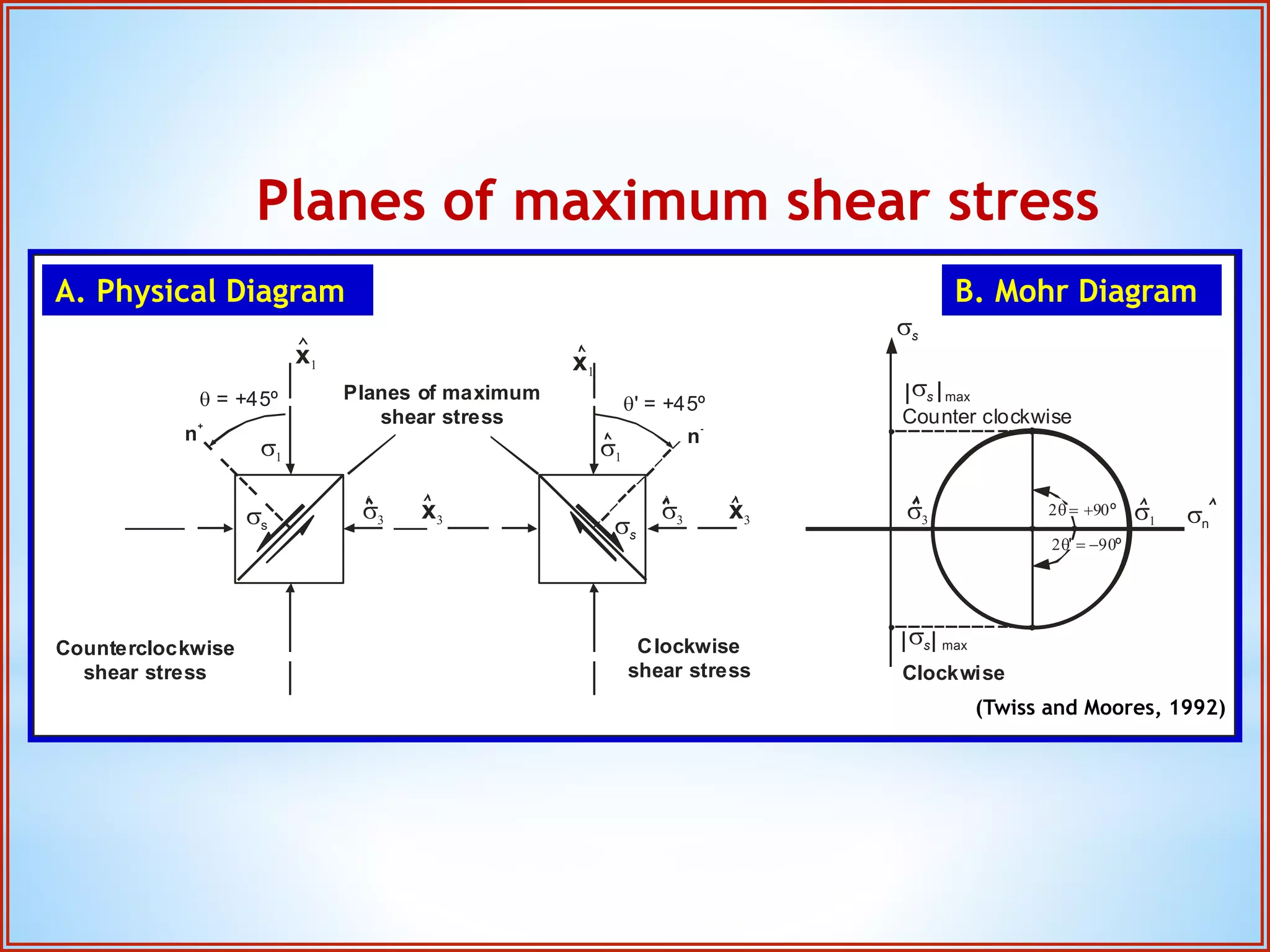
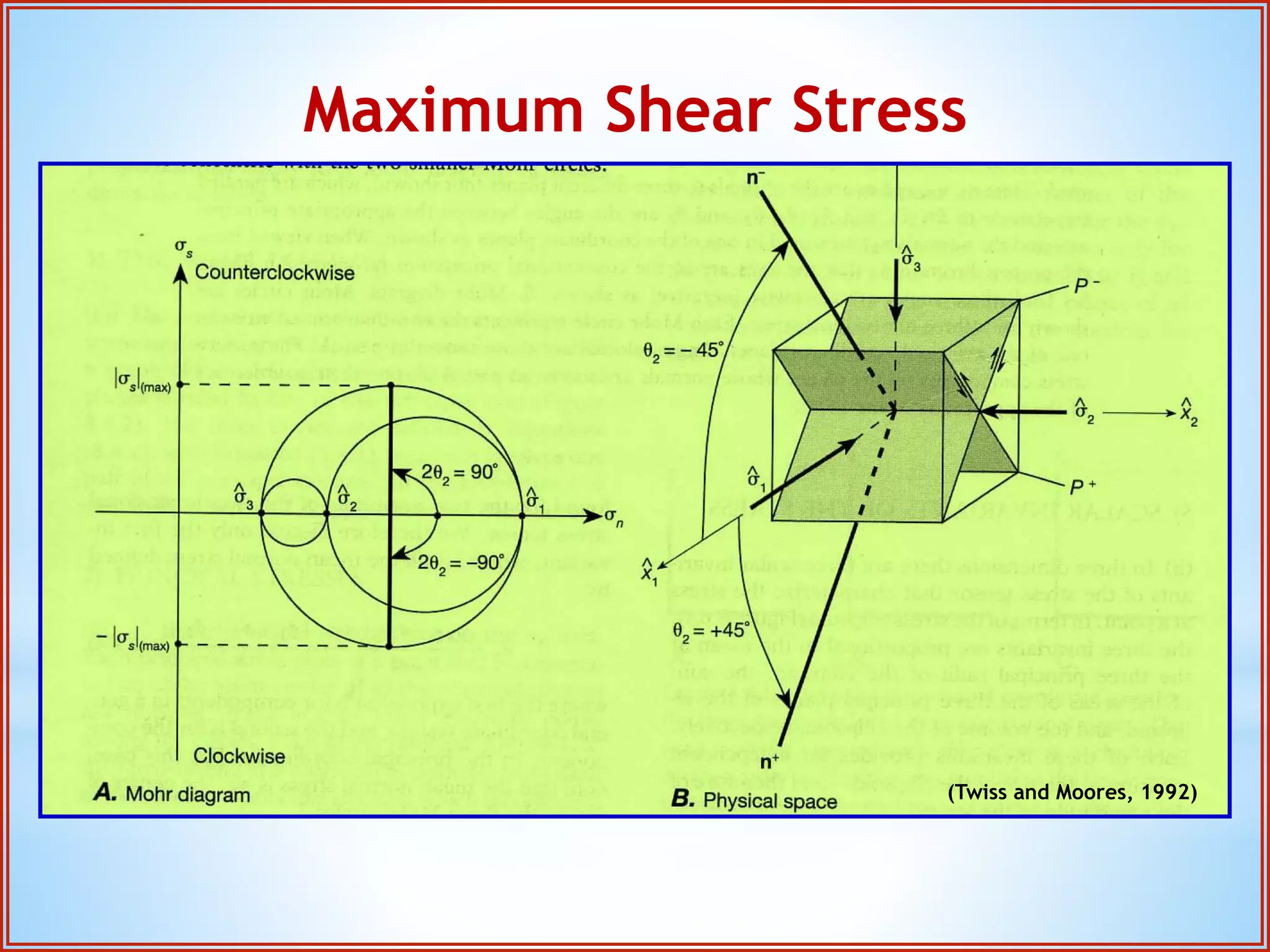
Planes of maximum shear stress 
A. Physical Diagram B. Mohr Diagram 
n- 
Planes of maximum 
shear stress 
x3 
Clockwise 
shear stress 
x 
ss ss 
Counterclockwise 
shear stress 
' = +45º 
s 
x3 s3 
s 
n+ 
ss 
x 
 = +45º 
s  s max 
Counter clockwise 
s s3 
 º sn 
s  s max 
Clockwise 
'º 
s3 
(Twiss and Moores, 1992)
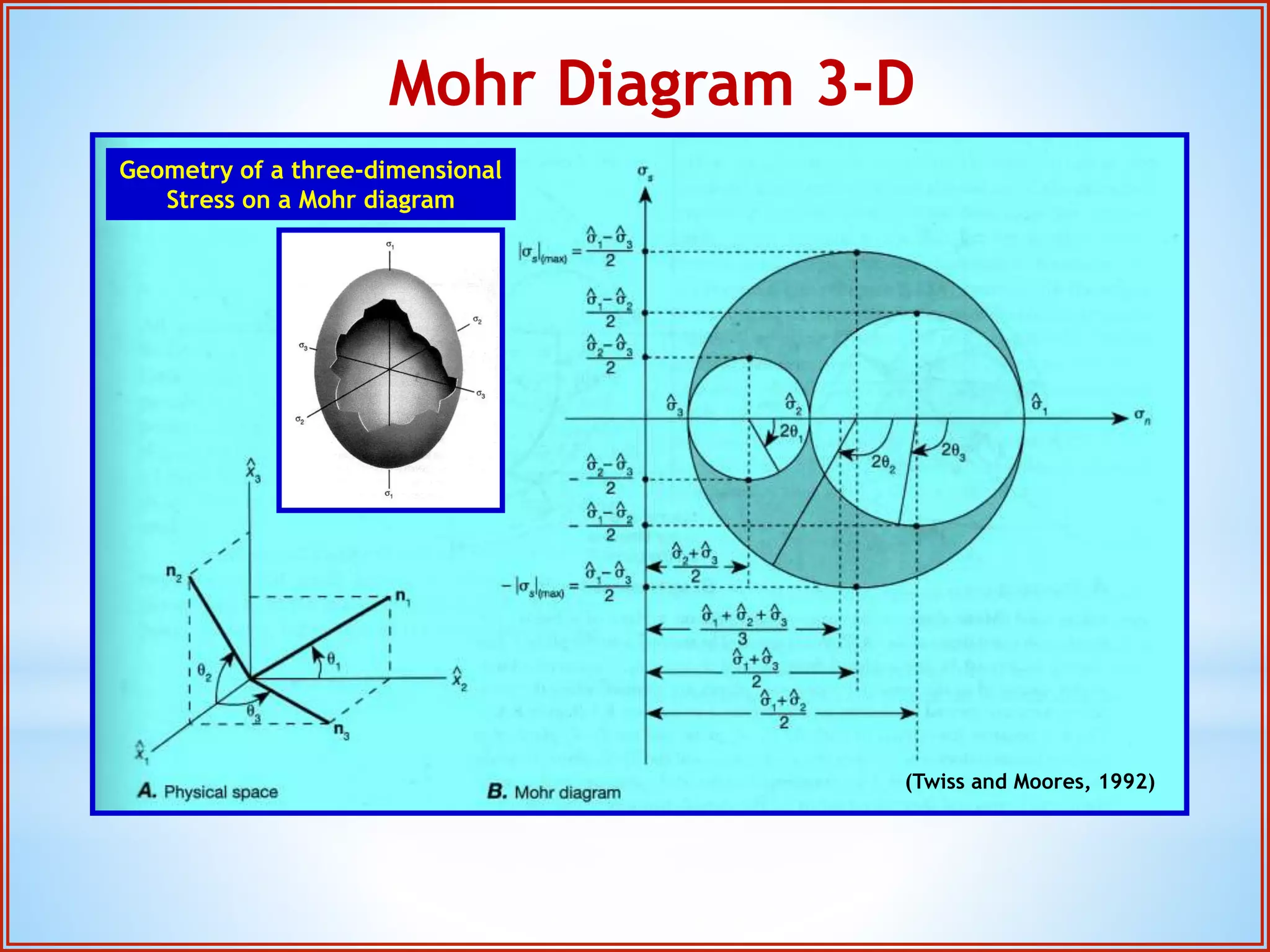
Mohr Diagram 3-D 
(Twiss and Moores, 1992) 
Geometry of a three-dimensional 
Stress on a Mohr diagram
Maximum Shear Stress 
(Twiss and Moores, 1992)
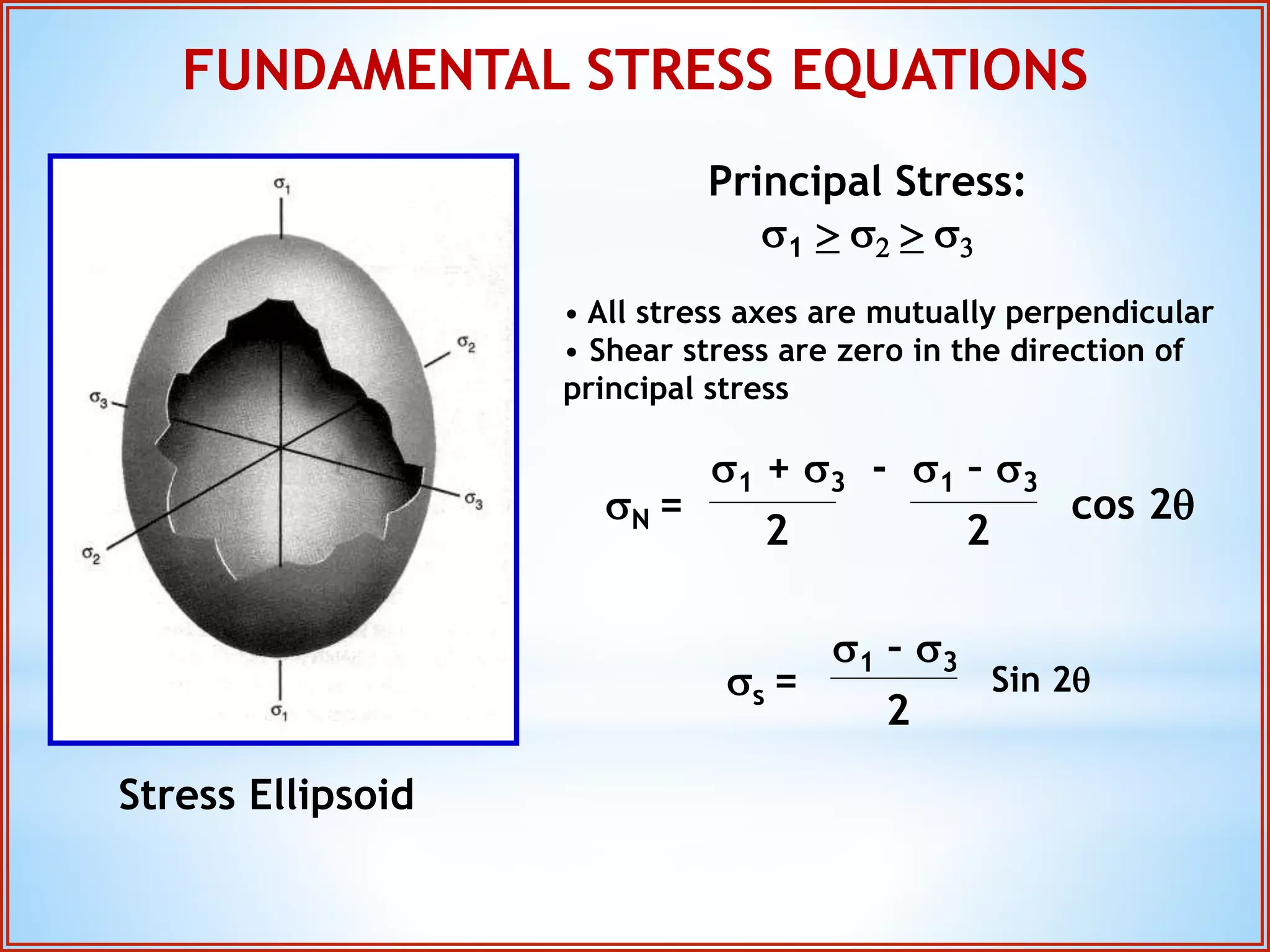
FUNDAMENTAL STRESS EQUATIONS 
Stress Ellipsoid 
Principal Stress: 
s1 > s > s3 
• All stress axes are mutually perpendicular 
• Shear stress are zero in the direction of 
principal stress 
s1 + s3 - s1 – s3 
sN = cos 2 
2 2 
s1 – s3 
ss = Sin 2 
2
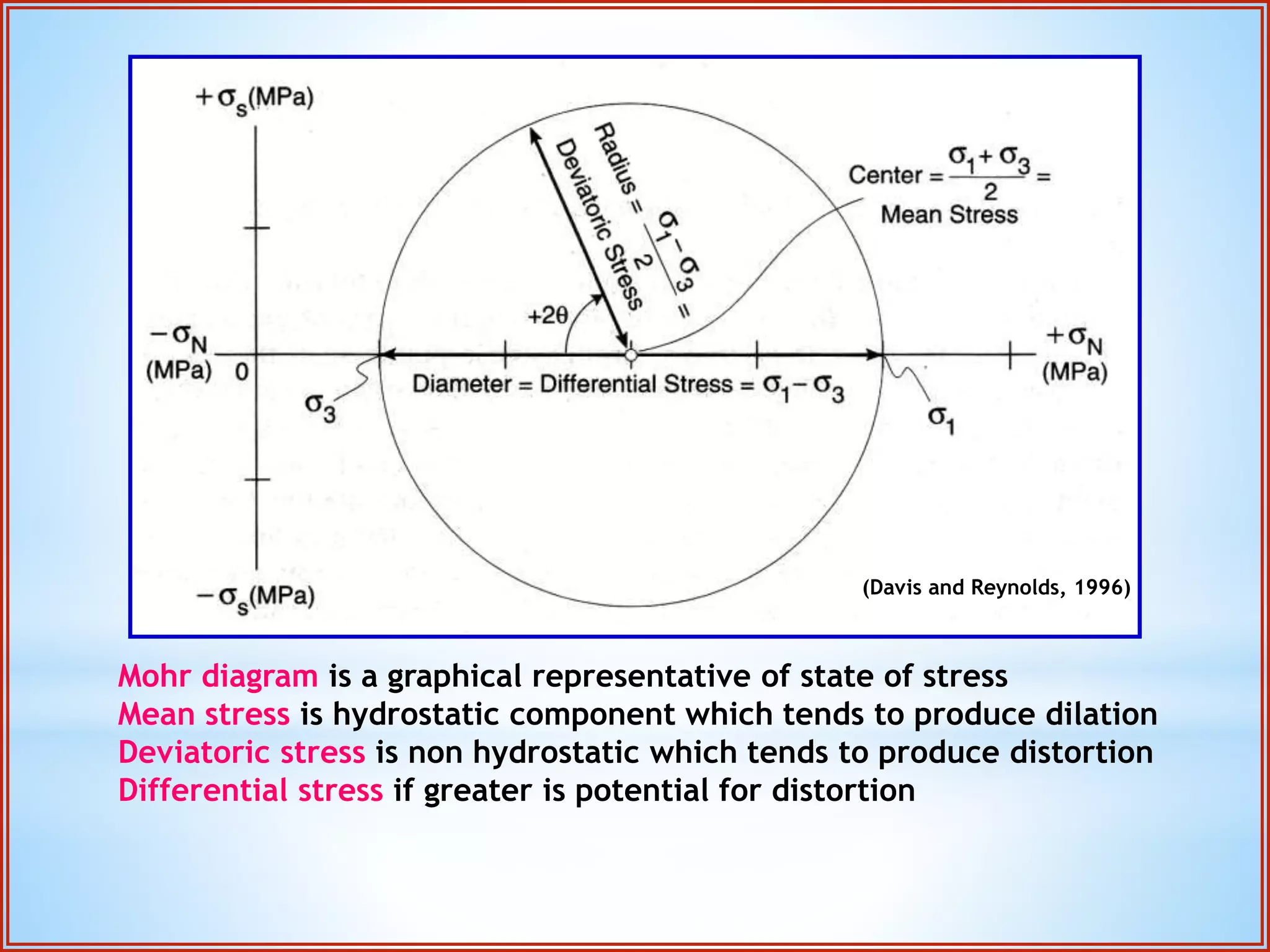
(Davis and Reynolds, 1996) 
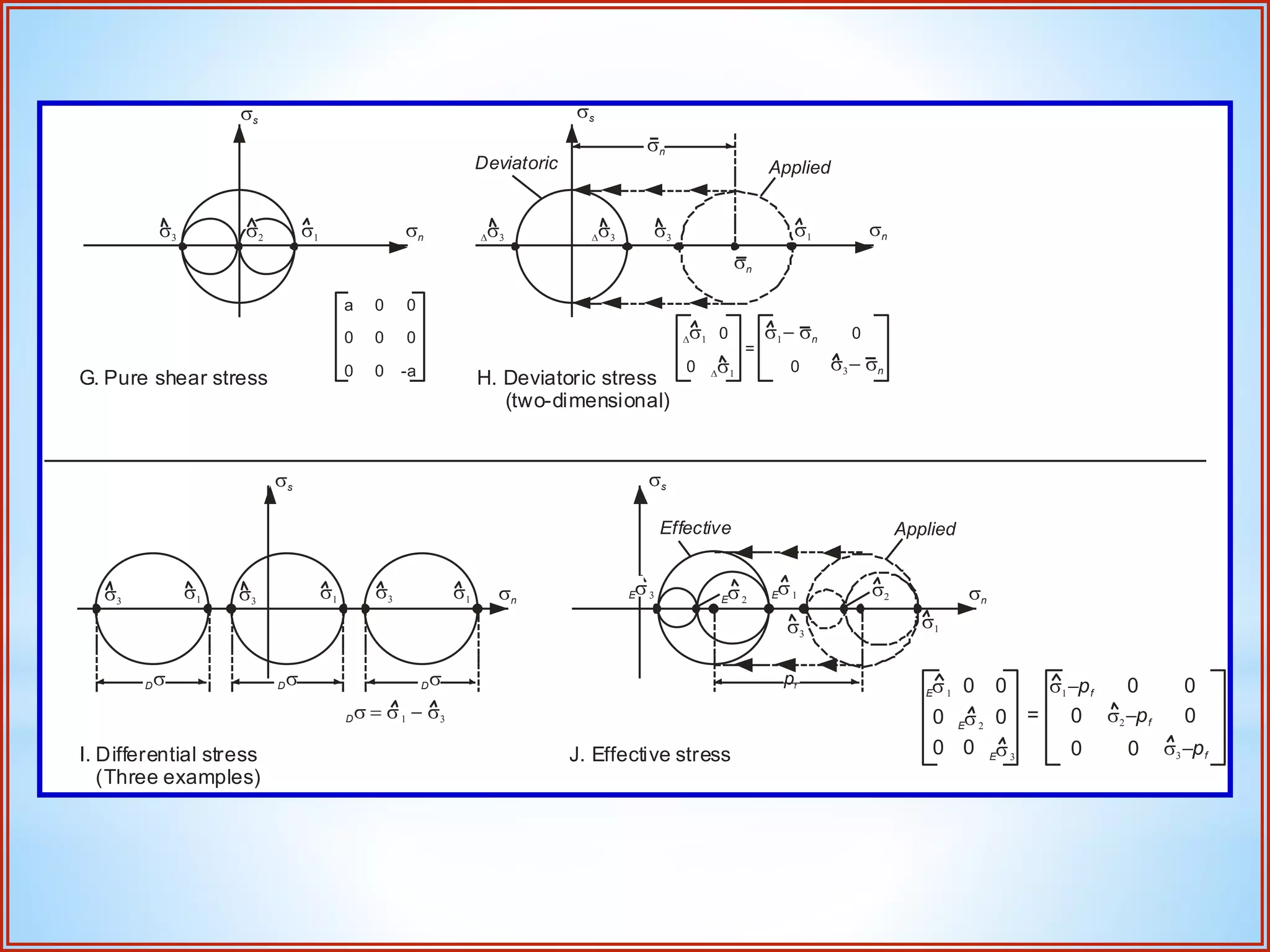
Mohr diagram is a graphical representative of state of stress 
Mean stress is hydrostatic component which tends to produce dilation 
Deviatoric stress is non hydrostatic which tends to produce distortion 
Differential stress if greater is potential for distortion
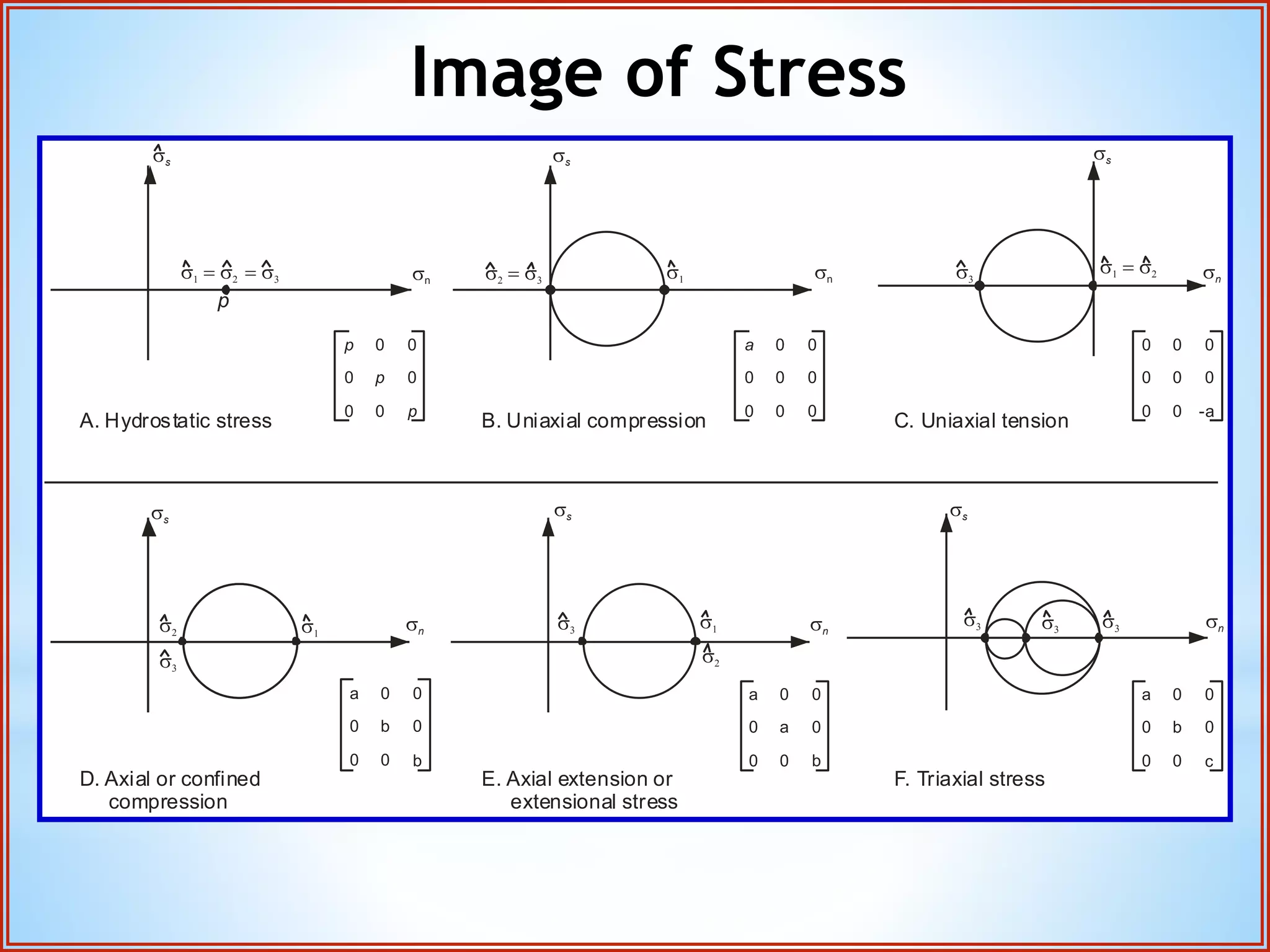
Image of Stress 
a 0 0 
0 
0 
0 
0 
0 0 0 
a 0 0 
b 
c 
0 
0 0 
A. Hydrostatic stress B. Uniaxial compression C. Uniaxial tension 
0 
a 
b 
0 
0 0 
0 
a 
p 0 0 
0 p 0 
0 0 p 
a 0 0 
b 
b 
0 
0 0 
0 0 0 
0 0 -a 
ss 
s s3 
D. Axial or confined F. Triaxial stress 
compression 
E. Axial extension or 
extensional stress 
sn 
p 
ss 
sn 
ss 
s s s   3 
s 
0 
0 
s s  3 
sn s 
ss 
s s   
sn s3 
s 
s3 
0 
ss 
sn s3 s3 s3 
0 
0 
ss 
sn 
s
0 
0 0 0 
0 0 -a 
Deviatoric Applied 
0   s s s  n 0 
0 
a 
ss 
 3 s 
sn 
  s 
sn 
s s3 sn 
ss 
s3 
0 
 3 s 
s s 3 n 
= 
0 
ss 
s sn s3 s 
Effective 
s3 s s3 s sn 
Ds Ds Ds 
Dss s  3 
ss 
s sn 
s 
s 
s3 
Es  
0 0 0 
s   pf 
Es 3 Es  
pf 
0 0 = 
Es  
Es  
0 
0 Es 3 
0 
0 
0 s  p3 f 
0 
0 
s   pf 
Applied 
G. Pure shear stress H. Deviatoric stress 
(two-dimensional) 
I. Differential stress 
(Three examples) 
J. Effective stress
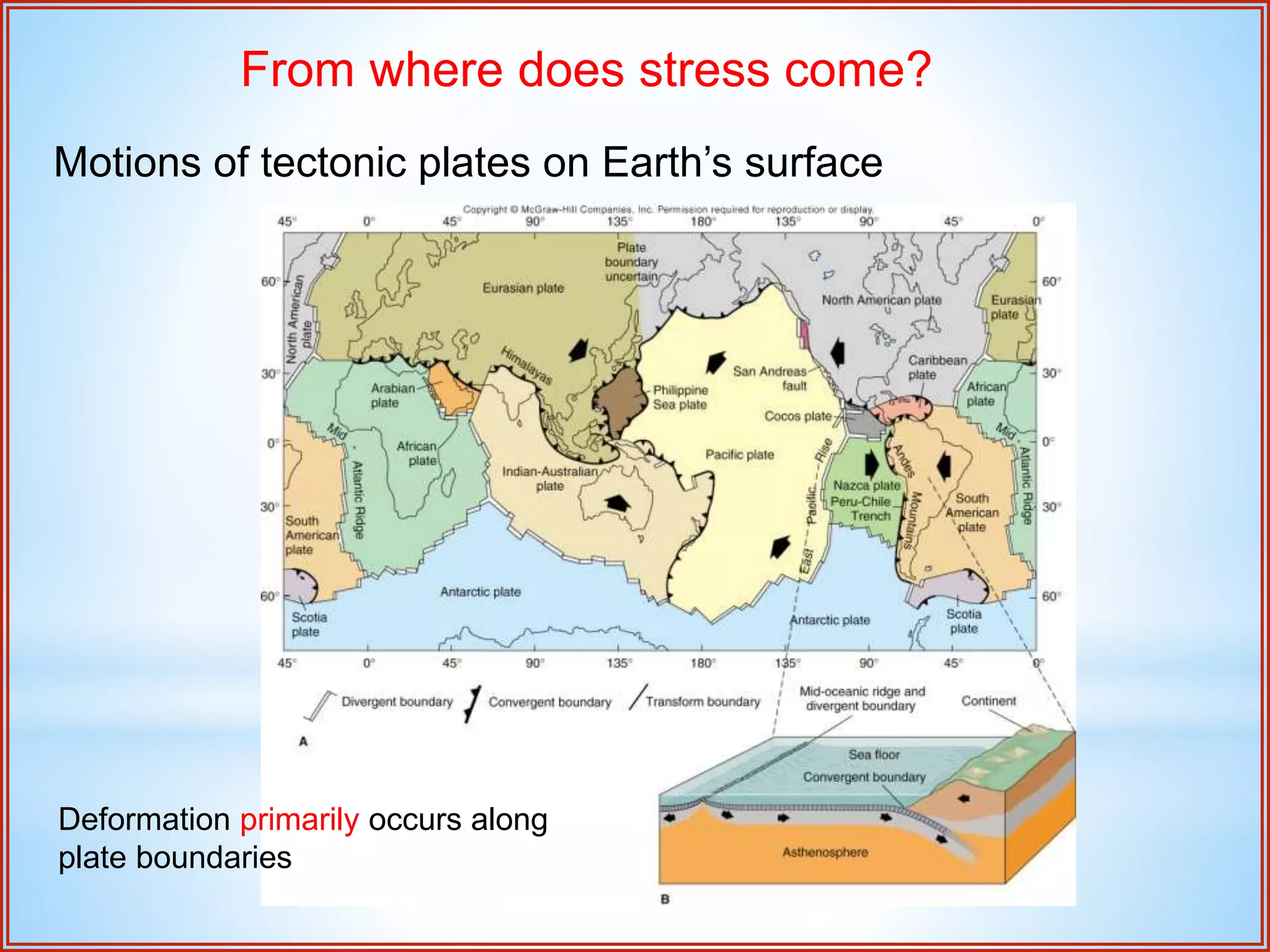
From where does stress come? 
Motions of tectonic plates on Earth’s surface 
Deformation primarily occurs along 
plate boundaries
STRESS 
 Body force works from distance and depends on the amount of materials 
affected (i.e. gravitational force). 
 Surface force are classes as compressive or tensile according to the 
distortion they produce. 
 Stress is defined as force per unit area. 
 Stress at the point can be divided as normal and shear component 
depending they direction relative to the plane. 
 Structural geology assumed that force at point are isotropic and 
homogenous 
 Stress vector around a point in 3-D as stress ellipsoid which have three 
orthogonal principal directions of stress and three principal planes. 
 Principal stress s1>s2>s3 
 The inequant shape of the ellipsoid has to do with forces in rock and has 
nothing directly to do with distortions. 
 Mohr diagram is a graphical representative of state of stress of rock
Structural Geology & Stress

Structural Geology & Stress

  • 1.
  • 2.
    What is StructuralGeology?? • Study of the architecture and geometry of the Earth’s crust and processes which have shaped it • Analysis of changes in shape of rock bodies (strain) produced by tectonic forces (stress) Stress Strain
  • 3.
    • Study ofrock Deformation as Response to Forces and Stresses • Involving Motion of Rigid Body
  • 4.
    Structural Analysis Structuralanalysis generally involves three tasks: 1. Descriptive Analysis: physical and geometrical description of rock structures (e.g. folds, faults etc) 2. Kinematic Analysis: evaluation of the displacement and change in shape, orientation and size that rocks undergo as a result of deformation (strain) 3. Dynamic Analysis: reconstruct forces and stresses which resulting rock deformation and failure (stress)
  • 5.
    Deformation of rockin various scale (Modified from Means, 1976) in Sapiee. B., 2005
  • 6.
    EVOLUTION OF STRUCTURE • Force history • Movement history Single Particle Particles
  • 7.
    Factors involve: •SCALE FACTOR (mm to km) • RHEOLOGY (flow of matter) • TIME FACTOR (Geologic Time Scale)
  • 8.
  • 9.
    Geologic Cross-Section and Seismic Section 5 Km
  • 10.
    DESCRIPTIVE ANALYSIS (Fold,Fault) • CONTACTS • PRIMARY STRUCTURES • SECONDARY STRUCTURES
  • 11.
    Primary Structure Primarystructures are features of rocks that form at or shortly after the time of formation of the rock itself. They are important: i. to determine to original facing direction of strata; ii. can be used as strainmarkers in deformed rocks; iii. some primary features (fossils) are useful in age determination; iv. interpret the environmet conditions under which the rock was formed; v. recognize primary features and distinguish them from later tectonic features. Bedding • Graded beds • Ripple marks • Crossbeds • Sole marks • Channel structures • Mud cracks • Fossils (tracks, imprints, body fossils) • Impact features (raindrop imprints, volcanic bombs etc) • De-watering (flame) structures • Soft-sediment deformation • Reduction spots Igneous structures • Columnar jointing • Flow surface features (rubble layers, ropey texture, baked horizons) • Pillow basalts
  • 12.
    Secondary Structure •Secondary rock structures are imposed on rocks by events (such as compression or stretching) experienced by rocks after their original formational. • The structures are most easily observed if the rocks have obvious primary structures, such as layering formed by successive episodes of deposition. • Primary depositional layering is almost always horizontal: it parallels the general configuration of surface on which deposition takes place, such as a floodplain or the floor of a lake or ocean. In consequence, when layers are found that are not horizontal, the geologist assumes that some force has been exerted upon them that has destroyed their original horizontality.
  • 13.
    BASIC CONCEPTS FORCESAND VECTORS • Force is any action which alters, or tends to alter • Newton II law of motion : F = M a • Unit force : kgm/s2 = newton (N) or dyne = gram cm/s2; N = 105 dynes (a). Force: vector quantity with magnitude and direction (b). Resolving by the parallelogram of forces Modified Price and Cosgrove (1990) Two Types of Force • Body Forces (i.e. gravitational force) • Contact Forces (i.e. loading)
  • 14.
    • F= mx a , gravitational acceleration: 9.8 m/sec2 •vector quantity: orientation and size. •can be applied to any plane. •normal and shear components on a plane can be resolved from an oblique force (see diagram to the right). •shear component promotes slip on the plane and the normal component inhibits slip on a plane, and the ratio of the two at which slip occurs describes the 'friction' on the plane. Pressure within a geologic context: •describes multitude of forces at a point within a fluid. •limit of F/area as area goes to 0 •fluids can not withstand a shear stress for a significant period of time, therefore if static non-flowing, all force vectors equal in size, and all must be normal vectors acting perpendicular to any given plane. Hence can be described by one number. •this is a special simple stress state - hydrostatic stress state. •geologic pressures: pore fluid pressures, magmatic pressures, 'rock pressure' = nondeviatoric component. •related strain? change in volume, no distortion (unless material is anisotropic with respect to mechanical properties).
  • 15.
    Force Equilibrium (A)Balance (B) Torque (C) Static Equilibrium (D) Dynamic Equilibrium (Davis and Reynolds, 1996)
  • 16.
    STRESS Stress definedas force per unit area: s = F/A A = area, Stress units = Psi, Newton (N), Pascal (Pa) or bar (105 Pa) Stress is force/area (hitting with a hammer) Importance of area: Think of difference between standing on water bed in high heels or sneakers
  • 17.
    Stress Three kindsof stress can be applied to rocks: tensional, compressive, and shear. Tensional stress occurs when a rock is subjected to forces that tend to elongate it or pull it apart; a rock that has experienced tensional stress tends to be narrower and longer than its original shape, like a piece of gum or taffy that has been pulled (pulled apart) A compressive stress on a rock is applied from opposite sides and has a tendency to shorten (compress) the rock between the opposing stresses, which may also stretch it parallel to the stress-free direction. (push together) A shear stress results when forces from opposite directions create a shear plane in an area in which the forces run parallel to one another. The scale of shear stress can vary from a few centimeters to hundreds of meters. (moved horizontally past each other)
  • 18.
    • Stress ata point in 2D • Types of stress Stress (s) Normal stress (sN) (+) Compressive (-) Tensile Shear stress (sS) (+) (-) Sapiee. B., 2005
  • 19.
    STRESS on PLANE • Coordinate System
  • 20.
    Stress Ellipsoid a)Triaxial stress b) Principal planes of the ellipsoid (Modified from Means, 1976) in Sapiee. B., 2005
  • 21.
    z s s3x X1 Arbitrary coordinate axes and planes B. Principal stress components s(top) zx C. General stress components X Principal coordinate axes and planes Z s s  (lft) xx (lft) x (top) zz s dx s (bot) zz dz s(rt) xz (bot) z s(rt) xx s(bot) zx (lft) xz s (rt) x X3 s3 (top) z A. Stress elipse The State of Two-Dimensional Stress at Point (Twiss and Moores, 1992) Principal Stress: s1 > s3 x, z = Surface Stress
  • 22.
    The State of 3-Dimensional Stress at Point Principal Stress: s z x1 x s3 B. Principal stress components x3 y A. Stress elipsoid y x2 x x y z s x szy syx z szz sxy syy syz sxx szx sxz y Arbitrary coordinate planes C. General stress components z Principal coordinate planes s1 > s > s3 Stress Tensor Notation s11 s12 s13 s = s21 s22 s23 s31 s32 s33 s12 = s21, s13 = s31, s23 = s32 (Twiss and Moores, 1992)
  • 23.
    Geologic Sign Conventionof Stress Tensor (Twiss and Moores, 1992)
  • 24.
    sn A. PhysicalDiagram A. Mohr Diagram r n (p) s  s (p) (p) Mohr Diagram 2-D (p) s  s (p) sn s  s 2 2 s s   3 2 sn s s   3 sn , s s s     3 cos 2 s s     3 sin ss x  3 s(p) n s3  s Plane P x s3 (Twiss and Moores, 1992)
  • 25.
    A. Physical DiagramB. Mohr Diagram  x3 n' p (p')  p' n x1   (p') sn , ss sn  s  s s sn s3 (p) sn , (p)s  s  (Twiss and Moores, 1992)
  • 26.
    A. Physical DiagramB. Mohr Diagram s s  xx' xz  sxx s s  zz' zx s s  xx zz 2 s s  xx zz ss sxz s sn  º)  s s3 szz szx z s3  x3 x1 x sxz º)  (Twiss and Moores, 1992)
  • 27.
    Planes of maximumshear stress A. Physical Diagram B. Mohr Diagram n- Planes of maximum shear stress x3 Clockwise shear stress x ss ss Counterclockwise shear stress ' = +45º s x3 s3 s n+ ss x  = +45º s  s max Counter clockwise s s3  º sn s  s max Clockwise 'º s3 (Twiss and Moores, 1992)
  • 28.
    Mohr Diagram 3-D (Twiss and Moores, 1992) Geometry of a three-dimensional Stress on a Mohr diagram
  • 29.
    Maximum Shear Stress (Twiss and Moores, 1992)
  • 30.
    FUNDAMENTAL STRESS EQUATIONS Stress Ellipsoid Principal Stress: s1 > s > s3 • All stress axes are mutually perpendicular • Shear stress are zero in the direction of principal stress s1 + s3 - s1 – s3 sN = cos 2 2 2 s1 – s3 ss = Sin 2 2
  • 31.
    (Davis and Reynolds,1996) Mohr diagram is a graphical representative of state of stress Mean stress is hydrostatic component which tends to produce dilation Deviatoric stress is non hydrostatic which tends to produce distortion Differential stress if greater is potential for distortion
  • 32.
    Image of Stress a 0 0 0 0 0 0 0 0 0 a 0 0 b c 0 0 0 A. Hydrostatic stress B. Uniaxial compression C. Uniaxial tension 0 a b 0 0 0 0 a p 0 0 0 p 0 0 0 p a 0 0 b b 0 0 0 0 0 0 0 0 -a ss s s3 D. Axial or confined F. Triaxial stress compression E. Axial extension or extensional stress sn p ss sn ss s s s   3 s 0 0 s s  3 sn s ss s s   sn s3 s s3 0 ss sn s3 s3 s3 0 0 ss sn s
  • 33.
    0 0 00 0 0 -a Deviatoric Applied 0   s s s  n 0 0 a ss  3 s sn   s sn s s3 sn ss s3 0  3 s s s 3 n = 0 ss s sn s3 s Effective s3 s s3 s sn Ds Ds Ds Dss s  3 ss s sn s s s3 Es  0 0 0 s   pf Es 3 Es  pf 0 0 = Es  Es  0 0 Es 3 0 0 0 s  p3 f 0 0 s   pf Applied G. Pure shear stress H. Deviatoric stress (two-dimensional) I. Differential stress (Three examples) J. Effective stress
  • 34.
    From where doesstress come? Motions of tectonic plates on Earth’s surface Deformation primarily occurs along plate boundaries
  • 36.
    STRESS  Bodyforce works from distance and depends on the amount of materials affected (i.e. gravitational force).  Surface force are classes as compressive or tensile according to the distortion they produce.  Stress is defined as force per unit area.  Stress at the point can be divided as normal and shear component depending they direction relative to the plane.  Structural geology assumed that force at point are isotropic and homogenous  Stress vector around a point in 3-D as stress ellipsoid which have three orthogonal principal directions of stress and three principal planes.  Principal stress s1>s2>s3  The inequant shape of the ellipsoid has to do with forces in rock and has nothing directly to do with distortions.  Mohr diagram is a graphical representative of state of stress of rock