Sequence Stratigraphy
Name: Rishabh Tripathi & Kumar Shantanu.
Roll Numbers:R080114031&R080114016
INTRODUCTION
Sequence Stratigraphy is a branch of geology that
attempts to subdivide and link sedimentary deposits
into unconformity bound units on a variety of scales
and explain these stratigraphic units in terms of
variations in sediment supply and variations in the
rate of change in accommodation space (often
associated with changes in relative sea level).
It is mostly for marine sediments but with
modifications it can be used for terrestrial
accumulations.
Types of Sea Level
• Relative Sea Level.
• Eustatic Sea Level.
Accommodation Space Equation
T+E=S+W
where,
• T is the rate of tectonic subsidence
• E is the rate of eustatic sea-level rise
• S is the rate of sedimentation
• W is the rate of water depth increase (or
deepening)
Causes of change in Sea Level
Eustatic Sea level:
• Glaciation, ocean temperature, and the
volume of groundwater.
• Changes in the distribution of mass on Earth,
caused by mantle convection and plate
tectonic motion.
Relative Sea level:
• Tides.
• Winds
• Ocean currents.
Causes of change in tectonic subsidence
• Three main mechanisms.
• –Stretching
• –Cooling
• –Loading
TERMINOLOGIES IN USE
• Parasequence: Parasequences are defined
as a relatively conformable succession of
genetically related beds or bedsets bounded
by marine flooding surfaces and their
correlative surfaces.
• Progradation: sequence means seaward
movement of a shoreline.
• Retrogression: sequence means continent
ward movement of a shoreline.
• Marine regression is a geological process
occurring when areas of submerged
seafloor are exposed above the sea level.
• Marine transgression, occurs when
flooding from the sea covers previously
exposed land.
Parasequence Sets and Stacking Patterns
• There are 3 types of stacking patterns that we
observe:-
• Progradational stacking: In a progradational set of
parasequences, each parasequence builds out or
advances somewhat farther seaward than the
parasequence before.
• Aggradational stacking: In an aggradational set of
parsequences, each parasequence progrades to
roughly the same position as the previous
parasequence.
• Retrogradational stacking: In a retrogradational set
of parasequences, each parasequence progrades less
than the preceding parasequence.
DEPOSITIONAL SEQUENCE
• A depositional sequence is defined as a relatively
conformable succession of genetically related
strata bounded by subaerial unconformities or their
correlative conformities.
In addition, every depositional sequence is the
record of one cycle of relative sea level.
• As a result, depositional sequences have a
predictable internal structure of surfaces and
systems tracts
SYSTEM TRACTS
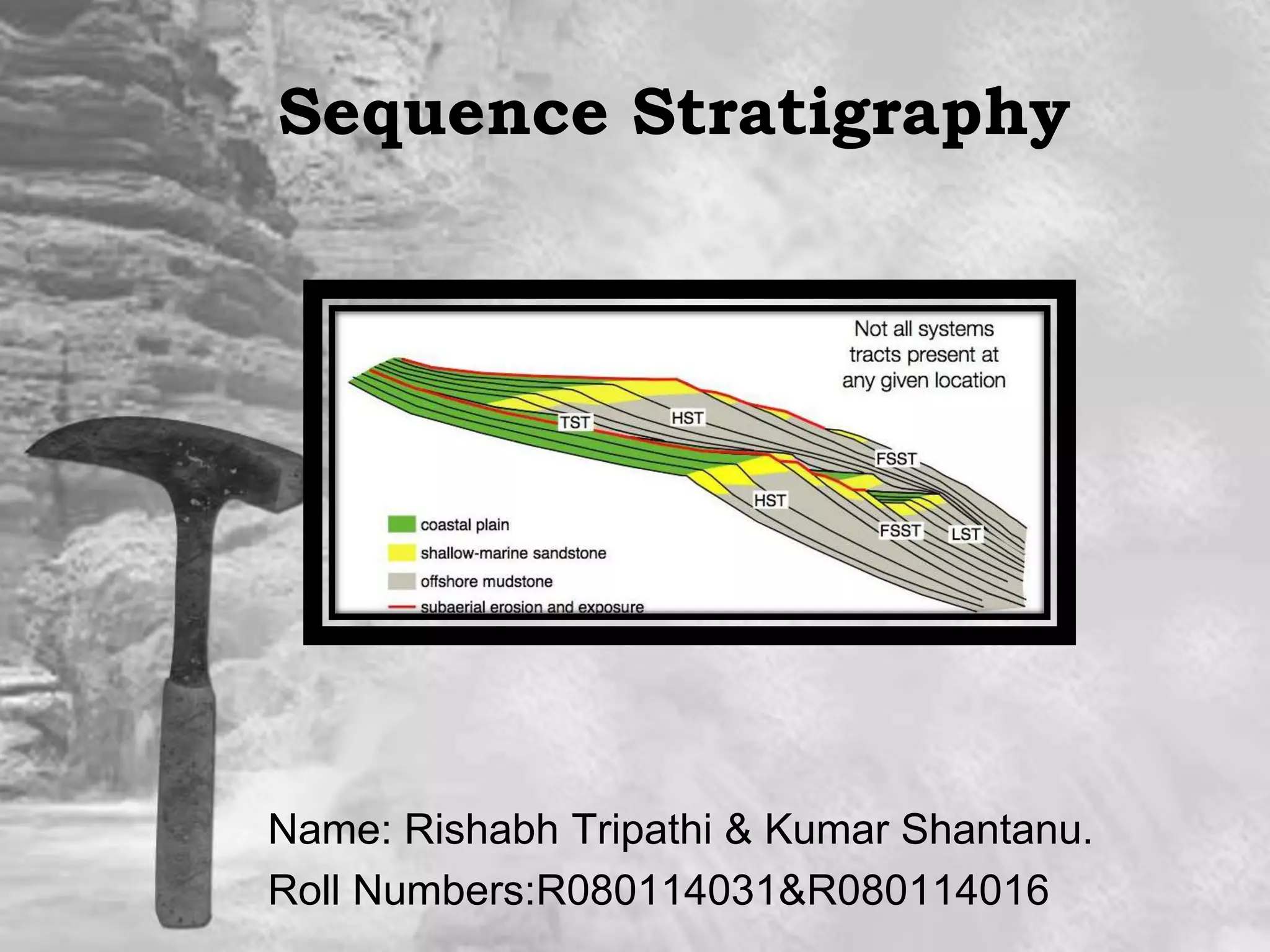
• A discrete package of distinctive sediment
types (facies) that are laid down during different
phases of a cycle of sea-level change.
• Highland systems tract.
• Falling stage system tracts.
• Lowland system tracts.
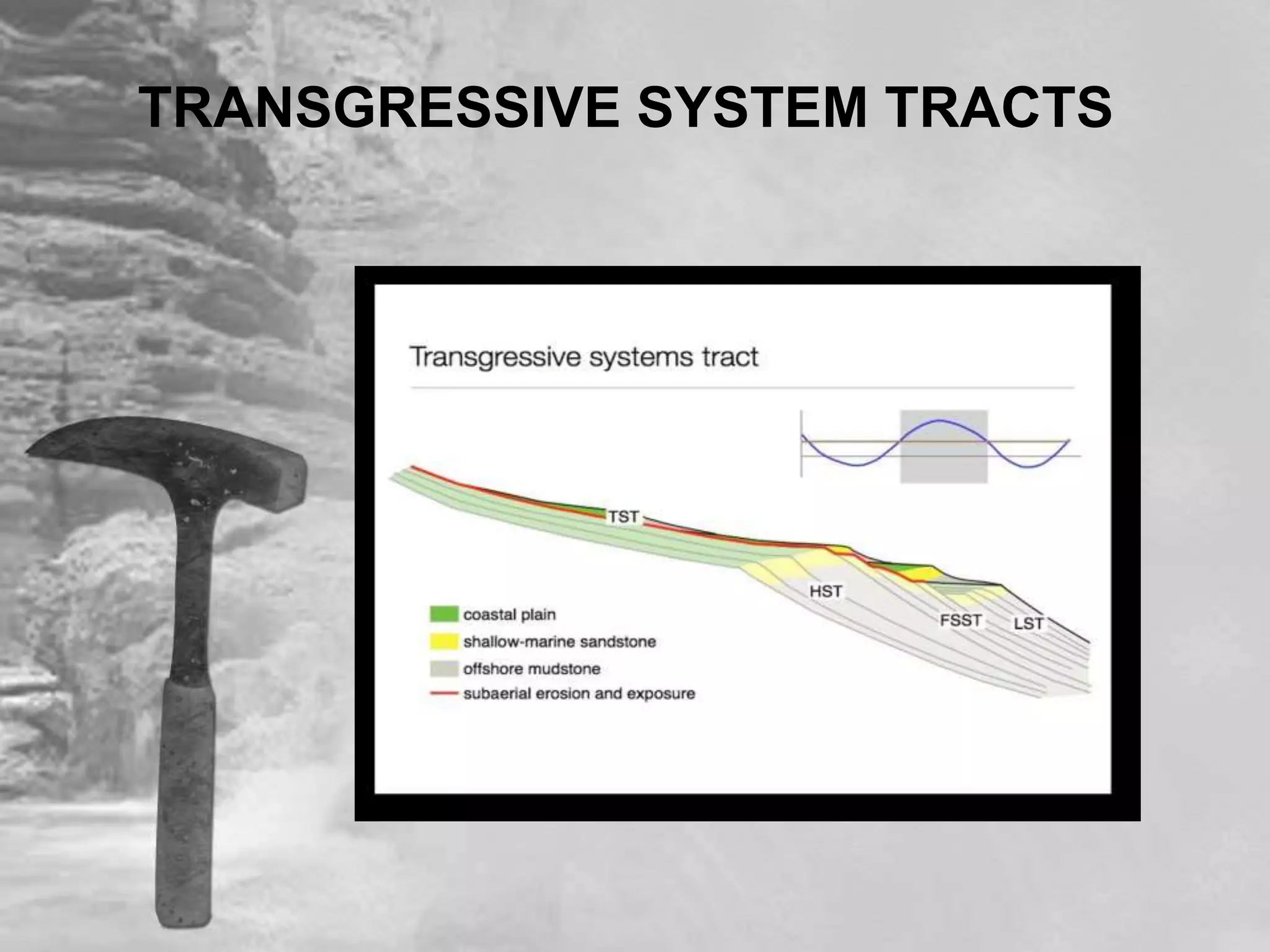
• Transgressive systems tract.
HIGHSTAND SYSTEM TRACTS
FALLING-STAGE SYSTEM TRACT
LOWSTAND SYSTEM TRACTS
TRANSGRESSIVE SYSTEM TRACTS
SEQUENCE BOUNDARIES
• The sequence boundary is an unconformity up
dip and a correlative conformity down dip.
• Transgressive Surface:- separates LST from
TST.
• Major flooding Surface:- separates TST from
HST.
• Basal surface of forced regression:-
separates FSST from LST.
• Unconformity separates HST from FSST.
THANKYOU

Sequence Stratigraphy

  • 1.
    Sequence Stratigraphy Name: RishabhTripathi & Kumar Shantanu. Roll Numbers:R080114031&R080114016
  • 2.
    INTRODUCTION Sequence Stratigraphy isa branch of geology that attempts to subdivide and link sedimentary deposits into unconformity bound units on a variety of scales and explain these stratigraphic units in terms of variations in sediment supply and variations in the rate of change in accommodation space (often associated with changes in relative sea level). It is mostly for marine sediments but with modifications it can be used for terrestrial accumulations.
  • 3.
    Types of SeaLevel • Relative Sea Level. • Eustatic Sea Level.
  • 4.
    Accommodation Space Equation T+E=S+W where, •T is the rate of tectonic subsidence • E is the rate of eustatic sea-level rise • S is the rate of sedimentation • W is the rate of water depth increase (or deepening)
  • 5.
    Causes of changein Sea Level Eustatic Sea level: • Glaciation, ocean temperature, and the volume of groundwater. • Changes in the distribution of mass on Earth, caused by mantle convection and plate tectonic motion. Relative Sea level: • Tides. • Winds • Ocean currents.
  • 6.
    Causes of changein tectonic subsidence • Three main mechanisms. • –Stretching • –Cooling • –Loading
  • 7.
    TERMINOLOGIES IN USE •Parasequence: Parasequences are defined as a relatively conformable succession of genetically related beds or bedsets bounded by marine flooding surfaces and their correlative surfaces. • Progradation: sequence means seaward movement of a shoreline. • Retrogression: sequence means continent ward movement of a shoreline.
  • 8.
    • Marine regressionis a geological process occurring when areas of submerged seafloor are exposed above the sea level. • Marine transgression, occurs when flooding from the sea covers previously exposed land.
  • 9.
    Parasequence Sets andStacking Patterns • There are 3 types of stacking patterns that we observe:- • Progradational stacking: In a progradational set of parasequences, each parasequence builds out or advances somewhat farther seaward than the parasequence before. • Aggradational stacking: In an aggradational set of parsequences, each parasequence progrades to roughly the same position as the previous parasequence. • Retrogradational stacking: In a retrogradational set of parasequences, each parasequence progrades less than the preceding parasequence.
  • 11.
    DEPOSITIONAL SEQUENCE • Adepositional sequence is defined as a relatively conformable succession of genetically related strata bounded by subaerial unconformities or their correlative conformities. In addition, every depositional sequence is the record of one cycle of relative sea level. • As a result, depositional sequences have a predictable internal structure of surfaces and systems tracts
  • 12.
    SYSTEM TRACTS • Adiscrete package of distinctive sediment types (facies) that are laid down during different phases of a cycle of sea-level change. • Highland systems tract. • Falling stage system tracts. • Lowland system tracts. • Transgressive systems tract.
  • 13.
  • 14.
  • 15.
  • 16.
  • 17.
    SEQUENCE BOUNDARIES • Thesequence boundary is an unconformity up dip and a correlative conformity down dip. • Transgressive Surface:- separates LST from TST. • Major flooding Surface:- separates TST from HST. • Basal surface of forced regression:- separates FSST from LST. • Unconformity separates HST from FSST.
  • 18.