A presentation on
Fold & its Classification
Submitted to-
Prof. A. K. Shandilya
Dept. of Applied Geology
Dr. Harisingh Gour
Vishwavidyalaya, Sagar
Submitted by-
Praphulla Sonowal
M. Tech 1st Semester
Reg. No. Y17251016
Introduction
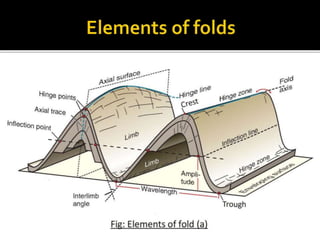
Elements of fold
Classification of fold
Conclusion
Bibliography
 The word fold was used by Hall (1815) for the first
time to explain the rock structures.
 Van Hise (1894) contributed on the geometry of
folds, whileWillis (1891) worked out their mechanics.
 Fold is a wave like structure which is formed by
bending or flexuring of any type of planes or layers in
igneous, sedimentary and metamorphic rocks due to
compressional force.
 Folds are best displayed by stratified formations.
Basis of classification:
1. Fold Closure
2. Symmetry
3. Plunge of fold axis
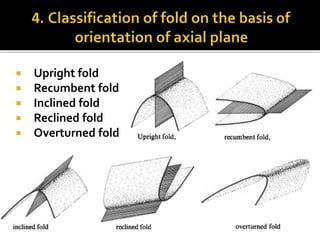
4. Orientation of axial plane
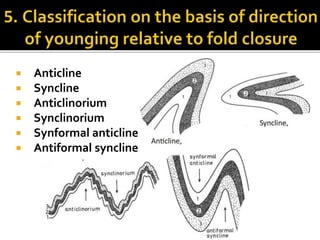
5. Direction of younging relative to fold closure
6. Nature of hinge line
7. Interlimb angle
8. Shape of hinge
9. No of hinges
10. Geometrical elements (Dip isogons, axial plane
thickness & Orthogonal thickness)
11. Superposition of fold
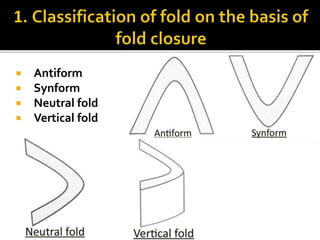
 Antiform
 Synform
 Neutral fold
 Vertical fold
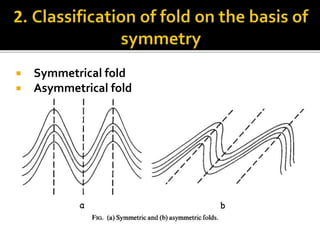
 Symmetrical fold
 Asymmetrical fold
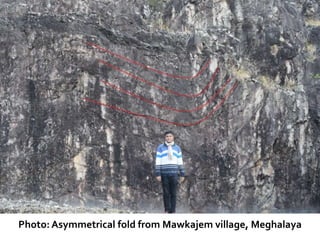
Photo: Asymmetrical fold from Mawkajem village, Meghalaya
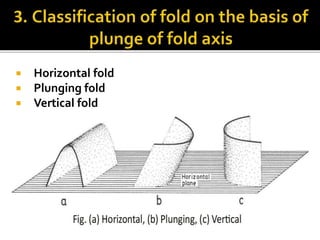
 Horizontal fold
 Plunging fold
 Vertical fold
 Upright fold
 Recumbent fold
 Inclined fold
 Reclined fold
 Overturned fold
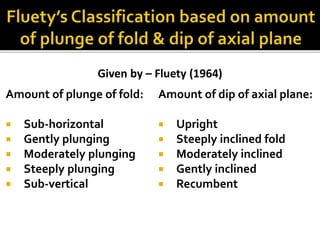
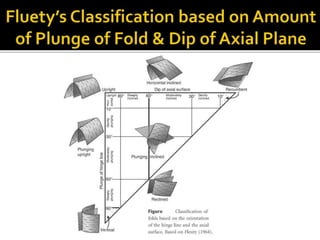
Amount of plunge of fold:
 Sub-horizontal
 Gently plunging
 Moderately plunging
 Steeply plunging
 Sub-vertical
Amount of dip of axial plane:
 Upright
 Steeply inclined fold
 Moderately inclined
 Gently inclined
 Recumbent
Given by – Fluety (1964)
 Anticline
 Syncline
 Anticlinorium
 Synclinorium
 Synformal anticline
 Antiformal syncline
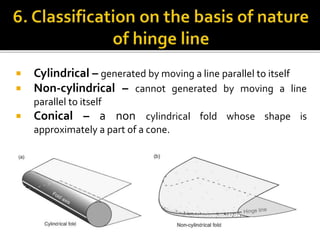
 Cylindrical – generated by moving a line parallel to itself
 Non-cylindrical – cannot generated by moving a line
parallel to itself
 Conical – a non cylindrical fold whose shape is
approximately a part of a cone.
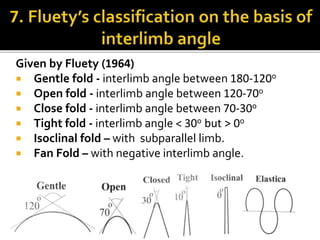
Given by Fluety (1964)
 Gentle fold - interlimb angle between 180-120o
 Open fold - interlimb angle between 120-70o
 Close fold - interlimb angle between 70-30o
 Tight fold - interlimb angle < 30o but > 0o
 Isoclinal fold – with subparallel limb.
 Fan Fold – with negative interlimb angle.
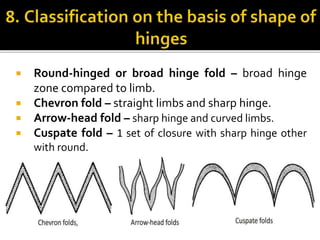
 Round-hinged or broad hinge fold – broad hinge
zone compared to limb.
 Chevron fold – straight limbs and sharp hinge.
 Arrow-head fold – sharp hinge and curved limbs.
 Cuspate fold – 1 set of closure with sharp hinge other
with round.
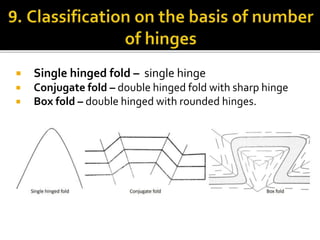
 Single hinged fold – single hinge
 Conjugate fold – double hinged fold with sharp hinge
 Box fold – double hinged with rounded hinges.
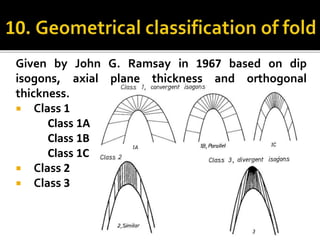
Given by John G. Ramsay in 1967 based on dip
isogons, axial plane thickness and orthogonal
thickness.
 Class 1
Class 1A
Class 1B
Class 1C
 Class 2
 Class 3
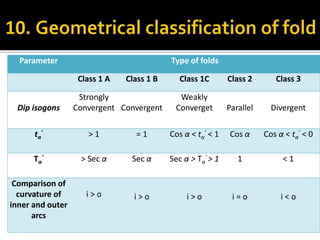
Parameter Type of folds
Class 1 A Class 1 B Class 1C Class 2 Class 3
Dip isogons
Strongly
Convergent Convergent
Weakly
Converget Parallel Divergent
tα
’ > 1 = 1 Cos α < tα
’ < 1 Cos α Cos α < tα
’ < 0
Tα
’ > Sec α Sec α Sec α > Tα
’ > 1 1 < 1
Comparison of
curvature of
inner and outer
arcs
i > o i > o i > o i = o i < o
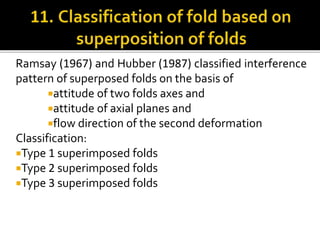
Ramsay (1967) and Hubber (1987) classified interference
pattern of superposed folds on the basis of
attitude of two folds axes and
attitude of axial planes and
flow direction of the second deformation
Classification:
Type 1 superimposed folds
Type 2 superimposed folds
Type 3 superimposed folds
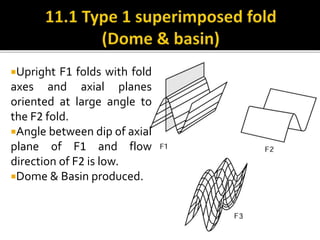
Upright F1 folds with fold
axes and axial planes
oriented at large angle to
the F2 fold.
Angle between dip of axial
plane of F1 and flow
direction of F2 is low.
Dome & Basin produced.
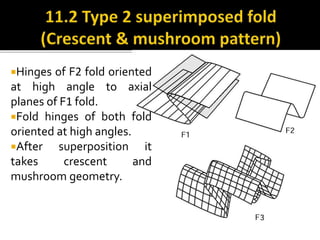
Hinges of F2 fold oriented
at high angle to axial
planes of F1 fold.
Fold hinges of both fold
oriented at high angles.
After superposition it
takes crescent and
mushroom geometry.
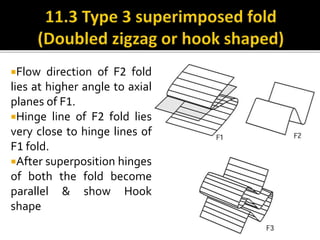
Flow direction of F2 fold
lies at higher angle to axial
planes of F1.
Hinge line of F2 fold lies
very close to hinge lines of
F1 fold.
After superposition hinges
of both the fold become
parallel & show Hook
shape
 Folding bring minerals like copper & lead closer to the
surface making their extraction easy.
 Fold mountain receives heavy rainfall giving rise to
rivers which are use for hydroelectric power
generation.
 During folding faults develops leading to
earthquakes.
 Lee ward sides of fold mountains receives low rainfall
which discourage agriculture and settlement.
 Ramsay J. G. and Huber, M.I. :The techniques of modern
structural geology –Volume 2 : Folds and Fractures.
 Ghosh, S. K. : Structural Geology - Fundamentals and Modern
Developments.
 Jain, A. K. : An Introduction to Structural Geology, Geological
society of India.
 Billings, M. P. : Structural Geology, 3/E.
 Fossen, H. : Structural Geology.
Fold & its classification

Fold & its classification

  • 1.
    A presentation on Fold& its Classification Submitted to- Prof. A. K. Shandilya Dept. of Applied Geology Dr. Harisingh Gour Vishwavidyalaya, Sagar Submitted by- Praphulla Sonowal M. Tech 1st Semester Reg. No. Y17251016
  • 2.
    Introduction Elements of fold Classificationof fold Conclusion Bibliography
  • 3.
     The wordfold was used by Hall (1815) for the first time to explain the rock structures.  Van Hise (1894) contributed on the geometry of folds, whileWillis (1891) worked out their mechanics.  Fold is a wave like structure which is formed by bending or flexuring of any type of planes or layers in igneous, sedimentary and metamorphic rocks due to compressional force.  Folds are best displayed by stratified formations.
  • 5.
    Basis of classification: 1.Fold Closure 2. Symmetry 3. Plunge of fold axis 4. Orientation of axial plane 5. Direction of younging relative to fold closure 6. Nature of hinge line 7. Interlimb angle 8. Shape of hinge 9. No of hinges 10. Geometrical elements (Dip isogons, axial plane thickness & Orthogonal thickness) 11. Superposition of fold
  • 6.
     Antiform  Synform Neutral fold  Vertical fold
  • 7.
     Symmetrical fold Asymmetrical fold
  • 8.
    Photo: Asymmetrical foldfrom Mawkajem village, Meghalaya
  • 9.
     Horizontal fold Plunging fold  Vertical fold
  • 10.
     Upright fold Recumbent fold  Inclined fold  Reclined fold  Overturned fold
  • 11.
    Amount of plungeof fold:  Sub-horizontal  Gently plunging  Moderately plunging  Steeply plunging  Sub-vertical Amount of dip of axial plane:  Upright  Steeply inclined fold  Moderately inclined  Gently inclined  Recumbent Given by – Fluety (1964)
  • 13.
     Anticline  Syncline Anticlinorium  Synclinorium  Synformal anticline  Antiformal syncline
  • 14.
     Cylindrical –generated by moving a line parallel to itself  Non-cylindrical – cannot generated by moving a line parallel to itself  Conical – a non cylindrical fold whose shape is approximately a part of a cone.
  • 15.
    Given by Fluety(1964)  Gentle fold - interlimb angle between 180-120o  Open fold - interlimb angle between 120-70o  Close fold - interlimb angle between 70-30o  Tight fold - interlimb angle < 30o but > 0o  Isoclinal fold – with subparallel limb.  Fan Fold – with negative interlimb angle.
  • 16.
     Round-hinged orbroad hinge fold – broad hinge zone compared to limb.  Chevron fold – straight limbs and sharp hinge.  Arrow-head fold – sharp hinge and curved limbs.  Cuspate fold – 1 set of closure with sharp hinge other with round.
  • 17.
     Single hingedfold – single hinge  Conjugate fold – double hinged fold with sharp hinge  Box fold – double hinged with rounded hinges.
  • 18.
    Given by JohnG. Ramsay in 1967 based on dip isogons, axial plane thickness and orthogonal thickness.  Class 1 Class 1A Class 1B Class 1C  Class 2  Class 3
  • 19.
    Parameter Type offolds Class 1 A Class 1 B Class 1C Class 2 Class 3 Dip isogons Strongly Convergent Convergent Weakly Converget Parallel Divergent tα ’ > 1 = 1 Cos α < tα ’ < 1 Cos α Cos α < tα ’ < 0 Tα ’ > Sec α Sec α Sec α > Tα ’ > 1 1 < 1 Comparison of curvature of inner and outer arcs i > o i > o i > o i = o i < o
  • 20.
    Ramsay (1967) andHubber (1987) classified interference pattern of superposed folds on the basis of attitude of two folds axes and attitude of axial planes and flow direction of the second deformation Classification: Type 1 superimposed folds Type 2 superimposed folds Type 3 superimposed folds
  • 21.
    Upright F1 foldswith fold axes and axial planes oriented at large angle to the F2 fold. Angle between dip of axial plane of F1 and flow direction of F2 is low. Dome & Basin produced.
  • 22.
    Hinges of F2fold oriented at high angle to axial planes of F1 fold. Fold hinges of both fold oriented at high angles. After superposition it takes crescent and mushroom geometry.
  • 23.
    Flow direction ofF2 fold lies at higher angle to axial planes of F1. Hinge line of F2 fold lies very close to hinge lines of F1 fold. After superposition hinges of both the fold become parallel & show Hook shape
  • 24.
     Folding bringminerals like copper & lead closer to the surface making their extraction easy.  Fold mountain receives heavy rainfall giving rise to rivers which are use for hydroelectric power generation.  During folding faults develops leading to earthquakes.  Lee ward sides of fold mountains receives low rainfall which discourage agriculture and settlement.
  • 25.
     Ramsay J.G. and Huber, M.I. :The techniques of modern structural geology –Volume 2 : Folds and Fractures.  Ghosh, S. K. : Structural Geology - Fundamentals and Modern Developments.  Jain, A. K. : An Introduction to Structural Geology, Geological society of India.  Billings, M. P. : Structural Geology, 3/E.  Fossen, H. : Structural Geology.