A SEMINARON
JOINTS AND ITS CLASSIFICATION&
RECOGNITION OF JOINTS
DEPARTMENT OF APPLIED GEOLOGY
DR.HARISINGH GOUR VISWAVIDYALAYA,SAGAR [M.P.]
SUBMITTED TO –PROF.A.K. SHANDILYA SUBMITTED BY –SHIVAM JAIN
Joints
• Joints are the planar structure and simply known as crack
along bed/rock without displacement.
• Joints/Fracture is a planar or sub planar discontinuity which
causes movement ,and loss of cohesion and change in
mechanical properties of rock and minerals.
• Joints-A fracture without measurable shear displacement
(cracks or tensile fractures)
• Fault: A fracture with measurable displacement.
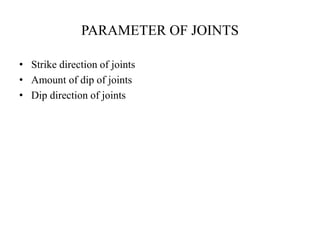
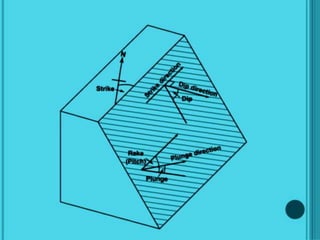
PARAMETER OF JOINTS
• Strike direction of joints
• Amount of dip of joints
• Dip direction of joints
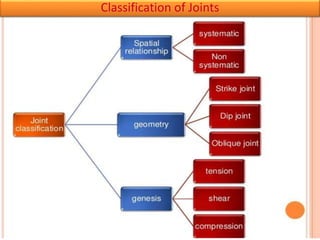
Classification of Joints
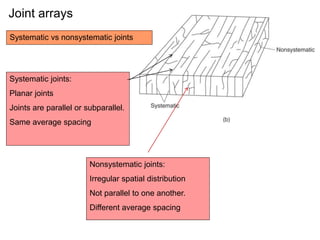
Joint arrays
Systematic vs nonsystematic joints
Systematic joints:
Planar joints
Joints are parallel or subparallel.
Same average spacing
Nonsystematic joints:
Irregular spatial distribution
Not parallel to one another.
Different average spacing
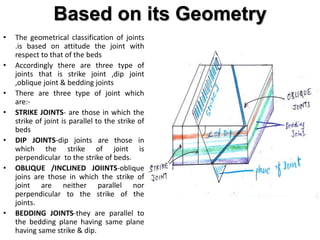
Based on its Geometry
• The geometrical classification of joints
.is based on attitude the joint with
respect to that of the beds
• Accordingly there are three type of
joints that is strike joint ,dip joint
,oblique joint & bedding joints
• There are three type of joint which
are:-
• STRIKE JOINTS- are those in which the
strike of joint is parallel to the strike of
beds
• DIP JOINTS-dip joints are those in
which the strike of joint is
perpendicular to the strike of beds.
• OBLIQUE /INCLINED JOIINTS-oblique
joins are those in which the strike of
joint are neither parallel nor
perpendicular to the strike of the
joints.
• BEDDING JOINTS-they are parallel to
the bedding plane having same plane
having same strike & dip.
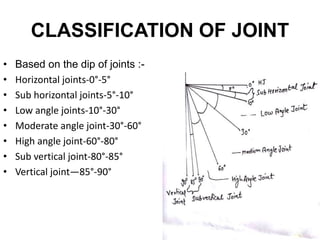
CLASSIFICATION OF JOINT
• Based on the dip of joints :-
• Horizontal joints-0°-5°
• Sub horizontal joints-5°-10°
• Low angle joints-10°-30°
• Moderate angle joint-30°-60°
• High angle joint-60°-80°
• Sub vertical joint-80°-85°
• Vertical joint—85°-90°
BASED ON ITS
GENESIS
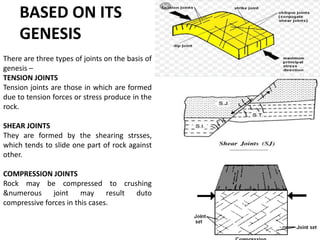
There are three types of joints on the basis of
genesis –
TENSION JOINTS
Tension joints are those in which are formed
due to tension forces or stress produce in the
rock.
SHEAR JOINTS
They are formed by the shearing strsses,
which tends to slide one part of rock against
other.
COMPRESSION JOINTS
Rock may be compressed to crushing
&numerous joint may result duto
compressive forces in this cases.
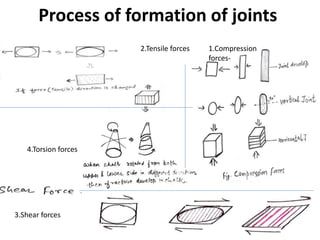
Process of formation of joints
4.Torsion forces
3.Shear forces
1.Compression
forces-
2.Tensile forces
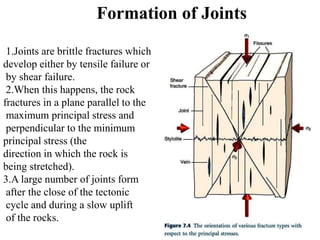
Formation of Joints
1.Joints are brittle fractures which
develop either by tensile failure or
by shear failure.
2.When this happens, the rock
fractures in a plane parallel to the
maximum principal stress and
perpendicular to the minimum
principal stress (the
direction in which the rock is
being stretched).
3.A large number of joints form
after the close of the tectonic
cycle and during a slow uplift
of the rocks.
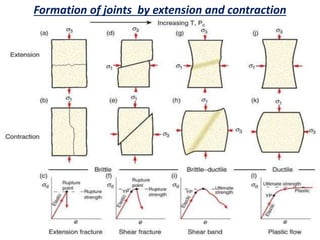
Formation of joints by extension and contraction
Geometrical relation with fold
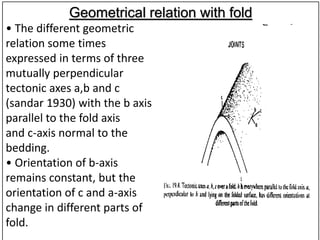
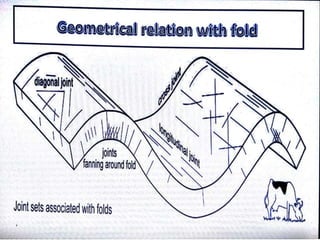
• The different geometric
relation some times
expressed in terms of three
mutually perpendicular
tectonic axes a,b and c
(sandar 1930) with the b axis
parallel to the fold axis
and c-axis normal to the
bedding.
• Orientation of b-axis
remains constant, but the
orientation of c and a-axis
change in different parts of
fold.
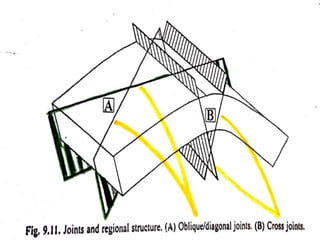
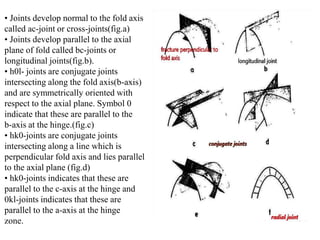
• Joints develop normal to the fold axis
called ac-joint or cross-joints(fig.a)
• Joints develop parallel to the axial
plane of fold called bc-joints or
longitudinal joints(fig.b).
• h0l- joints are conjugate joints
intersecting along the fold axis(b-axis)
and are symmetrically oriented with
respect to the axial plane. Symbol 0
indicate that these are parallel to the
b-axis at the hinge.(fig.c)
• hk0-joints are conjugate joints
intersecting along a line which is
perpendicular fold axis and lies parallel
to the axial plane (fig.d)
• hk0-joints indicates that these are
parallel to the c-axis at the hinge and
0kl-joints indicates that these are
parallel to the a-axis at the hinge
zone.
Geometrical
relation with fault
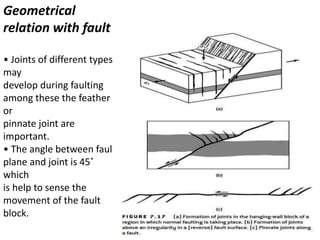
• Joints of different types
may
develop during faulting
among these the feather
or
pinnate joint are
important.
• The angle between fault
plane and joint is 45˚
which
is help to sense the
movement of the fault
block.
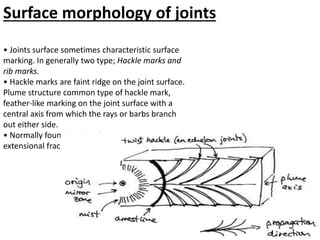
Surface morphology of joints
• Joints surface sometimes characteristic surface
marking. In generally two type; Hackle marks and
rib marks.
• Hackle marks are faint ridge on the joint surface.
Plume structure common type of hackle mark,
feather-like marking on the joint surface with a
central axis from which the rays or barbs branch
out either side.
• Normally found in shear fracture zone rare in
extensional fracture zone
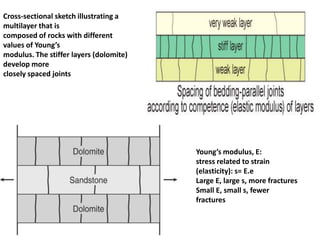
Cross-sectional sketch illustrating a
multilayer that is
composed of rocks with different
values of Young’s
modulus. The stiffer layers (dolomite)
develop more
closely spaced joints
Young’s modulus, E:
stress related to strain
(elasticity): s= E.e
Large E, large s, more fractures
Small E, small s, fewer
fractures
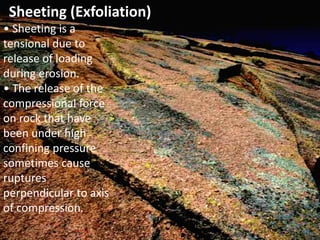
Sheeting (Exfoliation)
• Sheeting is a
tensional due to
release of loading
during erosion.
• The release of the
compressional force
on rock that have
been under high
confining pressure
sometimes cause
ruptures
perpendicular to axis
of compression.
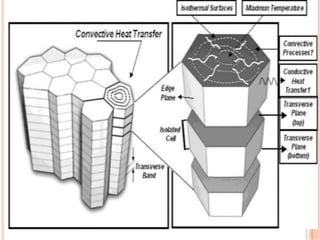
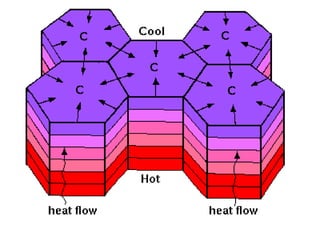
Columnar joints
• Basalt solidifies at about 1,000˚C and during
subsequent cooling it contracts of lave flow.
• The resulting tensional forces act primarily in
the horizontal plane and equal in all direction
within this plane.
• When rupture eventually take place, three
vertical fracture, making angles of 120˚ with
each other, radiate out from numerous
centers.
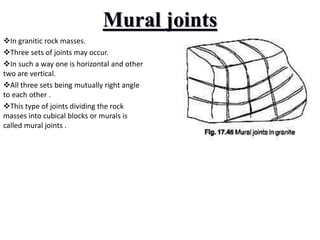
Mural joints
In granitic rock masses.
Three sets of joints may occur.
In such a way one is horizontal and other
two are vertical.
All three sets being mutually right angle
to each other .
This type of joints dividing the rock
masses into cubical blocks or murals is
called mural joints .
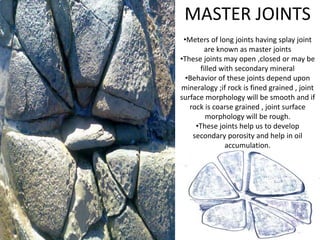
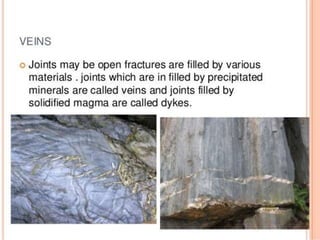
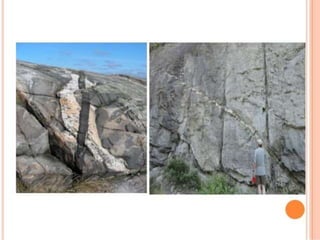
MASTER JOINTS
•Meters of long joints having splay joint
are known as master joints
•These joints may open ,closed or may be
filled with secondary mineral
•Behavior of these joints depend upon
mineralogy ;if rock is fined grained , joint
surface morphology will be smooth and if
rock is coarse grained , joint surface
morphology will be rough.
•These joints help us to develop
secondary porosity and help in oil
accumulation.
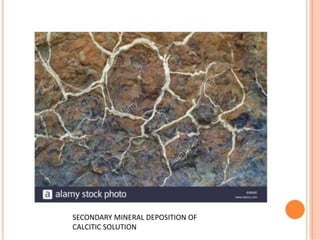
SECONDARY MINERAL DEPOSITION OF
CALCITIC SOLUTION
PRINCIPLE OF FALURE OF
RUPTURE/GENESIS OF
JOINTS
FACTOR CONTROLLING THE RUPTURE –
1.The nature of deformation preceding rupture
2.Physical condition at the time of rupture .
3.stress is necessary to cause rupture .
4.The orientation of fracture relative causative
structure stress
RECOGNITION OF JOINTS
1 . Flat or smooth surface, joint surface are
develop
2.Gap between joints.
3.block has been displaced due to faulting the
joint may be observed in the field
but it is necessary data in order to convey other
end to make pertinent analysis .
FIELD STUDYOF JOINTS:-
1.The joint may be observed in the field ,but it is
necessary to gather significant statistical data in order to
convey the fact to other and to make pertinent analysis.
2.In the engineering project such as dam ,dam sites
canal, tunnel ,roadways,railways,tracks,etc.
It is usually possible to make large scale map such as
1:100 or 1:200 in cm after unconsolidated and bedrock
exposed them joints fault,fold,can be seen .
3.In most geological map are smaller scale 1:2000ft
,1:5000,1:1km or 1;5km scale it is thus necessary
generalize the data obtained at individual outcrop.
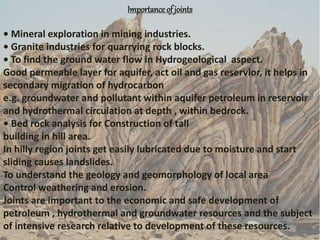
Importance of joints
• Mineral exploration in mining industries.
• Granite industries for quarrying rock blocks.
• To find the ground water flow in Hydrogeological aspect.
Good permeable layer for aquifer, act oil and gas reservior, it helps in
secondary migration of hydrocarbon
e.g. groundwater and pollutant within aquifer petroleum in reservoir
and hydrothermal circulation at depth , within bedrock.
• Bed rock analysis for Construction of tall
building in hill area.
In hilly region joints get easily lubricated due to moisture and start
sliding causes landslides.
To understand the geology and geomorphology of local area
Control weathering and erosion.
Joints are important to the economic and safe development of
petroleum , hydrothermal and groundwater resources and the subject
of intensive research relative to development of these resources.
joints and its classification and its recognition

joints and its classification and its recognition

  • 1.
    A SEMINARON JOINTS ANDITS CLASSIFICATION& RECOGNITION OF JOINTS DEPARTMENT OF APPLIED GEOLOGY DR.HARISINGH GOUR VISWAVIDYALAYA,SAGAR [M.P.] SUBMITTED TO –PROF.A.K. SHANDILYA SUBMITTED BY –SHIVAM JAIN
  • 2.
    Joints • Joints arethe planar structure and simply known as crack along bed/rock without displacement. • Joints/Fracture is a planar or sub planar discontinuity which causes movement ,and loss of cohesion and change in mechanical properties of rock and minerals. • Joints-A fracture without measurable shear displacement (cracks or tensile fractures) • Fault: A fracture with measurable displacement.
  • 3.
    PARAMETER OF JOINTS •Strike direction of joints • Amount of dip of joints • Dip direction of joints
  • 5.
  • 6.
    Joint arrays Systematic vsnonsystematic joints Systematic joints: Planar joints Joints are parallel or subparallel. Same average spacing Nonsystematic joints: Irregular spatial distribution Not parallel to one another. Different average spacing
  • 7.
    Based on itsGeometry • The geometrical classification of joints .is based on attitude the joint with respect to that of the beds • Accordingly there are three type of joints that is strike joint ,dip joint ,oblique joint & bedding joints • There are three type of joint which are:- • STRIKE JOINTS- are those in which the strike of joint is parallel to the strike of beds • DIP JOINTS-dip joints are those in which the strike of joint is perpendicular to the strike of beds. • OBLIQUE /INCLINED JOIINTS-oblique joins are those in which the strike of joint are neither parallel nor perpendicular to the strike of the joints. • BEDDING JOINTS-they are parallel to the bedding plane having same plane having same strike & dip.
  • 9.
    CLASSIFICATION OF JOINT •Based on the dip of joints :- • Horizontal joints-0°-5° • Sub horizontal joints-5°-10° • Low angle joints-10°-30° • Moderate angle joint-30°-60° • High angle joint-60°-80° • Sub vertical joint-80°-85° • Vertical joint—85°-90°
  • 10.
    BASED ON ITS GENESIS Thereare three types of joints on the basis of genesis – TENSION JOINTS Tension joints are those in which are formed due to tension forces or stress produce in the rock. SHEAR JOINTS They are formed by the shearing strsses, which tends to slide one part of rock against other. COMPRESSION JOINTS Rock may be compressed to crushing &numerous joint may result duto compressive forces in this cases.
  • 11.
    Process of formationof joints 4.Torsion forces 3.Shear forces 1.Compression forces- 2.Tensile forces
  • 12.
    Formation of Joints 1.Jointsare brittle fractures which develop either by tensile failure or by shear failure. 2.When this happens, the rock fractures in a plane parallel to the maximum principal stress and perpendicular to the minimum principal stress (the direction in which the rock is being stretched). 3.A large number of joints form after the close of the tectonic cycle and during a slow uplift of the rocks.
  • 13.
    Formation of jointsby extension and contraction
  • 14.
    Geometrical relation withfold • The different geometric relation some times expressed in terms of three mutually perpendicular tectonic axes a,b and c (sandar 1930) with the b axis parallel to the fold axis and c-axis normal to the bedding. • Orientation of b-axis remains constant, but the orientation of c and a-axis change in different parts of fold.
  • 15.
    • Joints developnormal to the fold axis called ac-joint or cross-joints(fig.a) • Joints develop parallel to the axial plane of fold called bc-joints or longitudinal joints(fig.b). • h0l- joints are conjugate joints intersecting along the fold axis(b-axis) and are symmetrically oriented with respect to the axial plane. Symbol 0 indicate that these are parallel to the b-axis at the hinge.(fig.c) • hk0-joints are conjugate joints intersecting along a line which is perpendicular fold axis and lies parallel to the axial plane (fig.d) • hk0-joints indicates that these are parallel to the c-axis at the hinge and 0kl-joints indicates that these are parallel to the a-axis at the hinge zone.
  • 17.
    Geometrical relation with fault •Joints of different types may develop during faulting among these the feather or pinnate joint are important. • The angle between fault plane and joint is 45˚ which is help to sense the movement of the fault block.
  • 18.
    Surface morphology ofjoints • Joints surface sometimes characteristic surface marking. In generally two type; Hackle marks and rib marks. • Hackle marks are faint ridge on the joint surface. Plume structure common type of hackle mark, feather-like marking on the joint surface with a central axis from which the rays or barbs branch out either side. • Normally found in shear fracture zone rare in extensional fracture zone
  • 19.
    Cross-sectional sketch illustratinga multilayer that is composed of rocks with different values of Young’s modulus. The stiffer layers (dolomite) develop more closely spaced joints Young’s modulus, E: stress related to strain (elasticity): s= E.e Large E, large s, more fractures Small E, small s, fewer fractures
  • 20.
    Sheeting (Exfoliation) • Sheetingis a tensional due to release of loading during erosion. • The release of the compressional force on rock that have been under high confining pressure sometimes cause ruptures perpendicular to axis of compression.
  • 21.
    Columnar joints • Basaltsolidifies at about 1,000˚C and during subsequent cooling it contracts of lave flow. • The resulting tensional forces act primarily in the horizontal plane and equal in all direction within this plane. • When rupture eventually take place, three vertical fracture, making angles of 120˚ with each other, radiate out from numerous centers.
  • 24.
    Mural joints In graniticrock masses. Three sets of joints may occur. In such a way one is horizontal and other two are vertical. All three sets being mutually right angle to each other . This type of joints dividing the rock masses into cubical blocks or murals is called mural joints .
  • 25.
    MASTER JOINTS •Meters oflong joints having splay joint are known as master joints •These joints may open ,closed or may be filled with secondary mineral •Behavior of these joints depend upon mineralogy ;if rock is fined grained , joint surface morphology will be smooth and if rock is coarse grained , joint surface morphology will be rough. •These joints help us to develop secondary porosity and help in oil accumulation.
  • 27.
    SECONDARY MINERAL DEPOSITIONOF CALCITIC SOLUTION
  • 29.
    PRINCIPLE OF FALUREOF RUPTURE/GENESIS OF JOINTS FACTOR CONTROLLING THE RUPTURE – 1.The nature of deformation preceding rupture 2.Physical condition at the time of rupture . 3.stress is necessary to cause rupture . 4.The orientation of fracture relative causative structure stress
  • 30.
    RECOGNITION OF JOINTS 1. Flat or smooth surface, joint surface are develop 2.Gap between joints. 3.block has been displaced due to faulting the joint may be observed in the field but it is necessary data in order to convey other end to make pertinent analysis .
  • 31.
    FIELD STUDYOF JOINTS:- 1.Thejoint may be observed in the field ,but it is necessary to gather significant statistical data in order to convey the fact to other and to make pertinent analysis. 2.In the engineering project such as dam ,dam sites canal, tunnel ,roadways,railways,tracks,etc. It is usually possible to make large scale map such as 1:100 or 1:200 in cm after unconsolidated and bedrock exposed them joints fault,fold,can be seen . 3.In most geological map are smaller scale 1:2000ft ,1:5000,1:1km or 1;5km scale it is thus necessary generalize the data obtained at individual outcrop.
  • 32.
    Importance of joints •Mineral exploration in mining industries. • Granite industries for quarrying rock blocks. • To find the ground water flow in Hydrogeological aspect. Good permeable layer for aquifer, act oil and gas reservior, it helps in secondary migration of hydrocarbon e.g. groundwater and pollutant within aquifer petroleum in reservoir and hydrothermal circulation at depth , within bedrock. • Bed rock analysis for Construction of tall building in hill area. In hilly region joints get easily lubricated due to moisture and start sliding causes landslides. To understand the geology and geomorphology of local area Control weathering and erosion. Joints are important to the economic and safe development of petroleum , hydrothermal and groundwater resources and the subject of intensive research relative to development of these resources.