Folding mechanisms
BY
K.Manikandabharath
Anna university,chennai.
Fold
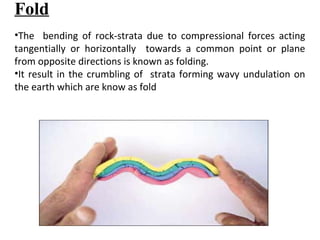
•The bending of rock-strata due to compressional forces acting
tangentially or horizontally towards a common point or plane
from opposite directions is known as folding.
•It result in the crumbling of strata forming wavy undulation on
the earth which are know as fold
CAUSES AND MECHANISM OF FOLD:
•
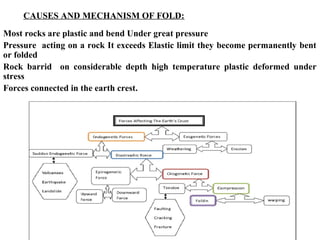
Most rocks are plastic and bend Under great pressure
•
Pressure acting on a rock It exceeds Elastic limit they become permanently bent
or folded
•
Rock barrid on considerable depth high temperature plastic deformed under
stress
•
Forces connected in the earth crest.
Fold mechanism is influenced by factors
affecting deformation:
• temperature
• pressure
• fluid
• properties of the rock as determined by
composition, texture, and anisotropy.
Fold mechanisms
Fold mechanisms include:
• Buckling
• Bending
• Flexure folding
• Flexural slip
• Flexural flow
• Passive (ductile) flow
• Kink folding
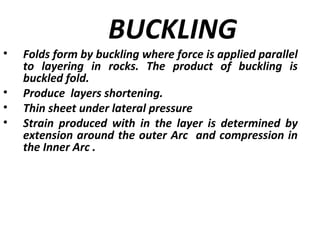
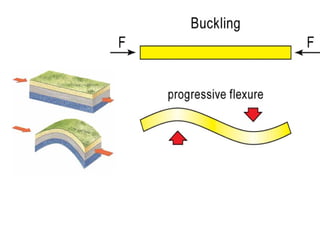
BUCKLING
• Folds form by buckling where force is applied parallel
to layering in rocks. The product of buckling is
buckled fold.
• Produce layers shortening.
• Thin sheet under lateral pressure
• Strain produced with in the layer is determined by
extension around the outer Arc and compression in
the Inner Arc .
BENDING
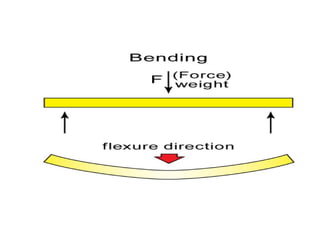
• Bending involves application of force
across layers.
• Generally produce folds that are
very gentle with large inter limb
angles.
• Layers in bending are bent like an
elastic beam the has been supported
at the ends and loaded in the middle.
•
Simple bending due to lateral compression
•
Stress axis horizontal
•
Strata with or without slide one another
Flexure folding
FLEXURAL SLIP
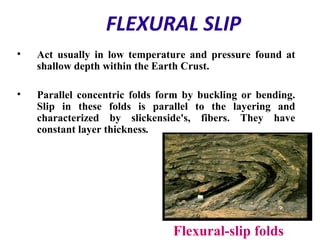
• Act usually in low temperature and pressure found at
shallow depth within the Earth Crust.
• Parallel concentric folds form by buckling or bending.
Slip in these folds is parallel to the layering and
characterized by slickenside's, fibers. They have
constant layer thickness.
Flexural-slip folds
12
FLEXURAL FLOW
• Flexural flow requires moderate-to high ductility contrast between
layers.
• In flexural fold amplitude and wavelength may be controlled by the
original thickness, spacing and strength of the strong layers.
• Form in rocks from low and moderate metamorphic grade. They are
similar like folds.
Example: shale (change thickness) and quartzite (fixed thickness)
Flexural-flow folds
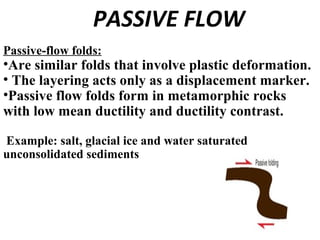
PASSIVE FLOW
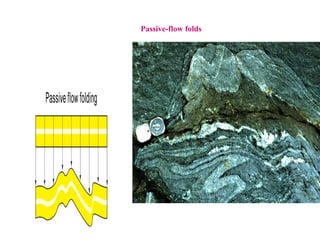
Passive-flow folds:
•Are similar folds that involve plastic deformation.
• The layering acts only as a displacement marker.
•Passive flow folds form in metamorphic rocks
with low mean ductility and ductility contrast.
Example: salt, glacial ice and water saturated
unconsolidated sediments
Passive-flow folds
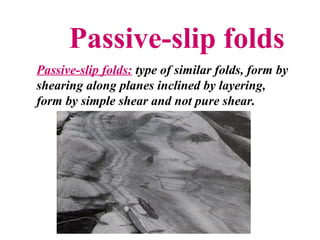
Passive-slip folds
•
Passive-slip folds: type of similar folds, form by
shearing along planes inclined by layering,
form by simple shear and not pure shear.
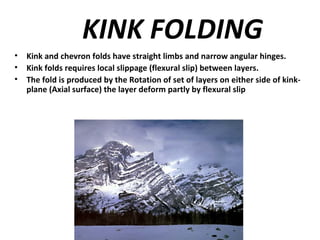
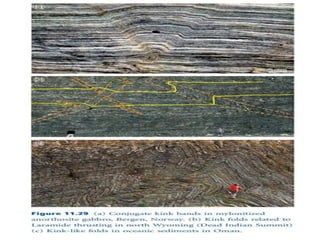
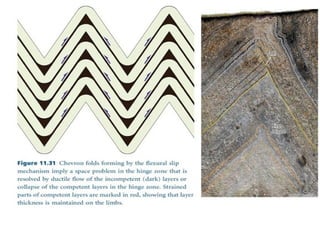
KINK FOLDING
• Kink and chevron folds have straight limbs and narrow angular hinges.
• Kink folds requires local slippage (flexural slip) between layers.
• The fold is produced by the Rotation of set of layers on either side of kink-
plane (Axial surface) the layer deform partly by flexural slip
THANK U

Folding mechanisms

  • 1.
  • 2.
    Fold •The bending ofrock-strata due to compressional forces acting tangentially or horizontally towards a common point or plane from opposite directions is known as folding. •It result in the crumbling of strata forming wavy undulation on the earth which are know as fold
  • 3.
    CAUSES AND MECHANISMOF FOLD: • Most rocks are plastic and bend Under great pressure • Pressure acting on a rock It exceeds Elastic limit they become permanently bent or folded • Rock barrid on considerable depth high temperature plastic deformed under stress • Forces connected in the earth crest.
  • 4.
    Fold mechanism isinfluenced by factors affecting deformation: • temperature • pressure • fluid • properties of the rock as determined by composition, texture, and anisotropy.
  • 5.
    Fold mechanisms Fold mechanismsinclude: • Buckling • Bending • Flexure folding • Flexural slip • Flexural flow • Passive (ductile) flow • Kink folding
  • 6.
    BUCKLING • Folds formby buckling where force is applied parallel to layering in rocks. The product of buckling is buckled fold. • Produce layers shortening. • Thin sheet under lateral pressure • Strain produced with in the layer is determined by extension around the outer Arc and compression in the Inner Arc .
  • 8.
    BENDING • Bending involvesapplication of force across layers. • Generally produce folds that are very gentle with large inter limb angles. • Layers in bending are bent like an elastic beam the has been supported at the ends and loaded in the middle.
  • 10.
    • Simple bending dueto lateral compression • Stress axis horizontal • Strata with or without slide one another Flexure folding
  • 11.
    FLEXURAL SLIP • Actusually in low temperature and pressure found at shallow depth within the Earth Crust. • Parallel concentric folds form by buckling or bending. Slip in these folds is parallel to the layering and characterized by slickenside's, fibers. They have constant layer thickness. Flexural-slip folds
  • 12.
    12 FLEXURAL FLOW • Flexuralflow requires moderate-to high ductility contrast between layers. • In flexural fold amplitude and wavelength may be controlled by the original thickness, spacing and strength of the strong layers. • Form in rocks from low and moderate metamorphic grade. They are similar like folds. Example: shale (change thickness) and quartzite (fixed thickness)
  • 13.
  • 14.
    PASSIVE FLOW Passive-flow folds: •Aresimilar folds that involve plastic deformation. • The layering acts only as a displacement marker. •Passive flow folds form in metamorphic rocks with low mean ductility and ductility contrast. Example: salt, glacial ice and water saturated unconsolidated sediments
  • 15.
  • 16.
    Passive-slip folds • Passive-slip folds:type of similar folds, form by shearing along planes inclined by layering, form by simple shear and not pure shear.
  • 17.
    KINK FOLDING • Kinkand chevron folds have straight limbs and narrow angular hinges. • Kink folds requires local slippage (flexural slip) between layers. • The fold is produced by the Rotation of set of layers on either side of kink- plane (Axial surface) the layer deform partly by flexural slip
  • 20.